
Judge, 1911-08-05 · page 16 of 27
Judge — August 5, 1911 — page 16: what you’re looking at
What you’re looking at
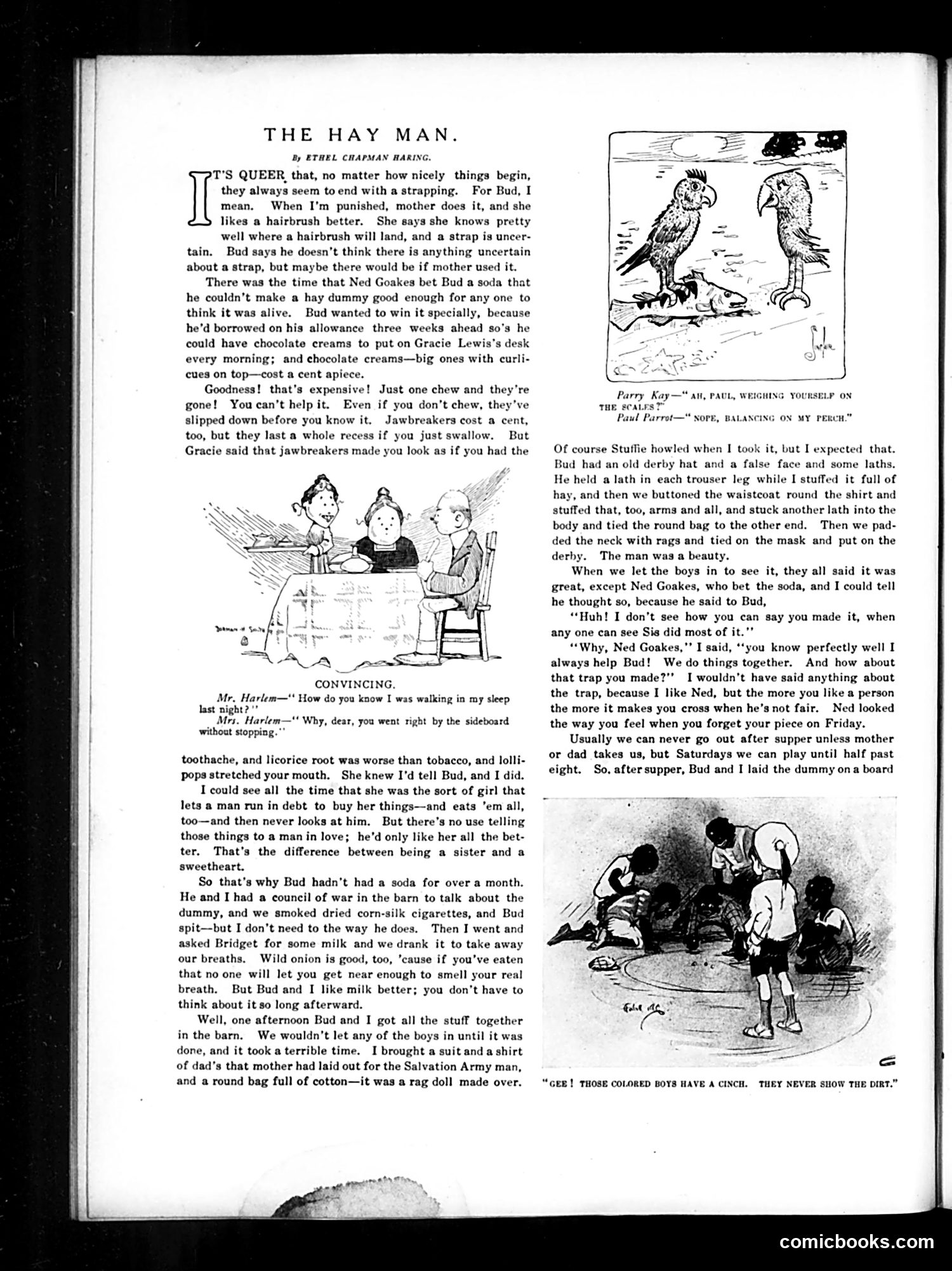
This is a short story by Ethel Chapman Haring, not primarily a political cartoon. The page features a narrative about two children, Bud and his sister (the narrator), who create a convincing scarecrow-like dummy from their father's old clothes stuffed with hay and cotton, intended to win a soda bet from a boy named Ned Goakes. The story explores childhood logic and relationships—Bud's romantic interest in Gracie Lewis (motivating the wager), sibling dynamics, and competitive honor among children. The small cartoon vignettes are humorous asides: one about a husband sleepwalking past food, another with anthropomorphic birds. The satire is gentle, poking fun at children's earnest schemes, their economic reasoning (counting penny candies), and social hierarchies. The implied ending—punishment awaits Bud—reflects early 20th-century attitudes toward mischief and parental discipline.
📄 Transcribed text from this page (OCR, searchable)
Machine-transcribed from the original scan — historical spelling and the odd misread are preserved.
THE HAY MAN. By ETHEL CHAPMAN HARING. T’S QUEER, that, no matter how nicely things begin, they always seem toend with a strapping. For Bud, I mean. When I'm punished, mother does it, and she likes a hairbrush better. She says she knows pretty well where a hairbrush will land, and a strap is uncer- tain. Bud says he doesn’t think there is anything uncertain about a strap, but maybe there would be if mother used it. There was the time that Ned Goakes bet Bud a soda that he couldn’t make a hay dummy good enough for any one to think it was alive. Bud wanted to win it specially, because he'd borrowed on his allowance three weeks ahead so's he could have chocolate creams to put on Gracie Lewis's desk every morning; and chocolate creams—big ones with curli- cues on top—cost a cent apiece. Goodness! that's expensive! Just one chew and they're gone! You can’t help it. Even if you don’t chew, they've slipped down before you know it. Jawbreakers cost a cent, too, but they last a whole recess if you just swallow. But Gracie said that jawbreakers made you look as if you had the CONVINCING. Mr. Harlem—" How do you know I was walking in my sleep last night?"” Mrs. Harlem—"' Why, dear, you went right by the sideboard without stopping.” toothache, and licorice root was worse than tobacco, and lolli- Pops stretched your mouth. She knew I'd tell Bud, and I did. I could see all the time that she was the sort of girl that lets a man run in debt to buy her things—and eats 'em all, too—and then never looks at him. But there's no use telling those things to a man in love; he'd only like her all the bet- ter. That's the difference between being a sister and a sweetheart. So that’s why Bud hadn’t had a soda for over a month. He and I had a council of war in the barn to talk about the dummy, and we smoked dried corn-silk cigarettes, and Bud spit—but I don’t need to the way he does. Then I went and asked Bridget for some milk and we drank it to take away our breaths. Wild onion is good, too, cause if you've eaten that no one will let you get near enough to smell your real breath. But Bud and I like milk better; you don't have to think about it so long afterward. Well, one afternoon Bud and I got all the stuff together in the barn. We wouldn't let any of the boys in until it was done, and it took a terrible time. I brought a suit anda shirt of dad’s that mother had laid out for the Salvation Army man, and a round bag full of cotton—it was a rag doll made over. Parry Kay—“ avi, PAUL, WEIGHING YOURSELP THE SCALrs? aul Parrot— NOPE, BALANCING ON MY PERCH.” Of course Stuflie howled when I took it, but I expected that. Bud had an old derby hat and a false face and some laths. He held a lath in each trouser leg while I stuffed it full of hay, and then we buttoned the waistcoat round the shirt and stuffed that, too, arms and all, and stuck another lath into the body and tied the round bag to the other end. Then we pad- ded the neck with rags and tied on the mask and put on the derby. The man was a beauty. When we let the boys in to see it, they all said it was great, except Ned Goakes, who bet the soda, and I could tell he thought so, because he said to Bud, “Huh! I don’t see how you can say you made it, when any one can see Sis did most of it."’ “Why, Ned Goakes,’’ I said, ‘‘you know perfectly well I always help Bud! We do things together. And how about that trap you made?"’ I wouldn't have said anything about the trap, because I like Ned, but the more you like a person the more it makes you cross when he’s not fair. Ned looked the way you feel when you forget your piece on Friday. Usually we can never go out after supper unless mother or dad takes us, but Saturdays we can play until half past eight. So, after supper, Bud and I laid the dummy ona board “GEE! THOSE COLORED BOYS HAVE A CINCH. THEY NEVER SHOW THE DIRT.” comicbooks.com