
Judge, 1911-08-05 · page 17 of 27
Judge — August 5, 1911 — page 17: what you’re looking at
What you’re looking at
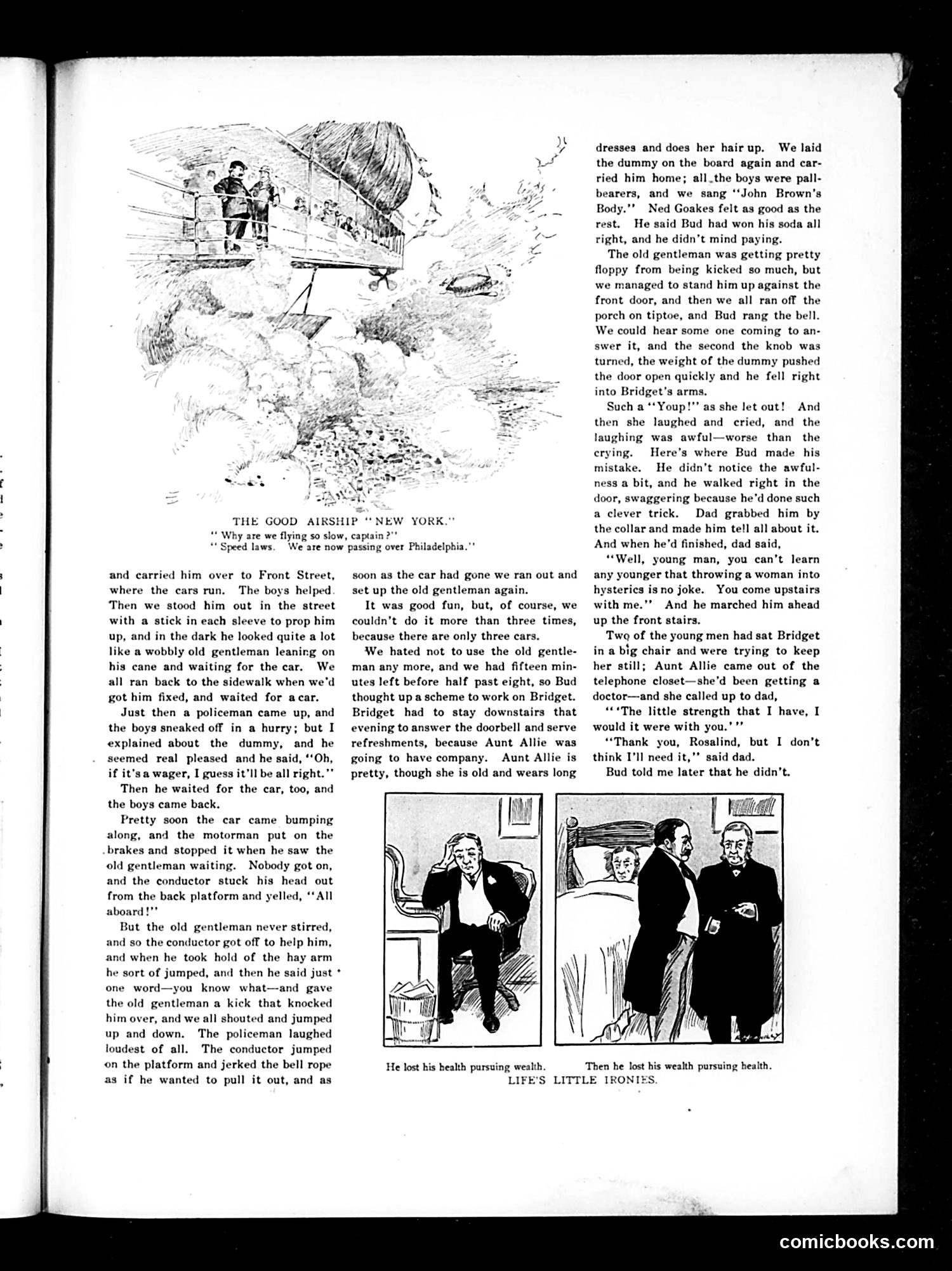
This page contains two separate pieces of satirical content: **Upper Section - "The Good Airship 'New York'":** A humorous story about boys playing pranks with a dummy dressed as an old man. They place it on streetcar tracks to trick conductors and motormen. The joke plays on the conductors' reactions—they brake suddenly, then kick the dummy in frustration upon discovering the deception. The final prank involves startling the servant "Bridget" by having the dummy fall into her arms, causing her hysterics. The father's punishment of his son emphasizes that frightening women is not a legitimate joke. **Lower Section - "Life's Little Ironies":** Two cartoon panels showing a wealthy man, captioned "He lost his health pursuing wealth" (left) and "Then he lost his wealth pursuing health" (right). This satirizes how wealthy men sacrifice their wellbeing chasing money, then waste their fortunes trying to regain health—a common turn-of-the-century critique of capitalist excess and vanity. Both pieces mock contemporary American social behavior: reckless youth mischief and the hypocritical priorities of the wealthy.
📄 Transcribed text from this page (OCR, searchable)
Machine-transcribed from the original scan — historical spelling and the odd misread are preserved.
THE GOOD AIRSHIP "NEW YORK.” “* Why are we flying so slow, captain ?"* ** Speed laws and carried him over to Front Street, where the cars run. The boys helped Then we stood him out in the street with a stick in each sleeve to prop him up, and in the dark he looked quite a lot like a wobbly old gentleman leaning on his cane and waiting for the car. We all ran back to the sidewalk when we'd got him fixed, and waited for acar. Just then a policeman came up, and the boys sneaked off in a hurry; but I explained about the dummy, and he seemed real pleased and he said, ‘Oh, if it's a wager, I guess it'll be all right.”” Then he waited for the car, too, and the boys came back. Pretty soon the car came bumping along, and the motorman put on the brakes and stopped it when he saw the old gentleman waiting. Nobody got on, and the conductor stuck his head out from the back platform and yelled, ‘All aboard !"" But the old gentleman never stirred, and so the conductor got off to help him, and when he took hold of the hay arm he sort of jumped, and then he said just one word—you know what—and gave the old gentleman a kick that knocked him over, and we all shouted and jumped up and down. The policeman laughed loudest of all. The conductor jumped on the platform and jerked the bell rope as if he wanted to pull it out, and as We ate now passing over Philadelphia."’ soon as the car had gone we ran out and set up the old gentleman again. It was good fun, but, of course, we couldn’t do it more than three times, because there are only three cars. We hated not to use the old gentle- man any more, and we had fifteen min- utes left before half past eight, so Bud thought up a scheme to work on Bridget. Bridget had to stay downstairs that evening to answer the doorbell and serve refreshments, because Aunt Allie was going to have company. Aunt Allie is pretty, though she is old and wears long He lost his health pursuing wealth. dresses and does her hairup. We laid the dummy on the board again and car- ried him home; all.the boys were pall- bearers, and we sang ‘John Brown's Body.’’ Ned Goakes felt as good as the rest. He said Bud had won his soda all right, and he didn’t mind paying. The old gentleman was getting pretty floppy from being kicked so much, but we managed to stand him up against the front door, and then we all ran off the porch on tiptoe, and Bud rang the bell. We could hear some one coming to an- swer it, and the second the knob was turned, the weight of the dummy pushed the door open quickly and he fell right into Bridget’s arms. Such a ‘*Youp!”’ as she let out! And then she laughed and and the laughing was awful—worse than the crying. Here's where Bud made his mistake. He didn't notice the awful- ness a bit, and he walked right in the door, swaggering because he'd done such a clever trick. Dad grabbed him by the collar and made him tell all about it. And when he'd finished, dad said, “Well, young man, you can’t learn any younger that throwing a woman into hysterics is no joke. You come upstairs with me.’’ And he marched him ahead up the front stairs. Two of the young men had sat Bridget in a big chair and were trying to keep her still; Aunt Allie came out of the telephone closet—she’d been getting a doctor—and she called up to dad, “The little strength that I have, I would it were with you.’’” “Thank you, Rosalind, but I don’t think I'll need i said dad. Bud told me later that he didn’t. cried, Then he lost his wealth pursuing health. LIFE’S LITTLE IRONIES. comicbooks.com