
A complete issue · 24 pages · 1911
Judge — July 8, 1911
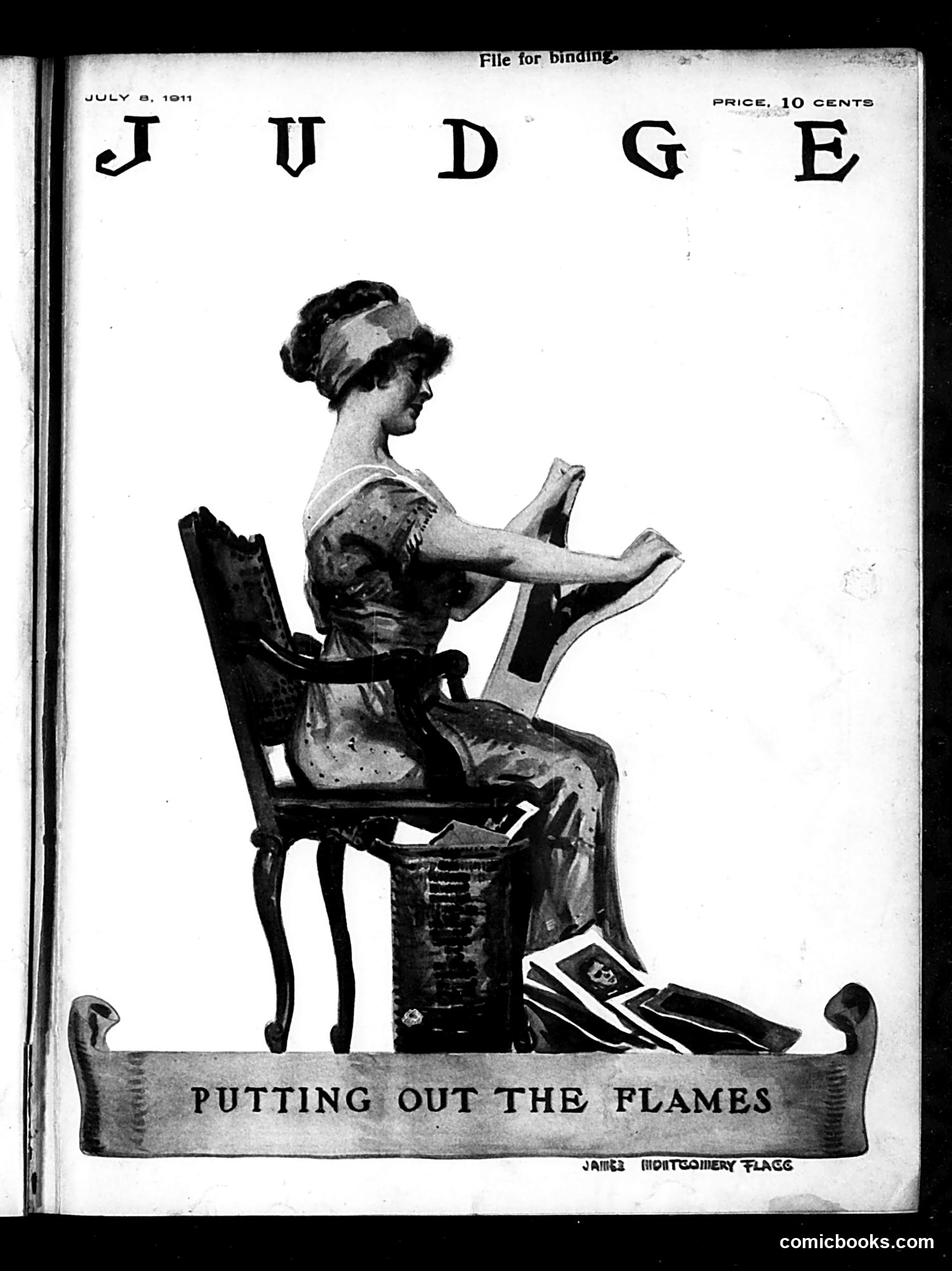
This cartoon depicts a woman seated, actively fanning flames with what appears to be papers or documents. The caption "Putting Out the Flames" suggests ironic commentary—she's ostensibly extinguishing a fire, but her vigorous fanning would logically intensify it rather than suppress it. The specific identity of the woman and the exact political situation referenced is unclear from the image alone. However, given Judge's satirical focus on contemporary politics and social issues, this likely critiques someone (possibly a political figure or activist) whose actions—despite stated intentions—are counterproductive or actually worsening a problem. The 1911 date and artistic style are consistent with early Progressive Era commentary on American political controversies.
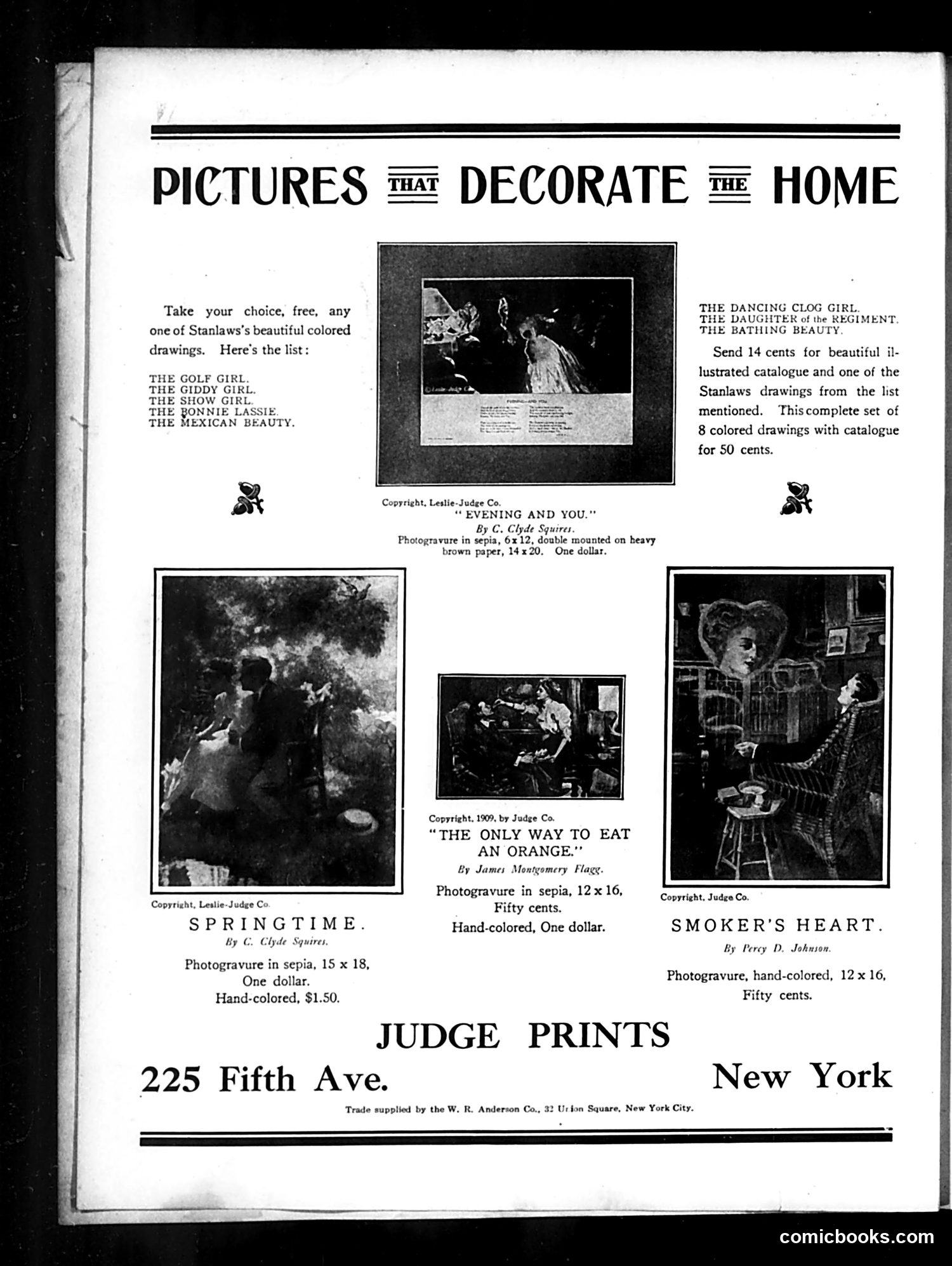
This page is primarily **advertising**, not satire or political commentary. It advertises decorative home art prints from Judge Prints (225 Fifth Ave, New York), offering customers free choice of colored drawings including "The Golf Girl," "The Giddy Girl," and "The Show Girl." Three specific artworks are showcased: "Springtime" (photogravure, $1–$1.50), "The Only Way to Eat an Orange" by James Montgomery Flagg (50 cents–$1), and "Smoker's Heart" (photogravure, 50 cents). The page also promotes a catalogue with eight colored drawings available for 50 cents. The content reflects early 20th-century consumer culture and domestic decoration marketing rather than political or social satire.
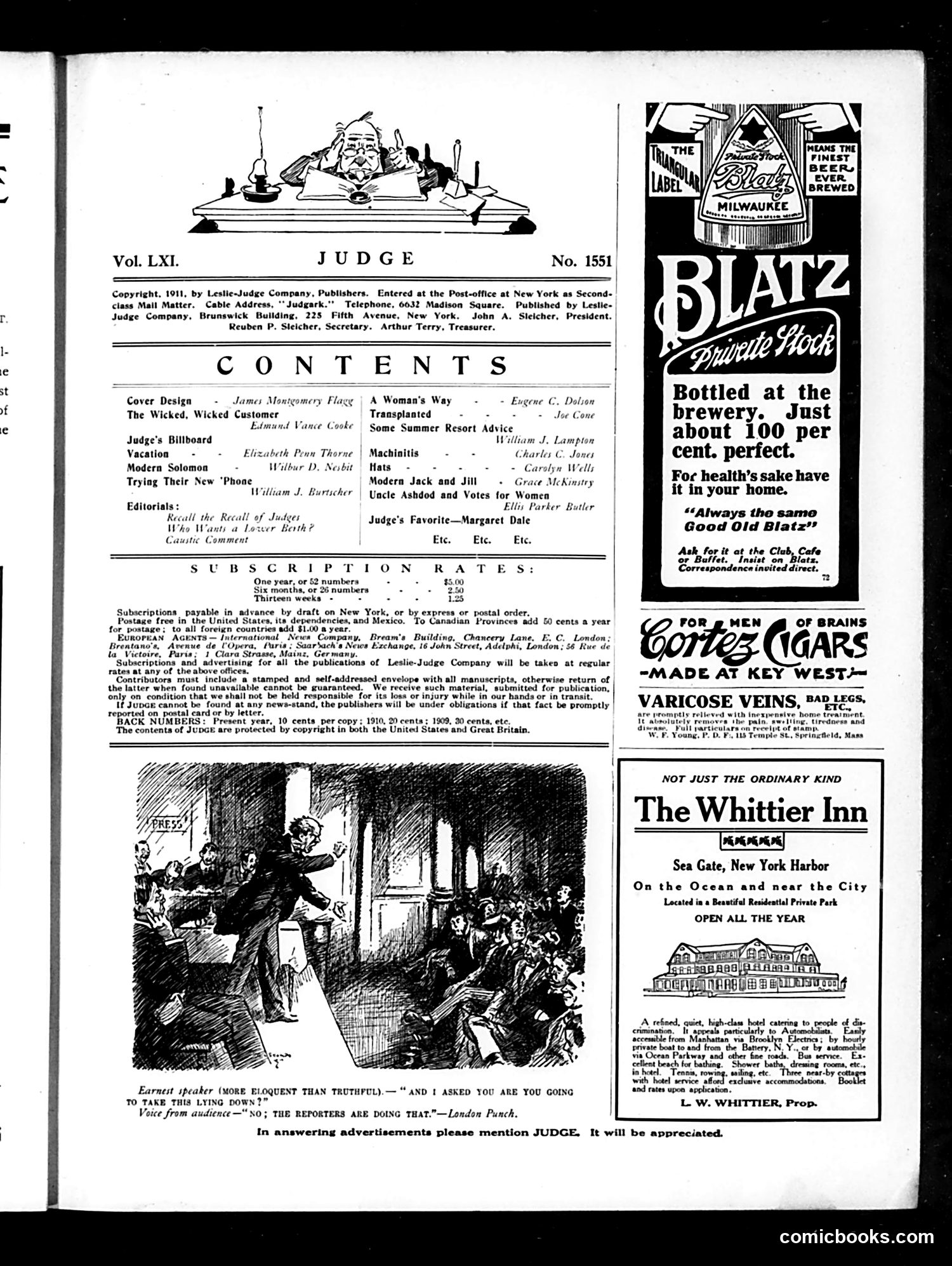
The main cartoon depicts a speaker addressing a crowded audience indoors, with the caption: "A MUCH MORE HONEST AND TRUTHFUL) — 'AND I ASKED YOU ARE YOU GOING TO TAKE THIS LYING DOWN?' / Voice from audience — 'NO; THE REPORTERS ARE DOING THAT.' — London Punch." This is political satire about press coverage of public speeches. The joke critiques reporters who literally recline while covering events, suggesting they report dishonestly or lazily rather than standing to properly document speeches. The humor plays on the double meaning of "lying down" — both as passive acceptance and as the reporters' actual physical position. This reflects early 20th-century anxieties about journalistic integrity and accuracy. The page also contains period advertisements for Blatz beer and The Whittier Inn hotel.
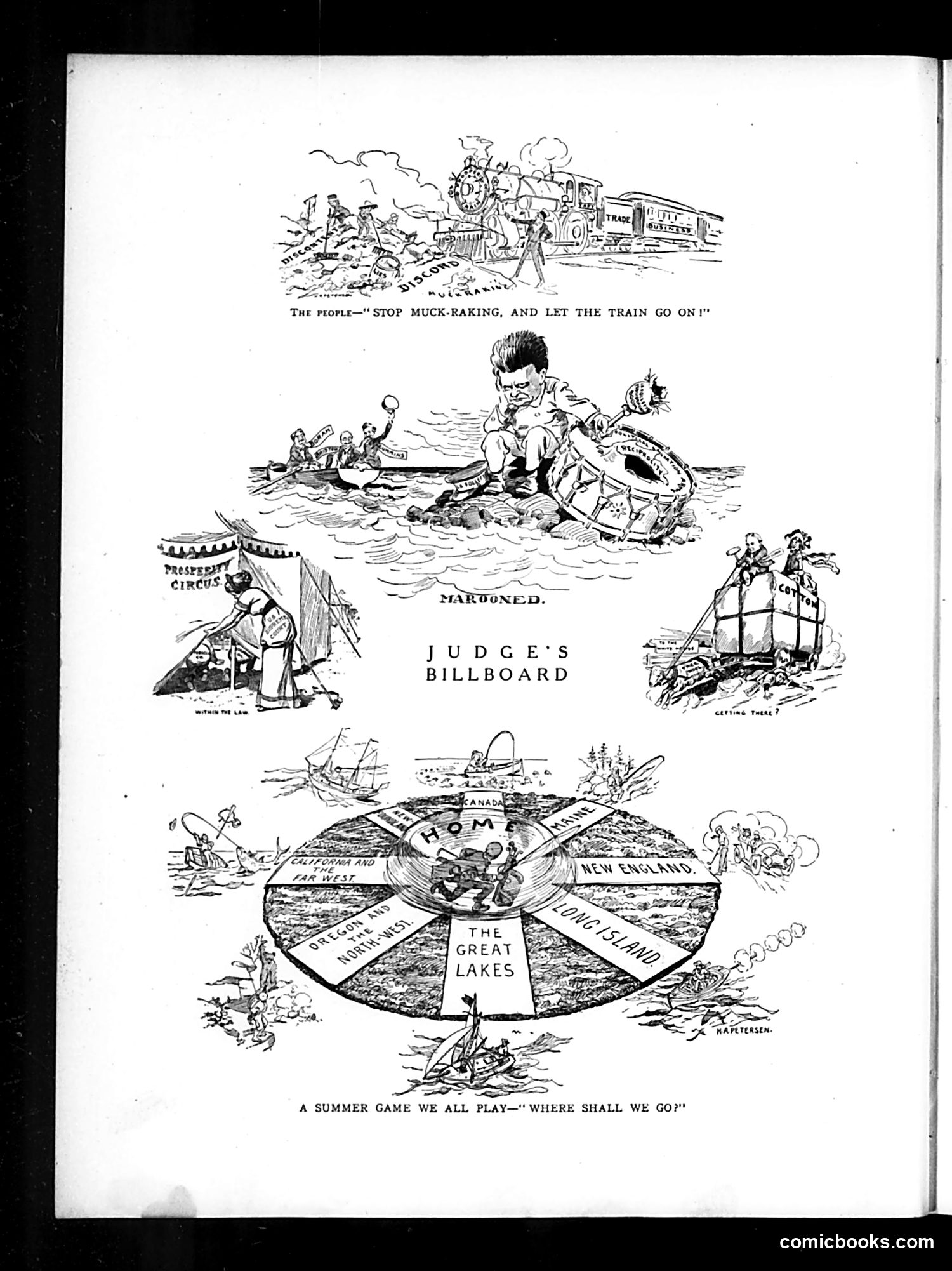
This page features satirical commentary on American expansion and travel debates, likely from the early 1900s. The top cartoon critiques infrastructure priorities—people demand the government "stop muck-raking and let the train go on," suggesting frustration with investigative journalism overshadowing railroad development. The central "Judge's Billboard" wheel diagram maps American travel destinations (Canada, New England, the Great Lakes, Pacific Northwest, etc.) around a central figure, likely representing political leadership or national direction. The surrounding vignettes depict various regional activities and conflicts. The caption "A Summer Game We All Play—'Where Shall We Go?'" frames this as commentary on American leisure and vacation choices becoming entangled with political/economic debates about development, expansion, and resource allocation during the Progressive Era. The satirical tone suggests Judge was critiquing how contemporary political controversies affected everyday American life.
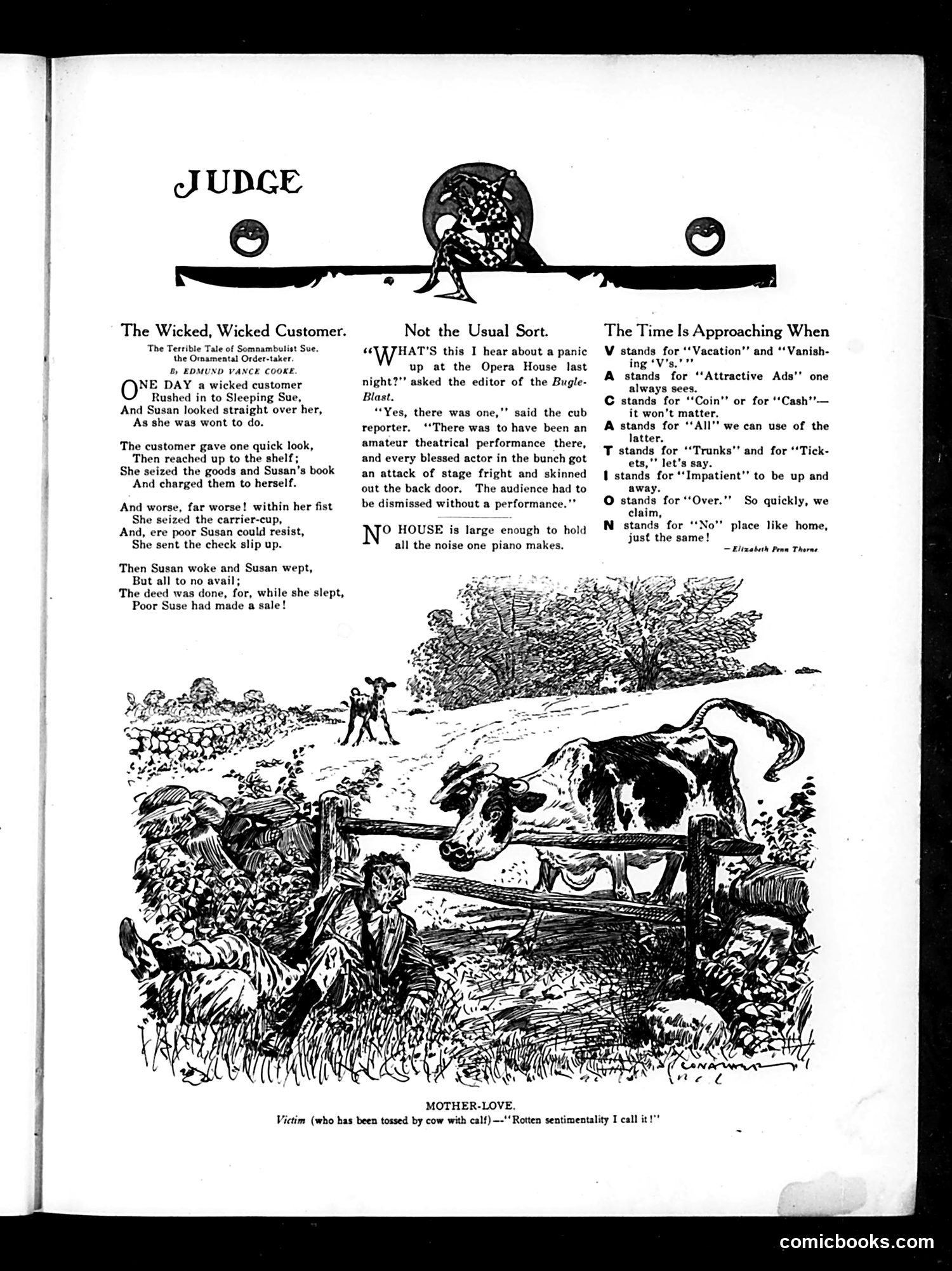
This page contains three distinct pieces: 1. **"The Wicked, Wicked Customer"** — A poem by Edmund Vance Cooke about a customer named Sue who returns goods to a shop, causing chaos. It's a humorous narrative about retail problems. 2. **"Not the Usual Sort"** — An editorial note about an opera house panic when actors experienced stage fright, with commentary on how "no house is large enough to hold all the noise one piano makes." 3. **A glossary section** defining abbreviations used in Judge magazine (V for "Vacation," A for "Ads," etc.). 4. **"Mother-Love"** — A humorous illustration showing a calf being called by its mother, with the caption: "Victim (who has been lossed by cow with call)—'Rotten sentimentally I call it!'" These are light, domestic humor pieces typical of Judge's early satirical content.
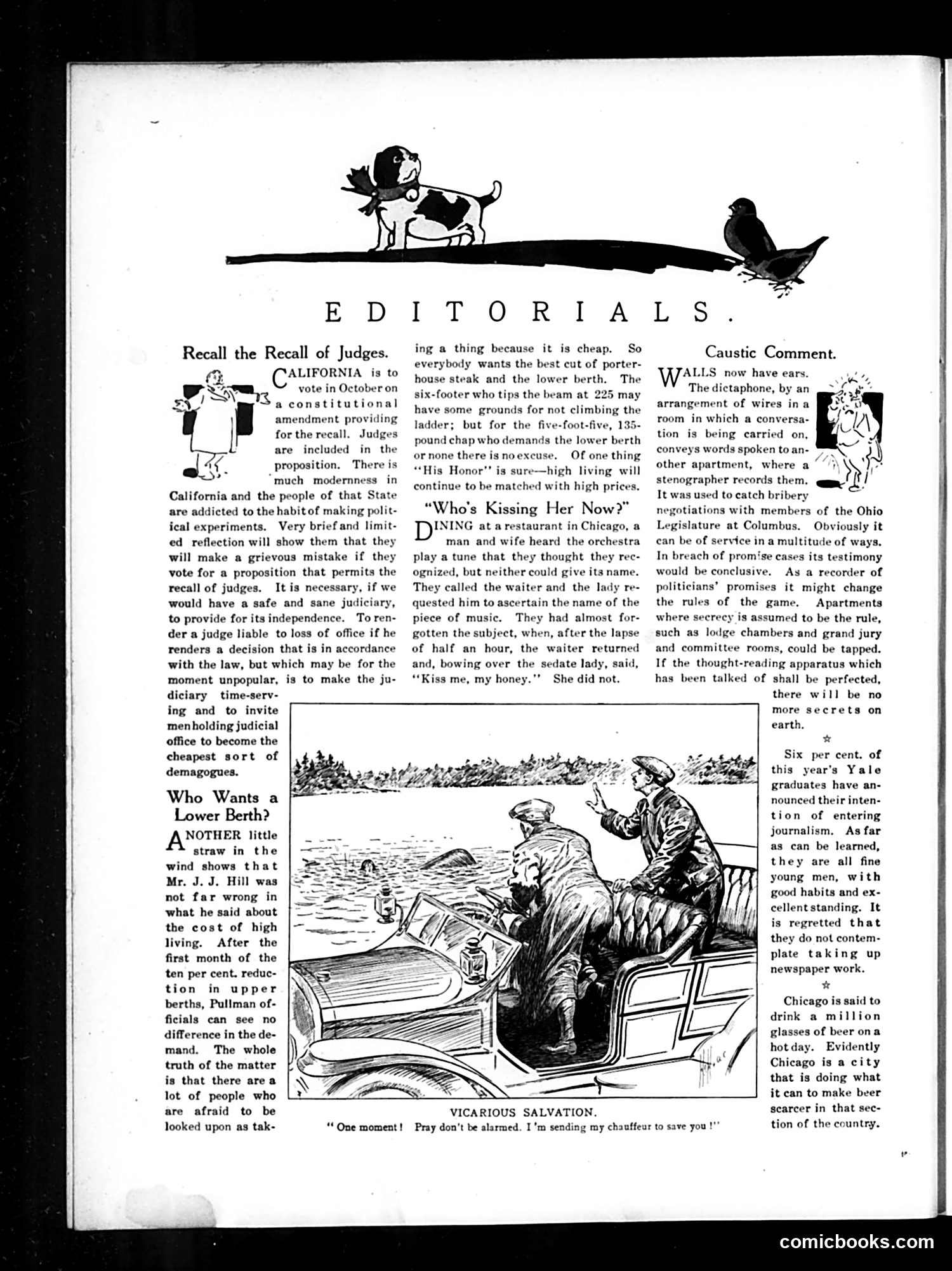
This page contains three satirical pieces on contemporary issues: **"Recall the Recall of Judges"** argues against California's upcoming constitutional amendment allowing judicial recall. The editorial warns that making judges removable for unpopular decisions would compromise judicial independence and turn judges into "demagogues" beholden to public opinion rather than law. **"Who Wants a Lower Berth?"** mocks consumer behavior, noting that despite Pullman reducing upper-berth prices by 10%, demand hasn't shifted. The piece suggests people prefer luxury (lower berths) regardless of cost—a commentary on conspicuous consumption and status-seeking among all classes. **"Who's Kissing Her Now?"** is a humorous anecdote about a couple dining in Chicago who request a waiter identify a song. When he returns an hour later with the answer—the song title "Kiss Me, My Honey"—it creates awkward social comedy. The "Vicarious Salvation" cartoon satirizes wealthy people's detachment from consequences, showing a man reassuring a drowning person by offering to send his chauffeur to help.
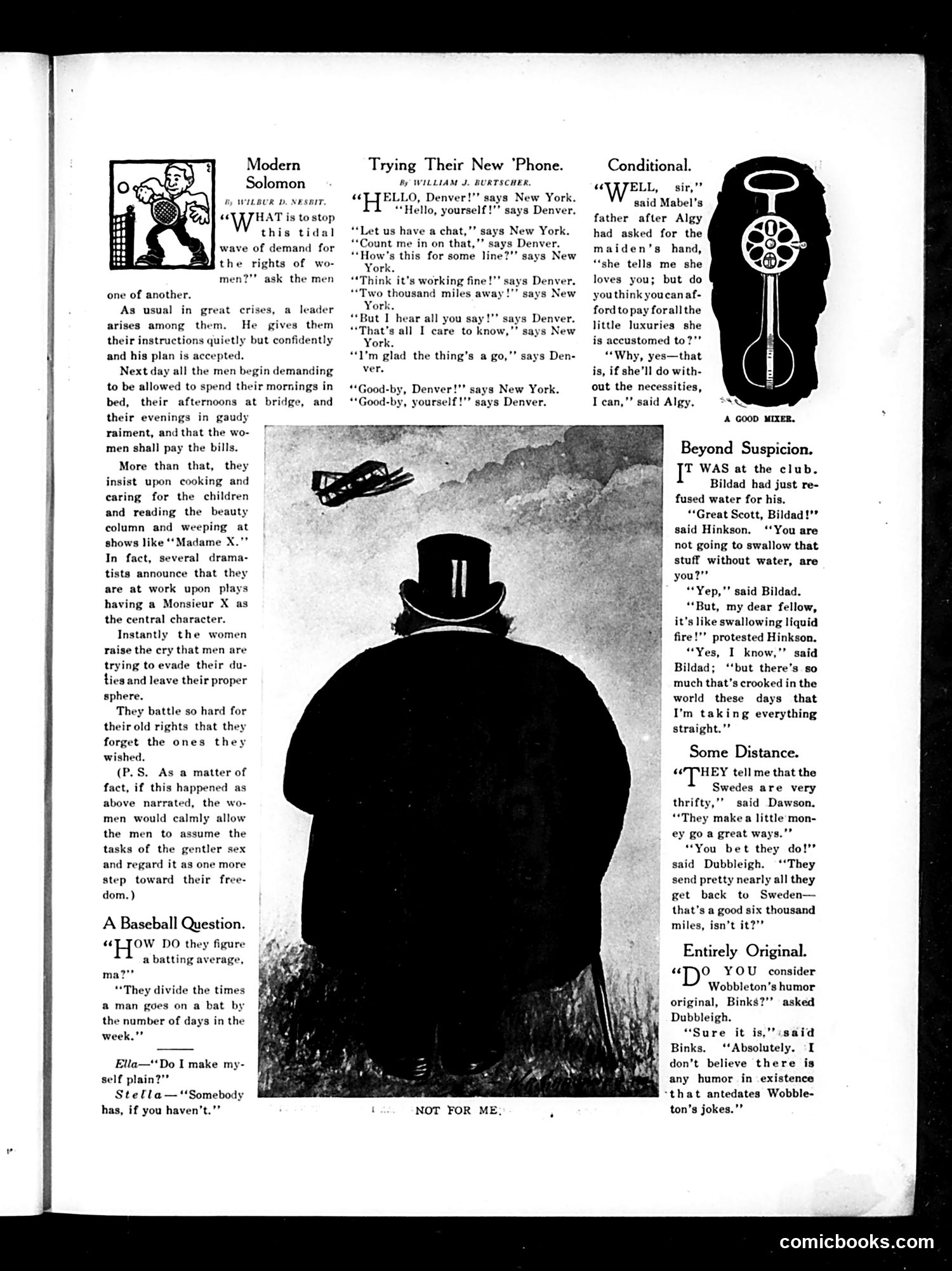
This page from Judge contains several brief satirical pieces typical of early 20th-century humor: **"Modern Solomon"** satirizes the women's suffrage movement by imagining men's counter-demand: they want leisure (sleeping in, playing bridge), fancy clothes, and women to work and pay bills. The joke's irony—exposed in the postscript—is that women would actually *welcome* men taking on domestic duties, exposing how men's resistance to equality stems from privilege rather than principle. **"Trying Their New 'Phone"** celebrates the recently-invented long-distance telephone between New York and Denver, mocking the novelty and awkwardness of early phone conversations ("Hello yourself!"). The remaining pieces are brief jokes about baseball statistics, marriage finances, drinking "straight" (whiskey without water, with a pun on moral straightness), Swedish frugality, and derivative humor. The page is primarily light social satire rather than hard political commentary, reflecting Judge's entertainment-focused approach to contemporary issues like women's rights.
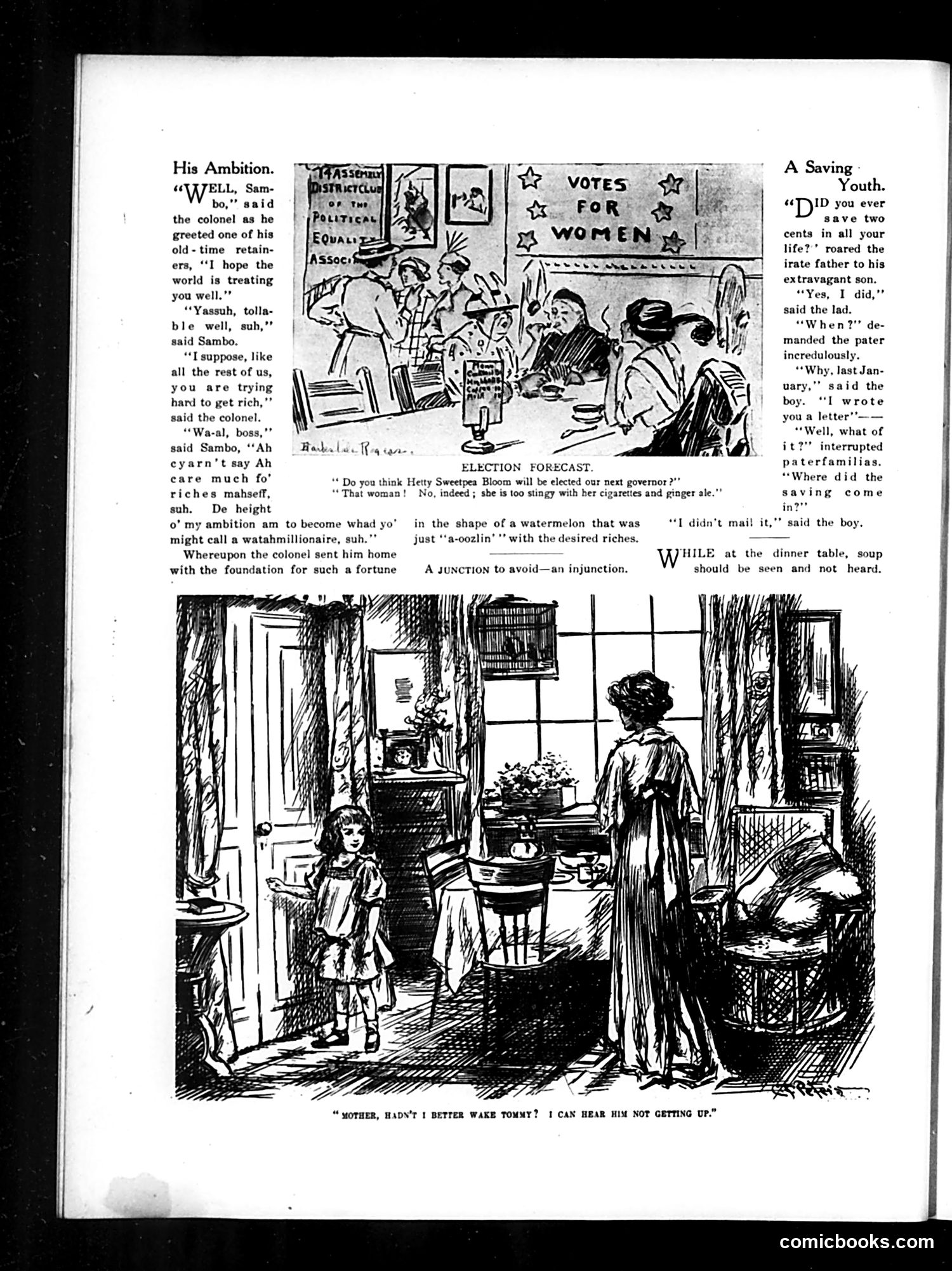
This page contains three distinct satirical pieces: **"His Ambition"**: A dialect-heavy exchange between a colonel and "Sambo," an African American character. The satire mocks both figures—the freedman's malapropism "watahmillionaire" (watermelon-millionaire) plays on racist stereotypes, while the colonel's paternalistic response is gently ridiculed for rewarding ambition with pocket change. **"Election Forecast"**: A brief cartoon about a female political candidate (Hetty Sweetpea Bloom) being unelectable because she's "stingy" with cigarettes and ginger ale—satirizing women's political disqualification based on trivial social expectations rather than policy. **"A Saving Youth"**: A domestic comedy about a boy claiming to have saved money by not mailing a letter to his father—absurdist humor undermining the father's earnest lesson about thrift. **Bottom cartoon**: A mother's quip about waking her son, humorously reversing the phrase "getting up" into "not getting up"—mild satire of parental exasperation. The page's overall tone: lighthearted social commentary mixed with period stereotypes.
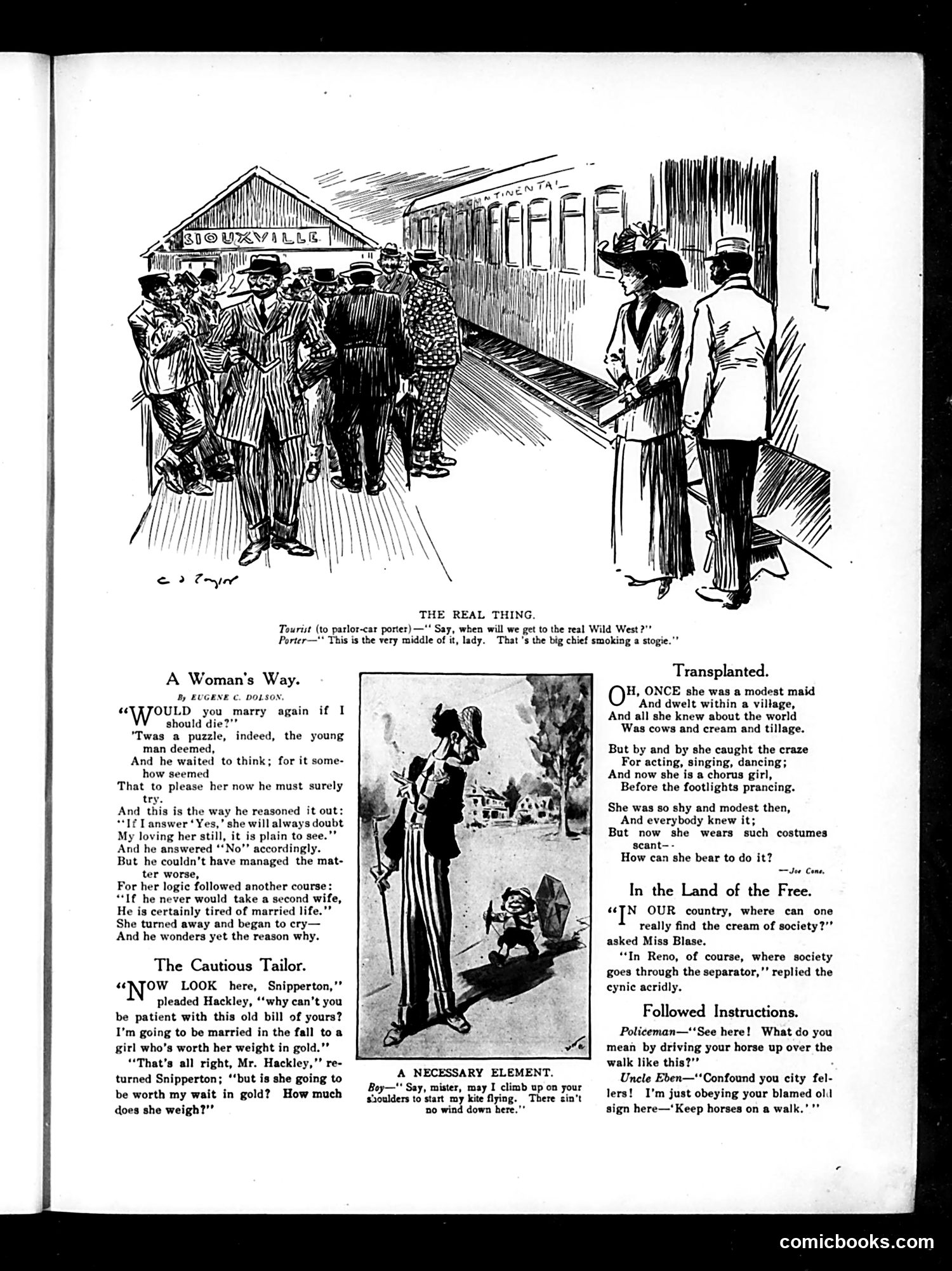
This page contains multiple short humorous pieces typical of early 20th-century satirical magazines: **"The Real Thing"** mocks tourists seeking the "Wild West," with a porter suggesting they're already in it—likely commentary on the mythologizing of the American frontier. **"A Woman's Way"** presents a domestic puzzle where a husband's logical reasoning backfires: answering "no" to remarriage makes his wife think he's tired of marriage, not that he loves her. **"The Cautious Tailor"** plays on a creditor's anxiety about an employee's upcoming marriage, demanding payment in gold rather than trusting future wages. **"Transplanted"** satirizes a village girl who becomes a chorus girl, questioning how she can wear revealing stage costumes after her modest upbringing. **"In the Land of the Free"** contains dark social commentary: a cynic quips that Reno (known for divorce) is where "society goes through the separator"—implying divorce mills process the wealthy. **"Followed Instructions"** offers rural-urban humor: a farmer drives his horse on the sidewalk, claiming he's obeying a sign reading "Keep horses on a walk."
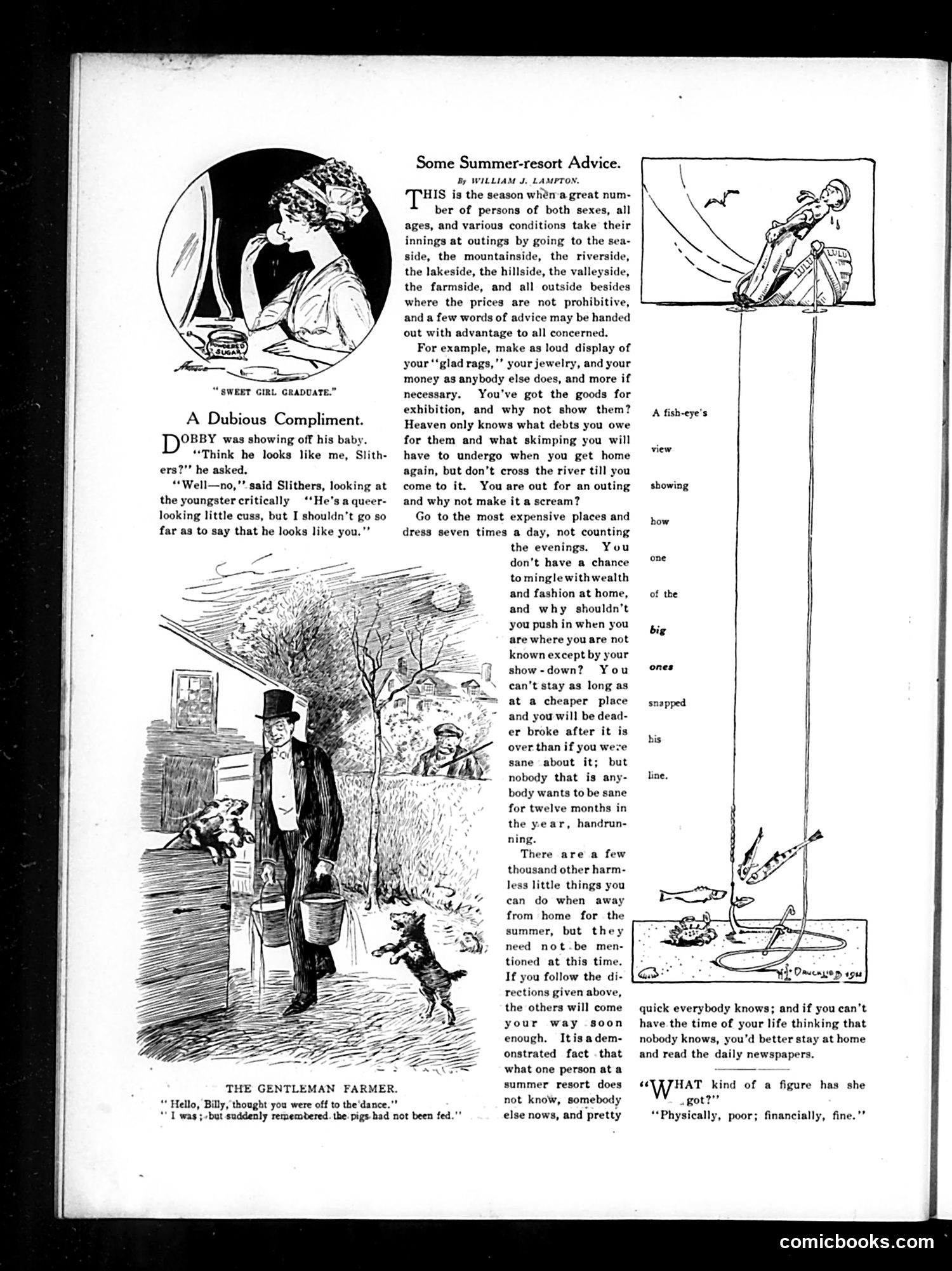
This page contains two satirical pieces targeting American leisure and social pretension: **"A Dubious Compliment"** (left): A brief joke mocking new parenthood. Dobey shows off his baby, asking if it resembles him. His friend Slithers tactfully dodges, suggesting the child looks "queer" rather than admitting it resembles its father—implying the baby is unattractive. **"Some Summer-resort Advice"** (center/right): William J. Lampton's essay satirizes wealthy Americans on vacation. The satire is deadpan: he advises readers to ostentatiously display jewelry and clothing, frequent expensive establishments, change outfits constantly, and generally overspend—all to impress strangers who don't know them. The joke is that this behavior leads to financial ruin, yet people pursue it anyway because they care more about appearances than sense. **"The Gentleman Farmer"** (bottom): A brief caption joke about a farmer who skipped a dance because he forgot to feed the pigs—suggesting rural practicality trumps social entertainment. The page mocks American class anxiety and conspicuous consumption during the Gilded Age leisure culture.
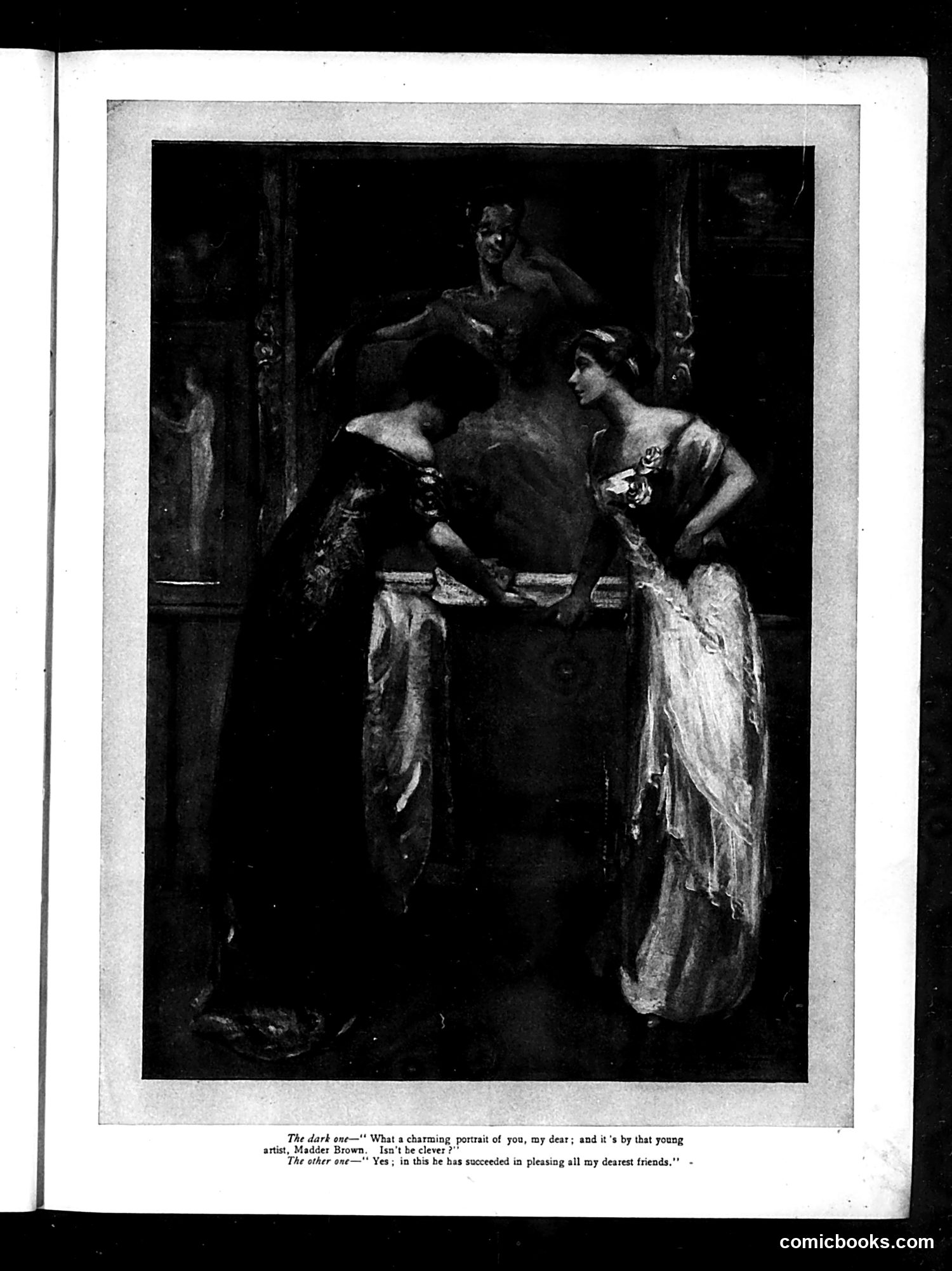
This appears to be a theatrical or satirical scene depicting two women in classical dress examining a portrait. One woman refers to an artist named "Madder Brown" and compliments his work. The other responds that the portrait has succeeded in pleasing "all my dearest friends." The satire likely concerns artistic vanity and social pretension. The joke appears to hinge on the second woman's backhanded compliment—suggesting the portrait is successful precisely because it pleases others rather than because it's an accurate or flattering likeness. "Madder Brown" may be a pun on the artist's name, though without additional context, the specific reference remains unclear. The dramatic staging and period costumes suggest Judge magazine's typical theatrical or society-focused satire of the era.
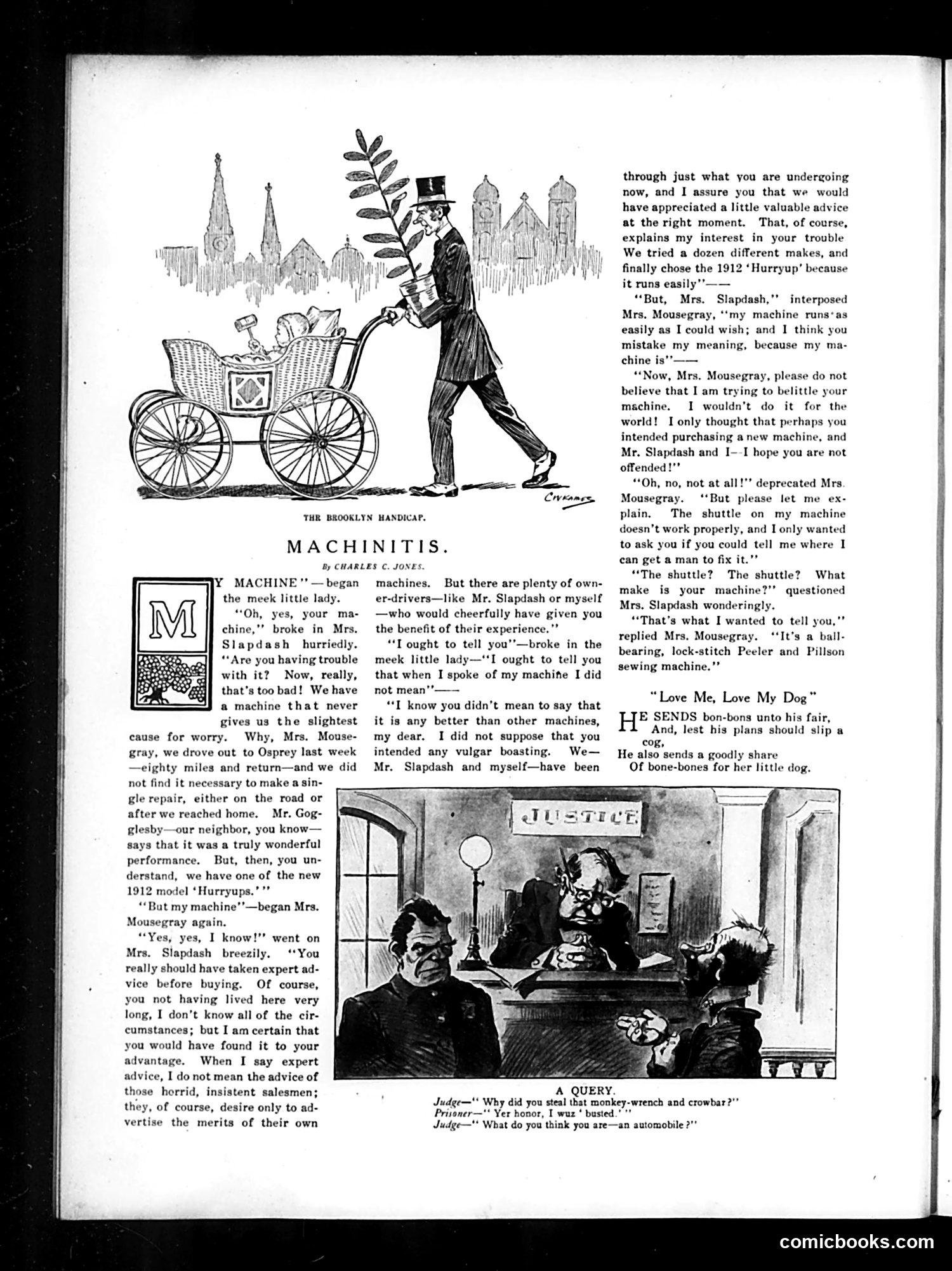
This page satirizes the emerging automobile culture of 1912 through two pieces: **"Machinitis"** (main story): Mocks the social pretentiousness surrounding new car ownership. Mrs. Slapdash boasts endlessly about her 1912 "Hurryup" automobile, interrupting Mrs. Mousegray repeatedly with unsolicited advice. The joke's payoff: Mrs. Mousegray wasn't discussing her car at all—she needed repair help for her *sewing machine* (a Peeler and Pillson). This satirizes how automobile owners had become insufferably obsessed with their vehicles, assuming all mechanical troubles must involve cars. **"A Query"** (courtroom joke): A prisoner claims he stole a monkey wrench and crowbar because he was "busted" (broke). The judge retorts, "What do you think you are—an automobile?"—implying only automobiles need such repairs. The joke reflects the era's anxiety about cars as complex, fragile machines requiring constant maintenance. Both pieces capture 1912 America's automobile obsession and the social dynamics surrounding this new technology.
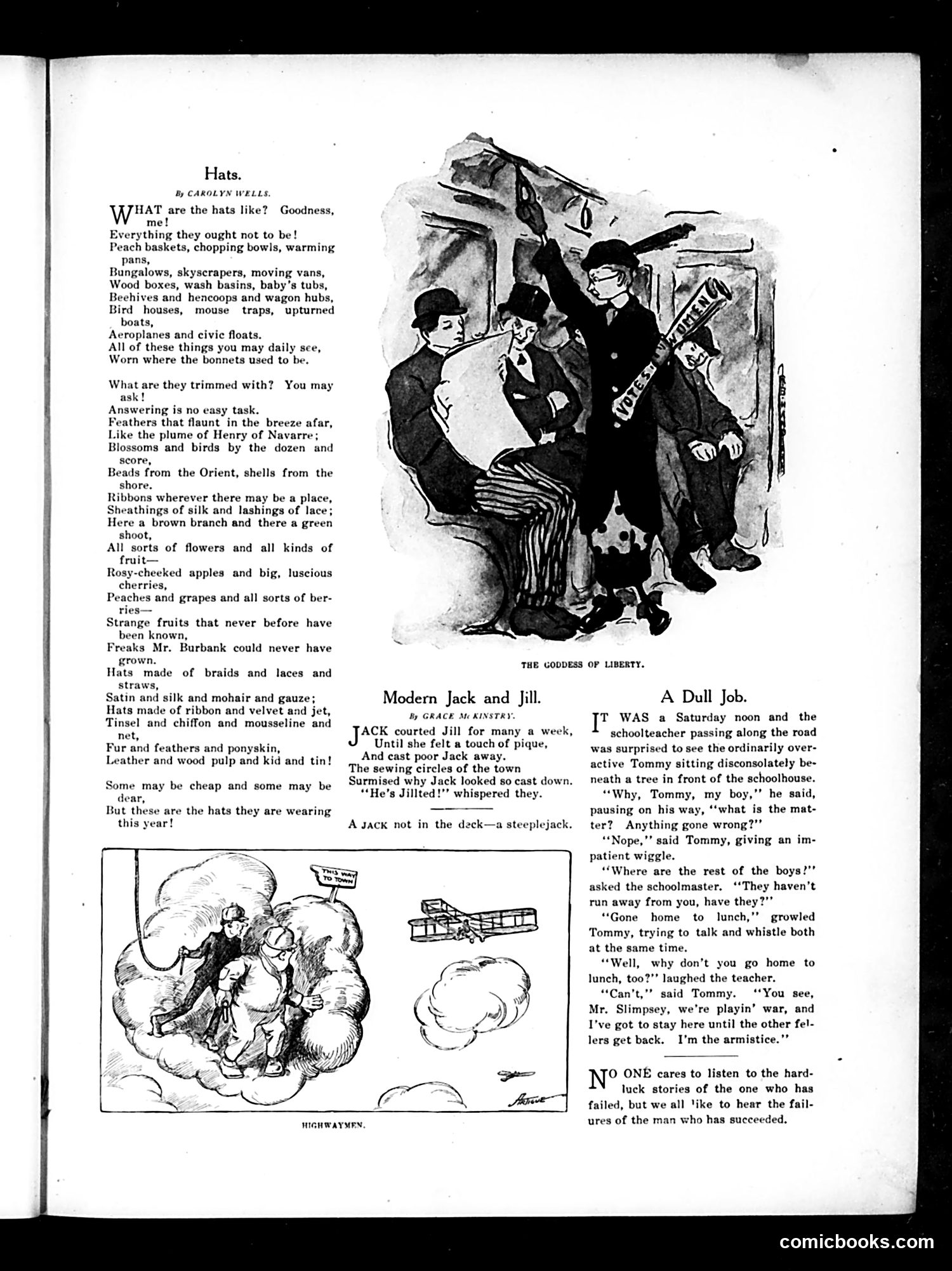
This page contains three satirical pieces typical of early 20th-century Judge magazine: **"Hats"** (poem by Carolyn Wells): A humorous critique of women's absurdly oversized, elaborately decorated hats fashionable at the time. The satire mocks how hats resembled everyday objects (peach baskets, bungalows, bird houses) and were trimmed with excessive ornamentation (fruits, flowers, feathers, shells, ribbons). This reflects genuine contemporary concern about the impracticality and expense of women's millinery fashions. **"Modern Jack and Jill"**: A brief comedic tale playing on the nursery rhyme, depicting a romantic rejection ("Jillted") with a visual pun showing a steeplejack (construction worker). **"A Dull Job"**: A children's humor piece where young Tommy must remain at school as "the armistice" while other boys play war games. The joke relies on Tommy's malapropropism—he means "umpire" or referee, not the diplomatic agreement ending conflict. The page reflects Judge's mix of social commentary (fashion critique) with light wordplay and children's humor.
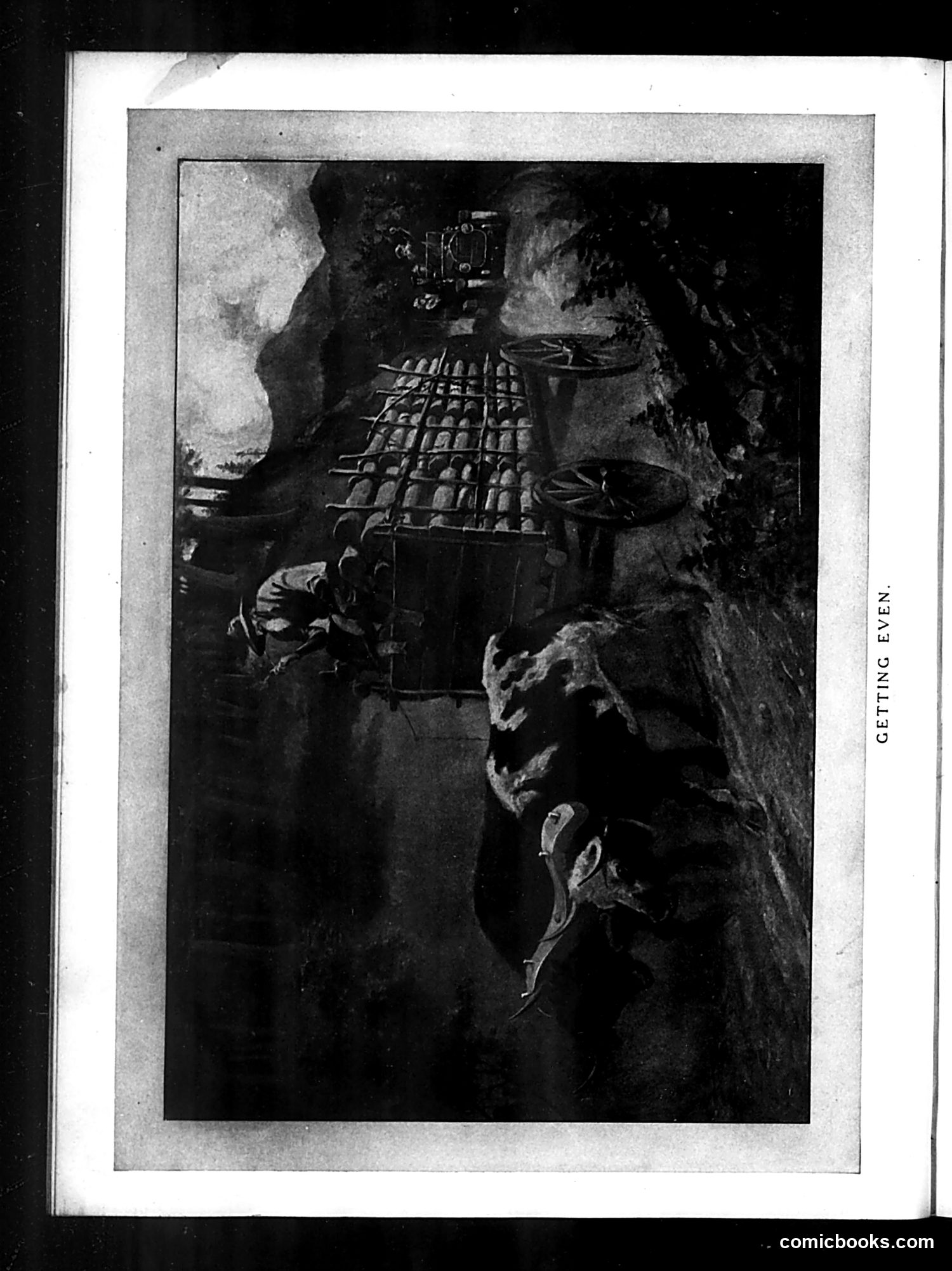
This satirical image shows what appears to be a violent confrontation, with the caption "GETTING EVEN" suggesting retribution or revenge as its theme. The photograph (rotated 90 degrees in the layout) depicts figures in what looks like a physical altercation or struggle, with one person wielding what appears to be a weapon or tool against another. Without clearer context about the specific historical moment this *Judge* magazine issue addresses, I cannot definitively identify the figures or the precise political/social event being satirized. The image likely critiques some contemporary dispute, conflict, or act of revenge from the era when this was published, but determining the exact reference requires additional publication information.
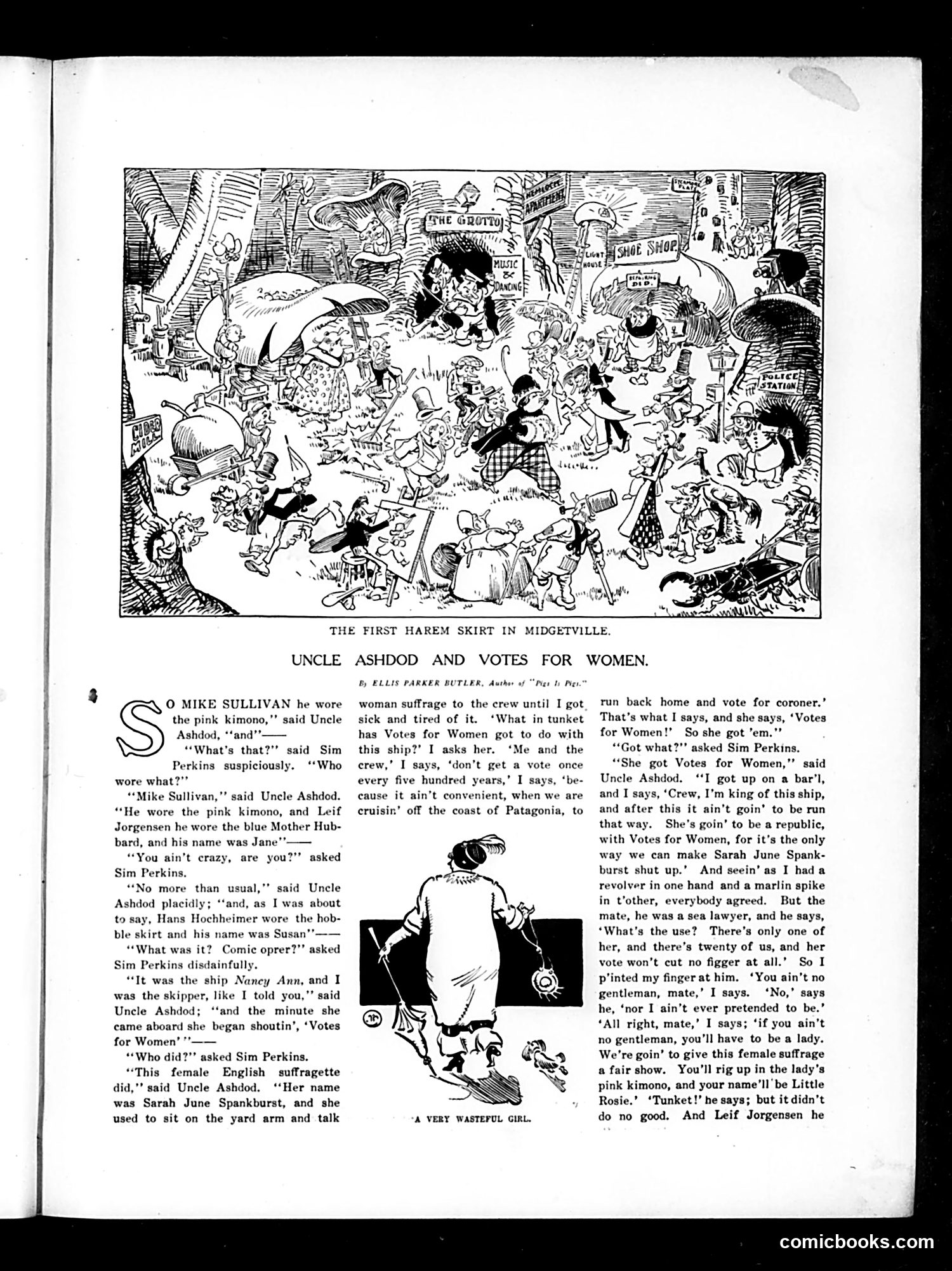
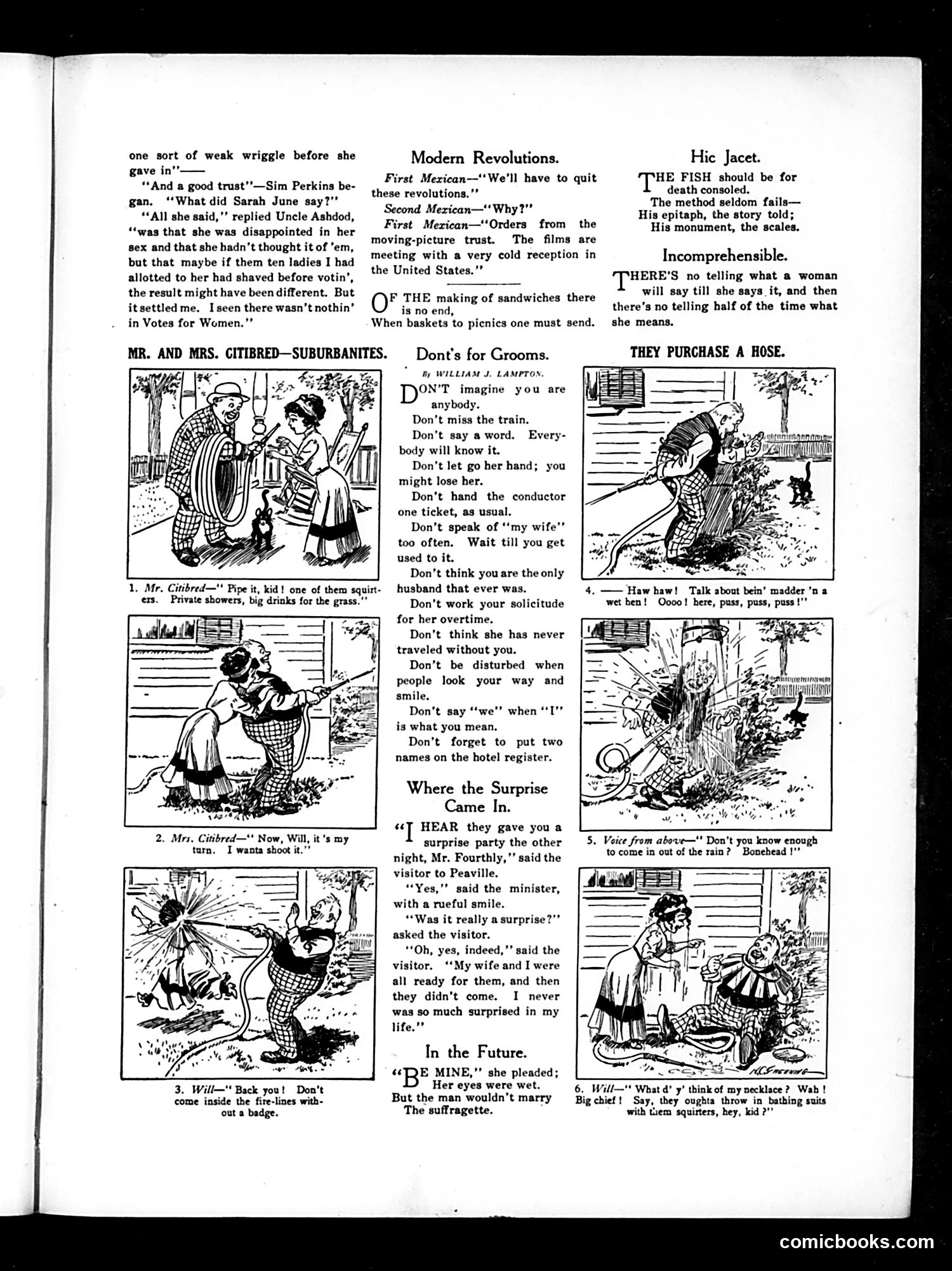
This story satirizes the women's suffrage movement through absurdist humor. Uncle Ashdod recounts how an English suffragette named Sarah June Spankburst boarded his ship and relentlessly promoted "Votes for Women" until the crew grew tired of her advocacy. The satire's point: the story ridicules suffragists as annoying agitators whose cause is so trivial it disrupts social order. When the captain finally grants women voting rights aboard ship to silence her, he must force a male crew member to dress in women's clothes ("pink kimono," "lady's pink kimono") to constitute a female voter—mocking both the suffragettes and the absurdity of expanding voting rights. The crude illustration and humor reflect anti-suffrage sentiment common in early 20th-century American publications. By portraying a suffragette as perpetually irritating and her demands as laughable, Judge attempted to delegitimize the movement through ridicule rather than serious argument.
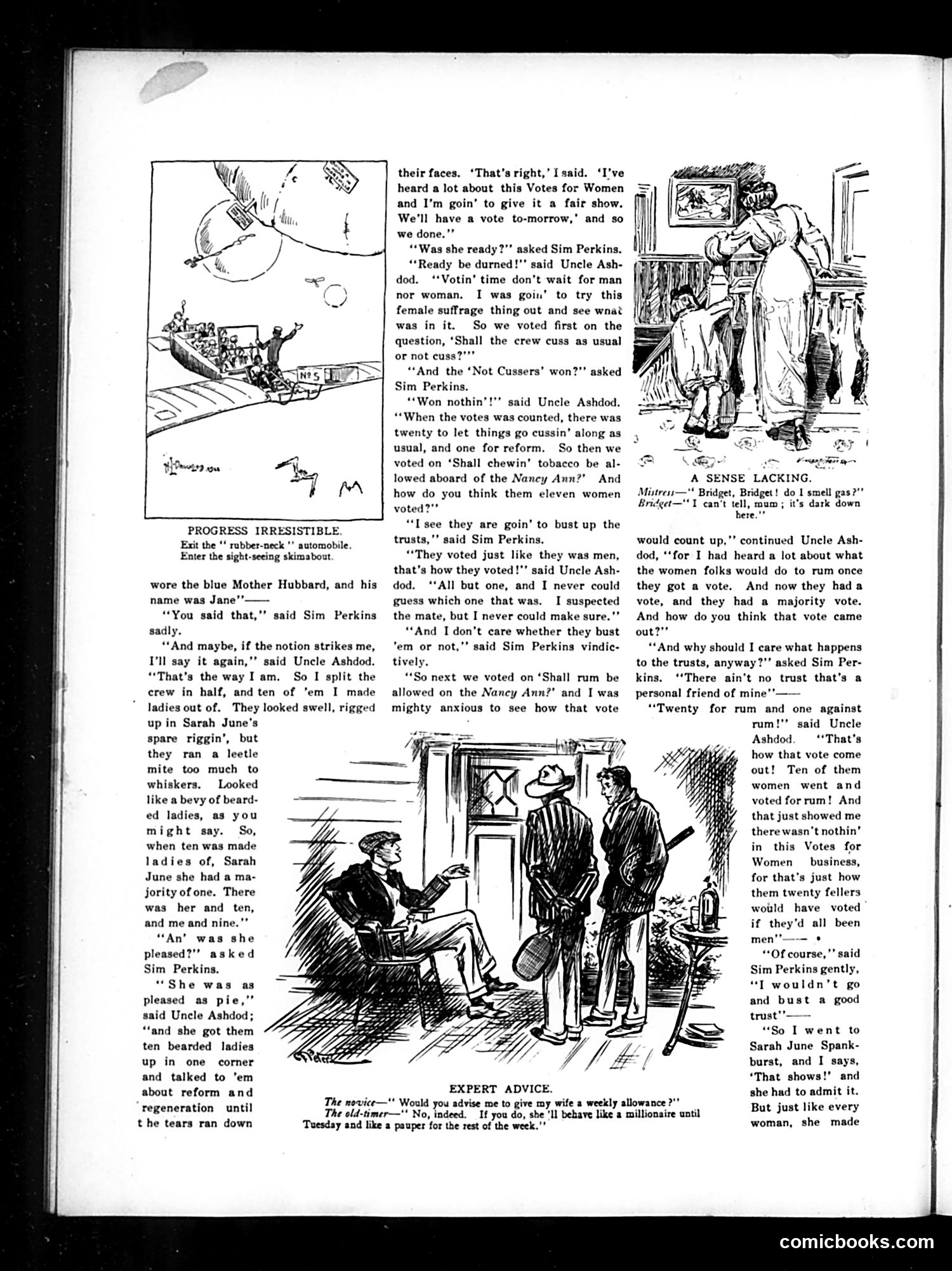
This page satirizes women's suffrage through Uncle Ashdod's tall tale about converting ten male sailors into "ladies" aboard his ship, then conducting votes on shipboard conduct. **The satire's point:** When given voting rights, the newly enfranchised women vote identically to men—they approve cursing, tobacco, and especially rum (20 for, 1 against). Uncle Ashdod expected women voters to be reform-minded temperance advocates, but they prove indistinguishable from male sailors in their vices. **The joke:** The cartoon mocks suffragists' idealistic arguments that women would elevate politics through their moral superiority. Instead, women demonstrate they're just like men—hardly the transformative force reformers promised. The caption "Progress Irresistible" drips with irony. The smaller "Expert Advice" and "A Sense Lacking" comics are unrelated domestic humor pieces common to the era's men's magazines. This reflects Judge magazine's skeptical, often hostile stance toward women's suffrage circa 1910s America.
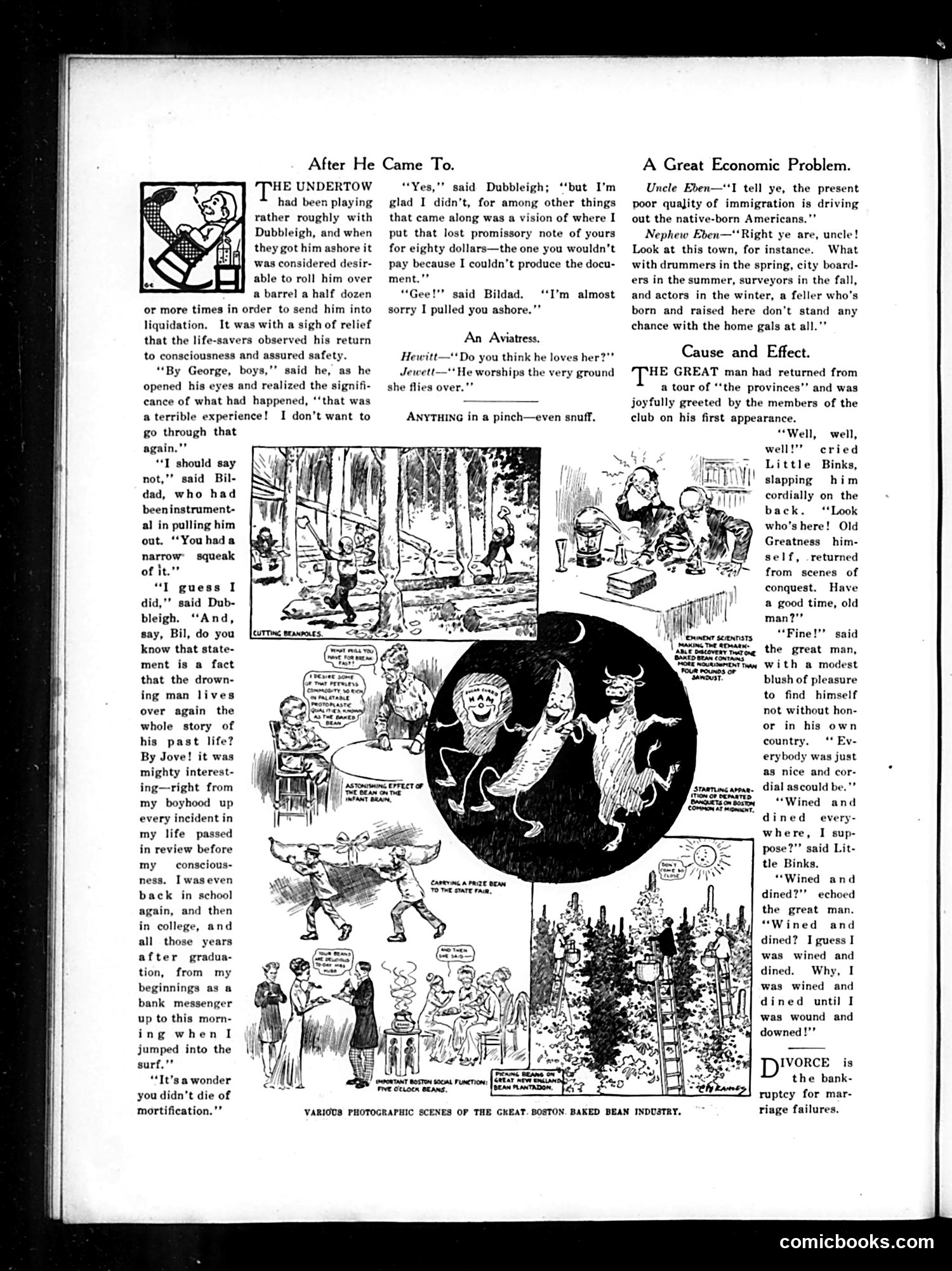
This page contains three distinct satirical pieces: **"After He Came To"** depicts a man nearly drowning, then recovering with an ironic twist—while nearly dying, he remembered where he'd hidden a promissory note he owed a friend. The joke hinges on the period's belief that drowning victims experience life-flashing-before-their-eyes, but subverts it: instead of profound reflection, the protagonist recalls a forgotten debt, mortifying his creditor who pulled him out. **"An Aviatress"** is a brief pun about an aviator's girlfriend—she "flies over" rather than walks, so he "worships the ground she flies over." This jokes about early aviation's novelty. **"Cause and Effect"** satirizes social climbing: a successful man returns from provincial touring and is fêted by club members who repeatedly wine and dine him until he's "wound and downed"—exhausted by excessive hospitality. The satire targets both provincial eagerness to honor visiting celebrities and urban pretension. The center section illustrates Boston's baked bean industry with various photographic scenes.
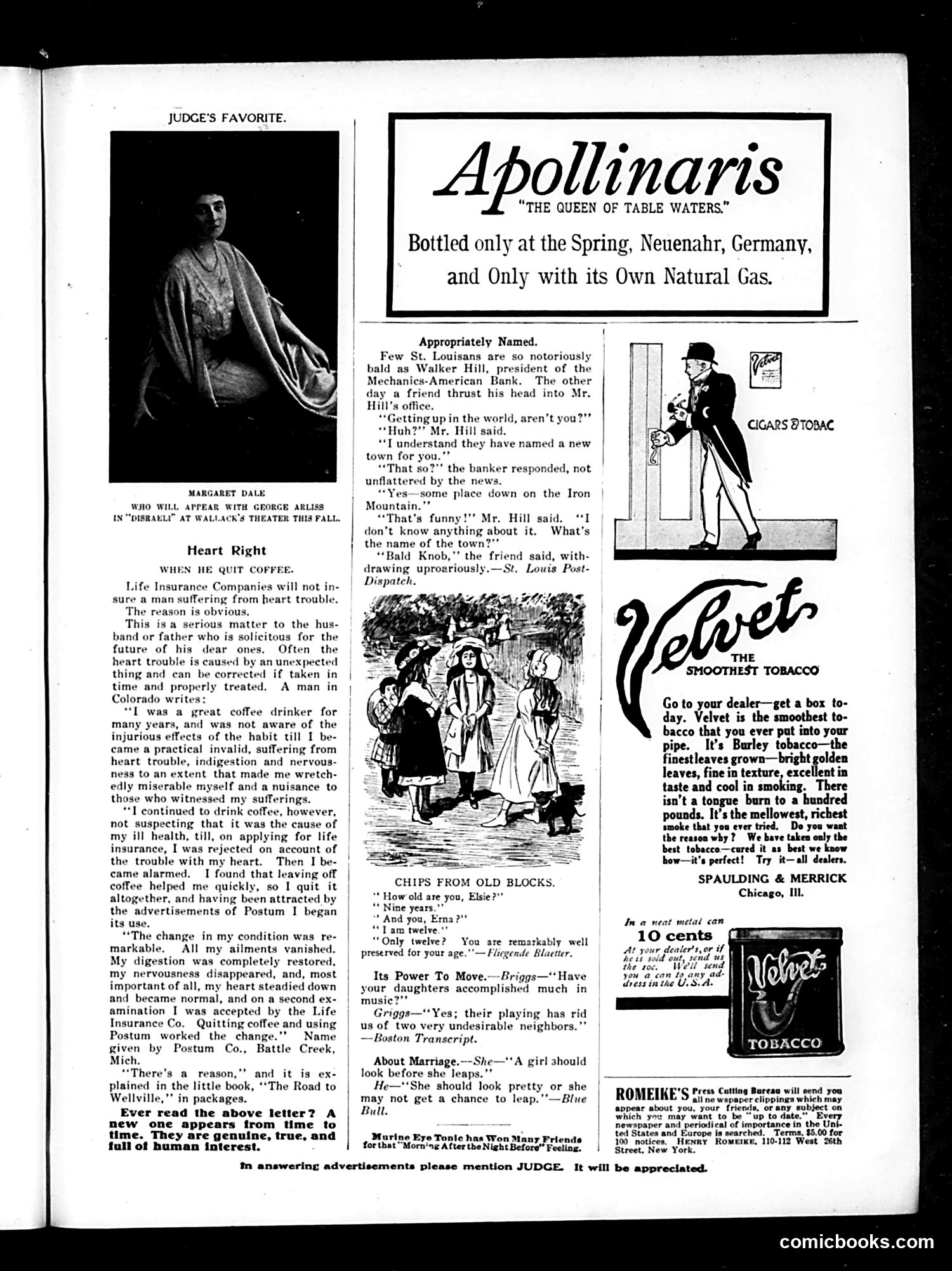
This page contains several short humor pieces typical of Judge magazine's satirical content: **"Heart Right"** is a Postum coffee substitute advertisement disguised as editorial content—a testimonial from a Colorado man whose heart trouble supposedly resolved after quitting coffee and switching to Postum. This reflects early 1900s health anxieties and the marketing of patent remedies. **"Appropriately Named"** is a brief joke about Walker Hill, a bald St. Louis banker whose name becomes the punchline when a friend mentions a town named "Bald Knob" has been named after him—a play on his obvious baldness. **"Chips from Old Blocks"** contains two unrelated short jokes about children's ages and daughters' musical ability. The page also features advertisements for Apollinaris mineral water, Velvet tobacco, and Murine eye tonic—typical turn-of-the-century patent medicines and consumer goods. The content reflects Judge's mix of social humor and commercial promotion.
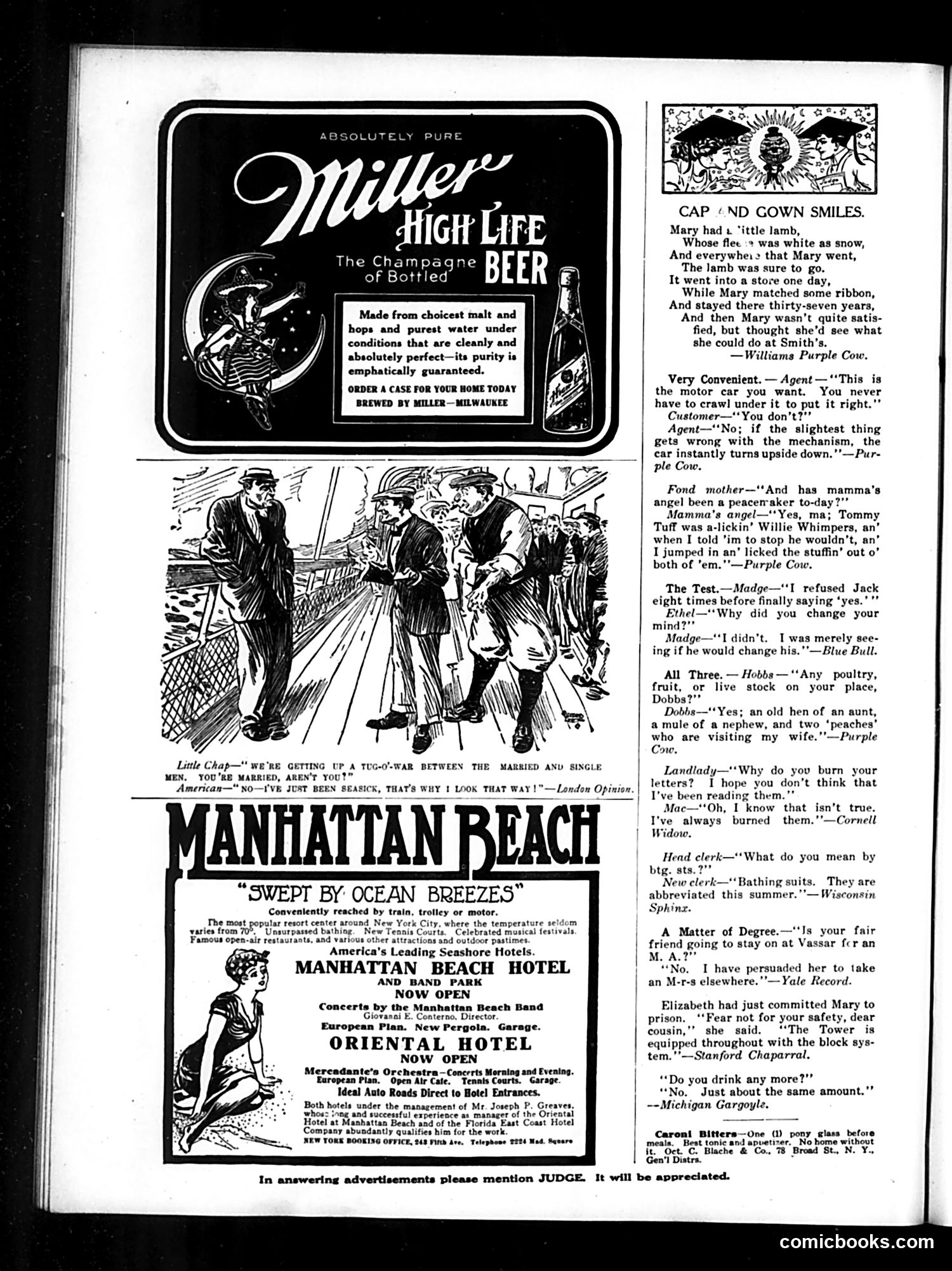
This page is primarily **advertising** for hotels and beer, with a sidebar of short humorous jokes typical of early 20th-century magazines. The main cartoon depicts a scene on a ship between "married and single men," illustrating a social division that appears to be the joke's premise—though the specific satire is unclear without fuller context. The large advertisements promote **Manhattan Beach Hotel** and **Oriental Hotel** as fashionable New York seashore resorts with orchestras and modern amenities, reflecting the leisure culture of wealthy Americans. **Miller High Life Beer** is advertised as pure and perfectly brewed in Milwaukee. The "Cap and Gown Smiles" section contains brief, light jokes about children misbehaving, motor cars breaking down, romantic rejection, and courtship—standard humor of the era emphasizing domestic situations and wordplay rather than political content. The page reflects early 1900s American consumer culture and genteel magazine humor targeting upper-middle-class readers.
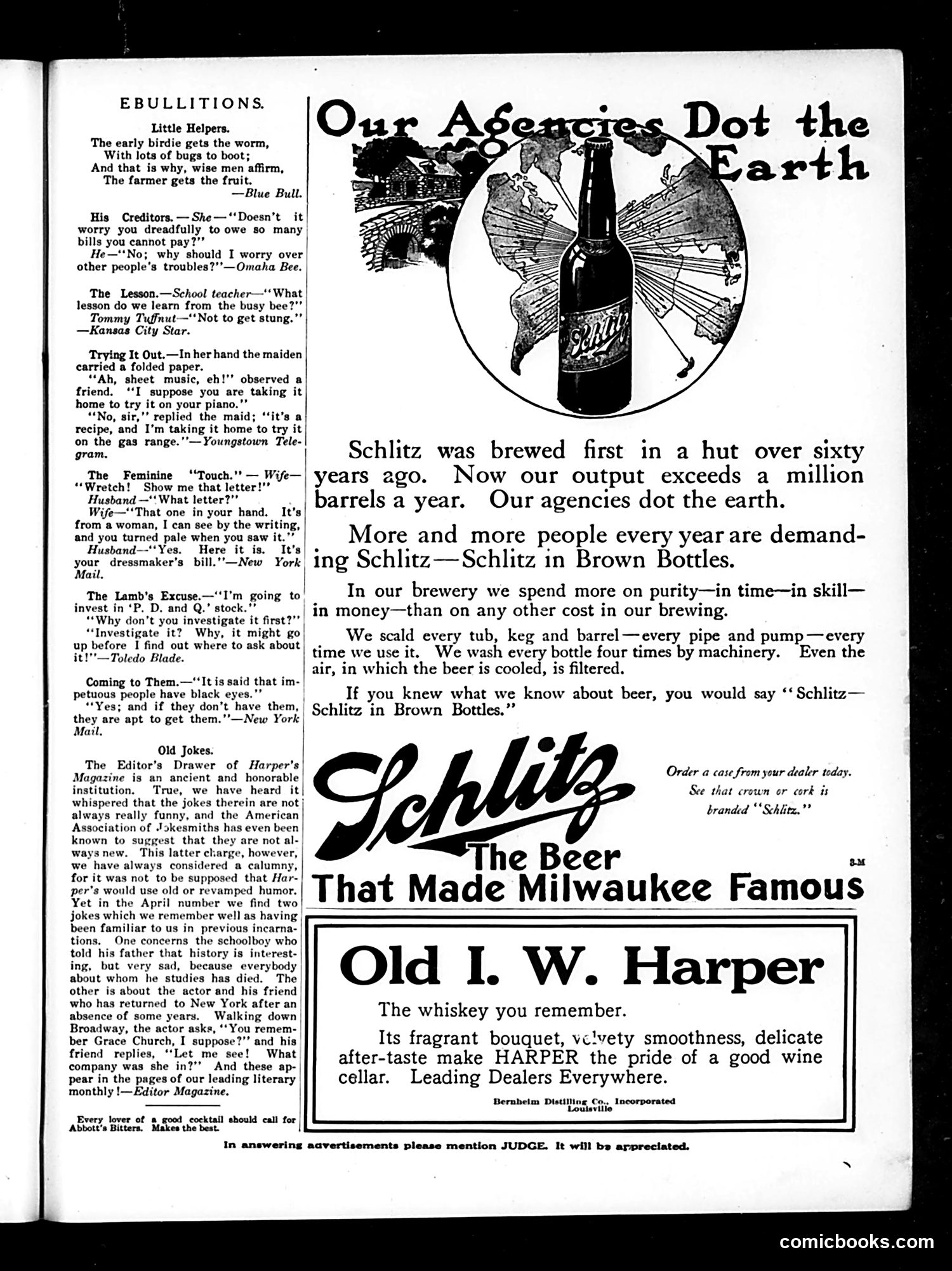
This page contains **satirical short jokes** in the "Ebullitions" section (left column) and **two alcohol advertisements** (right side). The jokes mock contemporary social types: a deadbeat debtor unconcerned about bills, a schoolboy's literalist answer about learning from busy bees, and a man anxious upon receiving his dressmaker's bill. One joke plays on the double meaning of "sheet music" as both musical notation and bedsheet recipes. These are light social satire targeting recognizable human foibles—financial irresponsibility, pretentious education, marital economics. The page also notes that Harper's Magazine's editorial section has reprinted very old jokes, poking fun at the literary magazine's lack of originality. The advertisements for **Schlitz beer** and **I.W. Harper whiskey** emphasize purity, manufacturing standards, and brand reputation—typical early-20th-century alcohol marketing before Prohibition. The Schlitz ad claims "our agencies dot the earth," suggesting global reach. This reflects pre-1920 American magazine culture, combining lighthearted humor with luxury product advertising.
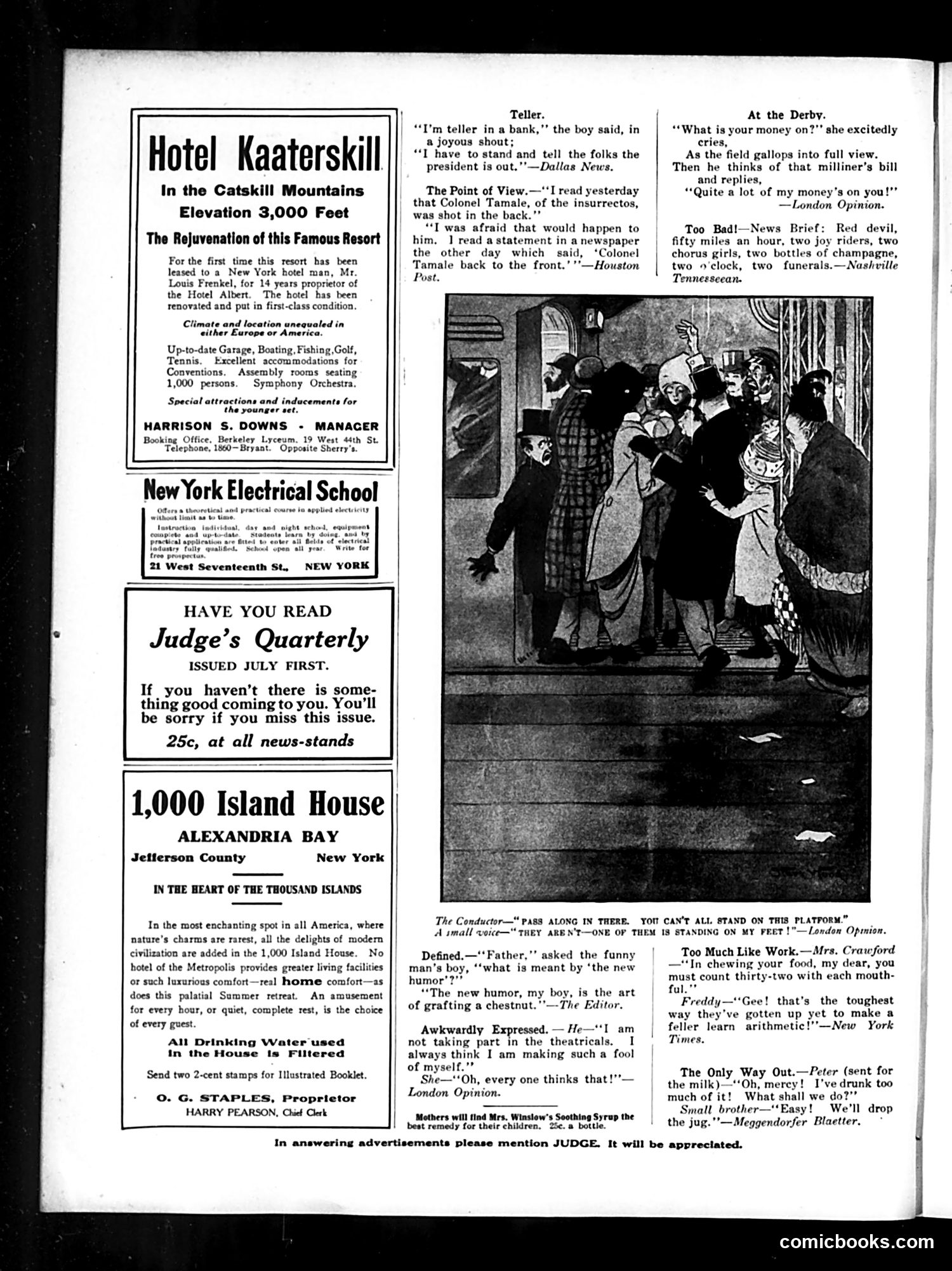
This page is primarily **advertisements** for resorts and schools, with a sidebar of brief **humorous quips and jokes** rather than political cartoons. The one illustration shows a crowded streetcar or train platform. The caption jokes about standing room: a conductor tells passengers they can't all stand on the platform, and a child's voice replies that one person is "standing on my feet"—a literal-minded child's joke about personal space. The text jokes are typical early-20th-century humor: a bank teller's job description, a military mishap, a couple at the horse races (she thinks he's betting on horses; he's thinking about her milliner's bill), streetcar crowding, definitions of "new humor" as recycled jokes, and parenting challenges with children who take instructions literally. **No political content is present.** This is entertainment and advertising for a general audience, reflecting middle-class American leisure activities and family life circa 1910s.
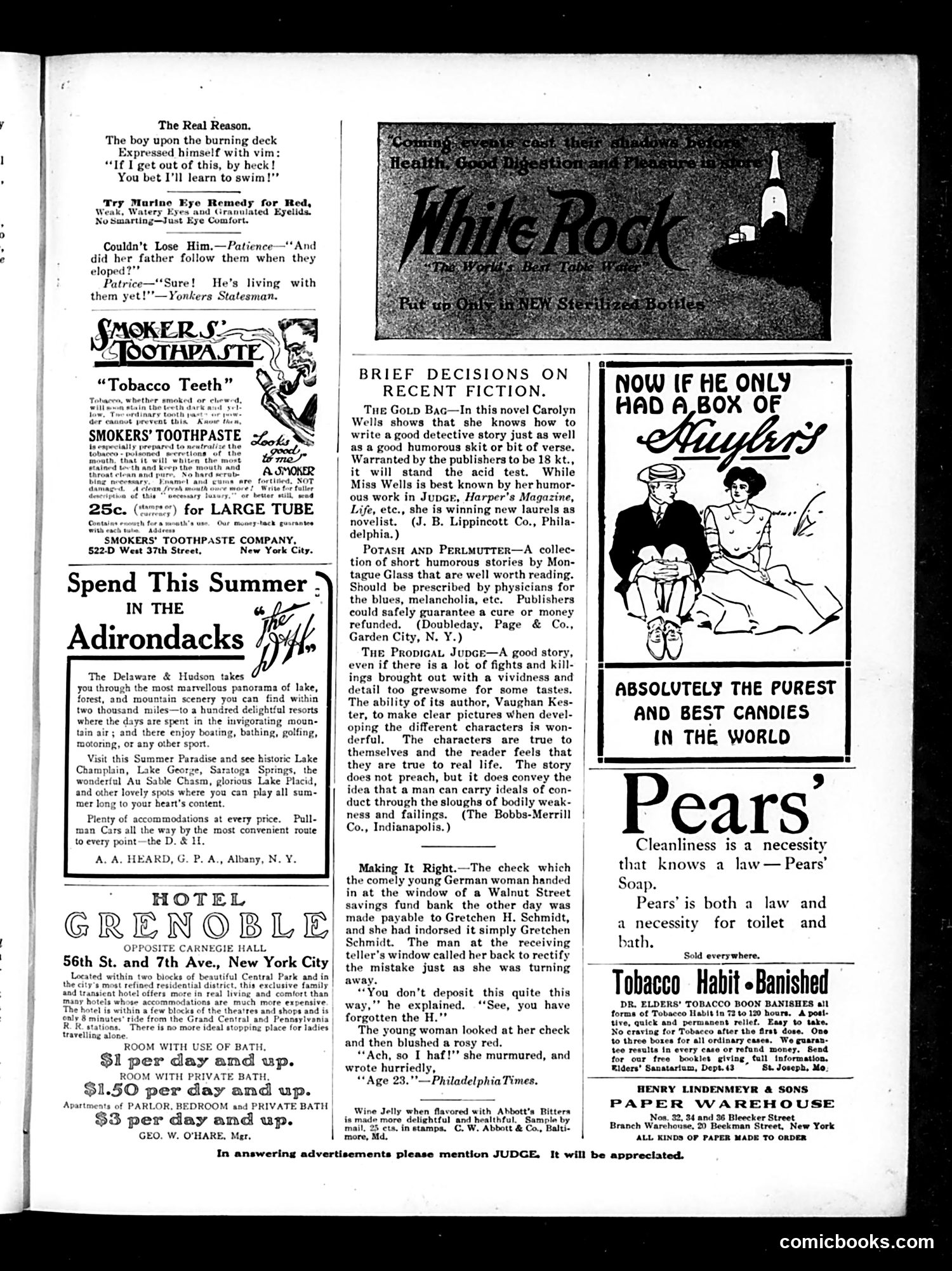
This page is primarily **advertisements and filler content** with minimal editorial cartoon material. The main elements are: **Text humor pieces**: Two brief jokes—one about a boy on a burning deck learning to swim, another about a father following an eloping couple ("He's living with them yet!"). These are generic, mild social humor typical of the era, requiring no special historical context. **Book reviews**: Brief notices of recent fiction, including works by Carolyn Wells and Montague Glass. The reviews use light humor (calling a detective novel "18 kt." gold, suggesting humorous stories cure melancholy). **One embedded cartoon**: "Making It Right" depicts a German woman at a bank correcting her check signature from simply "Gretchen Schmidt" to include her full name. This plays on ethnic/immigrant stereotypes common in early 20th-century American humor—suggesting a German woman's unfamiliarity with American banking procedures. **Advertisements dominate**: Hotels, travel, toothpaste, candy, and soap ads fill most space. The content reflects Gilded Age leisure marketing rather than political satire.
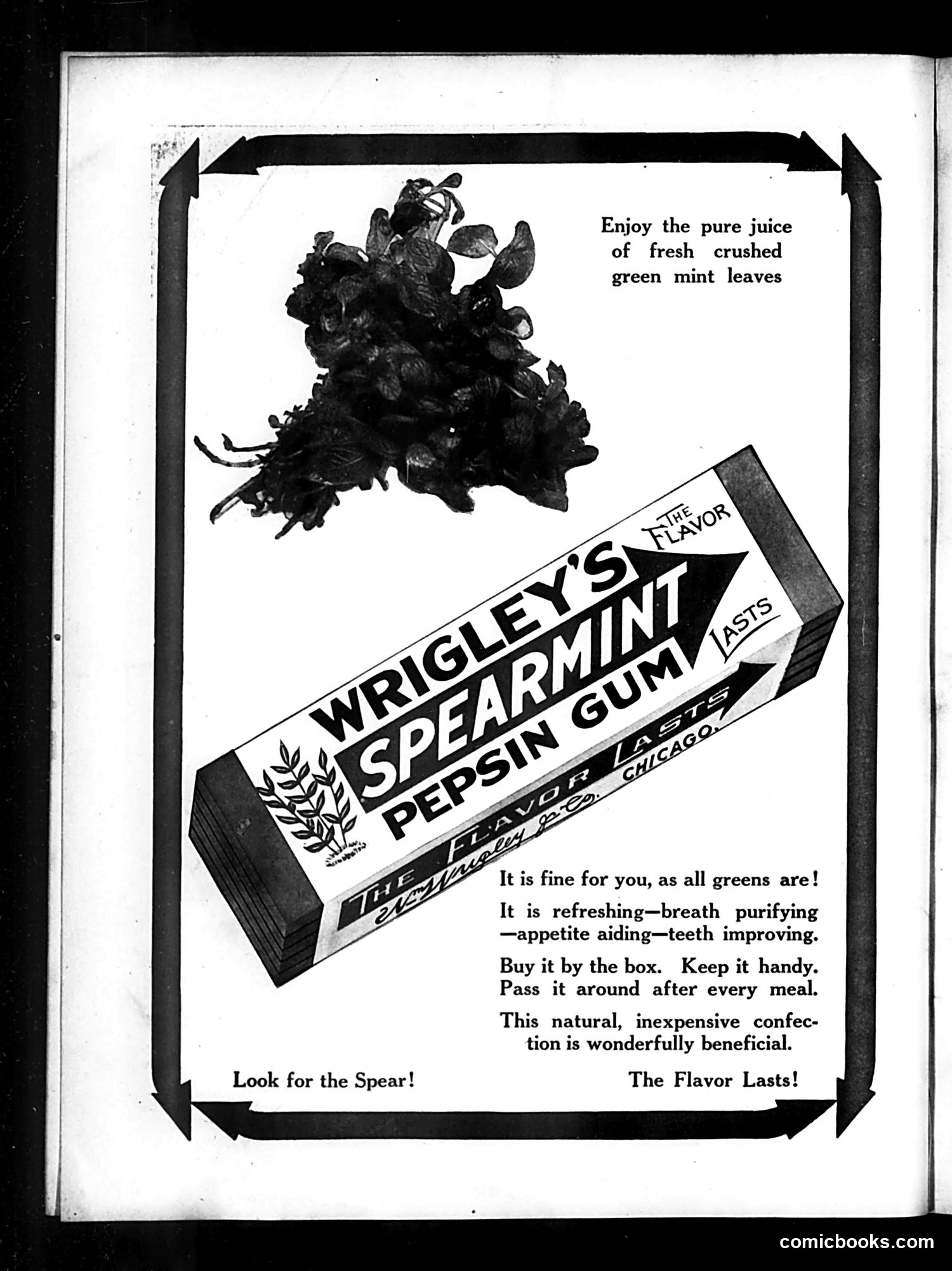
This is a **product advertisement**, not political satire. It promotes Wrigley's Spearmint Pepsin Gum, manufactured in Chicago. The page shows fresh mint leaves and the gum package, emphasizing the product's natural ingredients and purported health benefits—breath freshening, appetite aid, and teeth improvement. The marketing language ("natural, inexpensive confection") and health claims reflect early 20th-century advertising conventions, when gum manufacturers routinely marketed products with medicinal benefits. The phrase "Look for the Spear!" references the brand's spear-leaf logo visible on the package. This appears to be straightforward commercial advertising rather than editorial commentary or satire.