
Judge, 1911-07-08 · page 7 of 24
Judge — July 8, 1911 — page 7: what you’re looking at
What you’re looking at
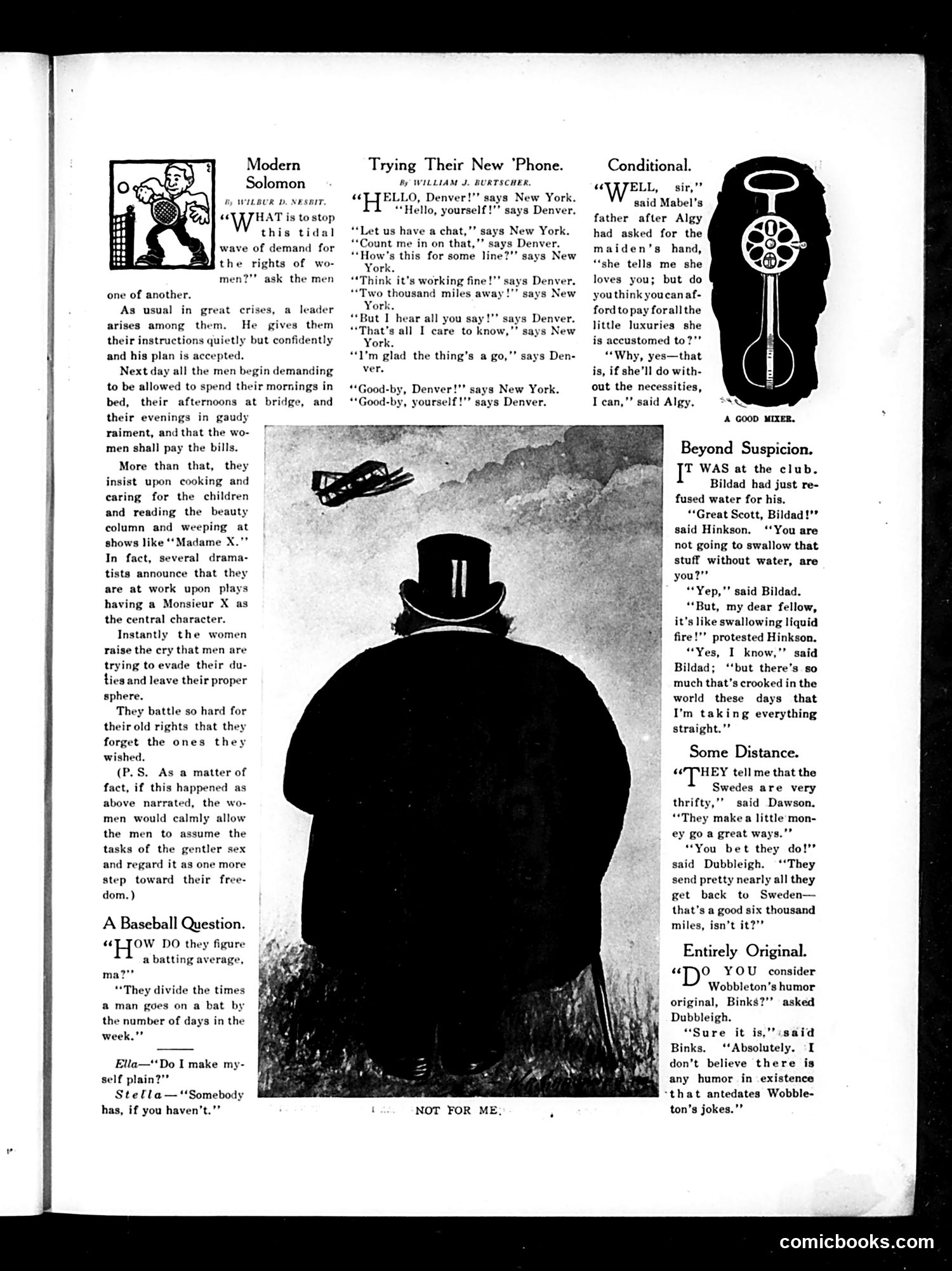
This page from Judge contains several brief satirical pieces typical of early 20th-century humor: **"Modern Solomon"** satirizes the women's suffrage movement by imagining men's counter-demand: they want leisure (sleeping in, playing bridge), fancy clothes, and women to work and pay bills. The joke's irony—exposed in the postscript—is that women would actually *welcome* men taking on domestic duties, exposing how men's resistance to equality stems from privilege rather than principle. **"Trying Their New 'Phone"** celebrates the recently-invented long-distance telephone between New York and Denver, mocking the novelty and awkwardness of early phone conversations ("Hello yourself!"). The remaining pieces are brief jokes about baseball statistics, marriage finances, drinking "straight" (whiskey without water, with a pun on moral straightness), Swedish frugality, and derivative humor. The page is primarily light social satire rather than hard political commentary, reflecting Judge's entertainment-focused approach to contemporary issues like women's rights.
📄 Transcribed text from this page (OCR, searchable)
Machine-transcribed from the original scan — historical spelling and the odd misread are preserved.
Solomon By WILBUR D. NESBIT. “YXTHAT is to stop this tidal wave of demand for the rights of wo- men?” ask the men one of another. As usual in great crises, a leader arises among them. He them their instructions quietly but confidently and his plan is accepted. Next day all the men begin demanding to be allowed to spend their mornings in bed, their afternoons at bridge, and their evenings in gaudy raiment, and that the wo- men shall pay the bills. More than that, they insist upon cooking and caring for the children and reading the beauty column and weeping at shows like ‘‘Madame X."’ In fact, several drama- tists announce that they are at work upon pla having a Monsieur X as the central character. Instantly the women raise the cry that men are trying to evade their du- ties and leave their proper sphere. They battle so hard for their old rights that they forget the ones they wished. (P.S. As a matter of fact, if this happened as above narrated, the wo- men would calmly allow the men to assume the tasks of the gentler sex and regard it as one more step toward their free- dom.) A Baseball Question. «éLJOW DO they figure a batting average, ma?” “They divide the times @ man goes on a bat by the number of days in the self plain? Stella— “Somebody has, if you haven’t.”” Trying Their New ‘Phone. by WILLIAM J. BURTSCHER. ««L_JELLO, Denver!”’ says New York. “Hello, yourself !"” says Denver. “Let us have a chat,”’ says New York. “Count me in on that,’? says Denver. “How's this for some line?” says New York. “Think it’s working fine!” “Two thousand miles away ! York. “But I hear all you say! “That's all I care to kno York. “I'm glad the thing’s a go,’’ says Den- ver. “Good-by, Denver!"" “Good: yourself !" 3 New York. Denver. Conditional. “YTELL, sir,’ said Mabel’s father after Algy had asked for the maiden’s hand, “she tells me she loves you; but do youthink youcanaf- ford topay forall the little luxuries she is accustomed to?"’ “Why, yes—that is, if she'll do with- out the necessities, I can,’’ said Algy. ww A GOOD MIXER. Beyond Suspicion. T WAS at the club. Bildad had just re- fused water for his. “Great Scott, Bildad!"” said Hinkson. ‘You are not going to swallow that stuff without water, are you?’’ “*Yep,”’ said Bildad. “But, my dear fellow, it’s like swallowing liquid fire!’’ protested Hinkson. “Yes, I know,’ said Bildad; ‘‘but there’s so much that’s crooked in the world these days that I'm taking everything straight.’’ Some Distance. 6é'T’HEY tell me that the Swedes are very thrifty,’ said Dawson. “They make a little mon- ey go a great ways.’” “You bet they do!’’ said Dubbleigh. ‘They send pretty nearly all they get back to Sweden— that’s a good six thousand miles, isn’t it?” Entirely Original. “T)yO YOU consider Wobbleton’s humor original, Binks?’’ asked Dubbleigh. “Sure it is," said Binks. ‘Absolutely. I don’t believe there is any humor in existence “that antedates Wobble- ton’s jokes.”” comicbooks.com