
A complete issue · 26 pages · 1911
Judge — June 17, 1911
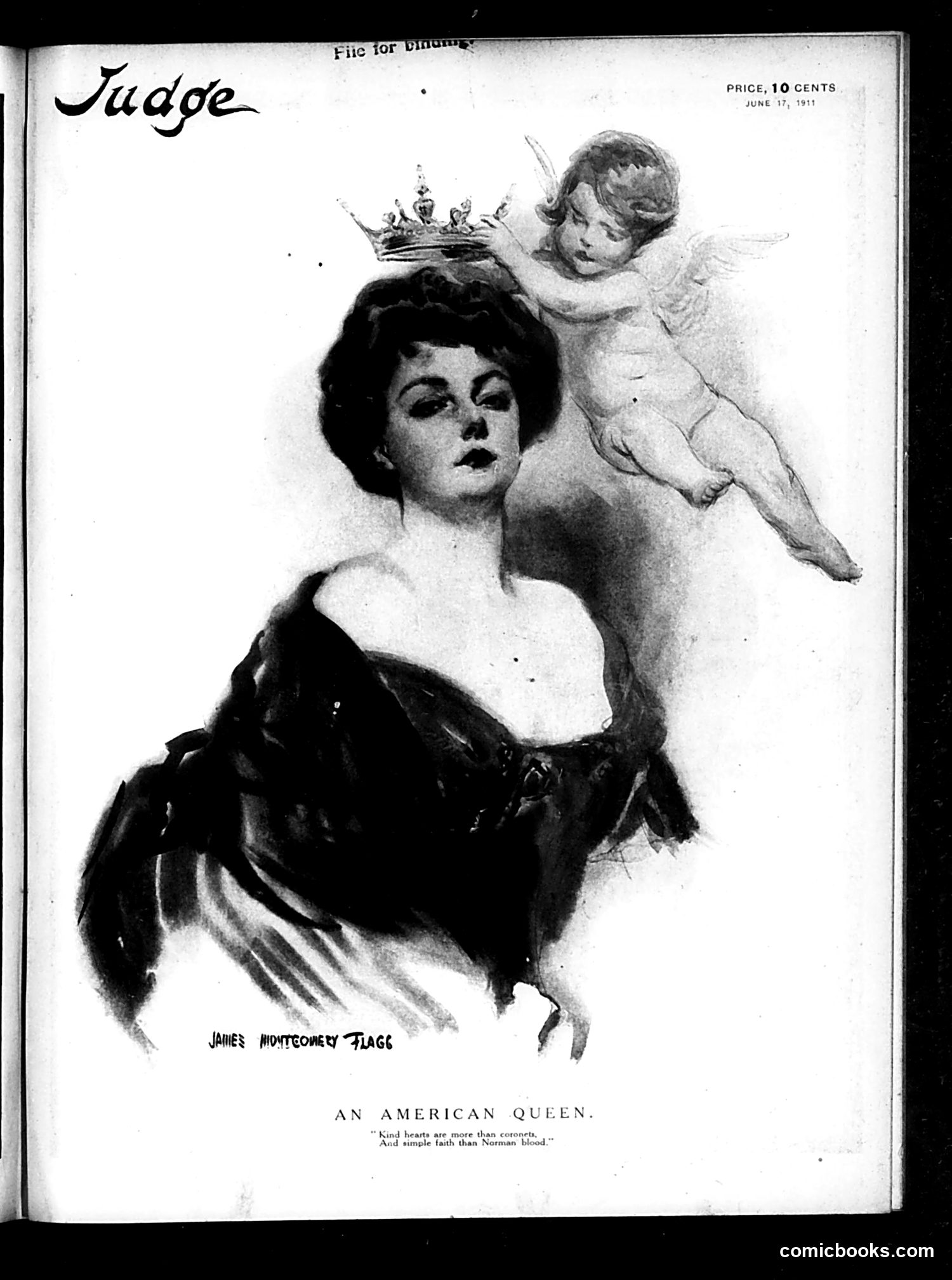
This illustration by James Montgomery Flagg depicts a woman being crowned by a cherub, titled "An American Queen." The accompanying verse reads: "Kind hearts are more than coronets, / And simple faith than Norman blood." The satire likely critiques American social aspirations and class pretension of the Gilded Age era. By portraying an American woman receiving a crown from a cherub (heavenly validation), Flagg suggests that American virtue and "kind hearts" deserve queenly status, surpassing European aristocratic claims based on bloodline ("Norman blood"). The work appears to be tongue-in-cheek commentary on American democratic ideals versus Old World aristocratic hierarchy—asserting that American character, not inherited nobility, confers true dignity.
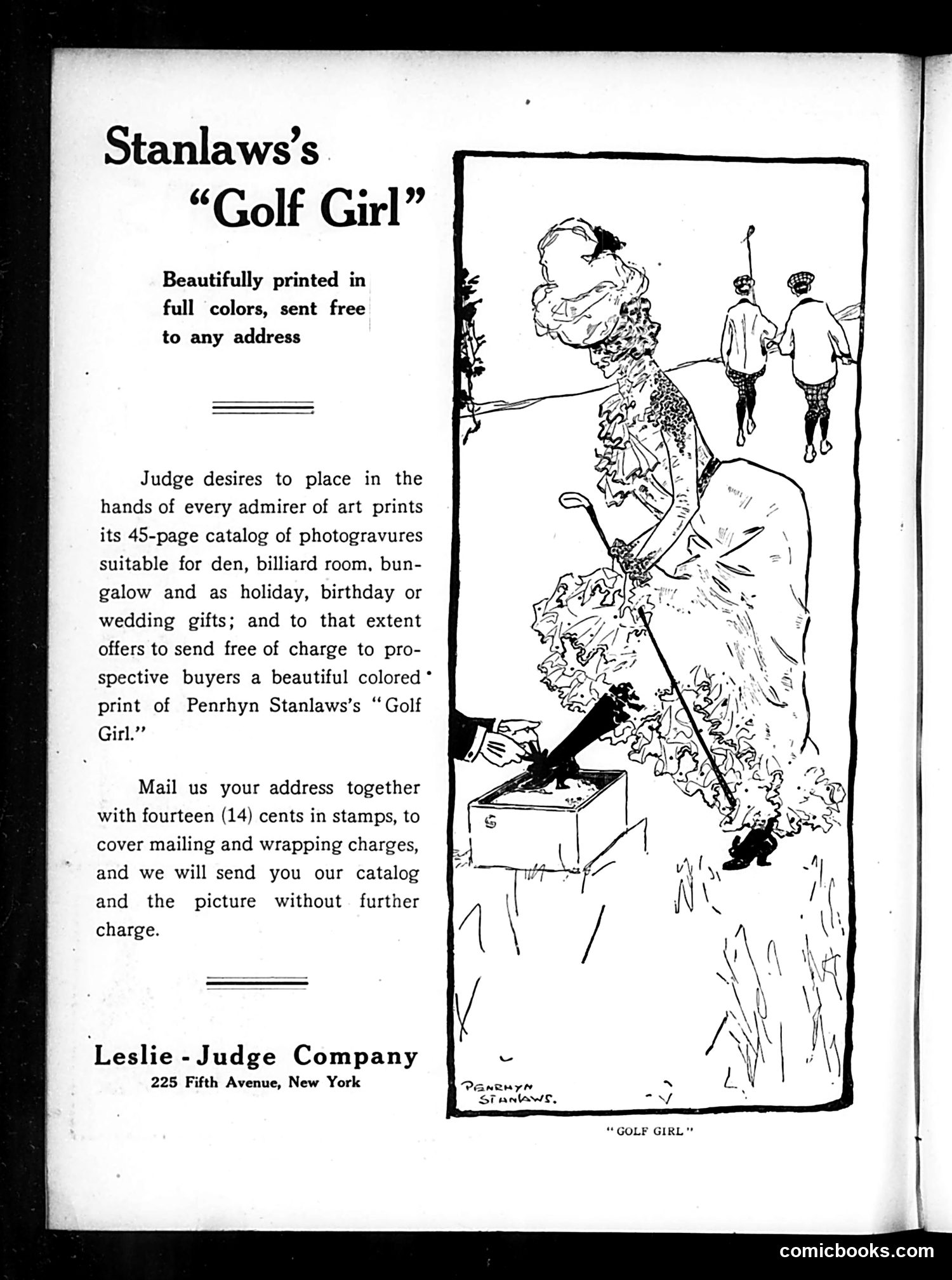
This is primarily an advertisement for Leslie-Judge Company's art print catalog, not a satirical cartoon. The page promotes a colored print of Penrhyn Stanlaws's "Golf Girl" (visible in the illustration at right). The image depicts a fashionably dressed woman at a golf course, with male golfers visible in the background. The woman's elaborate outfit—featuring decorative details and a large hat—represents early 20th-century upper-class leisure wear. The satire is subtle: the "Golf Girl" likely mocks the emerging phenomenon of women participating in traditionally male-dominated sports while maintaining impractical, ornate fashion standards. The comedic tension lies between athletic activity and excessive, constraining clothing. Judge magazine offers the print free with a fourteen-cent stamp contribution.
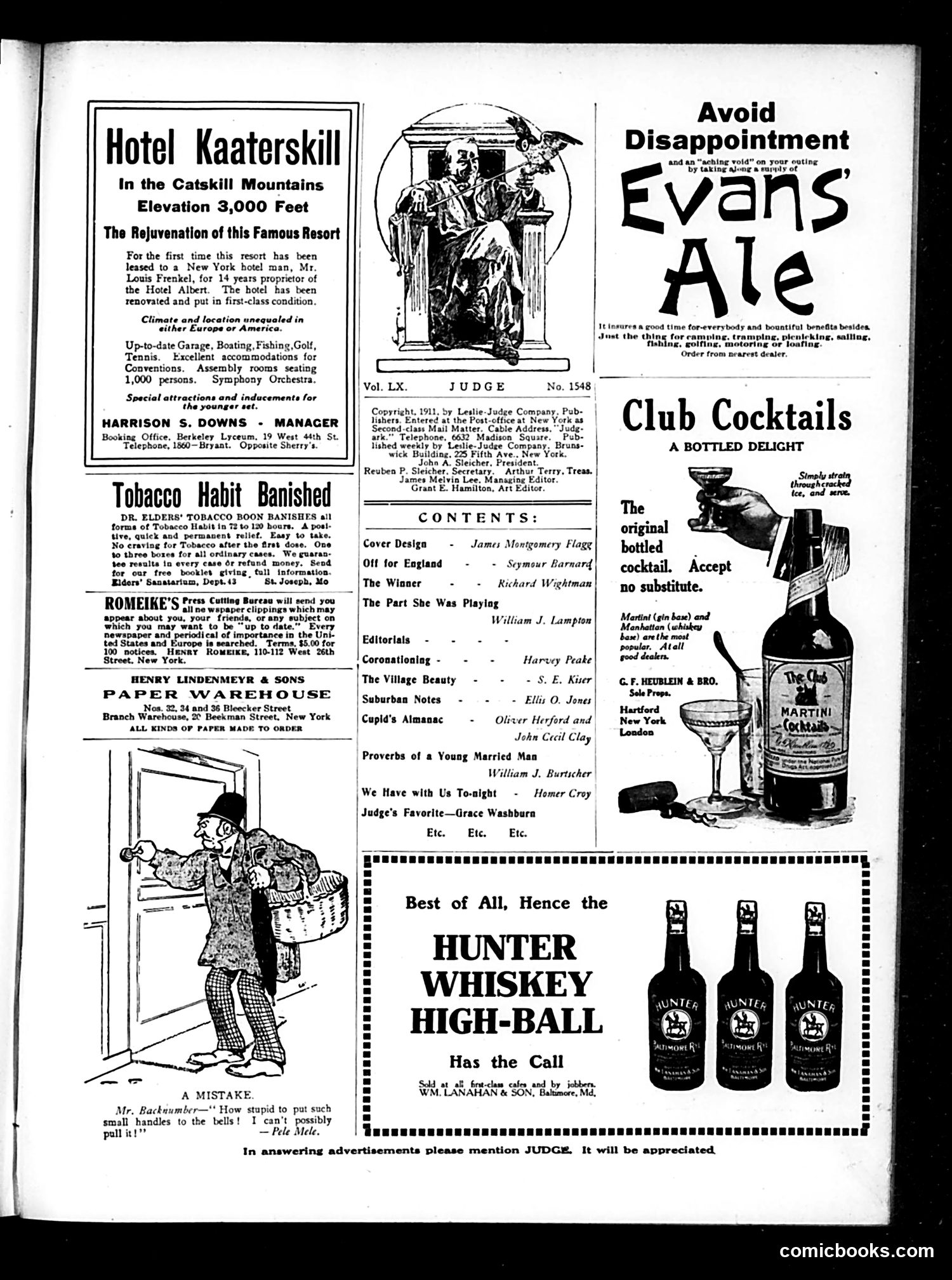
This page is primarily **advertising content** rather than political satire. It features several commercial advertisements typical of early 20th-century magazines: - Hotel Kaaterskill resort promotion - Dr. Elders' tobacco product ("Tobacco Habit Banished") - Homeike's paper warehouse - Evans Ale beverage - Club Cocktails liquor - Hunter Whiskey The only cartoon element is a small illustration labeled "A Mistake" showing a figure struggling with bells, accompanied by a brief humorous caption about putting handles on bells. The page reflects Prohibition-era advertising (note the emphasis on alcohol brands), suggesting this issue predates the 18th Amendment's enforcement. The content is commercial rather than politically satirical.
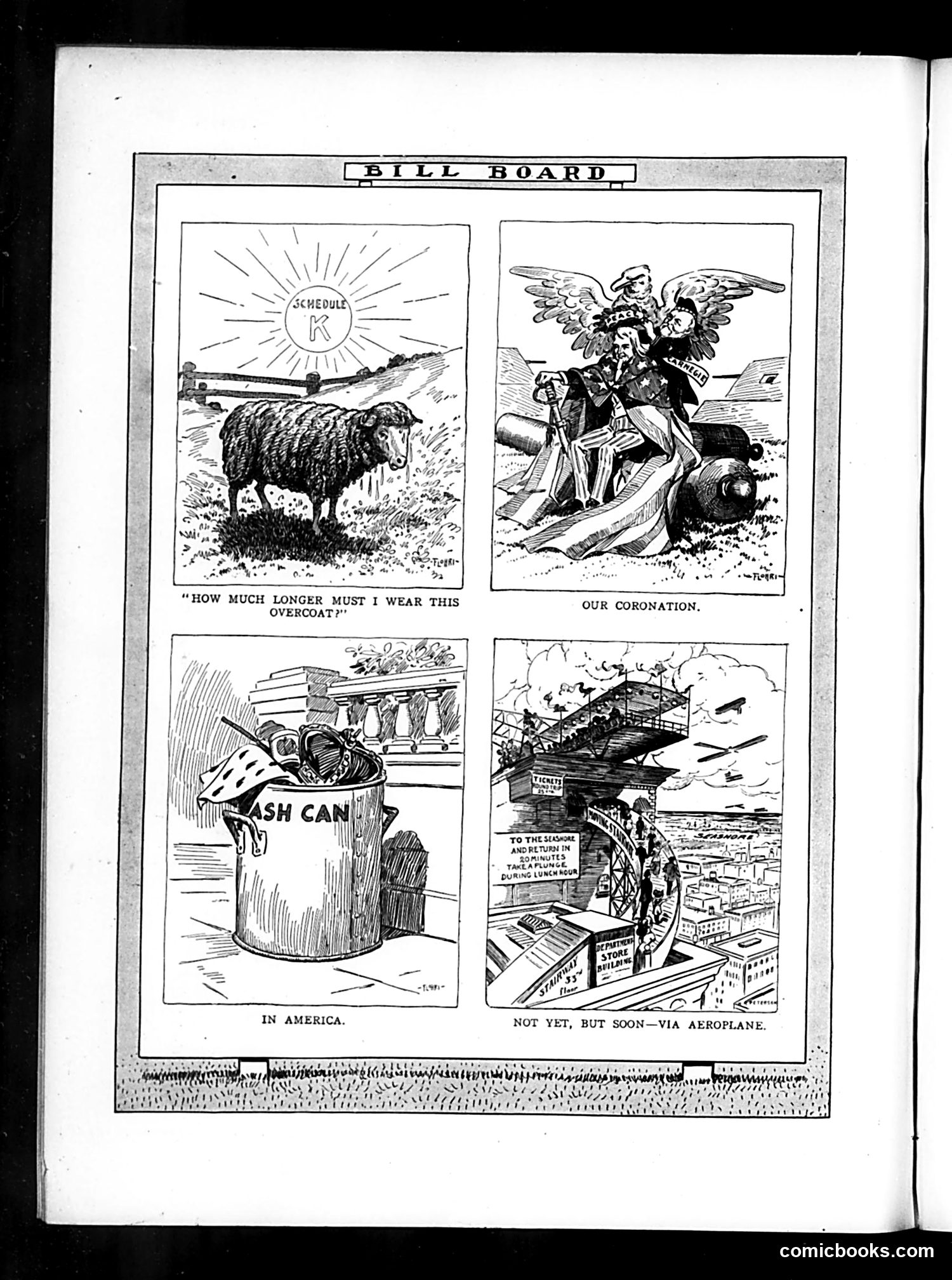
This page presents four satirical cartoons commenting on early 20th-century issues: 1. **"How Much Longer Must I Wear This Overcoat?"** - A sheep under a "Schedule K" sun, likely critiquing protective tariff policies that burden consumers. 2. **"Our Coronation"** - An eagle crowning a figure amid cannons, suggesting American imperial ambitions or military expansion. 3. **"In America"** - Depicts an ash can with an Uncle Sam hat, satirizing American waste or disposal of unwanted policies/values. 4. **"Not Yet, But Soon—Via Aeroplane"** - Shows a futuristic flying machine over a city, mocking predictions of rapid technological advancement in mail delivery or commerce. The cartoons collectively critique American tariffs, imperialism, waste, and over-optimistic technological forecasting.
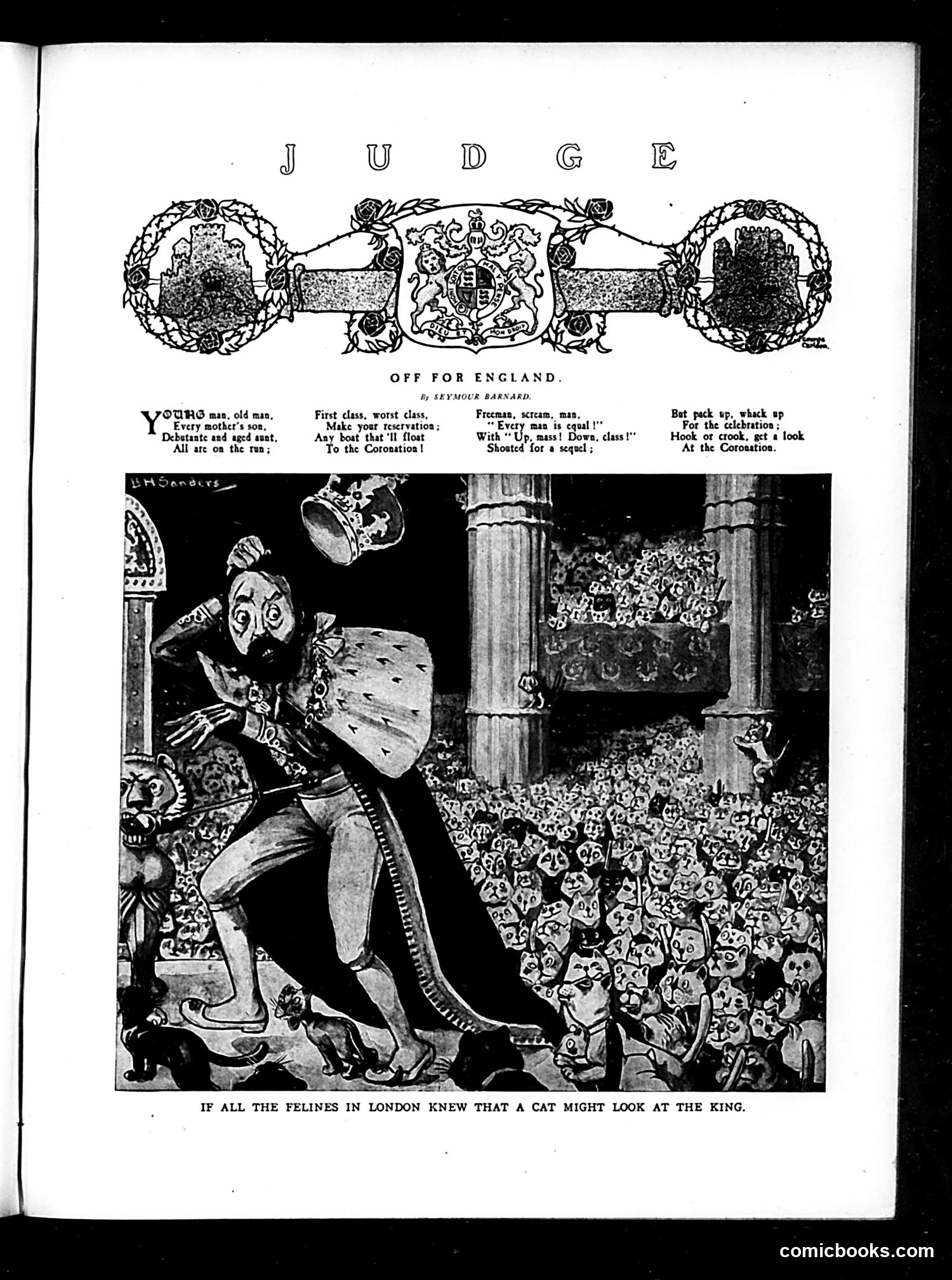
This page satirizes British royalty and the coronation ceremony. The header "JUDGE" with heraldic emblems frames a poem by Seymour Barnard mocking class distinctions ("Every man is equal") and coronation attendance. The cartoon below depicts a feline figure in royal regalia addressing a crowd of cats, captioned "IF ALL THE FELINES IN LONDON KNEW THAT A CAT MIGHT LOOK AT A KING." This references the old proverb "a cat may look at a king"—suggesting even lowly creatures can observe royalty without consequence. The satire appears to mock both British coronation pageantry and rigid social hierarchies, using the cat metaphor to ridicule the notion that ordinary people should be deferential toward monarchs. The anthropomorphized cats represent London's common population.
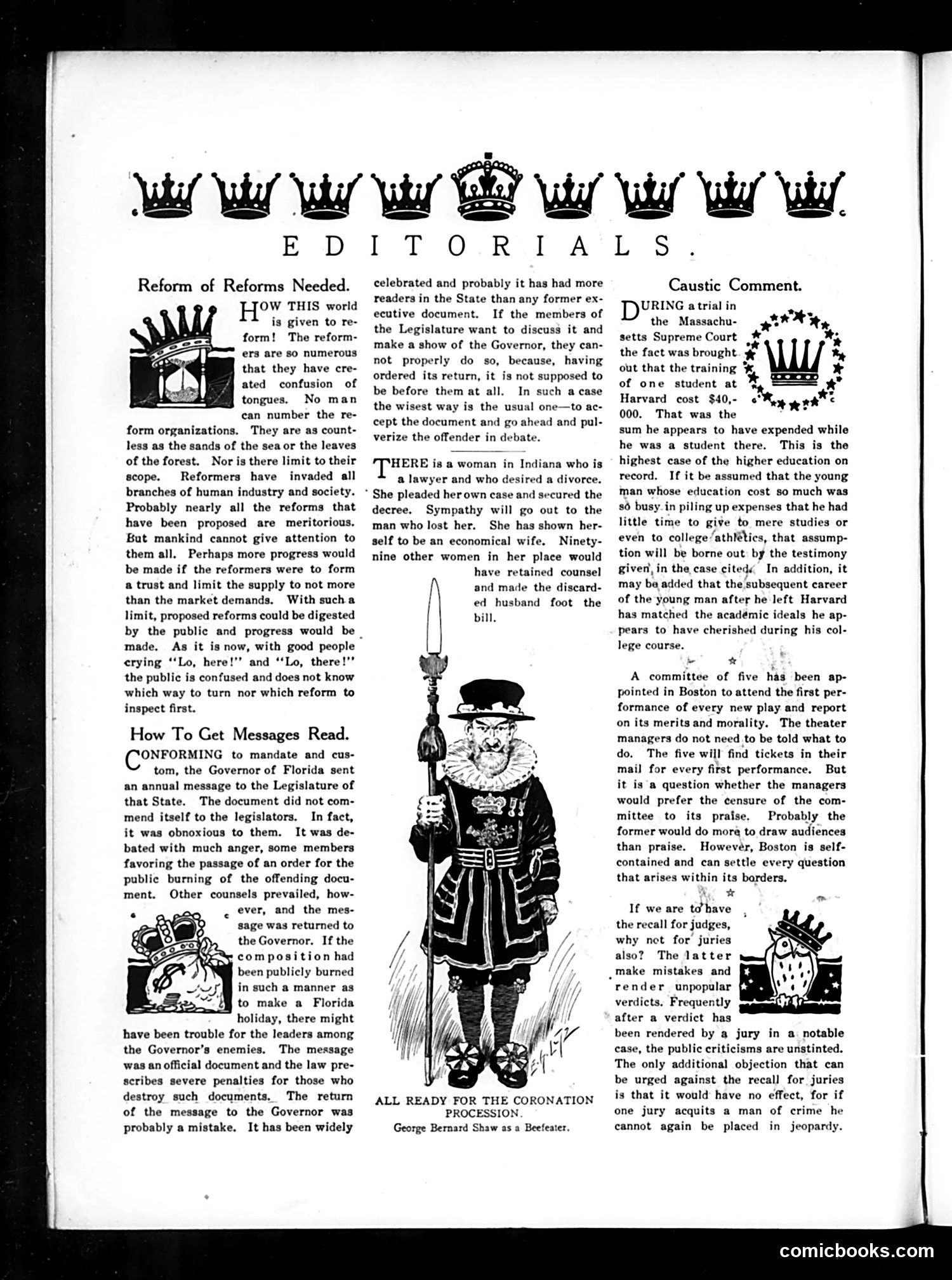
This page from the satirical magazine *Judge* contains three editorials and one illustration: **"Reform of Reforms Needed"** mocks the proliferation of reform movements in Progressive Era America, arguing there are so many competing reforms that the public cannot follow them all—suggesting reformers should form a "trust" to limit their supply. **"How To Get Messages Read"** satirizes a Florida governor whose legislature rejected his official message so angrily they threatened to burn it. The joke: by attempting to suppress it, they accidentally made it widely read—an ironic lesson in unintended consequences. **"Caustic Comment"** critiques Harvard's astronomical education costs ($40,000 per student), implying the expense didn't improve the graduate's actual accomplishments or character. **The illustration** depicts playwright George Bernard Shaw dressed as a Beefeater (Tower of London guard), likely referencing Shaw's pending coronation-related activities or satirizing his British public prominence around a royal event. The page exemplifies *Judge's* characteristic blend of political satire, social criticism, and comedic illustrations aimed at educated readers following contemporary controversies.
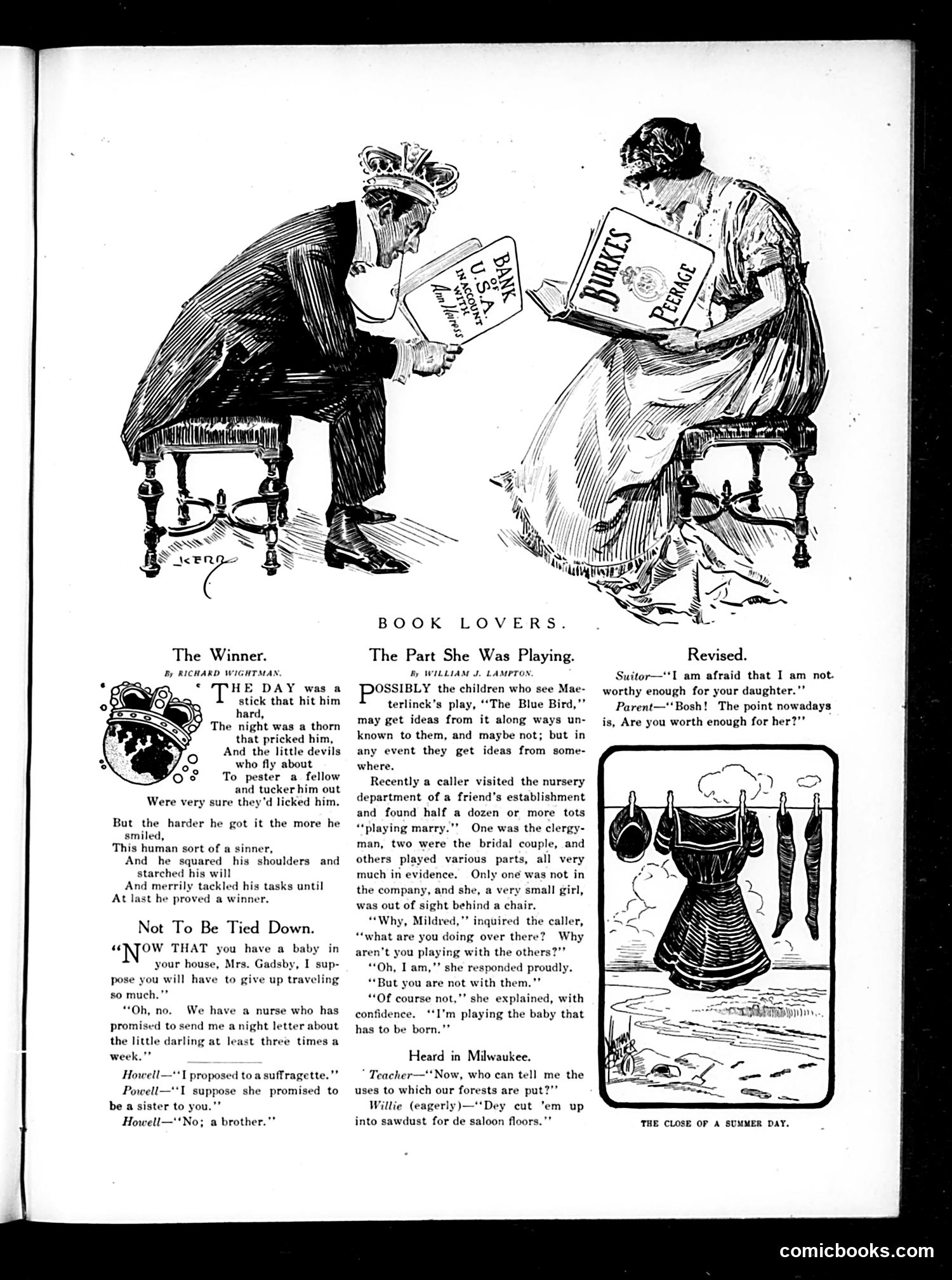
This page contains humorous short pieces and cartoons typical of early 20th-century Judge magazine. **"The Winner"** satirizes the self-made man ideal—a figure who endures hardship with cheerful determination and ultimately succeeds through sheer willpower and perseverance. It's gentle mockery of the popular motivational ethic of the era. **"Not To Be Tied Down"** jokes about changing social attitudes toward women and motherhood. Mrs. Gadsby refuses to abandon her lifestyle for a baby, instead delegating childcare to a nurse—poking fun at both modern women's independence and the wealthy's casual approach to parenting. **"The Part She Was Playing"** humorously depicts children reenacting a wedding play. The punchline—a small girl hiding, "playing the baby that has to be born"—gently mocks children's creative interpretations of adult activities they don't fully understand. **"Revised"** satirizes shifting class anxieties: a suitor worries about worthiness, but the parent dismisses virtue, caring only about the suitor's financial worth—commentary on materialistic values replacing traditional courtship standards.
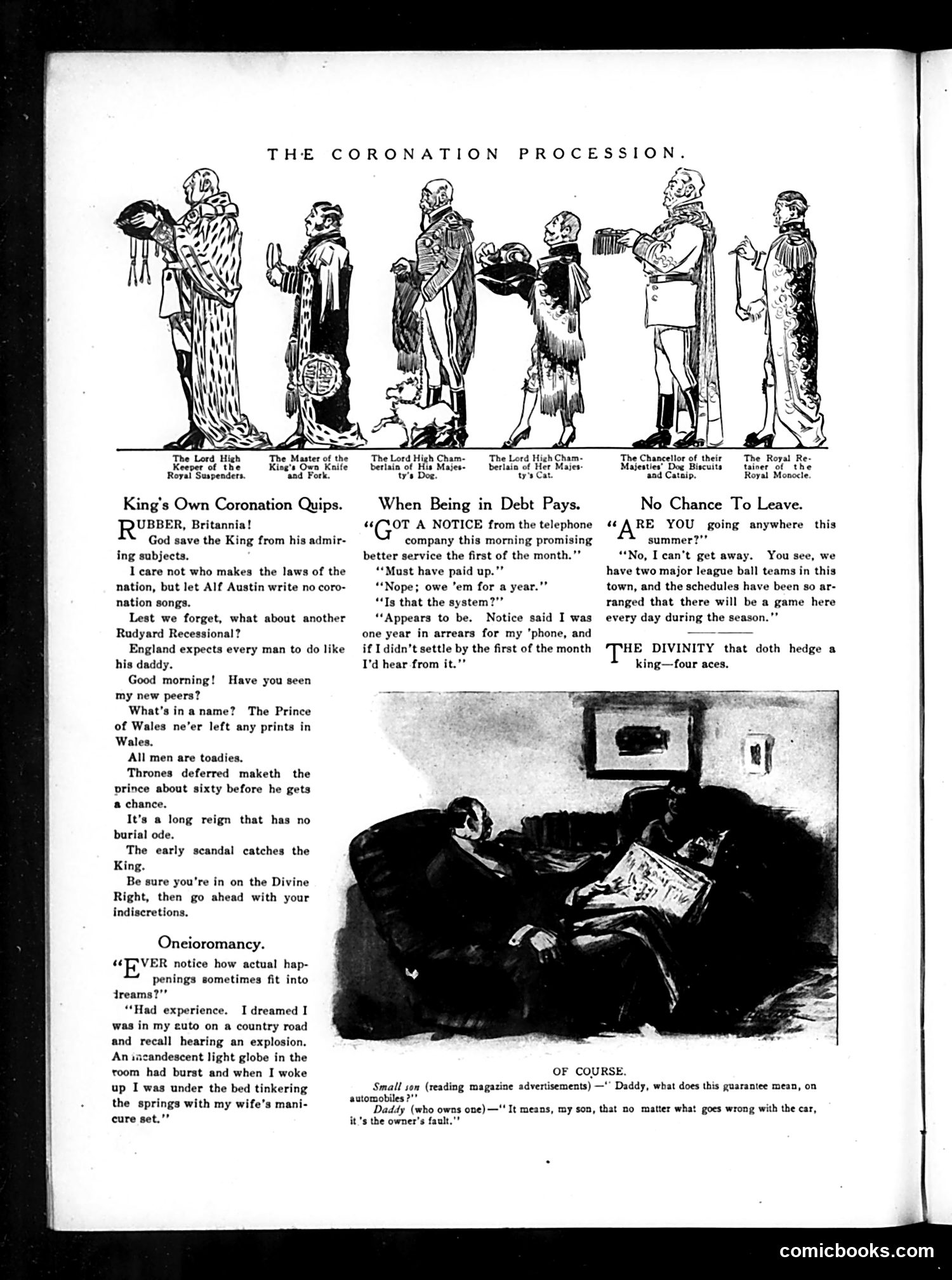
This page satirizes a British royal coronation (likely early 1900s, unclear which specific coronation) through mock-heroic absurdity. The top illustration parodies the formal procession with ridiculous officials—"Lord High Keeper of Royal Suspenders," "Master of the Own Knife and Fork"—deflating the ceremony's grandiosity. Below, "King's Own Coronation Quips" mocks British reverence for monarchy and tradition through cynical wordplay: complaints about bad coronation songs, jabs at the Prince of Wales, and dark humor about royal scandal and the "Divine Right" excuse for misbehavior. The other sections contain unrelated jokes about debt collection, baseball schedules preventing vacations, and car warranties—typical contemporary American humor. The bottom illustration shows a couple reading advertisements, commenting sarcastically on manufacturer guarantees. The overall message: monarchy deserves ridicule, and modern life brings its own absurdities.
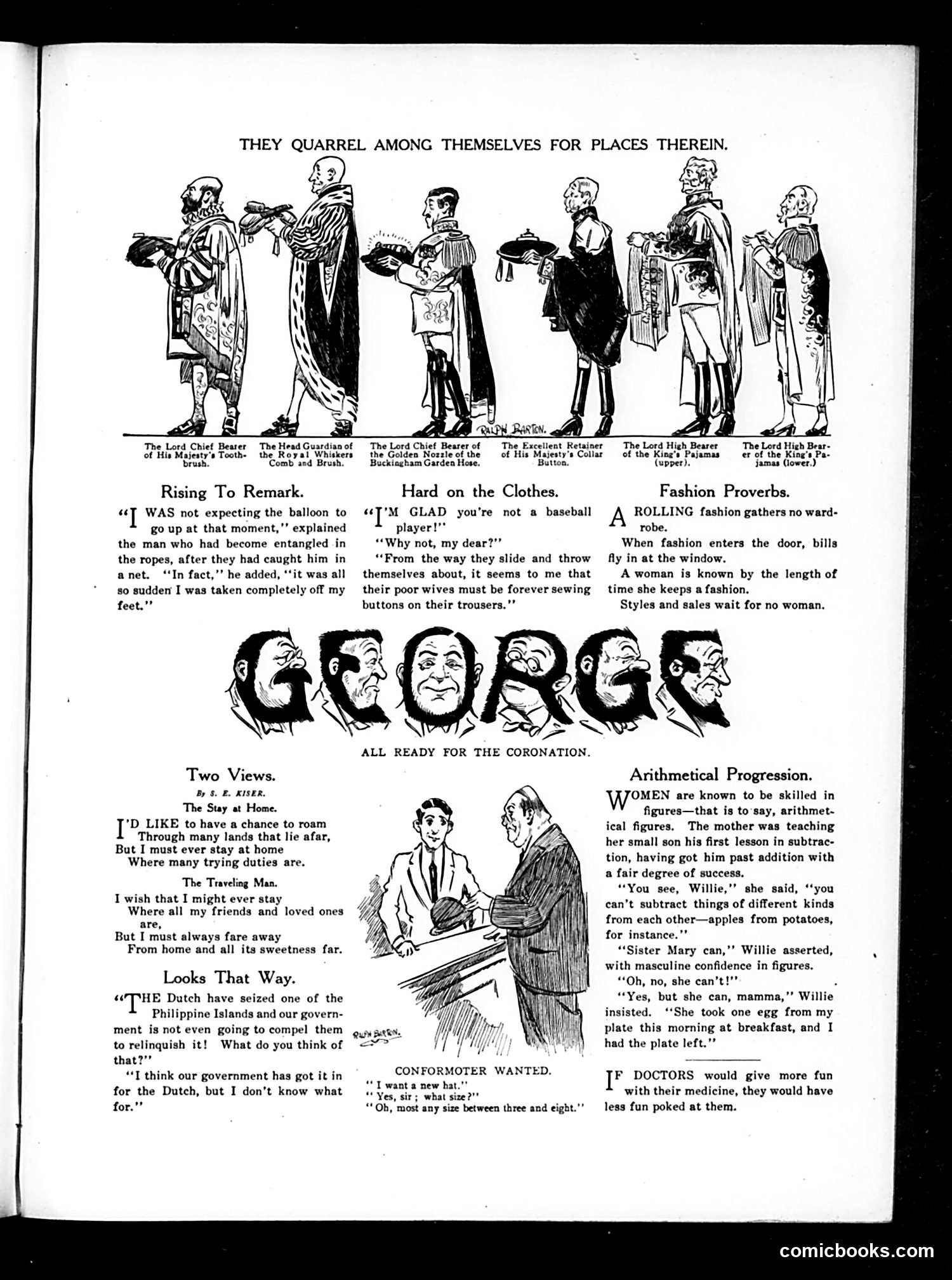
This Judge magazine page contains several satirical pieces mocking British court ceremonialism and social conventions. The top cartoon ridicules the elaborate titles given to minor royal household positions—"Lord Chief Bearer of the King's Pajamas," "Head Guardian of the Royal Whiskers Comb"—mocking the British monarchy's hierarchical pomp and the courtiers' squabbling over prestige and rank. The remaining content comprises short humorous pieces on varied topics: a man entangled in a hot air balloon, contrasting perspectives of travelers versus homebodies, baseball players' wives' sewing burdens, Philippine colonial politics, and women's arithmetic abilities. The "Fashion Proverbs" section satirizes women's spending habits and fashion obsession. These pieces target common satirical targets of the era: British formality, gender stereotypes (particularly women's materialism and mathematical incompetence), and contemporary colonial politics. The humor relies on exaggeration and wordplay typical of early-20th-century American humor magazines.
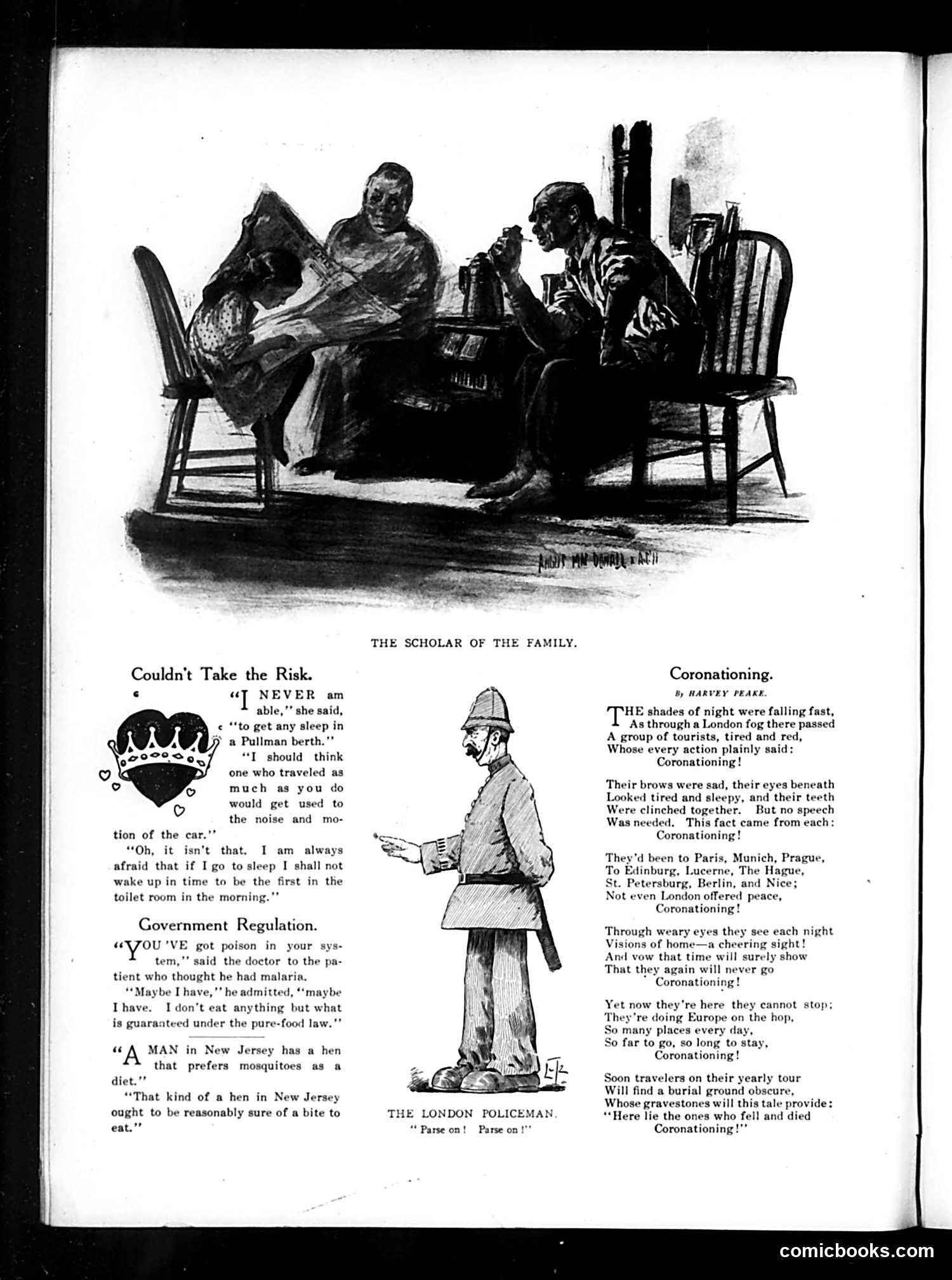
This page contains three separate humorous pieces satirizing early 20th-century American life: **"Couldn't Take the Risk"** mocks wealthy female travelers obsessed with social status—a woman fears sleeping on trains, not from discomfort but from missing her chance to be first to the toilet room, exposing vanity masquerading as concern. **"Government Regulation"** ridicules the Pure Food and Drug Act's bureaucratic reach: a patient reassures himself he has no poison in his system because he only eats "guaranteed" foods, yet is diagnosed with poison anyway—suggesting regulations create false security. **"Coronationing"** (by Harvey Peake) satirizes compulsive tourism. Exhausted travelers tour Europe obsessively during the Coronation period, unable to stop despite fatigue, visiting countless cities. The poem mockingly suggests they'll literally die from constant travel, their gravestones reading "died Coronationing!"—commentary on wealthy Americans' frenetic, status-driven tourism culture.
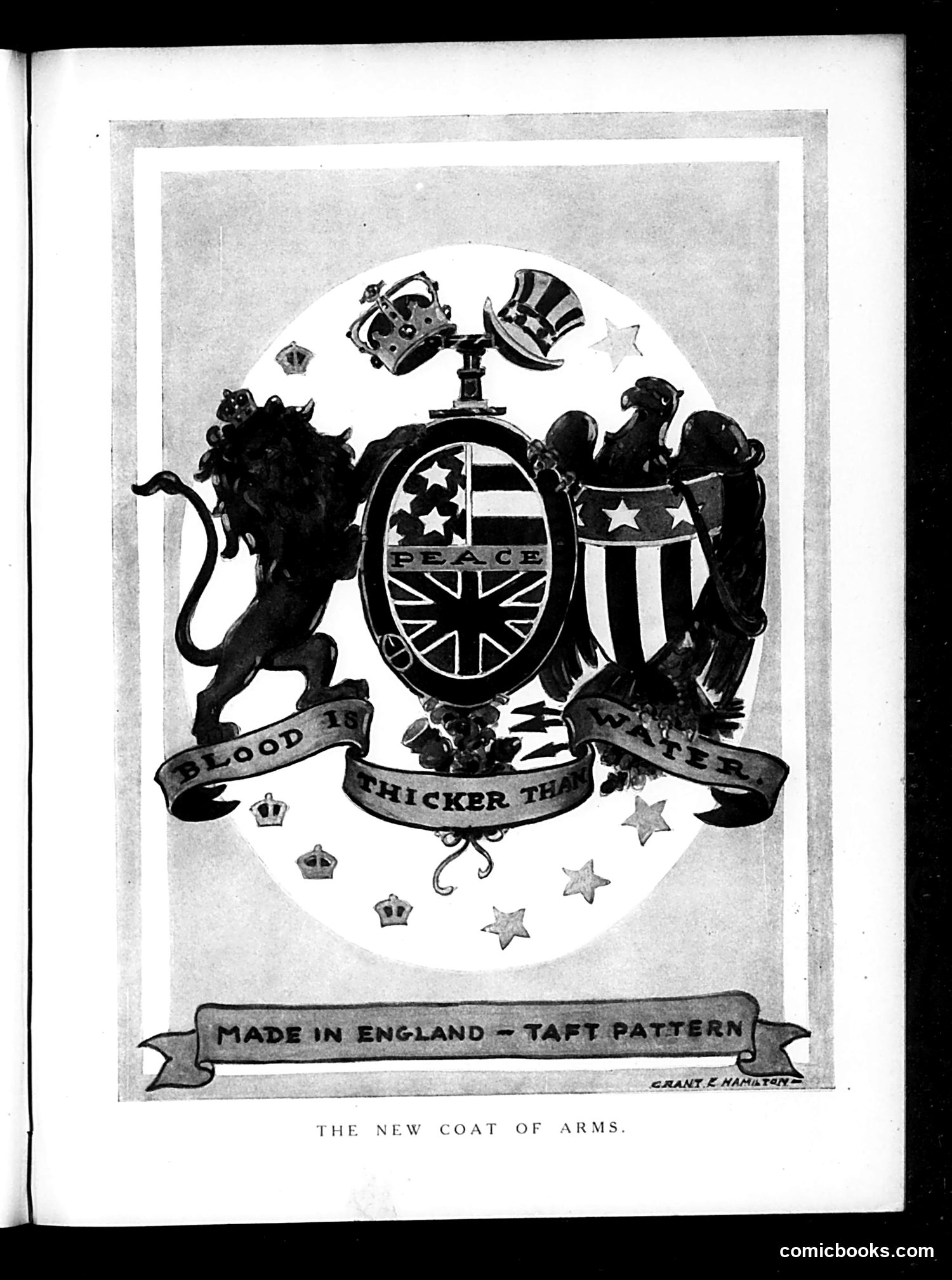
This satirical coat of arms from Judge magazine critiques Anglo-American relations during the Taft administration (1909-1913). The design combines British and American heraldic elements: a lion and eagle flank a central shield bearing both Union Jack and American stars-and-stripes. The banner reads "BLOOD THICKER THAN WATER," invoking the idea of shared Anglo-Saxon heritage. The accompanying crowns and daggers suggest the militaristic implications of this alliance. The subtitle "MADE IN ENGLAND—TAFT PATTERN" implies satirical criticism that President Taft's policies excessively favored British interests or aligned America too closely with British imperial power. The coat of arms parodies formal heraldry to mock what the cartoonist saw as an unhealthy political merger between the two nations.
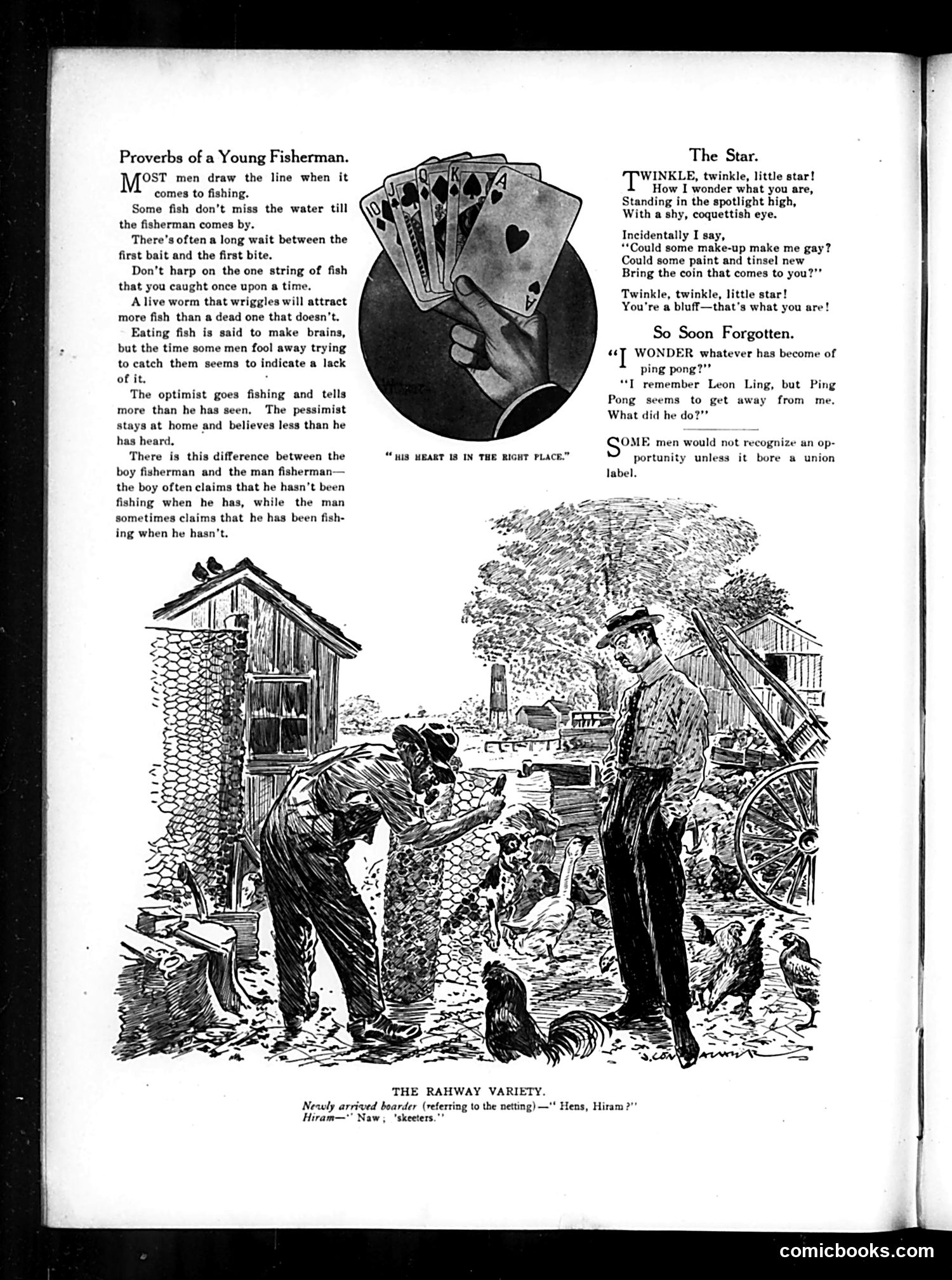
This page contains three unrelated satirical pieces typical of Judge magazine's format: **"Proverbs of a Young Fisherman"** offers humorous observations about fishing and fishermen's behavior—contrasting optimists who exaggerate their catches with pessimists who stay home, and boys who deny fishing versus men who claim fishing they never did. It's gentle social satire about human nature. **"The Star"** mocks theatrical performers (particularly chorus girls or vaudeville acts) who seek fame and fortune through "spotlight" prominence, sarcastically suggesting they're all "bluff"—all appearance, no substance. **"The Railway Variety"** cartoon depicts a farmer's confusion when a recently-arrived boarder mistakes his chicken netting for something else. The punchline reveals the netting actually protects against mosquitoes ("skeeters"), a rural joke about pests. These are standalone humor pieces without interconnected political meaning—typical Judge content mixing social commentary with domestic comedy and wordplay.
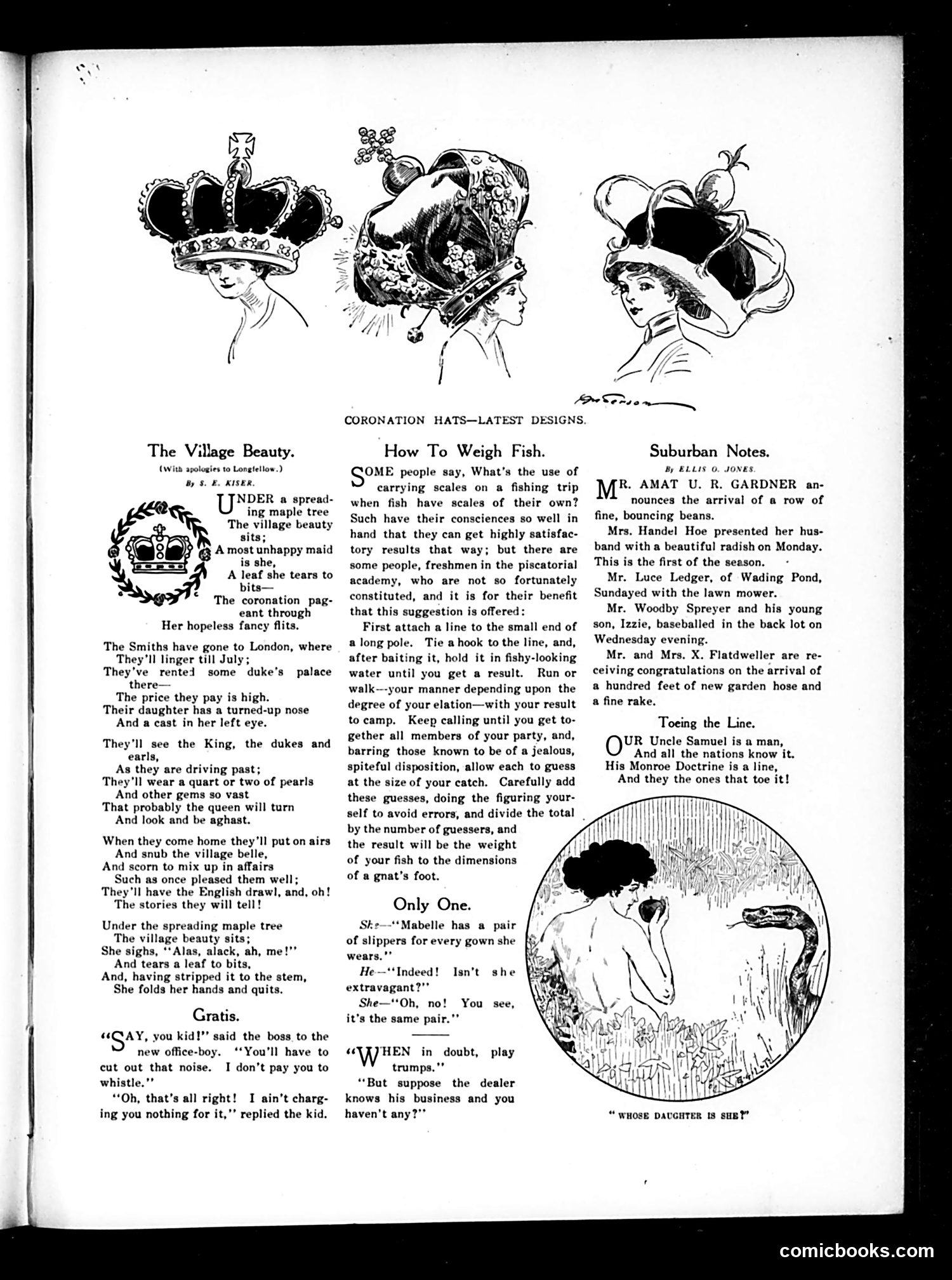
This *Judge* page contains satirical humor about early-20th-century American life: **"The Village Beauty"** mocks social climbing. While wealthy neighbors (the Smiths) travel to London for the coronation, they'll return with affected airs and snobby attitudes, leaving behind a genuinely beautiful village girl who can only daydream about such grandeur. The satire targets both the pretentiousness of newly wealthy Americans and the sad reality of those left behind. **"How to Weigh Fish"** is tongue-in-cheek advice for dishonest fishermen: instead of actual scales, gather your party and have each guess your catch's size, then average the guesses. The joke mocks exaggeration common in fishing stories. **"Suburban Notes"** uses ridiculous puns (AMAT U.R. GARDNER = "amateur gardener") to satirize suburban life and neighbors' mundane activities. The **coronation hats** at top reference the 1911 British coronation of George V—a major contemporary event that inspired fashion imitation. The page reflects early-1900s American anxieties: social mobility, pretense, leisure pursuits, and suburban conformity.
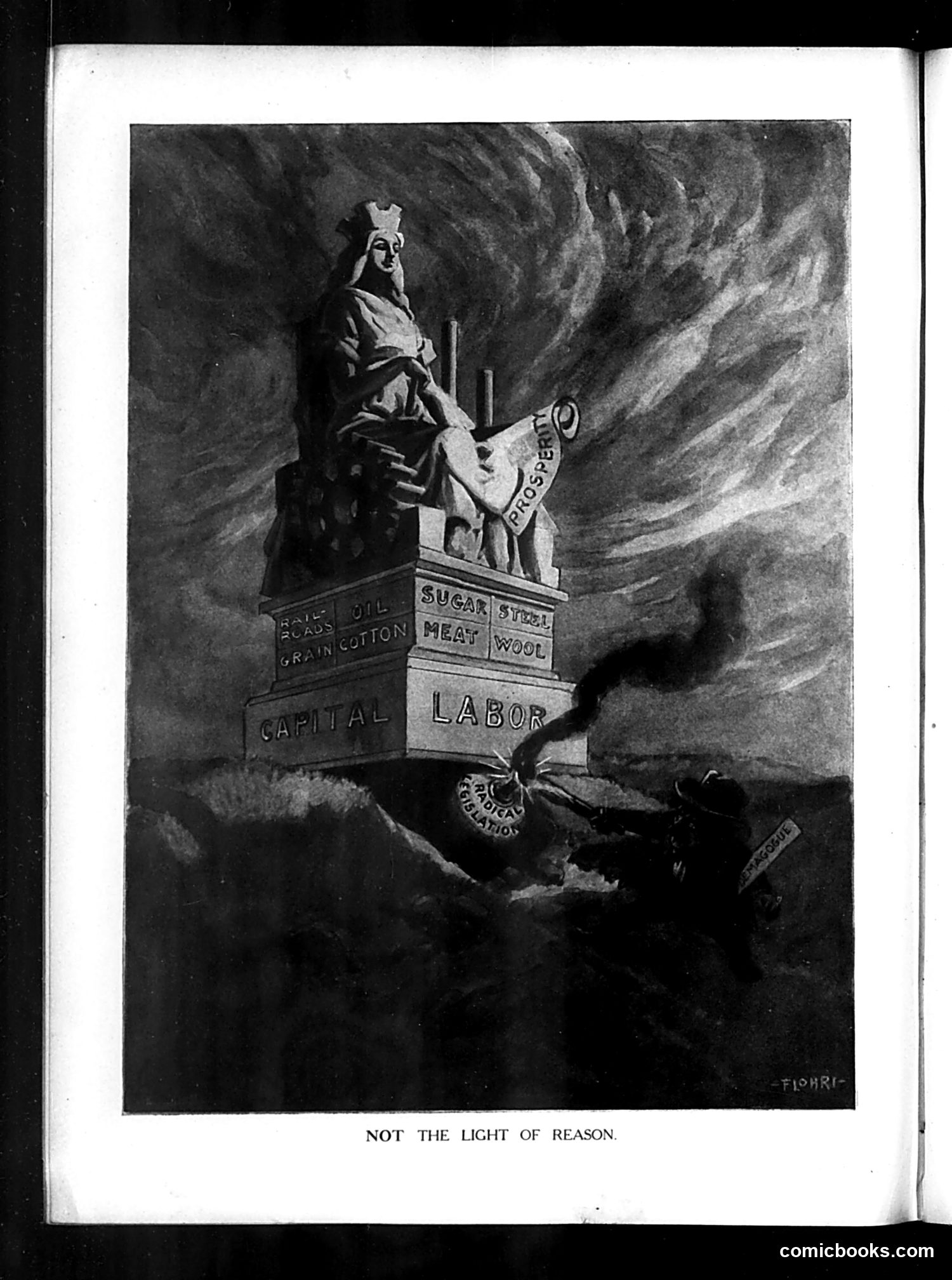
This political cartoon depicts a female figure (likely representing Liberty or Reason) standing atop a pedestal stacked with foundational economic sectors: Capital, Labor, Wool, Meat, Sugar, Cotton, Grain, and Roads. She holds a torch labeled "PROGRESS & REFORM." The dark, turbulent sky and the figure's pose suggest instability or danger. The title "Not the Light of Reason" indicates satire: the cartoon critiques progressive reforms as reckless rather than rational. The stacked foundation suggests these reforms rest precariously on fundamental economic structures. This likely comments on early 20th-century Progressive Era policies—taxation, labor regulations, or trust-busting—arguing they threaten economic stability. The work reflects conservative skepticism toward reform movements of that period.
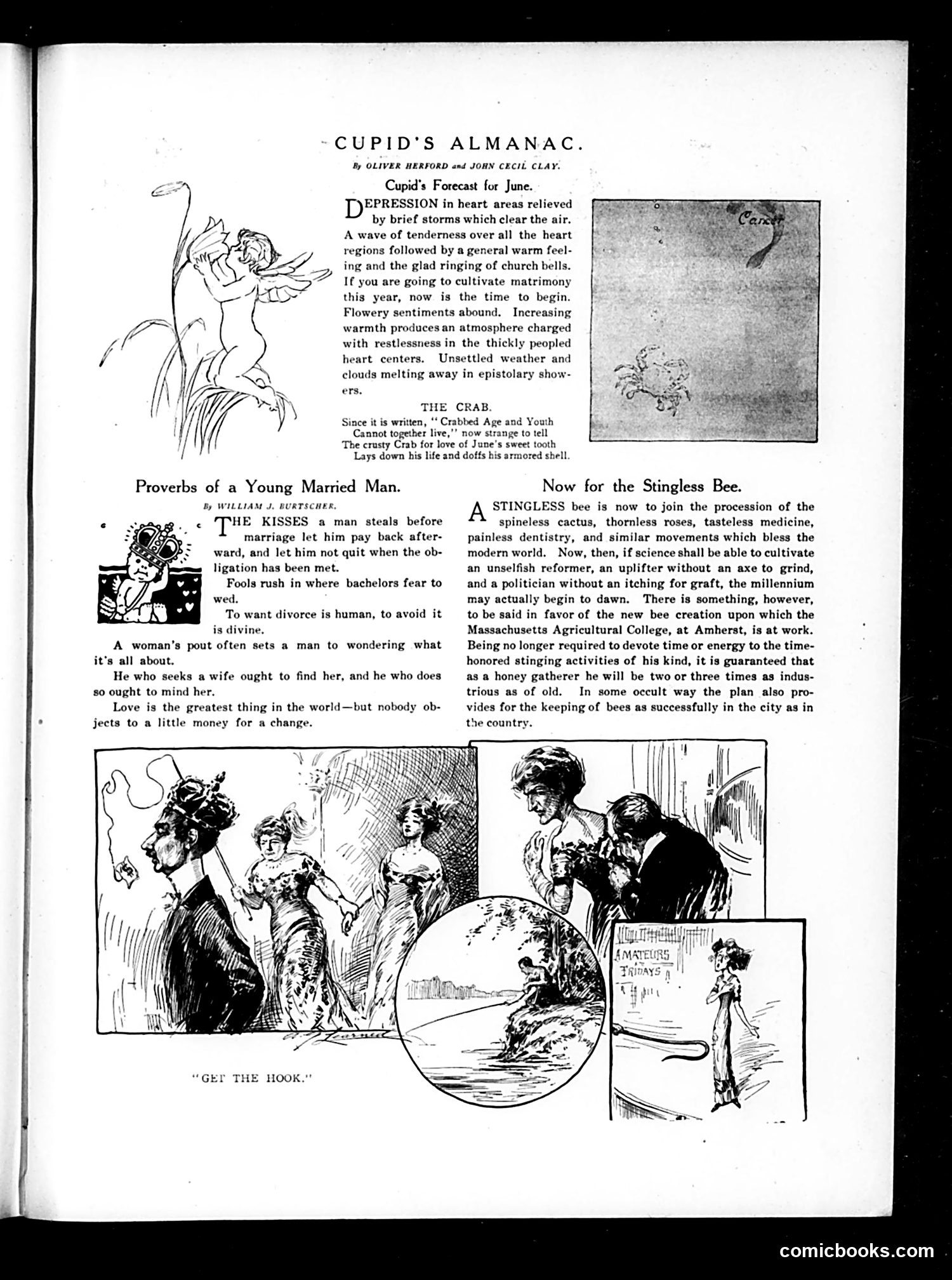
This is a satirical humor page from Judge magazine mixing romantic and social commentary. "Cupid's Forecast for June" humorously treats love and marriage like a weather forecast, predicting "depression in heart areas" clearing to warmth and church bells—suggesting June is prime matrimony season. "The Crab" offers a poetic aside: crabs abandon their defensive shells for love in June, a metaphor for vulnerability in romance. "Proverbs of a Young Married Man" cynically advises on marriage, including the famous quip that while love is life's greatest thing, "nobody objects to a little money for a change"—satirizing materialism in matrimony. "Now for the Stingless Bee" mocks progressive scientific movements (spineless cacti, painless dentistry) by proposing a "stingless bee" developed at Massachusetts Agricultural College. The satire suggests if science can remove inconvenient traits from nature, why not breed selfless reformers and non-corrupt politicians? The joke: such improvements are equally absurd. The illustration "Get the Hook" shows what appears to be romantic entanglement requiring intervention.
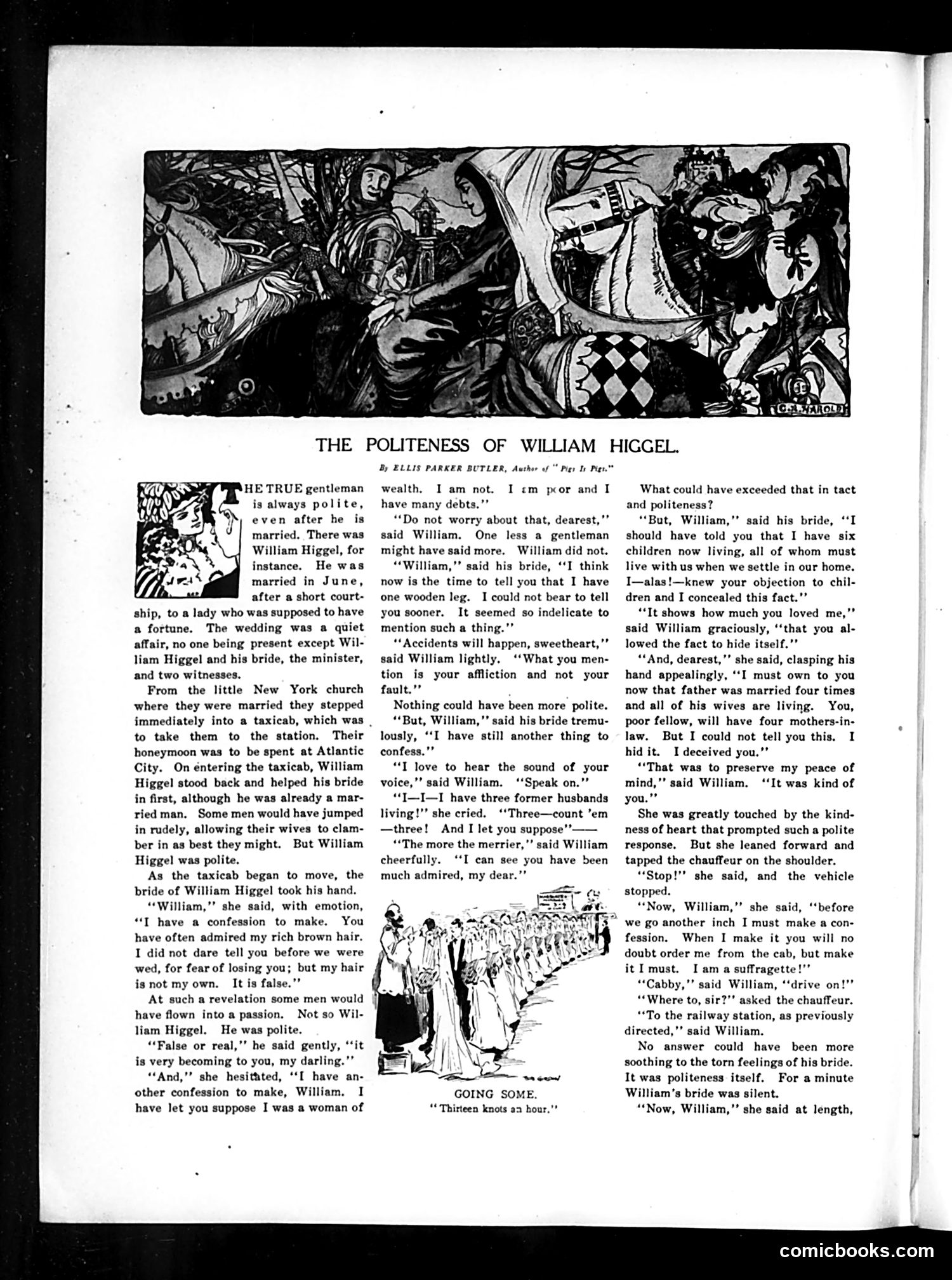
This satirical story by Ellis Parker Butler mocks excessive male politeness as absurd and emasculating. William Higgel maintains relentless courtesy despite his bride's shocking revelations: false hair, poverty, a wooden leg, three living ex-husbands, six children, four living mothers-in-law. He responds to each confession with gentle reassurance. The joke's climax reveals the satire's target: when she admits being a **suffragette** (women's suffrage activist), William finally breaks—ordering the cab to drive away. The implication is sardonic: a gentleman can tolerate any personal deception or family complication, but a woman demanding political rights crosses the line into the truly unforgivable. The cartoon illustrates this 1910s-era anxiety about women's expanding social power, mocking both excessive male politeness and women's suffrage activism simultaneously.
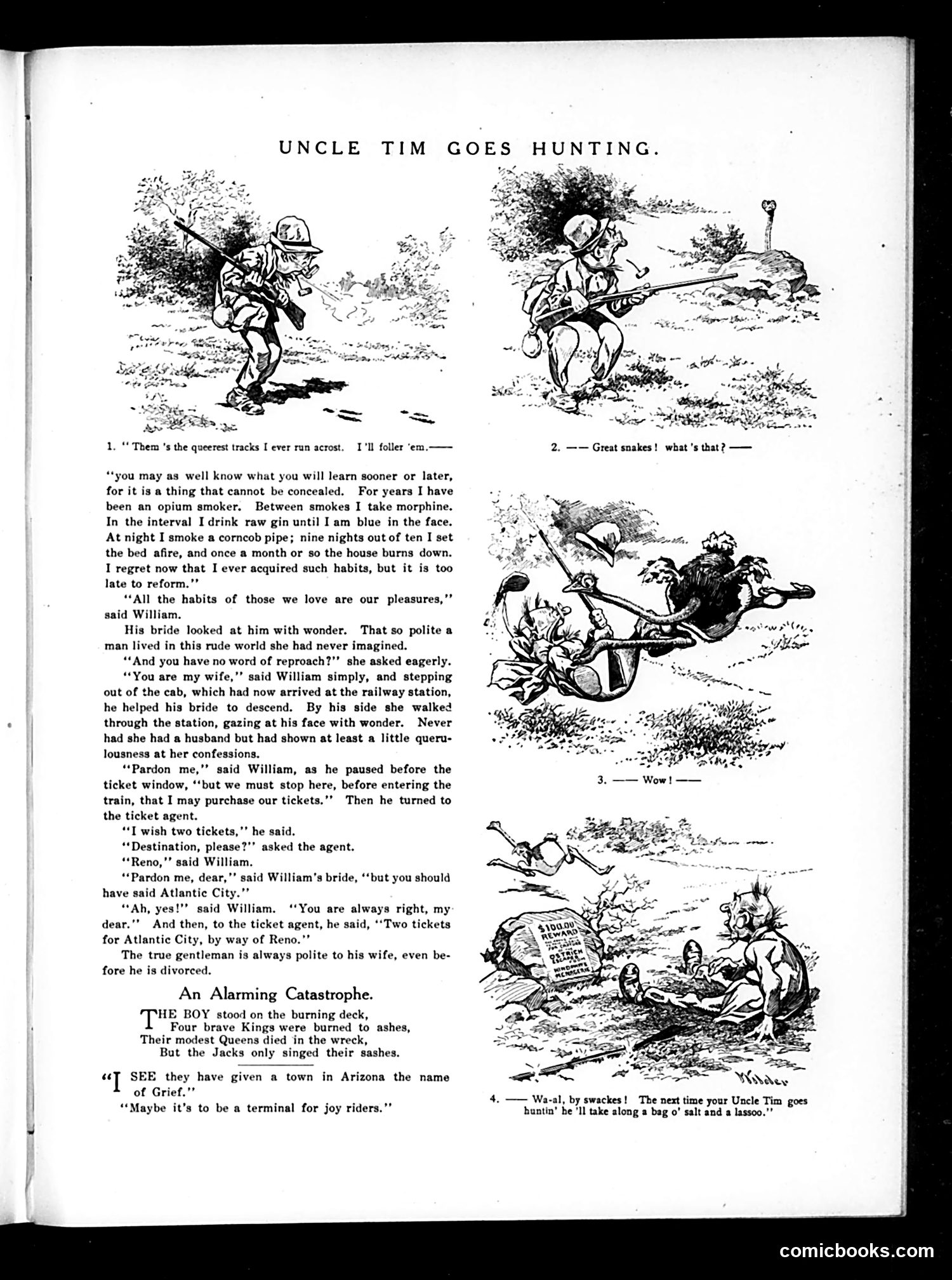
This is a multi-part humor page from Judge magazine. The main feature satirizes a character named Uncle Tim through hunting mishaps illustrated in four panels showing slapstick comedy—him encountering snakes, falling, and being chased by what appears to be an ostrich. The longer text passage is separate satire about a newlywed couple. It mocks the husband William for his excessive drug and alcohol habits (opium, morphine, gin, corncob pipes causing house fires), yet his bride finds him admirably "polite" for accepting her without reproach. The joke culminates when he says they're going to Reno—the then-famous divorce destination—but gallantly corrects himself to say Atlantic City when she objects, demonstrating that "true gentlemen" remain courteous even during divorce. The brief quips at bottom reference Arizona towns and joy-riders, likely contemporary references now unclear. The satire targets upper-class pretension and marital hypocrisy.
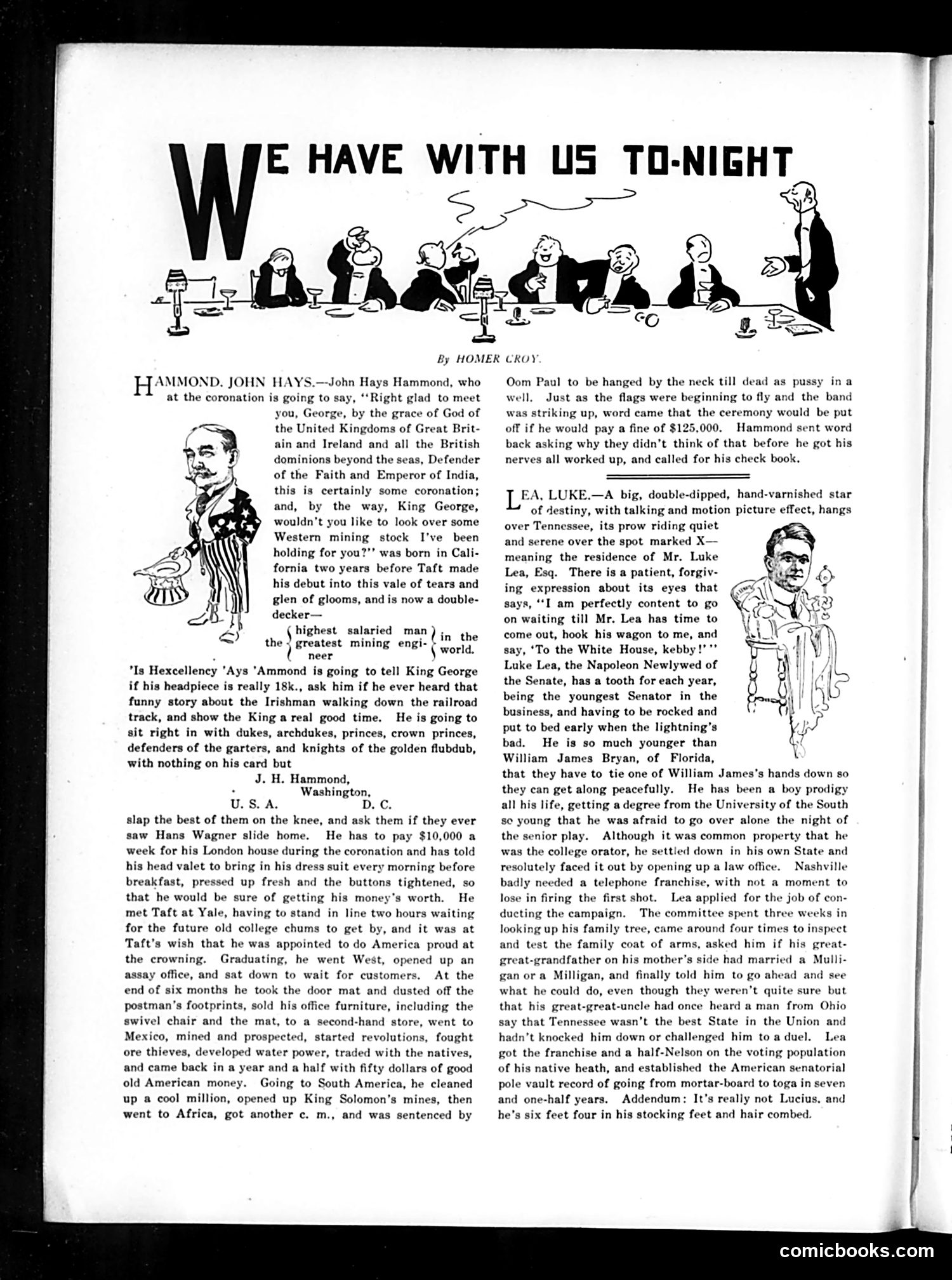
This page features satirical profiles by Homer Croy of three prominent figures attending King George V's coronation (1911). The cartoon at top shows them at a formal dinner. **John Hays Hammond** is mocked as a self-made mining magnate who shamelessly networks, even at royal events. The satire highlights his nouveau-riche behavior: paying $10,000/week for London lodging, obsessing over his dress suit's condition, and attempting to impress the King with business pitches. The joke culminates in his cool response to an execution threat in Mexico—simply demanding to know why they didn't ask for the fine *before* he got nervous. **Luke Lea**, a young Tennessee Senator, is caricatured as an ambitious boy-wonder politician. The "star of destiny" metaphor and references to his youth (having "a tooth for each year," needing to be "rocked and put to bed") mock his inexperience and eagerness for higher office (the White House reference). The satire targets American nouveaux riches and ambitious politicians using exaggeration and comic incongruity—Hammond's crass capitalism at a coronation, Lea's youthful ambition.
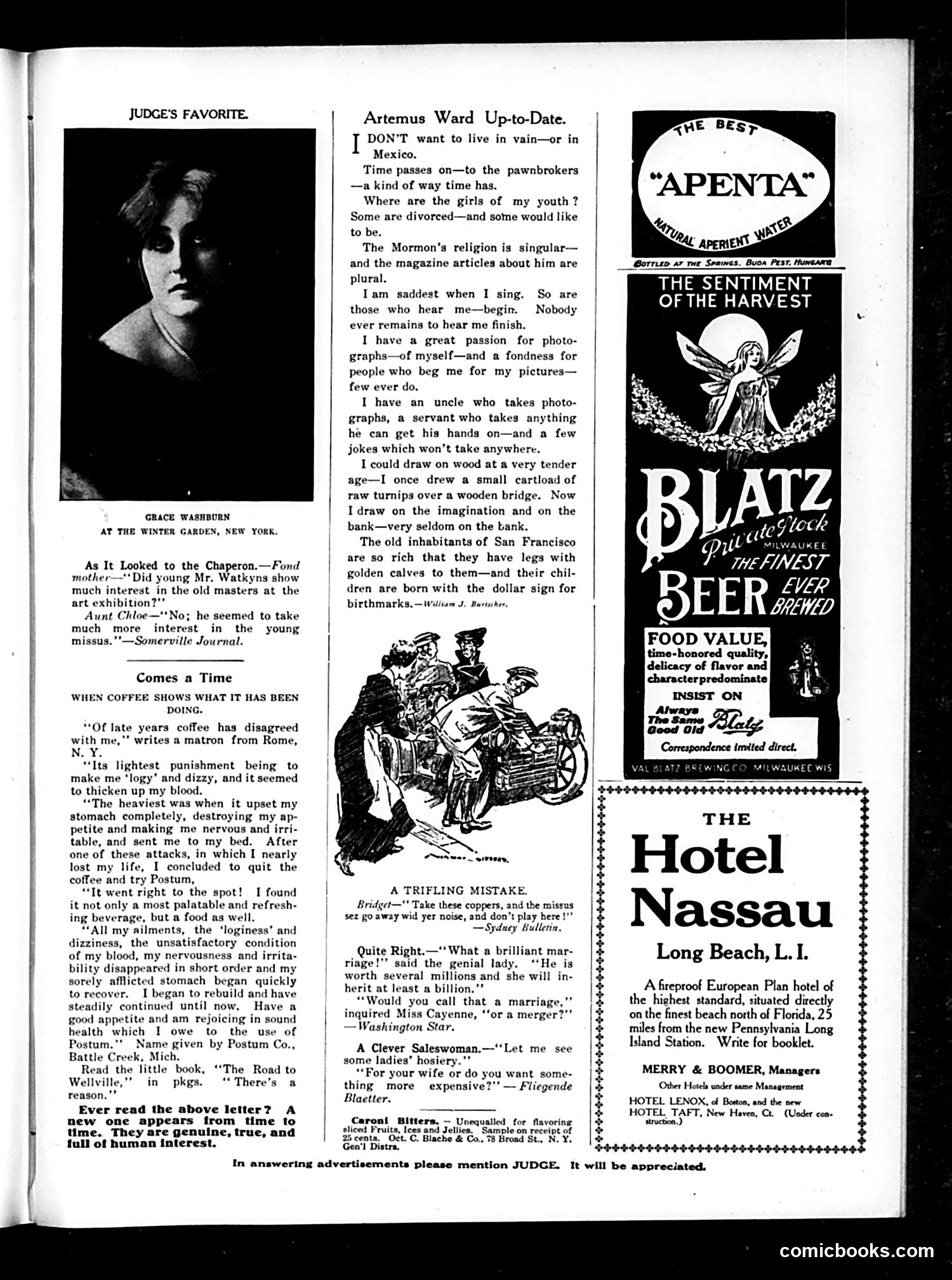
This page from *Judge* (a satirical weekly) mixes entertainment content with advertising typical of early-20th-century magazines. **Main Content:** The "Judge's Favorite" features Grace Washburn, an actress at New York's Winter Garden theater, with a brief joke about a young man feigning interest in "old masters" at an art exhibition while actually eyeing a young woman. **"Artemus Ward Up-to-Date"** presents humorous observations in the style of 19th-century humorist Artemus Ward—witty complaints about modern life: time passing to "pawnbrokers," divorced women, Mormon polygamy, his own poor singing voice, his narcissism about photographs, and San Francisco's wealthy citizens. The tone is self-deprecating, Victorian-era satirical humor. Several short jokes follow about domestic/romantic misunderstandings, playing on class differences and gender expectations. **Advertisements** dominate the right side: Apenta mineral water, Blatz beer, and the Hotel Nassau in Long Beach. The page reflects early-1900s concerns: consumer products (coffee alternatives), wealth disparities, and gender/marriage anxieties, presented through light satire and wordplay.
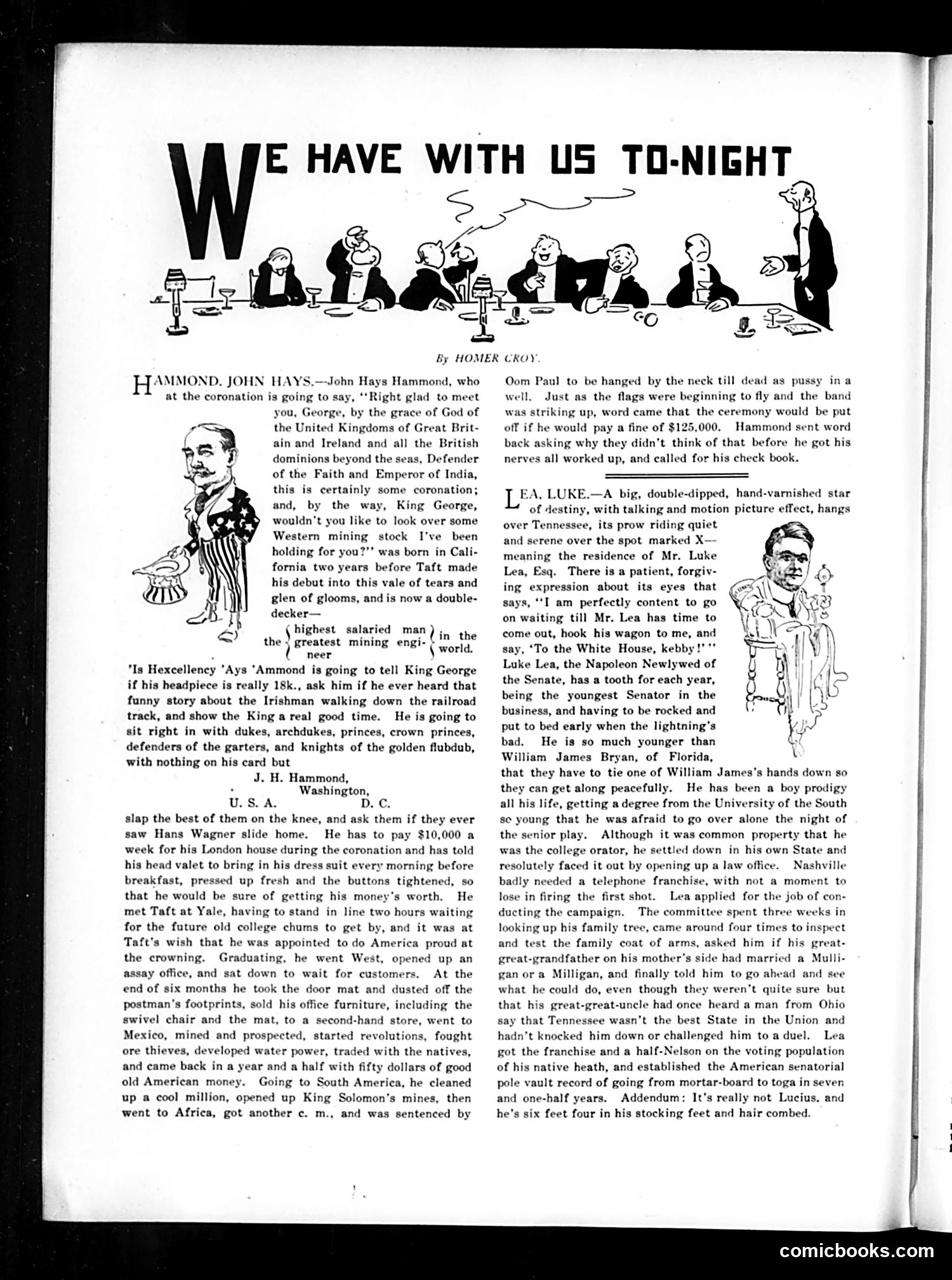
This satirical article profiles prominent figures attending King George V's coronation. The cartoon depicts John Hays Hammond, a wealthy mining engineer and financier, characterized as a social climber who will shamelessly pitch business deals to royalty. The satire ridicules Hammond's assumption that wealth and informal American manners grant him access to the British monarchy—imagining him buttonholing the King about Western mining stocks and regaling him with Irish railroad anecdotes. The second profile skewers Luke Lea, Tennessee's unusually young senator, mockingly comparing him unfavorably to William Jennings Bryan and describing his ambitions for higher office with condescending language about his youth and immaturity. Both profiles exemplify *Judge* magazine's tradition of lampooning American politicians and businessmen for their pretensions, crude commercialism, and social presumption during the Edwardian era.
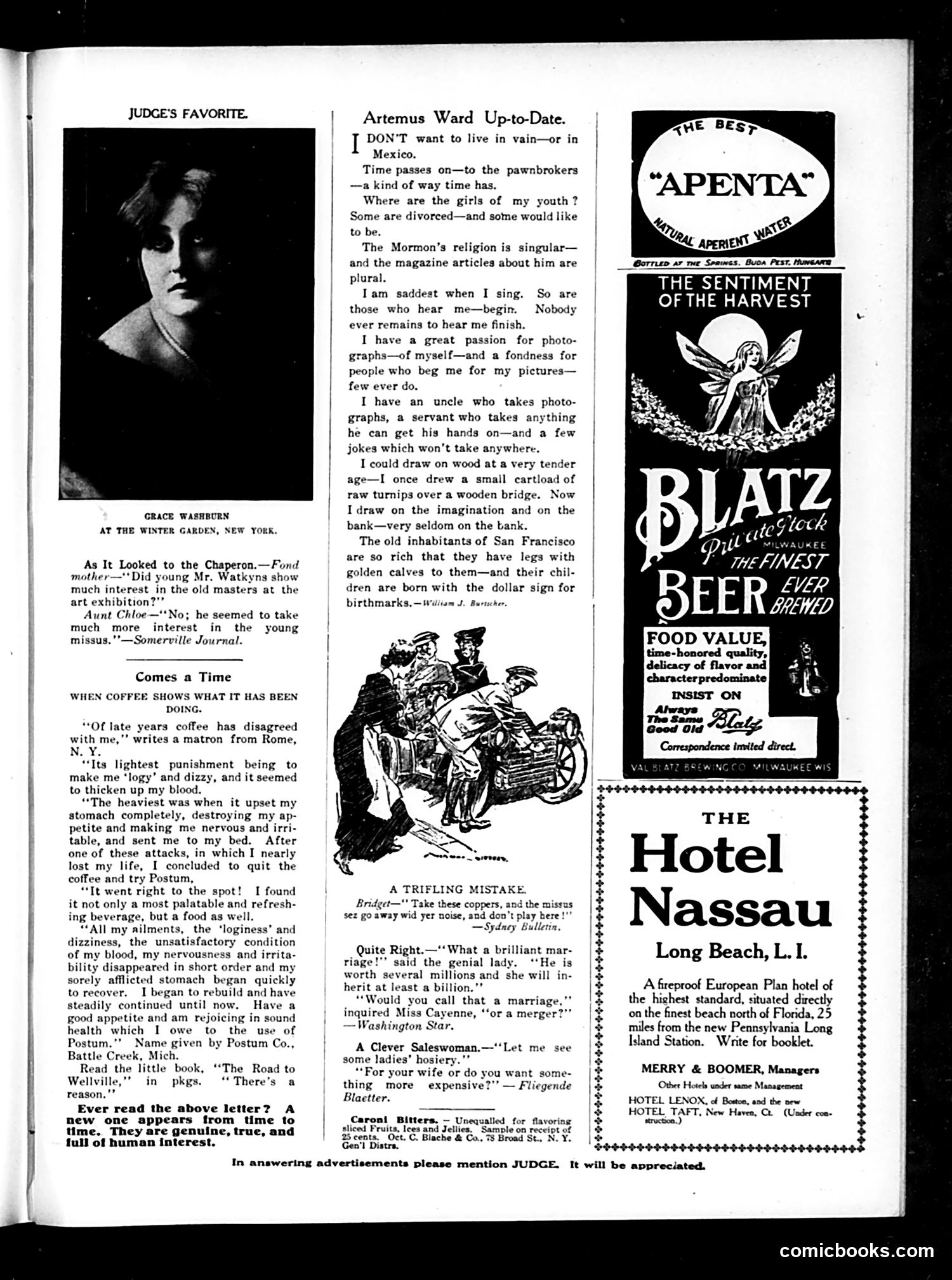
This page mixes humor columns with advertising. The main content includes: **"Judge's Favorite"**: A photo of Grace Washburn, an actress at the Winter Garden theater, paired with a brief joke about a young man showing more interest in a "young missus" than in art at an exhibition—poking fun at romantic distraction. **"Artemus Ward Up-to-Date"**: A humor column mimicking 19th-century humorist Artemus Ward's deadpan style, offering sardonic observations about modern life: pawnbrokers, divorce, Mormonism, failed singing talent, and drawing skills. The jokes rely on unexpected punchlines and wordplay typical of the era. **Short anecdotes**: Brief jokes about Irish servants, marriages, and sales tactics—standard period humor. The page is primarily **advertising-heavy**, featuring Apenta water, Blatz beer, and Hotel Nassau promotions—typical of Judge magazine's revenue model. The cartoons and columns are minor entertainment filler between paid advertisements.
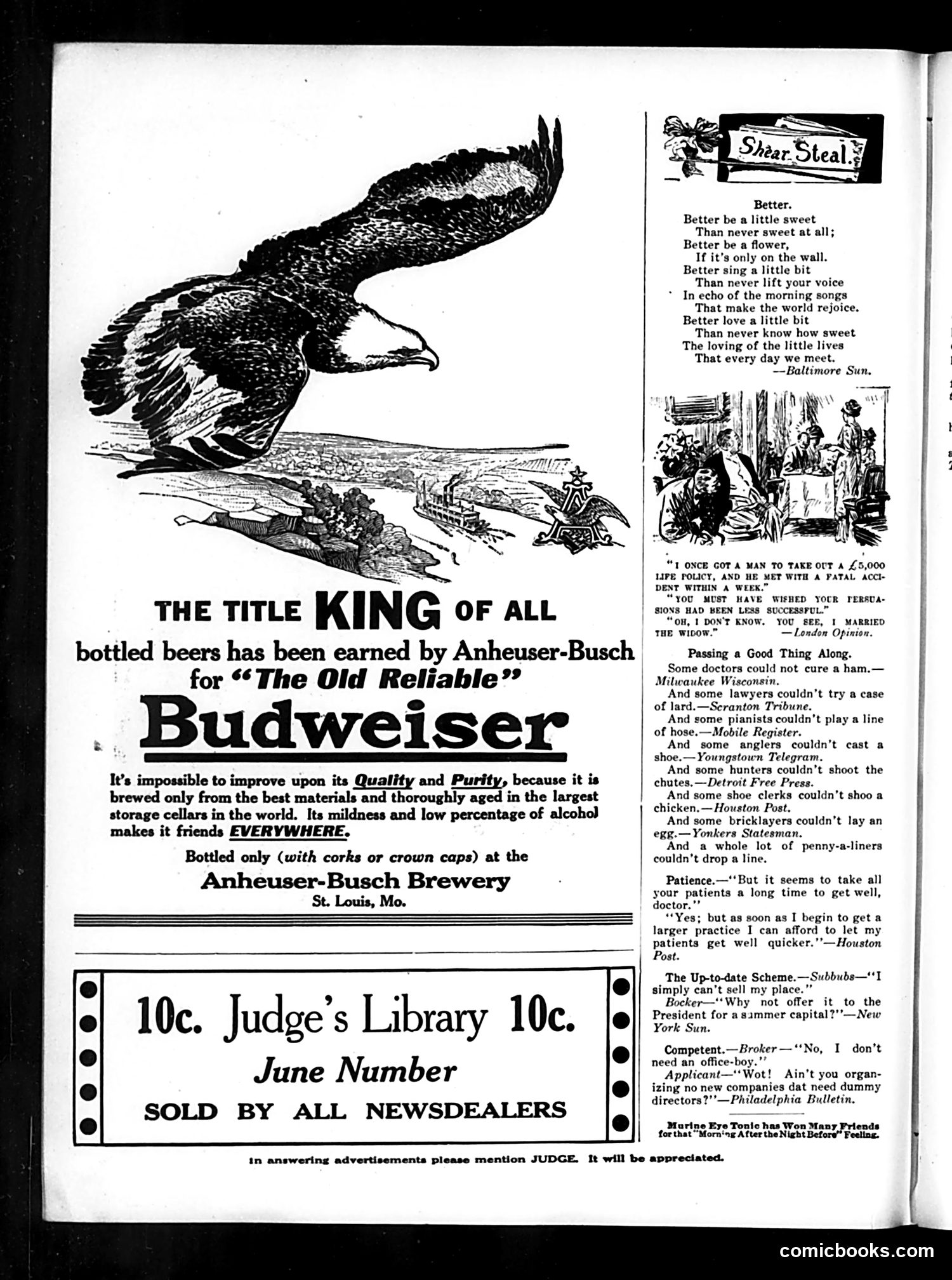
This page is primarily **advertising and filler content** rather than political satire. The dominant feature is a **Budweiser beer advertisement** using an eagle carrying a fish, claiming the beer has earned the title "King of All bottled beers" for being "The Old Reliable." The right column contains miscellaneous **joke fillers** common to satirical magazines—brief one-liners from various newspapers playing on professions (doctors, lawyers, pianists, anglers, etc.) who are incompetent at their trades but would excel at absurd substitutes. These are gentle, apolitical humor. At bottom is an advertisement for **Judge's June issue** (10 cents), sold by newsdealers. There is no significant political cartoon or social commentary on this particular page—it's largely commercial space and light comic filler typical of early 20th-century magazine layouts.
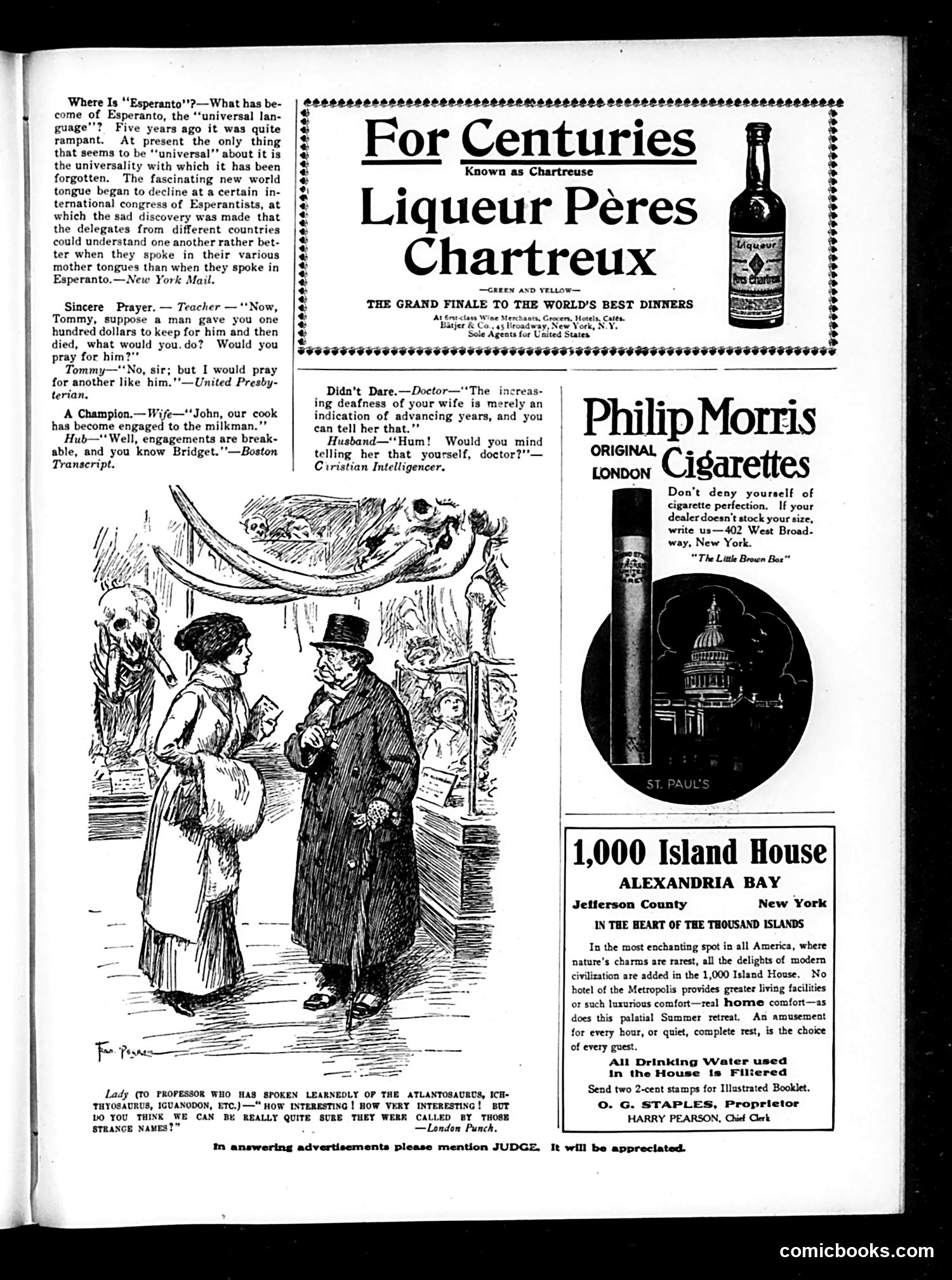
This page consists primarily of **advertisements and brief humorous anecdotes** rather than political cartoons. The one illustration shows a **lady speaking with a professor about extinct dinosaurs** (Atlantosaurus, Ichthyosaurus, Iguanodon). The joke, credited to London Punch, satirizes how people accept scientific nomenclature without questioning it—the lady implies these creatures may not have actually been called by such elaborate Latin names, gently mocking both academic pretension and casual acceptance of expert authority. The text column discusses **Esperanto**, an artificial universal language promoted in the early 1900s. The satire notes that despite its goal of international understanding, delegates at an Esperanto congress ironically communicated *better* in their native languages—a deadpan critique of the movement's failure. Other brief jokes mock doctors, domestic servants, and gender dynamics typical of early-20th-century humor. The advertisements promote liqueur, cigarettes, and a resort hotel—standard period commercial content.
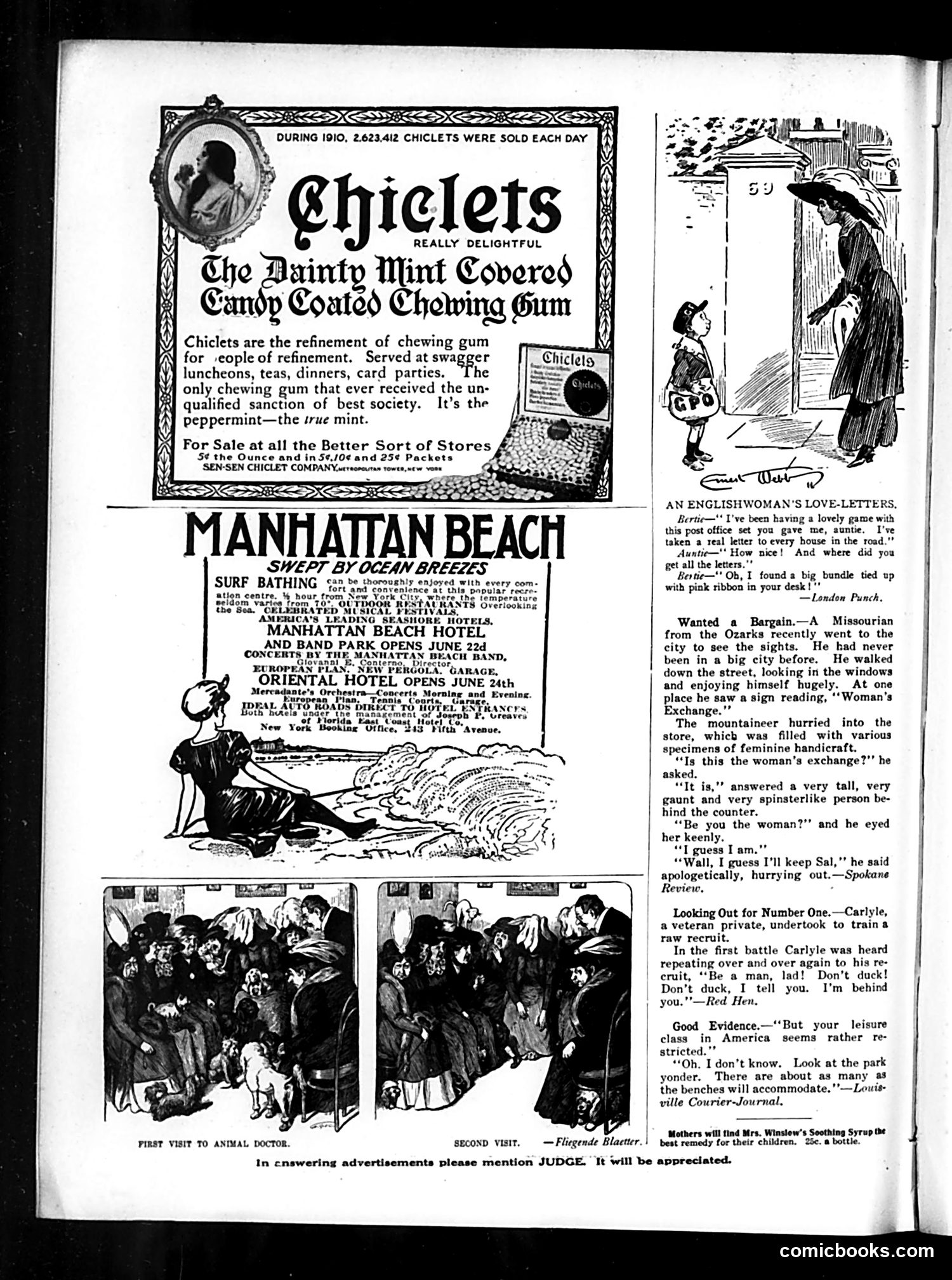
This page is primarily **advertising and humor content**, not political satire. The dominant elements are: **Advertisements:** Chiclets gum (emphasizing refined society consumption), Manhattan Beach resort, and Oriental Hotel. These ads reflect early 1910s luxury marketing targeting upper-class audiences. **Humor Pieces:** Several brief comedic anecdotes appear on the right: - "An Englishwoman's Love-Letters": A child accidentally mails private love letters, a play on innocent misunderstanding. - "Wanted a Bargain": A rural Ozark man visits a "Woman's Exchange" (a real store selling women's crafts), mishearing it as a literal wife-trading business—satirizing rural/urban cultural divide. - "Looking Out for Number One" and "Good Evidence": Brief military and leisure-class jokes. **Bottom illustrations:** Two nearly identical panels labeled "First Visit" and "Second Visit" to an animal doctor, suggesting escalating chaos—likely commenting on veterinary practice or animal behavior, though specifics aren't clear. The page demonstrates Judge's mix of consumer advertising and genteel humor targeting affluent, educated readers around 1910.
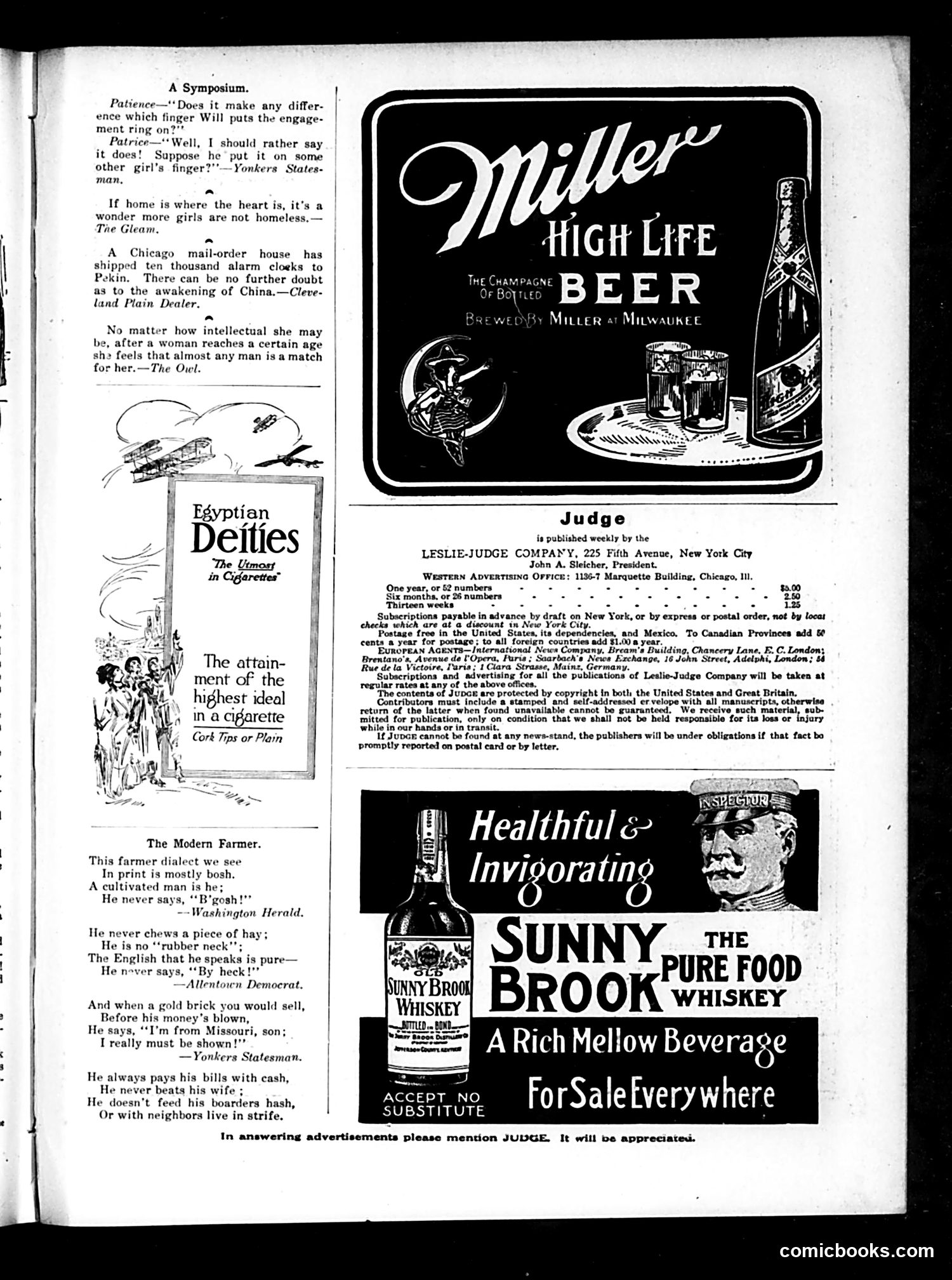
This page is primarily **advertisements and miscellaneous content** rather than political cartoons. The top section contains a "Symposium"—brief humorous quotes about engagement rings, homesickness, and courtship from various newspapers, reflecting early 20th-century domestic humor. Below that is "The Modern Farmer," a satirical poem contrasting the **stereotypical rural farmer dialect** (saying "B'gosh" and "by heck") with an actually educated, modern farmer who speaks proper English, pays bills in cash, and doesn't cheat people. This mocks outdated rural caricatures. The page is dominated by **period advertisements**: Miller High Life beer, Egyptian Deilties cigarettes, and Sunny Brook whiskey. These ads employ typical early 1900s marketing imagery—the whiskey particularly emphasizes being "healthful & invigorating" (a common claim before modern consumer protection regulations). The publication information identifies Judge as a Leslie-Judge Company weekly satirical magazine published from New York City, with advertising offices in Chicago.
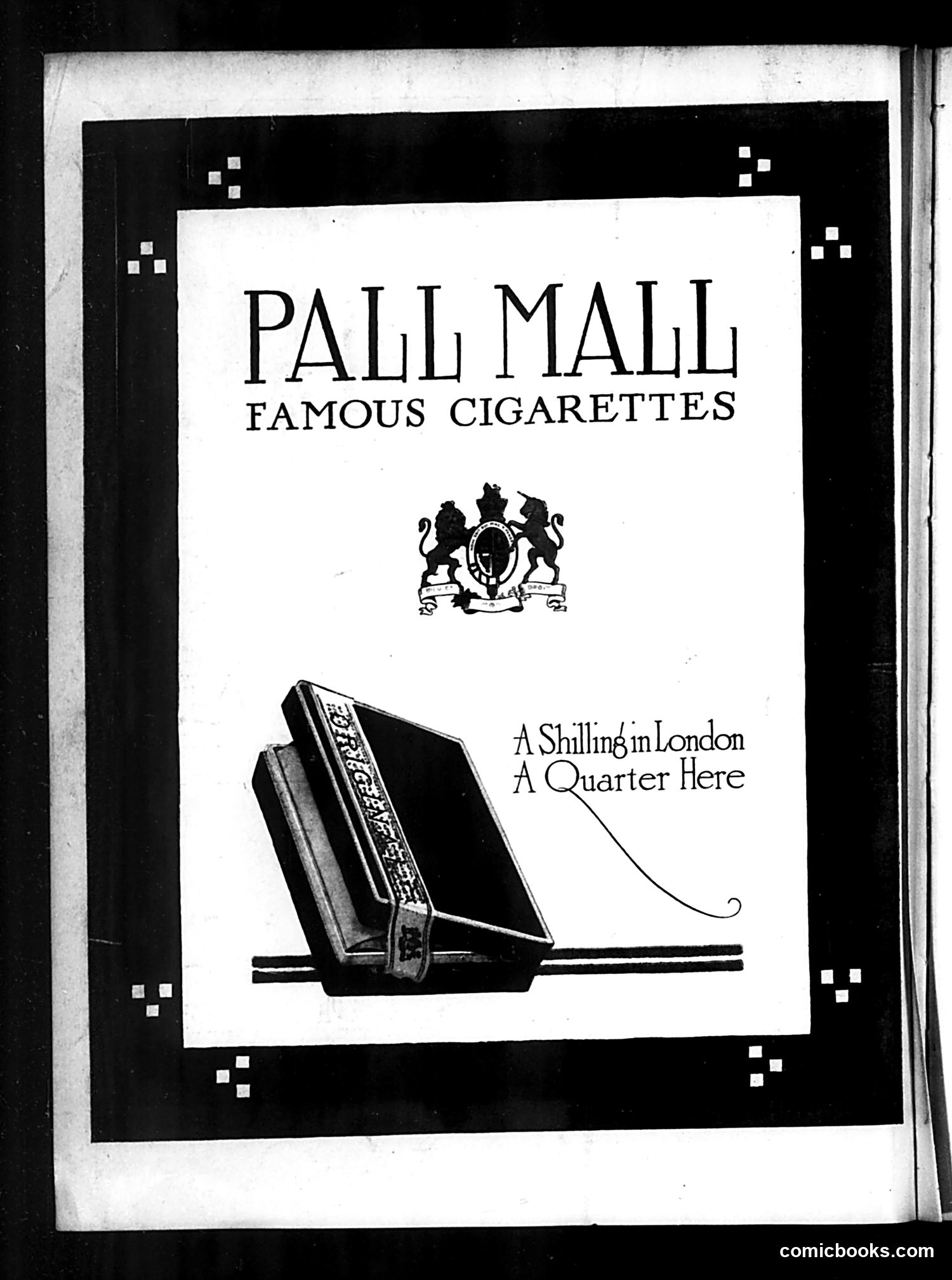
This is a **product advertisement**, not a political cartoon. It promotes Pall Mall cigarettes, a British brand, to American readers of *Judge* magazine. The ad emphasizes **price comparison**: "A Shilling in London / A Quarter Here." A shilling and a quarter were roughly equivalent currency values, suggesting Americans got the same prestigious British product at fair pricing. The heraldic crest above conveys sophistication and authenticity. The illustrated cigarette pack, shown at an angle with decorative banding, emphasizes the product's elegant packaging. The overall design—clean typography, formal crest, refined presentation—targets affluent readers seeking imported luxury goods. There is **no political satire** here; it's straightforward consumer marketing playing on transatlantic brand prestige during an era when British goods held particular cachet in America.