
Judge, 1911-06-17 · page 16 of 26
Judge — June 17, 1911 — page 16: what you’re looking at
What you’re looking at
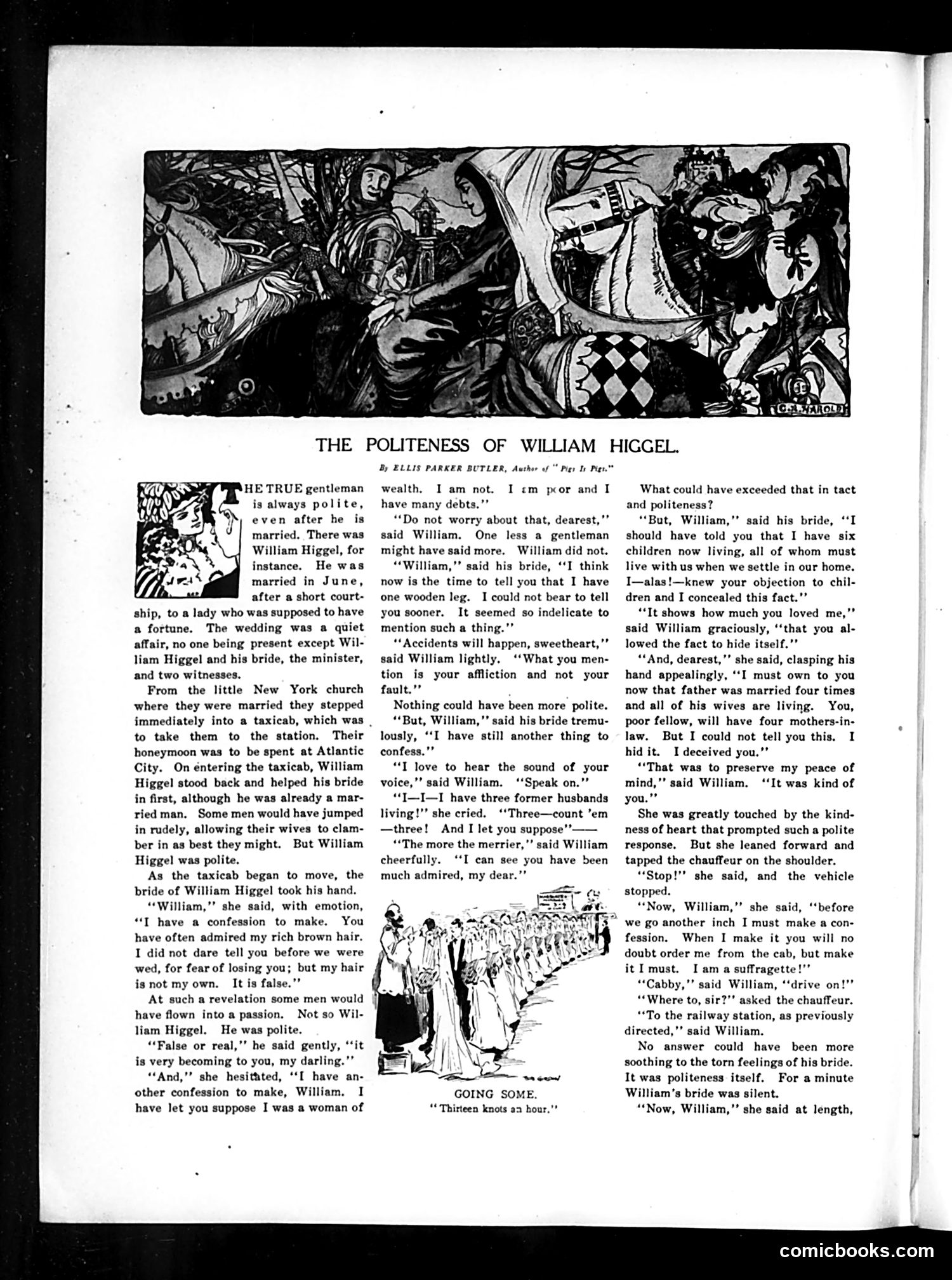
This satirical story by Ellis Parker Butler mocks excessive male politeness as absurd and emasculating. William Higgel maintains relentless courtesy despite his bride's shocking revelations: false hair, poverty, a wooden leg, three living ex-husbands, six children, four living mothers-in-law. He responds to each confession with gentle reassurance. The joke's climax reveals the satire's target: when she admits being a **suffragette** (women's suffrage activist), William finally breaks—ordering the cab to drive away. The implication is sardonic: a gentleman can tolerate any personal deception or family complication, but a woman demanding political rights crosses the line into the truly unforgivable. The cartoon illustrates this 1910s-era anxiety about women's expanding social power, mocking both excessive male politeness and women's suffrage activism simultaneously.
📄 Transcribed text from this page (OCR, searchable)
Machine-transcribed from the original scan — historical spelling and the odd misread are preserved.
HE TRUE gentleman is always polite, even after he is married. There was William Higgel, for instance. He was married in June, after a short court- ship, to a lady who was supposed to have a fortune. The wedding was a quiet affair, no one being present except Wil- liam Higgel and his bride, the minister, and two witnesses. From the little New York church where they were married they stepped immediately into a taxicab, which was | to take them to the station. Their honeymoon was to be spent at Atlantic City. On éntering the taxicab, William Higgel stood back and helped his bride in first, although he was already a mar- ried man, Some men would have jumped in rudely, allowing their wives to clam- ber in as best they might. But William Higgel was polite. As the taxicab began to move, the bride of William Higgel took his hand. # m,”’ she said, with emotion, “T have a confession to make. You have often admired my rich brown hair. I did not dare tell you before we were wed, for fear of losing you; but my hair is not my own. It is false.” At such a revelation some men would have flown into a passion. Not so Wil- liam Higgel. He was polite. “False or real,'’ he said gently, ‘‘it is very becoming to you, my darling.”’ “‘And,’’ she hesitated, ‘I have an- other confession to make, William. I have let you suppose I was a woman of THE POLITENESS OF WILLIAM HIGGEL. By ELLIS PARKER BUTLER, Author of “ Prey Ih Pig.” wealth. I am not. have many debts.”’ “‘Do not worry about that, dearest, said William. One less a gentleman might have said more. William did not. “William,” said his bride, ‘I think now is the time to tell you that I have one wooden leg. I could not bear to tell you sooner. It seemed so indelicate to mention such a thing.’’ “Accidents will happen, sweetheart,’ said William lightly, ‘“What you men- tion is your affliction and not your fault.’” Nothing could have been more polite. “But, William,’ said his bride tremu- lously, ‘‘I have still another thing to confess."” “TI love to hear the sound of your voice,’’ said William. ‘‘Speak on." “‘I—I—I have three former husbands living!’’ she cried. ‘‘Three—count ’em —three! And I let you suppose’’—— “The more the merrier,"’ said William cheerfully. ‘I can see you have been much admired, my dear.’” I cm poor and I GOING SOME. “Thirteen knots an hour,’’ What could have exceeded that in tact. and politeness? “But, William,’’ said his bride, ‘‘I should have told you that I have six children now living, all of whom must live with us when we settle in our home. I—alas!—knew your objection to chil- dren and I concealed this fact.’ “It shows how much you loved me,”” said William graciously, ‘‘that you al- lowed the fact to hide itself.’’ “And, dearest,’’ she said, clasping his hand appealingly, ‘‘I must own to you now that father was married four times and all of his wives are living. You, poor fellow, will have four mothers-in- law. But I could not tell you this. I hid it. I deceived you.’’ “That was to preserve my peace of mind,” said William. ‘‘It was kind of you.” She was greatly touched by the kind- ness of heart that prompted such a polite response. But she leaned forward and tapped the chauffeur on the shoulder. “Stop!"’ she said, and the vehicle stopped. ‘Now, William,”’ she said, ‘before we go another inch I must make a con- fession. When I make it you will no doubt order me from the cab, but make it I must. I am a suffragette!"’ “Cabby,’’ said William, ‘‘drive on!" “Where to, sir?’’ asked the chauffeur. ‘To the railway station, as previously directed,’’ said William. No answer could have been more soothing to the torn feelings of his bride. It was politeness itself. For a minute William’s bride was silent. “Now, William,’’ she said at length, comicbooks.com