
Judge, 1911-06-17 · page 18 of 26
Judge — June 17, 1911 — page 18: what you’re looking at
What you’re looking at
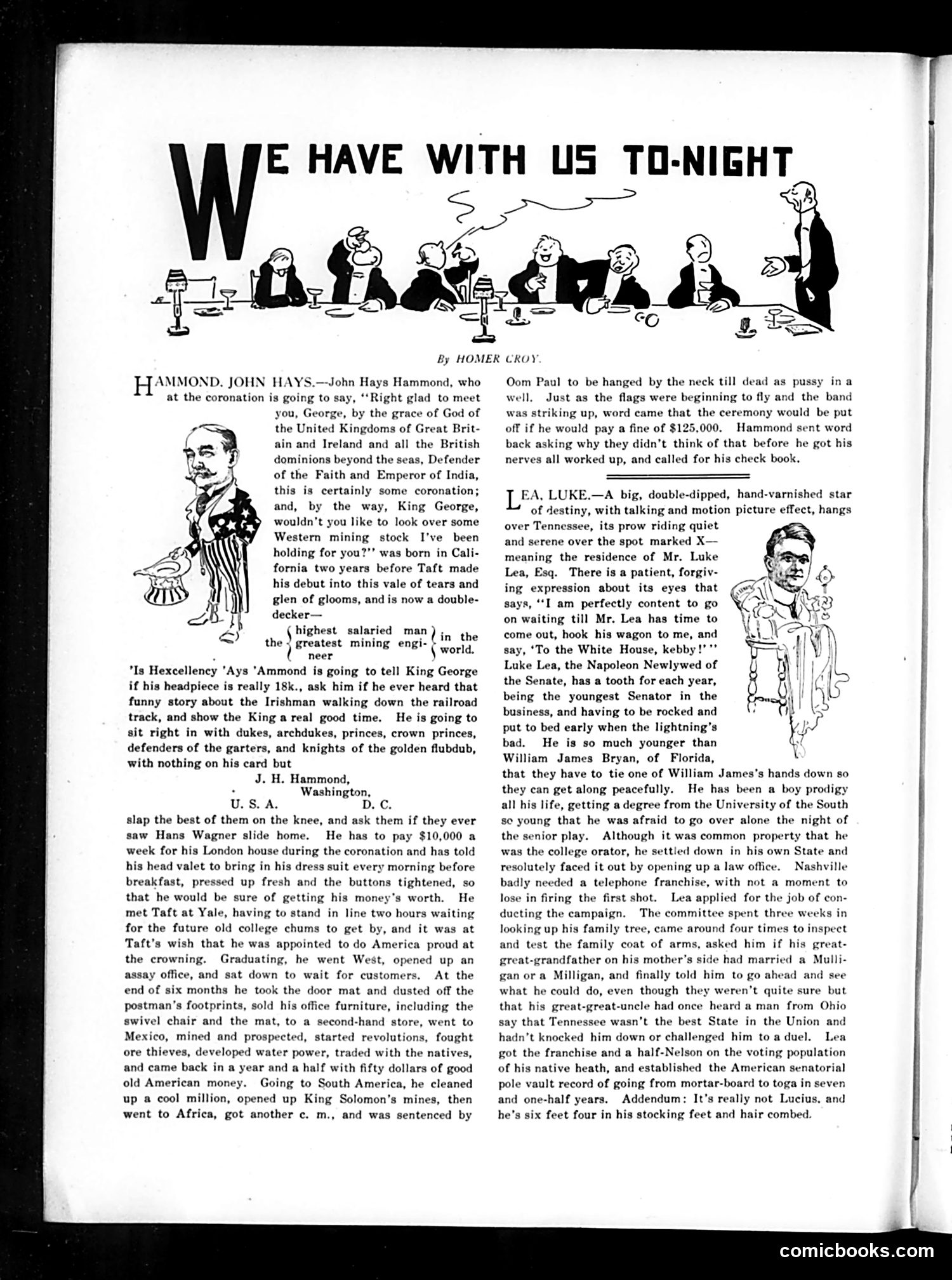
This page features satirical profiles by Homer Croy of three prominent figures attending King George V's coronation (1911). The cartoon at top shows them at a formal dinner. **John Hays Hammond** is mocked as a self-made mining magnate who shamelessly networks, even at royal events. The satire highlights his nouveau-riche behavior: paying $10,000/week for London lodging, obsessing over his dress suit's condition, and attempting to impress the King with business pitches. The joke culminates in his cool response to an execution threat in Mexico—simply demanding to know why they didn't ask for the fine *before* he got nervous. **Luke Lea**, a young Tennessee Senator, is caricatured as an ambitious boy-wonder politician. The "star of destiny" metaphor and references to his youth (having "a tooth for each year," needing to be "rocked and put to bed") mock his inexperience and eagerness for higher office (the White House reference). The satire targets American nouveaux riches and ambitious politicians using exaggeration and comic incongruity—Hammond's crass capitalism at a coronation, Lea's youthful ambition.
📄 Transcribed text from this page (OCR, searchable)
Machine-transcribed from the original scan — historical spelling and the odd misread are preserved.
E HAVE WITH US TO-NIGHT a, eon — By HOMER CROY. HAMMonp. JOHN HAYS.—John Hays Hammond, who at the coronation is going to say, ‘‘Right glad to meet you, George, by the grace of God of the United Kingdoms of Great Brit- ain and Ireland and all the British dominions beyond the seas, Defender of the Faith and Emperor of India, this is certainly some coronation; and, by the way, King George, wouldn't you like to look over some Western mining stock I’ve been holding for you?’’ was born in Cali- fornia two years before Taft made his debut into this vale of tears and glen of glooms, and is now a double- decker— (highest salaried man), the) greatest mining engi- i fe ue ‘ neer "Is Hexcellency 'Ays 'Ammond is going to tell King George if his headpiece is really 18k., ask him if he ever heard that funny story about the Irishman walking down the railroad track, and show the King a real good time. He is going to sit right in with dukes, archdukes, princes, crown princes, defenders of the garters, and knights of the golden flubdub, with nothing on his card but J. H. Hammond, . Washington, U.S. A. D.C. slap the best of them on the knee, and ask them if they ever saw Hans Wagner slide home. He has to pay $10,000 a week for his London house during the coronation and has told his head valet to bring in his dress suit every morning before breakfast, pressed up fresh and the buttons tightened, so that he would be sure of getting his money’s worth. He met Taft at Yale, having to stand in line two hours waiting for the future old college chums to get by, and it was at Taft's wish that he was appointed to do America proud at the crowning. Graduating, he went West, opened up an assay office, and sat down to wait for customers. At the end of six months he took the door mat and dusted off the postman’s footprints, sold his office furniture, including the swivel chair and the mat, to a second-hand store, went to ted, started revolutions, fought ore thieves, developed water power, traded with the natives, and came back in a year and a half with fifty dollars of good old American money. Going to South America, he cleaned up a cool million, opened up King Solomon's mines, then went to Africa, got another c. m., and was sentenced by Mexico, mined and prosp. Oom Paul to be hanged by the neck till dead as pu: Just as the flags were beginning to fly and the band striking up, word came that the ceremony would be put off if he would pay a fine of $125,000. Hammond sent word back asking why they didn’t think of that before he got his nerves all worked up, and called for his check book. L . LUKE.—A big, double-dipped, hand-varnished star of destiny, with talking and motion picture effect, hangs over Tennessee, its prow riding quiet and serene over the spot marked X— meaning the residence of Mr. Luke Lea, Esq. There is a patient, forgiv- ing expression about its eyes that says, ‘‘I am perfectly content to go on waiting till Mr. Lea has time to come out, hook his wagon to me, and say, ‘To the White House, kebby!’"’ Luke Lea, the Napoleon Newlywed of the Senate, has a tooth for each year, being the youngest Senator in the business, and having to be rocked and put to bed early when the lightning’s bad. He is so much younger than William James Bryan, of Florida, that they have to tie one of William James's hands down so they can get along peacefully. He has been a boy prodigy all his life, getting a degree from the University of the South se young that he was afraid to go over alone the night of the senior play. Although it was common property that he was the college orator, he settled down in his own State and resolutely faced it out by opening up a law office. Nashville badly needed a telephone franchise, with not a moment to lose in firing the first shot. Lea applied for the job of con- ducting the campaign. The committee spent three weeks in looking up his family tree, came around four times to inspect and test the family coat of arms, asked him if his great- great-grandfather on his mother’s side had married a Mulli- gan ora Milligan, and finally told him to go ahead and see what he could do, even though they weren't quite sure but that his great-great-uncle had once heard a man from Ohio say that Tennessee wasn’t the best State in the Union and hadn't knocked him down or challenged him to a duel. Lea got the franchise and a half-Nelson on the voting population of his native heath, and established the American senatorial pole vault record of going from mortar-board to toga in seven and one-half years. Addendum: It's really not Lucius, and he’s six feet four in his stocking feet and hair combed. comicbooks.com