
Judge, 1911-06-17 · page 7 of 26
Judge — June 17, 1911 — page 7: what you’re looking at
What you’re looking at
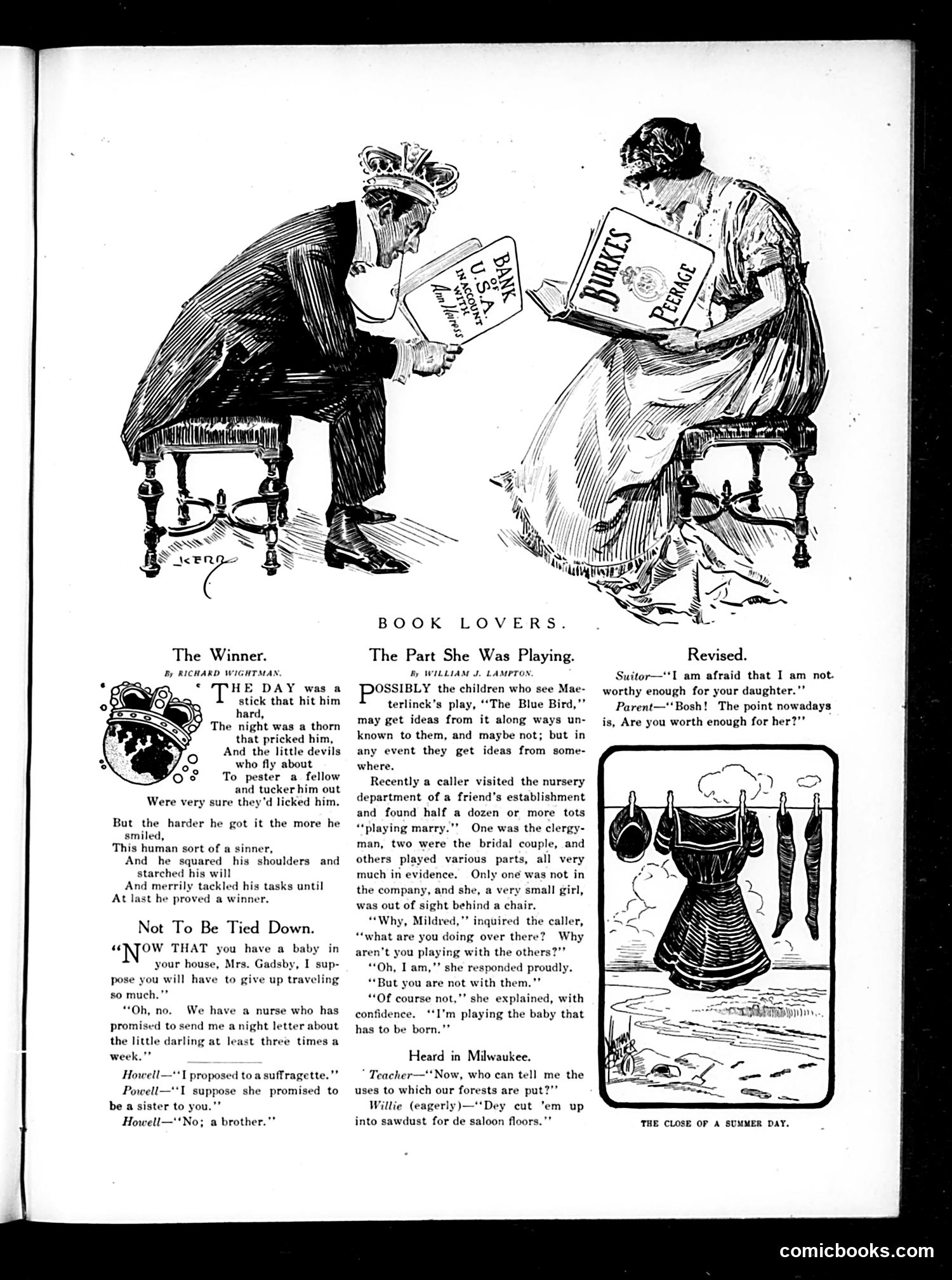
This page contains humorous short pieces and cartoons typical of early 20th-century Judge magazine. **"The Winner"** satirizes the self-made man ideal—a figure who endures hardship with cheerful determination and ultimately succeeds through sheer willpower and perseverance. It's gentle mockery of the popular motivational ethic of the era. **"Not To Be Tied Down"** jokes about changing social attitudes toward women and motherhood. Mrs. Gadsby refuses to abandon her lifestyle for a baby, instead delegating childcare to a nurse—poking fun at both modern women's independence and the wealthy's casual approach to parenting. **"The Part She Was Playing"** humorously depicts children reenacting a wedding play. The punchline—a small girl hiding, "playing the baby that has to be born"—gently mocks children's creative interpretations of adult activities they don't fully understand. **"Revised"** satirizes shifting class anxieties: a suitor worries about worthiness, but the parent dismisses virtue, caring only about the suitor's financial worth—commentary on materialistic values replacing traditional courtship standards.
📄 Transcribed text from this page (OCR, searchable)
Machine-transcribed from the original scan — historical spelling and the odd misread are preserved.
K ss S S The Winner. By RICHARD WIGHTMAN HE DAY was a stick that hit him hard, The night was a thorn that pricked him, And the little devils who fly about To pester a fellow and tucker him out Were very sure they'd licked him. But the harder he got it the more he smiled, This human sort of a sinner, And he squared his shoulders and starched his will And merrily tackled his tasks until At last he proved a win Not To Be Tied Down. «@\TOW THAT you have a baby in your house, Mrs. Gadsby, I sup- pose you will have to give up traveling so much."" “Oh, no. promised to send me a night letter about the little darling at least three times a We have a nurse who has week." Howell—*‘I proposed to a suffragette.”’ Powell—‘I suppose she promised to be a sister to you."” Howell—'‘No; a brother.” BOOK LOVERS. The Part She Was Playing. By WILLIAM J. LAMPTON. OSSIBLY the children who see Mae- terlinck’s play, ‘‘The Blue Bird,”’ may get ideas from it along ways un- known to them, and maybe not; but in any event they get ideas from some- where. Recently a caller visited the nursery department of a friend’s establishment and found half a dozen or more tots “playing marry.’? One was the clergy- man, two were the bridal couple, and others played various parts, all very much in evidence. Only one was not in the company, and she, a very small girl, was out of sight behind a chair. Why, Mildved,’’ inquired the caller, “what are you doing over there?) Why aren’t you playing with the others?”” “Oh, I am,"’ she responded proudly. **But you are not with them.”’ “Of course not,’’ she explained, with confidence. ‘I’m playing the baby that has to be born."’ Heard in Milwaukee, * Teacher—‘Now, who can tell me the uses to which our forests are put?”’ Willie (eagerly)—"*Dey cut ’em up into sawdust for de saloon floors."’ Revised. Suitor—‘‘I am afraid that I am not. worthy enough for your daughter."’ Parent—‘‘Bosh! The point nowadays is, Are you worth enough for her?”’ —— SELATAN THE CLOSE OF A SUMMER DAY. comicbooks.com