
A complete issue · 24 pages · 1911
Judge — April 1, 1911
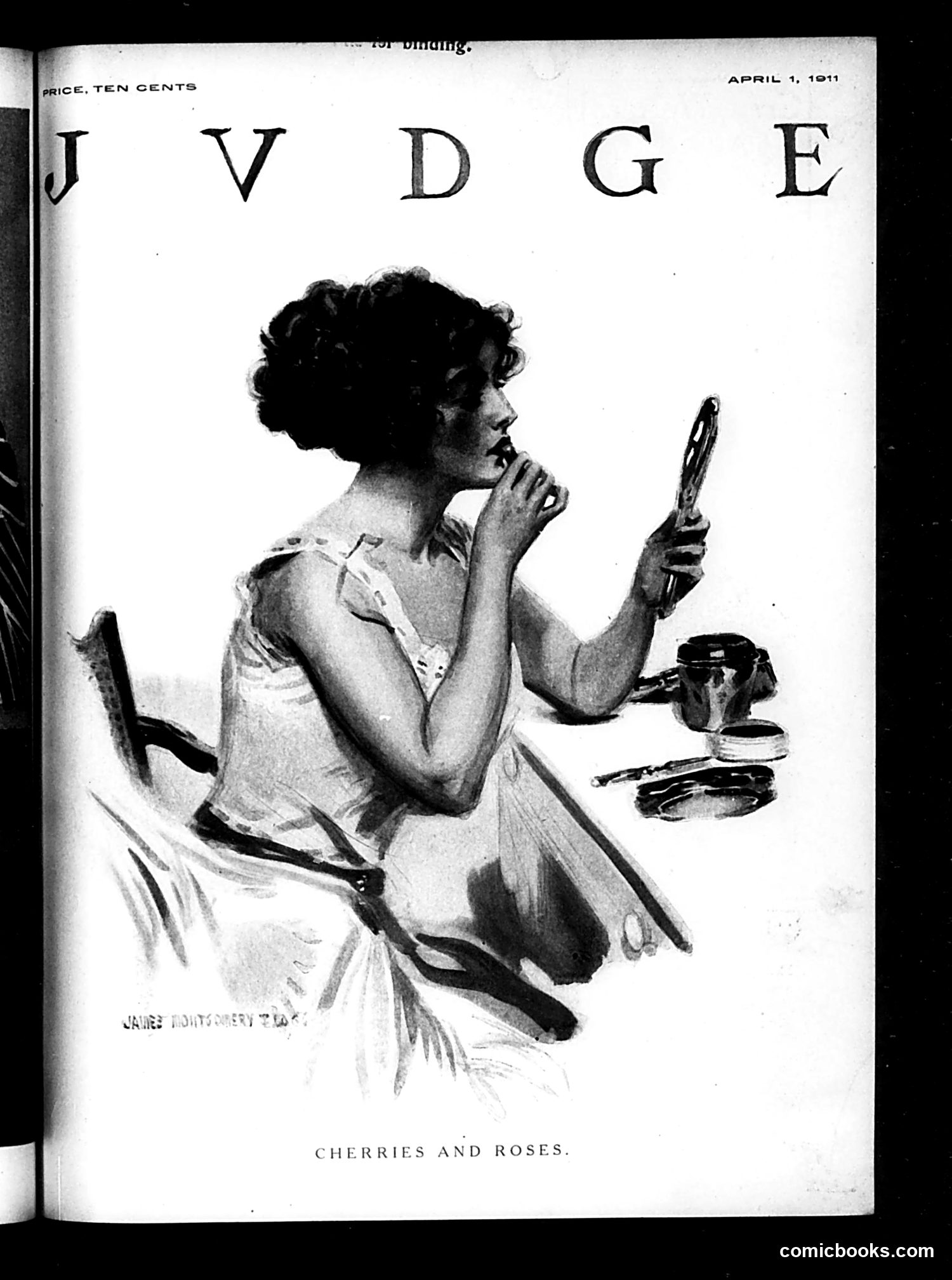
This cover illustration depicts a woman in profile, applying cosmetics or beauty products while holding a mirror. The caption "Cherries and Roses" appears to reference a common beauty product or cosmetic line from the era—likely referring to rouge or complexion aids marketed with romantic, floral names typical of early 20th-century advertising. The satire likely mocks women's vanity and the beauty industry's marketing tactics, presenting cosmetics as essential to feminine appearance. The contemplative pose—the woman studying her reflection—emphasizes self-absorption. This reflects Judge's general editorial stance of satirizing social trends, in this case the growing commercialization of women's beauty and consumer culture during the Progressive Era.
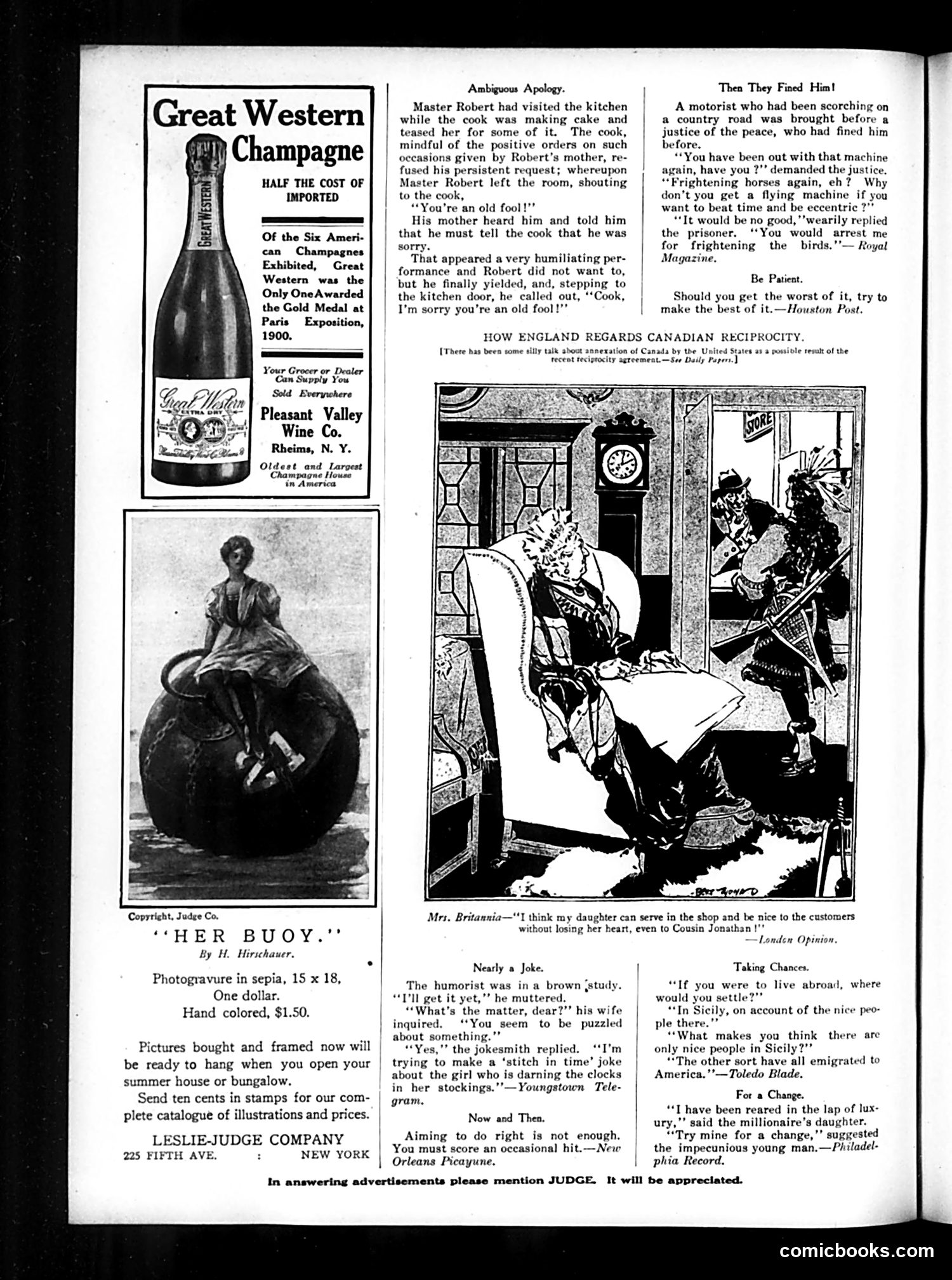
This page is primarily **advertising and humor columns** rather than political cartoons. The main visual content is "'Her Buoy'" by H. Hirschauer—a photogravure showing a woman sitting atop a large buoy, likely a whimsical commentary on femininity or romance at sea. Below are several **short humorous anecdotes** with titles like "Ambiguous Apology," "Then They Fixed Him," and "Nearly a Joke"—typical Judge fare of gentle domestic and social comedy. These involve misunderstandings between husbands/wives and absurd situations. The **header section** concerns Canadian reciprocity with Britain—a trade/political issue—illustrated with a cartoon showing what appears to be a British woman concerned about her daughter serving customers without losing her hearth. The page reflects early 1900s American leisure-class humor and commercial advertising rather than hard-hitting political satire.
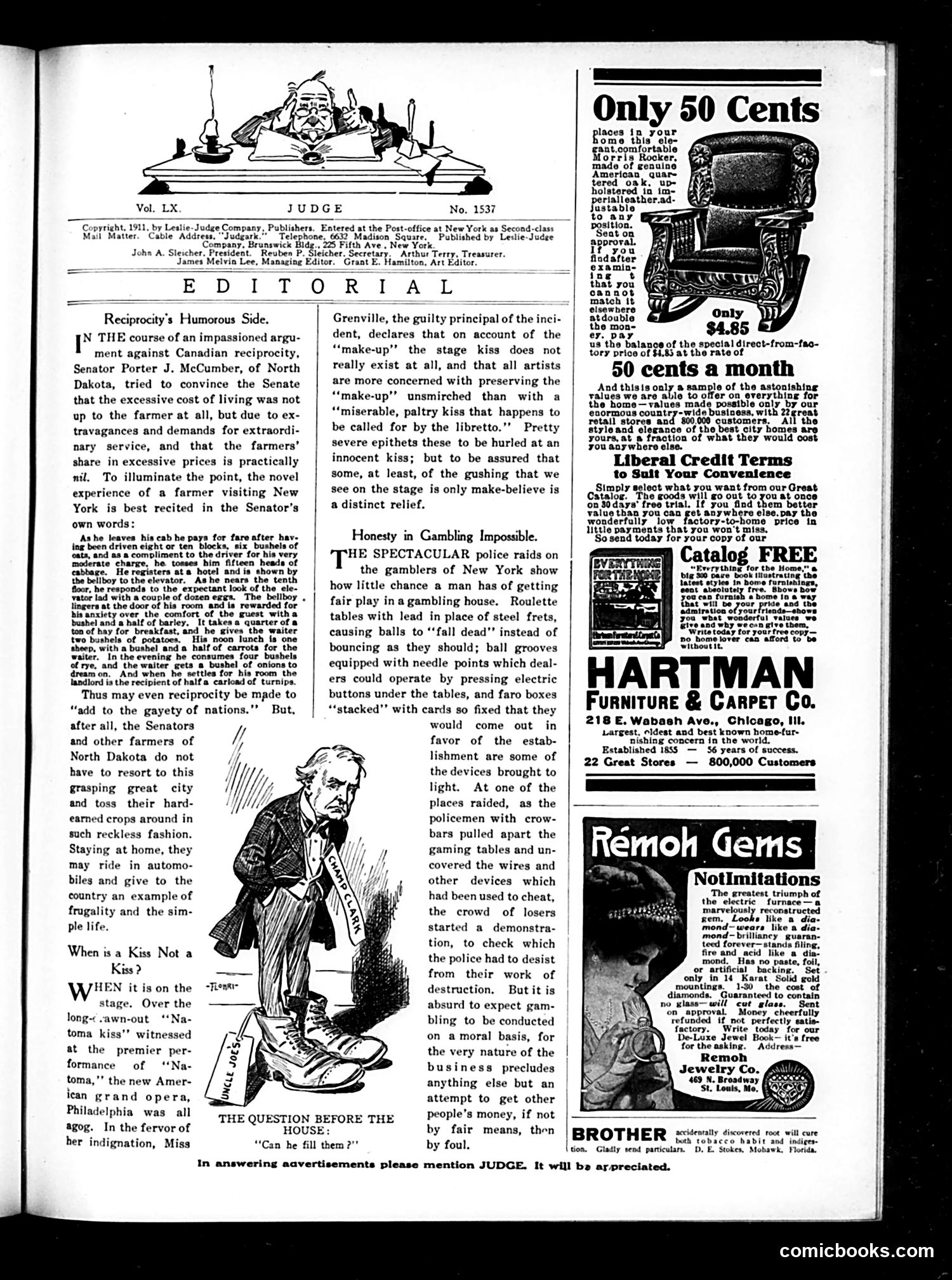
This page is primarily **editorial commentary and advertising** rather than traditional political cartoons. The main editorial, "Reciprocity's Humorous Side," discusses Senator Porter McCumber's complaint about excessive costs in farming, sarcastically suggesting that farmers' complaints about prices seem exaggerated compared to city dwellers' demands. The second editorial, "Honesty in Gambling Impossible," describes police raids on New York gambling houses, detailing cheating devices (rigged tables, marked cards, electric buttons). The accompanying illustration shows someone being caught or exposed in gambling-related deception. The satire targets both corrupt gambling operations and the hypocrisy of expecting moral behavior in inherently dishonest enterprises. The remainder comprises period advertisements for furniture, gemstones, and other goods.
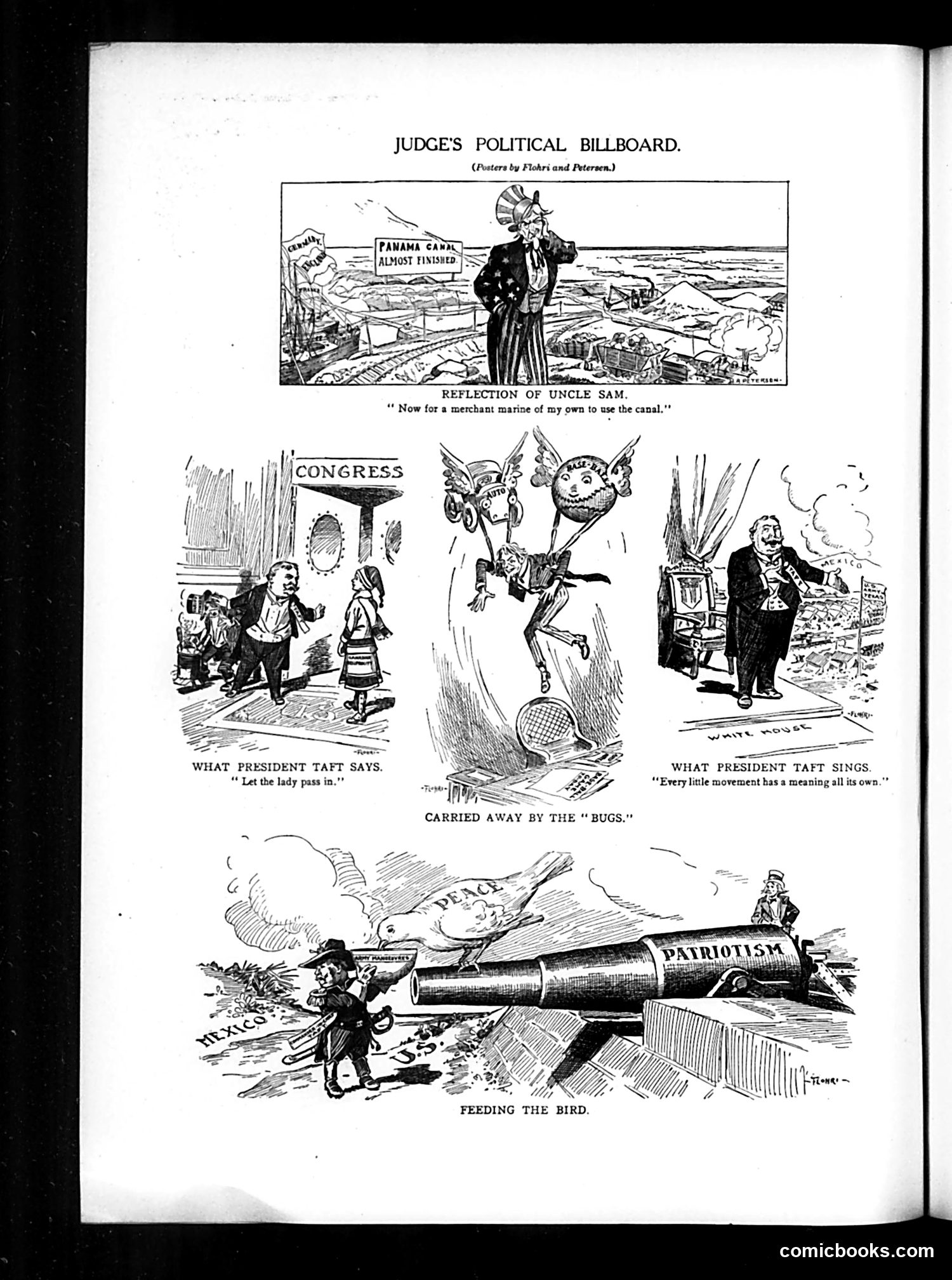
This satirical page attacks President William Howard Taft's political record through five cartoons. The top panel shows Uncle Sam reflecting on the nearly-finished Panama Canal—a major project. Below, three panels mock Taft's statements and actions: "What President Taft Says" depicts him dismissing concerns ("Let the lady pass in"), while "Carried Away by the 'Bugs'" shows political issues as flying insects disrupting order. The right panel, "What President Taft Sings," suggests his policies lack substance. The bottom cartoon, "Feeding the Bird," appears most critical: a large "Patriotism" cannon feeds an eagle, implying the administration uses patriotic rhetoric to distract from actual governing failures. Overall, the page portrays Taft as ineffective, contradictory, and reliant on empty nationalist appeals rather than substantive policy.
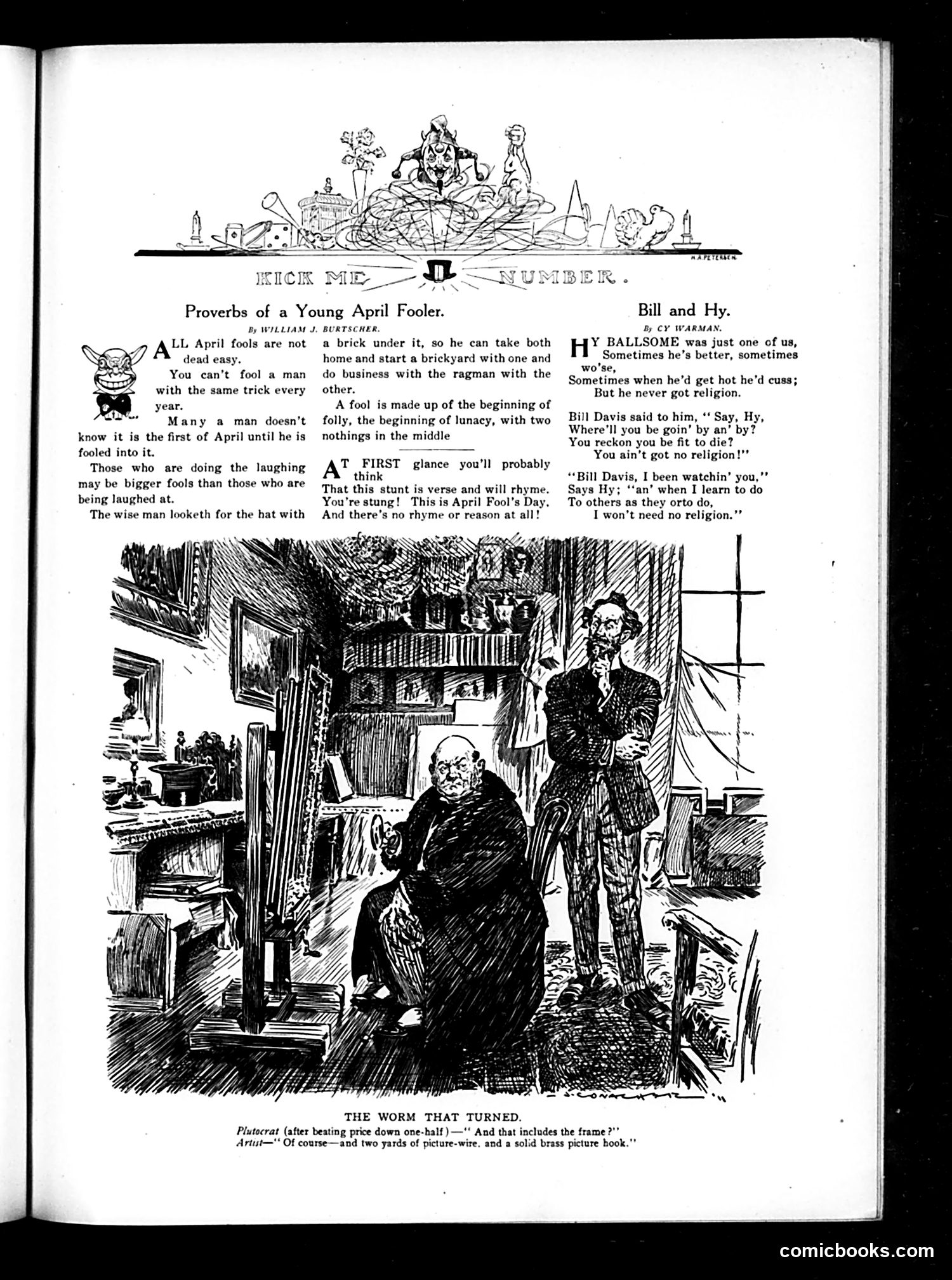
This page contains two pieces of humor content: **"Proverbs of a Young April Fooler"** (left): A collection of witty sayings about April Fools' Day pranks and foolishness, presented with a decorative header and small mascot illustration. It plays with paradoxes about who qualifies as a "fool." **"Bill and Hy"** (right): A dialogue between two characters—Bill Davis and Hy Ballsome—about religion. Hy boasts he's never adopted religion despite Bill's warnings. The humor derives from their contrasting moral perspectives and casual vernacular speech patterns typical of working-class character comedy from this era. **"The Worm That Turned"** (bottom): An illustration showing what appears to be a domestic confrontation scene, with a caption suggesting a husband has finally asserted himself after being dominated, achieving some victory in their relationship power dynamic. The page exemplifies Judge's mix of wordplay, character-based humor, and social satire.
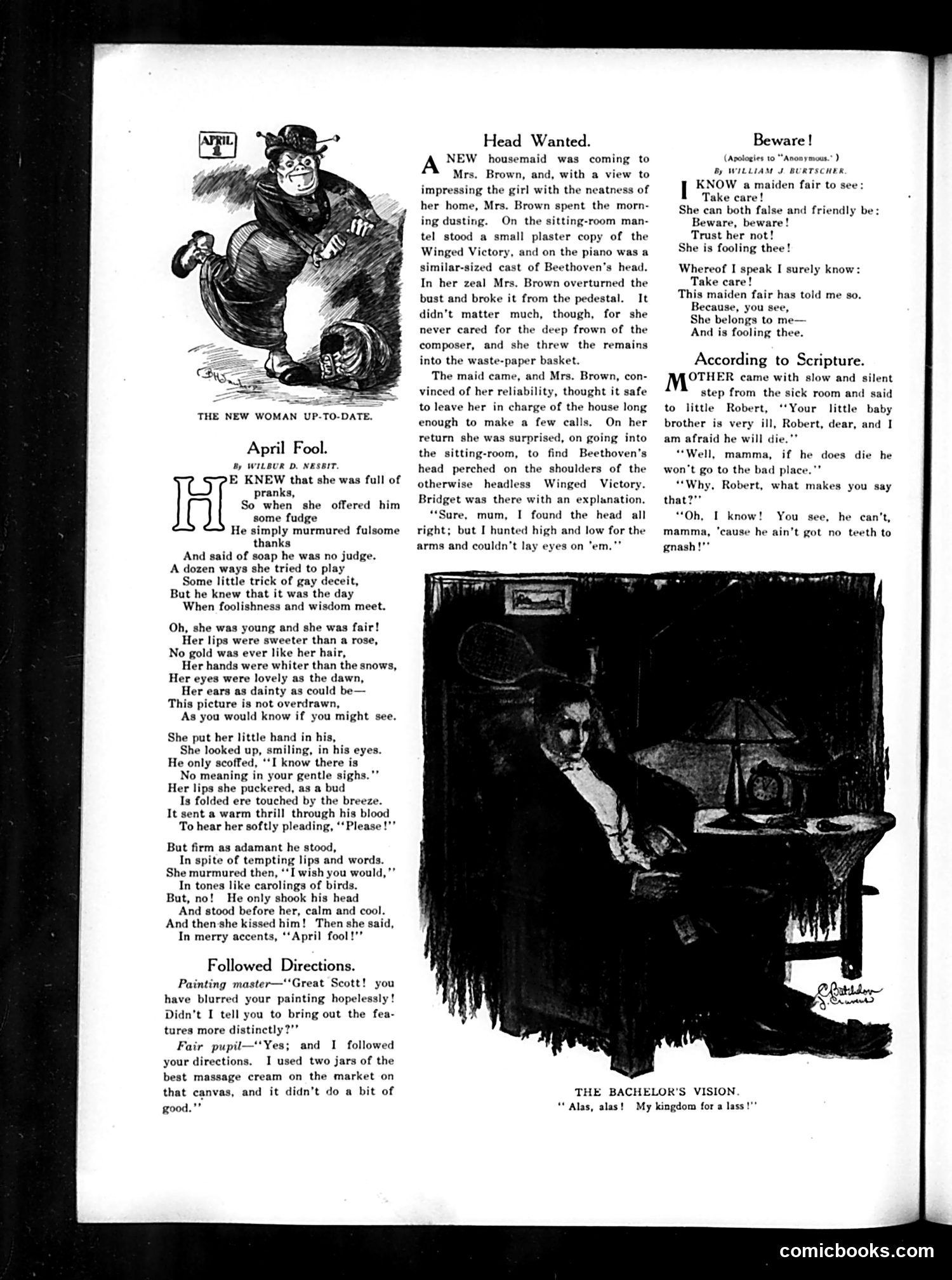
This page contains four humorous pieces typical of early 20th-century American satire: **"The New Woman Up-to-Date"** and **"April Fool"** mock the "New Woman"—a contemporary social figure challenging traditional gender roles. The poem depicts a woman attempting April Fool pranks on a man who remains immune to her charms, ultimately seducing him through a kiss, then revealing it as a trick. The satire critiques both the woman's manipulative independence and the man's complacent resistance. **"Head Wanted"** is a domestic humor piece where a housemaid, finding a broken Beethoven bust, absurdly places the head on a headless Winged Victory sculpture, unable to comprehend that the two statues were originally separate. The joke mocks servant-class literal-mindedness. The other brief pieces—**"Beware!"**, **"According to Scripture,"** and **"The Bachelor's Vision"**—offer light romantic and domestic humor typical of Judge's content. The cartoon illustration shows a caricatured woman in an exaggerated pose, labeled "The New Woman Up-to-Date," embodying period anxieties about changing female social roles.
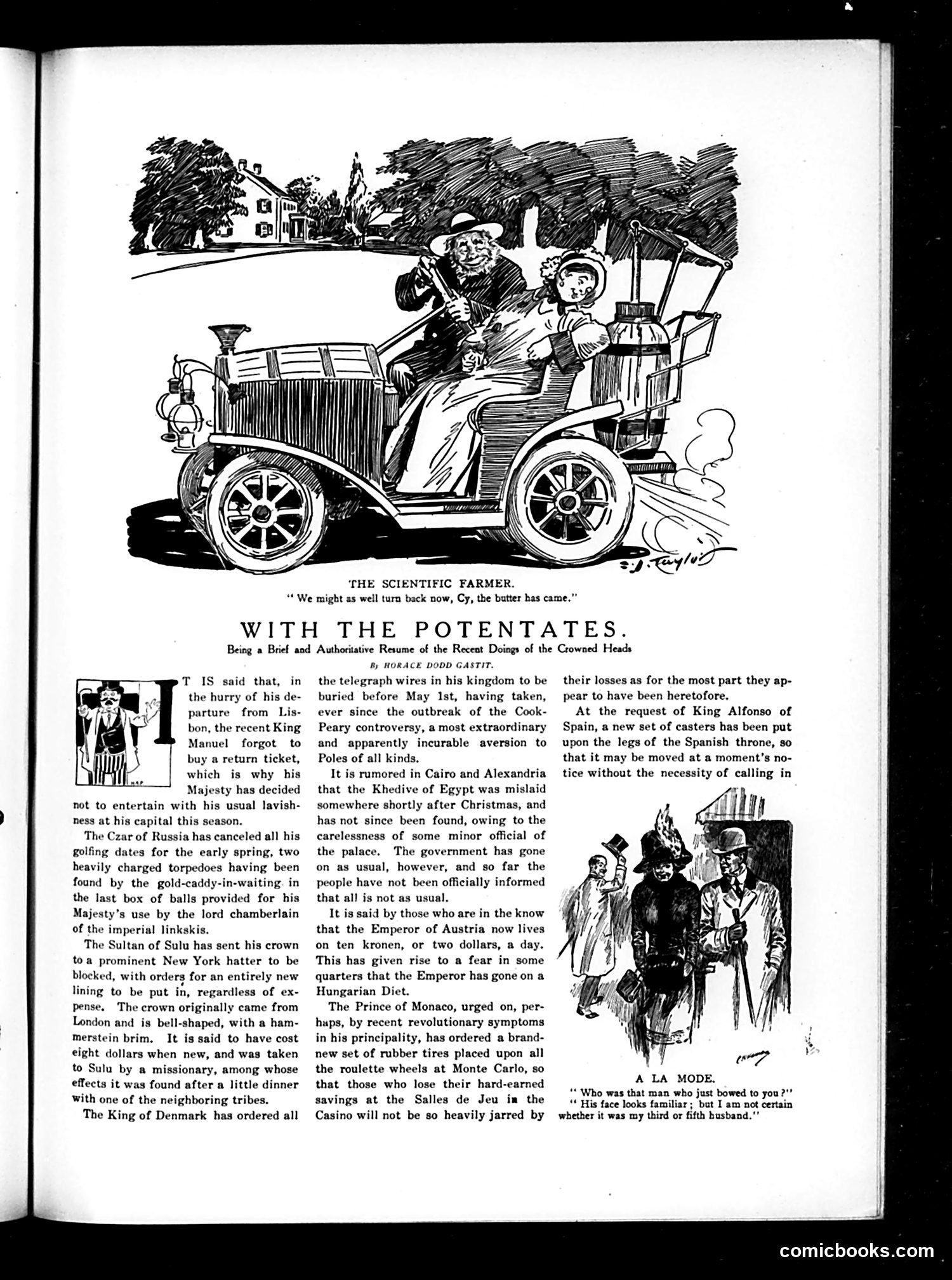
This is political satire mocking European royalty through absurdist humor. The main cartoon shows a farmer and wife in an early automobile with a caption joking that they should turn back because "the butter has came"—playing on rural dialect for comic effect. The article below offers mock-serious "news" about crowned heads, using exaggeration and wordplay: - **King Manuel of Portugal**: Recently fled Lisbon (historical reference to the 1910 revolution); the joke is he forgot a return ticket and can't afford entertaining. - **The Czar**: Finding torpedoes in his golf balls (reference to revolutionary unrest/assassination attempts). - **King of Denmark**: Banning telegraph wires to avoid "Poles" (pun on Cook-Peary polar exploration controversy). - **Emperor of Austria**: Living on two dollars daily, supposedly on a "Hungarian Diet" (pun). - **Prince of Monaco**: Adding rubber tires to roulette wheels so losers aren't "jarred." The satire targets instability, financial decline, and absurdity among European monarchies during an era of rising republican sentiment and social upheaval.
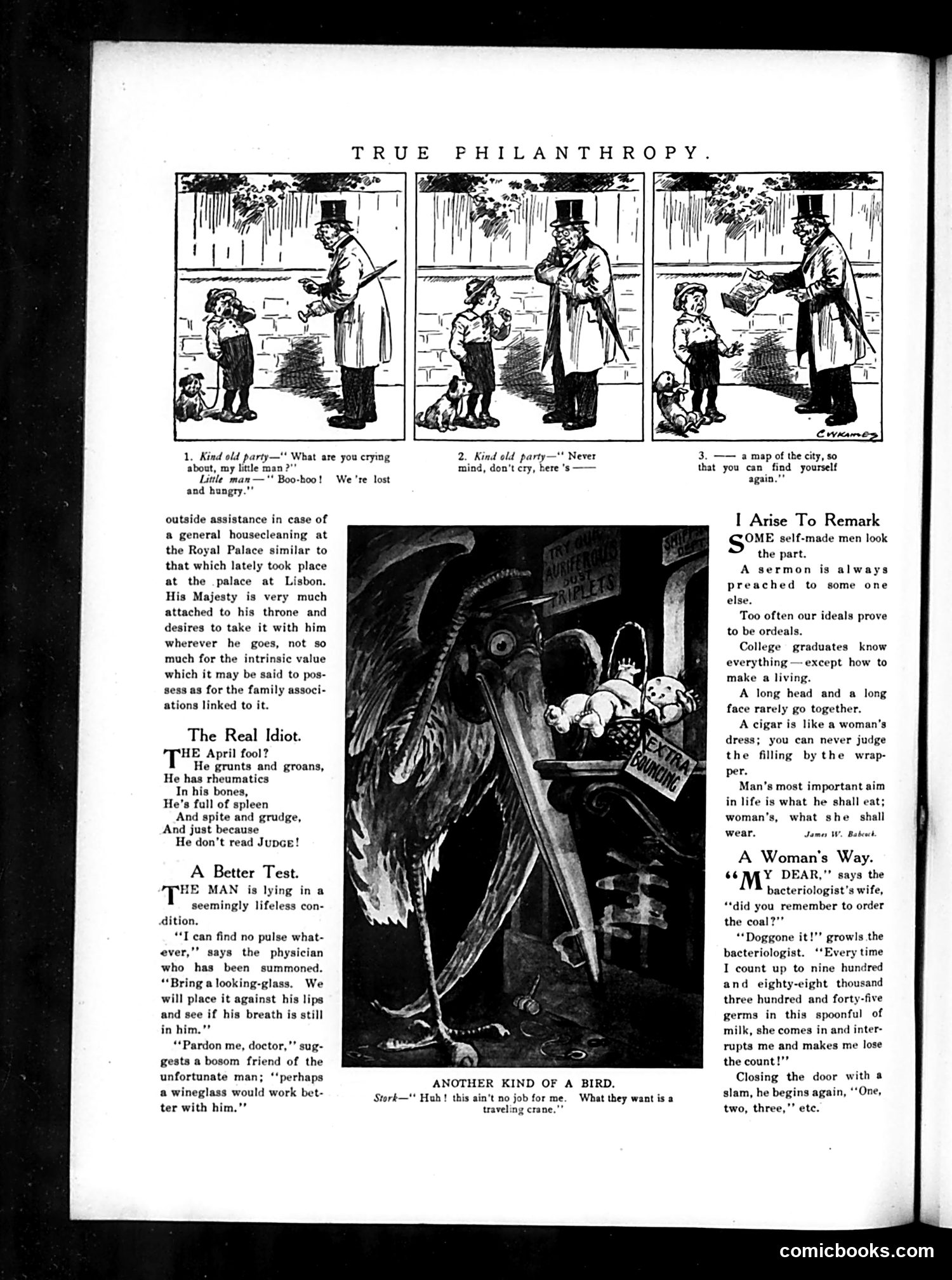
The three-panel cartoon at top satirizes superficial charity. A well-dressed gentleman encounters a lost, hungry child. In panels 1-2, he offers sympathy and directions (a map). Panel 3 reveals the joke: he gives the child a map to find their way home—materially unhelpful but allowing him to feel philanthropic without genuine sacrifice. The satire critiques wealthy donors who perform charity for appearance's sake rather than providing real assistance. The child remains hungry and lost; the gentleman maintains his self-image as benevolent. Below, miscellaneous humorous observations mock various social types: the "Real Idiot" who doesn't read *Judge* magazine; physician humor; and gender commentary on women's practical concerns versus men's intellectual pursuits. The page reflects *Judge's* satirical examination of class, pretense, and hypocrisy in Gilded Age American society.
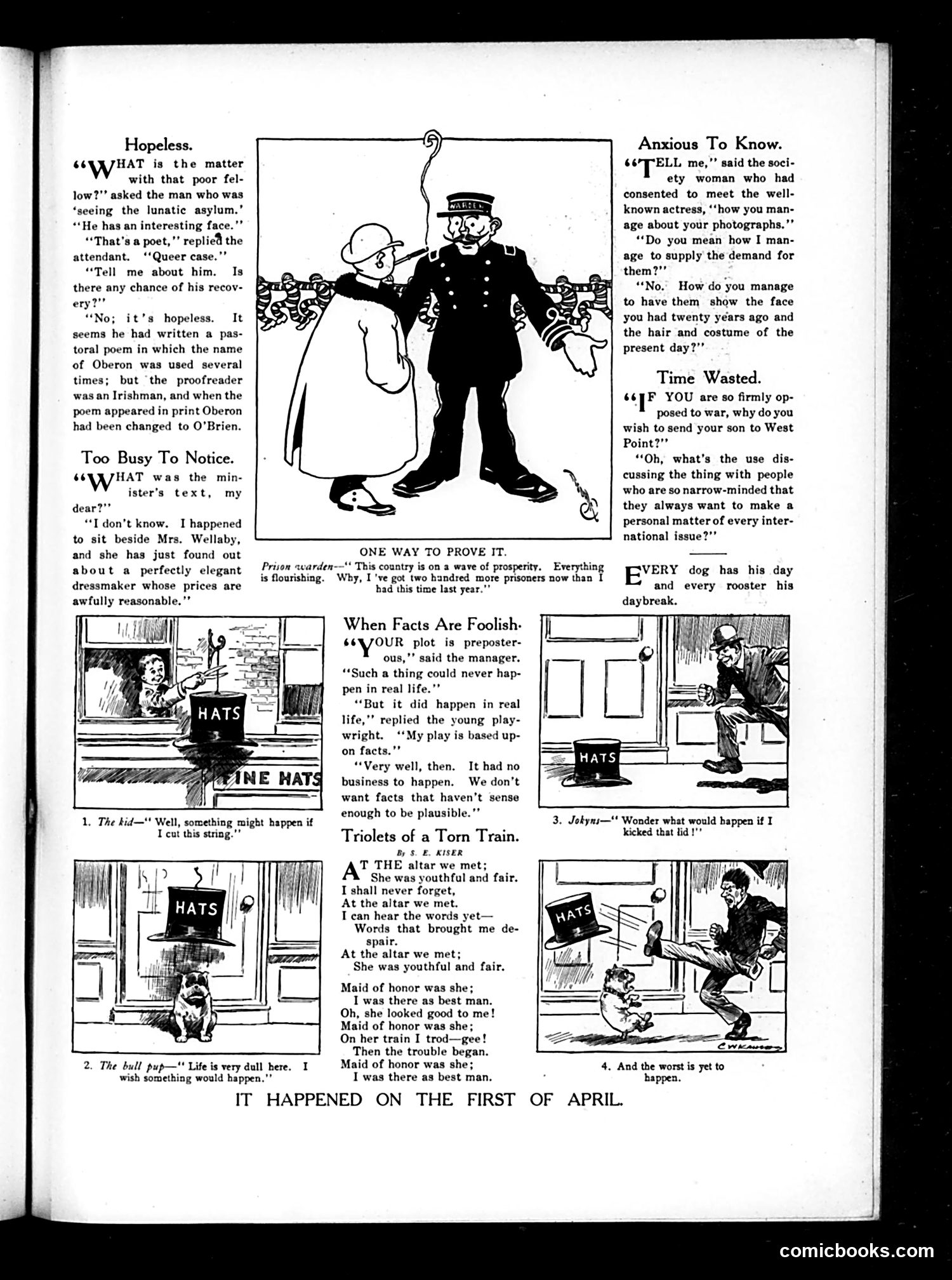
This is a collection of short satirical pieces typical of Judge magazine's humor. Key content: **"Hopeless"** mocks Irish proofreaders through a poet driven mad when his "Oberon" was changed to "O'Brien" in print—a jab at both Irish identity and editorial incompetence. **"One Way to Prove It"** shows a prison warden claiming prosperity because he has more prisoners, absurdly using incarceration as an economic indicator—satirizing flawed logic about national prosperity. **"When Facts Are Foolish"** depicts a theater manager rejecting a true story as implausible, mocking theater gatekeepers who demand "realistic" plots that paradoxically reject actual reality. **"Triolets of a Torn Train"** offers groom's regret—he stepped on the bride's train at the altar, starting marital trouble. It's gentle romantic satire about wedding mishaps. The remaining pieces ("Anxious to Know," "Time Wasted," "Too Busy") are brief social observational humor about photography vanity, anti-war hypocrisy, and distracted socialites. The page title references April Fools' Day pranks.
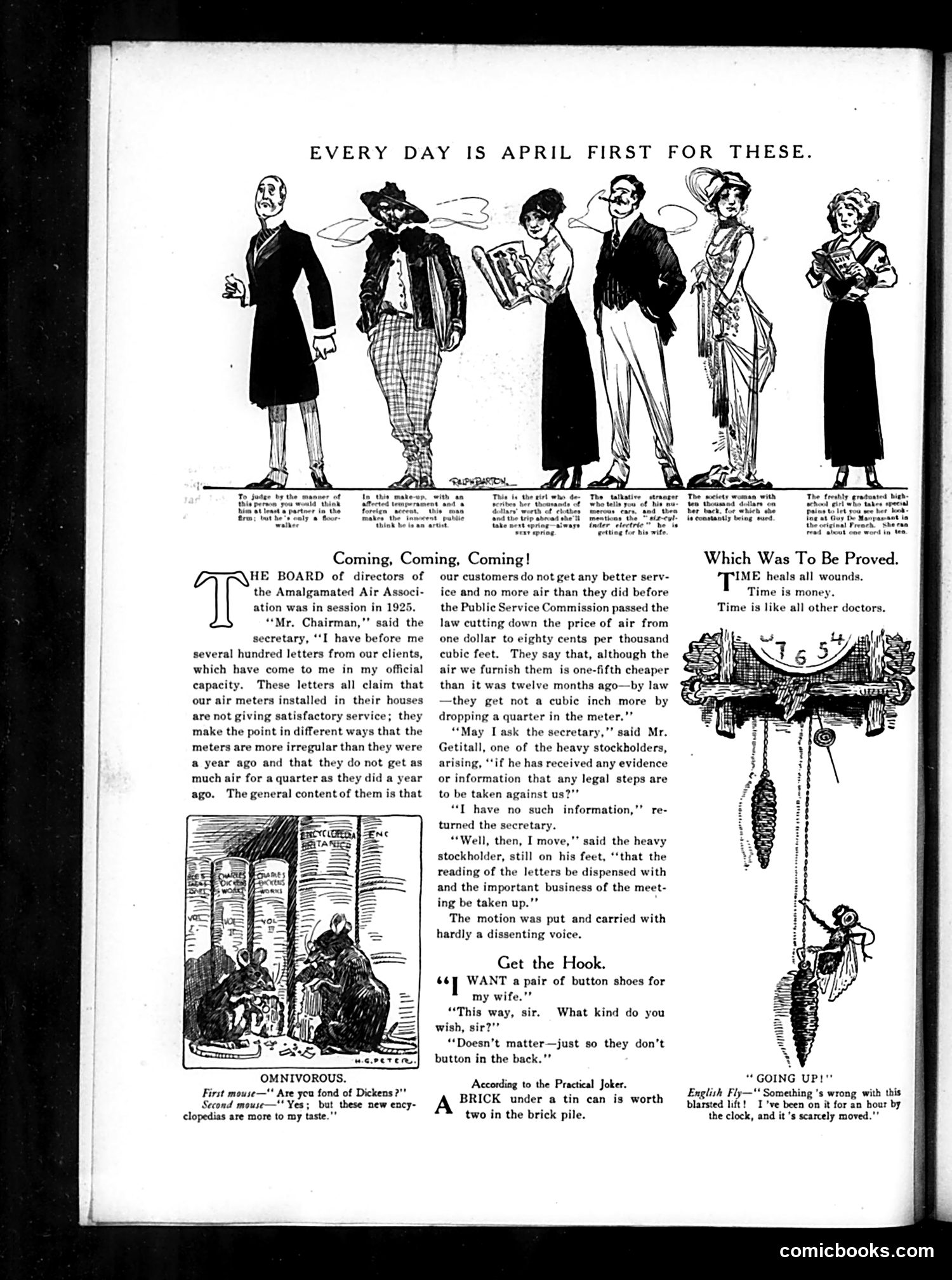
This Judge magazine page satirizes price regulation and corporate malfeasance through multiple pieces: **Top cartoon**: "Every Day is April First" depicts various con artists and swindlers—the caption suggests these figures perpetually deceive the public, implying April Fools' Day is their everyday business. **Main article**: The "Amalgamated Air Association" is a fictional utility company exploiting a regulatory loophole. After authorities cut air prices from $1 to 80 cents per thousand cubic feet, customers complain they receive *less* air despite paying less—the company simply rigged the meters to cheat them. When the board hears this, executives vote to ignore the complaints entirely, prioritizing profit over honesty. **Satire point**: The piece mocks how regulated monopolies circumvent consumer protections through fraud. Companies reduce prices nominally while reducing service proportionally, rendering regulation meaningless. The smaller jokes at bottom are unrelated filler typical of satirical magazines—wordplay and mild humor.
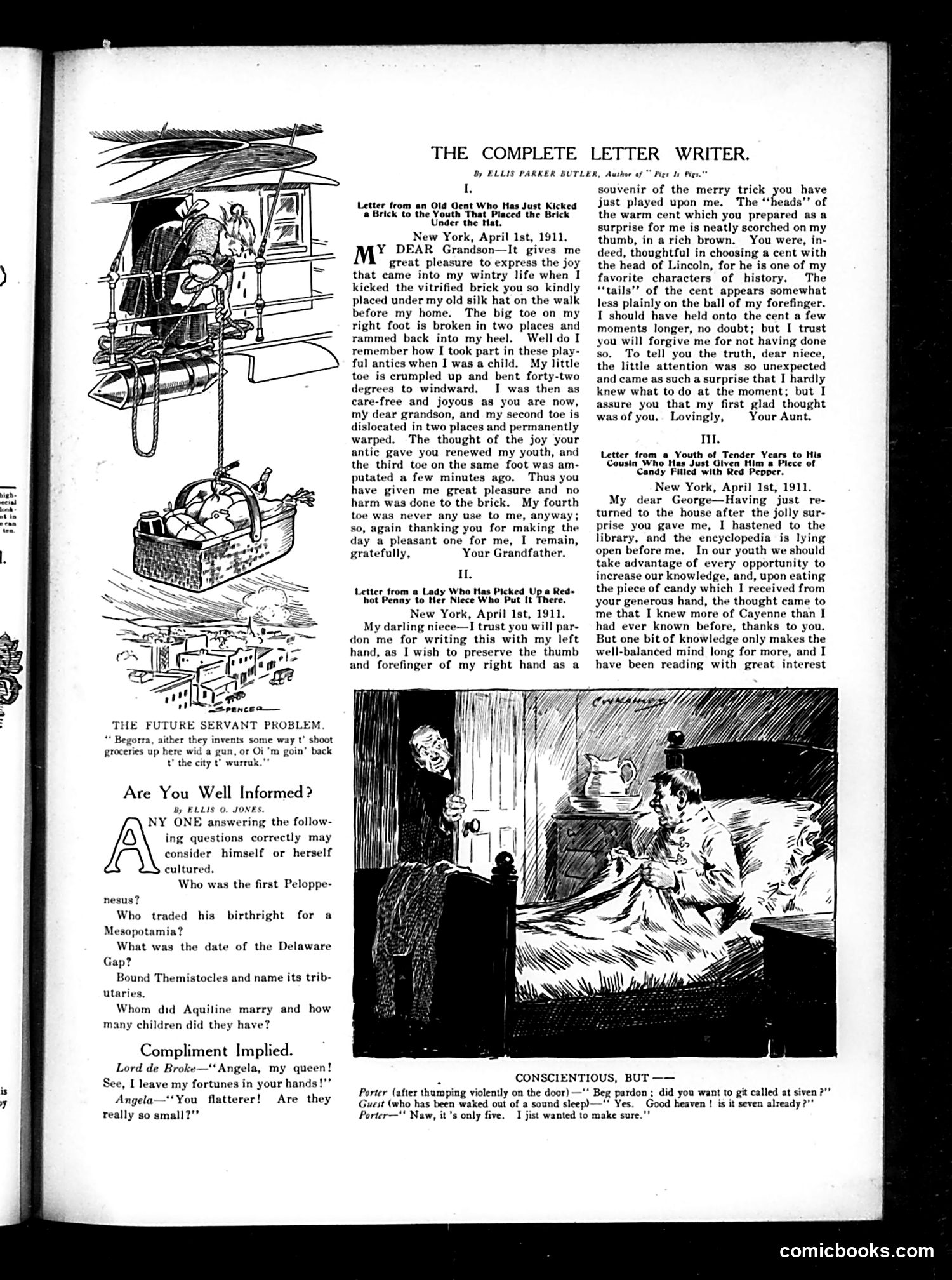
This page from *Judge* magazine (April 1, 1911) contains satirical "thank you" letters mocking a common prank tradition—likely April Fools' Day pranks played on relatives. **The Content:** Three fictional letters thank pranksters for their "kindnesses": an elderly grandfather thanks his grandson for placing a brick under his hat (resulting in broken toes), an aunt thanks her niece for heating a penny (causing burns), and a young cousin thanks George for candy filled with red pepper (causing mouth pain). **The Satire:** The humor lies in the exaggerated, formal politeness of the letters. Each writer describes genuine harm with elaborate gratitude, praising the prankster's thoughtfulness while cataloging injuries in mock-serious detail. The joke exposes the absurdity of pretending harmful pranks are wholesome family fun. **Context:** This reflects turn-of-the-century American humor that found slapstick injury funny. The satire gently critiques this attitude by making the consequences uncomfortably explicit through formal language.
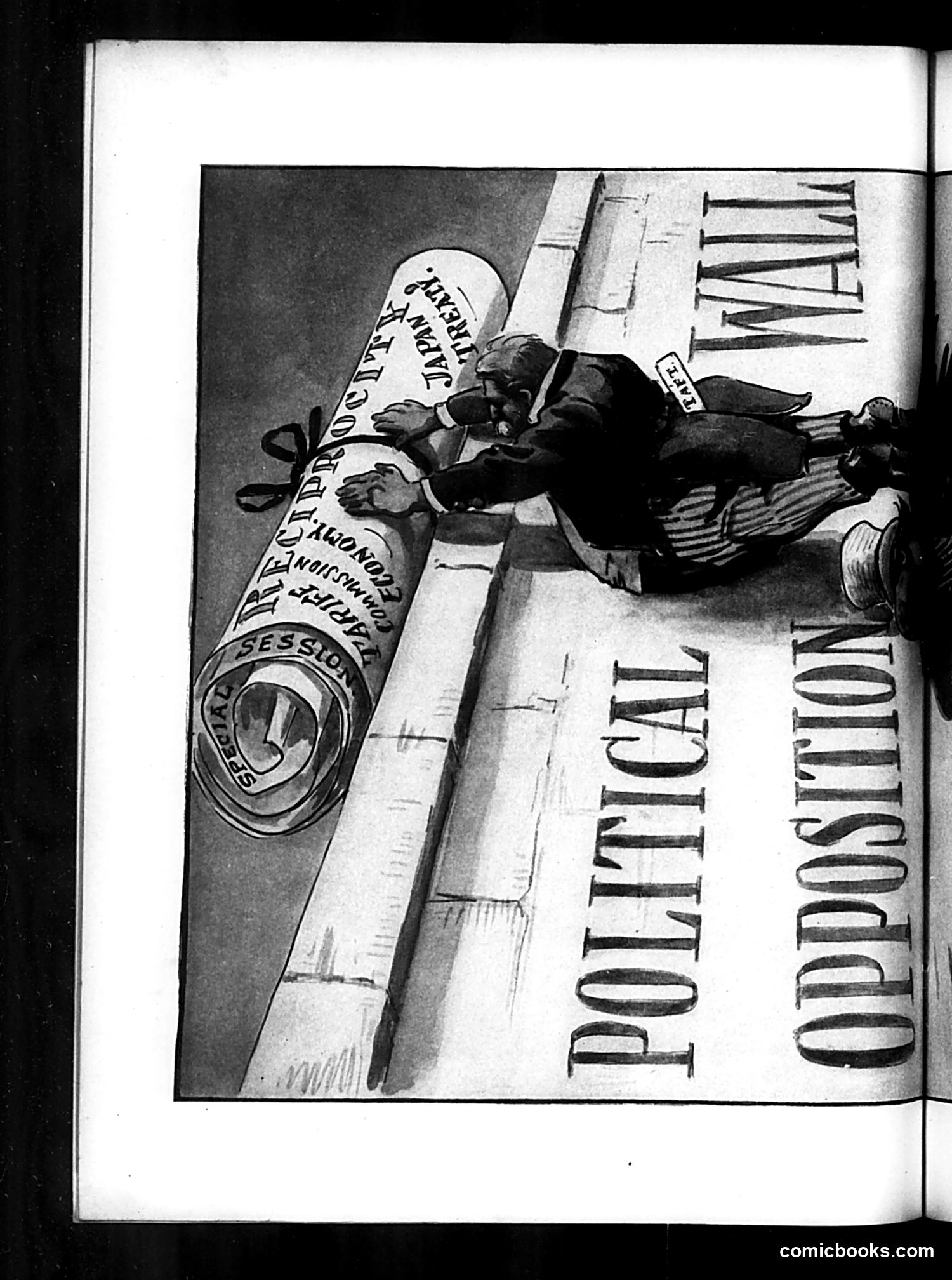
This Judge magazine page depicts a figure operating what appears to be a large industrial or military device labeled with text suggesting "SESSION" and other partially visible text. The figure wears striped clothing and a hat, appearing to operate machinery with concentrated effort. The caption reads "POLITICAL OPPOSITION" (visible on the right side), suggesting this is satirizing political opposition or resistance as mere mechanical operation—possibly commentary on politicians or political figures functioning as if automated or programmed rather than acting with genuine conviction. Without clearer visibility of all text on the device or the specific historical date, I cannot definitively identify which political moment or figures this targets. The satire appears to mock the mechanical, impersonal nature of political opposition itself.
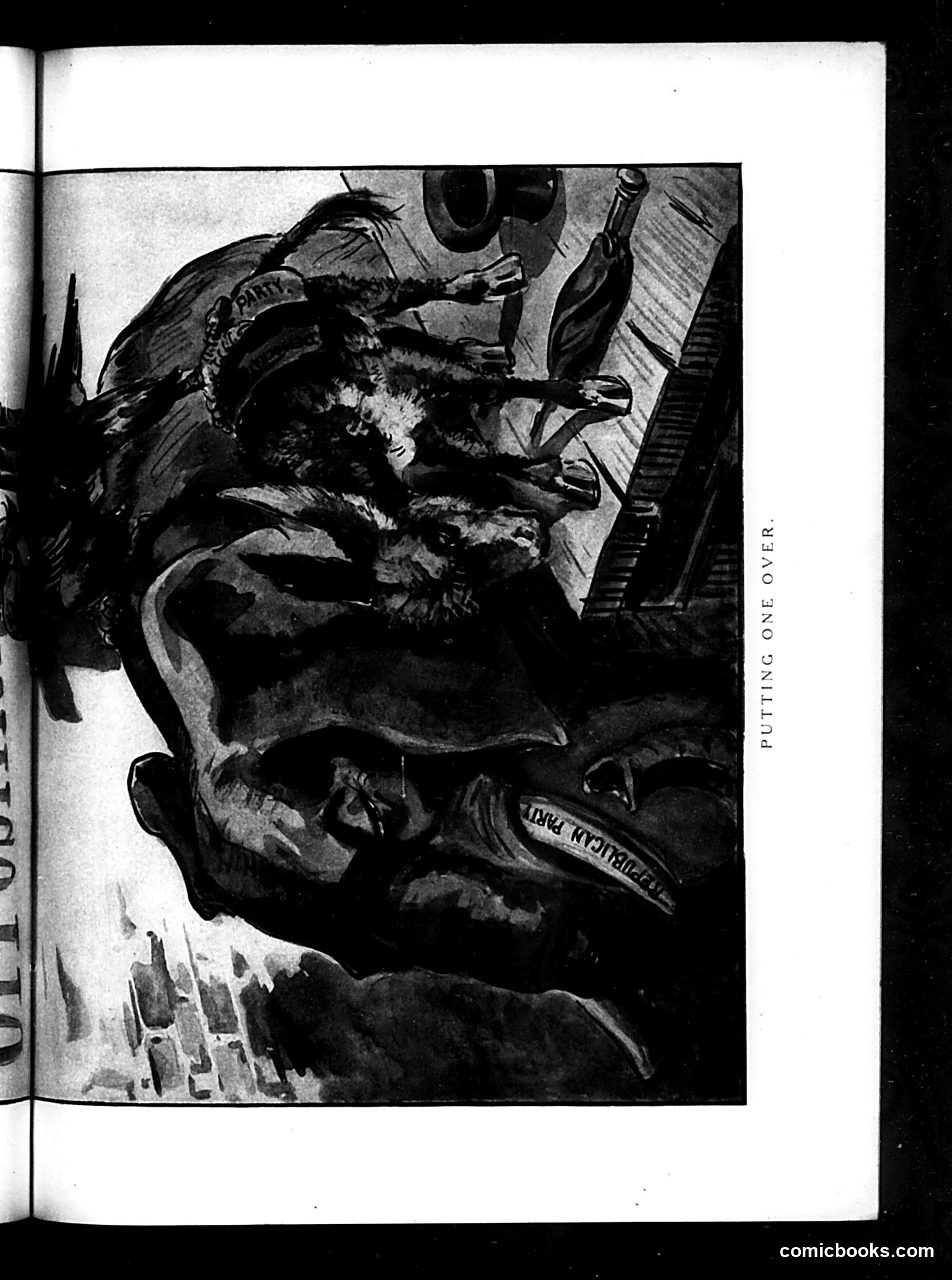
This political cartoon depicts a figure—likely a politician or public official—literally struggling to push a bottle (presumably containing some policy or scheme) over an edge or obstacle, straining against significant resistance. The figure is portrayed in an exaggerated, unflattering manner typical of Judge magazine's satirical style. The title "PUTTING ONE OVER" suggests the cartoon critiques someone attempting to deceive the public or force through an unpopular measure. The physical struggle depicted emphasizes the difficulty or desperation of the effort. Without clear date context or clearer identification of the specific figure, I cannot definitively identify which political situation this references, though the visual language indicates skepticism toward some attempted deception or forced policy implementation.
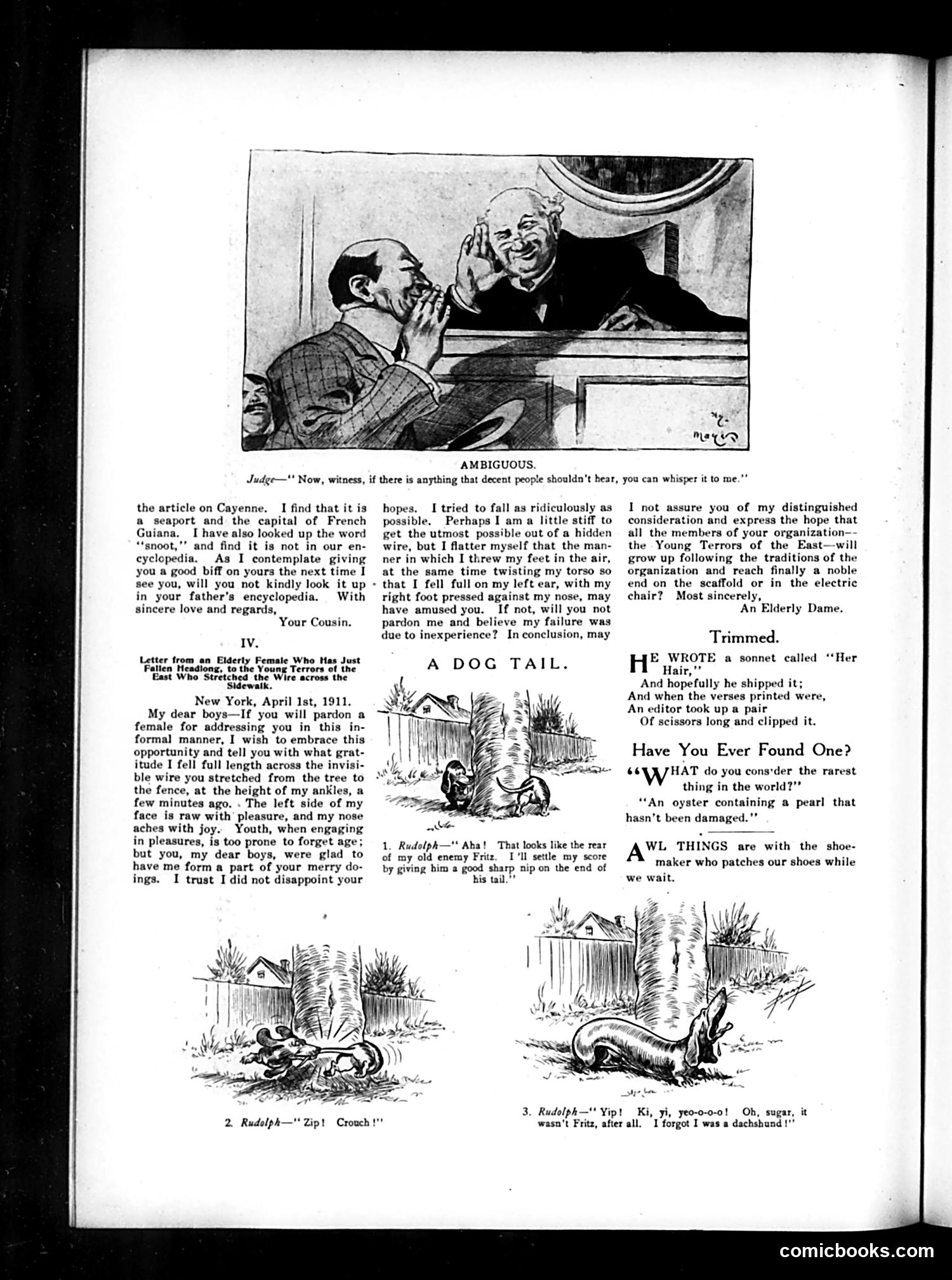
**The Main Cartoon ("Ambiguous"):** A judge sits in court while a witness covers his mouth to whisper. The joke plays on judicial propriety—the judge invites the witness to whisper anything "decent people shouldn't hear," creating comic irony about what courts will tolerate. **"Letter from an Elderly Female":** This is satirical social commentary. A elderly woman sarcastically thanks boys who stretched a wire across a sidewalk that tripped her. Her mock-grateful, overly formal letter is humorous, but it subtly critiques youthful cruelty and recklessness toward the elderly. The closing wish that the boys end "on the scaffold or in the electric chair" is darkly ironic. **"A Dog Tail" / "Trimmed" / "Have You Ever Found One?":** These are brief humorous vignettes—a dog chases the wrong animal, a poem gets edited down, and an oyster without a damaged pearl is supposedly rare. They're light comic fillers typical of Judge magazine's miscellaneous humor content.
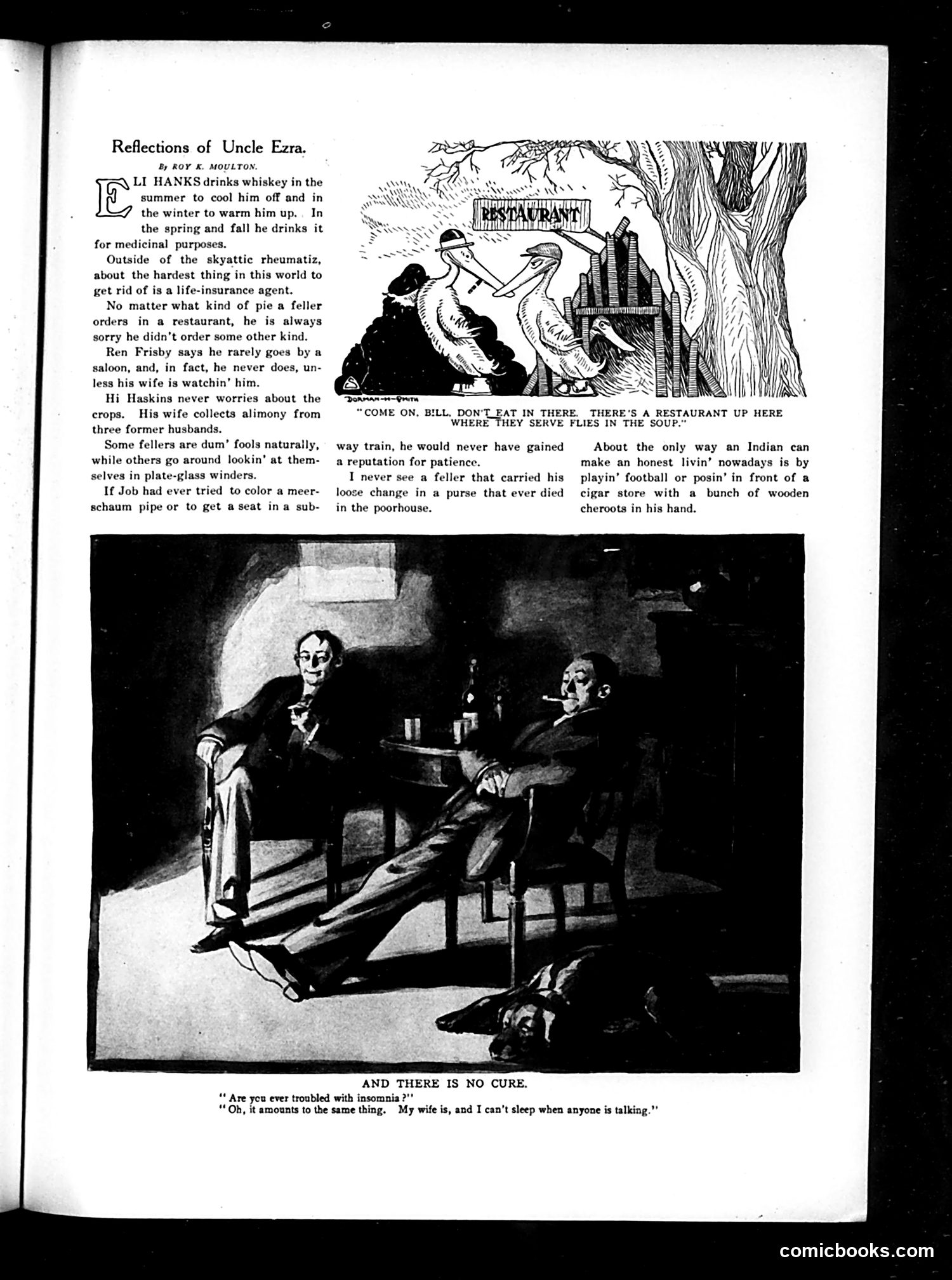
This page collects rural American humor and social observations by "Uncle Ezra," a rustic character dispensing folksy wisdom. The top cartoon depicts two ducks fleeing a restaurant, joking that the establishment serves "flies in the soup"—mocking cheap, unsanitary diners of the era. The lower illustration shows two men discussing insomnia, where one complains his wife's talking prevents sleep—a common domestic complaint used for comedic effect. The text throughout offers cynical observations on American life: life-insurance salesmen as pests, men sneaking to saloons when wives aren't watching, and a sardonic note about Native Americans reduced to "honest livin'" only through sports or posing as cigar-store decorations—reflecting the period's racist stereotypes. The humor relies on period-specific anxieties: railway travel, rheumatism remedies, and restaurant quality—concerns of early 20th-century readers.
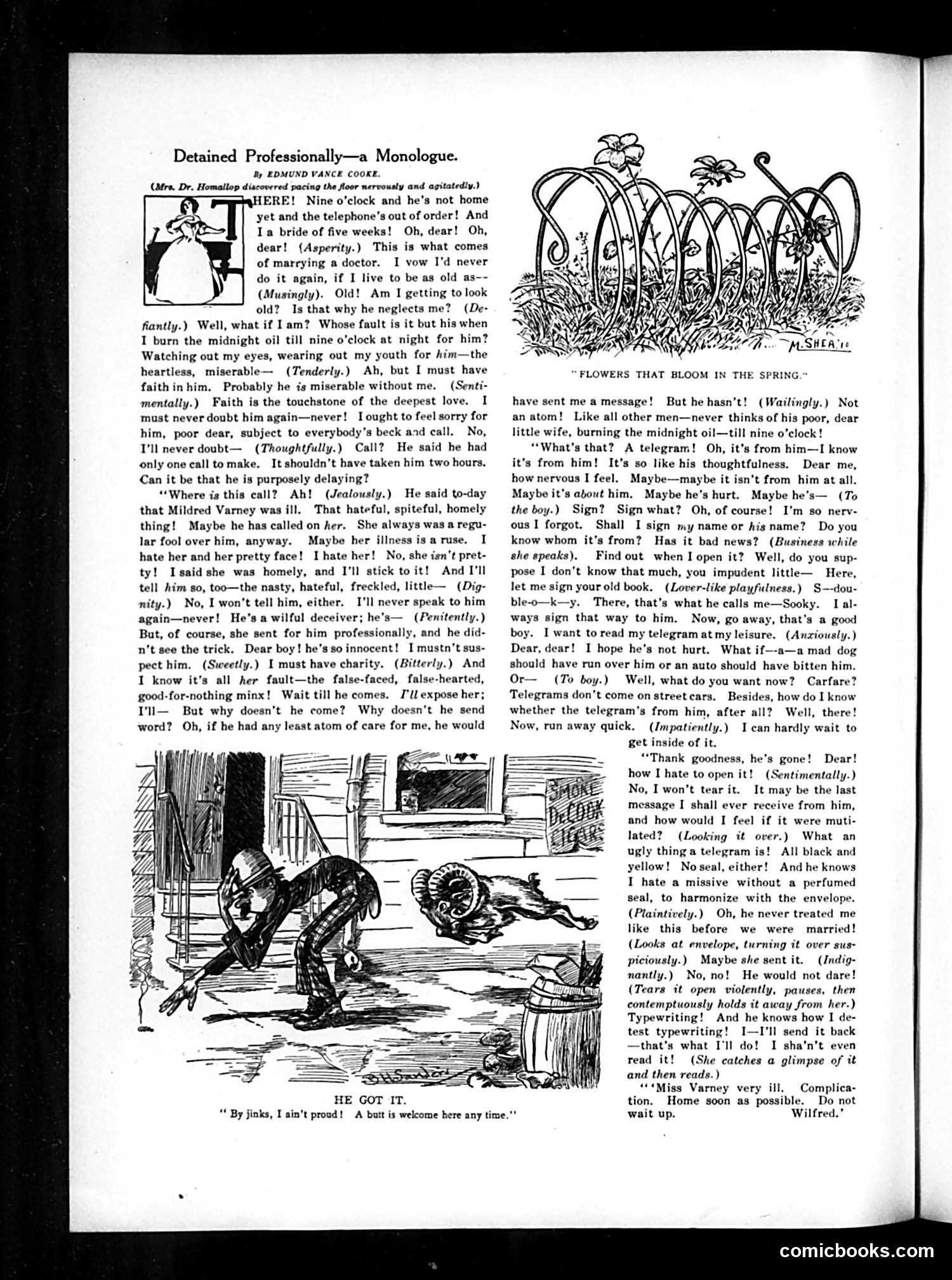
This is a satirical monologue by Edmund Vance Cooke depicting a newlywed doctor's wife anxiously awaiting her husband's return. The piece mocks the emotional volatility and jealous suspicions of a bride married only five weeks. The humor lies in her rapid mood swings: she oscillates between devotion ("Faith is the touchstone of deepest love"), suspicion (worrying he's visiting the "hateful" Mildred Varney under false pretenses of a medical call), and self-recrimination. She simultaneously romanticizes sacrifice ("burning the midnight oil") while resenting it. The satire targets both the anxiety of a doctor's wife (whose husband's professional duties keep him away unpredictably) and the stereotype of the emotionally unstable newlywed. When a telegram arrives, her hysteria peaks—she obsesses over its contents before even opening it, imagining disasters. The accompanying cartoons show a dog with a telegram and bicycles labeled "Flowers That Bloom in the Spring," likely visual jokes about delivery methods and springtime romance—ironic counterpoints to her domestic anxiety.
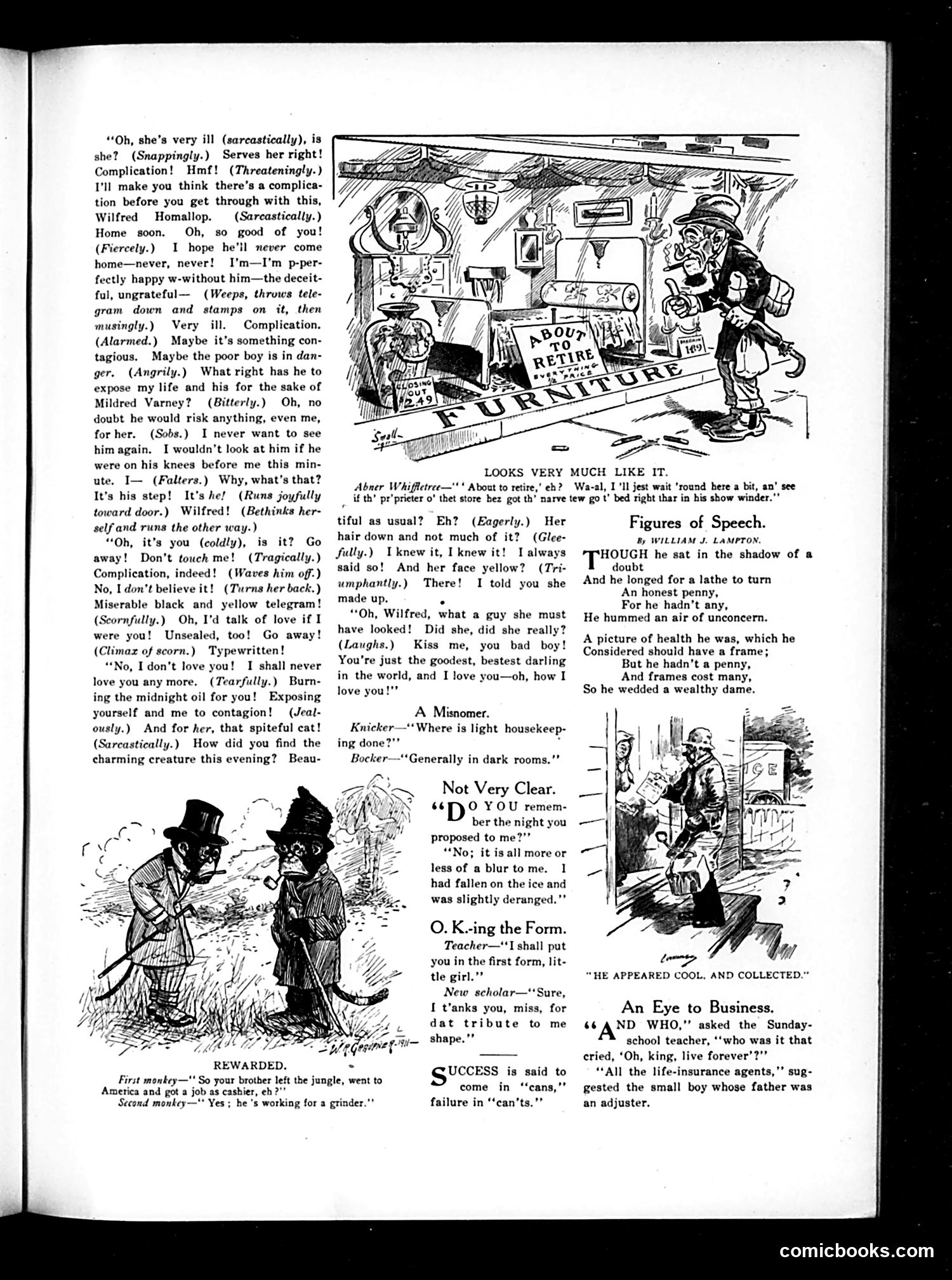
This Judge magazine page contains several satirical pieces mocking domestic life and social conventions of the era. **The main drama** depicts a wife receiving news of her husband's illness. She cycles through exaggerated emotions—angry, then worried, then overjoyed when he arrives—satirizing the melodramatic emotionality expected of women and marital discord masked by social performance. **"Rewarded"** jokes darkly that the brother "worked for a grinder"—likely slang for a street organ player or low-status job—undercutting the immigrant success narrative. **"A Misnomer"** puns on "light housekeeping" as a euphemism for affairs conducted in darkness. **"O.K.-ing the Form"** features an Irish immigrant child mishearing "first form" (school class) as a compliment about her body shape—ethnic humor based on accent and class-based ignorance. **"An Eye to Business"** satirizes that life-insurance agents would praise a despotic king's longevity, since their profits depend on calculating death. The adjuster father reference suggests insurance claim disputes.
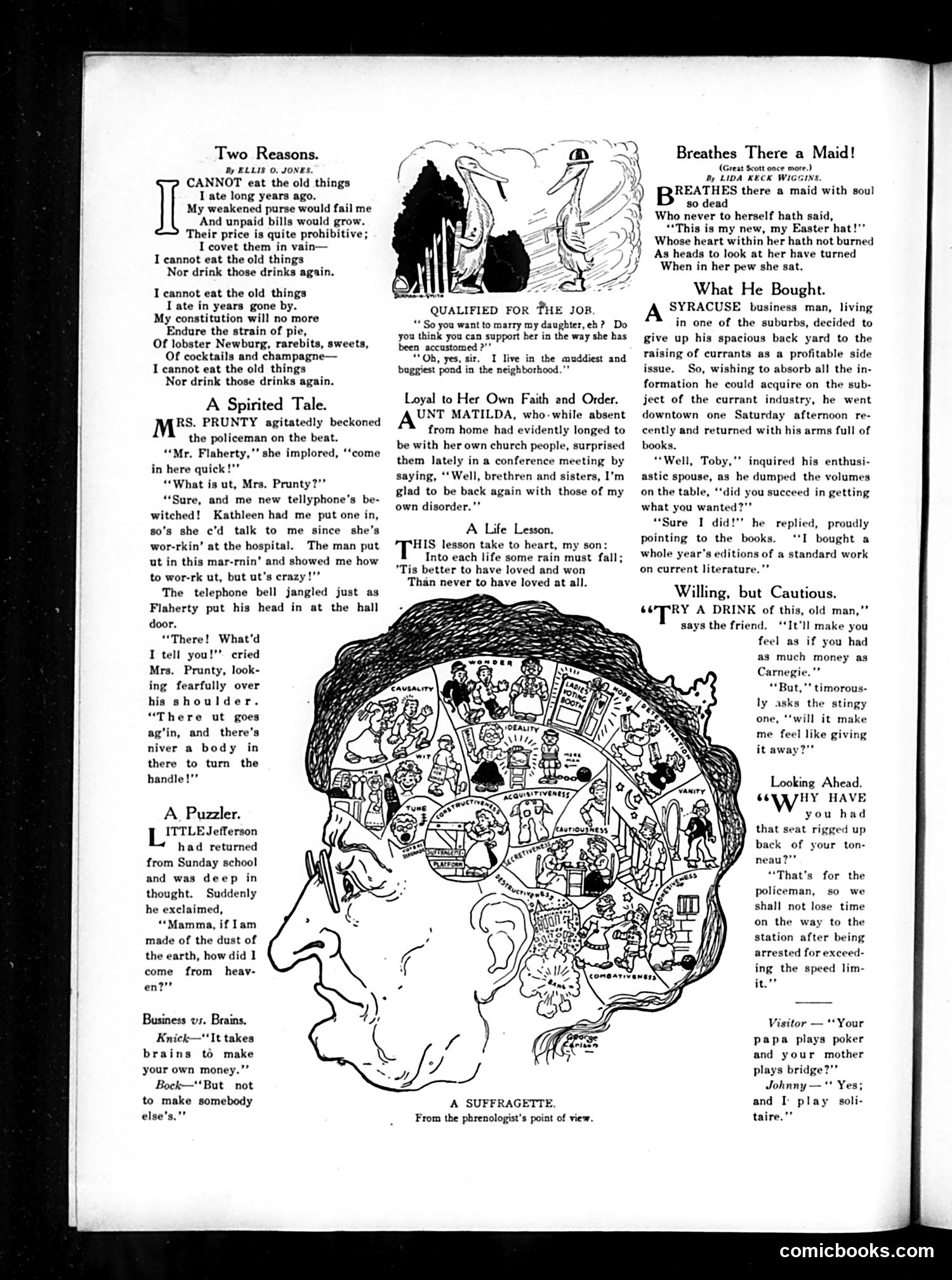
This page from Judge contains several short humorous pieces reflecting early 20th-century American life and concerns: **"Two Reasons"** — A poem about aging and inflation: the speaker can't afford or physically tolerate the foods and drinks he enjoyed years ago, suggesting post-WWI economic hardship and rising prices. **"A Spirited Tale"** — Mrs. Prunty, an Irish immigrant (indicated by dialect), fears her new telephone is "bewitched" because it rings with nobody present—satire of older generations' confusion with new technology. **"A Suffragette"** — A phrenology cartoon (pseudoscience linking skull shape to character) caricaturing a suffragist's head as oddly-shaped, mocking women's voting rights activists. **"What He Bought"** — A man buys books on "current literature" intending to learn about currants (the fruit), missing the wordplay—gentle satire of practical ignorance. The remaining pieces joke about marriage, children's logic, and speeding fines—typical Judge humor of the era, blending gentle social observation with contemporary concerns about technology, immigration, and women's rights.
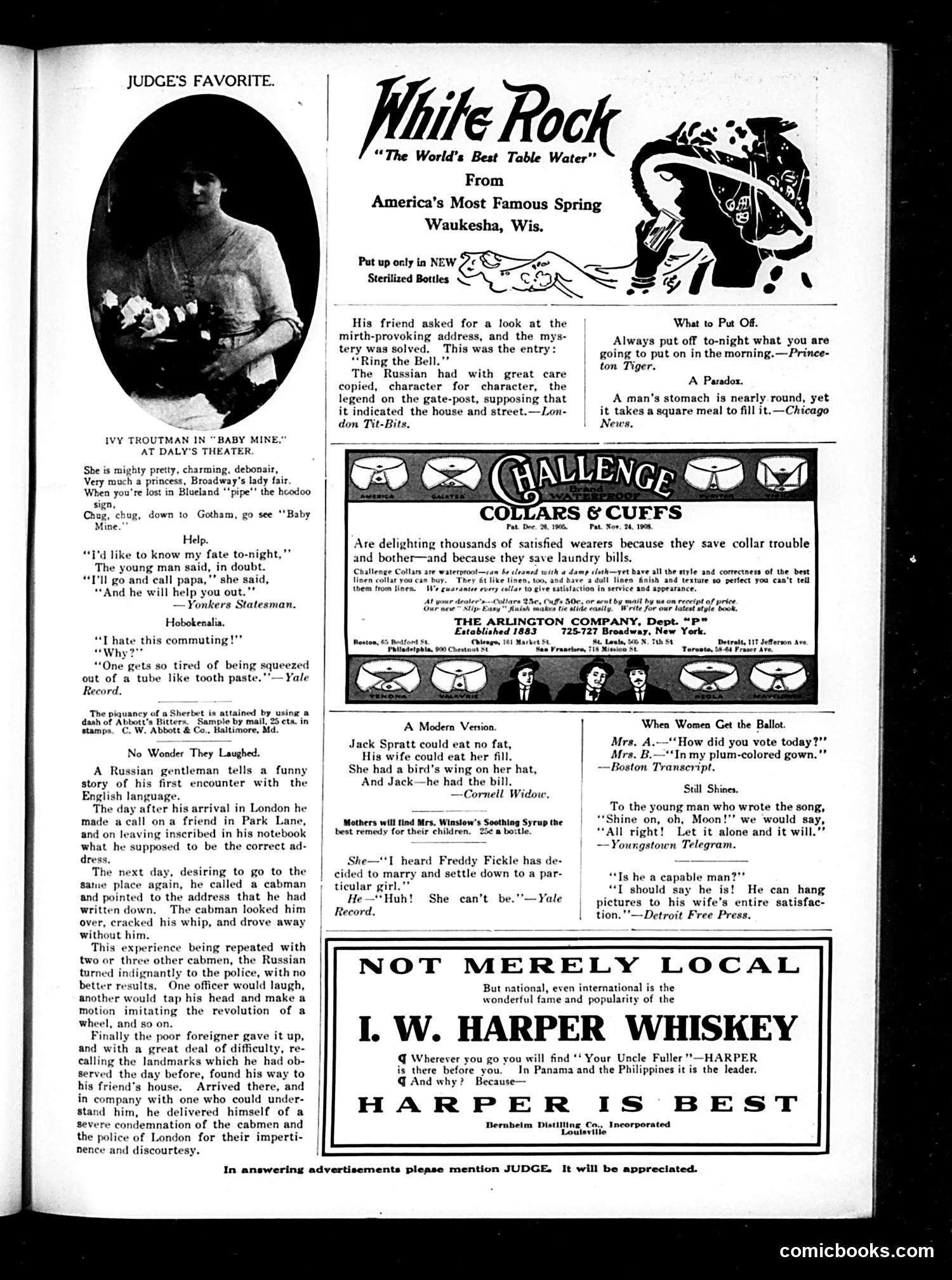
This is primarily a **humor and advertising page** from Judge magazine, with no significant political cartooning. The "Judge's Favorite" section features **Ivy Troutman**, an actress in the Broadway play "Baby Mine" at Daly's Theater—a straightforward promotional notice praising her performance. The page contains several **short humor pieces** typical of the era: a joke about a confused Russian immigrant who copied "Ring the Bell" from a gate-post as a London address; commuting complaints; and quips about procrastination and paradoxes. These reflect early 1900s urban American concerns and immigrant experiences. The substantial **advertisements** dominate—White Rock mineral water, Challenge Collars (waterproof detachable collars), and I.W. Harper Whiskey. The "Modern Version" of Jack Spratt jokes about women's suffrage indirectly (women "getting the ballot"), while other pieces contain mild gender humor typical of the period. No significant satire or political commentary is evident here.
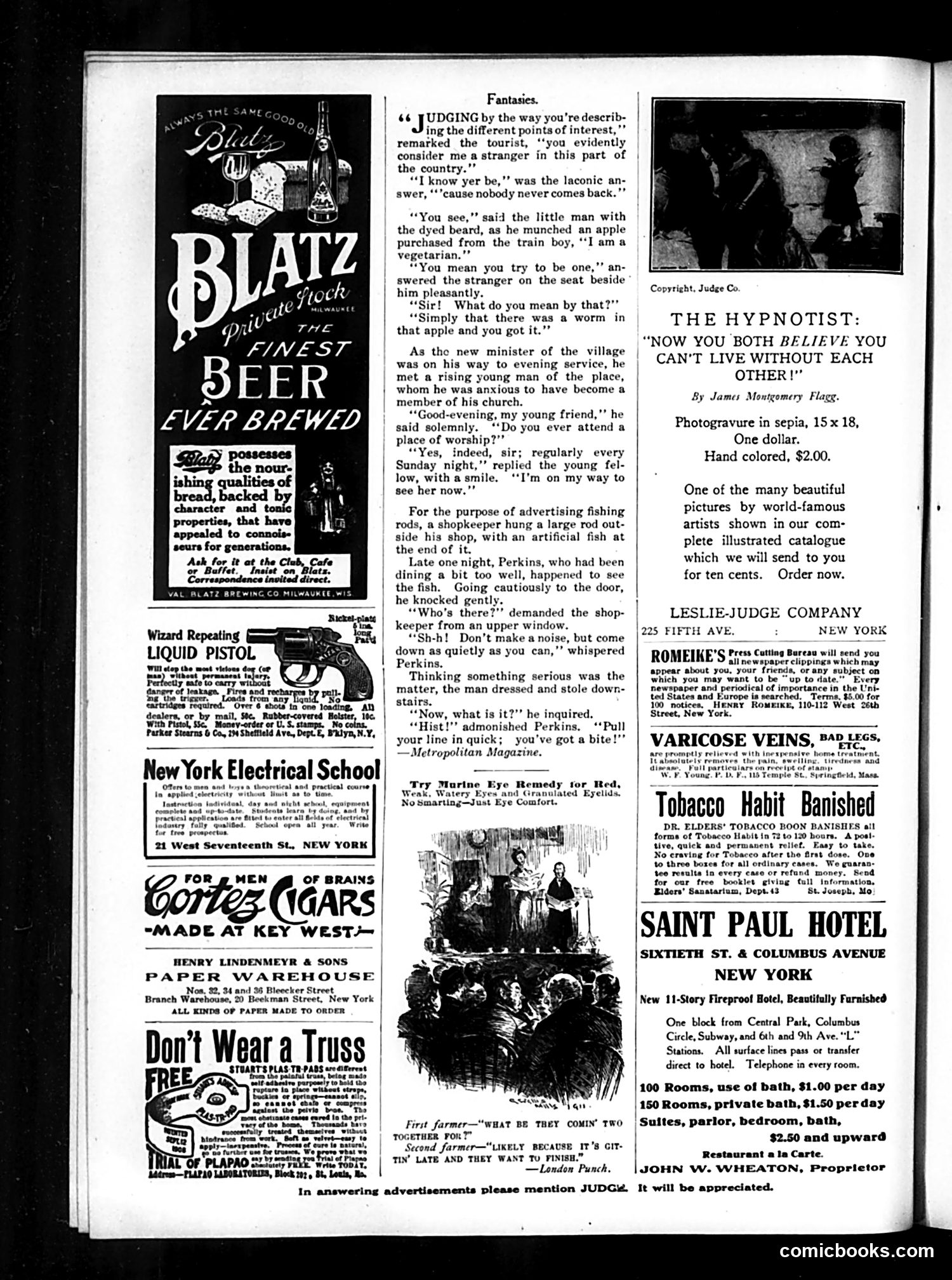
This page is primarily **advertising**, with several brief humorous anecdotes interspersed. The main illustrated content is "The Hypnotist," a James Montgomery Flagg artwork depicting hypnosis as a romantic/relationship tool—the joke being that a hypnotist has convinced a couple they're interdependent ("can't live without each other"). The text contains several short jokes typical of early 20th-century humor magazines: - A tourist-and-local exchange mocking a region's unpleasantness - A vegetarian who unknowingly eats a worm - A reverend trying to recruit a young man to church (who's actually visiting a girlfriend) - A drunk man attempting to "help" a shopkeeper reel in what he thinks is a real fish These are gentle, observational comedies about rural life, clerical earnestness, and inebriation—common Judge magazine fare. The remaining content consists of product advertisements for beer, cigars, trusses, electrical schools, and hotels. There is no overt political satire on this particular page.
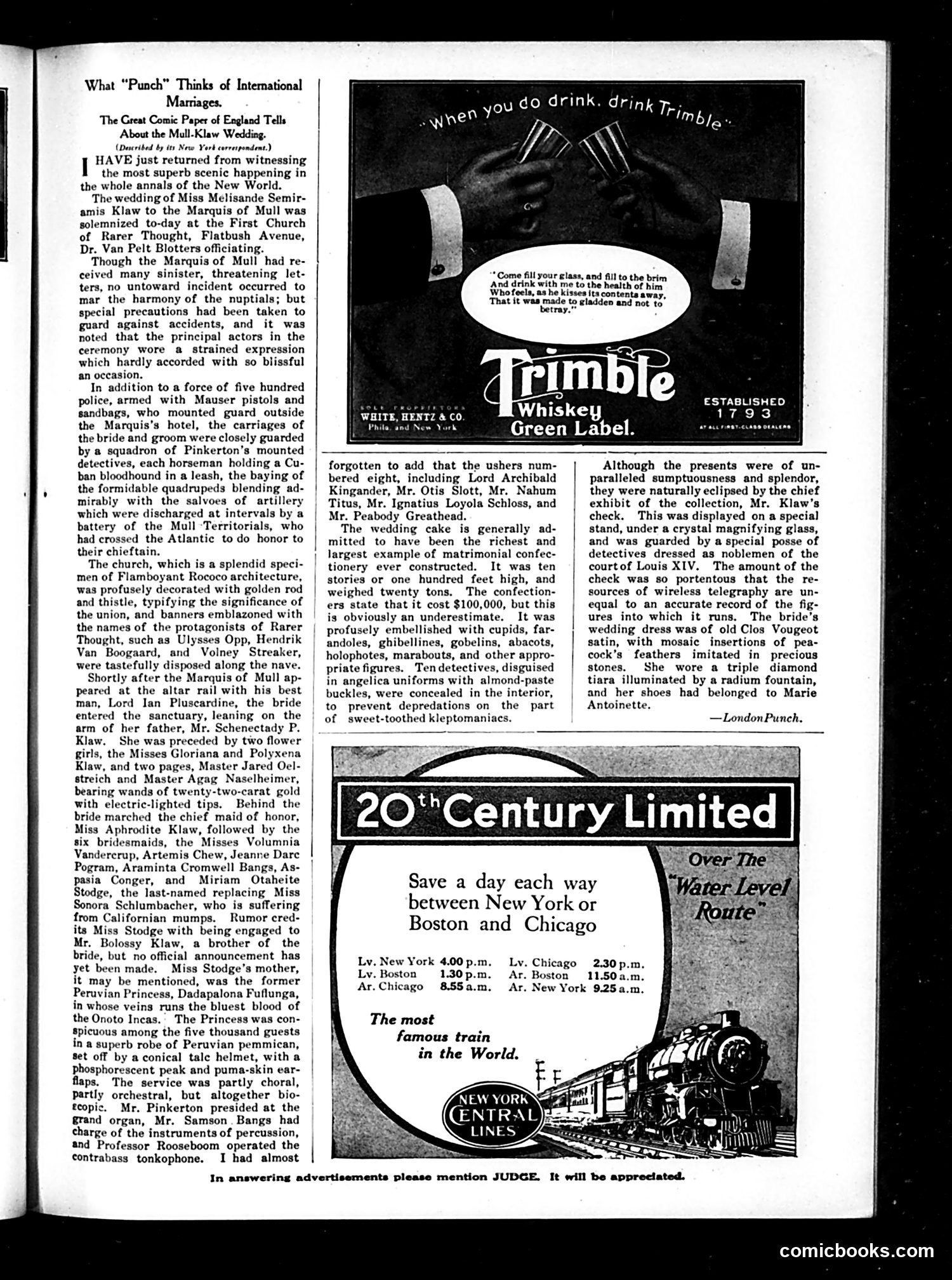
This is a satirical article from *Judge* mocking an extravagant international society wedding between an American heiress (Miss Melisande Semiramis Klaw) and a Scottish marquis (the Marquis of Mull). The satire targets: **The Joke**: The exaggerated, absurd security measures and pretentious details—500 police, Pinkerton detectives, Cuban bloodhounds, artillery salvoes, gold-tipped wands, and ridiculous guest names ("Polyxena Klaw," "Araminta Cromwell Bangs")—mock the ostentatious spectacle of Gilded Age wealthy Americans marrying European nobility. **Social Context**: International marriages between rich Americans and titled Europeans were fashionable but controversial, seen by some as status-seeking or potentially fraudulent. The piece sarcastically suggests such weddings require military-scale security, implying they're dangerous or unstable unions. **The Tone**: Pseudo-serious reportage with impossible details (a "Peruvian pemmican" dress, a "tonkophone") signals this is broad parody of society journalism. The page also contains period advertisements for Trimble Whiskey and the 20th Century Limited train.
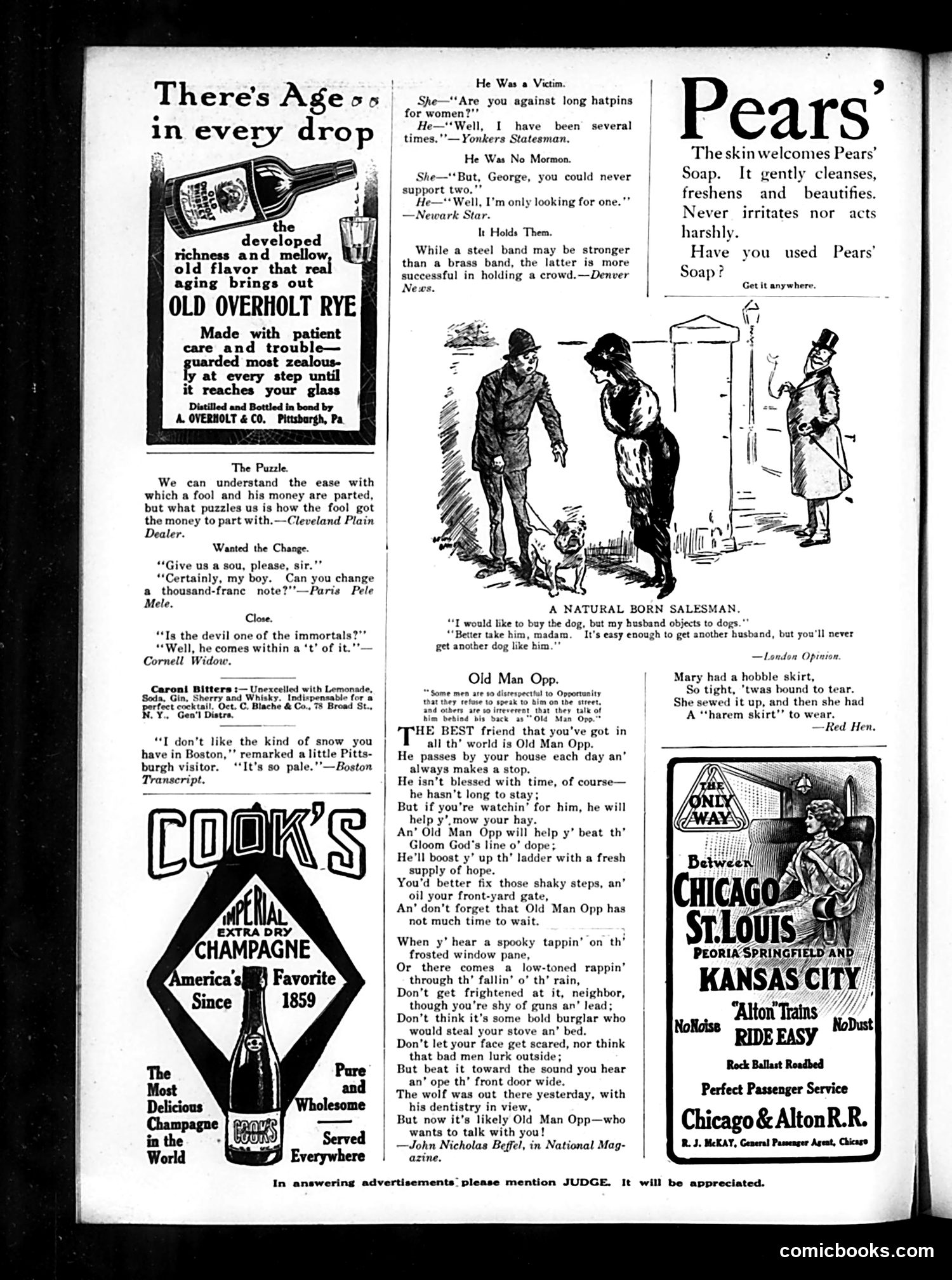
This is primarily an **advertising and humor page** from Judge magazine, not a political cartoon. The content consists of: **Main Cartoons/Humor:** - "A Natural Born Salesman" depicts a street encounter where a woman wants to buy a dog but her husband objects—the caption emphasizes the salesman's persistence and persuasiveness. - "Old Man Opp" is a lengthy poetic piece personifying "Opportunity" as a character who visits those willing to work (mowing hay, fixing gates). It's inspirational verse about seizing chances. **Advertisements:** The page features prominent ads for whiskey (Old Overholt Rye), champagne (Cook's), Pears' Soap, and the Chicago & Alton Railroad—typical early 20th-century consumer goods. **Scattered Jokes:** Brief one-liners about marriage, fashion (hobble skirts), and social observations—standard magazine filler humor of the era. **Overall Context:** This appears to be an ordinary editorial/advertising mix page rather than satirical commentary on contemporary political events or social movements. It reflects period concerns about courtship, opportunity, and consumer goods.
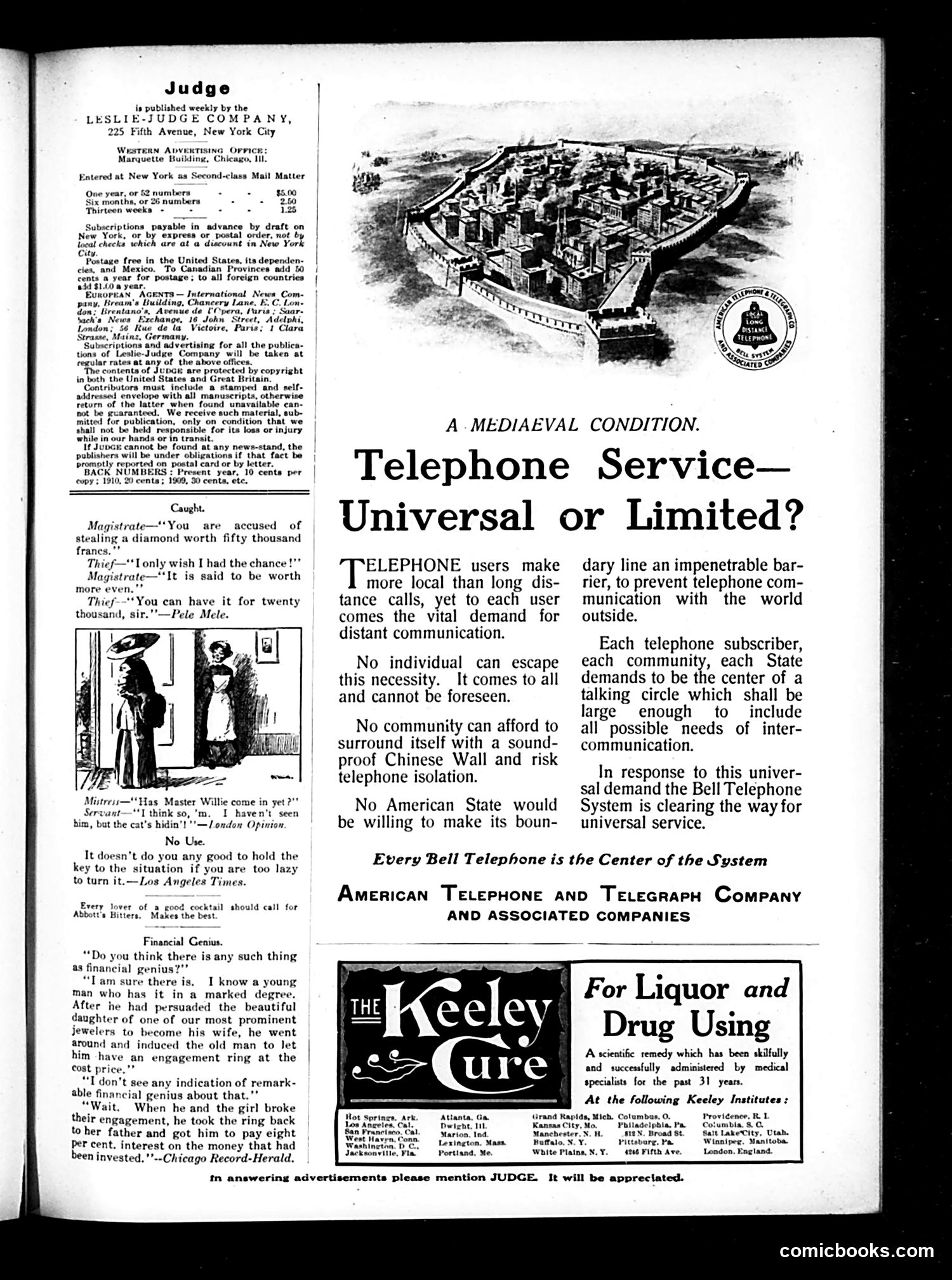
This page is primarily **advertising and masthead material** rather than political satire. The main content includes: **Structural elements:** - Judge magazine's publication information and subscription rates - Several brief humor snippets (dialogue jokes from various sources) **Central advertisement:** The large middle section promotes **AT&T's telephone service**, arguing for universal connectivity. The copy uses quasi-political language ("mediaeval condition") to frame limited telephone service as unacceptable, claiming every subscriber, community, and state needs access to nationwide communication networks. **Key context for modern readers:** This represents early **corporate advocacy advertising**—AT&T essentially arguing that monopoly telephone service benefits the public good. The "universal service" framing appears designed to justify centralized control of communications infrastructure. **Bottom advertisements:** The Keeley Cure advertisement for treating "liquor and drug using" reflects early-20th-century medical attitudes toward addiction as treatable illness (though methods would be considered questionable today). The page overall is more commercial than satirical.
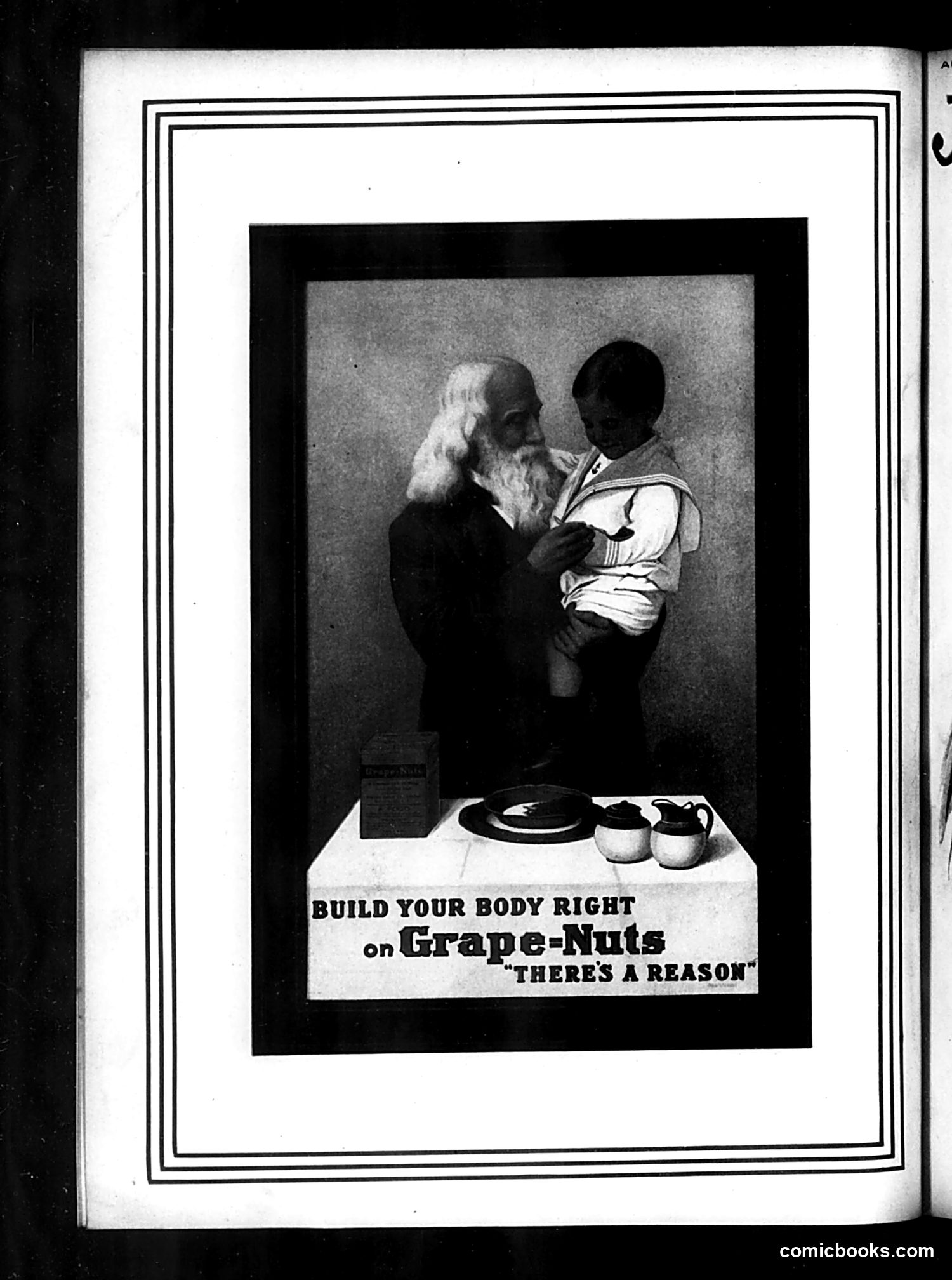
This is a commercial advertisement rather than political satire. It depicts an elderly man with a long white beard holding a young child, positioned above a table displaying Grape-Nuts cereal, a bowl, and two cups. The ad's message promises that consuming Grape-Nuts will help "build your body right," with the tagline "There's a reason"—which was Grape-Nuts' actual historical advertising slogan. The imagery uses the venerable elderly figure as implicit endorsement: his apparent health and vitality (suggested by his vigor in holding the child) presumably resulted from the product. This represents early 20th-century advertising strategy: using authority figures and health claims to market breakfast cereals, a relatively new commercial category at the time.