
Judge, 1911-04-01 · page 9 of 24
Judge — April 1, 1911 — page 9: what you’re looking at
What you’re looking at
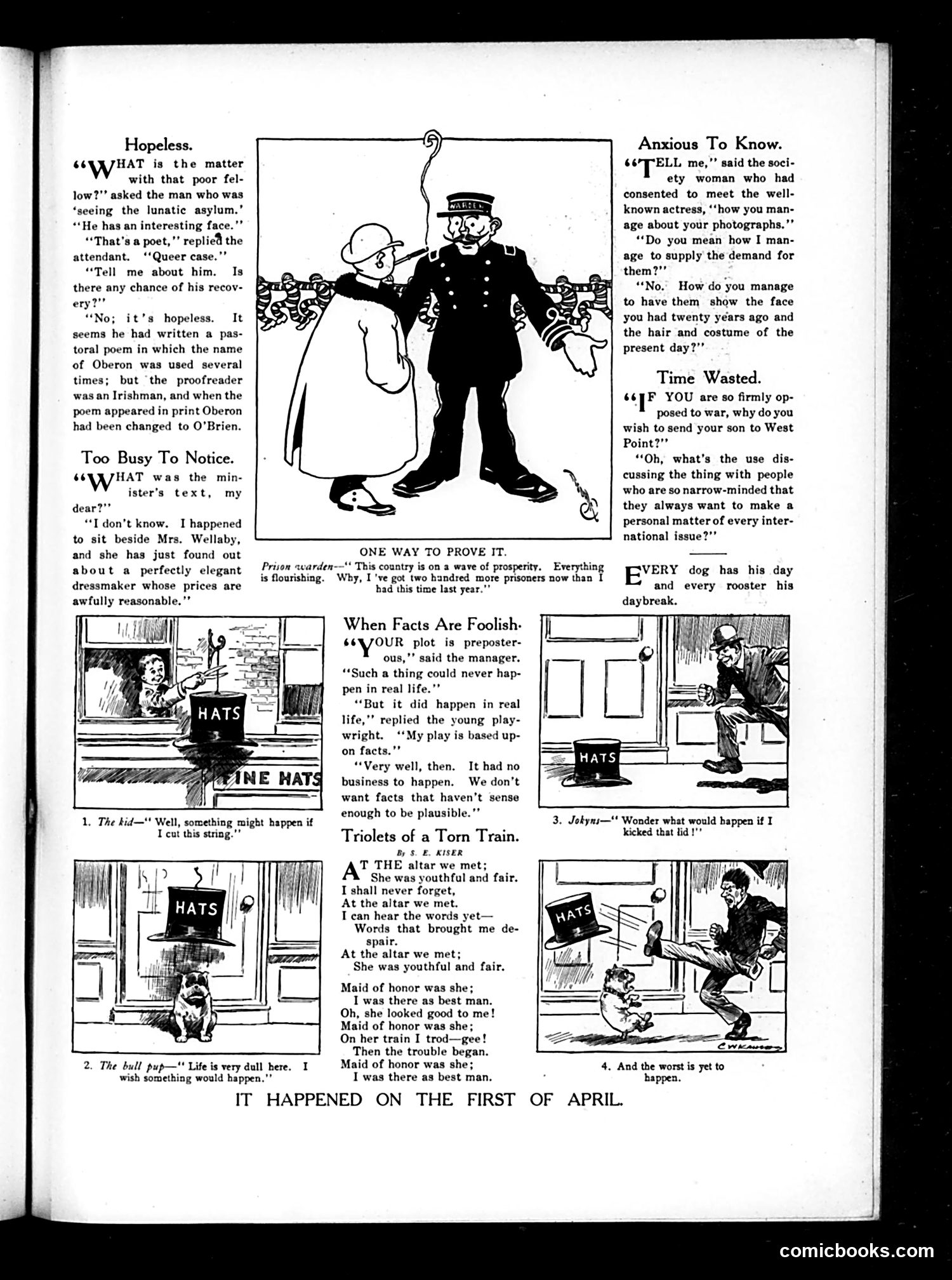
This is a collection of short satirical pieces typical of Judge magazine's humor. Key content: **"Hopeless"** mocks Irish proofreaders through a poet driven mad when his "Oberon" was changed to "O'Brien" in print—a jab at both Irish identity and editorial incompetence. **"One Way to Prove It"** shows a prison warden claiming prosperity because he has more prisoners, absurdly using incarceration as an economic indicator—satirizing flawed logic about national prosperity. **"When Facts Are Foolish"** depicts a theater manager rejecting a true story as implausible, mocking theater gatekeepers who demand "realistic" plots that paradoxically reject actual reality. **"Triolets of a Torn Train"** offers groom's regret—he stepped on the bride's train at the altar, starting marital trouble. It's gentle romantic satire about wedding mishaps. The remaining pieces ("Anxious to Know," "Time Wasted," "Too Busy") are brief social observational humor about photography vanity, anti-war hypocrisy, and distracted socialites. The page title references April Fools' Day pranks.
📄 Transcribed text from this page (OCR, searchable)
Machine-transcribed from the original scan — historical spelling and the odd misread are preserved.
Hopeless. oc HAT is the matter with that poor fel- low?’’ asked the man who was ‘seeing the lunatic asylum.’ ‘*He has an interesting fac “That's a poet,” replied the attendant. ‘‘Queer case.”’ “Tell me about him. Is there any chance of his recov- ery?” “No; it’s hopeless. It seems he had written a pas- toral poem in which the name of Oberon was used several times; but ‘the proofreader was an Irishman, and when the poem appeared in print Oberon had been changed to O’Brien. Too Busy To Notice. 6“ HAT was the min- ister’s text, my dear?"’ “T don’t know. I happened to sit beside Mrs. Wellaby, and she has just found out about a perfectly elegant dressmaker whose prices are awfully reasonable.’” Prison «warden— This country is on a wave of prosperity. is flourishing. Why, I 've got two handred more prisoners now than I 1. The kid—" Well, something might happen if I cut this string.” ONE WAY TO PROVE IT. had this time last year."’ When Facts Are Foolish. ESVOUR plot is preposter- ous,’’ said the manager. “Such a thing could never hap- pen in real life.”” “But it did happen in real life,” replied the young play- wright. “My play is based up- on facts.” “Very well, then. It had no business to happen. We don’t want facts that haven’t sense enough to be plausible.’’ Triolets of a Torn Train. By S. E, KISER T THE altar we met; She was youthful and fair. I shall never forget, At the altar we met. I can hear the words yet— Words that brought me de- spair. At the altar we met; She was youthful and fair. Maid of honor was she; I was there as best man. Oh, she looked good to me! Maid of honor was she; On her train I trod—gee! Then the trouble began. Anxious To Know. 66"-ELL me,” said the soci- ety woman who had consented to meet the well- known actress, ‘‘how you man- age about your photographs.’’ “Do you mean how I man- age to supply the demand for them?” : “No. How do you manage to have them show the face you had twenty years ago and the hair and costume of the present day?’’ Time Wasted. seyF YOU are so firmly op- posed to war, why do you wish to send your son to West Point?”’ “Oh, what's the use dis- cussing the thing with people who are so narrow-minded that they always want to make a personal matter of every inter- national issue?’’ EVERY dog has his day and every rooster his daybreak. 3. Jotyns—'* Wonder what would happen if I kicked that lid !'" Maid of honor was she; I was there as best man. 4. And the worst is yet to 2. The bull pup—'* Life is very dull here. I happen. wish something would happen."” IT HAPPENED ON THE FIRST OF APRIL. comicbooks.com