
Judge, 1911-04-01 · page 17 of 24
Judge — April 1, 1911 — page 17: what you’re looking at
What you’re looking at
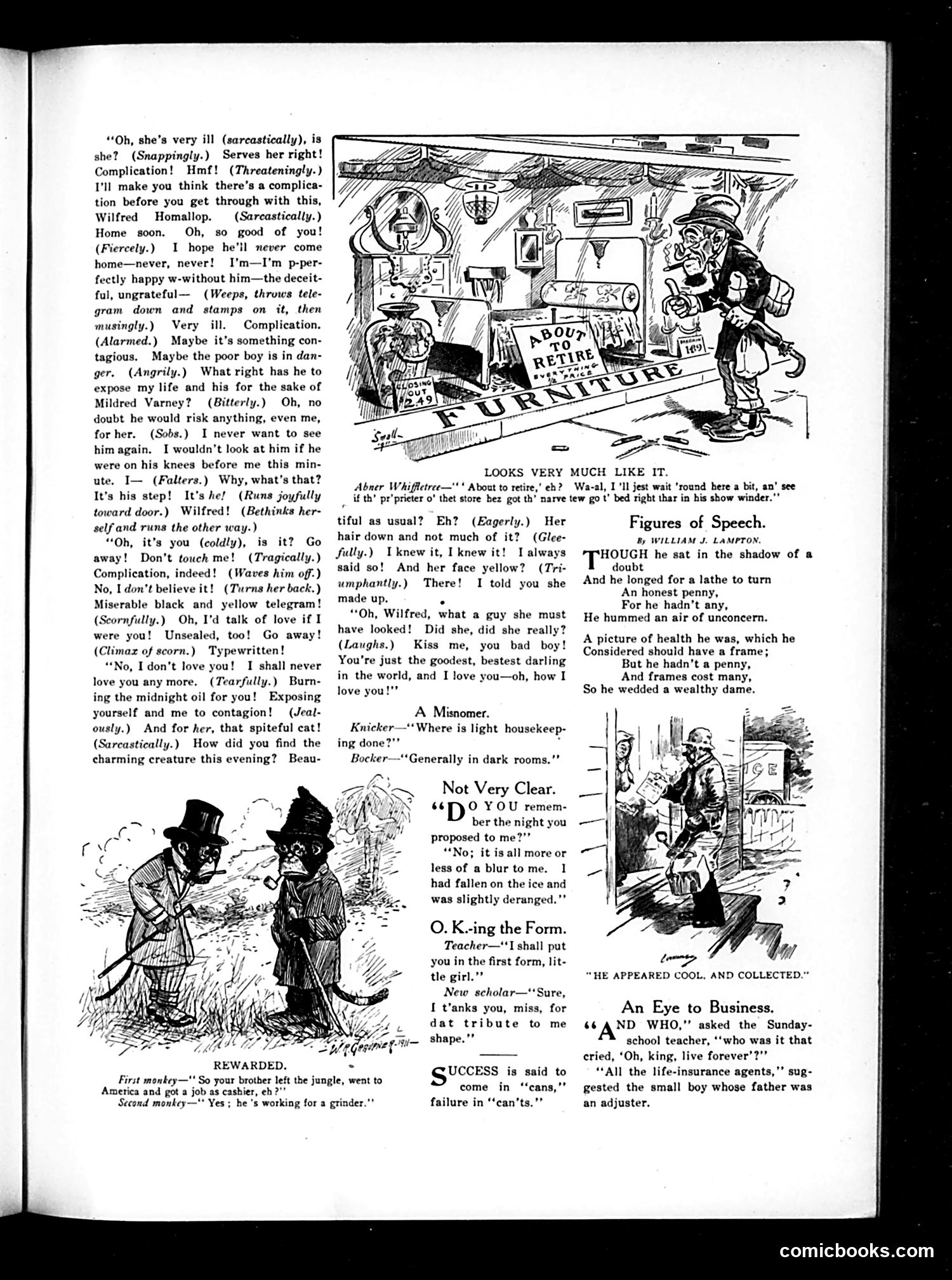
This Judge magazine page contains several satirical pieces mocking domestic life and social conventions of the era. **The main drama** depicts a wife receiving news of her husband's illness. She cycles through exaggerated emotions—angry, then worried, then overjoyed when he arrives—satirizing the melodramatic emotionality expected of women and marital discord masked by social performance. **"Rewarded"** jokes darkly that the brother "worked for a grinder"—likely slang for a street organ player or low-status job—undercutting the immigrant success narrative. **"A Misnomer"** puns on "light housekeeping" as a euphemism for affairs conducted in darkness. **"O.K.-ing the Form"** features an Irish immigrant child mishearing "first form" (school class) as a compliment about her body shape—ethnic humor based on accent and class-based ignorance. **"An Eye to Business"** satirizes that life-insurance agents would praise a despotic king's longevity, since their profits depend on calculating death. The adjuster father reference suggests insurance claim disputes.
📄 Transcribed text from this page (OCR, searchable)
Machine-transcribed from the original scan — historical spelling and the odd misread are preserved.
“Oh, she’s very ill (sarcastically), is she? (Snappingly.) Serves her right! Complication! Hmf! (Threateningly.) I'll make you think there’s a complica- tion before you get through with this, Wilfred Homallop. (Sarcastically.) Home soon. Oh, so good of you! (Fiercely.) I hope he’il never come home—never, never! I’m—I'm p-per- fectly happy w-without him—the deceit- ful, ungrateful— (Weeps, throws tele- gram down and stamps on it, then musingly.) Very ill. Complication. (Alarmed.) Maybe it’s something con- tagious. Maybe the poor boy is in dan- ger. (Angrily.) What right has he to expose my life and his for the sake of Mildred Varney? (Bitterly.) Oh, no doubt he would risk anything, even me, for her. (Sobs.) I never want to see him again. I wouldn't look at him if he were on his knees before me this min- ute. I— (Falters.) Why, what's that? It’s his step! It’s he? (Runs joyfully toward door.) Wilfred! (Bethinks her- self and runs the other way.) “Oh, it’s you (coldly), is it? Go away! Don’t touch me! (Tragically.) Complication, indeed! (Waves him off.) No, I don’t believe it! (Turns her back.) Miserable black and yellow telegram! (Scornfully.) Oh, I'd talk of love if I were you! Unsealed, too! Go away! (Climaz of scorn.) Typewritten! “No, I don’t love you! I shall never love you any more. (Tearfully.) Burn- ing the midnight oil for you! Exposing yourself and me to contagion! (Jeal- ously.) And for her, that spiteful cat! (Sarcastically.) How did you find the charming creature this evening? Beau- REWARDED. First monkey—'* So your brother left the jungle, went to America and got a job as cashier, eh ?"” Second monkey—** Yes ; he's working for a grinder.’* LOOKS VERY MUCH LIKE IT. Abner Whiffletree—'* About to retire,’ eh? Wa-al, I'll jest wait 'round here a bit, an’ see __ if th’ pr’prieter 0 thet store bez got th” narve tew go t’ bed right thar in his show winder."* tiful as usual? Eh? (Eagerly.) Her hair down and not much of it? (Glee- fully.) [knew it, I knew it! I always said so! And her face yellow? (Tri- umphantly.) There! I told you she made up. . “Oh, Wilfred, what a guy she must have looked! Did she, did she really? (Laughs.) Kiss me, you bad boy! You're just the goodest, bestest darling in the world, and I love you—oh, how I love you!"” A Misnomer. Knicker—‘‘ Where is light housekeep- ing done . Bocker—'‘Generally in dark rooms.’’ Not Very Clear. ee O YOU remem- ber the night you proposed to me?”” “No; it is all more or less of a blur tome. 1 had fallen on the ice and was slightly deranged."’ O. K.-ing the Form. Teacher—'I shall put you in the first form, lit- tle girl.”’ New scholar—‘‘Sure, I t’anks you, miss, for dat tribute to me shape.’’ SUccess is said to come in ‘‘cans,’’ failure in ‘‘can’ts."” Figures of Speech. By WILLIAM J. LAMPTON. HOUGH he sat in the shadow of a doubt And he longed for a lathe to turn An honest penny, For he hadn't any, He hummed an air of unconcern. A picture of health he was, which he Considered should have a frame; But he hadn’t a penny, And frames cost many, So he wedded a wealthy dame. “HE APPEARED COOL, AND COLLECTED.” An Eye to Business. 66 AND WHO," asked the Sunday- school teacher, ‘‘who was it that cried, ‘Oh, king, live forever’?"’ “All the life-insurance agents,’’ sug- gested the small boy whose father was an adjuster. comicbooks.com