
Judge, 1911-04-01 · page 16 of 24
Judge — April 1, 1911 — page 16: what you’re looking at
What you’re looking at
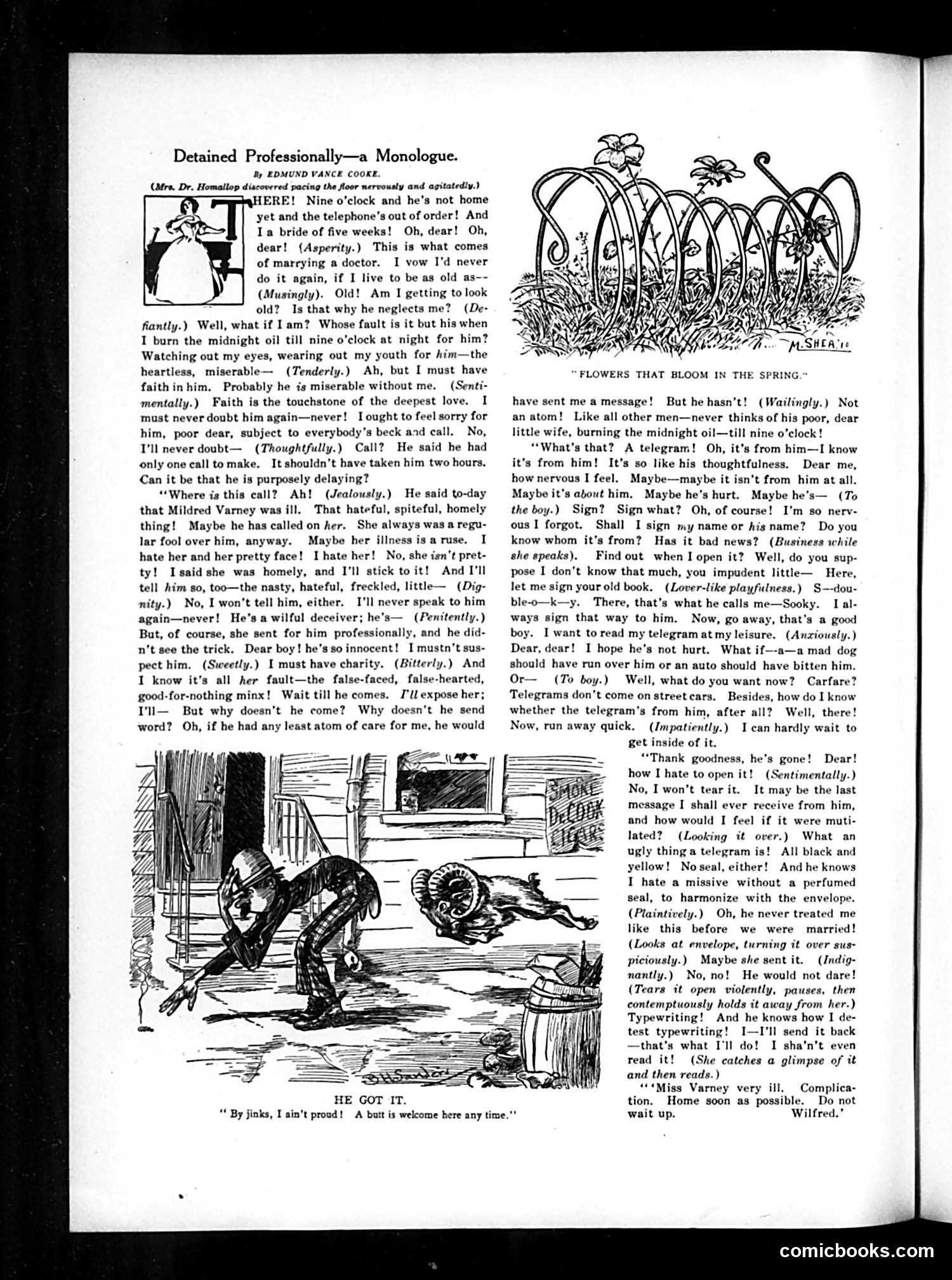
This is a satirical monologue by Edmund Vance Cooke depicting a newlywed doctor's wife anxiously awaiting her husband's return. The piece mocks the emotional volatility and jealous suspicions of a bride married only five weeks. The humor lies in her rapid mood swings: she oscillates between devotion ("Faith is the touchstone of deepest love"), suspicion (worrying he's visiting the "hateful" Mildred Varney under false pretenses of a medical call), and self-recrimination. She simultaneously romanticizes sacrifice ("burning the midnight oil") while resenting it. The satire targets both the anxiety of a doctor's wife (whose husband's professional duties keep him away unpredictably) and the stereotype of the emotionally unstable newlywed. When a telegram arrives, her hysteria peaks—she obsesses over its contents before even opening it, imagining disasters. The accompanying cartoons show a dog with a telegram and bicycles labeled "Flowers That Bloom in the Spring," likely visual jokes about delivery methods and springtime romance—ironic counterpoints to her domestic anxiety.
📄 Transcribed text from this page (OCR, searchable)
Machine-transcribed from the original scan — historical spelling and the odd misread are preserved.
Detained Professionally—a Monologue. By EDMUND VANCE COOKE. (Afra. Dr. Homallop discovered pacing the floor nervously and agitatedly.) ERE! Nine o’clock and he’s not home yet and the telephone’s out of order! And Ta bride of five weeks! Oh, dear! Oh, dear! (Asperity.) This is what comes A of marrying a doctor. I vow I'd never do it again, if I live to be as old as-- y | (Musingly). Old! Am I getting to look old? Is that why he neglects me? (De- fiantly.) Well, what if Iam? Whose fault is it but his when I burn the midnight oil till nine o'clock at night for him? Watching out my eyes, wearing out my youth for him—the heartless, miserable— (Tenderly.) Ah, but I must have faith inhim. Probably he is miserable without me. (Senti- mentally.) Faith is the touchstone of the deepest love. I must never doubt him again—never! Iought to feel sorry for him, poor dear, subject to everybody’s beck and call. No, I'll never doubt— (Thoughtfully.) Call? He said he had only one call tomake. It shouldn’t have taken him two hours. Can it be that he is purposely delaying? “Where is this call? Ah! (Jealously.) He said to-day that Mildred Varney was ill. That hateful, spiteful, homely thing! Maybe he has called on her. She always was a regu lar fool over him, anyway. Maybe her illness is a ruse. I hate her and her pretty face! I hate her! No, she isn’t pret- ty! Isaidshe was homely, and I'll stick to it! And I'll tell him so, too—the nasty, hateful, freckled, little— (Dig- nity.) No, I won't tell him, either. I'll never speak to him again—never! He's a wilful deceiver; he’s— (Fenitently.) But, of course, she sent for him professionally, and he did- n't see the trick. Dear boy! he’s so innocent! I mustn’t sus- pect him. (Sweetly.) I must have charity. (Bitterly.) And I know it’s all her fault—the false-faced, false-hearted, good-for-nothing minx! Wait till he comes. I'll expose her; I’'ll— But why doesn’t he come? Why doesn’t he send word? Oh, if he had any least atom of care for me, he would “FLOWERS THAT BLOOM IN THE SPRING.” have sent me a message! But he hasn’t! (Wailingly.) Not an atom! Like all other men—never thinks of his poor, dear little wife, burning the midnight oil—till nine o'clock! ‘What's that? A telegram! Oh, it’s from him—I know it's from him! It’s so like his thoughtfulness. Dear me, how nervous I feel. Maybe—maybe it isn’t from him at all. Maybe it’s about him. Maybe he’s hurt. Maybe he’s— (To the boy.) Sign? Sign what? Oh, of course! I'm so nerv- ous I forgot. Shall I sign myname or his name? Do you know whom it's from? Has it bad news? (Business while she speaks). Find out when I open it? Well, do you sup- pose I don’t know that much, you impudent little— Here, let me sign your old book. (Lover-like playfulness.) S—dou- ble-o—k—y. There, that’s what he calls me—Sooky. I al- Now, go away, that’s a good boy. I want to read my telegram at my leisure. (Anziously.) Dear, dear! I hope he’s not hurt. What if—-a—a mad dog should have run over him or an auto should have bitten him. Or— (To boy.) Well, what do you want now? Carfare? Telegrams don't come on streetcars. Besides, how do I know whether the telegram's from him, after all? Well, there! Now, run away quick. (Jmpatiently.) I can hardly wait to get inside of it. “Thank goodness, he’s gone! Dear! how I hate to open it! (Sentimentally.) No, I won't tear it. It may be the last message I shall ever receive from him, and how would I feel if it were muti- lated? (Looking it over.) What an ugly thing a telegram is! All black and yellow! Noseal, either! And he knows I hate a missive without a perfumed seal, to harmonize with the envelope. (Plaintively.) Oh, he never treated me like this before we were married! (Looks at envelope, turning it over sus- ways sign that way to him. “ By jinks, I ain't proud! A butt is welcome here any time."” piciously.) Maybe she sent it. (Indig- nantly.) No, no! He would not dare! (Tears it open violently, pauses, then contemptuously holds it away from her.) Typewriting! And he knows how I de- test typewriting! I—I'll send it back —that's what I'll do! I sha’n’t even read it! (She catches a glimpse of it and then reads.) “**Miss Varney very ill. Complica- tion. Home soon as possible. Do not wait up. Wilfred.’ comicbooks.com