
A complete issue · 24 pages · 1911
Judge — February 25, 1911
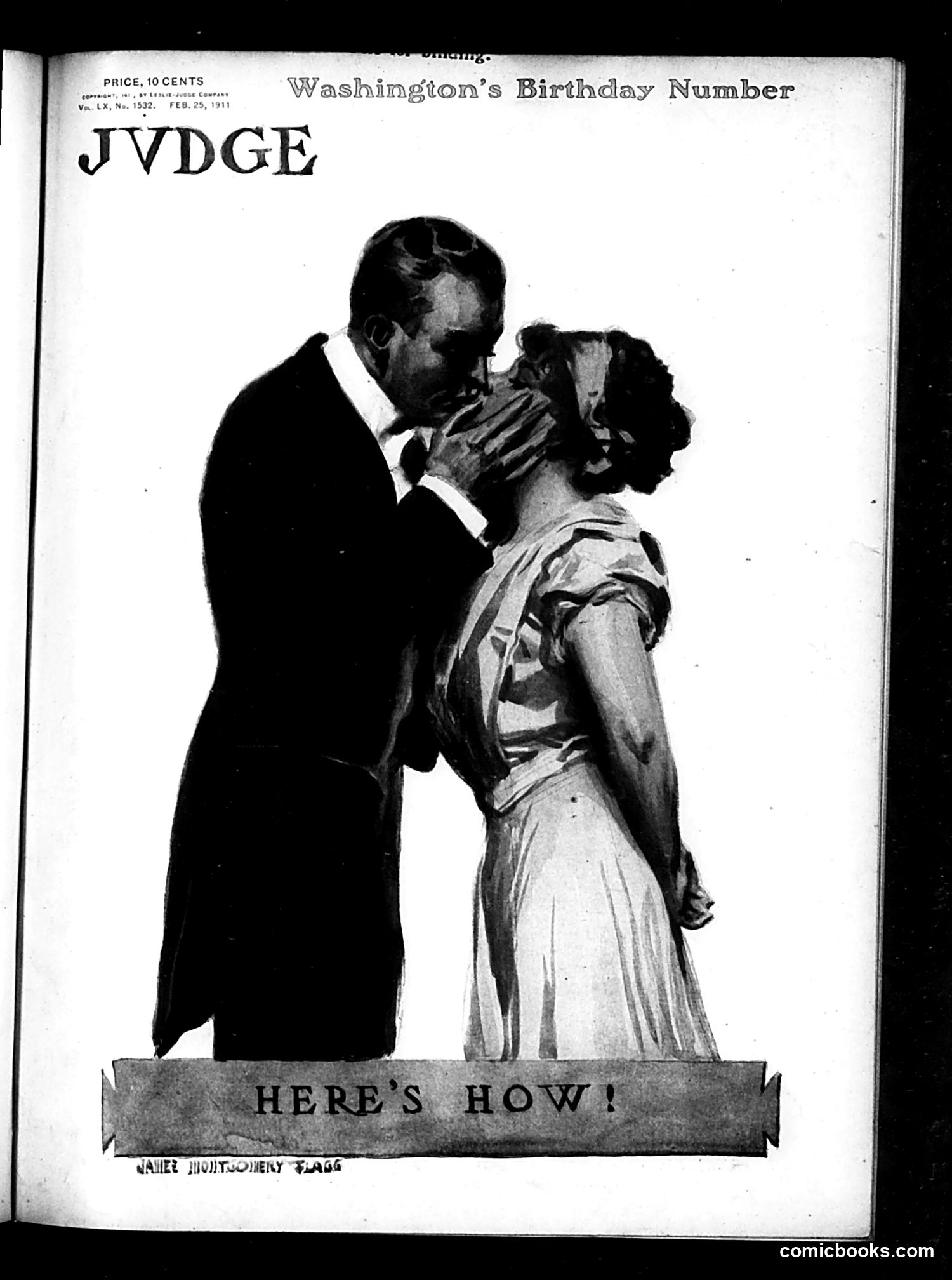
This is the cover of Judge magazine's Washington's Birthday issue (February 25, 1911). The illustration shows a man in formal attire kissing a woman's hand in an affectionate gesture, captioned "HERE'S HOW!" The satire likely plays on the tradition of celebrating George Washington's birthday by depicting a romantic or gallant gesture—suggesting "this is how" to properly honor the occasion or embody Washington's gentlemanly character. The image appears to use romantic civility as a humorous commentary, possibly mocking overly sentimental or exaggerated patriotic celebrations of the era. Without additional article text, the specific satirical target remains unclear, though the magazine's focus on social commentary suggests commentary on contemporary manners or patriotic excess.
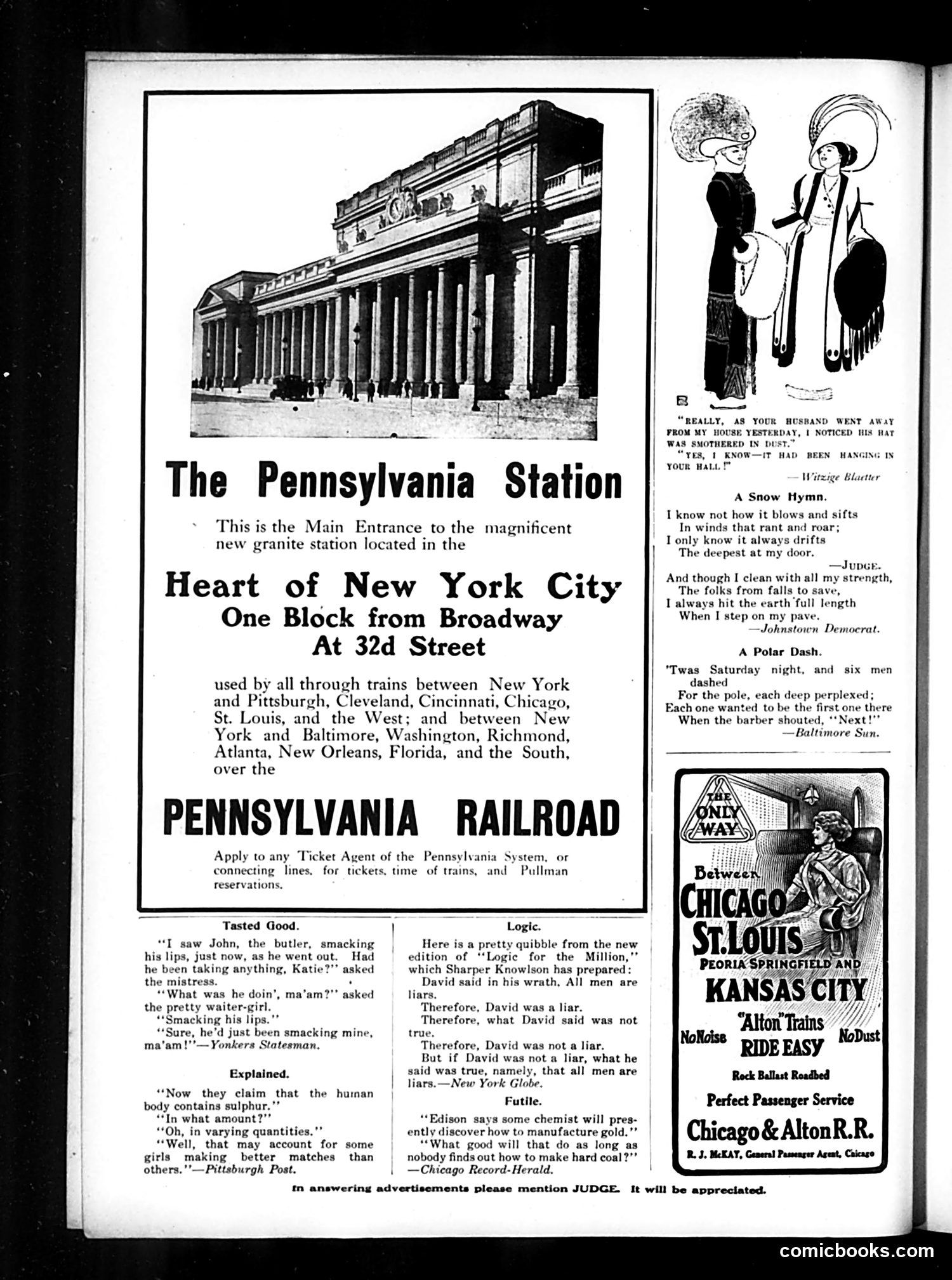
This page is primarily **advertising for the Pennsylvania Railroad**, featuring their new granite station at 32nd Street and Broadway in New York City. The large left panel showcases the station's architecture and lists rail routes served. The right side contains **humorous short pieces and jokes** typical of Judge magazine's satirical content, including: - A comic about a wife noticing her husband's hat hanging in the hall (domestic humor) - Poetry selections ("A Snow Hymn," "A Polar Dash") - Brief jokes about logic, chemistry, and human nature At the bottom are **additional advertisements**, including one for the Chicago & Alton Railroad. The page mixes advertising with light social satire and wordplay rather than political commentary.
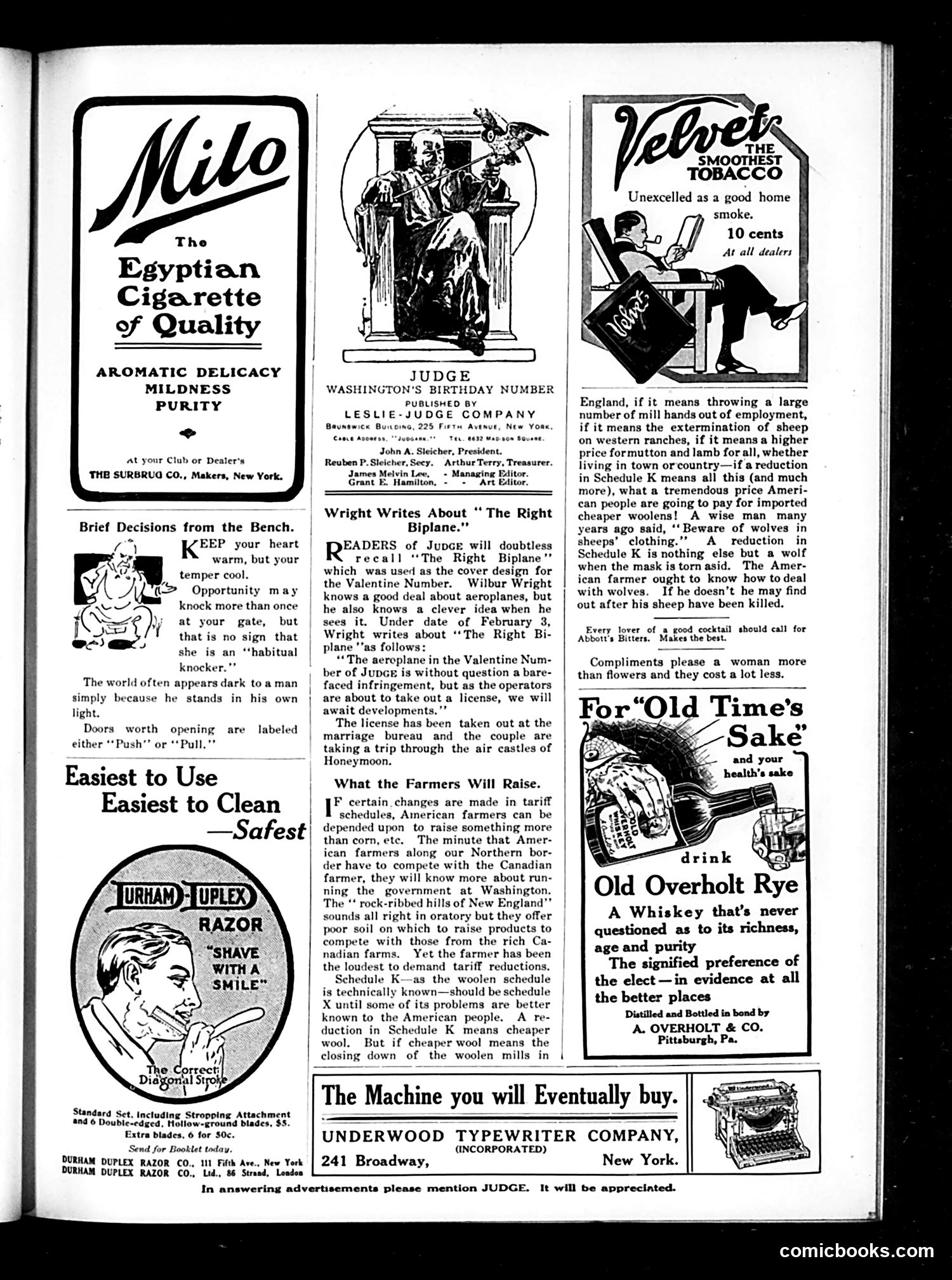
This page is predominantly **advertising** for period products: Milo Egyptian cigarettes, Velvet tobacco, Durham Duplex razors, Old Overholt Rye whiskey, and Underwood typewriters. The editorial content includes "Brief Decisions from the Bench," a recurring Judge feature offering satirical advice. One section discusses tariff schedules affecting American farmers—suggesting they could raise competitive products if trade barriers lowered. This references **early 20th-century protectionist debates** between farmers seeking cheaper imports versus manufacturers defending high tariffs. Another item humorously reports a Judge Valentine Number featuring an airplane used in a marriage bureau honeymoon trip, playing on contemporary fascination with aviation as a novelty. The overall tone is light satire on economic policy and modern technology, typical of Judge's genteel humor for educated readers.
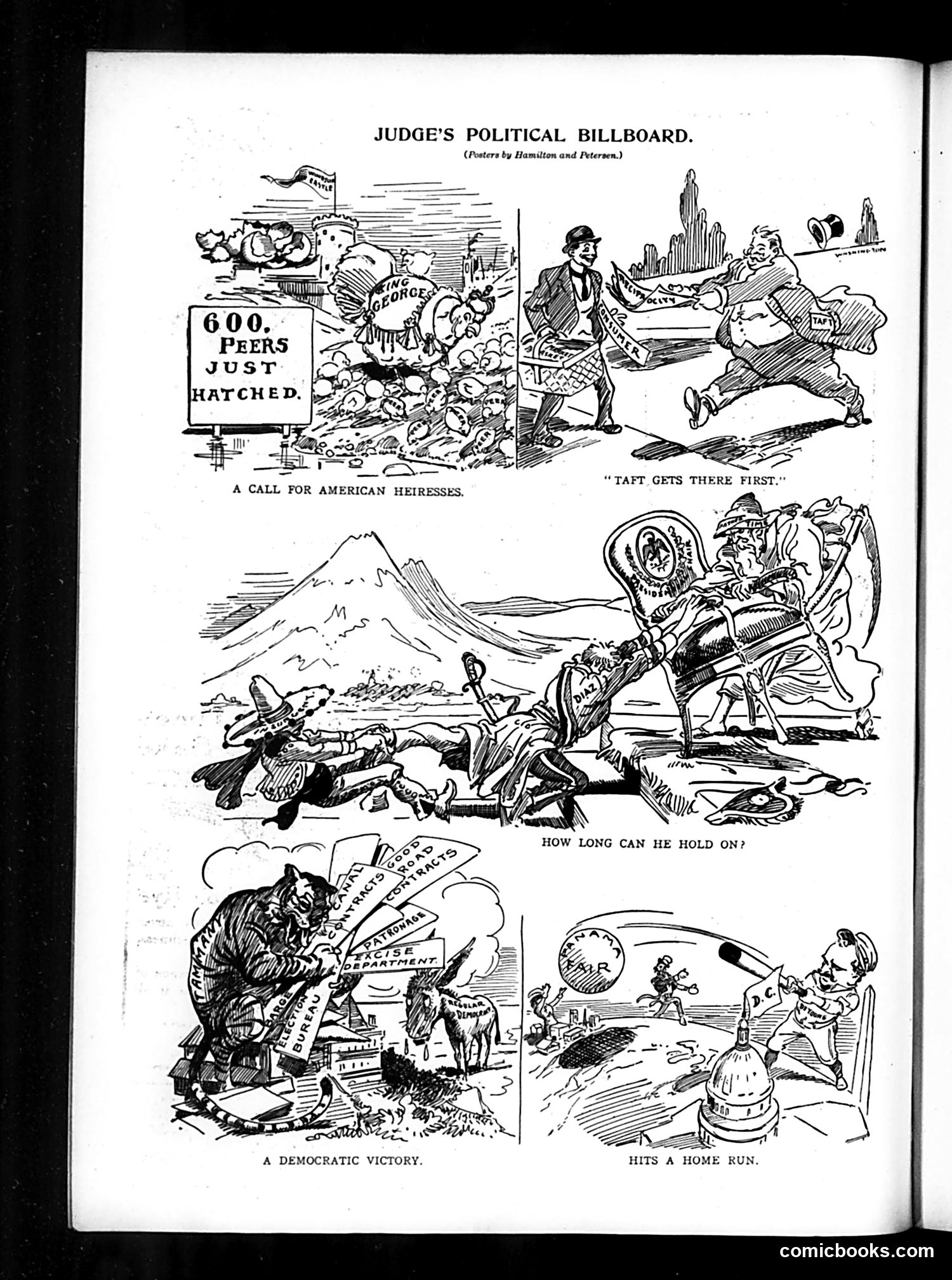
This satirical page from *Judge* magazine uses baseball metaphors to mock a political figure (likely a judge or justice) nicknamed "Taft," based on the caption "Taft Gets There First." The cartoons appear to reference Theodore Roosevelt-era politics, circa 1908-1912. The four panels employ baseball imagery to suggest the figure is either gaining unfair advantage or facing political pressure. "A Call for American Heiresses" mocks aristocratic pretensions. "How Long Can He Hold On?" questions political durability. "A Democratic Victory" and "Hits a Home Run" suggest electoral outcomes or political maneuvering. The satire criticizes the subject's political methods, using sports metaphors to make complex political struggles accessible and ridiculous to contemporary readers familiar with baseball.
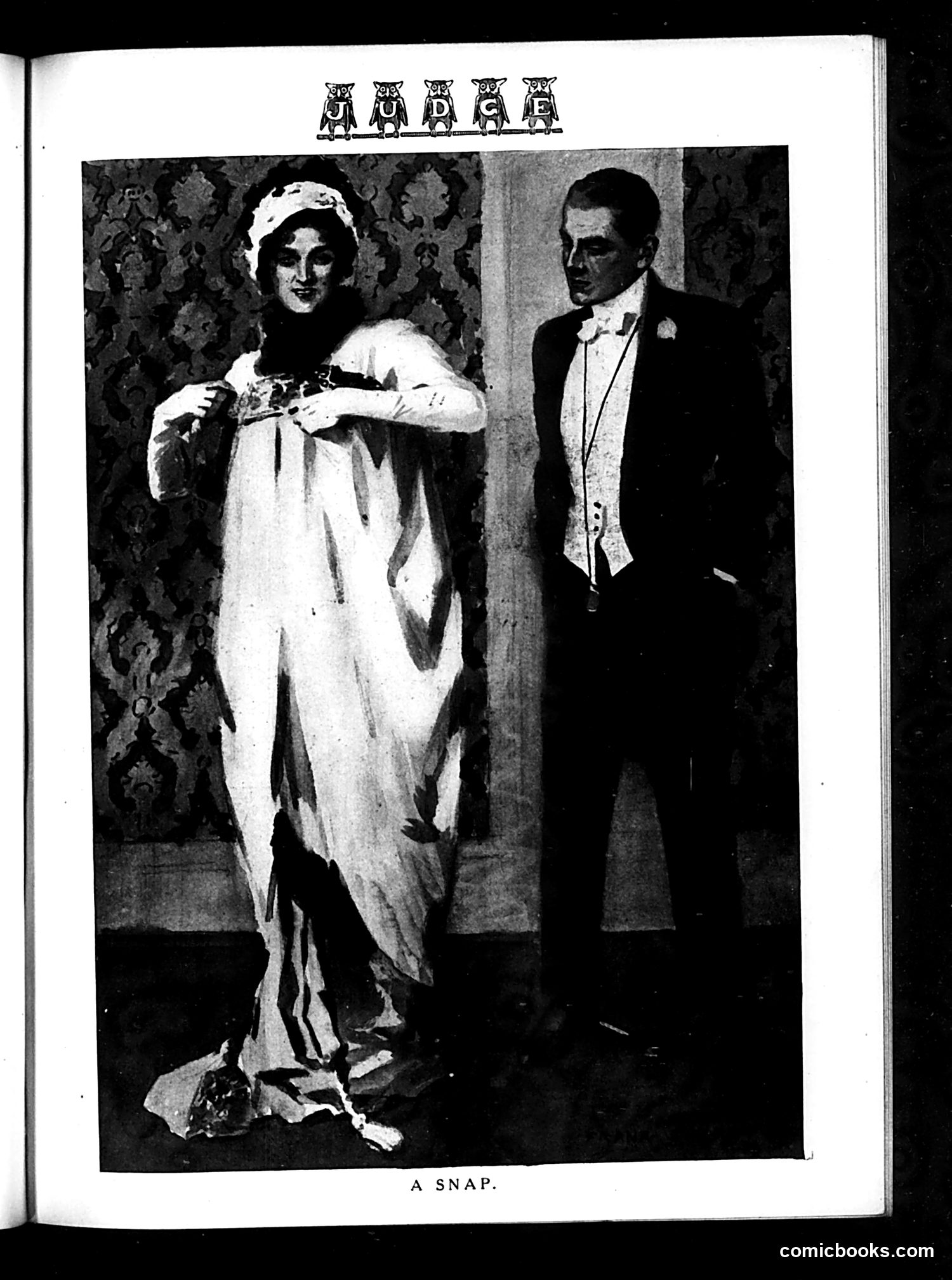
This satirical image depicts a scene titled "A Snap," likely a social commentary on wealth disparity or class relations. The woman on the left, dressed in an elaborate white gown with a headpiece, appears to be a wealthy society figure—her ornate costume suggesting upper-class status. The man on the right, dressed formally in evening wear, observes her display. The caption "A Snap" suggests this is a candid moment of social interaction being captured or mocked. The satire likely critiques either ostentatious wealth display, romantic/marital dynamics between classes, or the performative nature of high society. Without additional context, the specific political or social event referenced remains unclear, though the image appears to lampoon Victorian-era social pretension.
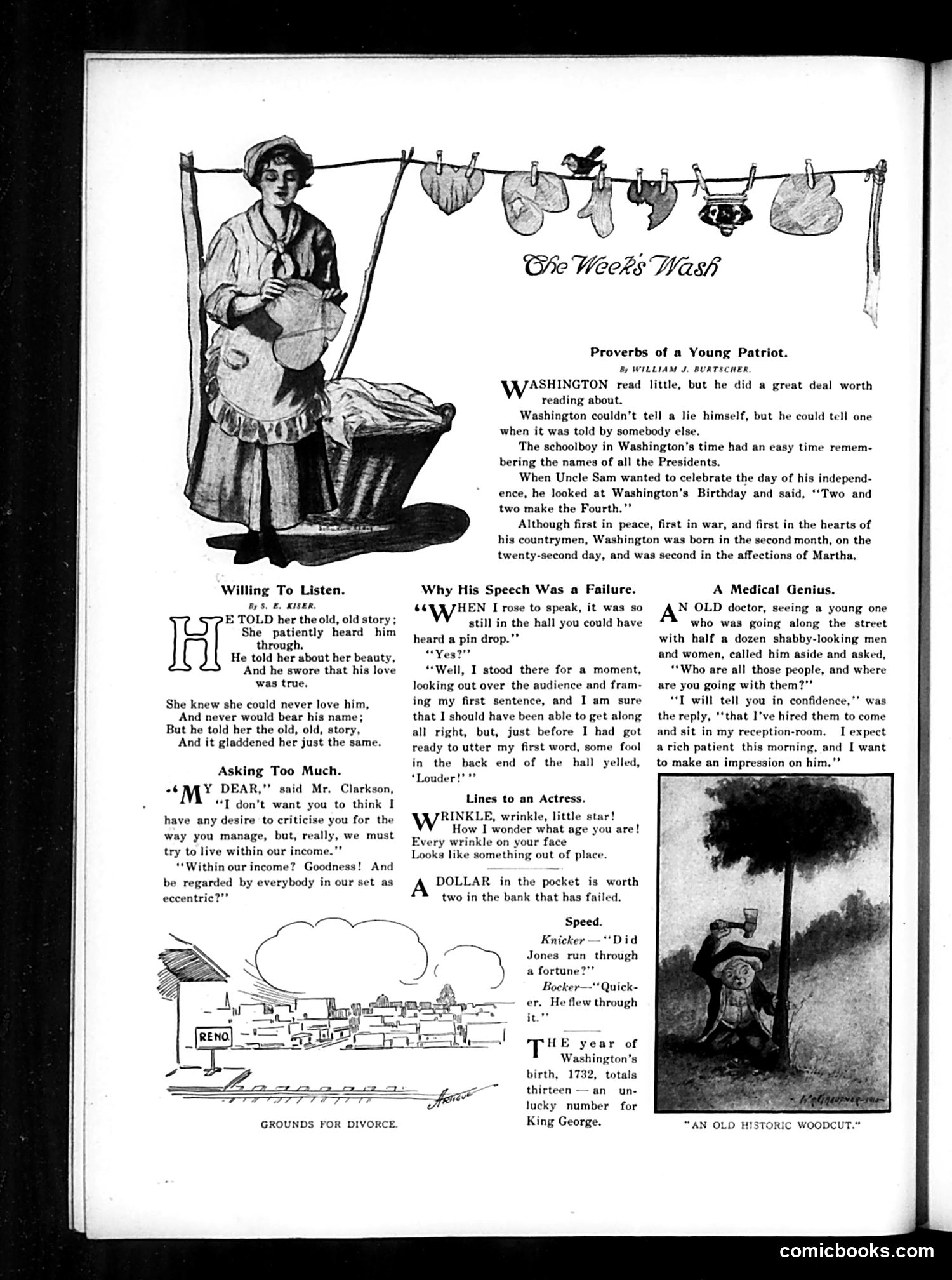
This page from *Judge* contains several satirical pieces mocking American social pretensions and gender dynamics circa early 1900s: **"Willing to Listen"** satirizes romantic deception—a man persistently recites clichéd declarations of love to a woman who doesn't reciprocate, yet she finds comfort in the performance anyway. The joke targets both male insincerity and female gullibility. **"Asking Too Much"** mocks upper-class anxiety about appearances. Mr. Clarkson suggests living within their means; his wife finds this unthinkable—appearing "eccentric" to their social set matters more than financial reality. **"Proverbs of a Young Patriot"** offers irreverent quips about George Washington, undermining his legendary honesty and importance. The reference to Washington's birth year (1732) totaling thirteen—"an unlucky number for King George"—is a patriotic jab at the British. **"A Medical Genius"** depicts a young doctor hiring shabby patients to fill his waiting room, creating false impressiveness for wealthy clients—satirizing medical fraud and social climbing. The cartoons collectively mock vanity, financial pretense, and dishonesty across romance, class hierarchy, and professional life.
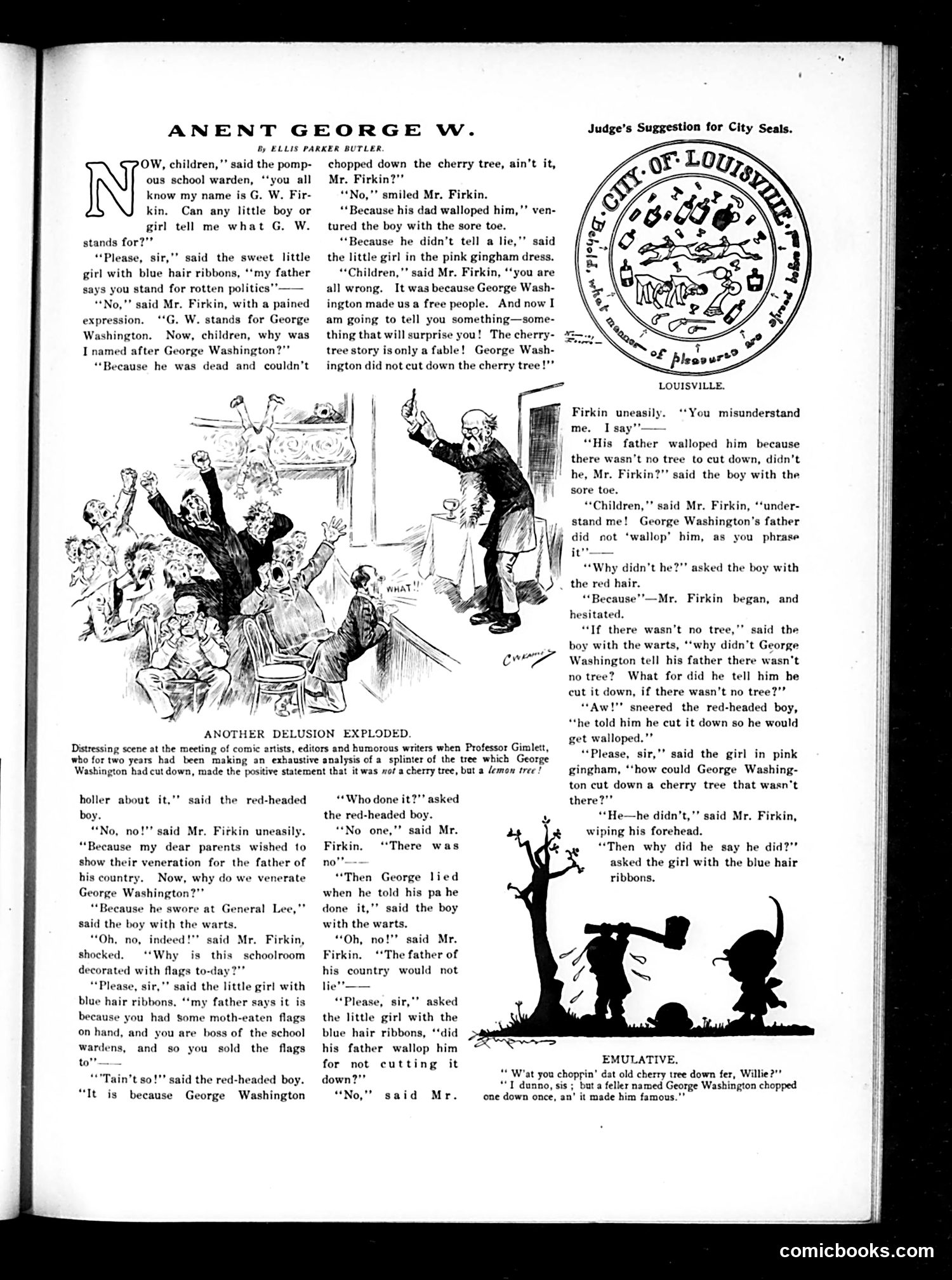
This satirical story by Ellis Parker Butler mocks the mythologized George Washington cherry-tree legend—the false anecdote that young Washington confessed to cutting down his father's cherry tree, supposedly demonstrating his honesty. The joke: A pompous schoolteacher (Mr. Firkin) tries to teach children that Washington is revered for creating a free nation, but the children repeatedly cite the cherry-tree myth instead. When Mr. Firkin finally admits the story is false—it was a "lemon tree, but a lemon tree"—the children's logic exposes the absurdity: if there was no tree, how could Washington have cut it down or lied about it? The satire targets both the persistence of false historical myths in American education and the weakness of adults who can't defend their own lessons against child logic. The bottom cartoon ("Emulative") shows a child imitating Washington's supposed deed for fame, cementing the irony: a fabricated story influences real behavior.
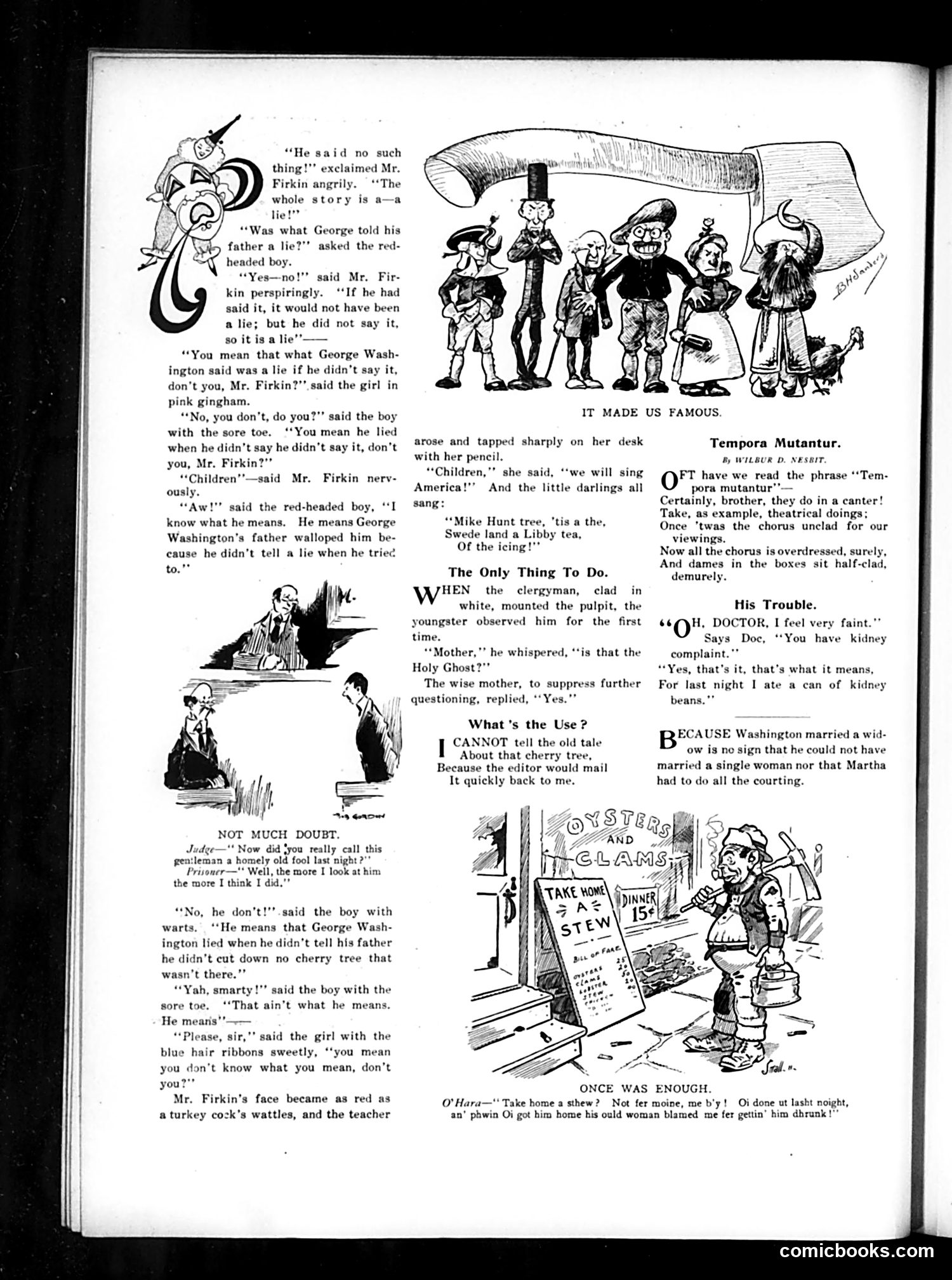
This page satirizes the famous (likely apocryphal) George Washington cherry tree legend, where young Washington supposedly confessed to cutting down his father's tree rather than lying about it—a tale used to teach honesty to children. **The main cartoon** mocks how this moral lesson became muddled and logically absurd when actually explained to schoolchildren. Mr. Firkin, the flustered teacher, tries to defend the story's lesson about truthfulness, but the students trap him in circular logic: if Washington didn't cut the tree down, did lying about it count as lying? The children's increasingly absurd questioning exposes how nonsensical the whole moralizing becomes. **The satire's point**: American civic mythology (represented by the Washington legend) crumbles under scrutiny. The story itself is likely fabricated, and its moral lesson becomes incoherent when examined critically—suggesting that America's foundational narratives aren't as solid as believed. The other brief pieces on the page continue this theme of deflating pretense and exposing contradictions in American life and values.
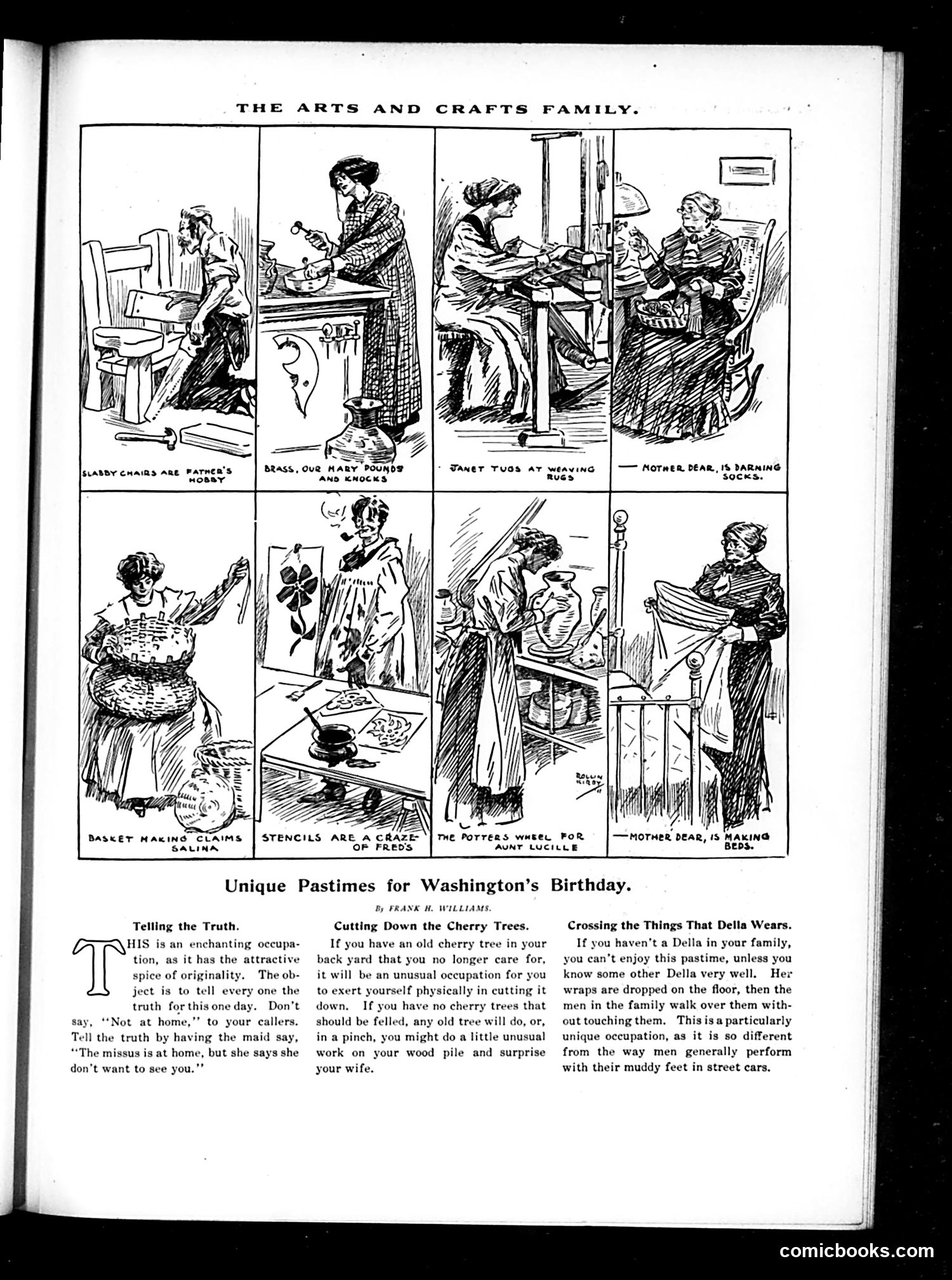
This satirical piece mocks genteel domestic activities supposedly suited for Washington's Birthday celebrations. The cartoon depicts various household members engaged in "arts and crafts" pastimes: a woman sketching, someone working brass, another weaving rugs, basket-making, stenciling, and pottery. The accompanying text humorously suggests three "unique" ways to spend the holiday: (1) telling the truth to visitors for one day only—a joke about social dishonesty; (2) physically cutting down cherry trees, likely referencing the famous (apocryphal) Washington anecdote; and (3) allowing men to step on women's dropped clothing without touching it, satirizing both gender dynamics and peculiar domestic habits. The satire targets the pretentiousness of "arts and crafts" hobbies and the artificial patriotic observances of the era, suggesting these activities are ridiculous substitutes for genuine holiday meaning.
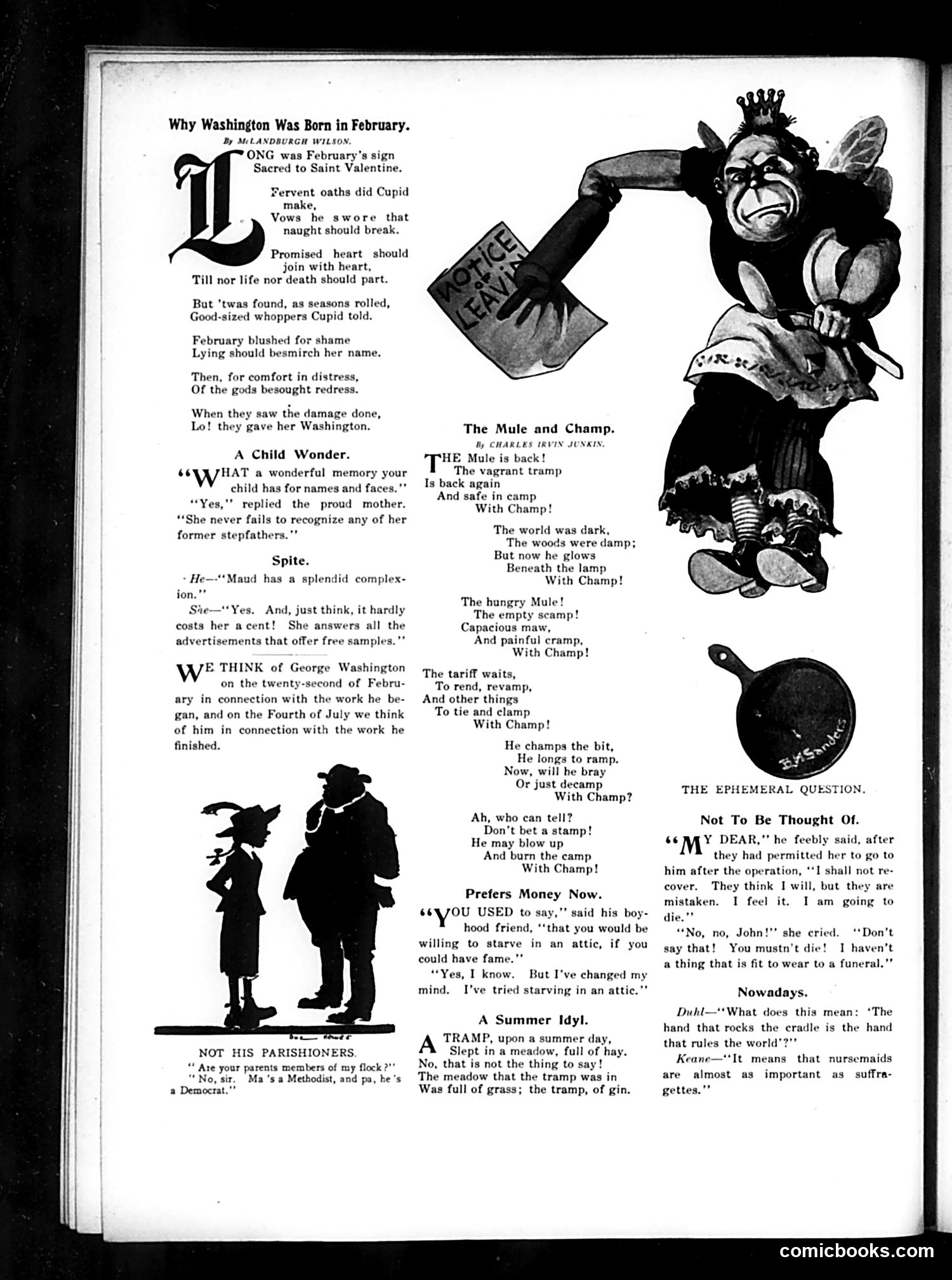
This page from the satirical magazine **Judge** contains several brief humorous pieces mocking social conventions and politics of the era (likely early 1900s based on style): **"Why Washington Was Born in February"** jokingly suggests February (Saint Valentine's month) was so shamed by romantic deception that the gods gave it George Washington as compensation—a patriotic joke treating Washington's birth as redemptive. **"The Mule and Champ"** appears to reference a political figure (likely President Theodore Roosevelt's horse "Champ") in a poem playing on the mule as a stubborn beast, possibly satirizing political stubbornness or tariff debates mentioned in the text. The remaining pieces are brief satirical quips: one mocking a child's ability to recognize "stepfathers," another on a woman's vanity (ignoring skin-care costs while answering free-sample ads), and one suggesting modern women care more about funeral wardrobes than their husbands' lives—typical period misogynistic humor. The overall tone is light, domestic satire targeting feminine vanity and relationship instability.
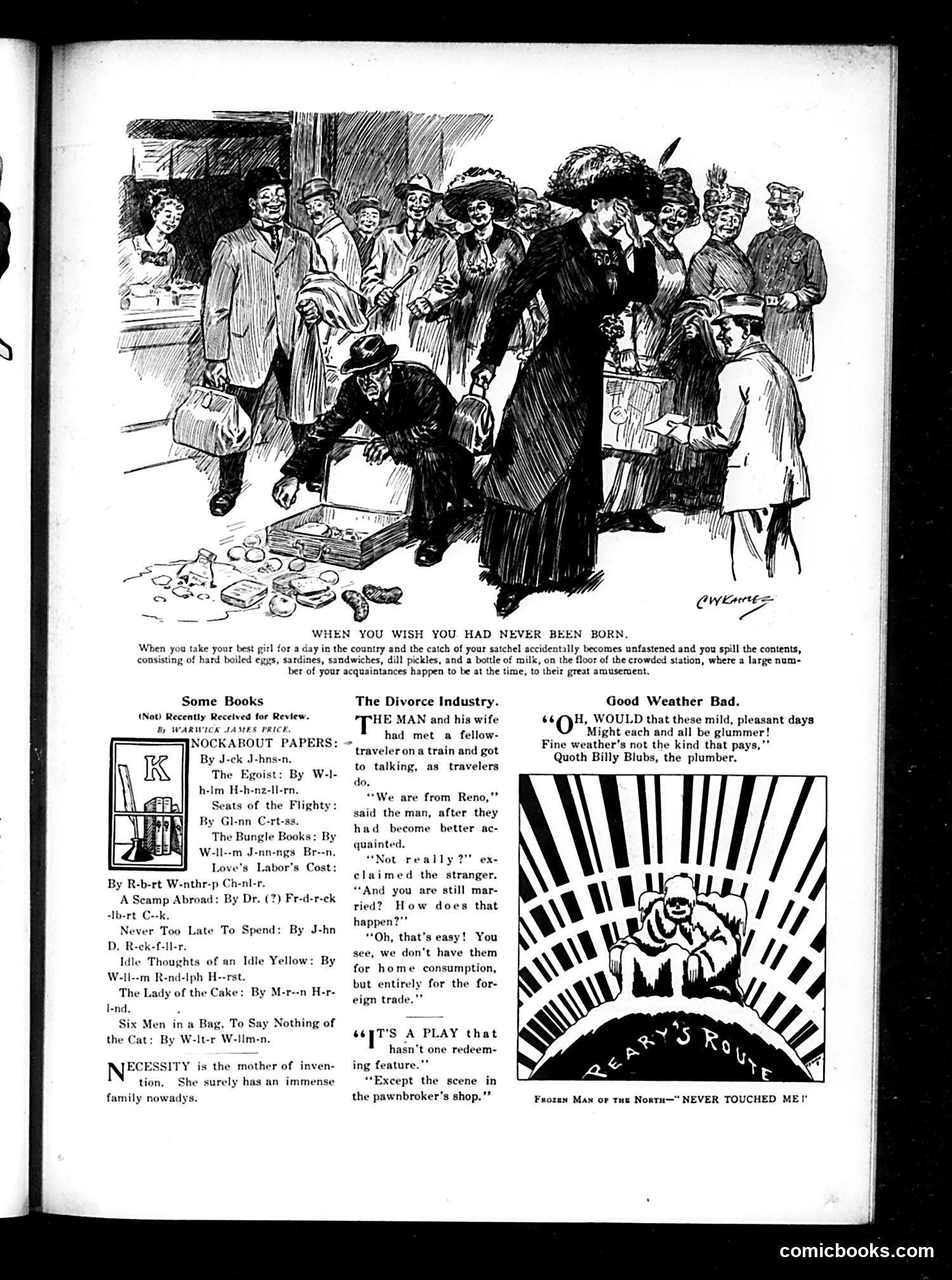
The main cartoon satirizes social embarrassment: a man's picnic lunch spills across a crowded train station floor—hard-boiled eggs, sardines, pickles, milk—mortifying him before numerous acquaintances. The humor targets Victorian-era anxieties about public dignity and class decorum. "The Divorce Industry" jokes that Reno, Nevada was notorious as a divorce destination (due to lenient residency laws). The cartoon's irony: a couple remains married despite being *from* Reno, shocking a stranger who assumes all Reno residents divorce. The punchline—they breed divorces for "export" to other states—mocks both the divorce industry and suggests moral degeneracy. The "Some Books" section parodies contemporary authors through vowel-deleted names (likely recognizable to period readers). "Good Weather Bad" features a plumber complaining that pleasant weather reduces his business—a simple economic joke about service workers preferring emergencies. The page blends political/social satire with everyday humor typical of Judge magazine's satirical approach.
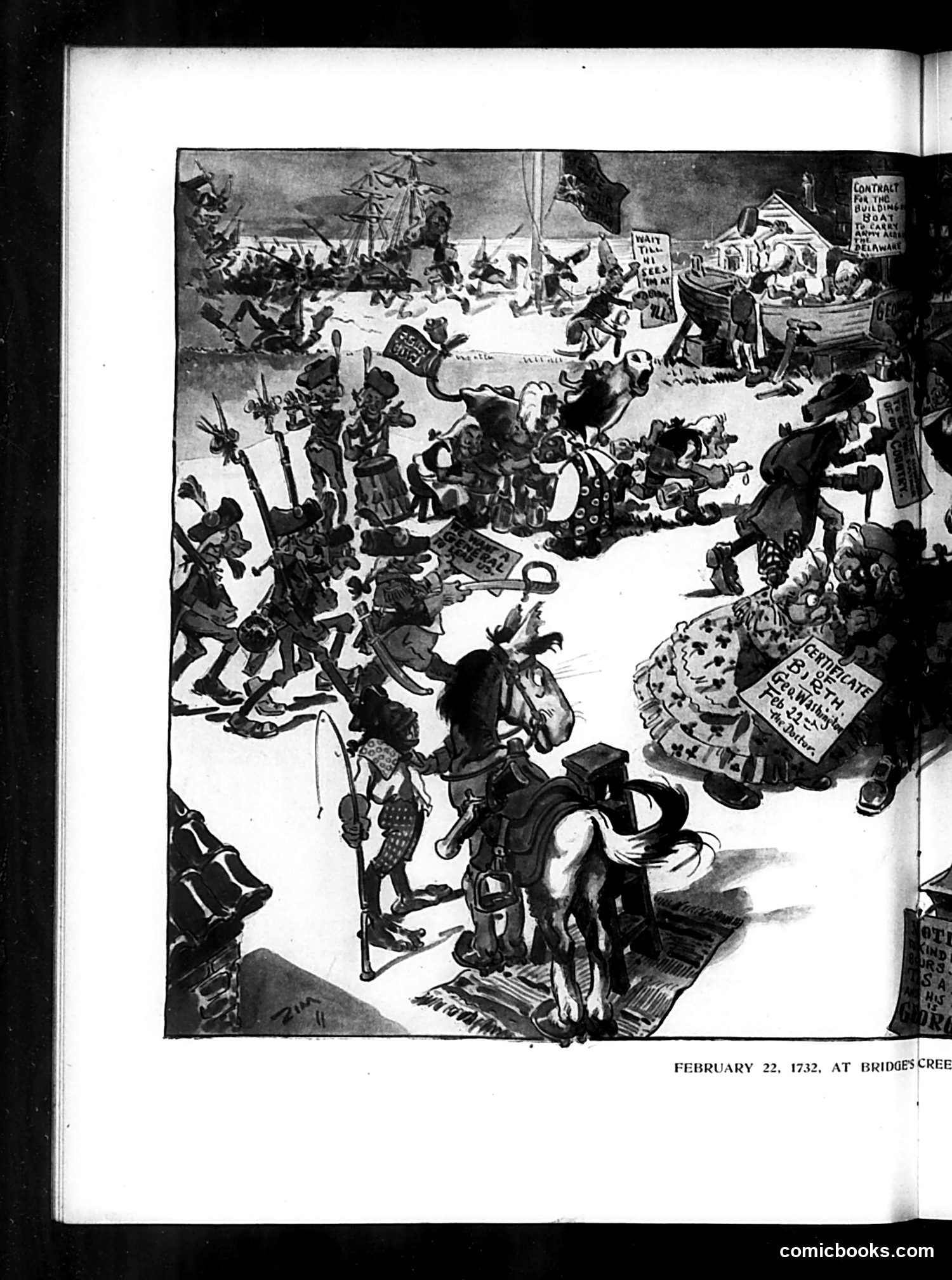
This satirical illustration depicts a chaotic scene dated February 22, 1732, at Bridges Creek. The cartoon appears to reference historical colonial American activity, possibly related to early settlement or trade disputes. The scene shows numerous figures in period dress engaged in various activities—some appear to be fighting or arguing, others conducting business or ceremonies. Ships are visible in the background, suggesting maritime commerce or colonial enterprise. Signs with text (though largely illegible in this reproduction) indicate specific grievances or commercial disputes. The crowded, tumultuous composition suggests satire of colonial disorder, possibly mocking disputes between settlers, merchants, or colonial authorities. Without clearer text legibility, the specific political targets and controversies remain partially unclear, though the February 22 date may reference significant colonial events.
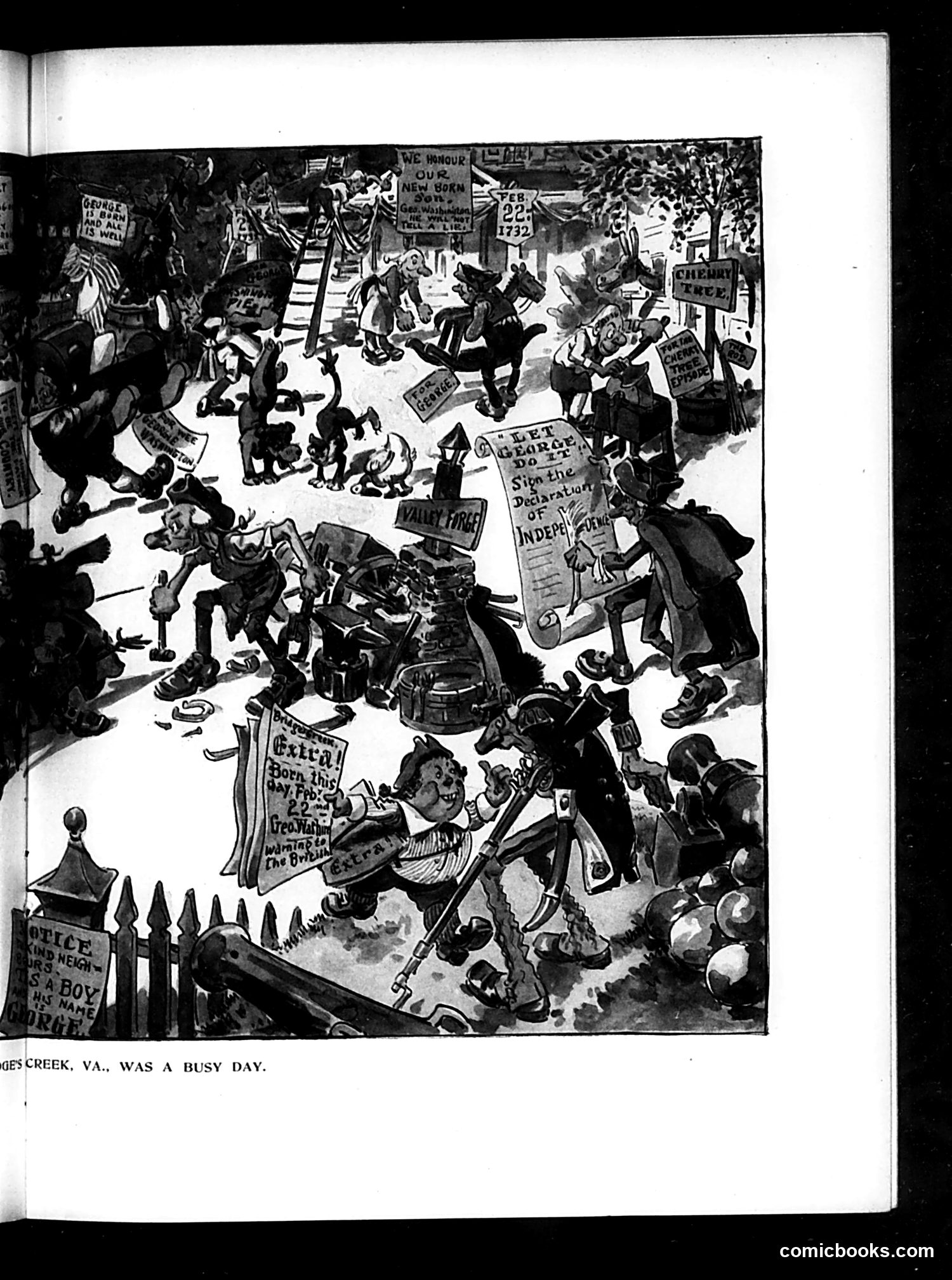
This is a chaotic street scene satirizing political unrest, likely from the early 20th century. The caption references "Ages Creek, VA., was a busy day," suggesting a specific local incident of civil disorder or protest. The cartoon depicts numerous figures in conflict—some appear to be officials or authority figures confronting crowds of common people. Visible signs reference topics like "Liberty," "Independence," and what appears to be labor or civil rights demands. The style suggests commentary on labor disputes, riots, or political demonstrations common during this era. Without clearer text legibility, the specific historical event remains unclear, but Judge magazine typically lampooned political movements, social upheaval, and class conflict through exaggerated caricature and visual chaos.
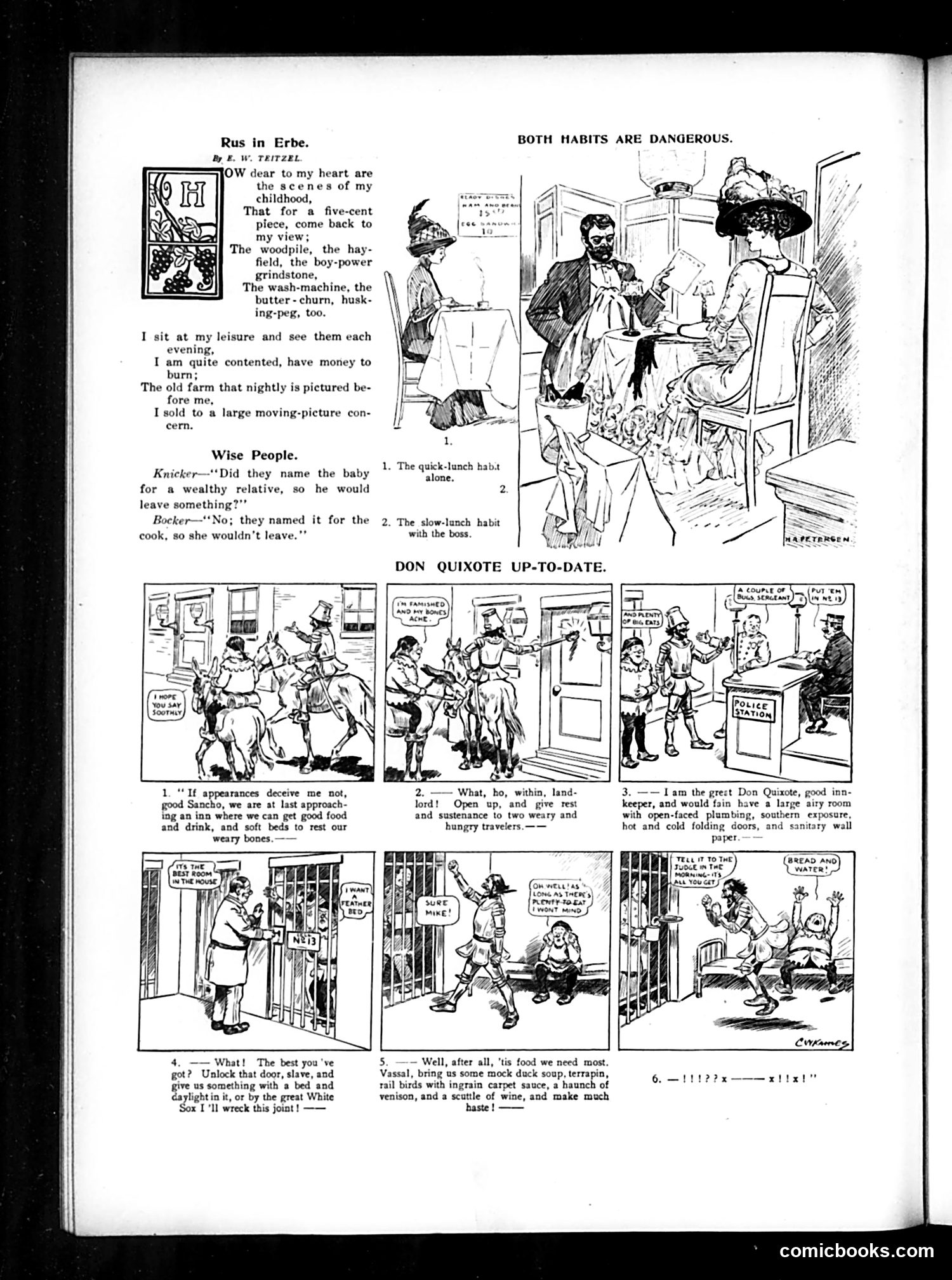
This page contains three distinct pieces of satirical content: **"Rus in Erbe"** (a pun on "Rus in Urbe"—Latin for "country in the city") mocks nostalgia for rural childhood. The joke: the author sold his family farm to a motion-picture company, so he now watches movies of farm life instead of living it—satirizing how commercialization and technology replace authentic experience. **"Wise People"** is a brief joke about naming a baby after the cook (rather than a wealthy relative) to prevent her from quitting employment—commenting on working-class economics and household management. **"Don Quixote Up-to-Date"** parodies Cervantes' classic by transplanting the idealistic knight into modern American contexts. The satire tracks Quixote's progressive disillusionment: he arrives at an inn expecting romance and adventure, discovers it's a modern establishment with plumbing rather than chivalric amenities, and ends confined to jail, reduced to bread and water. It mocks both romantic idealism and modern American materialism. All three pieces satirize the gap between idealized expectations and harsh reality.
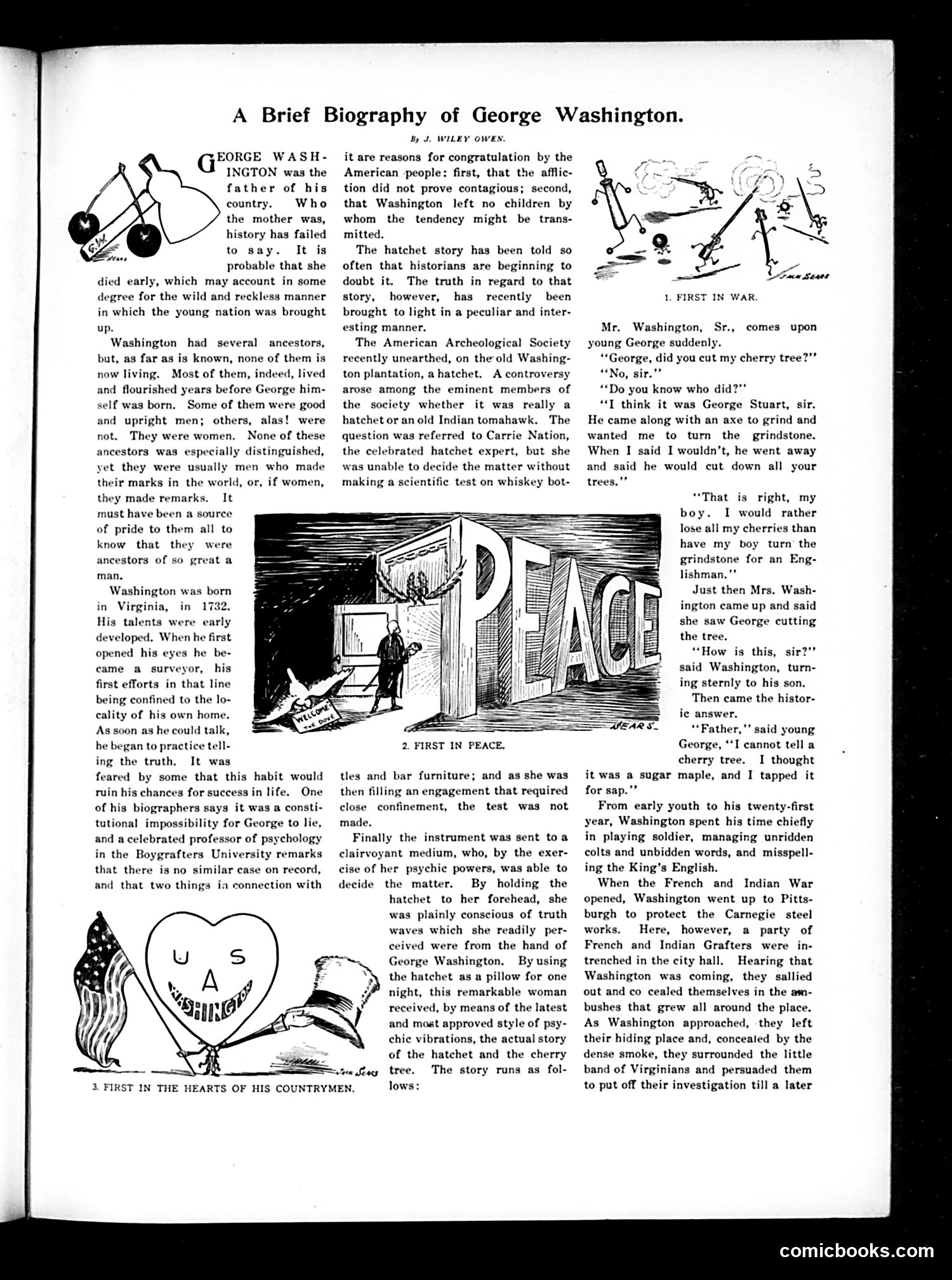
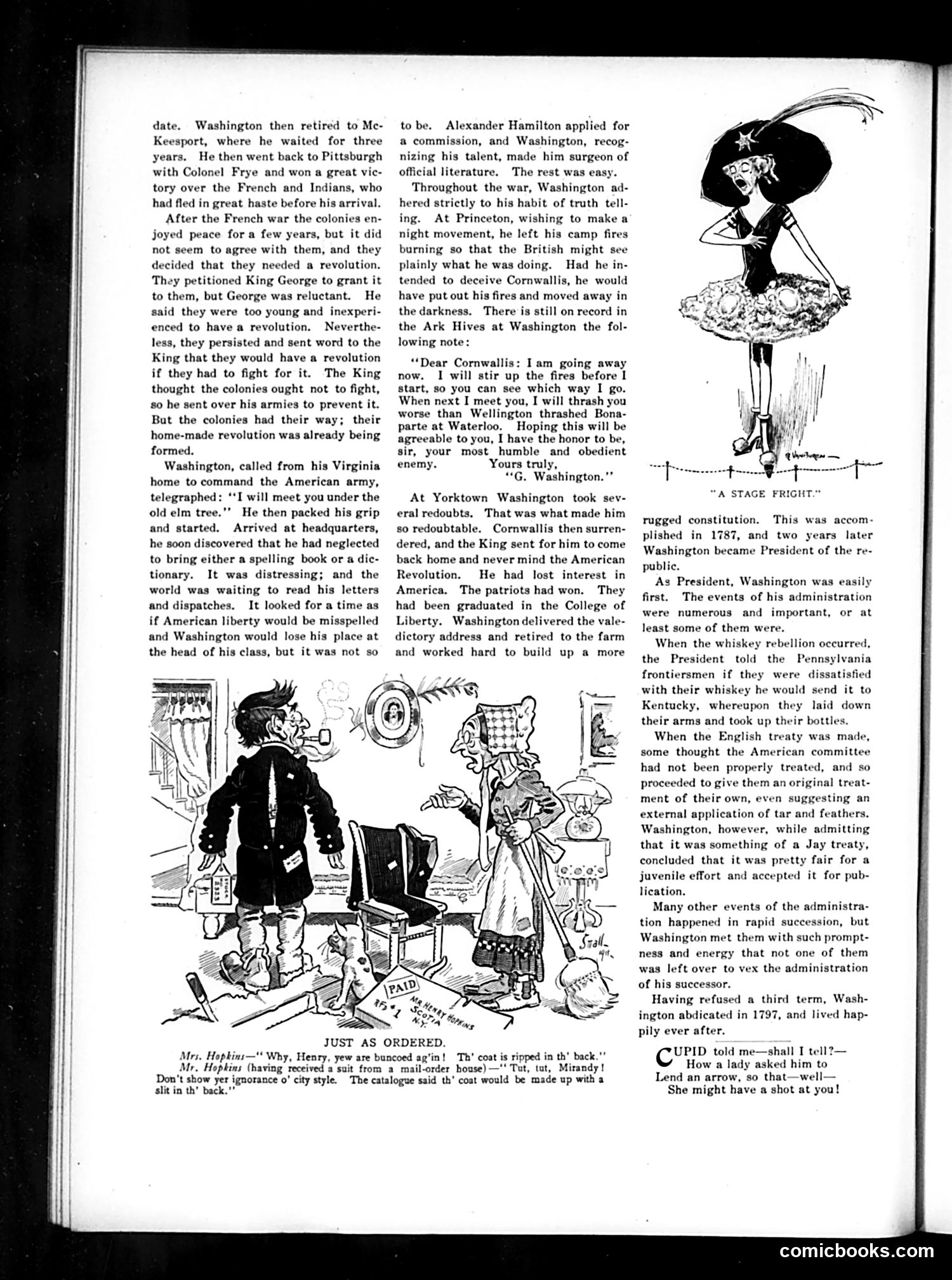
This page combines humorous historical narrative with contemporary satire. The main text hilariously reimagines George Washington's life in deliberately absurd ways—claiming he telegraphed from Virginia, that Alexander Hamilton served as "surgeon of official literature" to fix his spelling, and that Washington wrote Cornwallis a courtesy note announcing his tactical movements. The satire's point: it mocks how Americans mythologize Washington as flawlessly honest and brilliant. By exaggerating his virtue to ridiculous extremes, the author exposes how the founding narrative has become sanitized legend. Below is an unrelated cartoon titled "Just As Ordered," depicting a man upset that his mail-order coat has a slit in the back—a dig at mail-order fraud and false advertising, common consumer complaints of the era. His wife's confusion about "city style" suggests rural versus urban sophistication gaps. The "Stage Fright" illustration appears to reference theatrical anxiety, though context is cut off.
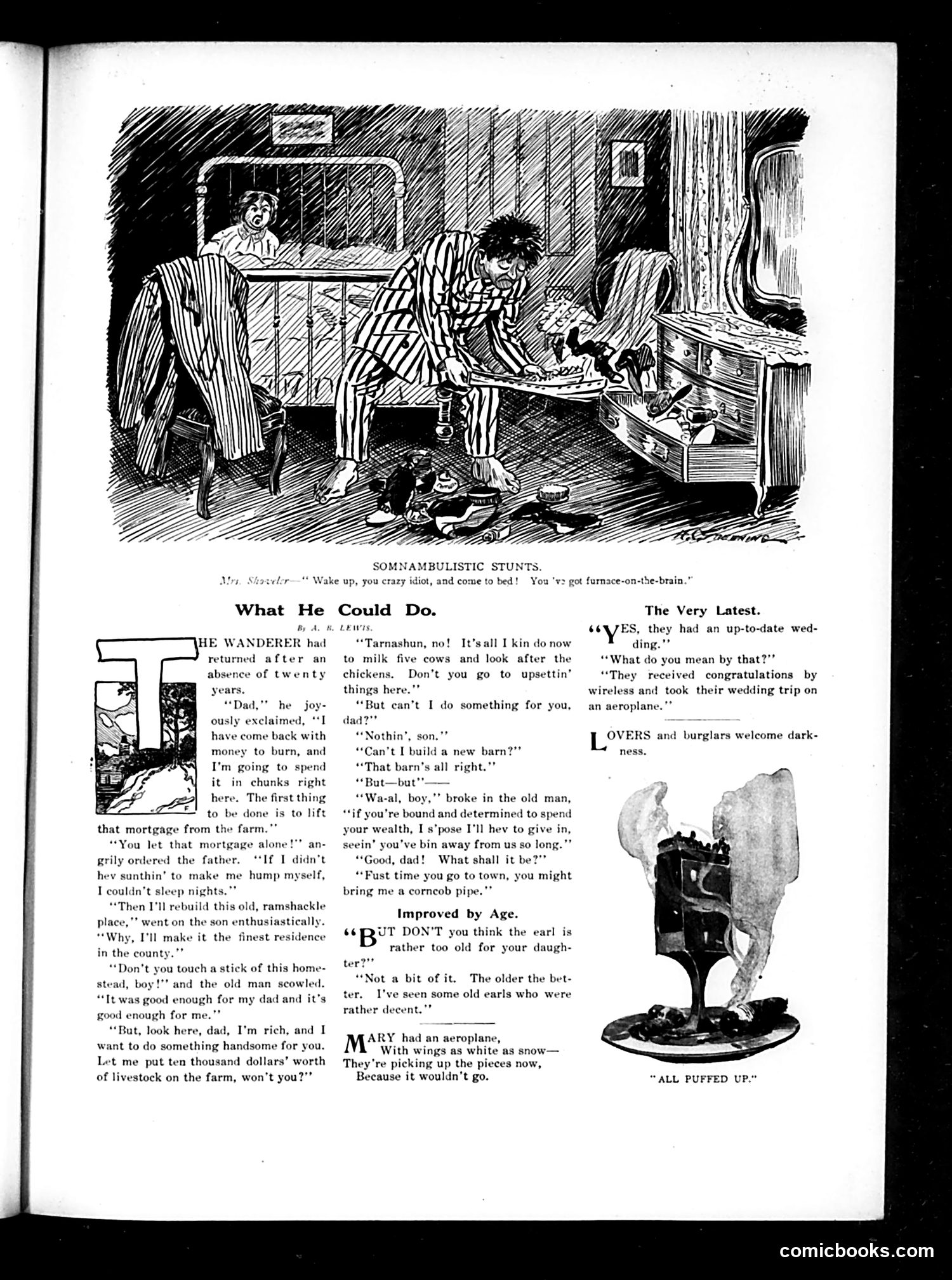
This page contains several unrelated short humorous pieces typical of early 20th-century satirical magazines. **"Somnambulistic Stunts"** (top): A cartoon depicting a sleepwalker in pajamas causing household chaos while family members react. **"What He Could Do"**: A narrative joke about a returning wanderer who wants to spend newfound wealth helping his stubborn father improve the family farm—lifting mortgages, rebuilding structures, buying livestock. The father refuses everything until finally accepting one modest gift: a corncob pipe. The satire targets immigrant or rural stubbornness and resistance to progress/improvement. **"The Very Latest"**: A brief joke about a fashionable modern wedding where congratulations arrive by wireless (radio) and the couple honeymooned by airplane—mocking contemporary technological obsession. **"Improved by Age"**: A quip about marrying off a daughter to an elderly earl, suggesting older aristocrats are preferable because some are "decent." **"Mary had an Aeroplane"**: A brief verse about an airplane crash. The page reflects pre-WWI American attitudes toward rural life, modern technology, and marriage prospects.
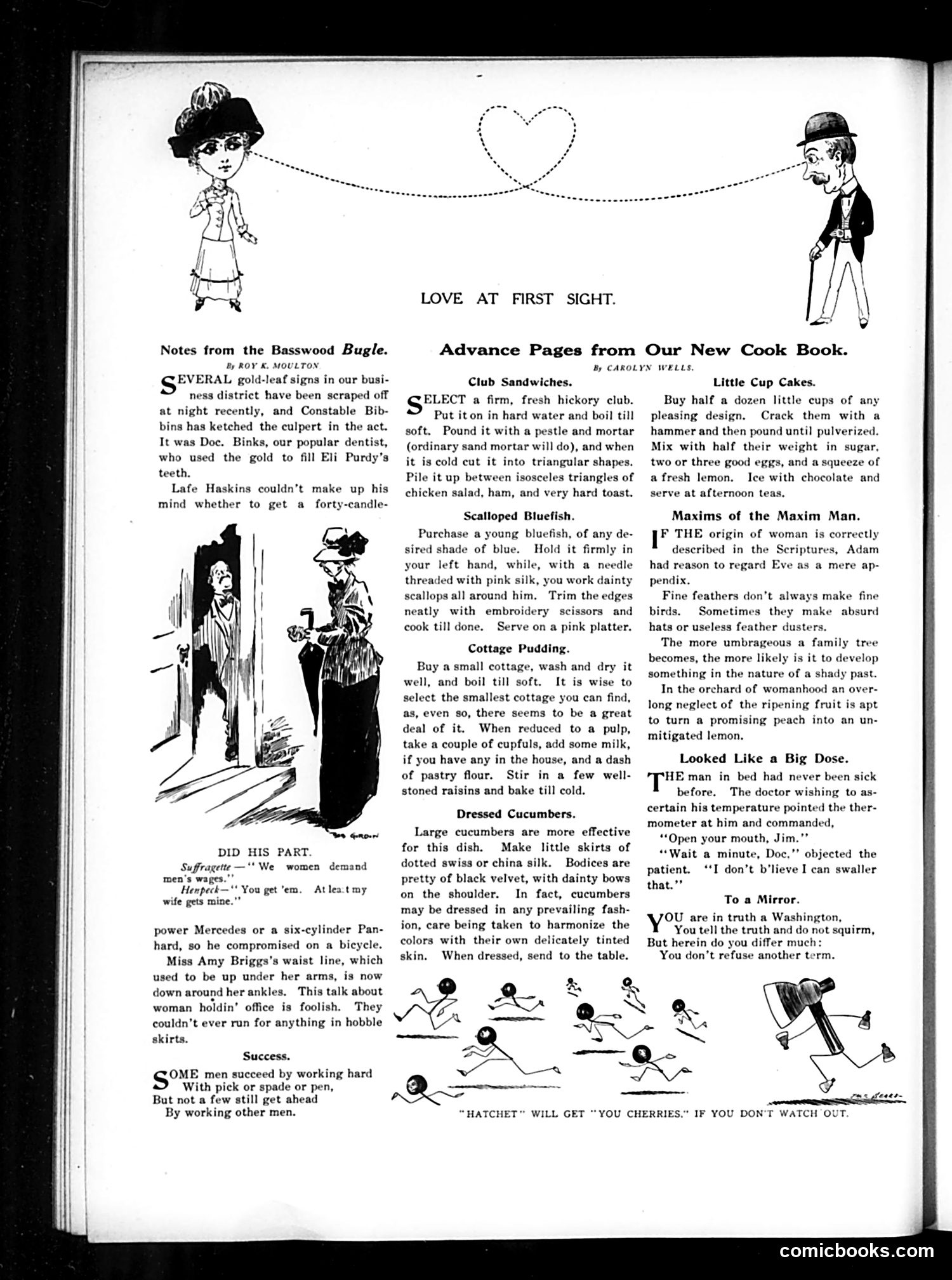
This page mixes humor columns with satirical "recipes" and social commentary typical of early 20th-century Judge magazine. **Main Content:** The "Cook Book" section by Carolyn Wells uses absurdist humor, treating non-food items as recipes—"Club Sandwiches" instructs readers to purchase an actual club (wooden stick), boil and pound it; "Cottage Pudding" means buying a small house, boiling it until soft. This mocks pretentious or obscure cookbook language. **Social Satire:** - The "Suffragete" dialogue jokes that women demanding equal wages aren't truly equal—the husband still controls his own earnings - "Woman holdin' office is foolish" mocks women's ambitions, citing impractical fashion (hobble skirts) - The "Maxims of the Maxim Man" section contains misogynistic quips comparing women to fruit and treating them as subordinate **Other Notes:** Small-town gossip ("Basswood Bugle") and doctor humor fill remaining space. The bottom cartoon about "Hatchet" and cherries appears incomplete in this OCR. Overall, the page reflects early 1900s attitudes: patronizing toward women's rights while claiming humor.
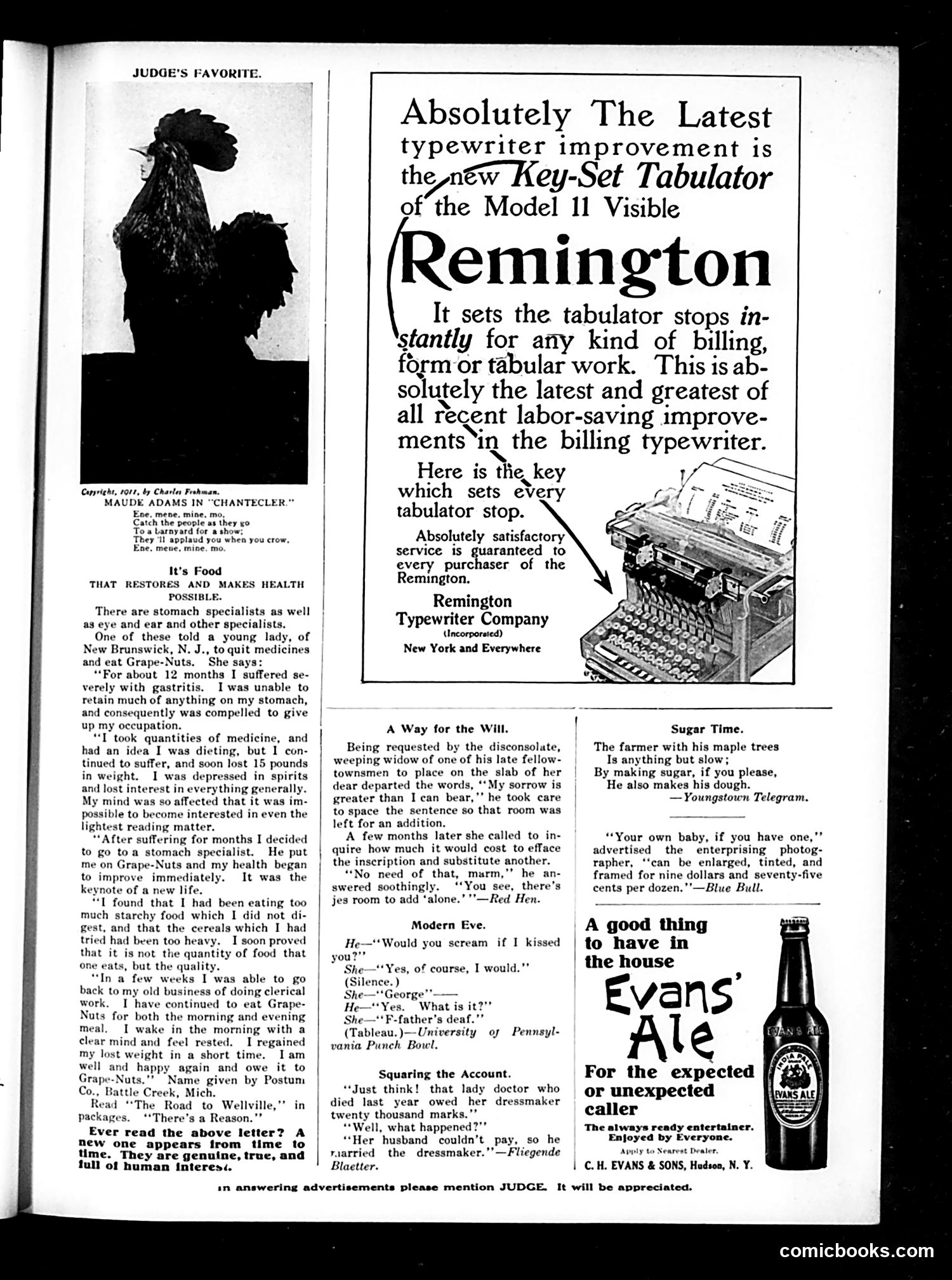
This page from *Judge* (circa 1908) features: **Main Cartoon**: "Judge's Favorite" depicts **Maude Adams in "Chantecler"**—a famous theatrical production. The silhouette shows a rooster, referencing the play's barnyard setting. The accompanying verse mocks the show's popularity, suggesting audiences will applaud anything presented as theatrical spectacle ("They'll applaud you when you crow"). **Advertisements**: The page is predominantly advertising—Grape-Nuts cereal (with a testimonial about digestive health), and Remington typewriter's new "Key-Set Tabulator" for billing work. **Humor Sections**: Below are brief comedic vignettes typical of *Judge*'s format: jokes about modern courtship, widows' gravestones, and marital mishaps—light social commentary with no specific political content. The page reflects early-1900s concerns: health via nutrition, office mechanization, and urban social etiquette.
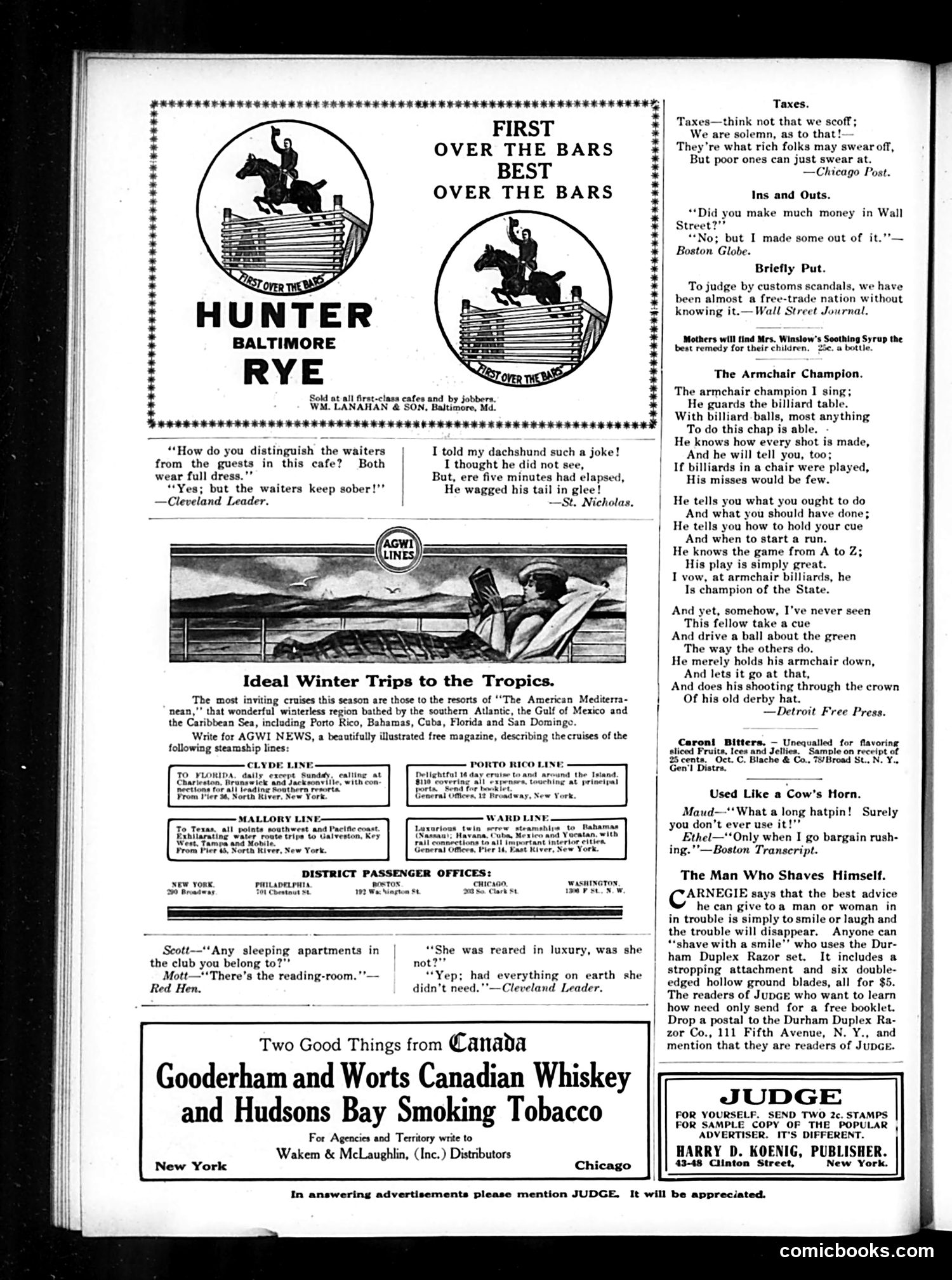
This page is primarily **advertising and humor** rather than political commentary. The main features are: **Top Advertisement:** Hunter Baltimore Rye whiskey, using equestrian imagery ("First Over the Bars") as a marketing motif—suggesting quality and superiority. **Humorous Short Jokes:** Several brief, genteel quips about social situations (waiters vs. guests in formal dress, a dachshund's reaction to a joke, etc.). These represent typical Judge magazine "comic relief" content—light, non-topical humor. **Travel Advertising:** Cruise lines promoting tropical vacation destinations (Caribbean, Florida), reflecting the leisure interests of Judge's affluent readership. **Satirical Verses:** "The Armchair Champion" mocks pretentious men who critique billiards games from armchairs without actually playing—social satire targeting armchair quarterbacking. **Miscellaneous Ads:** Canadian whiskey, smoking tobacco, razors, and patent medicines (Mrs. Winslow's Soothing Syrup). The page reflects early 20th-century magazine culture: advertisements mixed with light humor and verse targeting an educated, affluent audience.
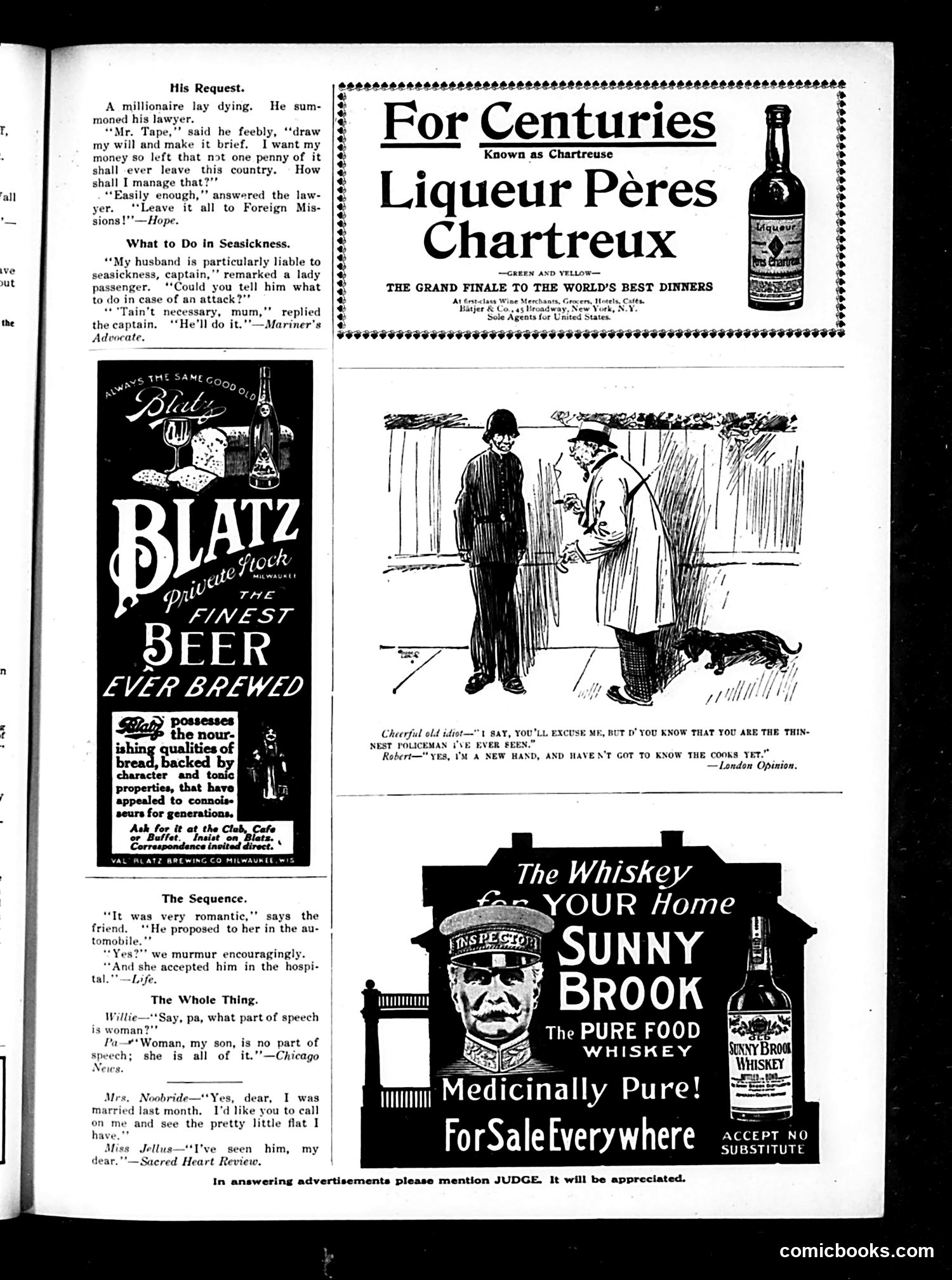
This page contains primarily **advertisements** interspersed with brief humorous anecdotes rather than political cartoons. The main advertisement promotes **Liqueur Pères Chartreux**, a French liqueur marketed as "the grand finale to the world's best dinners." Below are ads for **Blatz Beer** (claiming superior brewing qualities) and **Sunny Brook Whiskey** (labeled "medicinally pure"—relevant since this appears to be Prohibition-era, when alcohol was marketed for medicinal purposes to circumvent bans). The cartoon depicts a **policeman confronting someone** with the caption about being a "new hand" unfamiliar with local laws. The text snippets are light social humor: a dying millionaire wanting money kept in America (solved by giving to Foreign Missions), seasickness remedies, and observations about women and courtship. **Context for modern readers**: This reflects pre-Prohibition advertising when alcohol was openly promoted, and the "medicinal" claims hint at coming legal restrictions.
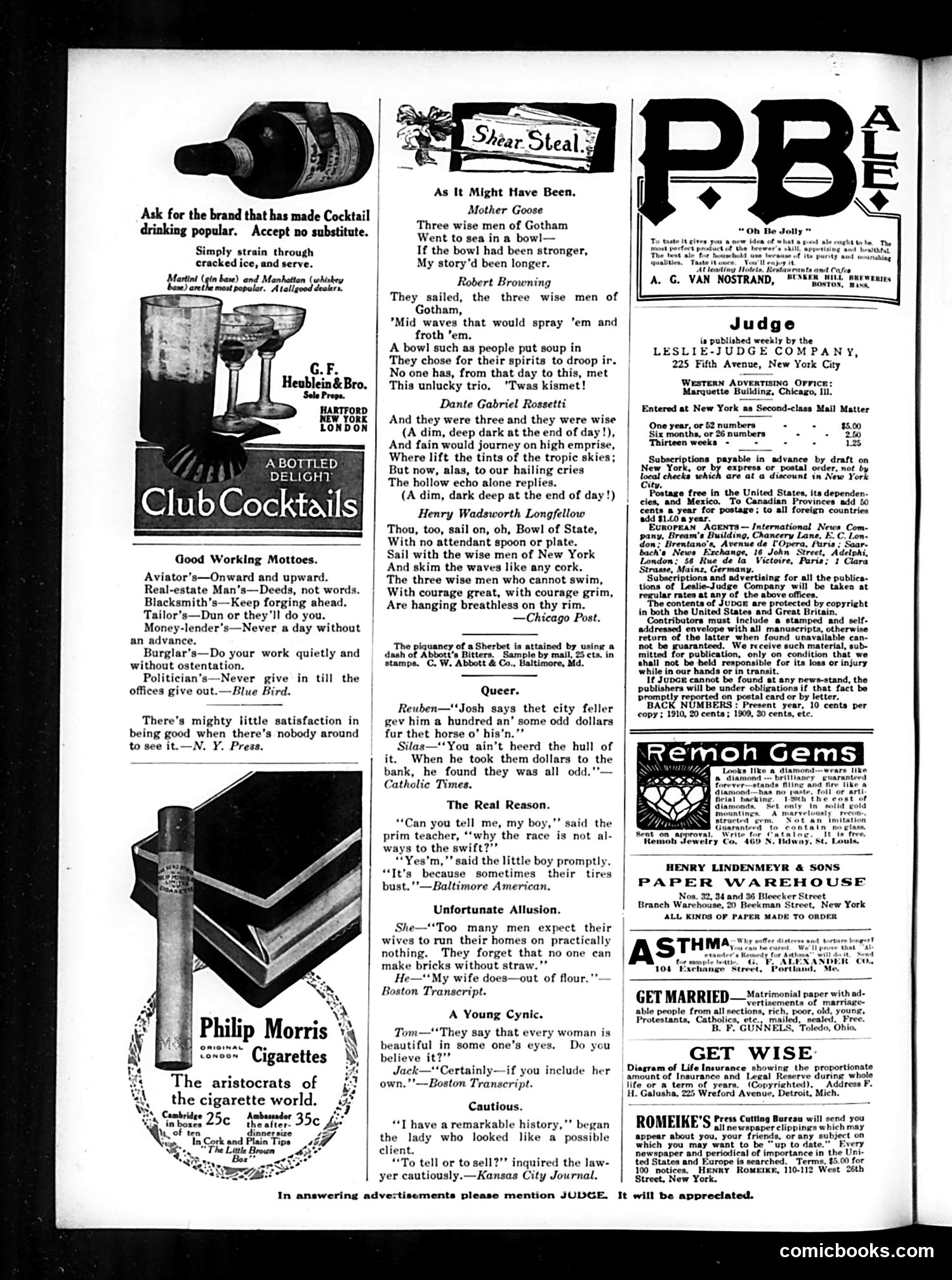
This page from *Judge* contains primarily **short humor pieces and advertisements** rather than political cartoons. The content includes: **Humor Pieces:** The central feature is "As It Might Have Been, Mother Goose"—a playful parody reimagining the nursery rhyme about three wise men of Gotham going to sea in a bowl. Multiple writers (Browning, Rossetti, Longfellow) contribute mock-serious versions of the absurd scenario, treating it as high literature. This is gentle satire on pretentious poetry rather than political commentary. Below are brief jokes about practical matters: a farmer's misunderstanding about "odd" dollars at a bank, a wife making flour into "bricks" (a Depression-era reference to making something from nothing), and a lawyer asking whether a client wants to tell or *sell* her story. **Advertisements:** The page is heavily dominated by ads for Club Cocktails, Philip Morris cigarettes, and various services—typical of *Judge's* revenue model. There is **no significant political satire** visible on this page.
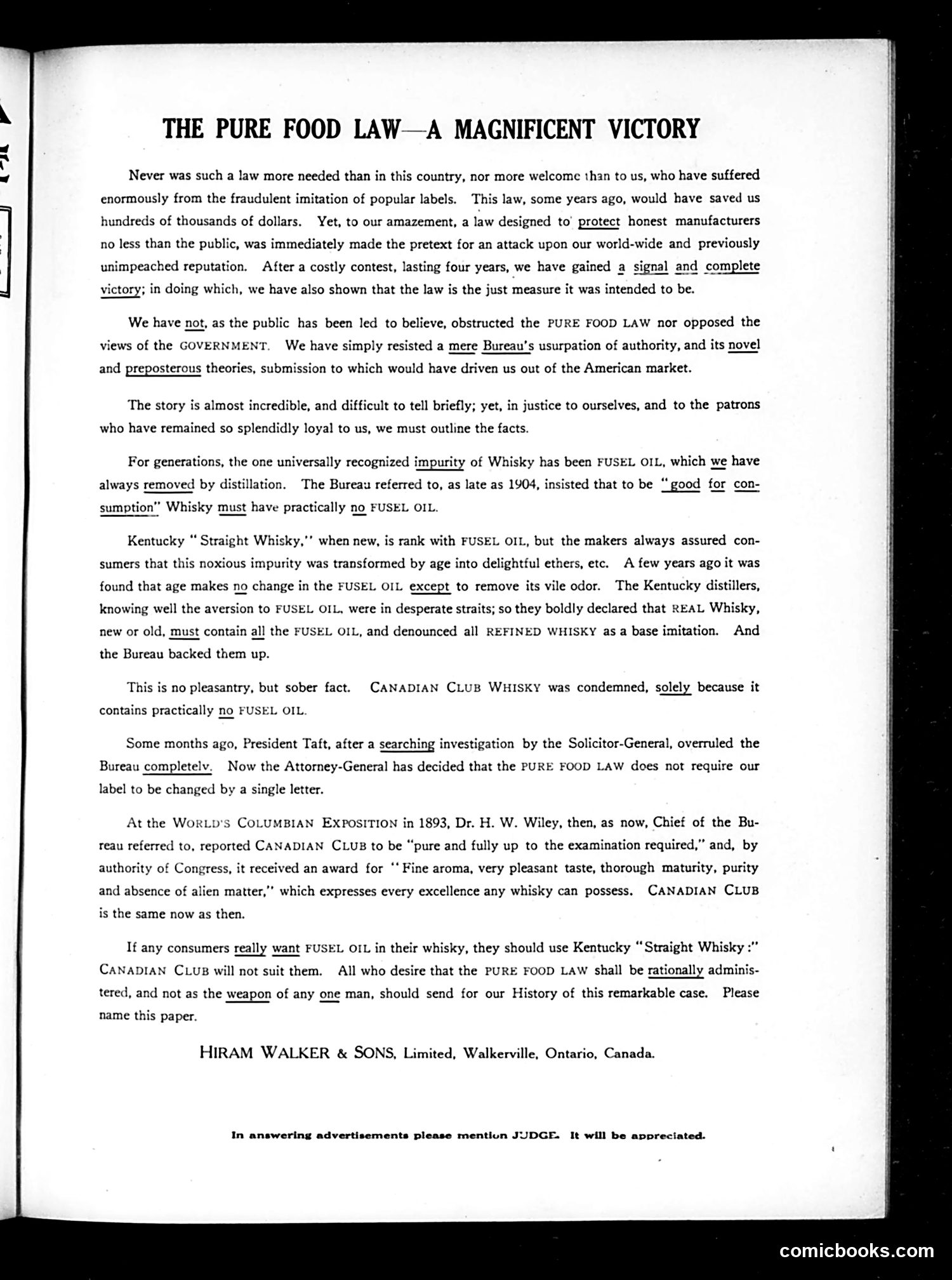
This is a **full-page advertisement**, not a cartoon, by Canadian whisky manufacturer Hiram Walker & Sons. It claims victory in a four-year legal battle over the Pure Food Law (enacted 1906). The dispute centered on **fusel oil**, a chemical byproduct in whisky. Walker's Canadian Club was condemned because it contained *minimal* fusel oil (removed through refinement), while Kentucky distillers argued *authentic* whisky must contain fusel oil. The Bureau of Chemistry agreed with Kentucky producers. Walker celebrates **President Taft's intervention** and the Attorney General's decision overturning the Bureau's position, allowing their label unchanged. The ad invokes Dr. H.W. Wiley's 1893 World's Columbian Exposition award for Canadian Club's purity—ironically from the same Bureau that later attacked them. The underlying issue: competing definitions of product authenticity, with government agencies initially favoring established (if chemically inferior) Kentucky whisky over refined Canadian imports. Walker frames their victory as defending rational regulation against bureaucratic overreach.
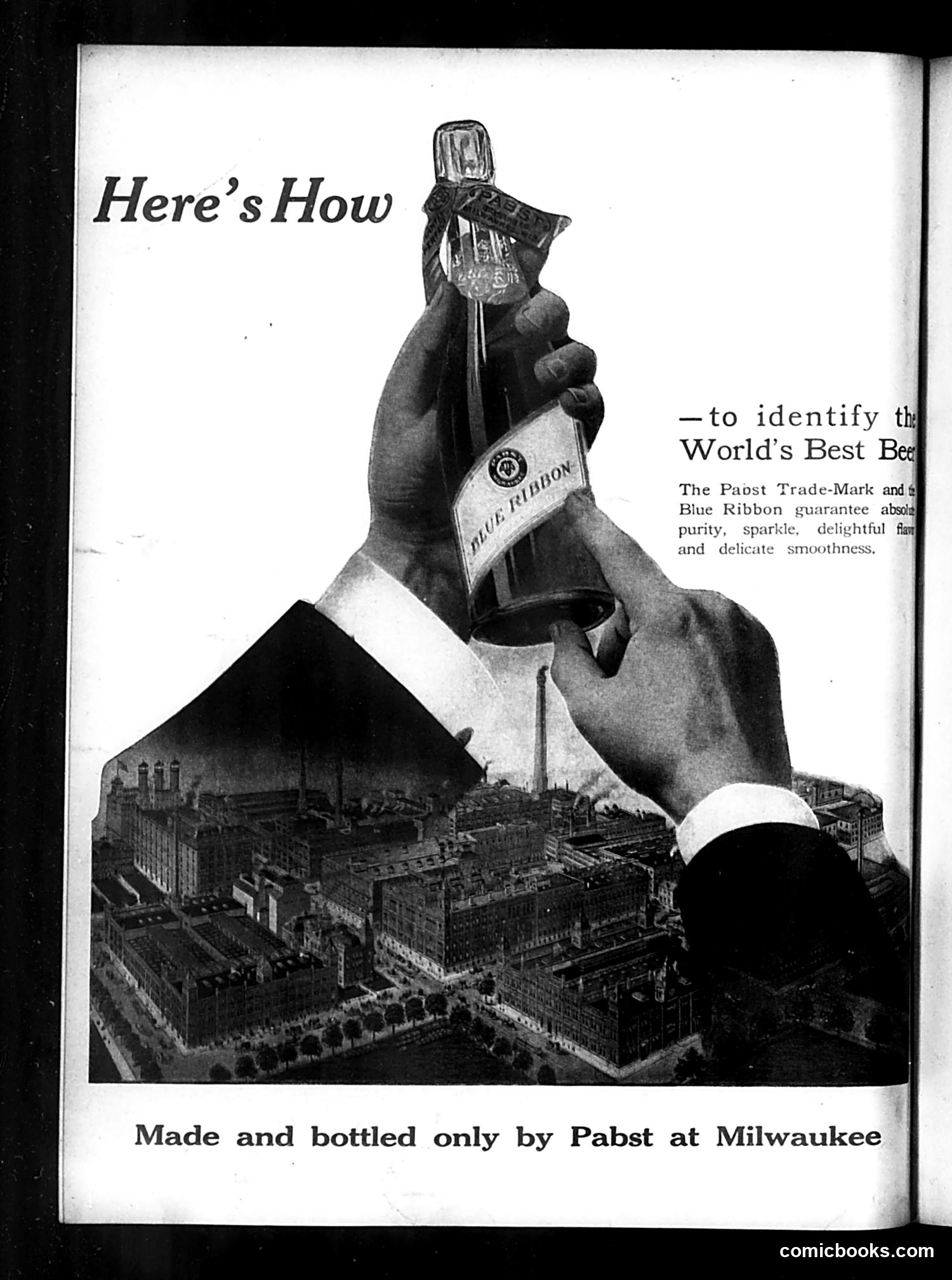
This is a Pabst Blue Ribbon beer advertisement rather than political satire. The image shows a giant hand holding a bottle of Pabst beer above an aerial view of what appears to be the Milwaukee brewery. The ad uses the visual metaphor of a massive hand presenting the product to emphasize Pabst's scale and importance as a brewer. The text highlights the "Blue Ribbon" trademark as a guarantee of quality—"purity, sparkle, delightful flavor and delicate smoothness." The emphasis on "Made and bottled only by Pabst at Milwaukee" stresses authenticity and local production. This represents typical early-20th-century advertising strategy: using dramatic imagery and brand assurance to market beer during the pre-Prohibition era.