
Judge, 1911-02-25 · page 16 of 24
Judge — February 25, 1911 — page 16: what you’re looking at
What you’re looking at
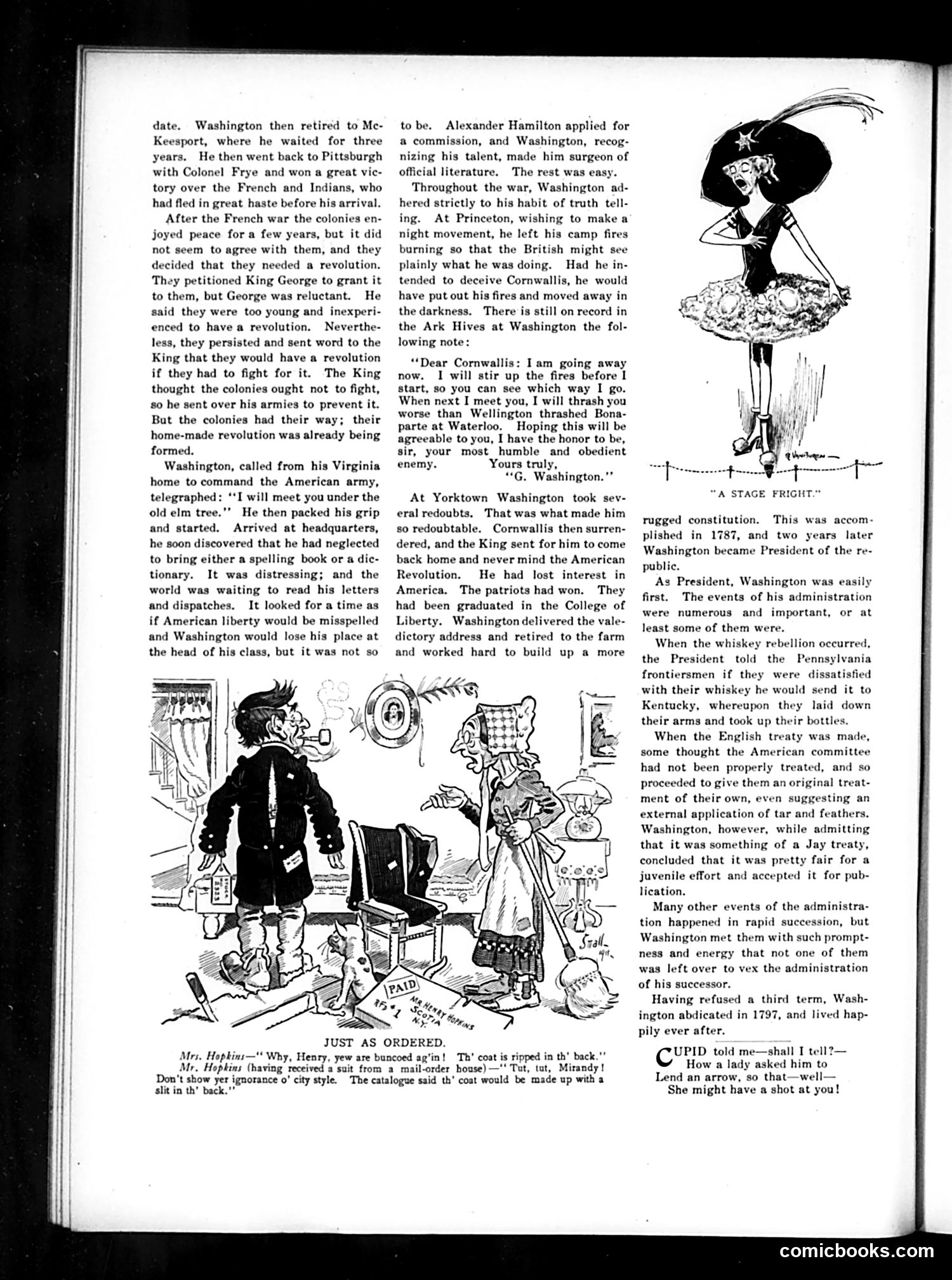
This page combines humorous historical narrative with contemporary satire. The main text hilariously reimagines George Washington's life in deliberately absurd ways—claiming he telegraphed from Virginia, that Alexander Hamilton served as "surgeon of official literature" to fix his spelling, and that Washington wrote Cornwallis a courtesy note announcing his tactical movements. The satire's point: it mocks how Americans mythologize Washington as flawlessly honest and brilliant. By exaggerating his virtue to ridiculous extremes, the author exposes how the founding narrative has become sanitized legend. Below is an unrelated cartoon titled "Just As Ordered," depicting a man upset that his mail-order coat has a slit in the back—a dig at mail-order fraud and false advertising, common consumer complaints of the era. His wife's confusion about "city style" suggests rural versus urban sophistication gaps. The "Stage Fright" illustration appears to reference theatrical anxiety, though context is cut off.
📄 Transcribed text from this page (OCR, searchable)
Machine-transcribed from the original scan — historical spelling and the odd misread are preserved.
date. Washington then retired to Mc- Keesport, where he waited for three years. He then went back to Pittsburgh with Colonel Frye and won a great vic- tory over the French and Indians, who had fled in great haste before his arrival. After the French war the colonies en- joyed peace for a few years, but it did not seem to agree with them, and they decided that they needed a revolution. They petitioned King George to grant it to them, but George was reluctant. He said they were too young and inexperi- enced to have a revolution. Neverthe- less, they persisted and sent word to the King that they would ha revolution if they had to fight for it. The King thought the colonies ought not to fight, so he sent over his armies to prevent it. But the colonies had their way; their home-made revolution was already being formed. Washington, called from his Virginia home to command the American army, telegraphed: ‘‘I will meet you under the old elm tree.’ He then packed his grip and started. Arrived at headquarters, he soon discovered that he had neglected to bring either a spelling book or a dic- tionary. It was distressing; and the world was waiting to read his letters and dispatches. It looked for a time as if American liberty would be misspelled and Washington would lose his place at the head of his class, but it was not so to be. Alexander Hamilton applied for a commission, and Washington, recog- nizing his talent, made him surgeon of official literature. The rest was easy. Throughout the war, Washington ad- hered strictly to his habit of truth tell- ing. At Princeton, wishing to make a night movement, he left his camp fires burning so that the British might see plainly what he was doing. Had he in- tended to deceive Cornwallis, he would have put out his fires and moved away the darkness. There is still on record in the Ark Hives at Washington the fol- lowing note: “Dear Cornwallis: Iam going away now. I will stir up the fires before I start, so you can see which way I go. When next I meet you, I will thrash you worse than Wellington thrashed Bona- parte at Waterloo. Hoping this will be agreeable to you, I have the honor to be, sir, your most humble and obedient enemy. Yours truly, “G. Washington.” At Yorktown Washington took sev- eral redoubts. That was what made him so redoubtable. Cornwallis then surren- dered, and the King sent for him to come back home and never mind the American Revolution. He had lost interest in America. The patriots had won. They had been graduated in the College of Liberty. Washington delivered the vale- dictory address and retired to the farm and worked hard to build up a more JUST AS ORDERED. Mrs. Hopkins—'* Why, Henry, yew are buncoed ag’in ! Th’ coat is ripped in th’ back.'’ Mr. Hopkins (having received a suit from a mail-order house)—‘‘ Tut, tut, Mirandy! Don't show yer ignorance o’ city style. The catalogue said th’ coat would be made up with a slit in th’ back.'” “A STAGE FRIGHT.” rugged constitution. This was accom- plished in 1787, and two years later Washington became President of the re- public. As President, Washington was easily first. The events of his administration were numerous and important, or at least some of them were. When the whiskey rebellion occurred, the President told the Pennsylvania frontiersmen if they were dissatisfied with their whiskey he would send it to Kentucky, whereupon they laid down their arms and took up their bottles. When the English treaty was made, some thought the American committee had not been properly treated, and so proceeded to give them an original treat- ment of their own, even suggesting an external application of tar and feathers. Washington, however, while admitting that it was something of a Jay treaty, concluded that it was pretty fair for a juvenile effort and accepted it for pub- lication. Many other events of the administra- tion happened in rapid succession, but Washington met them with such prompt- ness and energy that not one of them was left over to vex the administration of his successor. Having refused a third term, Wash- ington abdicated in 1797, and lived hap- pily ever after. UPID told me—shall I tell?— How a lady asked him to Lend an arrow, so that—well— She might have a shot at you! comicbooks.com