
Judge, 1911-02-25 · page 6 of 24
Judge — February 25, 1911 — page 6: what you’re looking at
What you’re looking at
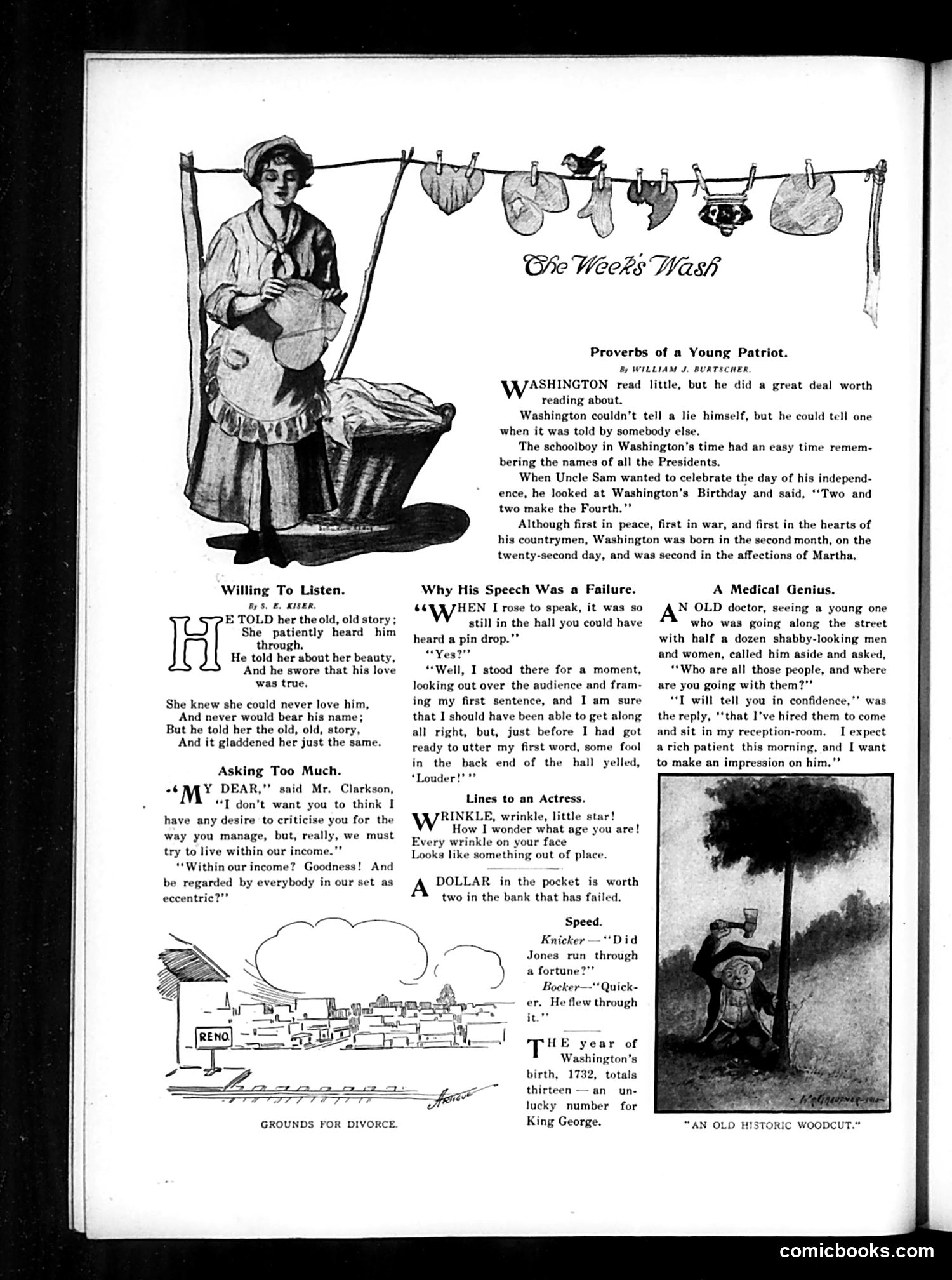
This page from *Judge* contains several satirical pieces mocking American social pretensions and gender dynamics circa early 1900s: **"Willing to Listen"** satirizes romantic deception—a man persistently recites clichéd declarations of love to a woman who doesn't reciprocate, yet she finds comfort in the performance anyway. The joke targets both male insincerity and female gullibility. **"Asking Too Much"** mocks upper-class anxiety about appearances. Mr. Clarkson suggests living within their means; his wife finds this unthinkable—appearing "eccentric" to their social set matters more than financial reality. **"Proverbs of a Young Patriot"** offers irreverent quips about George Washington, undermining his legendary honesty and importance. The reference to Washington's birth year (1732) totaling thirteen—"an unlucky number for King George"—is a patriotic jab at the British. **"A Medical Genius"** depicts a young doctor hiring shabby patients to fill his waiting room, creating false impressiveness for wealthy clients—satirizing medical fraud and social climbing. The cartoons collectively mock vanity, financial pretense, and dishonesty across romance, class hierarchy, and professional life.
📄 Transcribed text from this page (OCR, searchable)
Machine-transcribed from the original scan — historical spelling and the odd misread are preserved.
Willing To Listen. By 8. E. KISER. E TOLD her the old, old story; She patiently heard him through. He told her about her beauty, And he swore that his love was true. She knew she could never love him, And never would bear his name; But he told her the old, old, story, And it gladdened her just the same. Asking Too Much. “6 Y DEAR,"’ said Mr. “T don’t want you to think I have any desire to criticise you for the way you manage, but, really, we must try to live within our income.’ “Within our income? Goodness! And be regarded by everybody in our set as eccentric?’’ Clarkson, Cre Weeks Wash Proverbs of a Young Patriot. By WILLIAM J. BURTSCHER ASHINGTON read little, but he did a great deal worth reading about. Washington couldn't tell a lie himself, but he could tell one when it was told by somebody else. The schoolboy in Washington's time had an easy time remem- bering the names of all the Presidents. When Uncle Sam wanted to celebrate the day of ence, he looked at Washington's Birthday and said, two make the Fourth." Although first in peace, first in war, and first in the hearts of his countrymen, Washington was born in the second month, on the twenty-second day, and was second in the affections of Martha. Why His Speech Was a Failure. SO\HEN I rose to speak, it was so still in the hall you could have heard a pin drop.” “Yes?"" “Well, I stood there for a moment, looking out over the audience and fram- ing my first sentence, and I am sure that I should have been able to get along all right, but, just before I had got ready to utter my first word, some fool in the back end of the hall yelled, ‘Louder! Lines to an Actress. RINKLE, wrinkle, little star! How I wonder what age you are! Every wrinkle on your face Looks like something out of place. DOLLAR in the pocket is worth two in the bank that has failed. Speed. Knicker —‘‘Did Jones run through a fortune Bocker—‘Quick- er. He flew through ie.” HE year of Washington’s birth, 1732, totals thirteen — an un- GROUNDS FOR DIVORCE. lucky number for King George. A Medical Genius. AN OLD doctor, seeing a young one who was going along the street with half a dozen shabby-looking men and women, called him aside and asked, “Who are all those people, and where are you going with them?” “T will tell you in confidence,’’ was the reply, ‘‘that I've hired them to come and sit in my reception-room. I expect arich patient this morning, and I want to make an impression on him." “AN OLD HISTORIC WOODCUT.” comicbooks.com