
Judge, 1911-02-25 · page 15 of 24
Judge — February 25, 1911 — page 15: what you’re looking at
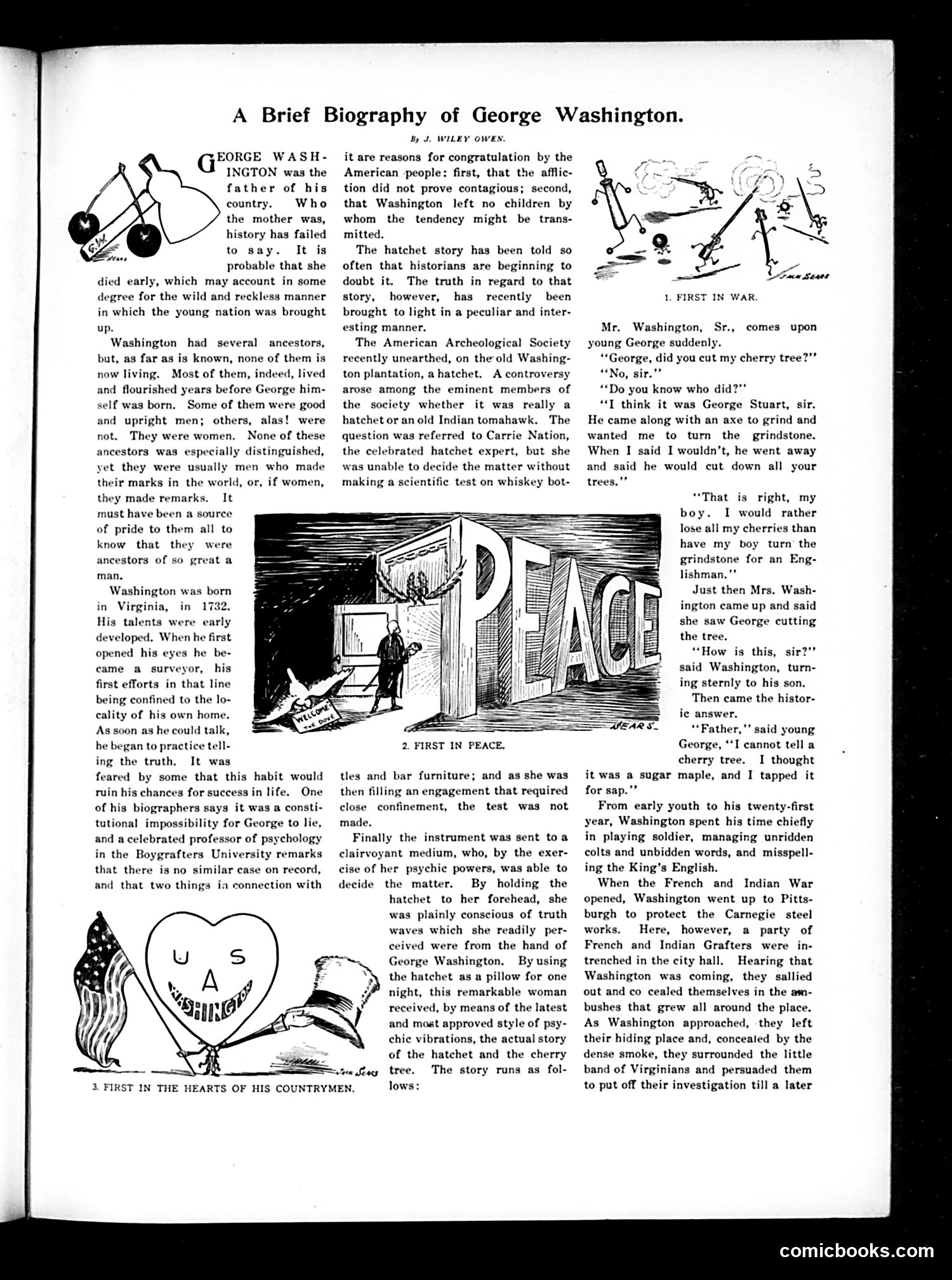
A restored page from Judge, 1911-02-25. Page through the whole issue in the reader above.
📄 Transcribed text from this page (OCR, searchable)
Machine-transcribed from the original scan — historical spelling and the odd misread are preserved.
A Brief Biography of George Washington. EORGE WASH- INGTON was the father of his country. Who the mother was, history has failed to say. It is probable that she died early, which may account in some degree for the wild and reckless manner in which the young nation was brought up. Washington had several but, as far as is known, none of them is now living. Most of them, indeed, lived and flourished years before George him- self was born. Some of them were good and upright men; others, alas! were not. They were women. None of these ancestors was especially distinguished, yet they were usually men who made their marks in the world, or, if women, they made remarks. It must have been a source of pride to them all to know that they ancestors of so great a Eyes ancestors, were man. Washington was born in Virginia, in His talents were early developed. When he first opened his eyes he be- came a surveyor, his first efforts in that line being confined to the lo- cality of his own home. As soon as he could talk, he began to practice tell- ing the truth. It was feared by some that this habit would ruin his chances for success in life. One of his biographers says it was a con tutional impossibility for George to lie, and a celebrated professor of psychology in the Boygrafters University remarks that there is no similar case on record, and that two things ia connection with 0 Ss 3. FIRST IN THE HEARTS OF HIS COUNTRYMEN. By J. WILEY OWEN. it are reasons for congratulation by the American people: first, that the afflic- tion did not prove contagious; second, that Washington left no children by whom the tendency might be trans- mitted. The hatchet story has been told so often that historians are beginning to doubt it. The truth in regard to that story, however, has recently been brought to light in a peculiar and inter- esting manner. The American Archeological Society recently unearthed, on the old Washing- ton plantation, ahatchet. A controversy arose among the eminent members of the society whether it was really a hatchet or an old Indian tomahawk. The question was referred to Carrie Nation, the celebrated hatchet expert, but she was unable to decide the matter without making a scientific test on whiskey bot- 2. FIRST IN PEACE. tles and bar furniture; and as she was then filling an engagement that required close confinement, the test was not made. Finally the instrument was sent toa clairvoyant medium, who, by the exer- cise of her psychic powers, was able to the matter. By holding the hatchet to her forehead, she was plainly conscious of truth waves which she readily per- ceived were from the hand of George Washington. By using the hatchet as a pillow for one night, this remarkable woman received, by means of the latest and most approved style of psy- chic vibrations, the actual story of the hatchet and the cherry tree. The story runs as fol- lows: decide ean LGncu Seat 1. FIRST IN WAR. Mr. Washington, Sr., young George suddenly, “George, did you cut my cherry tree?’” “No, sir."” “Do you know who did?"’ “I think it was George Stuart, sir. He came along with an axe to grind and wanted me to turn the grindstone. When I said I wouldn't, he went away and said he would cut down all your comes upon trees,"" “That is right, my boy. I would rather lose all my cherries than have my boy turn the grindstone for an Eng- lishman."" Just then Mrs. Wash- ington came up and said she saw George cutting the tree. ‘How is this, sir?’’ said Washington, turn- ing sternly to his son. Then came the histor- ic answer. ‘*Father,”’ said young George, ‘‘I cannot tell a cherry tree. I thought it was a sugar maple, and I tapped it for sap."” From early youth to his twenty-first year, Washington spent his time chiefly in playing soldier, managing unridden colts and unbidden words, and misspell- ing the King’s English. When the French and Indian War opened, Washington went up to Pitts- burgh to protect the Carnegie steel works. Here, however, a party of French and Indian Grafters were in- trenched in the city hall. Hearing that Washington was coming, they sallied out and co cealed themselves in the am- bushes that grew all around the place. As Washington approached, they left their hiding place and, concealed by the dense smoke, they surrounded the little band of Virginians and persuaded them to put off their investigation till a later comicbooks.com