
A complete issue · 24 pages · 1910
Judge — November 5, 1910
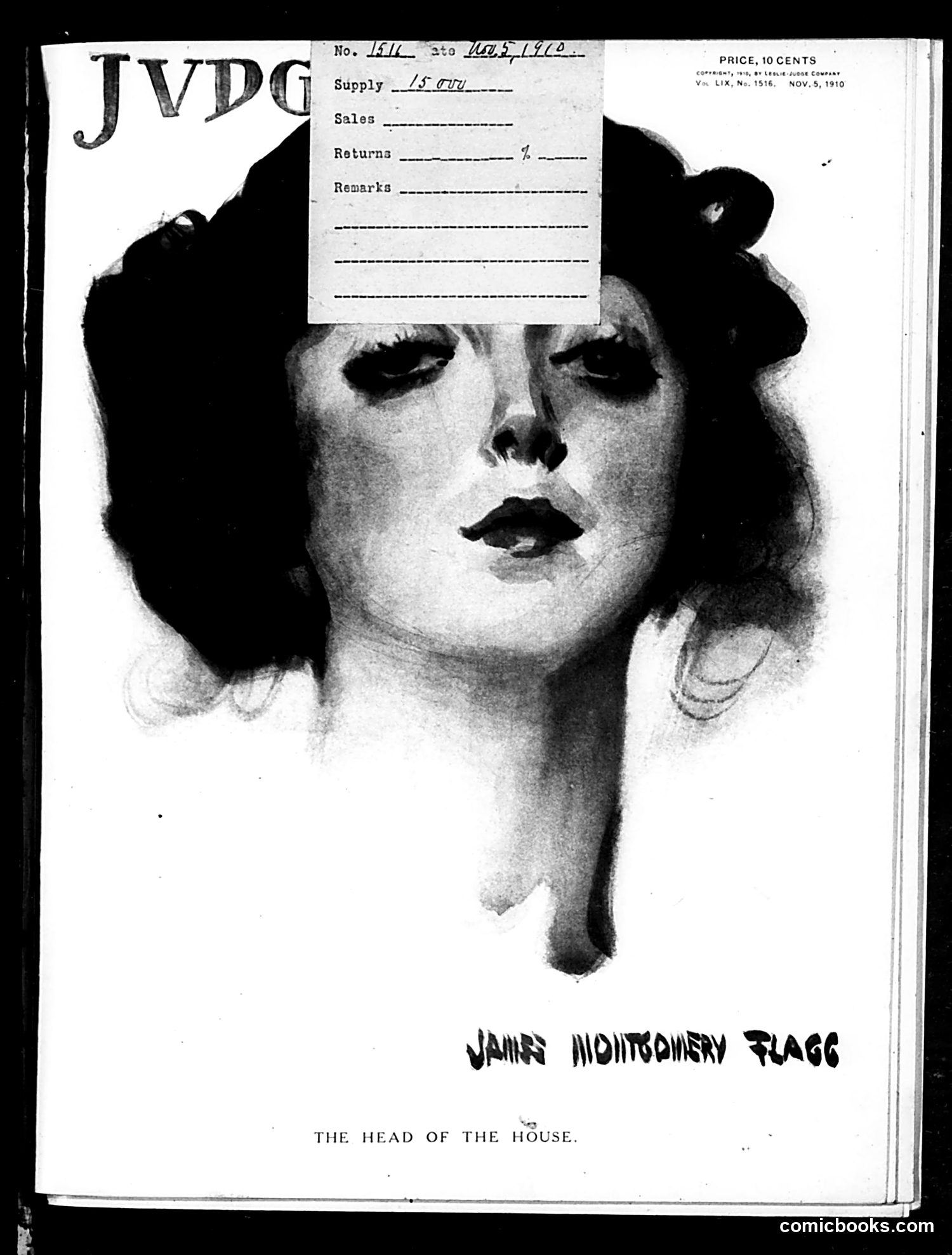
This Judge magazine cover from November 5, 1910 features a portrait labeled "James Montgomery Flagg" with the caption "The Head of the House." The image appears to be a self-referential piece by or about the prominent illustrator Flagg himself. The "head of the house" title likely contains satirical commentary—possibly about Flagg's prominence in American illustration and design, or perhaps a domestic/marital joke typical of Judge's humor. The illustration showcases the soft-focus, portrait style characteristic of Flagg's own work, suggesting the cover itself may be demonstrating his artistic technique. Without additional context about specific 1910 events or Flagg's personal life, the exact satirical target remains unclear, though it appears to be gentle social satire rather than sharp political commentary.
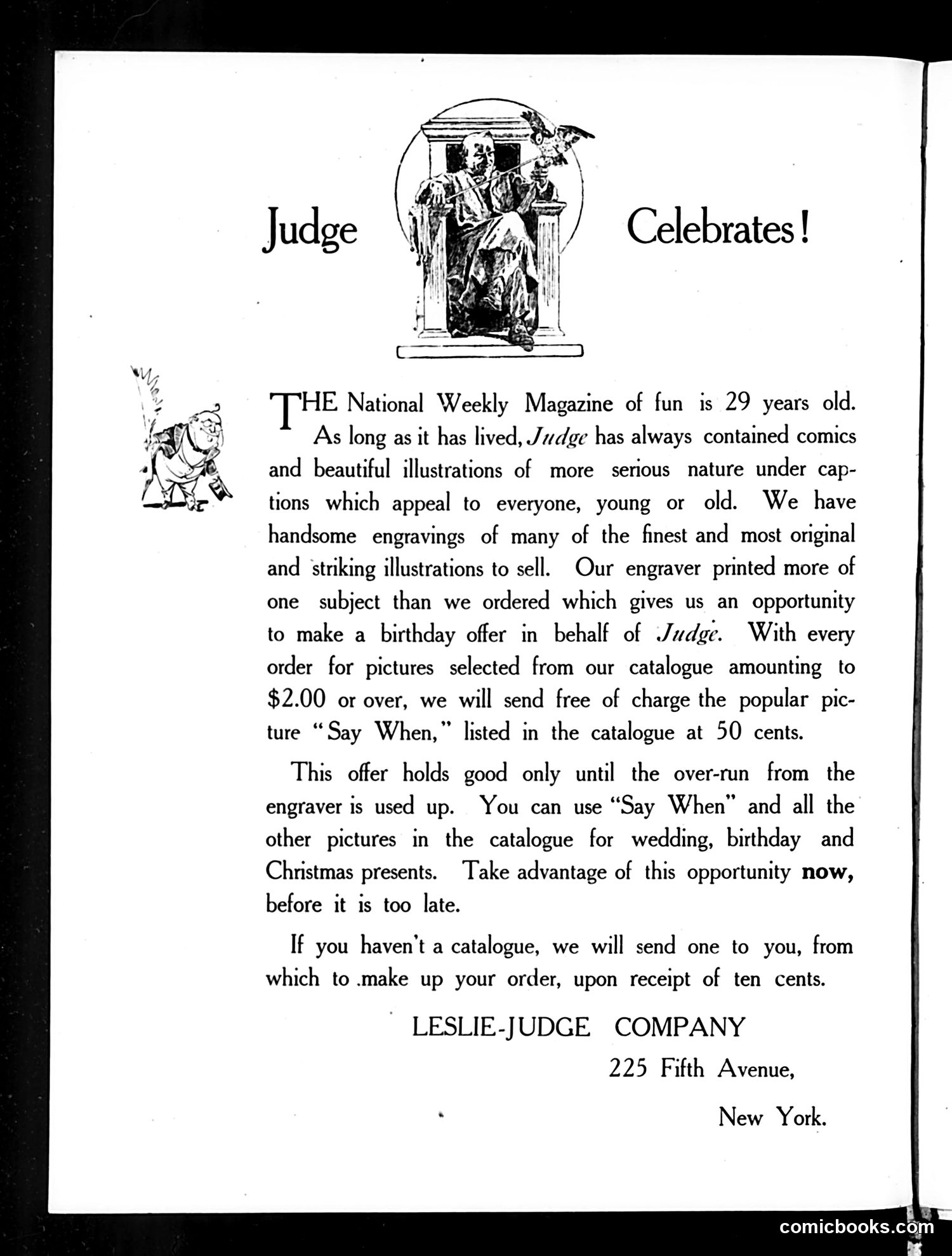
This page is primarily **advertising**, not satire. It celebrates Judge magazine's 29th anniversary with a promotional offer. The central image shows **Lady Justice** (blindfolded figure with scales and sword), representing the magazine's name and authority. A small cartoon figure on the left appears to be a jester or comic character, reinforcing Judge's identity as a humor publication. The text announces a birthday promotional deal: customers ordering engravings/illustrations worth $2.00 or more receive a free picture called "Say When" (normally 50 cents). This offer exploits an engraver's overrun to benefit customers during the magazine's anniversary celebration. The advertisement pitches Judge as containing quality comics and illustrations appealing to all ages, encouraging orders for gifts while stock lasts.
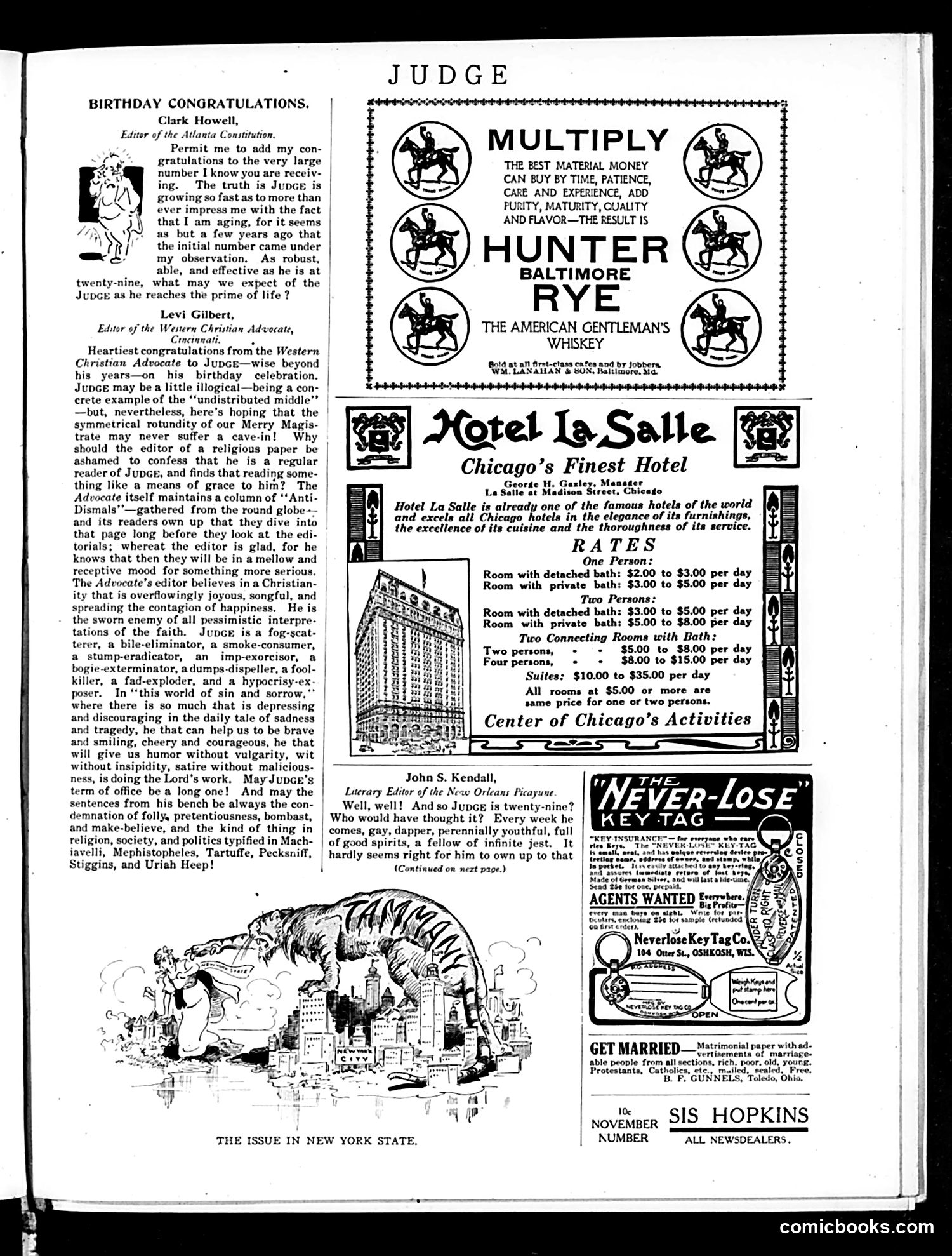
This page is primarily **advertisements and birthday congratulations** rather than political satire. The birthday section congratulates three editors: Clark Howell (Atlanta Constitution), Levi Gilbert (Western Christian Advocate), and John S. Kendall (New Orleans Picayune). The congratulatory messages are lighthearted personal tributes rather than satirical commentary. The main cartoon, titled "The Issue in New York State," depicts a large tiger looming menacingly over a cityscape—likely representing a political threat or controversy in New York during this era, though the specific reference is unclear from the image alone. The page otherwise features advertisements for Hunter Rye whiskey, Hotel La Salle in Chicago, a "Never-Lose" key tag, and matrimonial services—typical commercial content from this period of the magazine.
This page is primarily **advertising** rather than editorial cartoon content. The dominant advertisements are for the Pennsylvania Railroad and the Grand Hotel in New York City. The upper left contains a brief editorial note about **Judge's cartoon history of Roosevelt**, mentioning cartoons celebrating his birthday and illustrating his appointments. It references specific cartoons from the magazine's archives dealing with Roosevelt's civil-service reform efforts. The right column includes birthday congratulations to Judge magazine itself (appearing to be its twenty-ninth anniversary) and humorous verses about a stork and a character named Mary with a sharp tongue. **No clear political satire or caricatures are visually prominent** on this particular page—it functions primarily as a commercial advertisement vehicle rather than as a showcase for Judge's typical satirical cartoon content.
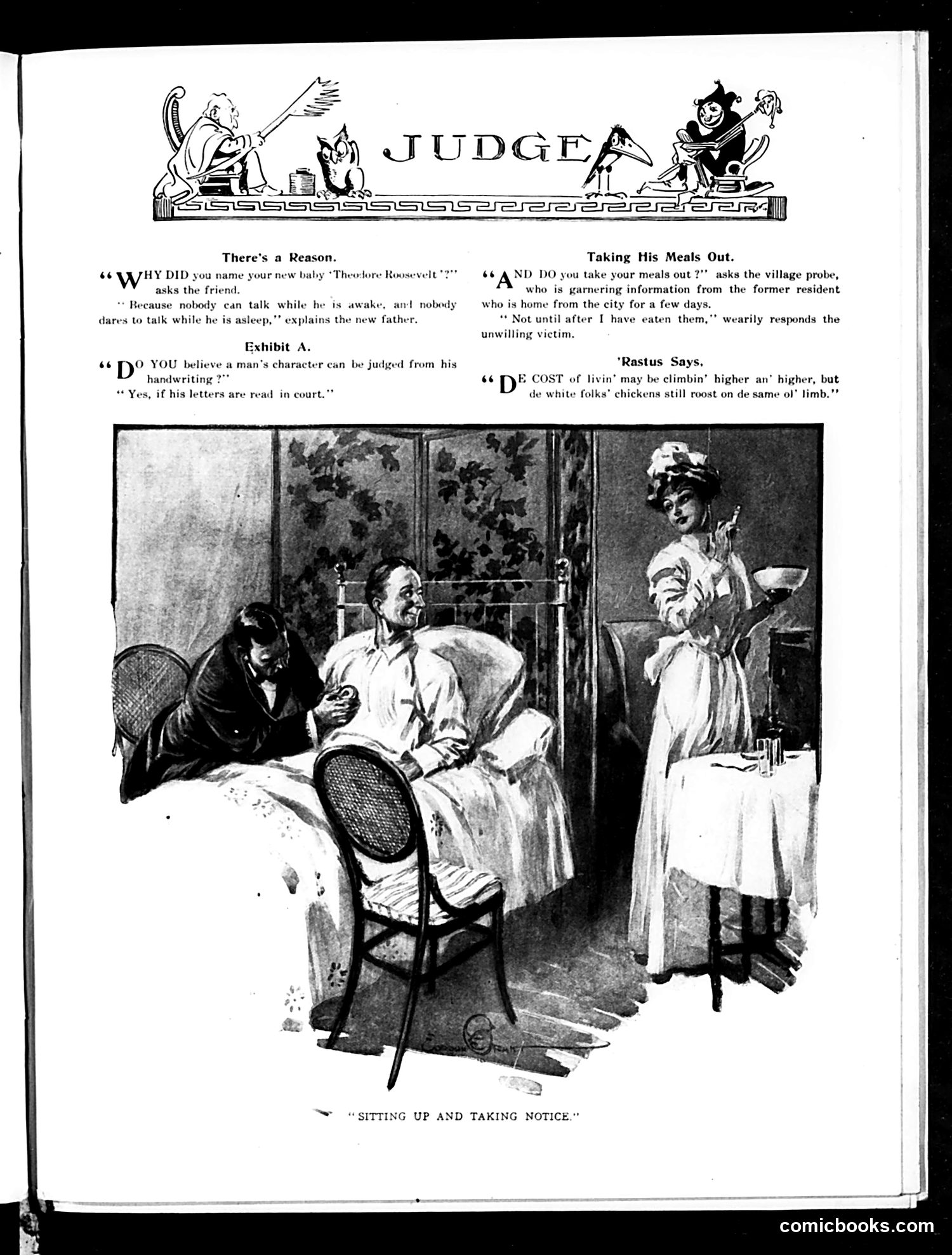
This page presents satirical commentary on character judgment and domestic life. The main illustration, titled "Sitting Up and Taking Notice," depicts a sick man in bed with a nurse and a concerned visitor—likely satirizing how people's true character emerges during illness or hardship. The text snippets mock various social pretensions: a father explains naming his son "Theodore Roosevelt" (the popular president), someone defends eating meals outside the home, and "Rastus" (a racist stereotype character) comments on economic mobility among African Americans with crude dialect humor. The recurring theme is **hypocrisy**—people's public pretenses contrasted with reality. The overall tone reflects early 1900s satirical magazine humor, mixing social observation with period-typical ethnic stereotyping now considered offensive.
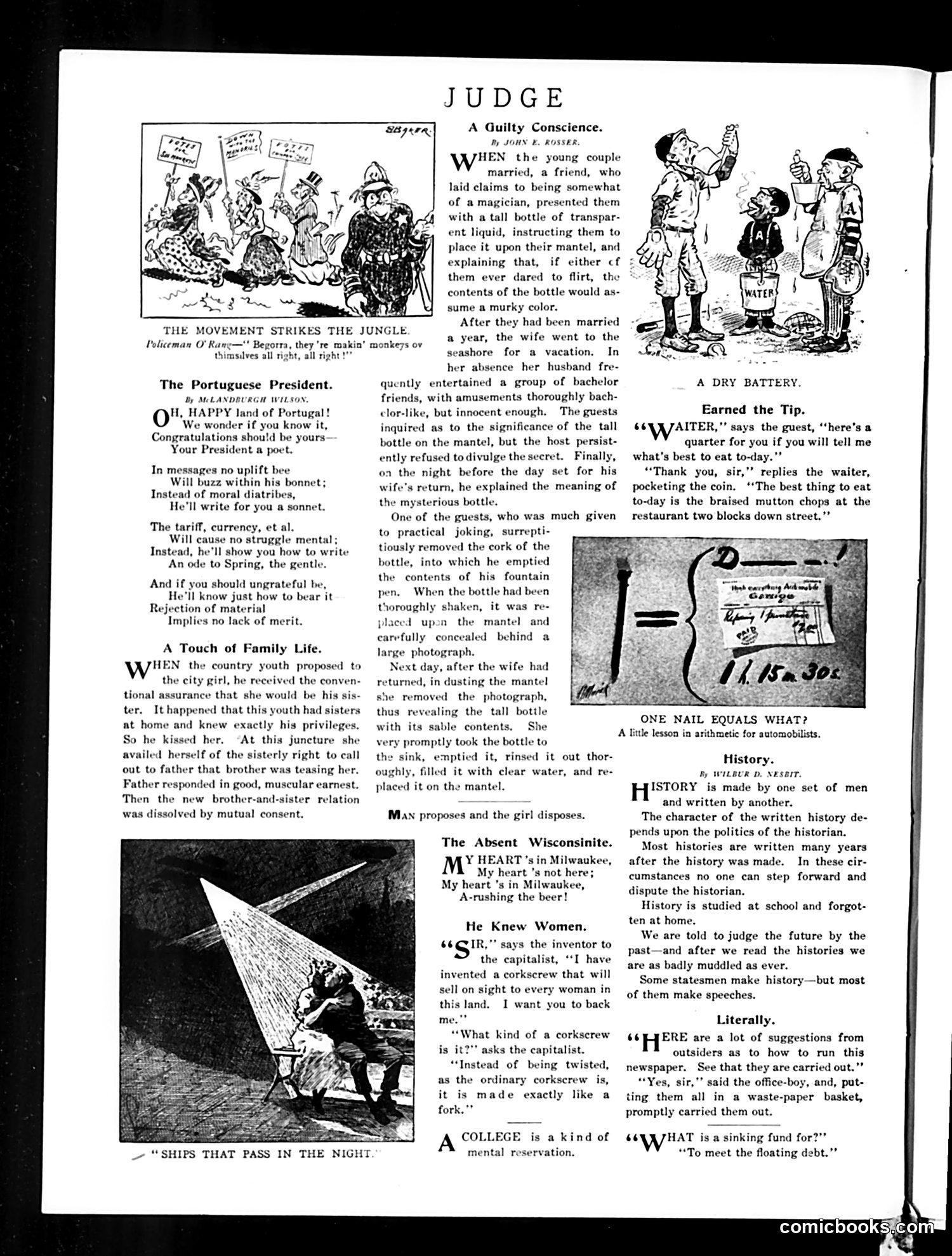
This page from the satirical magazine *Judge* contains several unrelated humor pieces typical of early 20th-century American magazines: **"The Portuguese President"** mocks Portugal's leader for allegedly being more interested in poetry than practical governance—a common jab at leaders deemed ineffectual or distracted from serious matters. **"A Guilty Conscience"** presents a domestic comedy: a husband and wife receive a magical bottle that supposedly turns dark if either flirts. A prankster friend secretly adds ink to it. When the wife returns and sees the darkened bottle, she immediately cleans it—the joke being her guilty conscience makes her assume she's responsible, when actually the husband's innocent bachelor party caused it. **Other brief items** include light observations about family dynamics, immigration/dialect humor (the policeman), and wordplay. The cartoons and jokes rely on now-dated assumptions about gender relations, national stereotypes, and early 1900s social contexts that modern readers would find quaint or offensive.
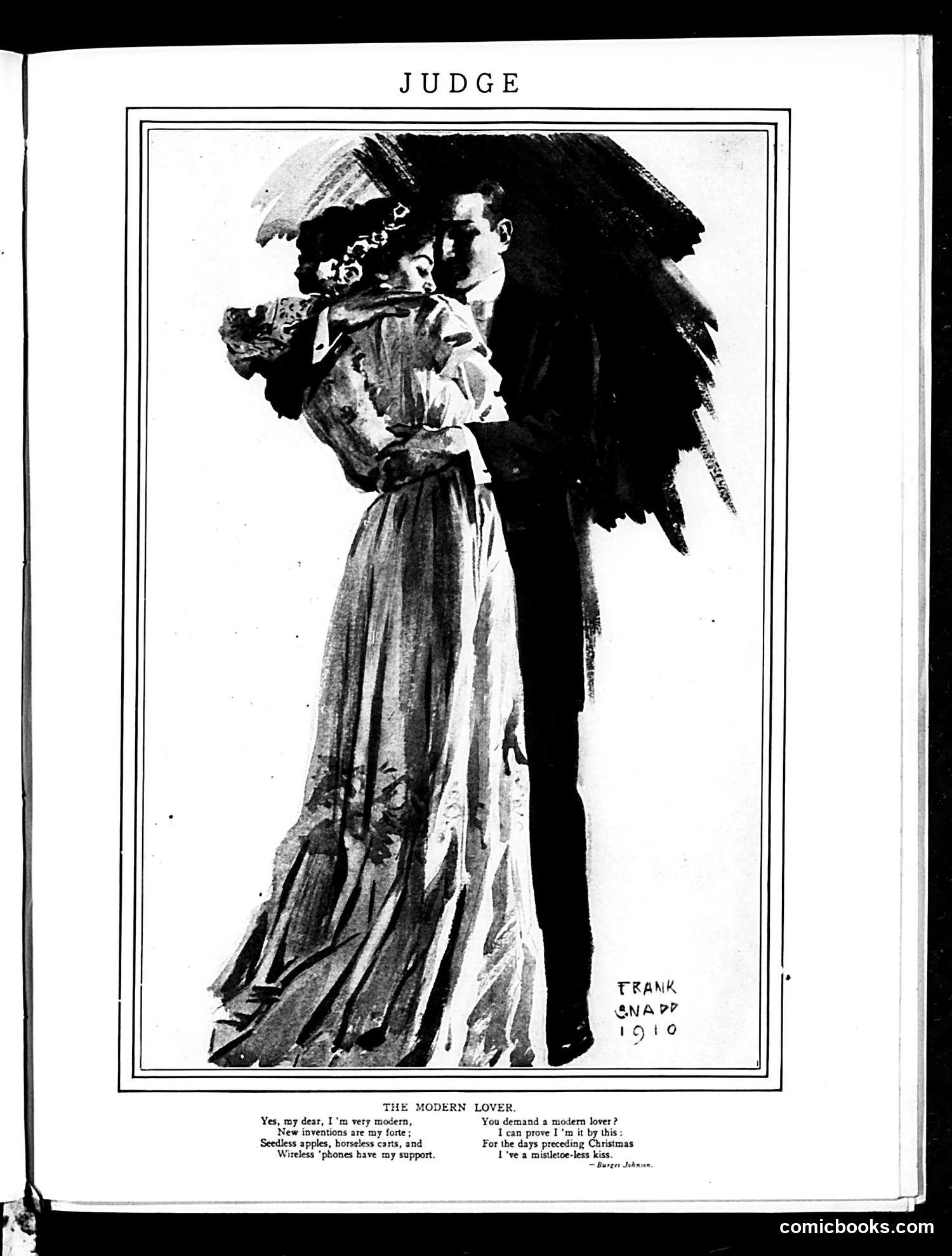
This satirical cartoon by Frank Snapp critiques the modern man's embrace of new technology while paradoxically rejecting romance. The male figure represents a contemporary gentleman boasting of supporting wireless phones, horseless carriages, and seedless apples—symbols of early 20th-century progress. The joke's punchline mocks this modernity: he claims to be a "modern lover" by offering a "mistletoe-less kiss"—eliminating the romantic tradition of kissing under mistletoe during Christmas. The cartoon satirizes how obsession with technological innovation can strip away human warmth and sentiment. It's social commentary on the anxiety that rapid modernization created, suggesting that some "progress" actually represented cultural loss rather than improvement.
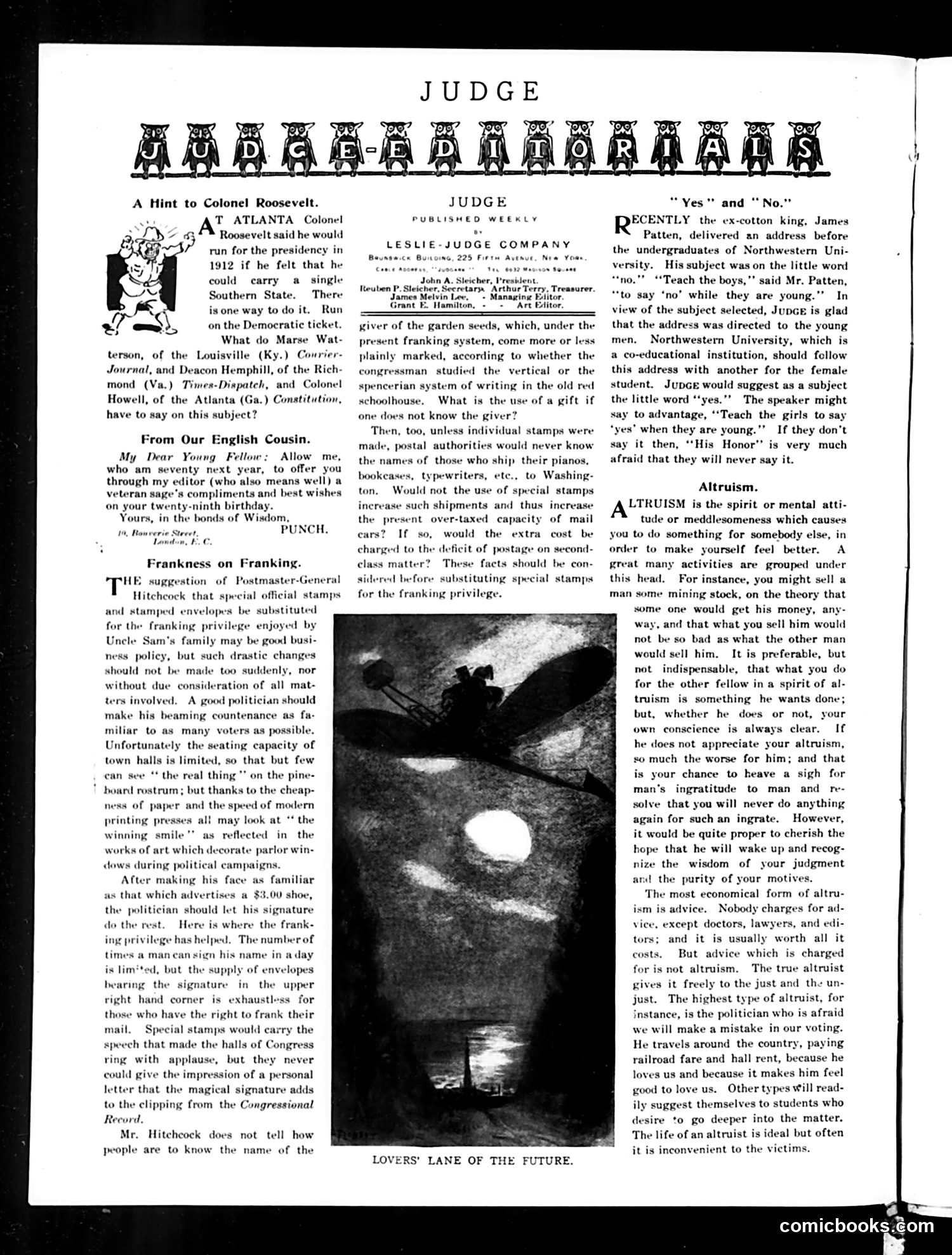
This page primarily discusses **Theodore Roosevelt's potential 1912 presidential run**. The opening cartoon suggests Roosevelt could win Southern states by running on the Democratic ticket—a pointed jab at the Republican Roosevelt's unpopularity in the Democratic South. The main satirical content addresses **congressional franking privileges** (free mail for politicians). The piece mocks how congressmen exploit this system, sending self-promotional materials nationwide under their personal signature. Judge argues that while this benefits politicians' visibility, it wastes postal resources and taxpayer money. The satire suggests politicians use franking less to serve constituents than to advertise themselves—their beaming faces on envelopes reaching voters who'd never attend rallies. A secondary item discusses altruism and charity, arguing true altruism is disinterested help, not self-serving "advice." The page concludes with criticism of cotton magnate James Patten's address to Northwestern students, which emphasized saying "no"—apparently ironic given the overall page's skepticism of American institutions.
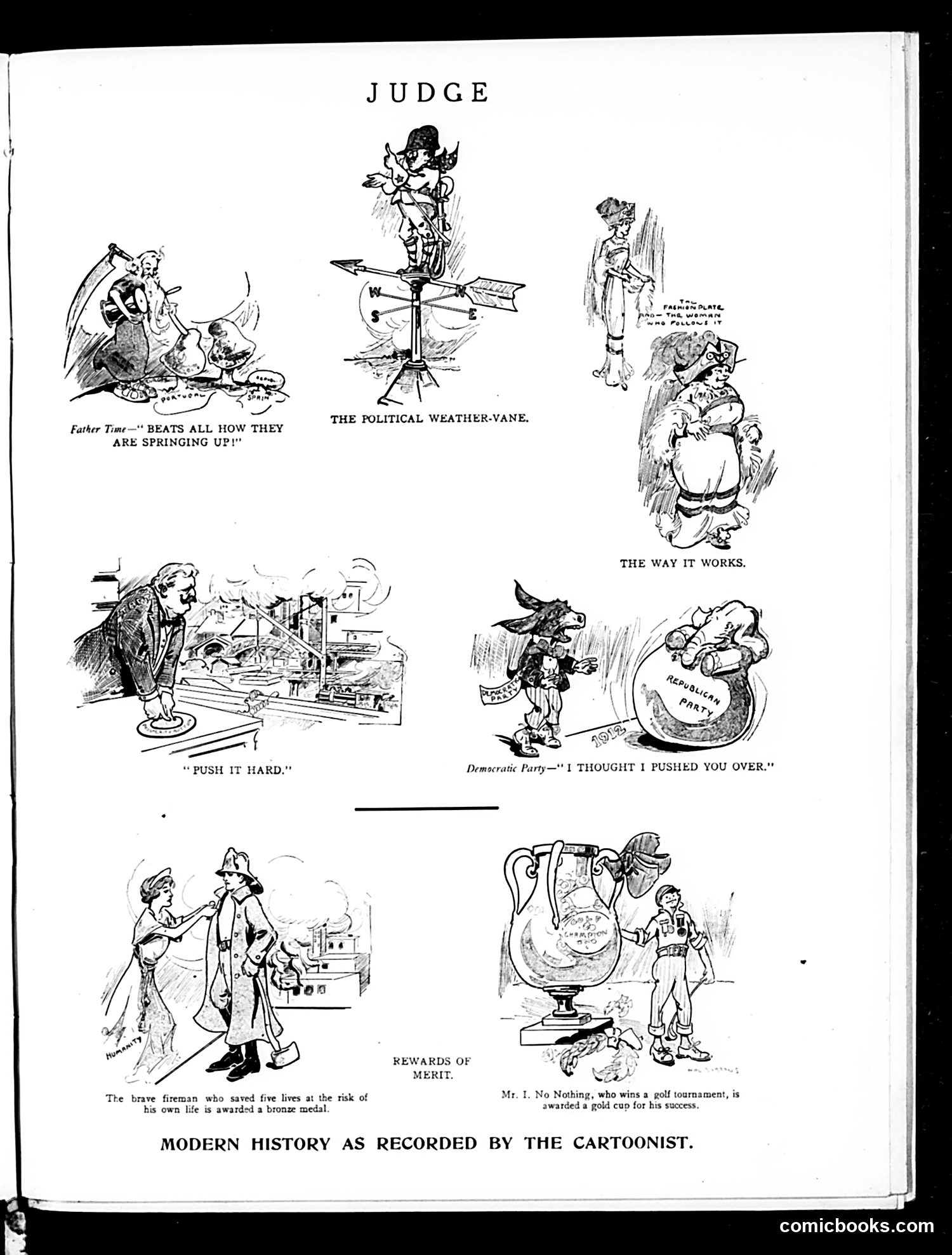
This Judge page satirizes the perceived values of modern society circa early 1900s. "The Political Weather-Vane" mocks politicians' inconsistency—they shift positions with changing winds. "Push It Hard" depicts someone cranking political machinery. The Democratic Party cartoon shows internal conflict ("I thought I pushed you over"). The central satire targets misplaced rewards: "Rewards of Merit" contrasts a fireman who risked his life receiving only a bronze medal, while "Mr. I. No Nothing" wins a gold cup merely for winning a golf tournament. The cartoonist argues society values trivial athletic achievement over genuine heroism and self-sacrifice. The page's subtitle—"Modern History as Recorded by the Cartoonist"—signals this as critical commentary on contemporary priorities and the perceived moral decline of the era.
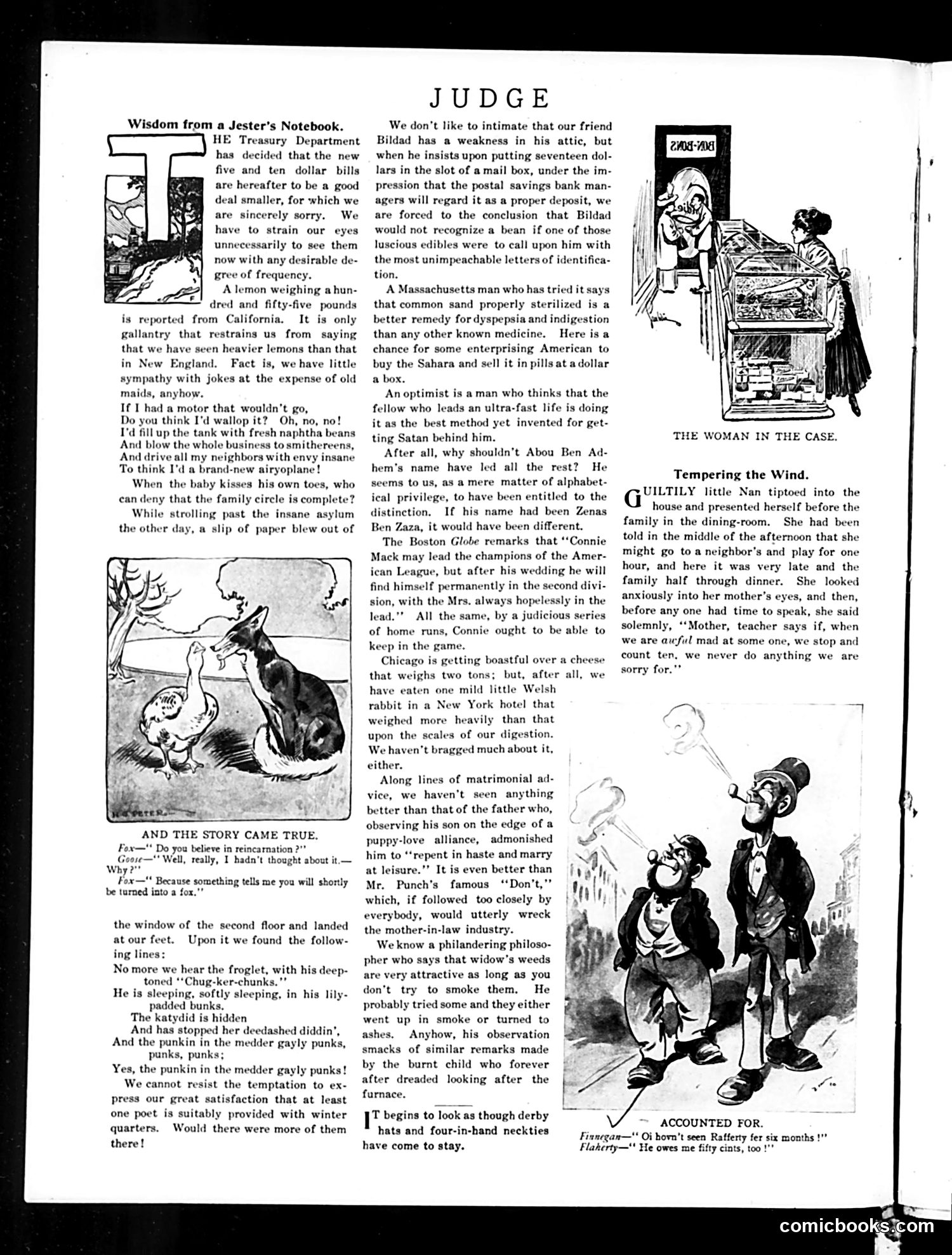
This page from the satirical magazine *Judge* contains several short humorous pieces and cartoons mocking contemporary absurdities: **Main Cartoons:** - "And the Story Came True" depicts a fox threatening to turn someone into a fox—a joke about reincarnation beliefs - "The Woman in the Case" and "Accounted For" show domestic/romantic scenarios with exaggerated character types - "Tempering the Wind" illustrates a mother and child, likely satirizing sentimentality **Satirical Commentary:** The "Wisdom from a Jester's Notebook" section mocks various targets: the Treasury Department's decision to make currency smaller (straining eyesight), absurdly large produce, unreliable motors, and peculiar folk remedies (sand for indigestion). References to "Abou Ben Adhem," "Connie Mack" (baseball manager), and "Mr. Punch" ground the humor in recognizable contemporary figures and publications. The overall tone is light social satire—poking fun at bureaucratic decisions, pseudoscientific claims, and human foibles rather than serious political critique.
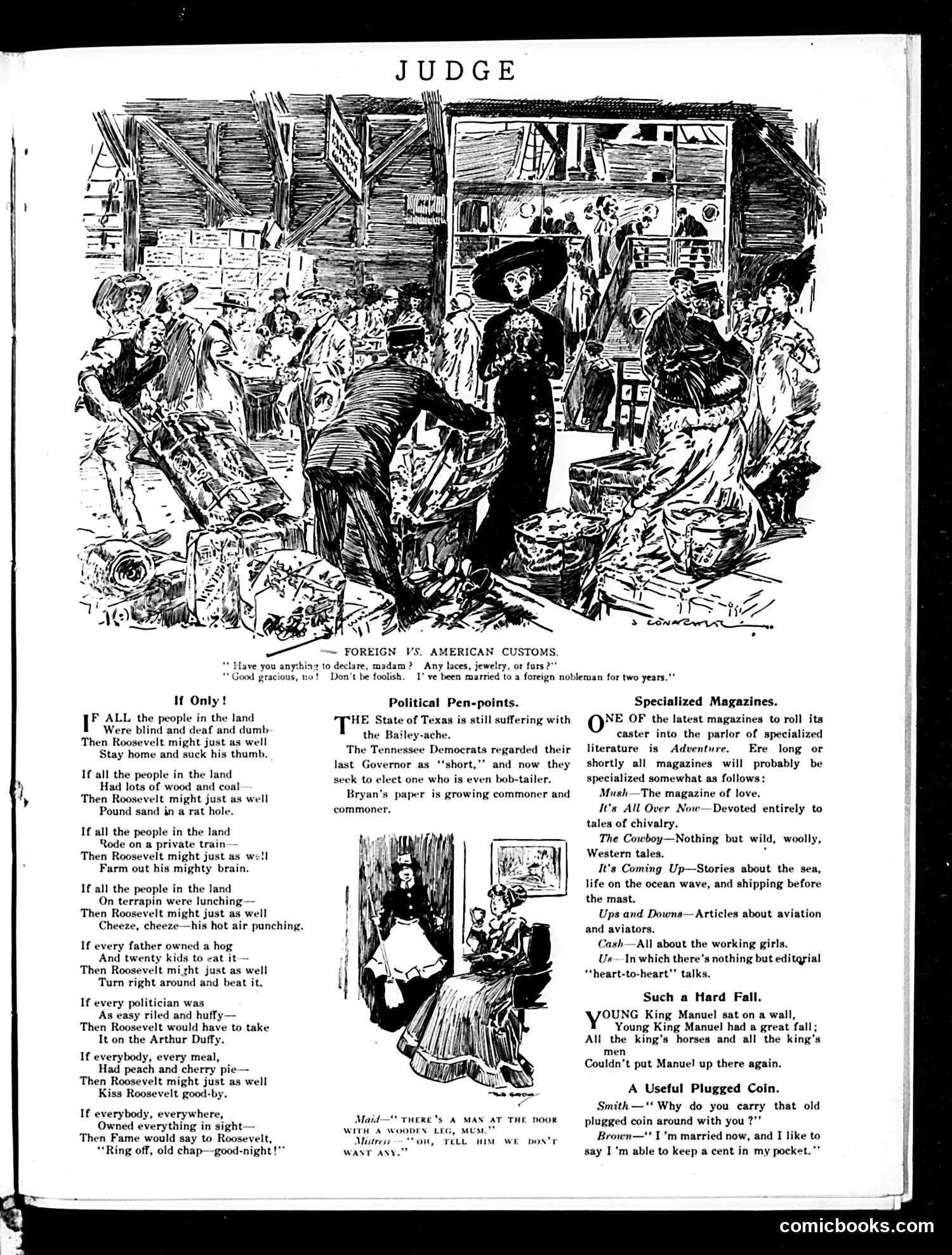
This page contains political satire targeting **President Theodore Roosevelt**, who is the implicit target of the longest piece, "If Only!" The poem sarcastically suggests Roosevelt would be irrelevant if Americans had basic necessities and contentment—a critique of his activist presidency and constant public visibility. The **top cartoon** depicts customs inspection, contrasting "Foreign vs. American Customs." A wealthy woman entering declares nothing, claiming foreign nobility marriage exempts her from American rules—satirizing both class pretension and the perceived privilege of the wealthy. **"Political Pen-points"** briefly mocks regional politics: Texas's "Bailey-ache" (likely Senator Joseph Bailey), Tennessee's preference for short governors, and Bryan's newspaper becoming "commoner." The **"Specialized Magazines"** section humorously lists emerging niche publications (Mush, The Cowboy, etc.), reflecting early 20th-century publishing trends. Minor jokes include wordplay on "plugged coin" (a fake coin) and a pun about keeping "a cent" (penny) as a married man—suggesting marriage means financial constraint. The overall tone is typical Judge satirical humor: attacking Roosevelt's omnipresence, mocking social pretension, and observing contemporary trends.
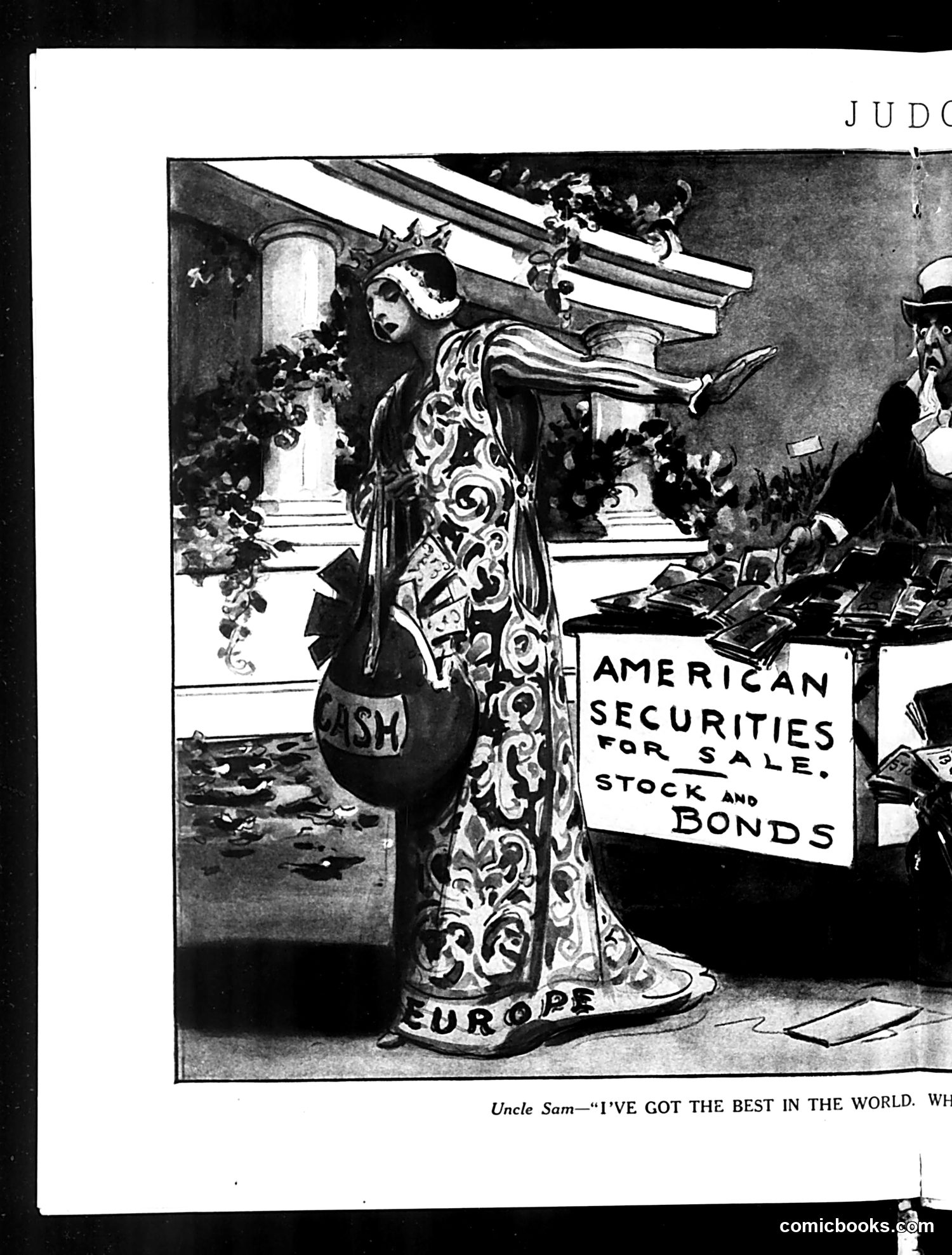
This Judge magazine cartoon depicts Uncle Sam (personified as a figure in patriotic dress) advertising "American Securities for Sale. Stock and Bonds." The figure labeled "Europe" stands nearby in ornate royal clothing, appearing to peddle wares. The satire critiques American financial markets and international commerce, likely from the early 20th century. Uncle Sam boasts he has "the best in the world," suggesting American economic superiority or the aggressive marketing of U.S. securities abroad. Europe's presence—depicted in elaborate, old-world regalia—implies a contrast between modern American capitalism and traditional European aristocracy. The cartoon likely comments on American financial expansion and competitive advantage in global markets during this era.
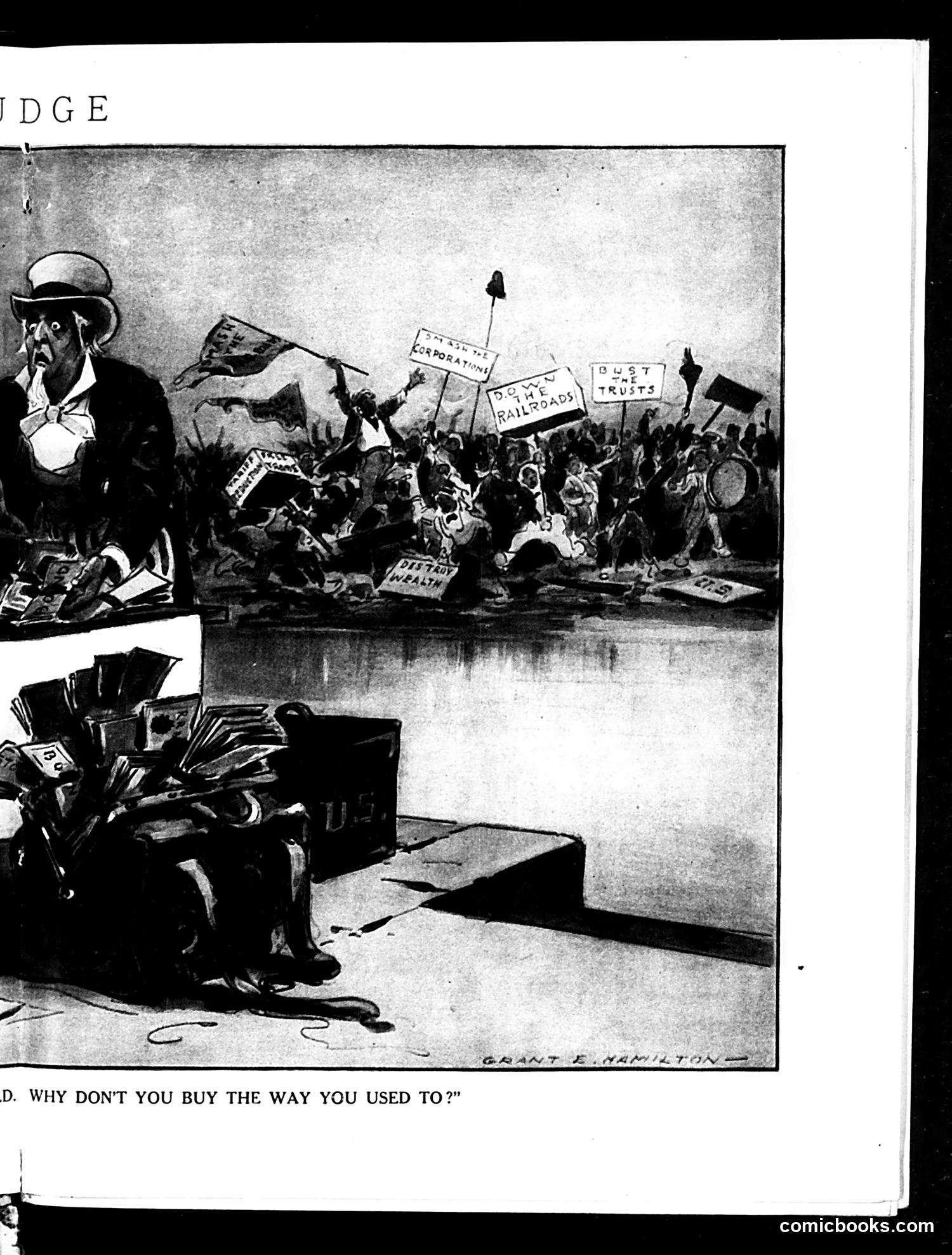
This political cartoon by Grant E. Hamilton satirizes **corporate trusts and monopolies** during what appears to be the **Gilded Age/Progressive Era** (late 1800s-early 1900s). **The imagery:** - Left: Uncle Sam, gaunt and depleted, asking "Why don't you buy the way you used to?" - Right: A massive crowd of common people protesting, holding signs reading "DUST THE TRUSTS," "RAILROADS," and "TRUSTS" - A pile of money/currency in the foreground **The satire:** Monopolistic corporations and trusts have squeezed ordinary Americans so severely that consumer spending has collapsed—hence Uncle Sam's complaint. The cartoon criticizes how concentrations of corporate power impoverished regular citizens, triggering public demand for trust-busting. The visual contrast between the weakened national symbol and the angry populace emphasizes the political crisis these monopolies created.
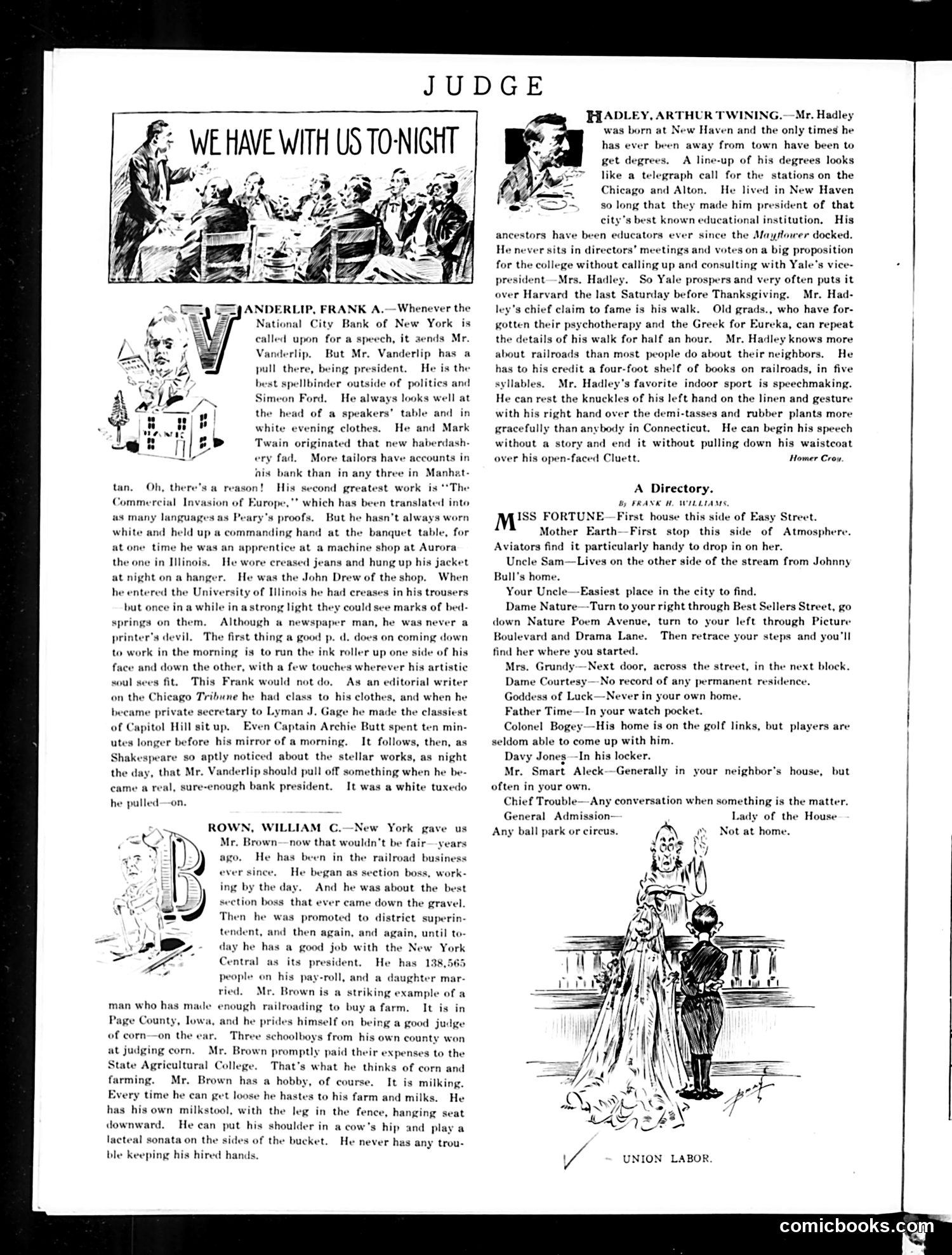
This page profiles three prominent American businessmen and educators circa early 1900s: **Frank A. Vanderlip** (National City Bank president): The satire mocks his rise from humble printer's devil to refined banker. The joke centers on his obsession with appearance—he and Mark Twain supposedly started a haberdashery trend. Despite his current white-tie sophistication, he once ran printing equipment; the humor lies in his transformation and pretension. **William C. Rowan** (New York Central Railroad president): Presented as a self-made railroad executive who rose from section boss through merit. The satire is gentler here—the piece celebrates his hobby of milking cows on his Iowa farm, finding humor in the contrast between powerful railroad magnate and farmer-at-heart. **Arthur Hadley** (Yale president): His satire emphasizes academic pedigree—his degrees are so numerous they resemble a telegraph address. The joke: even Yale's president must consult his wife before major college decisions. The page's "Directory" section appears separate, listing humorous "addresses" for various character types (Miss Fortune, Uncle Sam, etc.). Overall, these are gentle profiles satirizing turn-of-the-century American success stories and their quirks.
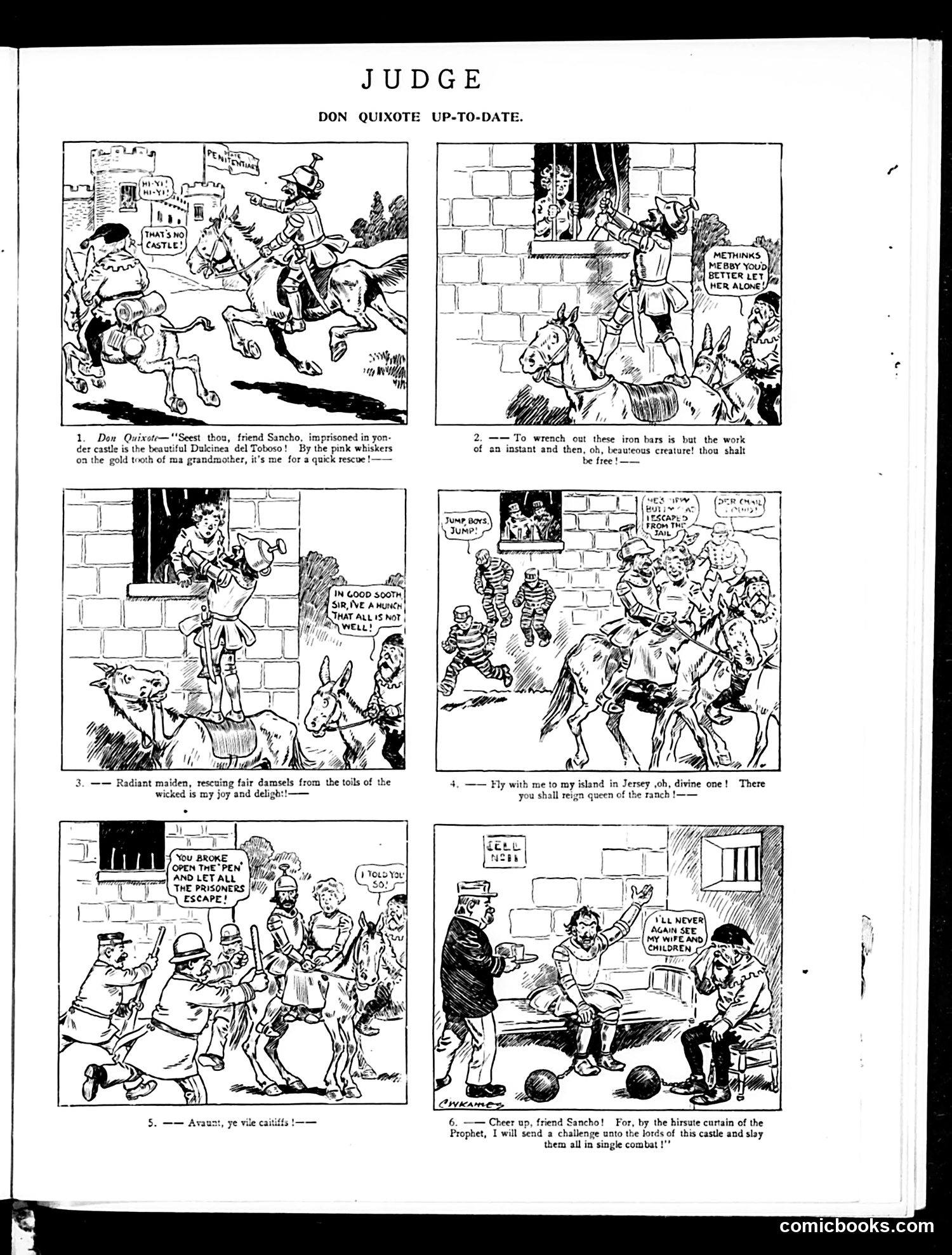
This comic page adapts Cervantes' *Don Quixote* as contemporary satire. The "knight" rescues a maiden from a castle, believing himself a chivalrous hero—but the setting and dialogue reveal modern American references: "Jersey," a "ranch," and what appears to be a prison or jail rather than a romantic castle. The satire likely mocks idealistic reformers or political figures who see themselves as noble rescuers of the downtrodden, but whose interventions are misguided or comical. The Quixote figure is delusional about his noble mission, much like the magazine might have satirized actual contemporary reformers as quixotic do-gooders. The comic works by contrasting Cervantes' timeless tale of delusion with 1920s American settings, suggesting that modern "quixotes"—whether politicians, activists, or idealists—similarly tilt at windmills while believing themselves heroic.
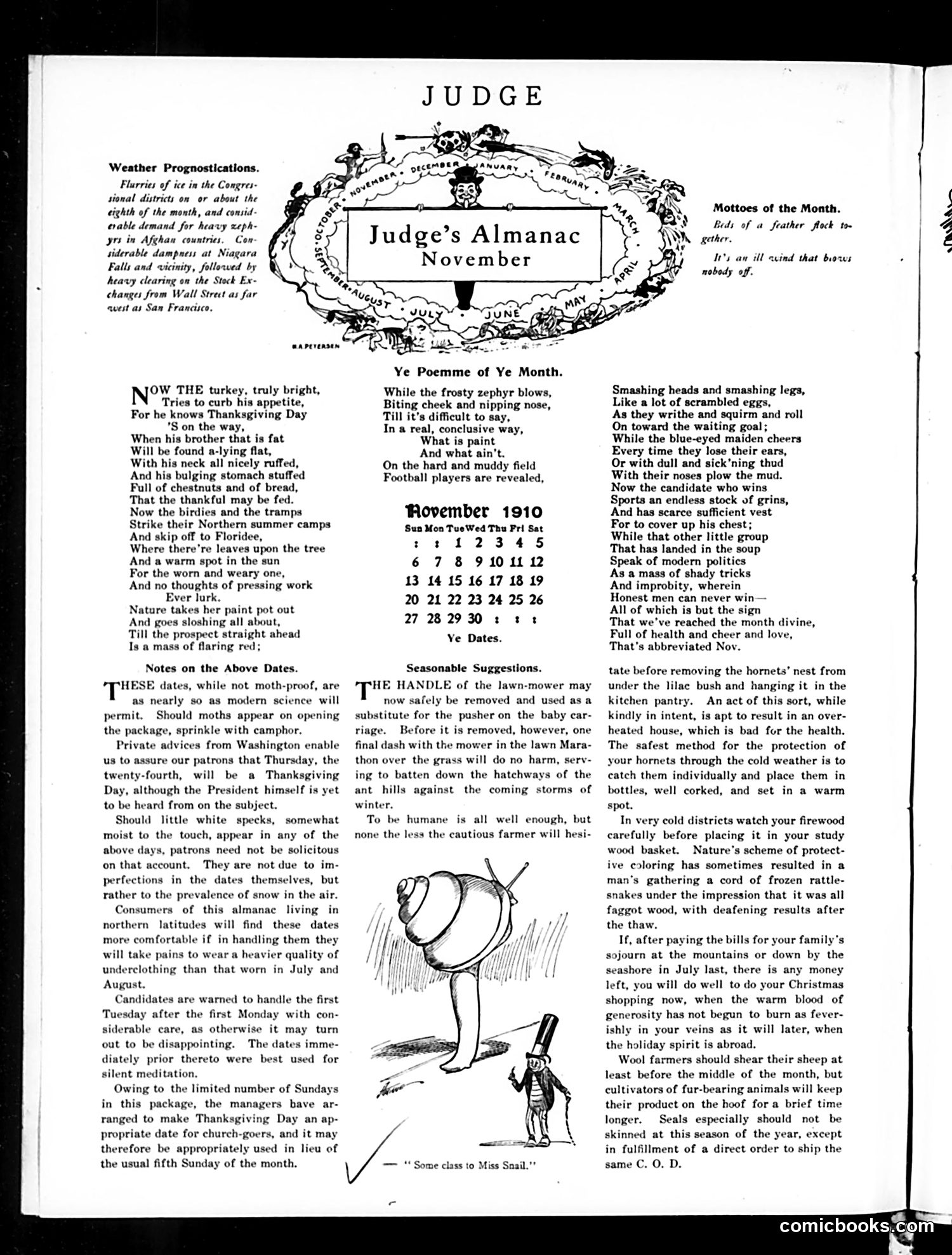
This is a satirical "almanac" page mocking weather predictions and political commentary. The "Weather Prognostications" opening jests that Congress will experience "flurries" and "considerable dampness," with clearing on Wall Street—a cynical swipe at politicians and financial markets. The main cartoon depicts a large snail with a tiny man in formal dress beside it, captioned "Some class to Miss Snail," likely satirizing high society pretension or a specific social figure obsessed with refinement. Throughout, the page humorously advises readers on seasonal activities: removing lawn-mower handles for baby carriages, protecting hornet nests, and preparing for winter. The football poem describes violent collisions with darkly comic detachment ("smashing heads...like scrambled eggs"), while celebrating female spectators' enthusiasm for players' injuries. The overall tone is irreverent mockery of American institutions, society's affectations, and Thanksgiving preparations—typical of Judge's satirical style during this Progressive Era period.
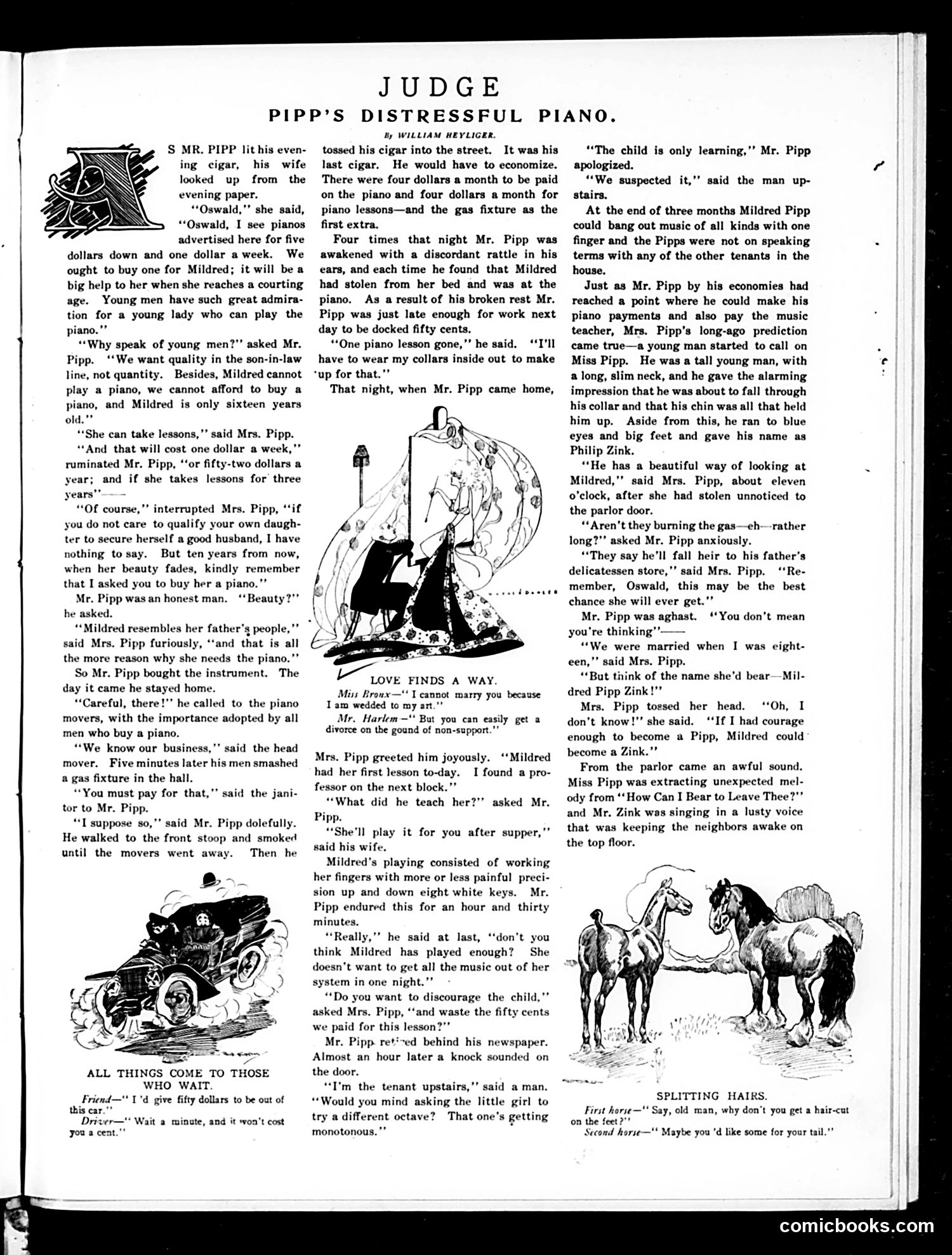
This is a humorous domestic satire by William Heyliger about consumer debt and parental pressures in early 20th-century America. Mr. Pipp, a working-class man, reluctantly buys a piano for his daughter Mildred after his wife persuades him it will help her attract a suitable husband. The joke unfolds through cascading financial and domestic disasters: the piano delivery damages the apartment, lessons cost money he can't afford, Mildred practices incessantly at night (costing him sleep and a day's wages), and her terrible playing annoys the upstairs neighbor. The satire targets the era's commercialism (aggressive installment-plan advertising), middle-class social anxiety about daughters' marriageability, and the gap between aspirations and financial reality. The subplot cartoon "Love Finds a Way" offers a counterpoint about artistic commitment versus economic survival.
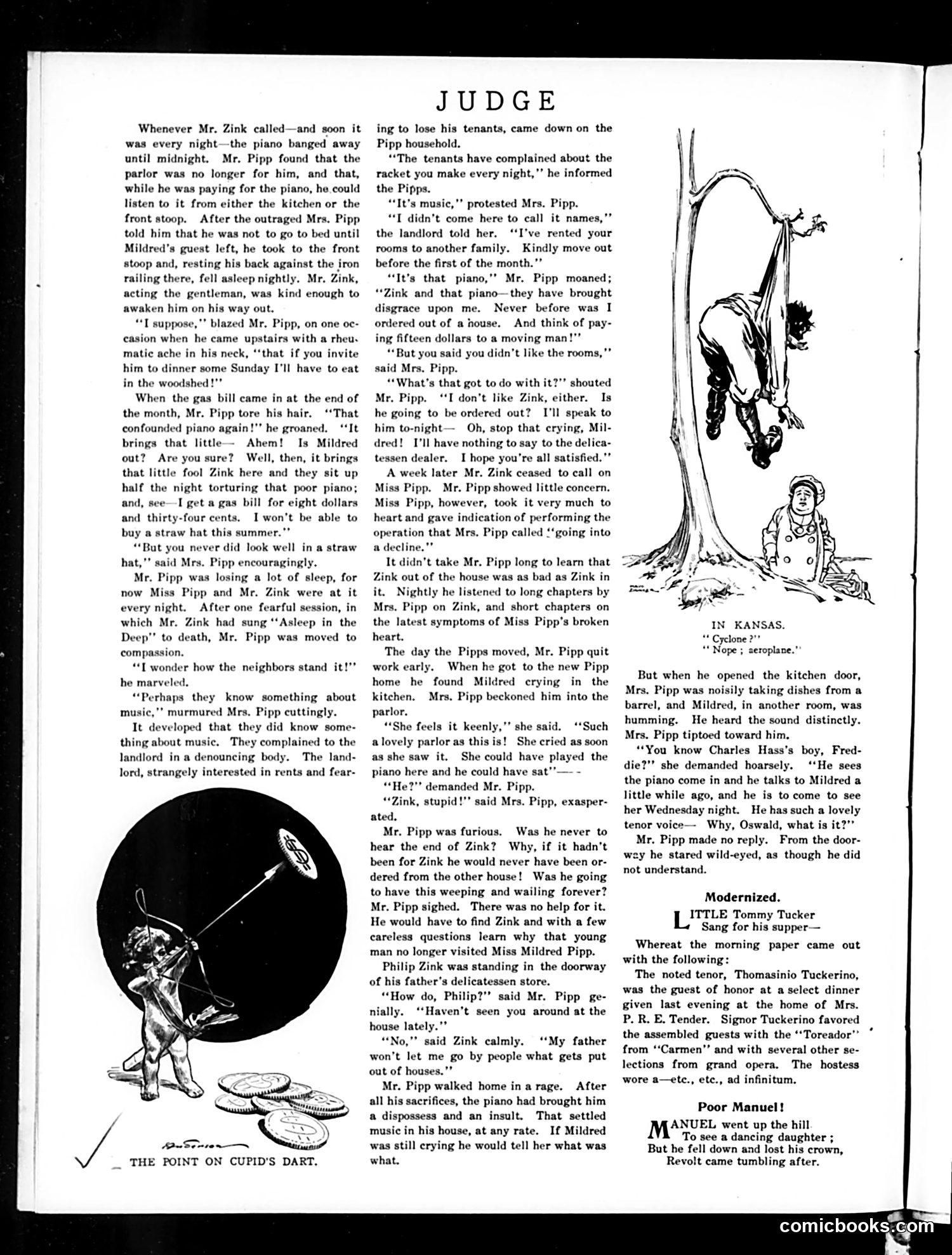
This humorous domestic story satirizes romantic courtship disrupting household peace. Mr. Zink, a suitor, visits nightly to court Miss Pipp, monopolizing the piano and keeping the household awake with loud music. Mr. Pipp (the father, paying the bills) is displaced from his own parlor and loses sleep. The satire targets: the financial burden of entertaining suitors, women's limited social outlets (piano-playing as courtship activity), and the powerlessness of fathers in their own homes. The punchline: after Mr. Pipp finally evicts Zink and moves to escape the situation, his daughter Mildred pines for him—and the new parlor's superiority only compounds Mr. Pipp's torment. The joke is that he cannot escape the romantic problem, only its symptoms. The accompanying illustration "The Point on Cupid's Dart" visualizes romantic love's painful absurdity through Cupid dropping plates.
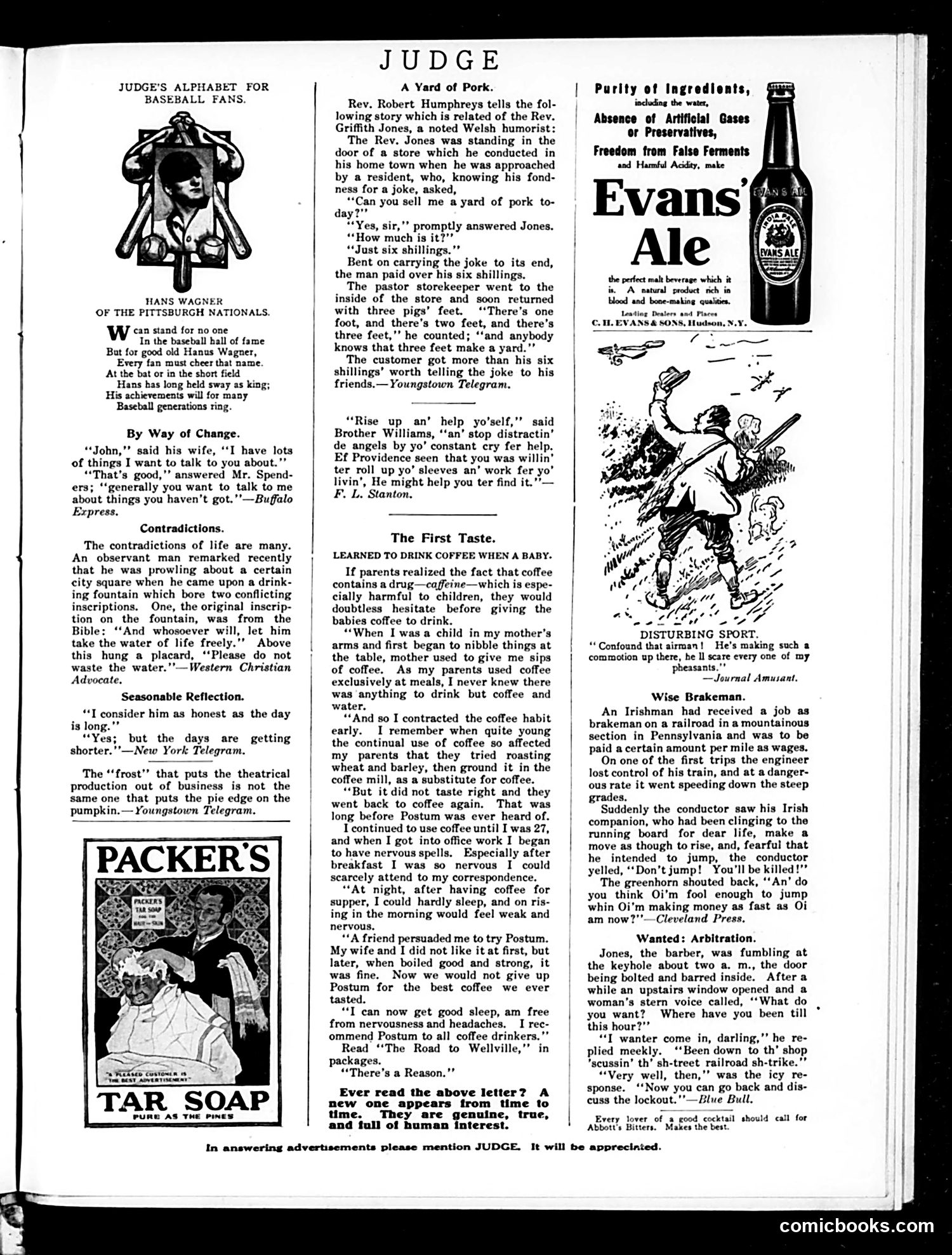
This page from **Judge** (a satirical American magazine) contains mixed content: **Baseball Feature:** A tribute to Hans Wagner of the Pittsburgh Nationals, presented as part of "Judge's Alphabet for Baseball Fans." Wagner appears to have been a notable player of his era, celebrated for his batting and shortstop abilities. **Humorous Anecdotes:** Several short jokes about everyday contradictions—a wife wanting to discuss purchases they don't own, a fountain with conflicting water-conservation messages, theatrical "frost" versus autumn frost. **Main Story: "A Yard of Pork"** features Welsh clergyman Reverend Griffith Jones playing a pun-based joke on a customer requesting a "yard of pork"—Jones delivers three pigs' feet (literally equaling a yard), turning a commercial transaction into wordplay. **Advertisements:** Packer's Tar Soap and Evans' Ale dominate the right side, with a Postum testimonial about childhood coffee consumption and its harmful effects on nerves. The page reflects early 20th-century concerns about caffeine in children's diets and period advertising conventions. The humor relies on puns and gentle domestic observations typical of Judge's satirical style.
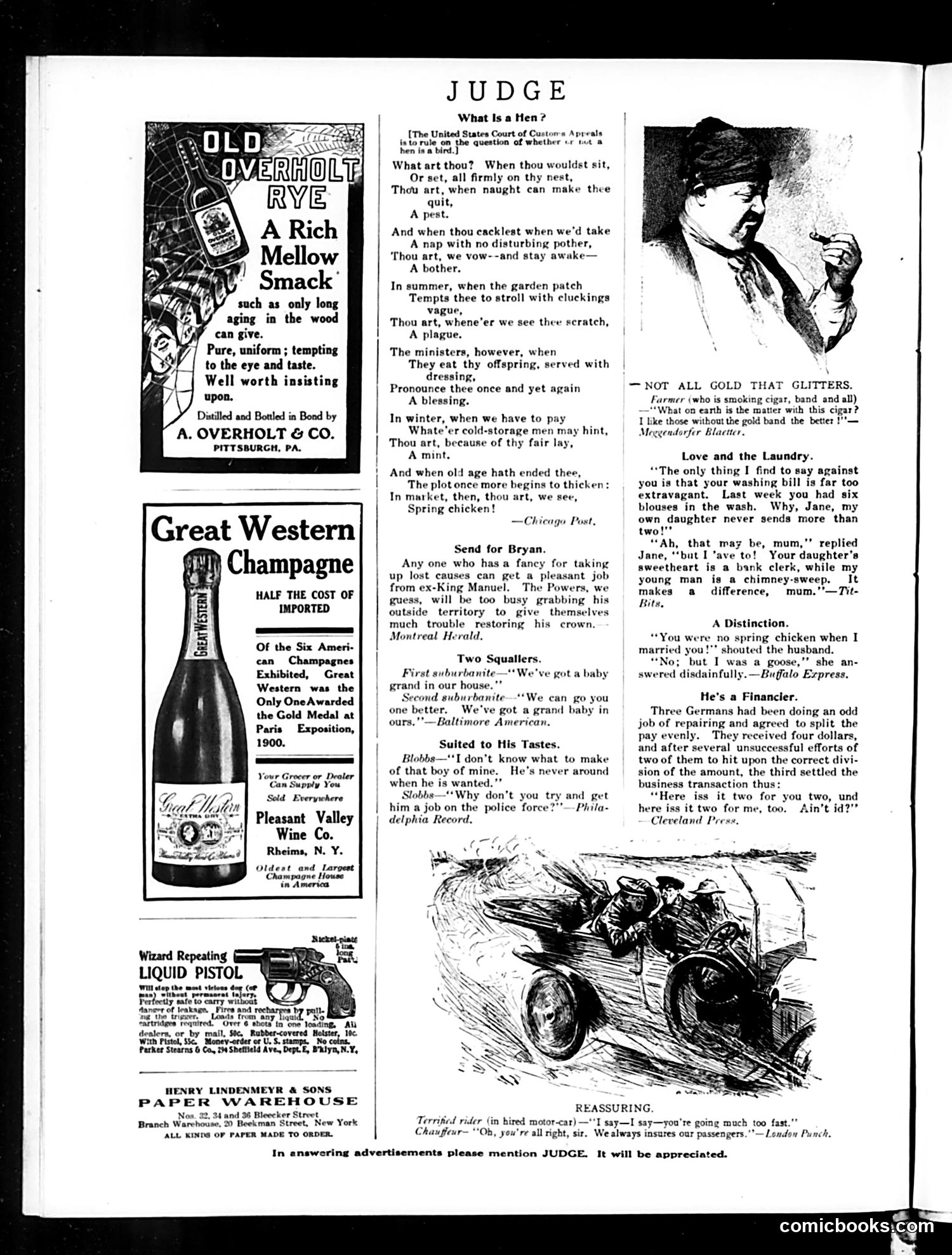
This page from *Judge* magazine consists primarily of **advertisements** (whiskey, champagne, paper warehouse) with scattered **humorous short items** typical of the publication's satirical format. The main content piece, "What Is a Hen?," is a tongue-in-cheek poem responding to a real U.S. Court of Customs Appeals case debating whether hens qualify as "birds" for tariff purposes. The satire mocks bureaucratic absurdity by cataloging the hen's contradictory identities: a "bother" (noise), a "plague" (garden damage), a "blessing" (food), a "mint" (egg production), and ultimately "spring chicken" (aged meat). The joke exposes how official classifications depend entirely on context and economic interest rather than biological reality. The remaining items are brief jokes about domestic life, Irish accents, and class differences—standard *Judge* fare from the early 1900s. The illustration at bottom shows a terrified motorist, with the caption "Terrified rider" making a joke about automobile speed and passenger safety concerns of that era.
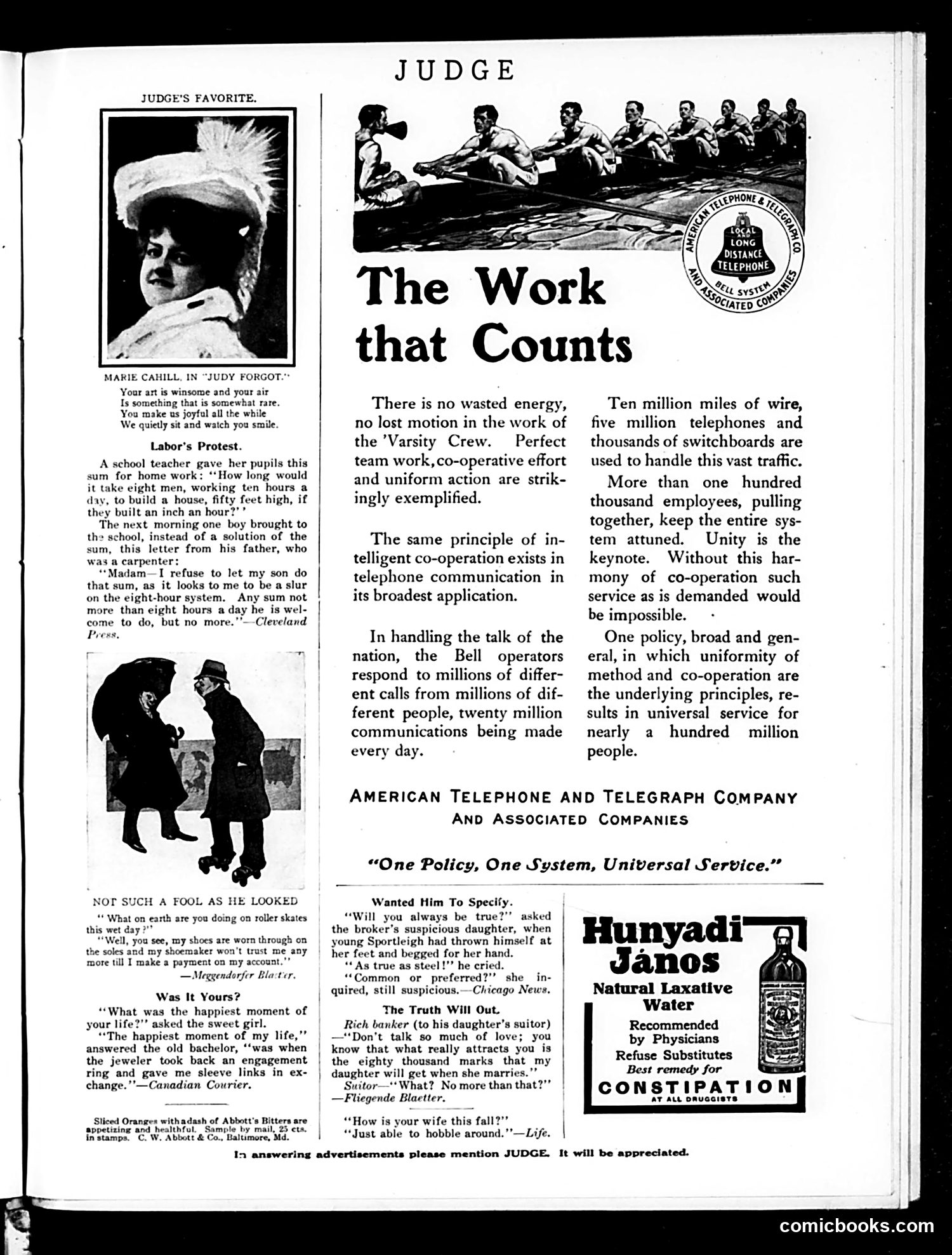
This page mixes entertainment with advertising from the early 20th century. **Main Content:** The top features Marie Cahill, a stage actress in "Judy Forgot"—a contemporary theatrical production. Below are several brief humorous anecdotes typical of Judge's "jokes" section, including a carpenter's protest of a math problem based on the eight-hour workday (labor activism), a man wearing roller skates due to poverty, and an old bachelor relieved to escape engagement. **Centerpiece Advertisement:** The large AT&T advertisement uses a rowing crew metaphor to promote telephone service, equating teamwork and cooperation with the company's organizational efficiency. The image of rowers working in unison symbolizes unified effort serving "nearly a hundred million people." **Other Jokes:** Brief comedic exchanges about marriage, finance, and fidelity—standard period humor. **Lower Advertisements:** Include patent medicines (Hunyadi János laxative water, Abbott's Bitters) typical of magazine advertising from this era, when such products were heavily marketed. The page reflects early 1900s American popular culture: vaudeville entertainment, labor concerns, marriage satire, and aggressive patent medicine advertising.
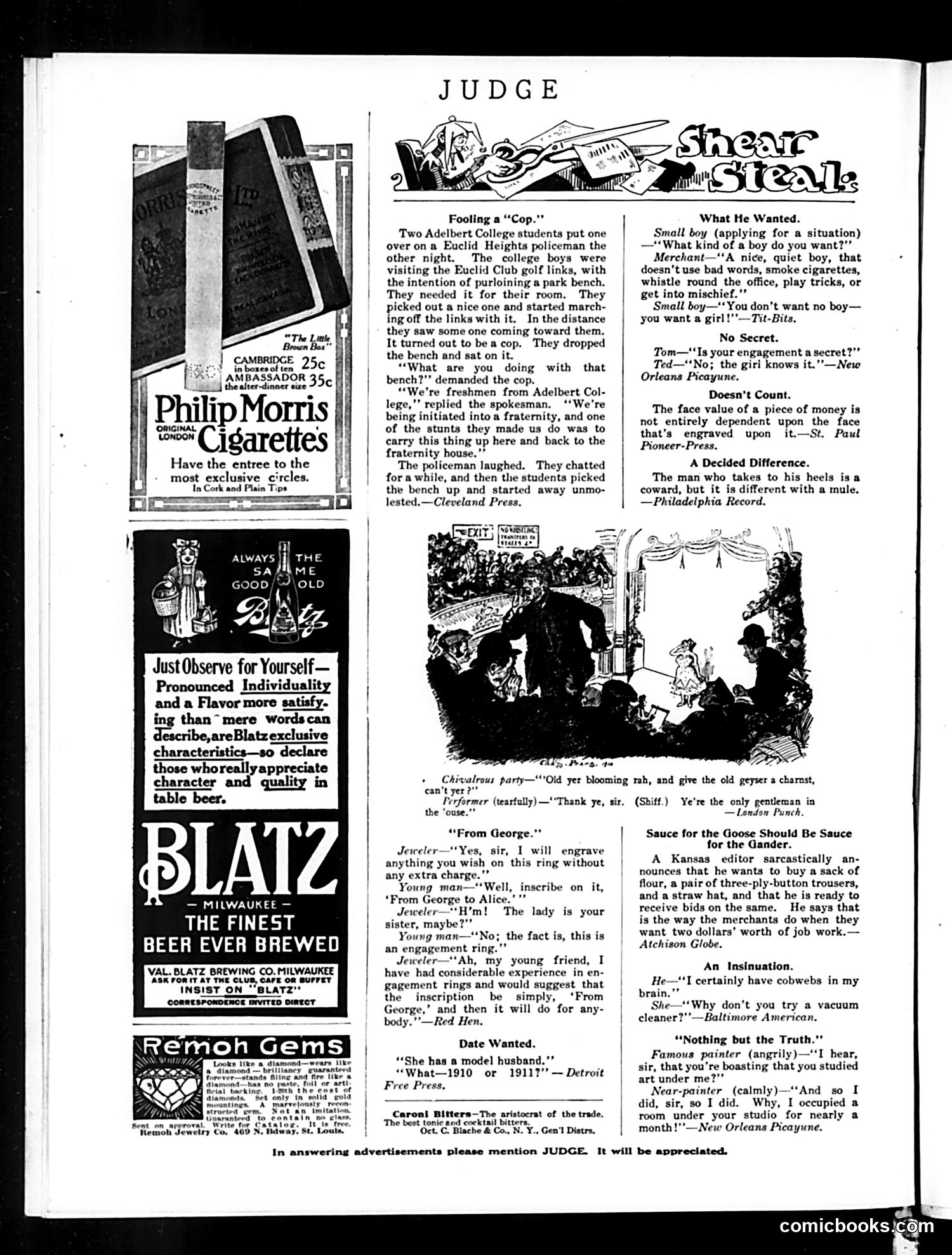
This page is primarily **advertising and short humorous anecdotes** rather than political satire. The content includes: **Advertisements:** Philip Morris cigarettes, Blatz beer, and Remon Gems dominate, using period appeals to exclusivity and sophistication. **Humorous Short Pieces:** The cartoons and text snippets are light social comedy typical of early 20th-century humor magazines: - "Fooling a Cop" depicts college students tricking a policeman into believing they're stealing a bench as fraternity initiation - Various one-liners mock romance, materialism, and gender dynamics ("You don't want a boy—you want a girl!") - A jeweler's exchange jokes about engagement rings - Social commentary on merchant pricing practices **Style:** The humor relies on wordplay, irony, and mild class/generational observations rather than sharp political critique. The overall tone is genteel and family-friendly—typical of Judge's satirical-but-accessible approach to American middle-class life in this era.
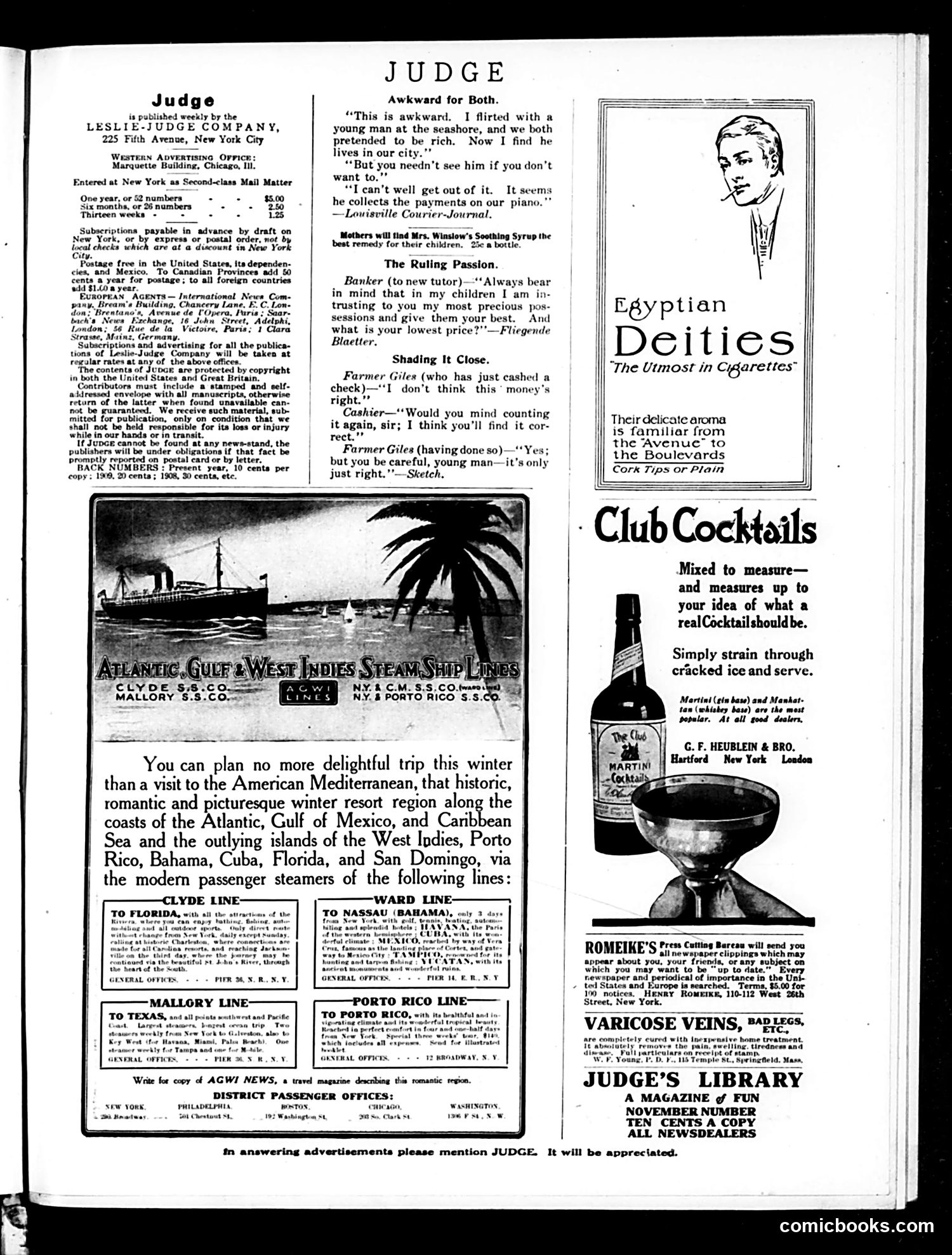
This page is predominantly **advertising and publication information**, not political satire. The masthead and subscription details occupy much of the left column. The few small cartoon **jokes** included are mild social humor, not political commentary: - **"Awkward for Both"** satirizes the social embarrassment when two people who pretended wealth at the seashore discover they're actually neighbors—and he's a debt collector for their piano. The joke pokes fun at social pretension and the awkwardness of false appearances unraveling. - **"The Ruling Passion"** (banker hiring tutor) and **"Shading It Close"** (farmer counting money) are generic, lighthearted observations about human nature rather than political satire. The bulk of the page consists of advertisements for **ocean cruises, cigarettes, cocktails, and various services**—typical *Judge* magazine commercial content. There is no evident political cartooning or contemporary political reference material visible on this page.
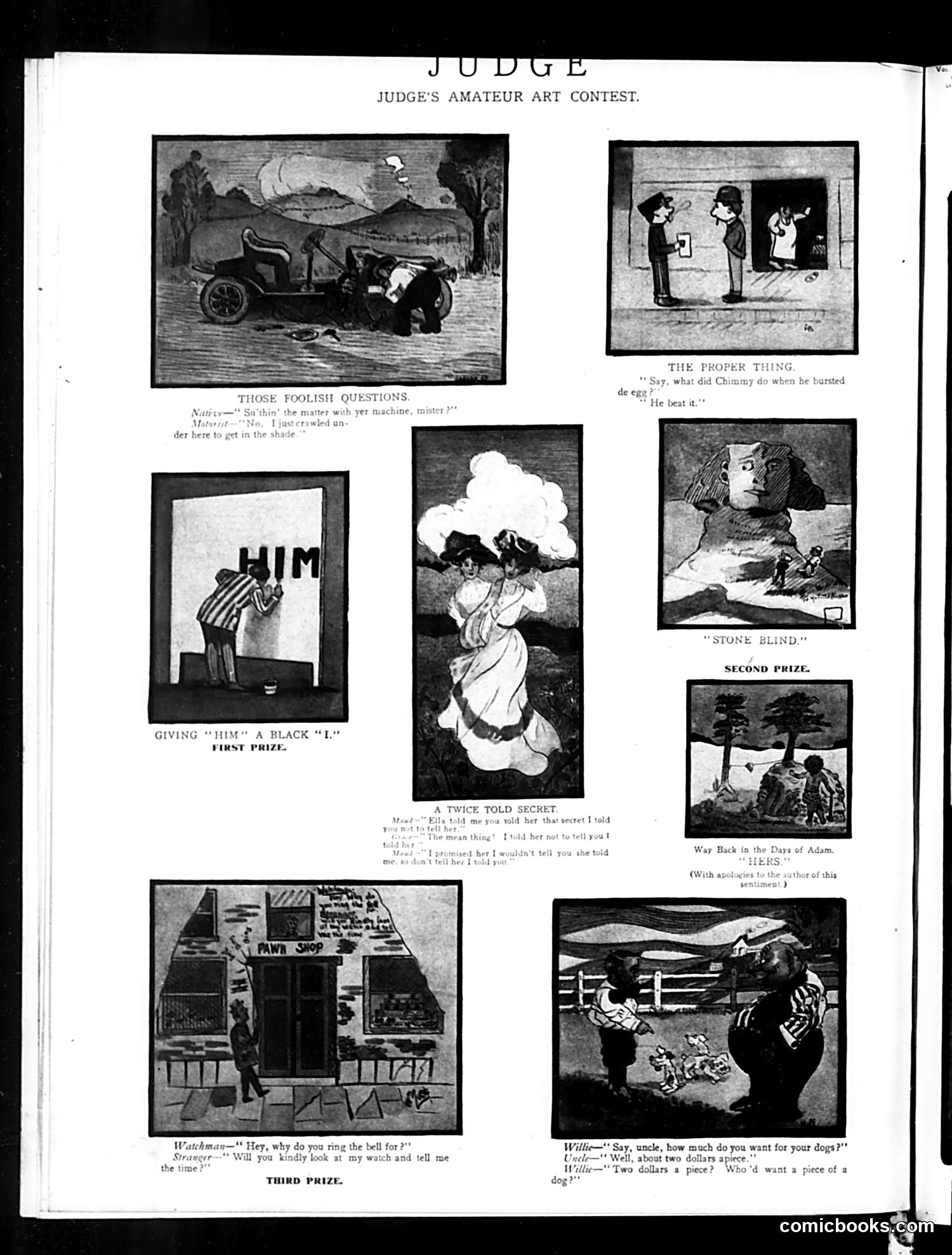
This page showcases Judge magazine's amateur art contest entries. The cartoons are untitled humorous sketches with punch lines rather than political satire. The first prize shows someone giving "HIM" a black mark or failing grade. The second prize, "Stone Blind," depicts a figure with exaggerated features. Other entries include: a couple in a car with foolish questions about machinery; a woman with a large cloud-like hat; a pawn shop scene where a stranger asks to examine a watch; and a rural scene where a child bargains with an uncle over dogs' value. The humor relies on wordplay, visual gags, and period-appropriate situational comedy—domestic misunderstandings, rural/urban contrasts, and earnest stupidity. These appear to be reader submissions celebrating amateur comic drawing rather than sophisticated satire.