
Judge, 1910-11-05 · page 8 of 24
Judge — November 5, 1910 — page 8: what you’re looking at
What you’re looking at
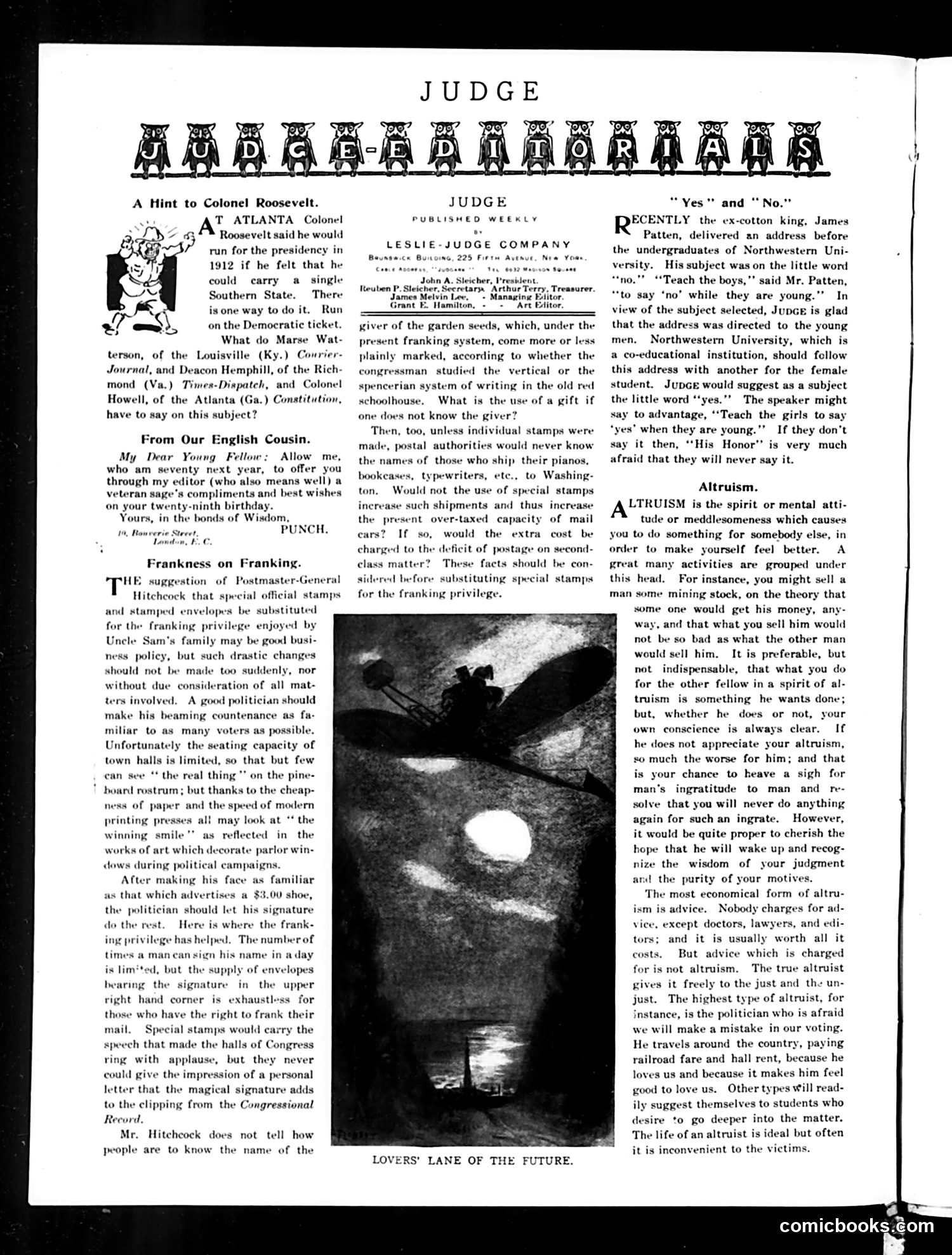
This page primarily discusses **Theodore Roosevelt's potential 1912 presidential run**. The opening cartoon suggests Roosevelt could win Southern states by running on the Democratic ticket—a pointed jab at the Republican Roosevelt's unpopularity in the Democratic South. The main satirical content addresses **congressional franking privileges** (free mail for politicians). The piece mocks how congressmen exploit this system, sending self-promotional materials nationwide under their personal signature. Judge argues that while this benefits politicians' visibility, it wastes postal resources and taxpayer money. The satire suggests politicians use franking less to serve constituents than to advertise themselves—their beaming faces on envelopes reaching voters who'd never attend rallies. A secondary item discusses altruism and charity, arguing true altruism is disinterested help, not self-serving "advice." The page concludes with criticism of cotton magnate James Patten's address to Northwestern students, which emphasized saying "no"—apparently ironic given the overall page's skepticism of American institutions.
📄 Transcribed text from this page (OCR, searchable)
Machine-transcribed from the original scan — historical spelling and the odd misread are preserved.
A Hint to Colonel Roosevelt. T ATLANTA jonel LS 3£™ Roosevelt said he would run for the presidency in 1912 if he felt that he could carry a single Southern State. There is one way to do it. Run on the Democratic ticket. What do Marse Wat- terson, of the Louisville (Ky.) Courier- Journal, and Deacon Hemphill, of the Rich- mond (Va.) Times-Dispatch, and Colonel Howell, of the Atlanta (Ga.) Constitution, have to say on this subject? From Our English Cousin. My Dear Young Fellow: Allow who am seventy next year, to offer you through my editor (who also means well) a veteran sage’s compliments and best wishes on your twenty-ninth birthday. Yours, in the bonds of Wisdom, PUNCH. me, erie Stee Jan on Franking. of Postmaster-General 1 stamps Frankn HE, suggestion Hitchcock t and stamped envelopes be substituted for th Uncle Sam's fam| . but such drastic changes enjoyed by franking. privile may be good busi- ness pol should not be made too suddenly, nor without due consideration of all mat- ters involved. A good politician should make his beaming countenance as fa- miliar to as many voters as possible. Unfortunately the seating capacity of town halls is limited, so that but few can see ‘* the real thing" on the pine- " board rostrum; but thanks to the cheap- ss of paper and the speed of modern f printing presses all may look at ‘* the winning smile '’ as reflected in’ the rate parlor win- works of art which d dows during politic After making bis as that which advertises a $3.00 shoe, the politician should let his signature Here is where the f has helped. The numberof day igns. as familiar do the rest ing privile times ar is lim ancansign his name in d, but the supply of envelopes the right hand corner is exhaustless for those who have the right to frank their cial stamps would carry the ‘h that made the halls of C ring with applause, but they never could give the impression of a personal letter that the magical signature adds to the clipping from the Congressional Record. Mr. Hitchcock does not people are to kr bearing the signature in upper gress tell how w the name of the JUDGE PUBLISHED WEEKLY LESLIE-JUDGE COMPANY 225 Furr New ¥ John A. Sleicher, President Reuben P. Sleicher, Secretar Arthur Terry, Treasurer, James Melvin Lee, - Managing Esitor. Grant E. Hamilton, - ‘Art Editor, ————SSS—SSSS————————————— giver of the garden seeds, which, under the present franking system, come more or less plainly marked, according to whether the Aven Beungaice Buon congressman studied the vertical or the spencerian tem of writing in the old red schoolhous What is the use of a gift if one does not know the giver? Then, too, unless individual stamps were made, postal authorities would never know the names of those who ship their pianos, bookcases, typewriters, etc., to Washing- Would not the use of special stamps se such shipments and thus increase the over-taxed capacity of mail cars? If so, would the charged to the deficit of postage on second- The: substituting special stamps ton. incre present extra cost be » facts should be con- class matter? sidered before for the franking privilege. LOVERS’ LANE OF THE FUTURE. Yes" and “*No.”* ECENTLY the ex-cotton king, James Patten, delivered an address before the undergraduates of Northwestern Uni- His subject was on the little word “Teach the boys,’’ said Mr. Patten, “*to say ‘no’ while they are young.’ In view of the subject selected, Jupce is glad that the address was directed to the young Northwestern University, which is a co-educational institution, should follow this address with another for the female student. JupGE would suggest as a subject the little word “tyes.’’ The speaker might say to advantage, ‘‘Teach the girls to say * when they are young.’’ If they don’t say it then, ‘His Honor’? is very much afraid that they will never say it. men. Altruism. ALTRUISM is the spirit or mental atti- tude or meddlesomeness which causes you to do something for somebody else, in order to make yourself feel better. A great many activities are grouped under this head. For instance, you might sell a man some mining stock, on the theory that some one would get his money, any- way, and that what you sell him would not be so bad as what the other man would sell him. It is preferable, but not indispensable, that what you do for the other fellow in a spirit of al- truism is something he wants done; whether he does or not, your is always clear. If ‘our altruism, but, own conscience he does not appreciate y so much the worse for him; and that is your chance to heave a sigh for man’s ingratitude to man and rm solve that you will never do anything again for such an ingrate. However, it would be quite proper to cherish the hope that he will wake up and recog- nize the wisdom of your judgment and the purity of your motives. The most economical form of altru- Nobody charges for ad- ind edi- ism is advice. xcept doctors, lawyers, and it is usually worth all it But advice which is charged snot altruism. The true altruist gives it freely to the just and the un- just. The highest type of altruist, for instance, is the politician who is afraid we will make a mistake in our voting. He travels around the country, paying railroad fare and hall rent, because he loves us and because it makes him feel good to love us. Other types Will read- ily suggest themselves to students who desire to go deeper into the matter. The life of an altruist is ideal but often it is inconvenient to the victims. comicbooks:éom