
Judge, 1910-11-05 · page 17 of 24
Judge — November 5, 1910 — page 17: what you’re looking at
What you’re looking at
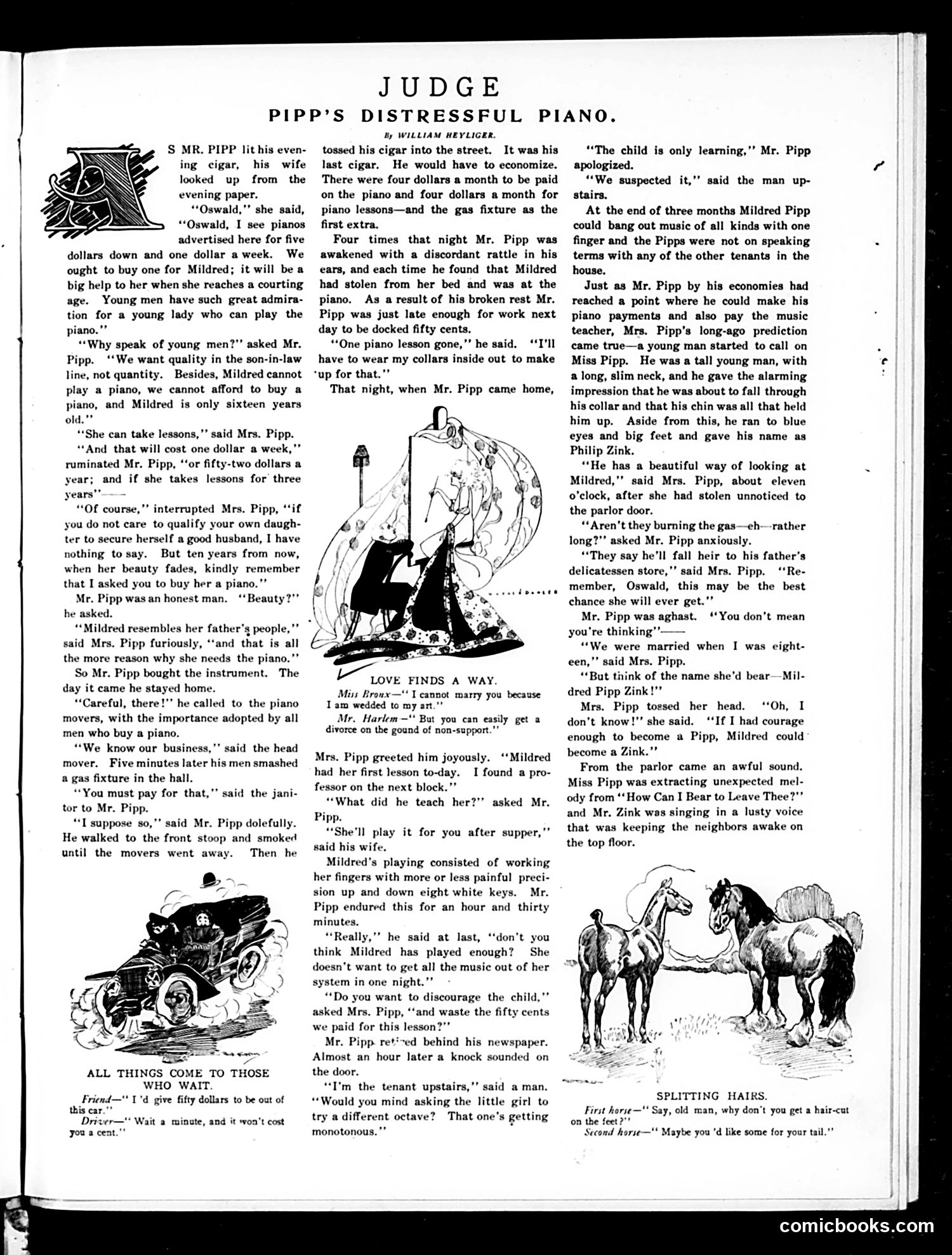
This is a humorous domestic satire by William Heyliger about consumer debt and parental pressures in early 20th-century America. Mr. Pipp, a working-class man, reluctantly buys a piano for his daughter Mildred after his wife persuades him it will help her attract a suitable husband. The joke unfolds through cascading financial and domestic disasters: the piano delivery damages the apartment, lessons cost money he can't afford, Mildred practices incessantly at night (costing him sleep and a day's wages), and her terrible playing annoys the upstairs neighbor. The satire targets the era's commercialism (aggressive installment-plan advertising), middle-class social anxiety about daughters' marriageability, and the gap between aspirations and financial reality. The subplot cartoon "Love Finds a Way" offers a counterpoint about artistic commitment versus economic survival.
📄 Transcribed text from this page (OCR, searchable)
Machine-transcribed from the original scan — historical spelling and the odd misread are preserved.
JUDGE PIPP’S DISTRESSFUL PIANO. S MR. PIPP lit his even- ing cigar, his wife looked up from the evening paper. “Oswald,”’ she said, “Oswald, I see pianos advertised here for five dollars down and one dollar a week. We ought to buy one for Mildred; it will bea big help to her when she reaches a courting age. Young men have such great admira- tion for a young lady who can play the piano.”” “Why speak of young men?” asked Mr. Pipp. ‘We want quality in the son-in-law line, not quantity. Besides, Mildred cannot play a piano, we cannot afford to buy a piano, and Mildred is only sixteen years old.”” “She can take lessons,”’ said Mrs. Pipp. ‘And that will cost one dollar a week,”’ ruminated Mr. Pipp, “‘or fifty-two dollars a ye and if she takes lessons for three yea - “Of course,’’ interrupted Mrs. Pipp, “if you do not care to qualify your own daugh- ter to secure herself a good husband, I have nothing to say. But ten years from now, when her beauty fades, kindly remember that I asked you to buy her a piano.’’ Mr. Pipp was an honest man. ‘‘Beauty he asked. “Mildred resembles her father’ people,’’ said Mrs. Pipp furiously, “and that is all the more reason why she needs the piano." So Mr. Pipp bought the instrument. The day it came he stayed home. “Careful, there!’’ he called to the piano movers, with the importance adopted by all men who buy a piano. “We know our business,"’ said the head mover. Five minutes later his men smashed a gas fixture in the hall. “You must pay for that,”’ said the jani- tor to Mr. Pipp. “I suppose so,”’ said Mr. Pipp dolefully. He walked to the front stoop and smoked until the movers went away. Then he —— y ALL THINGS COME TO THOSE WHO WAIT. Friend—" 1'd give fifty dollars to be out of this car. ait a minute, and it won't cost By WILLIAM HEYLIGER. tossed his cigar into the street. It was his last cigar. He would have to economize. There were four dollars a month to be paid on the piano and four dollars a month for piano lessons—and the gas fixture as the first extra. Four times that night Mr. Pipp was awakened with a discordant rattle in his ears, and each time he found that Mildred had stolen from her bed and was at the piano. As a result of his broken rest Mr. Pipp was just late enough for work next day to be docked fifty cents. “One piano lesson gone,” he said. “I'll have to wear my collars inside out to make ‘up for that."” That night, when Mr. Pipp came home, “vove FINDS A WAY. Miss Browx—" T cannot marry you because Tam wedded to my art."" Mr. Harlem —" But you can easily get a divorce on the gound of non-support."” Mrs. Pipp greeted him joyously. ‘Mildred had her first lesson to-day. I found a pro- fessor on the next block.’” “‘What did he teach her?’’ asked Mr. D. “She'll play it for you after supper, said his wife. Mildred’s playing consisted of working her fingers with more or less painful preci- sion up and down eight white keys. Mr. Pipp endured this for an hour and thirty minutes. “Really,”’ he said at last, ‘‘don’t you think Mildred has played enough? She doesn’t want to get all the music out of her system in one night.’ “Do you want to discourage the child,’’ asked Mrs. Pipp, ‘‘and waste the fifty cents we paid for this lesson?” Mr. Pipp reti-ed behind his newspaper. Almost an hour later a knock sounded on the door. “I'm the tenant upstairs,’’ said a man. “Would you mind asking the little girl to try a different octave? That one’s getting monotonous.” ° “The child is only learning,” Mr. Pipp apologized. “We suspected it,"’ said the man up- stairs. At the end of three months Mildred Pipp could bang out music of all kinds with one finger and the Pipps were not on speaking terms with any of the other tenants in the house. Just as Mr. Pipp by his economies had reached a point where he could make his piano payments and also pay the music teacher, Mrs. Pipp’s long-ago prediction came true—a young man started to call on Miss Pipp. He was a tall young man, with a long, slim neck, and he gave the alarming impression that he was about to fall through his collar and that his chin was all that held him up. Aside from this, he ran to blue eyes and big feet and gave his name as Philip Zink. “He has a beautiful way of looking at Mildred,” said Mrs. Pipp, about eleven o'clock, after she had stolen unnoticed to the parlor door. “‘Aren’t they burning the gas—eh—-rather long?"’ asked Mr. Pipp anxiously. “They say he'll fall heir to his father’s delicatessen store,"’ said Mrs. Pipp. ‘“Re- member, Oswald, this may be the best chance she will ever get.’’ Mr. Pipp was aghast. ‘You don’t mean you're thinking” —— “We were married when I was eight- een,”’ said Mrs. Pipp. “‘But think of the name she'd bear dred Pipp Zink!"’ Mrs. Pipp toesed her head. ‘‘Oh, I don’t know!’ she said. ‘‘If I had courage enough to become a Pipp, Mildred could become a Zink.’’ From the parlor came an awful sound. Miss Pipp was extracting unexpected mel- ody from ‘‘How Can I Bear to Leave Thee? and Mr. Zink was singing in a lusty voice that was keeping the neighbors awake on the top floor. Mil- SPLITTING HAIRS. First horse—"' Say, old man, why don't you get a hair-cut on the feet ?"" Second horse—"* Maybe you'd like some for your tail."” comicbooks.com