
A complete issue · 21 pages · 1910
Judge — October 29, 1910
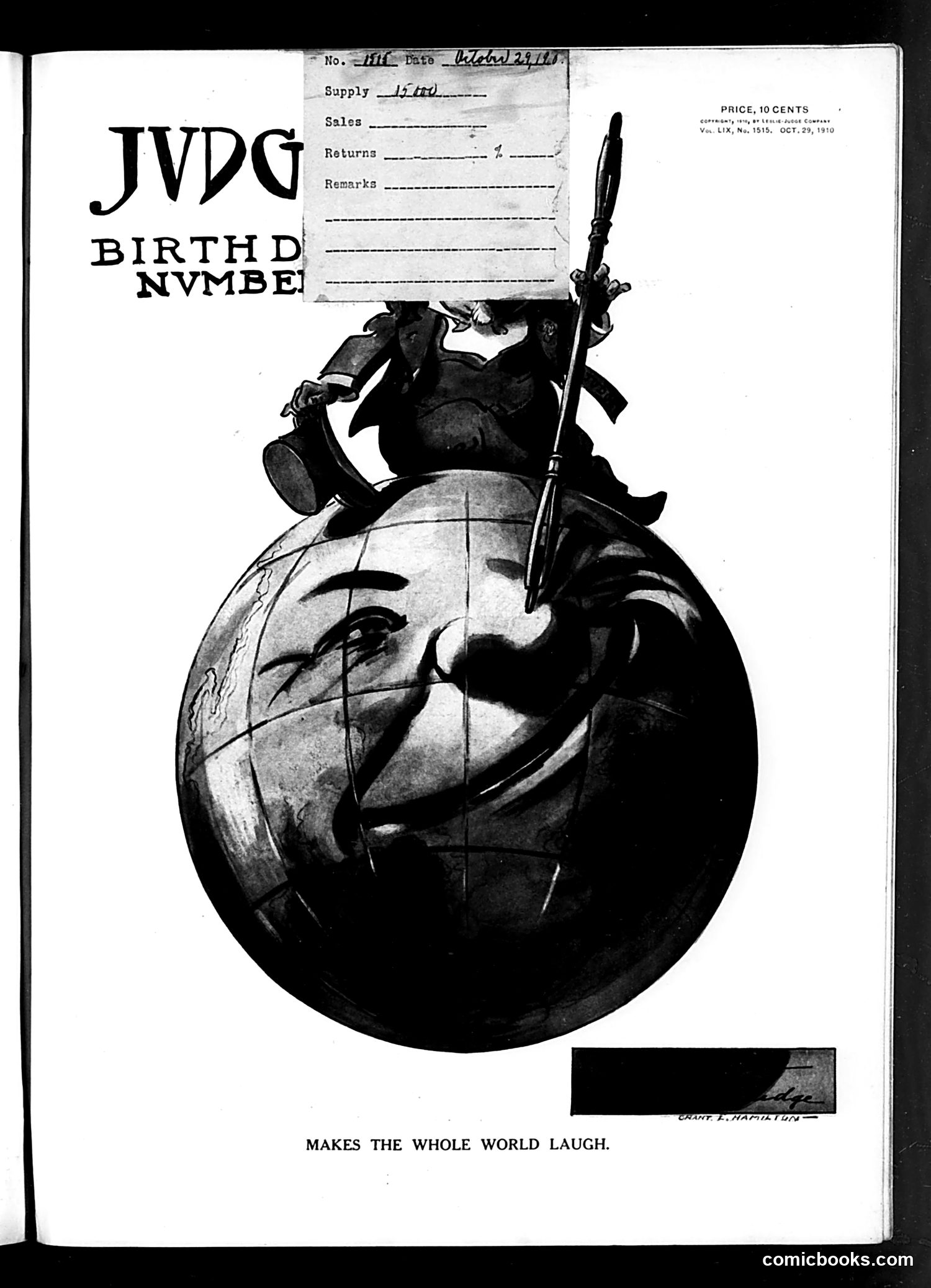
This is a magazine cover featuring a large globe with a figure perched on top, holding what appears to be a rifle or gun, with military/combat gear. The figure's exaggerated facial features suggest this is a caricature, though the specific identity is unclear from the image alone. The tagline "MAKES THE WHOLE WORLD LAUGH" suggests satirical commentary on militarism, imperialism, or international conflict—common themes in early 1900s American satire. The figure armed atop the world likely represents either American military adventurism abroad or a commentary on global power dynamics and warfare of the period. The administrative fields at top (Supply, Sales, Returns, etc.) appear to be a magazine tracking sheet rather than editorial content.
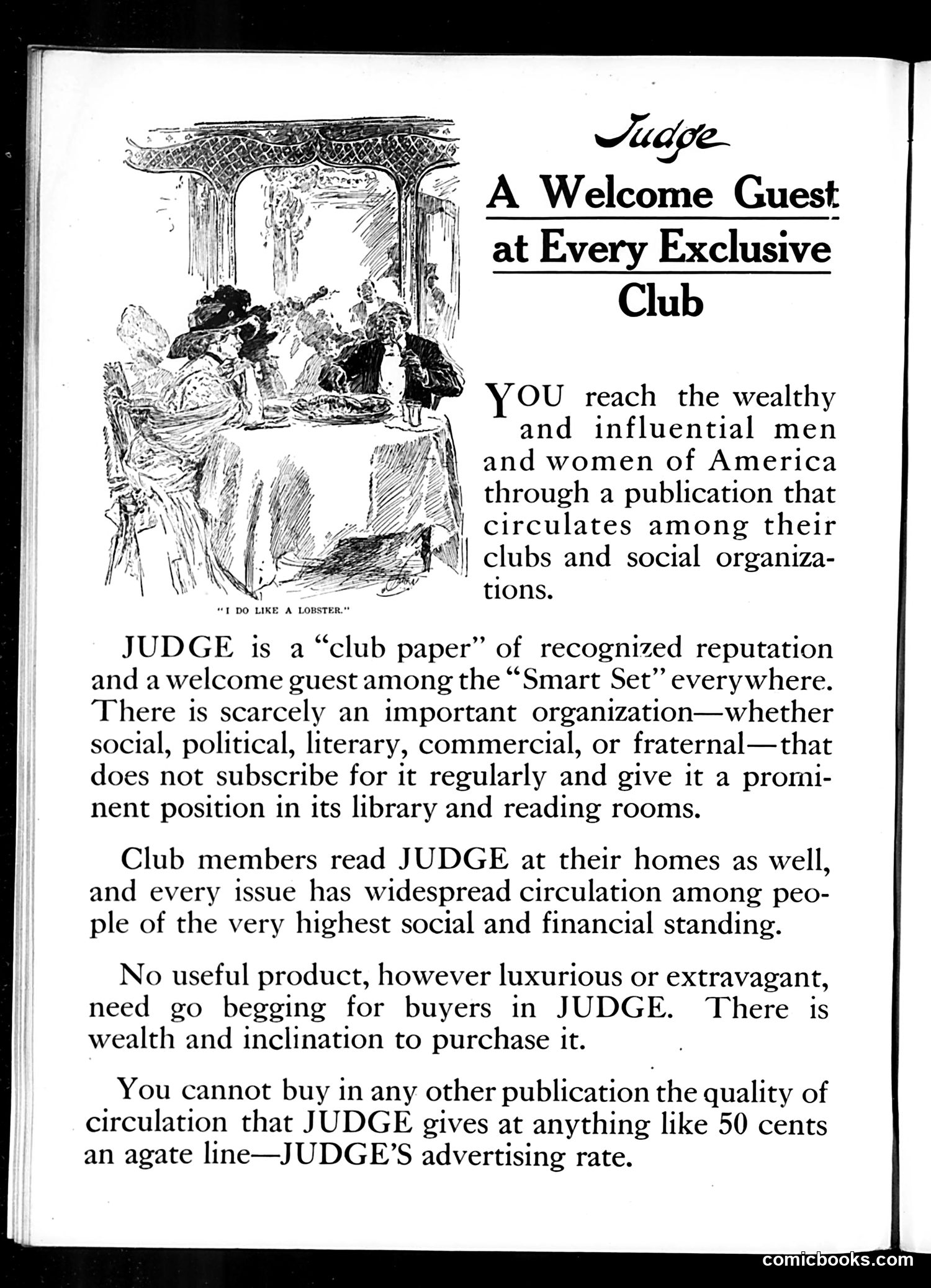
This page is primarily **advertising for Judge magazine itself**, not political satire. The illustration shows well-dressed diners at an exclusive club, captioned "I DO LIKE A LOBSTER"—depicting the affluent readership Judge targets. The text promotes Judge as a "club paper" that reaches wealthy, influential Americans through their social organizations. It emphasizes that exclusive clubs subscribe and display it prominently, and members read it at home. The advertisement claims Judge offers superior circulation among the "Smart Set" at competitive rates (50 cents per agate line). The cartoon reinforces the pitch: Judge positions itself as a sophisticated, welcome presence in elite spaces where wealthy potential customers gather and socialize.
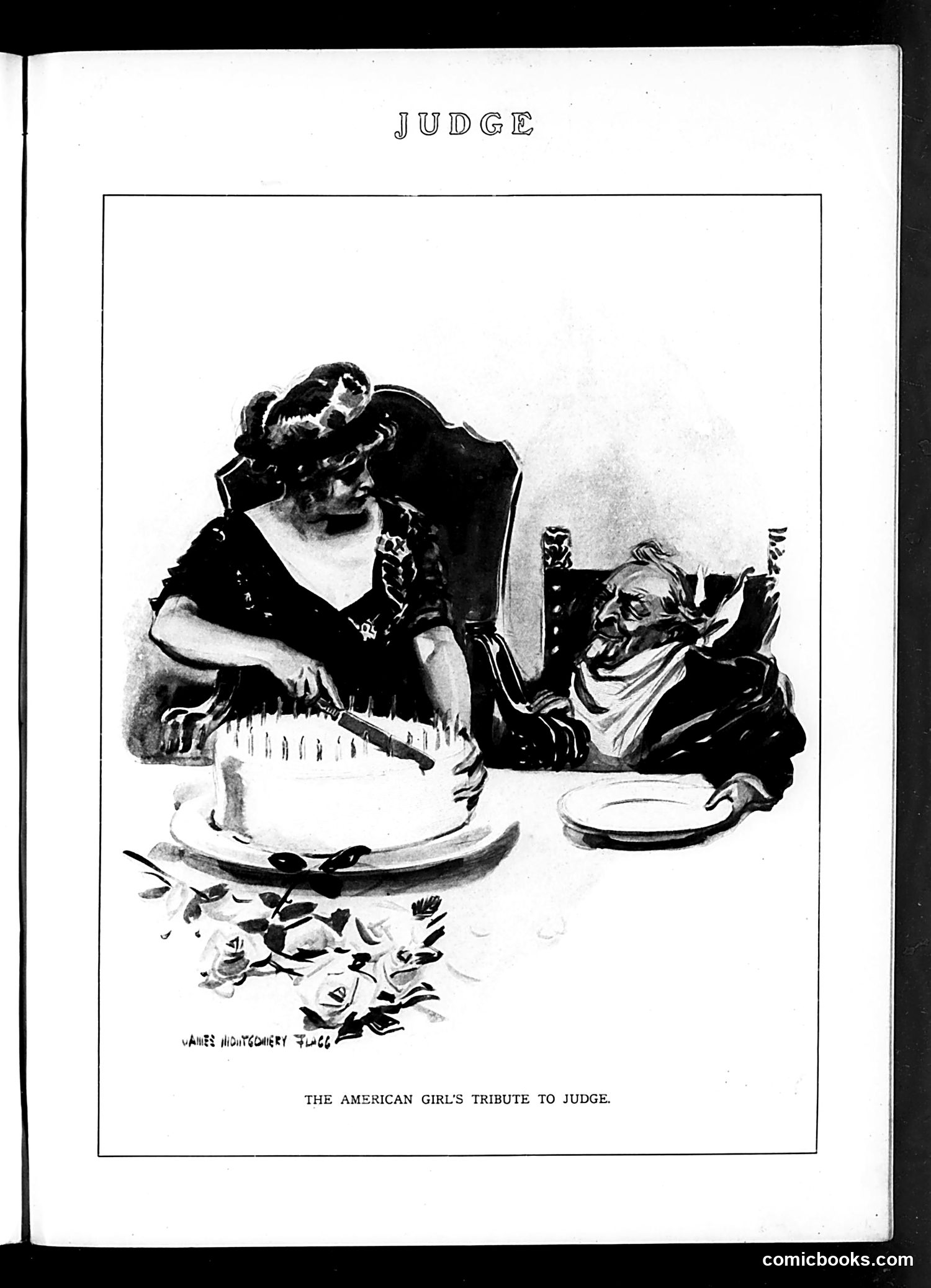
This illustration, signed by James Montgomery Flagg, depicts a woman presenting a large decorated cake to an elderly male judge seated at a table. The caption indicates this is meant as homage to the judicial figure, likely referencing Judge magazine itself or an actual prominent jurist of the era. The satire appears to play on the relationship between American women and judicial authority—possibly commenting on women's evolving social status or their appeals to male legal power. The elaborate cake presentation suggests either flattery toward the judiciary or ironic commentary on how women might "butter up" judges to gain favorable treatment in legal matters. Without additional historical context, the specific judge referenced remains unclear.
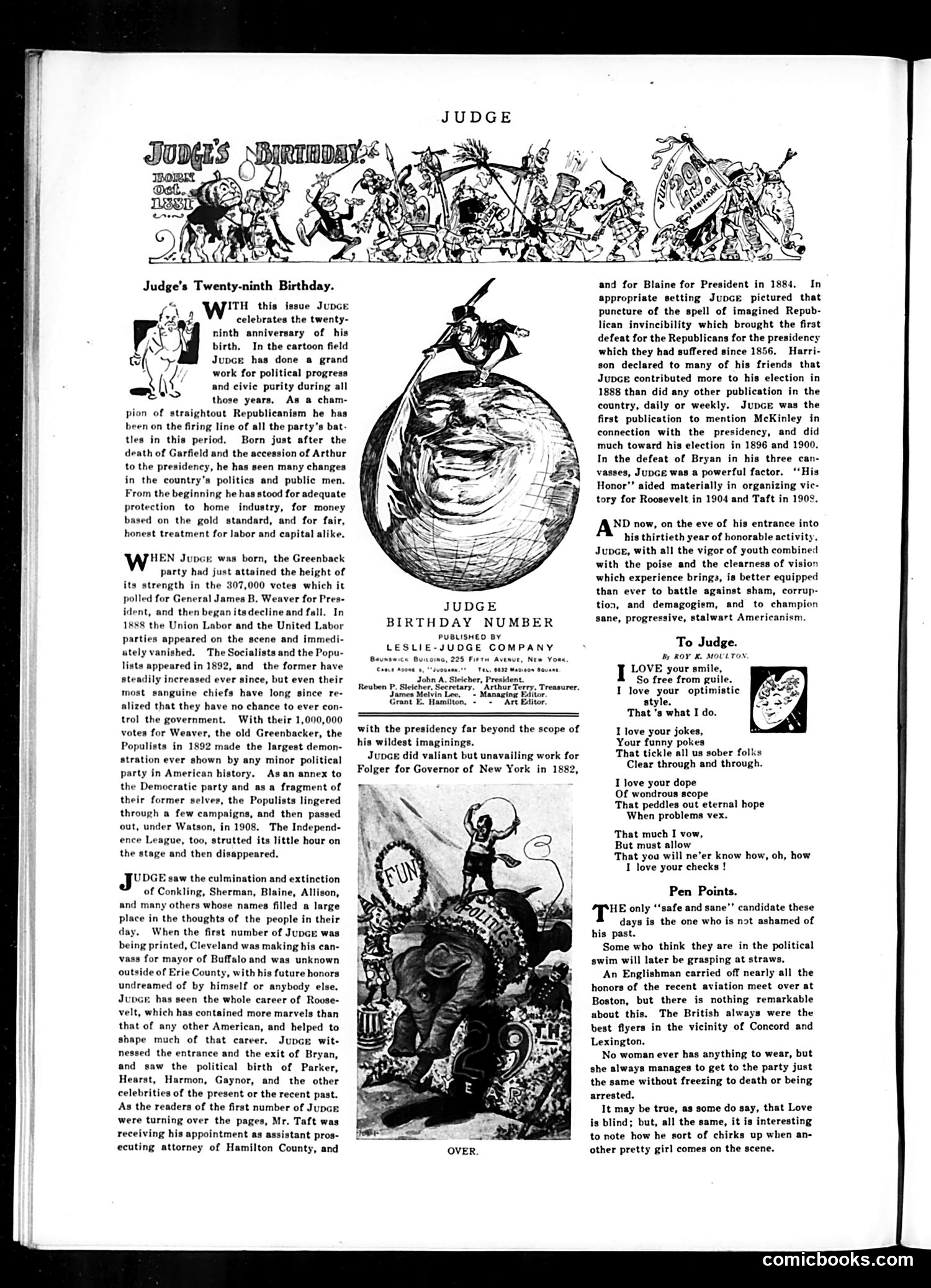
This is Judge magazine's birthday issue celebrating its twenty-ninth year. The header illustration shows a chaotic celebration scene typical of Judge's style. The main content discusses Judge's political impact, particularly its support for Republican candidates and causes. The text explicitly mentions the magazine's role in McKinley's election and Bryan's defeats, claiming Judge contributed more to Roosevelt's 1904 victory than any other publication. The cartoons appear to satirize political opponents and social issues of the era. One shows a figure riding a large apple or sphere labeled "FUN," likely mocking an opponent or ideology. The "To Judge" poem praises the magazine's role in fighting "sham, corruption, and demagogism," positioning Judge as a champion of progressive values and honest governance during the Progressive Era.
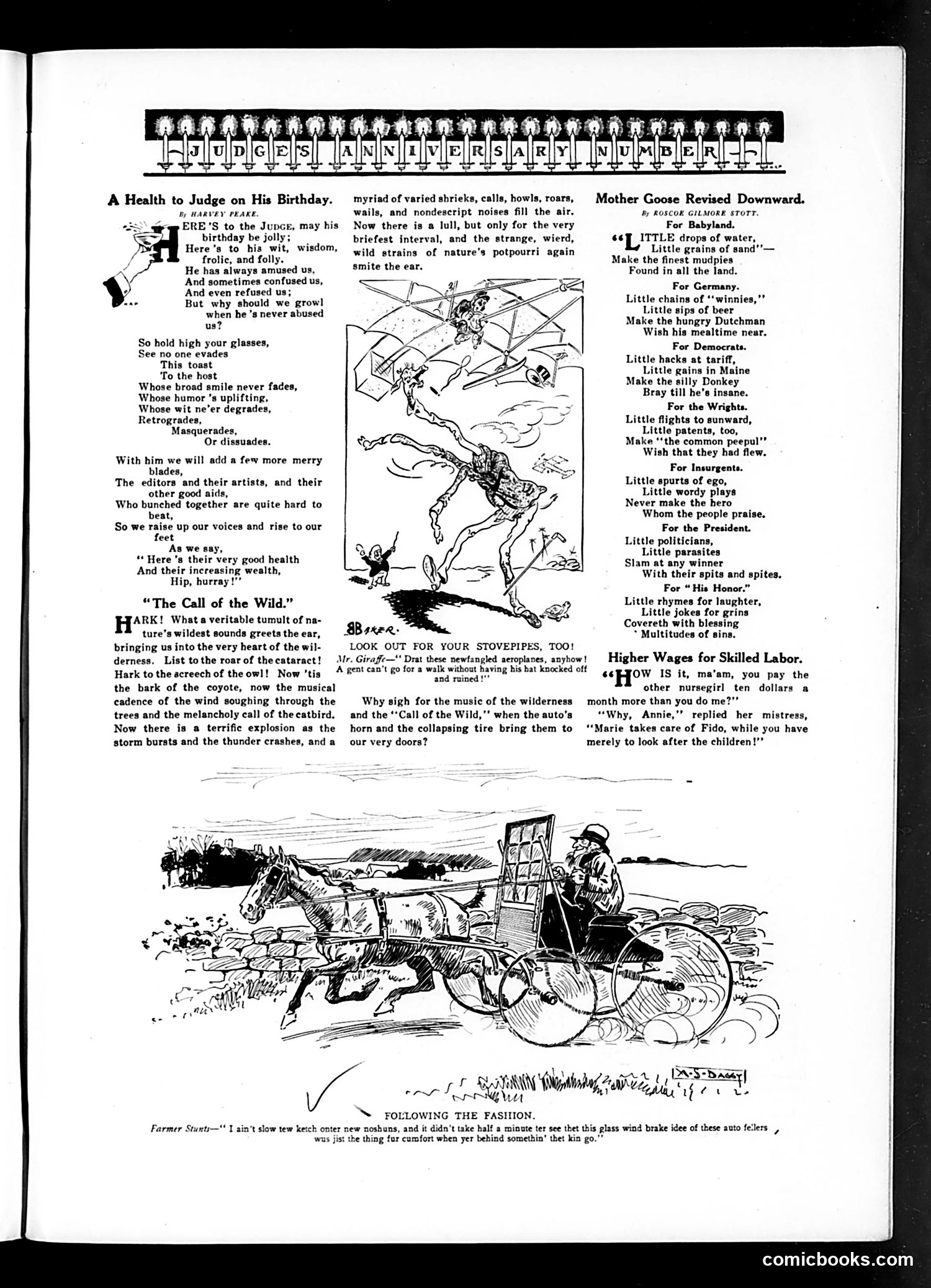
This page contains several distinct political satires typical of early 20th-century Judge magazine: **"The Call of the Wild"** depicts an automobile in chaos—crashing, with passengers flying through the air. The satire mocks the "wilderness" and danger of early automobile driving, contrasting the romantic notion of nature's "call" with the mechanical hazard of motorized vehicles. **"Mother Goose Revised Downward"** offers political parodies of nursery rhymes targeting various groups—Democrats, Germany, insurgents, labor movements, and the Wright brothers' aviation experiments. These mock contemporary political figures and causes through twisted traditional verses. **"Following the Fashion"** shows a farmer with an auto-drawn wagon, satirizing rural adoption of motorcar technology. The overall page reflects Judge's editorial stance mocking technological change, political movements, and social modernization circa 1910s.
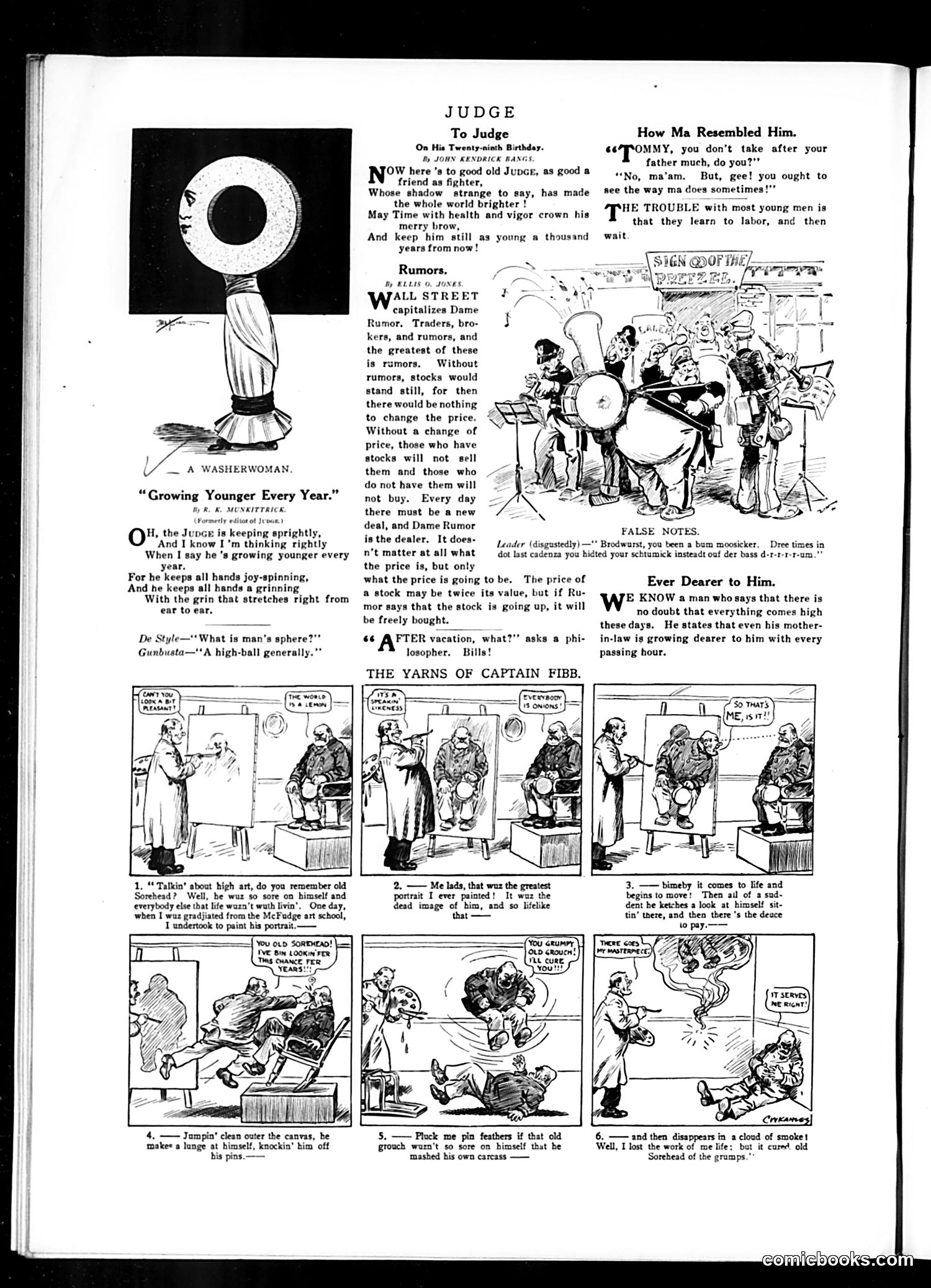
This page celebrates Judge's twenty-ninth birthday with poems praising the magazine's youthful spirit and influence. The main satirical content targets **Wall Street rumors and stock speculation**. The "Rumors" piece by Ellis O. Jones argues that stock prices depend not on actual value but on constantly circulating rumors. Traders profit from rumor-driven speculation rather than fundamental worth—a stock may be worthless but still "freely bought" if rumor says it's rising. This critiques the speculative excess and market manipulation of the era. "The Yarns of Captain Fibb" is a tall-tale comic strip about a sailor whose portrait becomes so lifelike it attacks him. It's lighthearted humor with no apparent political content. The shorter pieces offer gentle domestic humor: a mother notes her son resembles his father in his flaws; a man finds his mother-in-law increasingly "dear" (expensive) as costs rise. Overall, the page blends birthday celebration with modest social commentary on financial speculation and inflation.
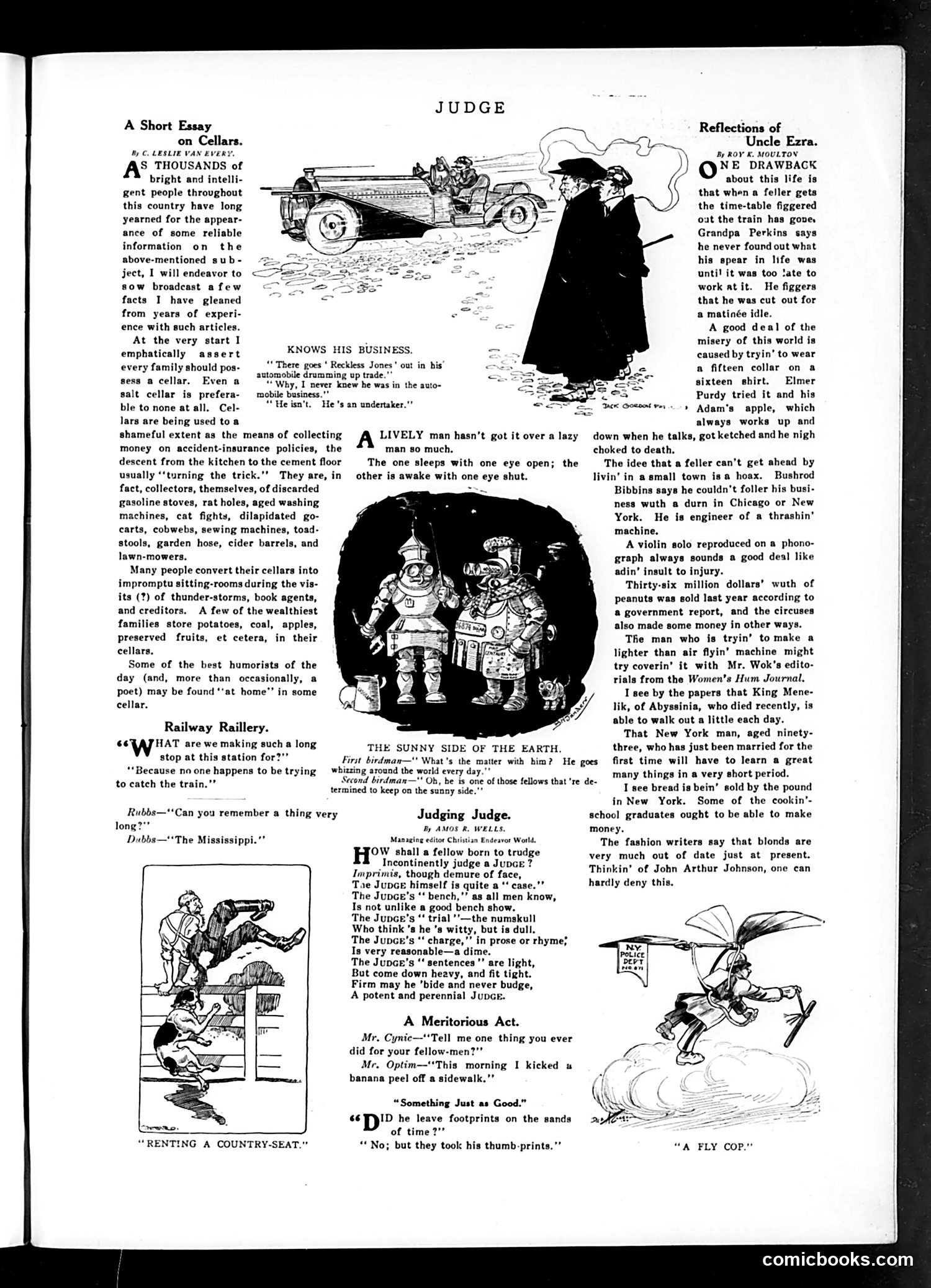
This page from the satirical magazine *Judge* contains several humor pieces and cartoons mocking American life and social conventions. The main essay "A Short Essay on Collars" ridicules the obsession with proper dress—specifically the impracticality of tight collars. One anecdote describes a man who choked to death trying to wear an oversized collar, satirizing the rigid class consciousness around appearance. "Railway Raillery" offers brief jokes about trains and human nature—playing on the contrast between lazy and industrious people. "Judging Judge" is a poem mocking the legal system and judges themselves, using puns ("bench show," "trial") to suggest judges are theatrical performers rather than serious arbiters of justice. The cartoons humorously depict rural and urban American life: a man renting a country property, an undertaker drumming up business via automobile, and birds discussing optimism. Overall, the page satirizes American conformity, the legal system, and the gap between rural and urban values—typical subjects for *Judge's* middle-class, satirical audience.
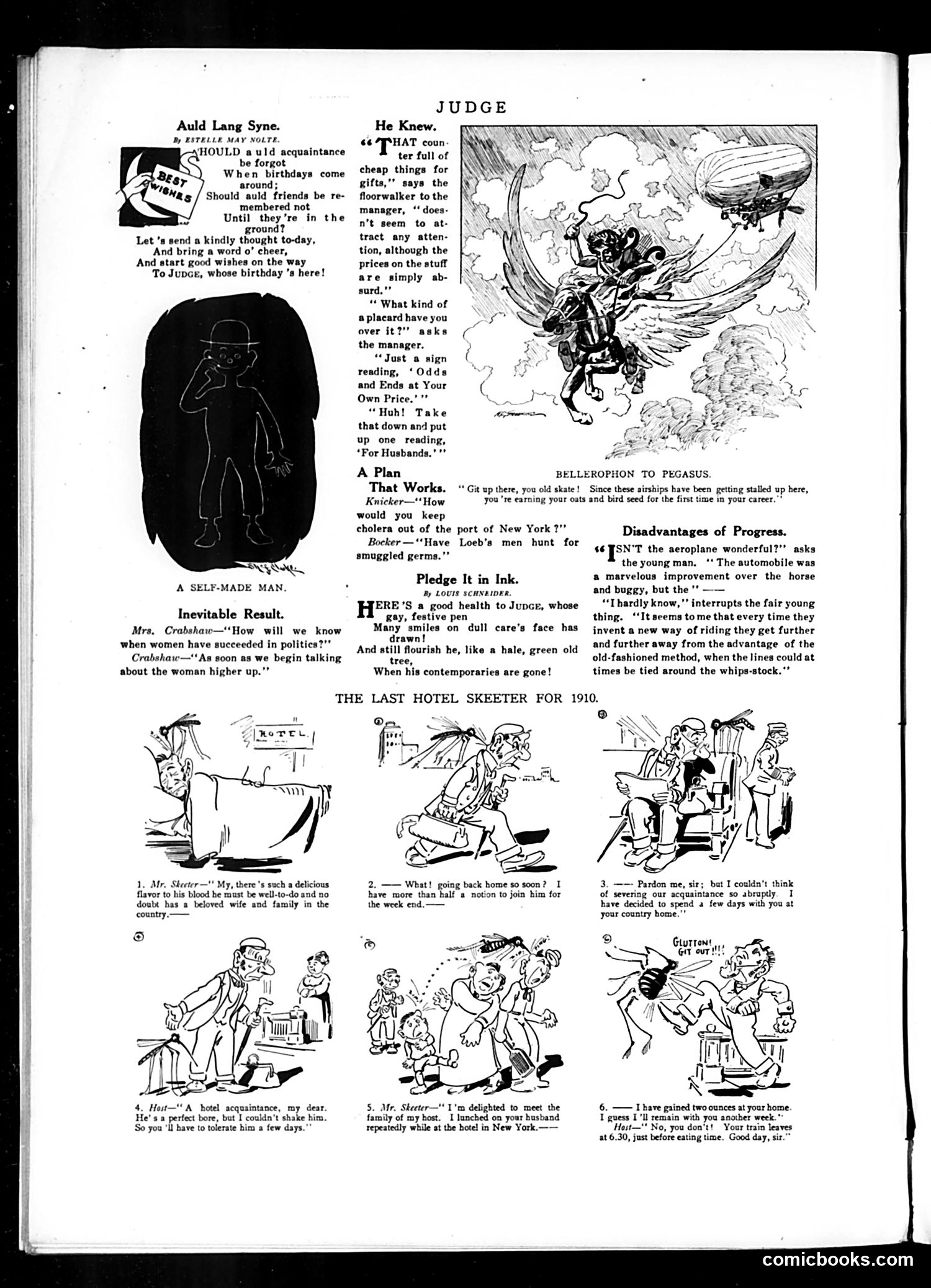
This page contains several satirical pieces typical of early 1900s American humor: **"Auld Lang Syne"** and related verses are birthday greetings to "Judge" (likely the magazine's namesake or mascot), presented with sentimental Scottish-themed poetry. **"The Last Hotel Skeeter for 1910"** is the main comic strip—a six-panel satire about a parasitic hotel guest ("Skeeter") who exploits social connections. The joke: the skeeter befriends hotel guests, then invites himself to their homes, eating voraciously until the exasperated host finally ejects him by claiming an early train departure. It satirizes freeloading social climbers and the era's tension between hospitality etiquette and unwanted guests. Other brief items mock women in politics, cheap department store merchandise, and progress (the aeroplane versus horses). "Bellerophon to Pegasus" references the mythological winged horse, joking about early aircraft getting stalled. The humor assumes reader familiarity with hotel culture, social hierarchy, and contemporary anxieties about modernity.
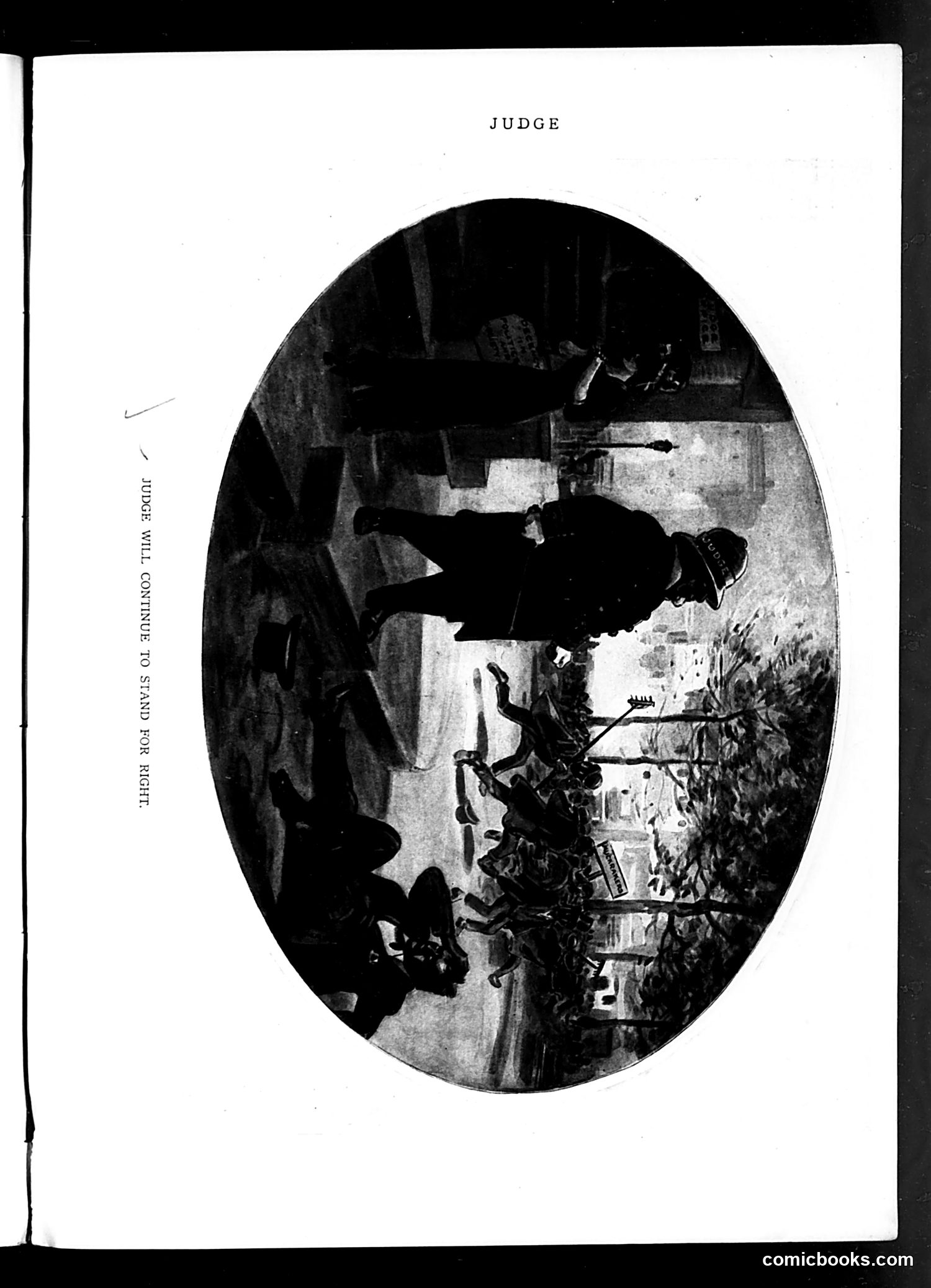
This appears to be a title page or section divider from *Judge* magazine, with the heading "JUDGE" at the top and a statement at the bottom reading "JUDGE WILL CONTINUE TO STAND FOR RIGHT." The page features an oval-framed black and white photograph showing what appears to be a courtroom or legal proceeding scene, oriented vertically. Multiple figures are visible in formal attire within an interior space. Without additional context about the specific date of this *Judge* issue, it's difficult to identify the particular legal case or political situation being referenced. The page seems to function as a masthead declaration of the magazine's editorial commitment to justice and righteousness, illustrated through a legal/courtroom image.
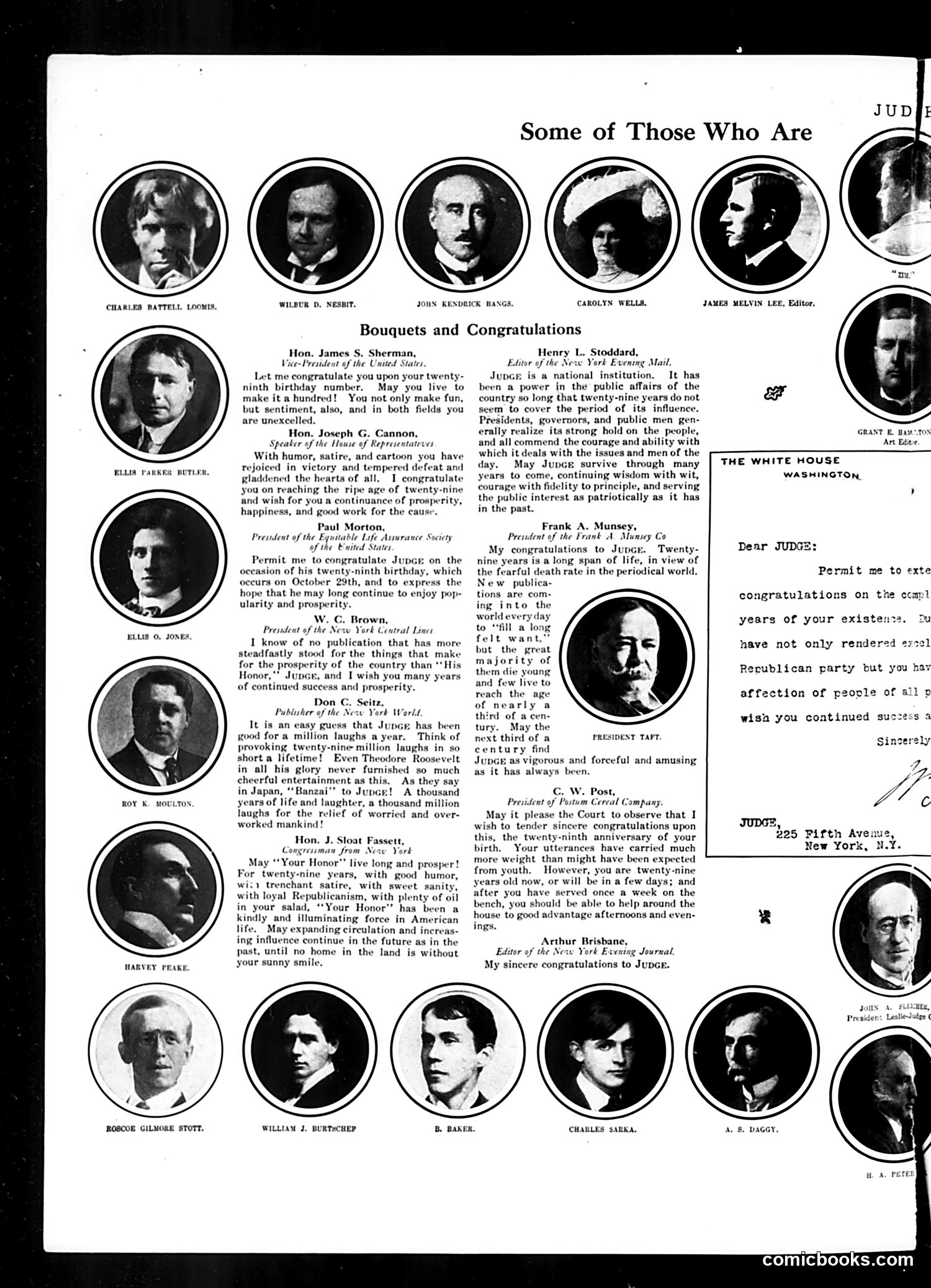
This page celebrates **Judge magazine's 29th anniversary** with congratulatory messages from prominent American figures of the era (circa 1912). **Key Context:** - Judge was a satirical weekly founded around 1881, targeting political and social issues - The contributors include Vice President James S. Sherman, House Speaker Joseph G. Cannon, President Taft, and business leaders (Frank Munsey, C.W. Post) - The tone emphasizes Judge's role as a "national institution" influencing public affairs and presidents **The Satire/Point:** Rather than attacking targets, this is self-congratulatory—showing Judge's cultural prestige by displaying endorsements from political elites. The magazine positions itself as a respectable arbiter of public opinion, not merely a joke publication. References to its "twenty-nine years" of "good humor" and "trenchant satire" serving "patriotically" suggest Judge saw itself as editorially serious despite its comic format. **What We'd Miss:** This demonstrates how satirical magazines functioned as genuine political influence in the early 20th century, with serious politicians publicly validating their work.
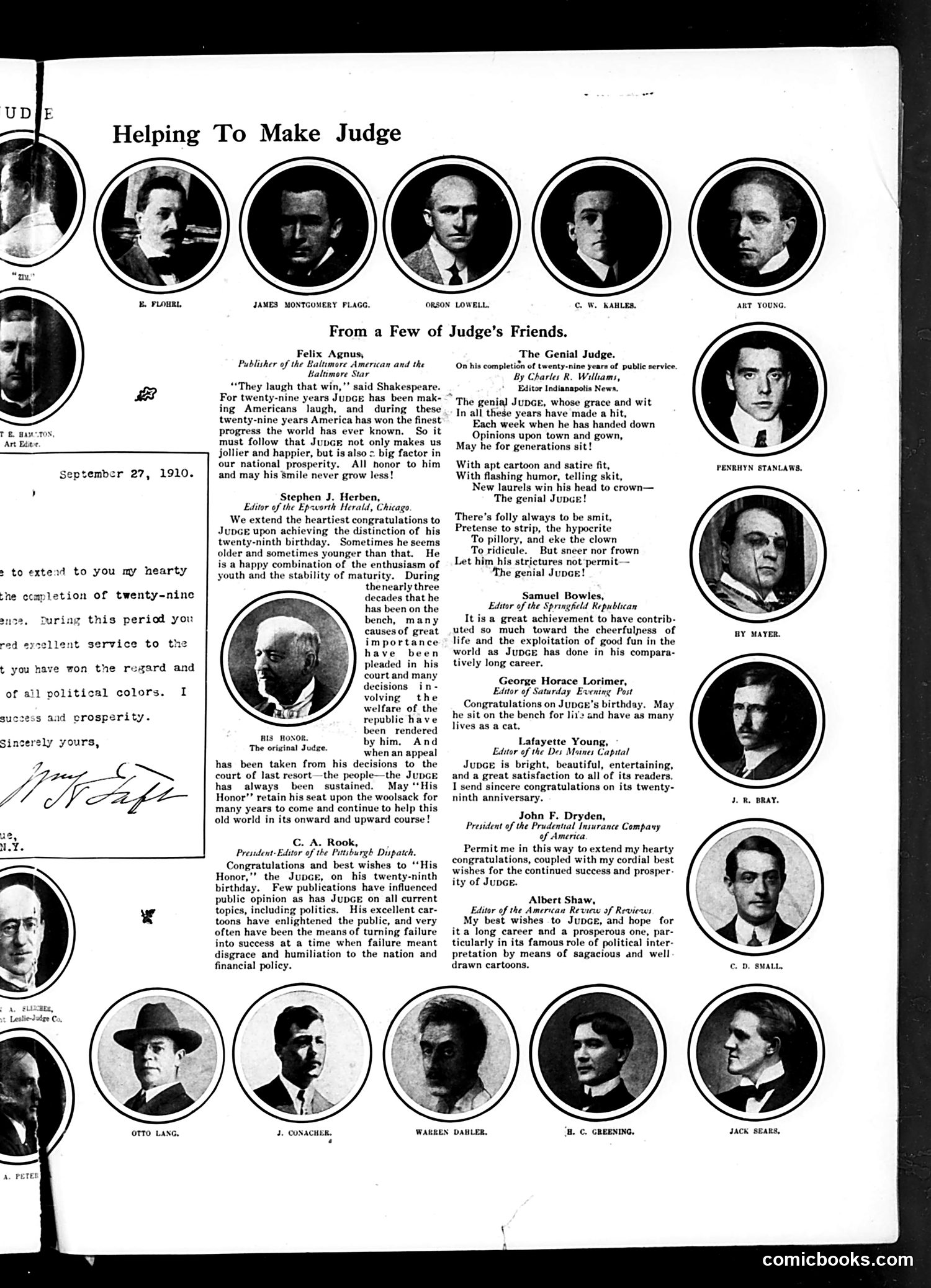
This page celebrates **Judge magazine's 29th anniversary** with congratulatory messages from prominent American editors and publishers. The portraits shown are these contributors—figures like Felix Agnus (Baltimore American), Stephen J. Herben (Epworth Herald), and C.A. Rook (Pittsburgh Dispatch). The satire is subtle: contributors humorously compare Judge to a sitting judge ("His Honor," "the bench," "woolsack"), playing on the magazine's name. They credit Judge with making Americans laugh while the nation prospered, suggesting satire and humor drive national progress. References to Judge's cartoons "enlightening the public" and addressing "politics" and "folly" reflect the magazine's role as a satirical voice on current affairs. The page essentially functions as an **advertisement disguised as editorial praise**—using respected editors' endorsements to legitimize Judge's influence on American public opinion and culture during the Progressive Era.
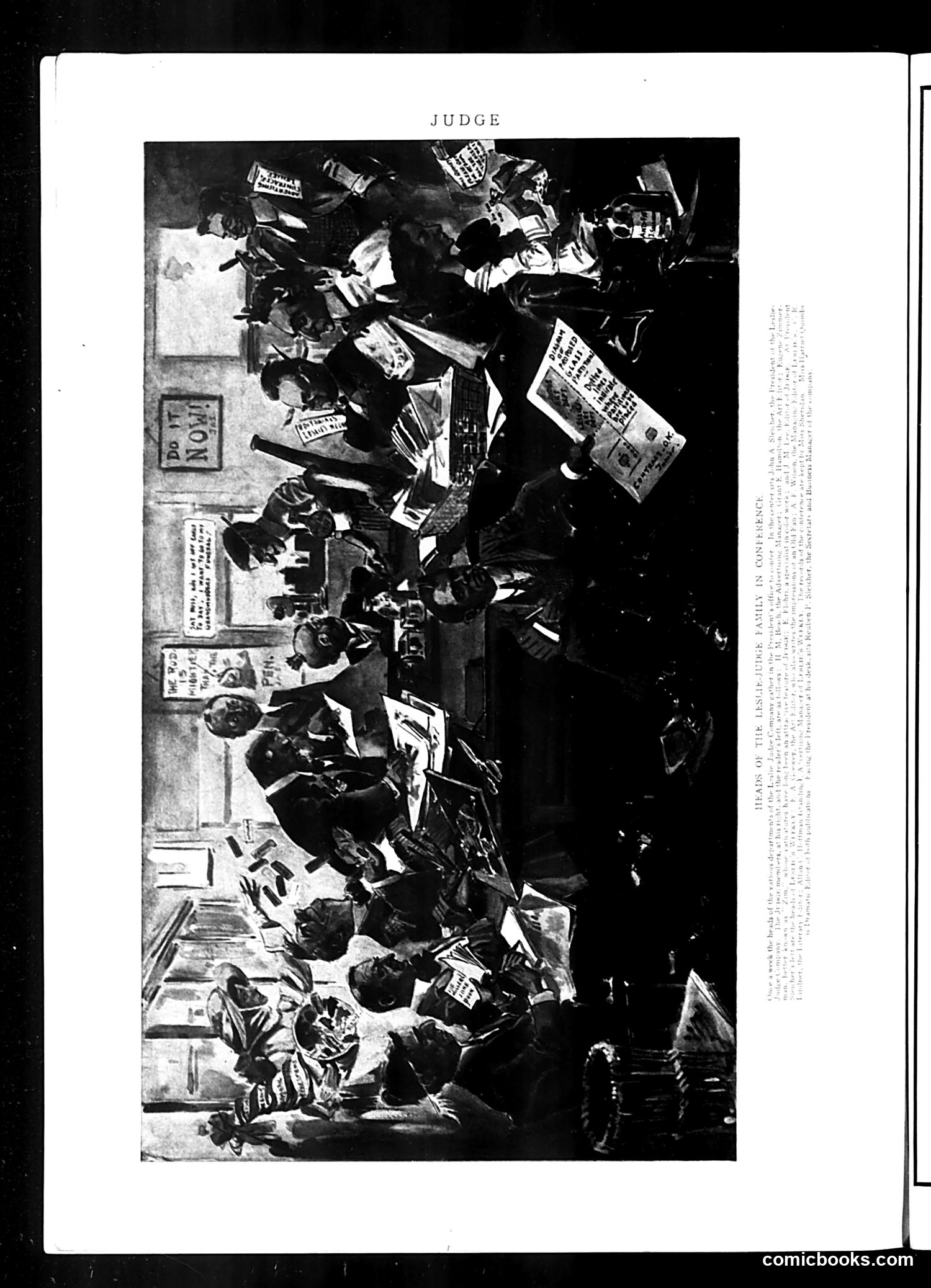
I can see this is a page from Judge magazine with the header "JUDGE" at the top and what appears to be a vertically-oriented black and white photograph or illustration showing multiple figures in what looks like a crowded scene. However, the image quality and orientation make it difficult to discern specific details about the figures, their identities, or the political/social commentary being conveyed. The OCR text provided only contains "comicbooks.com," which doesn't provide context for interpreting the cartoon's meaning or satirical intent. Without clearer visibility of facial features, identifying markers, text labels within the image, or legible accompanying article text, I cannot reliably identify the specific figures being caricatured or explain what political or social issues this cartoon addresses. To provide accurate historical context, I would need either a clearer image or the actual article text from the page.
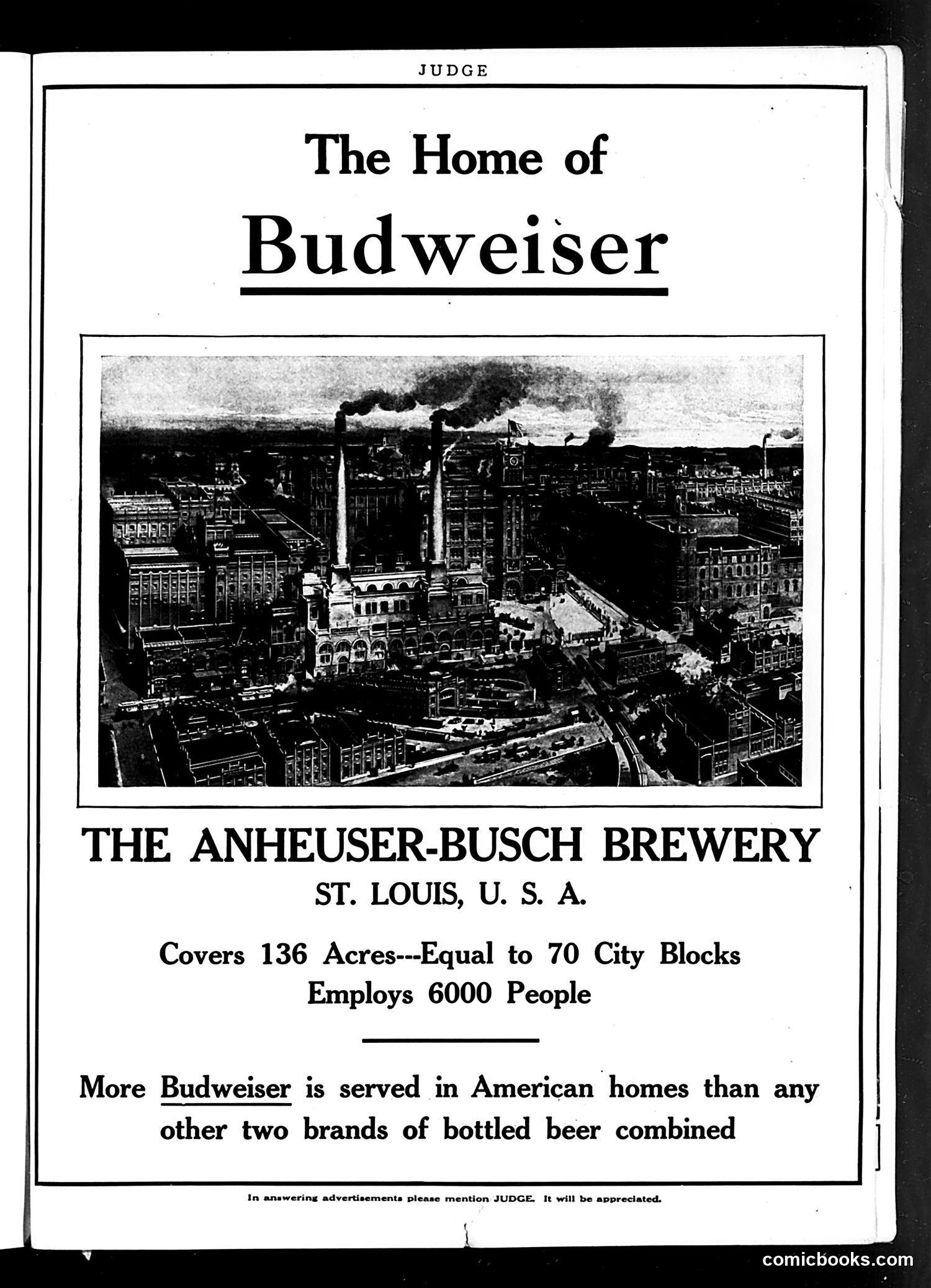
This is not a satirical cartoon but rather a full-page advertisement for Anheuser-Busch's Budweiser beer, appearing in Judge magazine. The page features an aerial photograph of the massive St. Louis brewery complex with its distinctive smokestacks. The ad emphasizes the brewery's scale (136 acres, employing 6,000 workers) and market dominance, claiming Budweiser outsells any two competing brands combined. This represents straightforward commercial advertising rather than satire—Judge, while primarily a humor magazine, accepted paid advertisements. The prominence and boastful claims reflect early 20th-century American industrial pride and aggressive beer market competition.
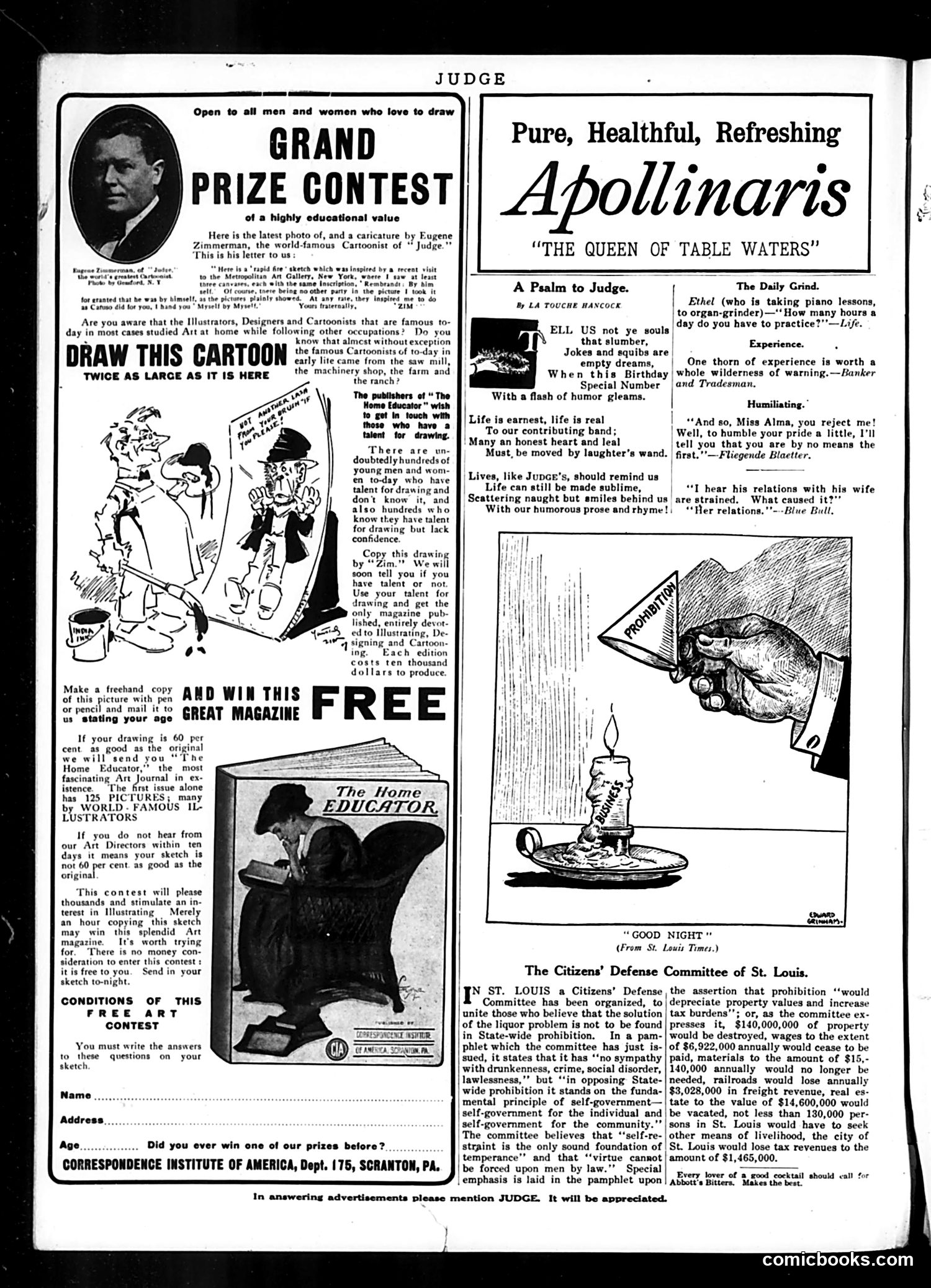
This page from Judge magazine contains **advertisements and filler content** rather than coherent political satire. The dominant item is a **drawing contest advertisement** featuring cartoonist Eugene Zimmerman ("Zim") of Judge, encouraging readers to copy his cartoon to win "The Home Educator" art magazine. This represents typical early-20th-century magazine self-promotion. The right column includes miscellaneous brief humor items (titled "A Psalm to Judge," "The Daily Grind," etc.)—short jokes from various sources—plus ads for Apollinaris water and a longer piece about St. Louis's **Citizens' Defense Committee**, which appears to argue *against* Prohibition, claiming it would destroy property values and wages. The page functions primarily as **space-filling and self-promotional content** rather than delivering focused satirical commentary. Without a clear publication date visible, the Prohibition reference suggests early 20th century, likely pre-1920.
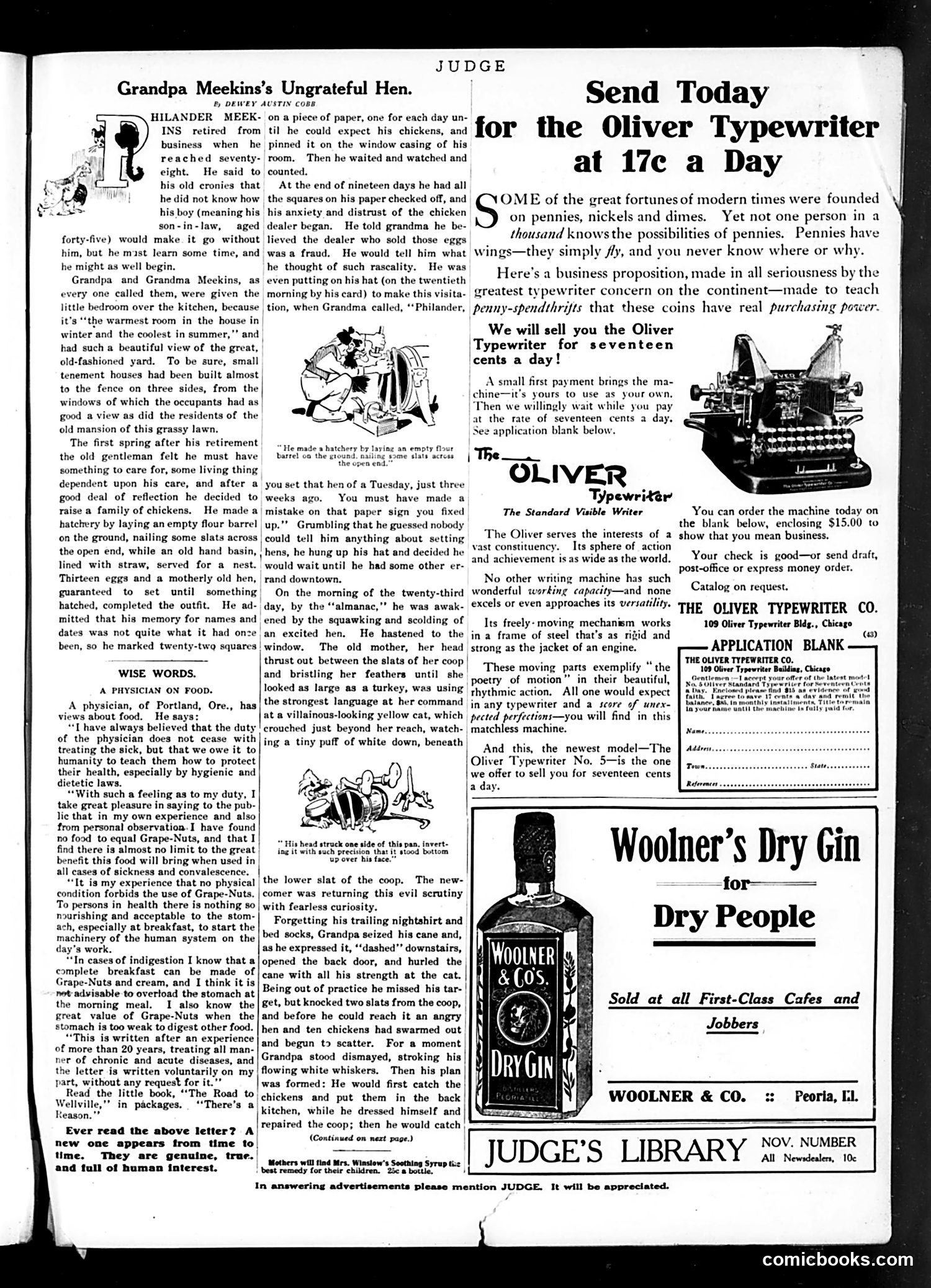
This is a humorous story (not a political cartoon) about a retired businessman who decides to raise chickens. Grandpa Meekins, age 78, meticulously tracks 19 days on paper waiting for eggs to hatch. On day 20, impatient and suspicious the dealer sold him duds, he prepares to confront the seller—when his wife interrupts. The satire targets **elderly retirees' anxious overthinking** and their struggle with newfound idleness after work. Meekins's obsessive paper-marking and hair-trigger accusations reflect how retirement can make men paranoid and fussy about minor matters. The story plays on the common anxiety that modern commerce is fraudulent. The page is primarily **advertising and miscellaneous content**—also featuring Oliver Typewriter ads and a testimonial about Grape-Nuts cereal (a common Judge magazine feature). The humor is gentle domestic satire rather than sharp social commentary.
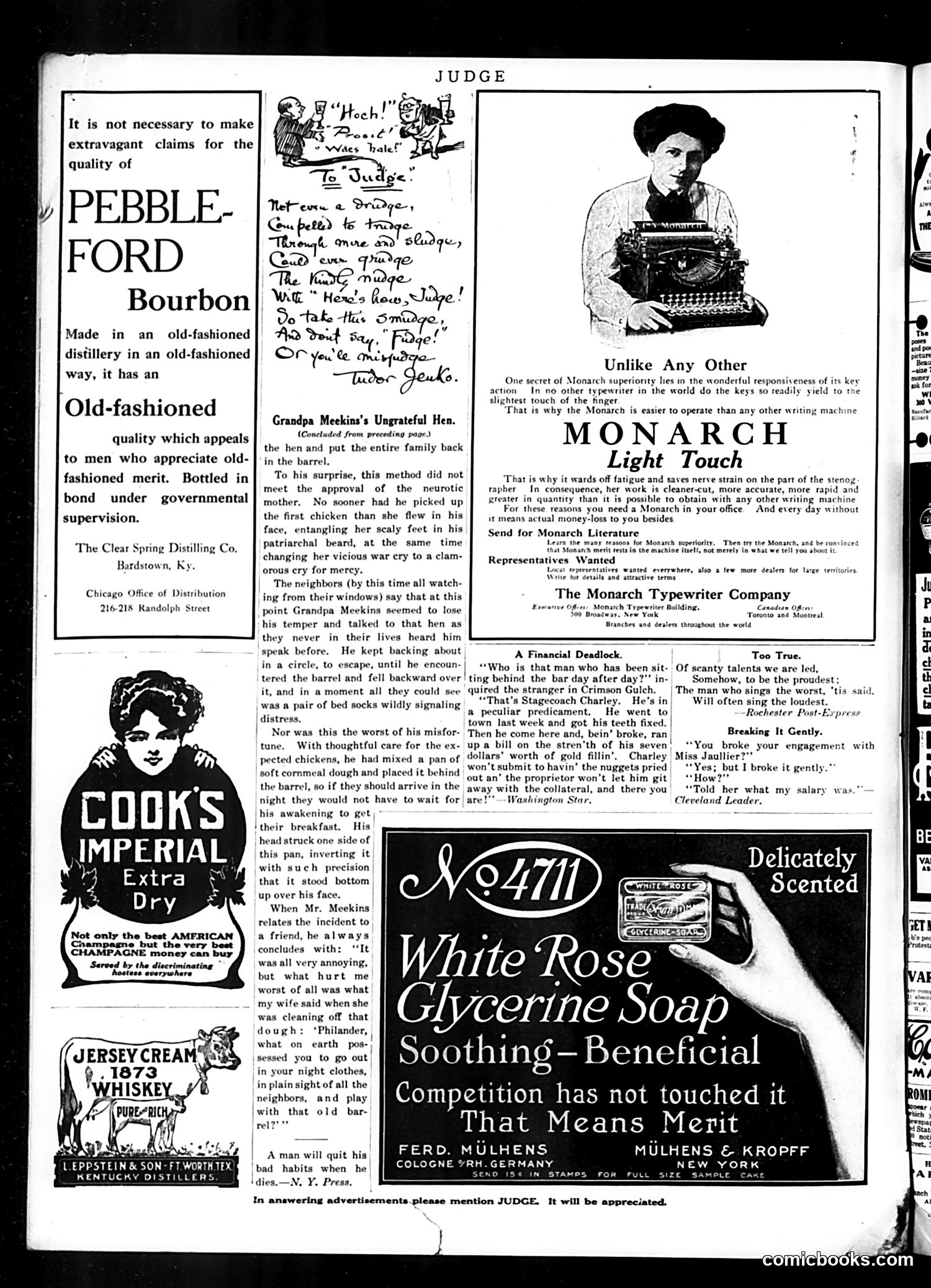
This page is primarily **advertising**, with one narrative humor piece ("Grandpa Meekins's Ungrateful Hen"). The main content features period product advertisements for bourbon, champagne, a typewriter, and soap—typical early 20th-century Judge content. The "Grandpa Meekins" story, concluding a serialized tale, depicts slapstick domestic chaos: an elderly man attempts to retrieve chickens from a barrel, gets attacked by a hen, falls backward into the barrel, and lands face-first in cornmeal dough he'd prepared. His wife's dry comment—complaining about cleaning mess rather than his predicament—delivers the comic payoff. The humor relies on physical comedy and gentle domestic satire about marriage dynamics. Several short joke items ("A Financial Deadlock," "Too True," "Breaking It Gently") offer brief quips about money troubles and marital discord—standard Judge fare mocking contemporary social situations with mild cynicism.
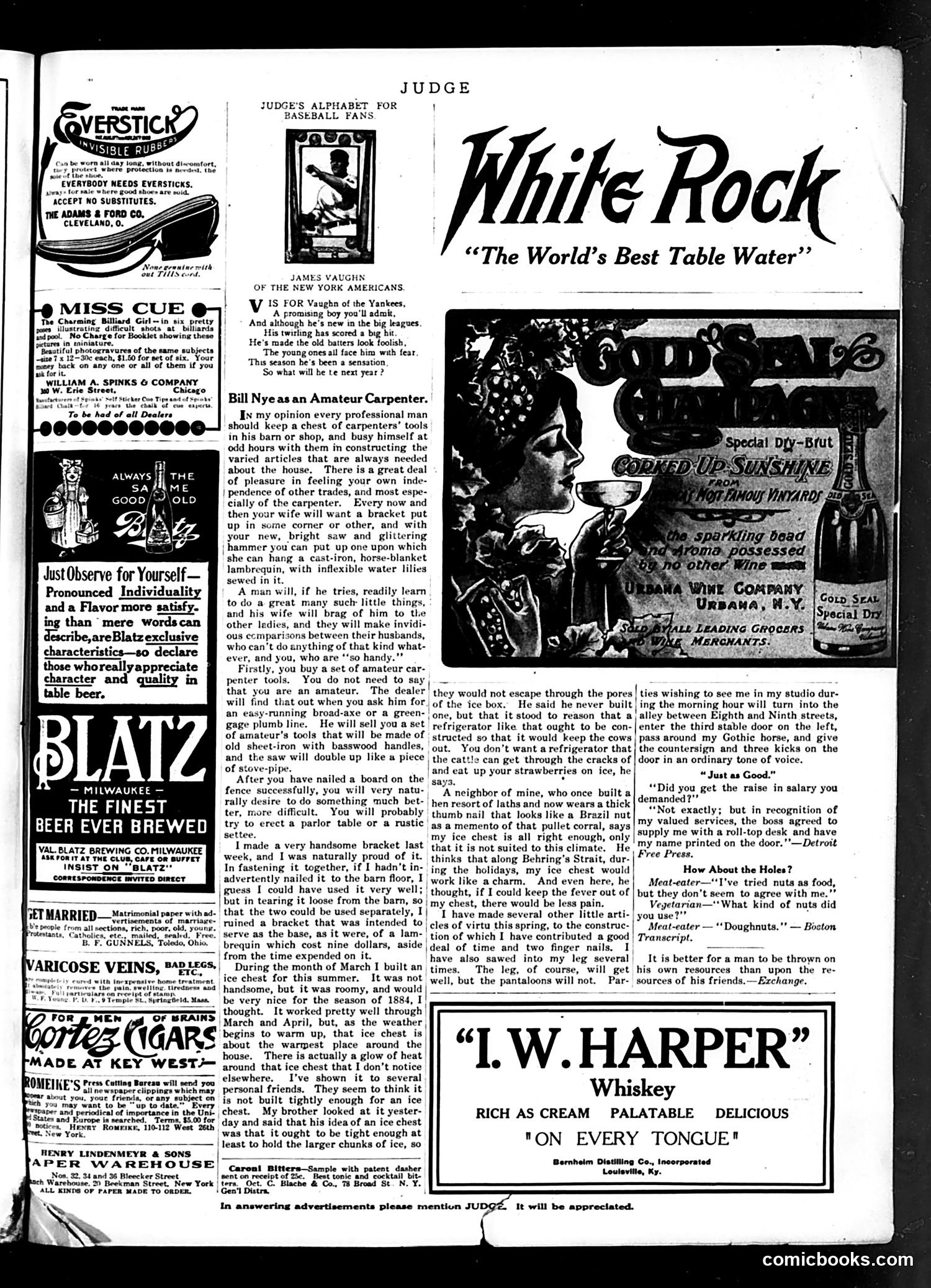
This page is primarily **advertisements and miscellaneous content** rather than satirical cartoons. The main visual element is "Judge's Alphabet for Baseball Fans," featuring James Vaughn of the New York Americans—a straightforward baseball card-style entry with verse, not satire. The substantial text piece "Bill Nye as an Amateur Carpenter" is humorous personal essay, not political satire. It presents Nye's comedic observations about amateur woodworking projects and poorly-constructed ice boxes, relying on anecdotes and folksy humor rather than social commentary. The page is filled with period advertisements (Blatz beer, White Rock water, I.W. Harper whiskey, cigars, etc.). There are no identifiable political cartoons or satirical commentary visible in the layout or text. This appears to be a typical interior page of the magazine mixing light entertainment content with advertising.
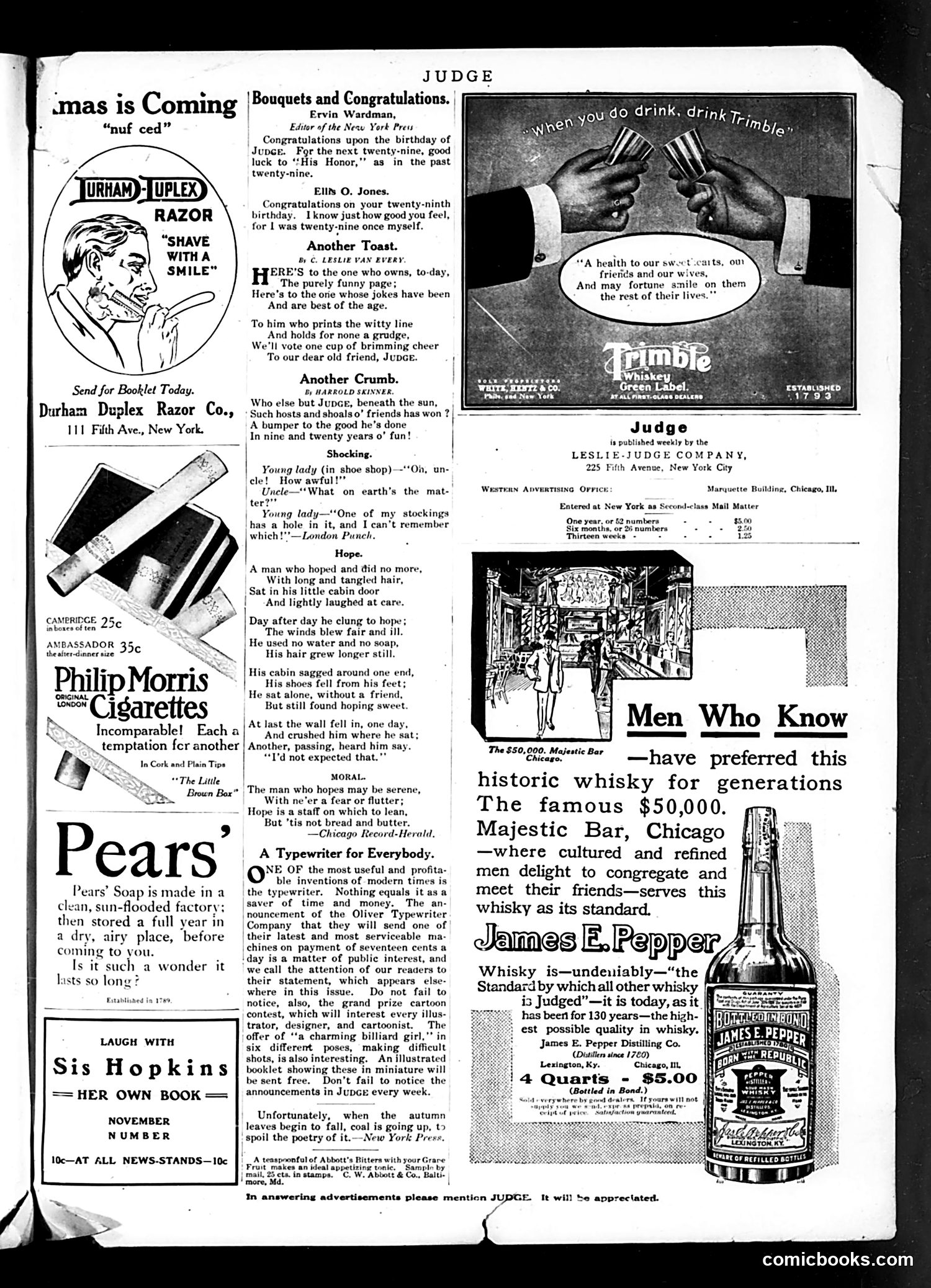
This page is primarily **advertisements and congratulatory content** rather than satirical cartoons. The main feature is "Bouquets and Congratulations"—birthday messages to Judge magazine on its 29th anniversary (established 1881, per the Trimble whiskey ad). Contributors like Ervin Wardman and Ellis O. Jones offer toasts praising the publication's humor and longevity. The page includes period advertising (Durham Duplex razors, Philip Morris cigarettes, Pears' soap, James E. Pepper whiskey) and a humorous poem titled "Hope" about a man who survives hardship through optimism, plus a brief joke from London Punch about a woman with a hole in her stocking. There is **no clear political satire** or identifiable caricatures on this page. It functions primarily as a **birthday tribute issue** mixed with commercial advertisements—typical filler content for a magazine anniversary edition.
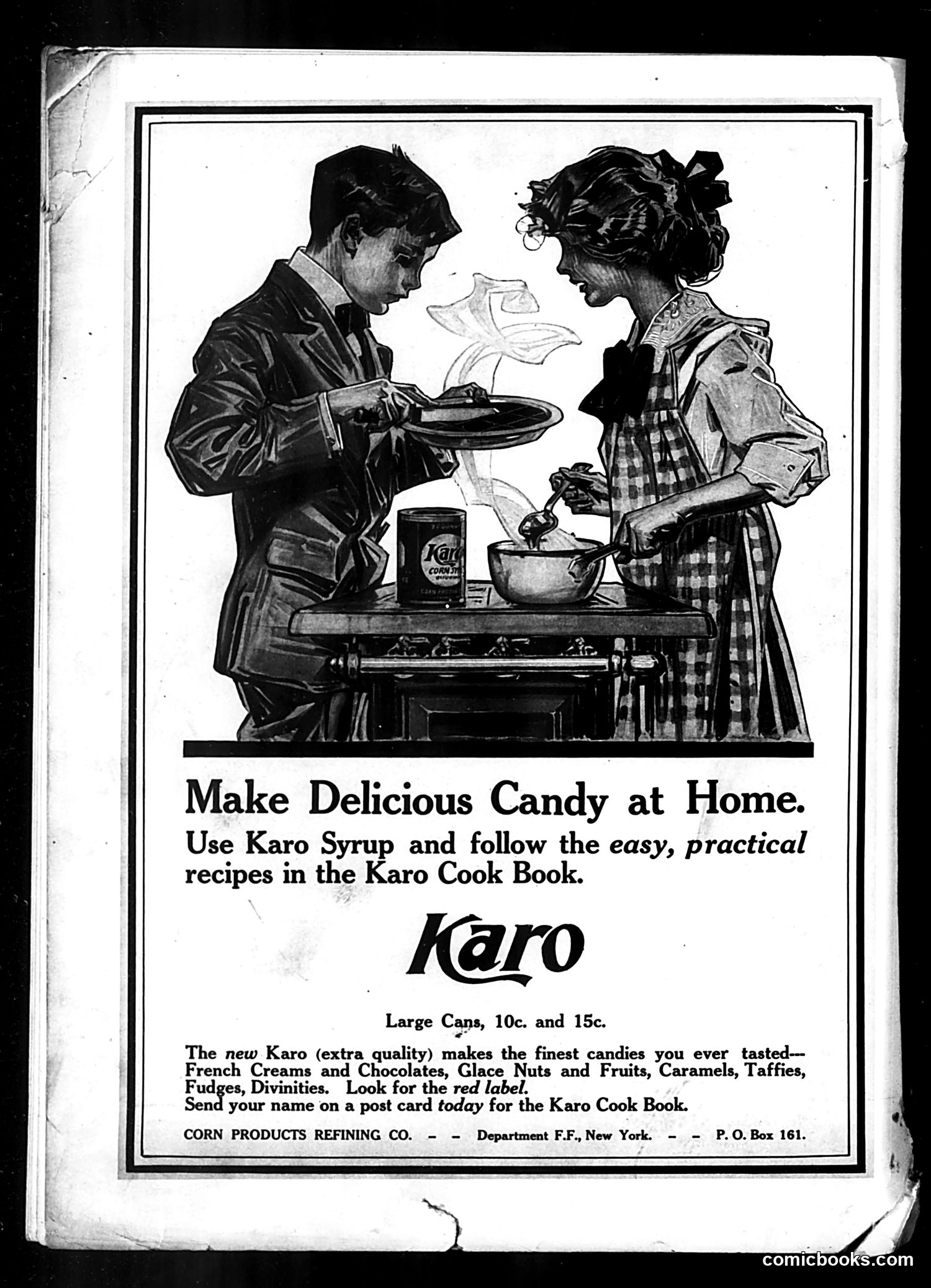
This is **not a satirical cartoon** but a **straightforward advertisement** for Karo Syrup, a corn-based sweetener product. The image depicts a domestic scene: a young man in a suit presents a homemade candy to a woman in an apron and checkered dress. The ad promotes making candy at home using Karo Syrup, positioning it as an accessible, practical activity for housewives. The appeal is to early 20th-century domesticity—women's traditional role in home candy-making—while emphasizing convenience through the "easy, practical recipes" in the accompanying Karo Cook Book. The pricing (10-15 cents for large cans) suggests affordability for middle-class households. This represents typical early advertising that reinforced gender roles while promoting consumer products as enabling domestic skill and family bonding.

I can see this is a page from *Judge* magazine, but the image is almost entirely black with only a thin white strip visible on the left edge. The OCR text contains only "comicbooks.com," which appears to be a watermark rather than actual magazine content. Without being able to see the cartoon(s), illustration(s), or substantive text on this page, I cannot identify the figures, political references, or satirical intent. The page reproduction is too dark to discern any meaningful visual content that would allow me to explain the satire or historical context to a modern reader. A clearer scan would be needed to provide useful analysis.