
Judge, 1910-10-29 · page 15 of 21
Judge — October 29, 1910 — page 15: what you’re looking at
What you’re looking at
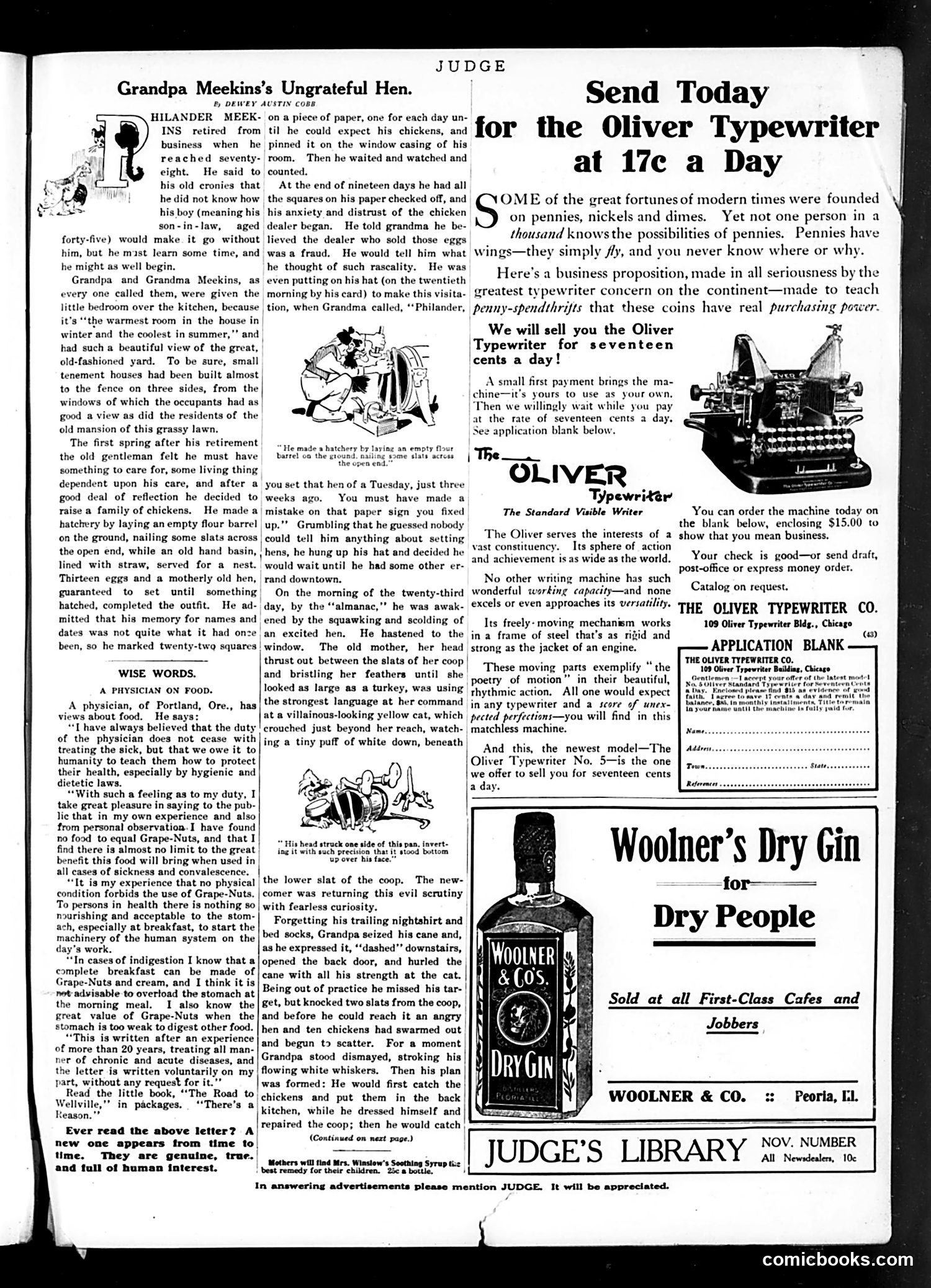
This is a humorous story (not a political cartoon) about a retired businessman who decides to raise chickens. Grandpa Meekins, age 78, meticulously tracks 19 days on paper waiting for eggs to hatch. On day 20, impatient and suspicious the dealer sold him duds, he prepares to confront the seller—when his wife interrupts. The satire targets **elderly retirees' anxious overthinking** and their struggle with newfound idleness after work. Meekins's obsessive paper-marking and hair-trigger accusations reflect how retirement can make men paranoid and fussy about minor matters. The story plays on the common anxiety that modern commerce is fraudulent. The page is primarily **advertising and miscellaneous content**—also featuring Oliver Typewriter ads and a testimonial about Grape-Nuts cereal (a common Judge magazine feature). The humor is gentle domestic satire rather than sharp social commentary.
📄 Transcribed text from this page (OCR, searchable)
Machine-transcribed from the original scan — historical spelling and the odd misread are preserved.
Grandpa Meekins JUDGE ’s Ungrateful Hen. fy DEWEY AUSTIN COBB HILANDER MEEK- INS retired from business when he reached seventy- eight. He said to his old cronies that he did not know how his boy (meaning his son-in-law, aged forty-five) would make. it go without him, but he mast learn some time, and he might as well begin. Grandpa and Grandma Meekins, as every one called them, were given the little bedroom over the kitchen, because it’s “the warmest room in the house in winter and the coolest in summer,” had such a beautiful view of the great, old-fashioned yard. To be sure, small tenement houses had been built almost to the fence on three sides, from the windows of which the occupants had as good a view as did the residents of the old mansion of this grassy lawn, The first spring after his retirement the old gentleman felt he must have something to care for, some living thing dependent upon his care, and after a good deal of reflection he decided to raise a family of chickens. He made a hatchery by laying an empty flour barrel on the ground, nailing some slats across the open end, while an old hand basin, | lined with straw, served for a nest. Thirteen eggs and a motherly old hen, guaranteed to set until something hatched, completed the outfit. He ad- mitted that his memory for names and dates was not quite what it had onze been, so he marked twenty-twa square: WISE WORDS. A PHYSICIAN ON FOOD. A physician, of Portland, Ore., has ws about food. He says: Ihave always believed that the duty of the physician does not cease with treating the sick, but that we owe it to humanity to teach them how to protect their health, especially by hygienic and dietetic laws. “With such a feeling as to my duty, I take great pleasure in saying to the pub- lic that in my own experience and also from personal observation. I have found vi no food to equal Grape-Nuts, and that I| find there is almost no limit to the gr benefit this food will bring when used in all cases of sickness and convalescence. “It is my experience that no physical condition forbids the use of Grape-Nuts. To persons in health there is nothing so nourishing and acceptable to the stom- ach, especially at breakfast, to start the machinery of the human system on the day's work. “In cases of indigestion I know that a complete breakfast can be made of Grape-Nuts and cream, and I think it is not advisable to overload the stomach at the morning meal. I also know the great value of Grape-Nuts when the stomach is too weak to digest other food. “This is written after an experience of more than 20 years, treating all man- ner of chronic and acute diseases, and the letter is written voluntarily on my part, without any request for it.’’ Read the little book, ‘‘The Road to Wellville,"” in packages. ‘‘There’s a Reason."" Ever read the above letter? A new one appears from time to time. They are genuine, true. and full of human interest. on a piece of paper, one for each day un- til he could expect his chickens, and pinned it on the window casing of his room, Then he waited and watched and counted, At the end of nineteen days he had all the squares on his paper checked off, and his anxiety and distrust of the chicken dealer began. He told grandma he be- lieved the dealer who sold those eggs was a fraud, He would tell him what he thought of such rascality. He was even putting on his hat (on the twentieth morning by his card) to make this visita- tion, when Grandma called, ‘Philander, and, He made a hatchery by laying an empty flour barrel oo the ground. nailing some slats actoas the © you set that hen of a Tuesday, just three weeks ago. You must have made a mistake on that paper sign you fixed up.’” Grumbling that he guessed nobody could tell him anything about setting hens, he hung up his hat and decided he would wait until he had some other er- rand downtown. On the morning of the twenty-third day, by the “almanac,” he was awak- ened by the squawking and scolding of an excited hen. He hastened to the window. The old mother, her head thrust out between the slats of her coop | and bristling her feathers until she looked as large as a turkey, was using the strongest language at her command at a villainous-looking yellow cat, which crouched just beyond her reach, watch- ing a tiny puff of white down, beneath yan, invert ;ood bottom: “ His head struck one side of thi ing it with such precision that up over his face.’ the lower slat of the coop. The new- comer was returning this evil scrutiny with fearless curiosity. Forgetting his trailing nightshirt and bed socks, Grandpa seized his cane and, as he expressed it, ‘‘dashed’” downs! opened the back door, and hurled the cane with all his strength at the cat. Being out of practice he missed his tar- get, but knocked two slats from the coop, and before he could reach it an angry hen and ten chickens had swarmed out and begun to scatter. For a moment Grandpa stood dismayed, stroking wis 1 | flowing white whiskers. Then his plan was formed: He would first catch the | chickens and put them in the back| kitchen, while he dressed himself and repaired the coop; then he would catch | (Continued on next page.) Mothers will find Mrs. Winslow's Soothing S; beat remedy for their children Doce bottle; y= Send Today for the Oliver Typewriter at 17¢ a Day OME of the great fortunes of modern times were founded on pennies, nickels and dimes. Yet not one person in a thousand knows the possibilities of pennies. Pennies have wings—they simply fy, and you never know where or why. Here's a business proposition, made in all seriousness by the greatest typewriter concern on the continent—made to teach penny-spendthrifts that these coins have real purchasing power. We will sell you the Oliver Typewriter for seventeen cents a day! A small first payment brings the ma- chine—it’s yours to use as your own, Then we willingly wait while you pay at the rate of seventeen cents a day. See application blank below. OLIVER Typewriter The Standard Visible Writer The Oliver serves the interests of a vast constituency. Its sphere of action and achievement is as wide as the world. No other writing machine has such wonderful working capacity—and none excels or even approaches its versatility. Its freely: moving mechanism works in a frame of steel that’s as rigid and strong as the jacket of an engine. These moving parts exemplify “the poetry of motion” in their beautiful, thythmic action. All one would expect in any typewriter and a score of unex- pected perfectians—you will find in this matchless machine. And this, the newest_model—The Oliver Typewriter No. 5—is the one we offer to sell you for seventeen cents a day. You can order the machine today on the blank below, enclosing $15.00 to show that you mean business. Your check is good—or send draft, post-office or express money order. Catalog on request. THE OLIVER TYPEWRITER CO. 109 Oliver Typewriter Bldg., Chicago APPLICATION BLANK ‘THE OLIVER TYPEWRITER CO. 109 Oliver Typewriter Building, Chicago Gentiemen x 1a your name wat Name. Woolner’s Dry Gin -for——— Dry People " WOOLNER & (0S. N ) WOOLNER & CO. JUDGE'S LIBRAR Peoria, Ii. NOV. NUMBER All Newsdealers, 10 In answering advertisements please mention JUDGE. It will be appreciated. comicbooks.com