
Judge, 1910-10-29 · page 7 of 21
Judge — October 29, 1910 — page 7: what you’re looking at
What you’re looking at
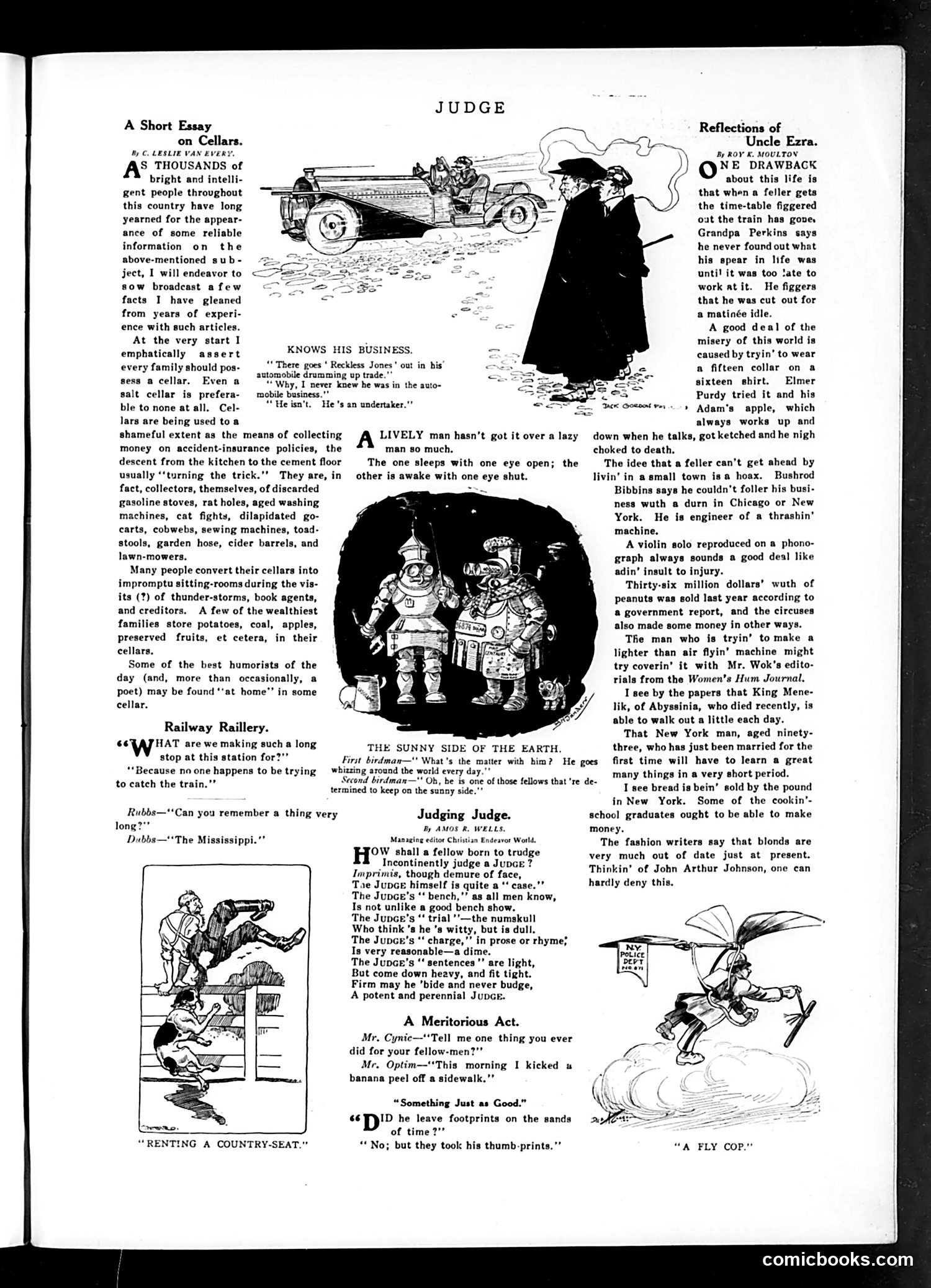
This page from the satirical magazine *Judge* contains several humor pieces and cartoons mocking American life and social conventions. The main essay "A Short Essay on Collars" ridicules the obsession with proper dress—specifically the impracticality of tight collars. One anecdote describes a man who choked to death trying to wear an oversized collar, satirizing the rigid class consciousness around appearance. "Railway Raillery" offers brief jokes about trains and human nature—playing on the contrast between lazy and industrious people. "Judging Judge" is a poem mocking the legal system and judges themselves, using puns ("bench show," "trial") to suggest judges are theatrical performers rather than serious arbiters of justice. The cartoons humorously depict rural and urban American life: a man renting a country property, an undertaker drumming up business via automobile, and birds discussing optimism. Overall, the page satirizes American conformity, the legal system, and the gap between rural and urban values—typical subjects for *Judge's* middle-class, satirical audience.
📄 Transcribed text from this page (OCR, searchable)
Machine-transcribed from the original scan — historical spelling and the odd misread are preserved.
bright and intelli- gent people throughout this country have long yearned for the appear- ance of some reliable information on the above-mentioned sub- ject, I will endeavor to sow broadcast afew facts I have gleaned from years of experi- ence with such articles. At the very start I emphatically assert every family should pos- sess a cellar. Even a salt cellar is prefera- ble to none at all. Cel- lars are being used to a shameful extent as the means of collecting money on accident-insurance policies, the descent from the kitchen to the cement floor usually ‘‘turning the trick.’’ They are, in fact, collectors, themselves, of discarded gasoline stoves, rat holes, aged washing machines, cat fights, dilapidated go- carts, cobwebs, sewing machines, toad- stools, garden hose, cider barrels, and lawn-mowers. Many people convert their cellars into impromptu sitting-rooms during the vi its (2) of thunder-storms, book agents, and creditors. A few of the wealthiest families store potatoes, coal, apples, preserved fruits, et cetera, in their cellars. Some of the best humorists of the day (and, more than occasionally, a poet) may be found ‘‘at home” in some cellar, mobile business."” “ He isn't. Railway Raillery. seyret are we making such a long stop at this station for?” “Because no one happens to be trying to catch the train.”” Rubbs—"Can you remember a thing very long? Dubbs—The Mississippi.” “RENTING A COUNTRY-SEAT.” KNOWS HIS BUSINESS. ‘There goes ‘ Reckless Jones ou automobile drumming up trade."” “Why, I never knew he was in the auto- He's an undertaker."’ LIVELY man hasn't got it over a lazy man so much. A The one sleeps with one eye open; the other is awake with one eye shut. THE SUNNY SIDE OF THE EARTH. First birdman—" What's the matter with him? He goes whizzing around the world every day." Second birdman—* Oh, be is one of those fellows that 're de- termined to keep on the sunny side."’ Judging Judge. By AMOS R. WELLS. Manazing editor Chiistian Endeavor World. HOW shall a fellow born to trudge Incontinently judge a JupcE ? Imprimis, though demure of face, Toe JupGe himself is quite a *‘ case."” The Jupce’s ‘‘ bench,"’ as all men know, Is not unlike a good bench show. The Jupce's “ trial ’—the numskull Who think 's he ’s witty, but is dull. The Jupce’s “‘ charge,’” in prose or rhyme? Is very reasonable—a dime. The Junce’s “‘ sentences” are light, But come down heavy, and fit tight. Firm may he 'bide and never budge, A potent and perennial JupcE. A Meritorious Act. Mr. Cynic—Tell me one thing you ever did for your fellow-men?”” Mr. Optim—“This morning I kicked u banana peel off a sidewalk.” “Something Just as Good.” sp» he leave footprints on the sands of time? “No; but they took his thumb-prints.’” Reflections of Uncle Ezra. By ROY K. MOULTON NE DRAWBACK about this life is that when a feller gets the time-table figgered out the train has gone. Grandpa Perkins says he never found out what his spear in life was until it was too tate to work atit. He figgers that he was cut out for a matinée idle. A good deal of the misery of this world is caused by tryin’ to wear a fifteen collar on a sixteen shirt. Elmer Purdy tried it and his Adam's apple, which always works up and down when he talks, got ketched and he nigh choked to death. The idee that a feller can’t get ahead by livin’ in a small town isa hoax. Bushrod Bibbins says he couldn't foller his busi- ness wuth a durn in Chicago or New York. He is engineer of a thrashin’ machine. A violin solo reproduced on a phono- graph always sounds a good deal like adin’ insult to injury. Thirty-six million dollars’ wuth of peanuts was gold last year according to a government report, and the circuses also made some money in other ways. The man who is tryin’ to make a lighter than air flyin’ machine might try coverin’ it with Mr. Wok’s edito- rials from the Women’s Hum Journal. I see by the papers that King Mene- lik, of Abyssinia, who died recently, is able to walk out a little each day. That New York man, aged ninety- three, who has just been married for the first time will have to learn a great many things in a very short period. I see bread is bein’ sold by the pound in New York. Some of the cookin’- school graduates ought to be able to make money. The fashion writers that blonds are very much out of date just at present. Thinkin’ of John Arthur Johnson, one can hardly deny this. “A FLY COP." comicbooks.com