
A complete issue · 16 pages · 1910
Judge — October 8, 1910
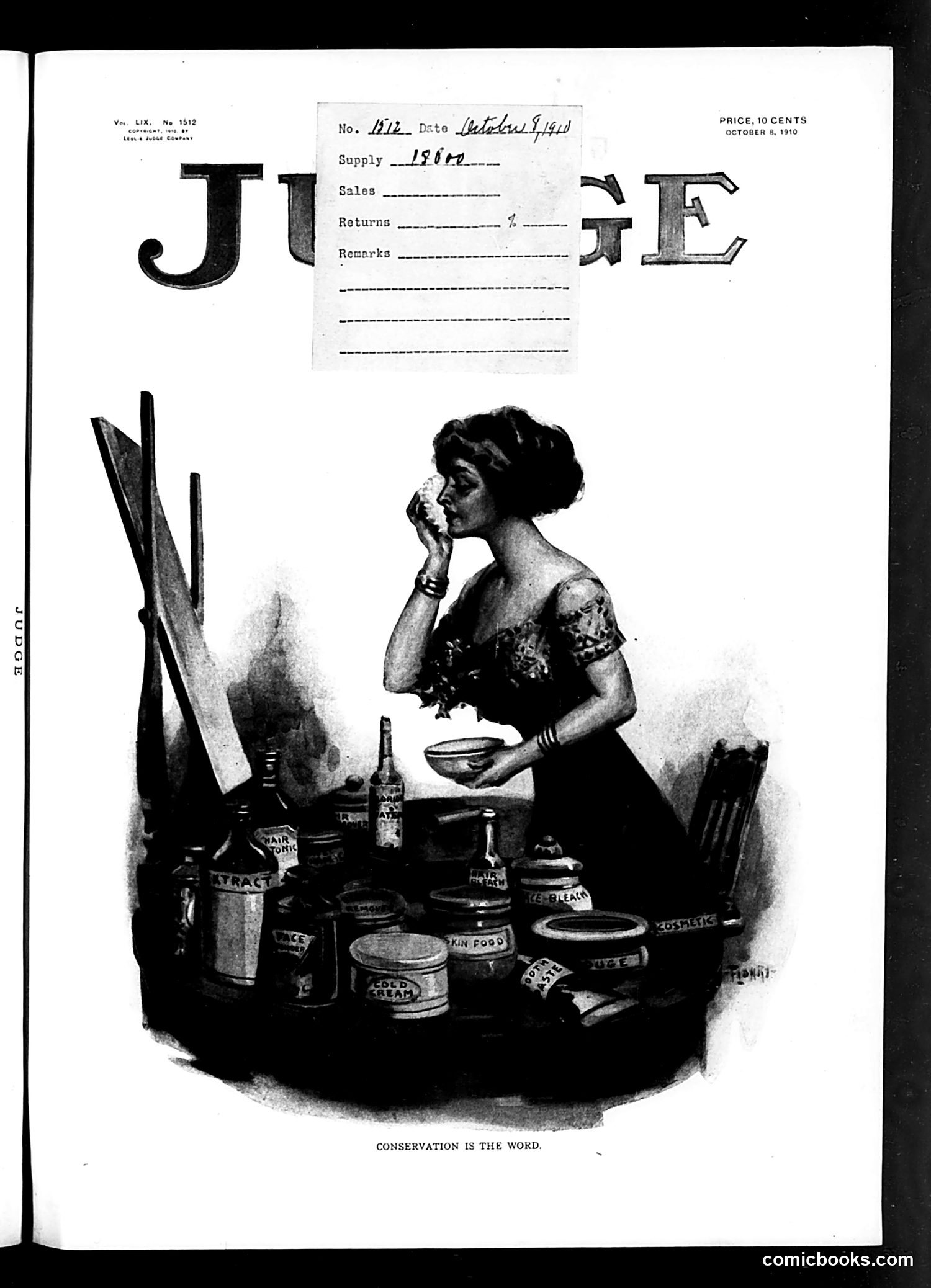
This Judge magazine page from October 6, 1910 contains a satirical illustration titled "Conservation is the Word." The cartoon depicts a well-dressed woman surrounded by various food and household products (canned goods, bottles, jars), appearing to contemplate what to use while holding a plate. The satire critiques the "conservation" movement gaining momentum during Theodore Roosevelt's presidency. Rather than depicting serious resource management, it mocks domestic housewives' attempts at food conservation—likely referencing wartime or economic scarcity concerns of the era. The woman's fashionable appearance and abundance of branded products suggest irony: that true "conservation" among the wealthy was mere performative gesture rather than genuine sacrifice or frugality. The cartoon comments on the gap between conservation rhetoric and actual consumer behavior among affluent Americans.
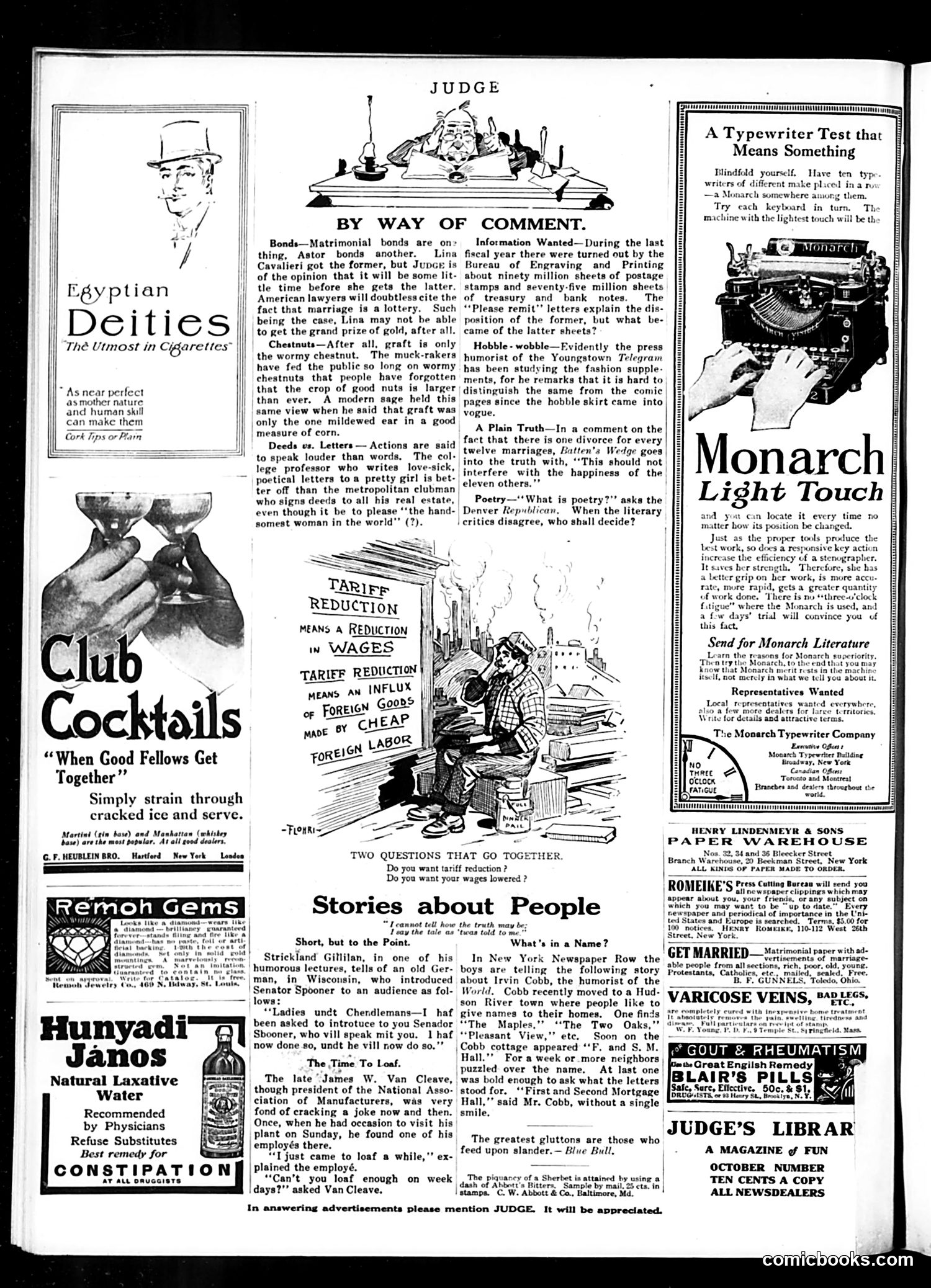
This page is primarily **advertising and commentary**, not political satire. The main content includes: **Central cartoon**: Illustrates tariff reduction debate—showing a worker amid industrial chaos labeled "TARIFF REDUCTION" and "FOREIGN LABOR," depicting concerns that lowering tariffs on foreign goods would harm American workers' wages. This reflects early 20th-century protectionist versus free-trade political tensions. **"By Way of Comment"**: Editorial notes on topics like actor bonds, graft, and press humor—typical magazine commentary. **Advertisements**: Egyptian Deities cigarettes, Club Cocktails, Monarch typewriters, and various patent medicines dominate the page. The tariff cartoon's message is straightforward: lower tariffs = job losses and wage cuts for American workers competing against cheaper foreign labor—a recurring political argument of that era.
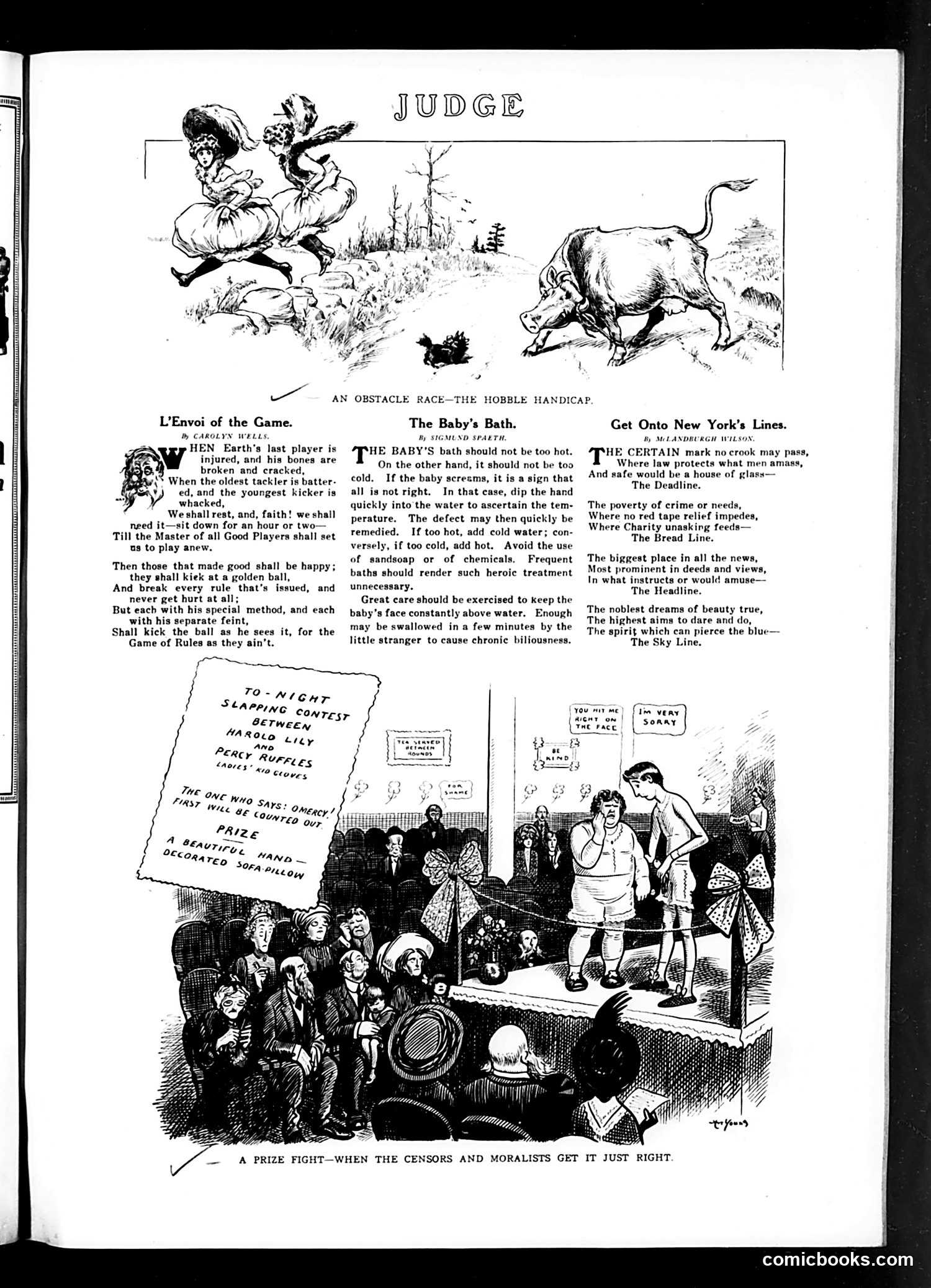
This page contains three distinct elements: **Top illustration**: "An Obstacle Race—The Hobble Handicap" shows two women in large, restrictive skirts struggling while a pig moves freely. This satirizes the "hobble skirt" fashion trend, mocking how impractical women's fashions constrained movement. **Middle text**: Three short pieces—"L'Envoi of the Game," "The Baby's Bath," and "Get Onto New York's Lines"—appear to be humorous advice columns or poetry snippets. **Bottom cartoon**: "A Prize Fight—When the Censors and Moralists Get It Just Right" depicts a boxing match before an audience, with a sign listing contest details. The satire critiques how censorship and moral oversight neutered public entertainment, making even prizefighting's dramatic appeal disappear when overly regulated.
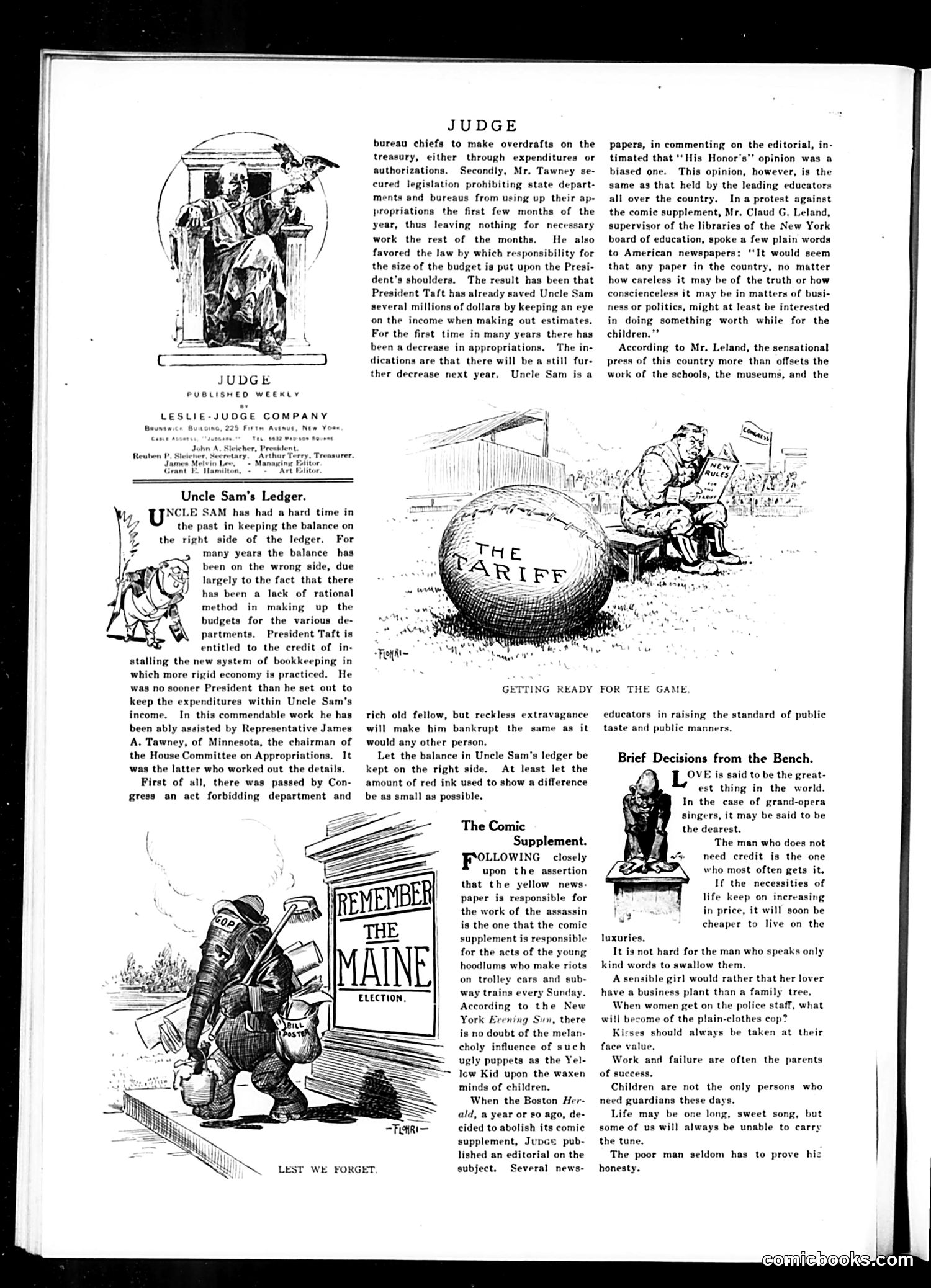
The page contains three distinct political cartoons: 1. **"Uncle Sam's Ledger"** criticizes President Taft's budget management, suggesting his accounting methods lack "rational method." The cartoon implies Taft is responsible for budget imbalances that should be corrected. 2. **"Getting Ready for the Game"** depicts a large sphere labeled "The Tariff" with Uncle Sam preparing for confrontation, likely referencing ongoing tariff debates during the Taft administration. 3. **"Lest We Forget"** shows a figure commemorating the Maine (USS Maine explosion, 1898), with a sign reading "Remember the Maine Election"—linking the historic incident to contemporary electoral politics. The page also includes "Brief Decisions from the Bench," a humor column offering satirical observations on social behavior and morality, unrelated to the cartoons above.
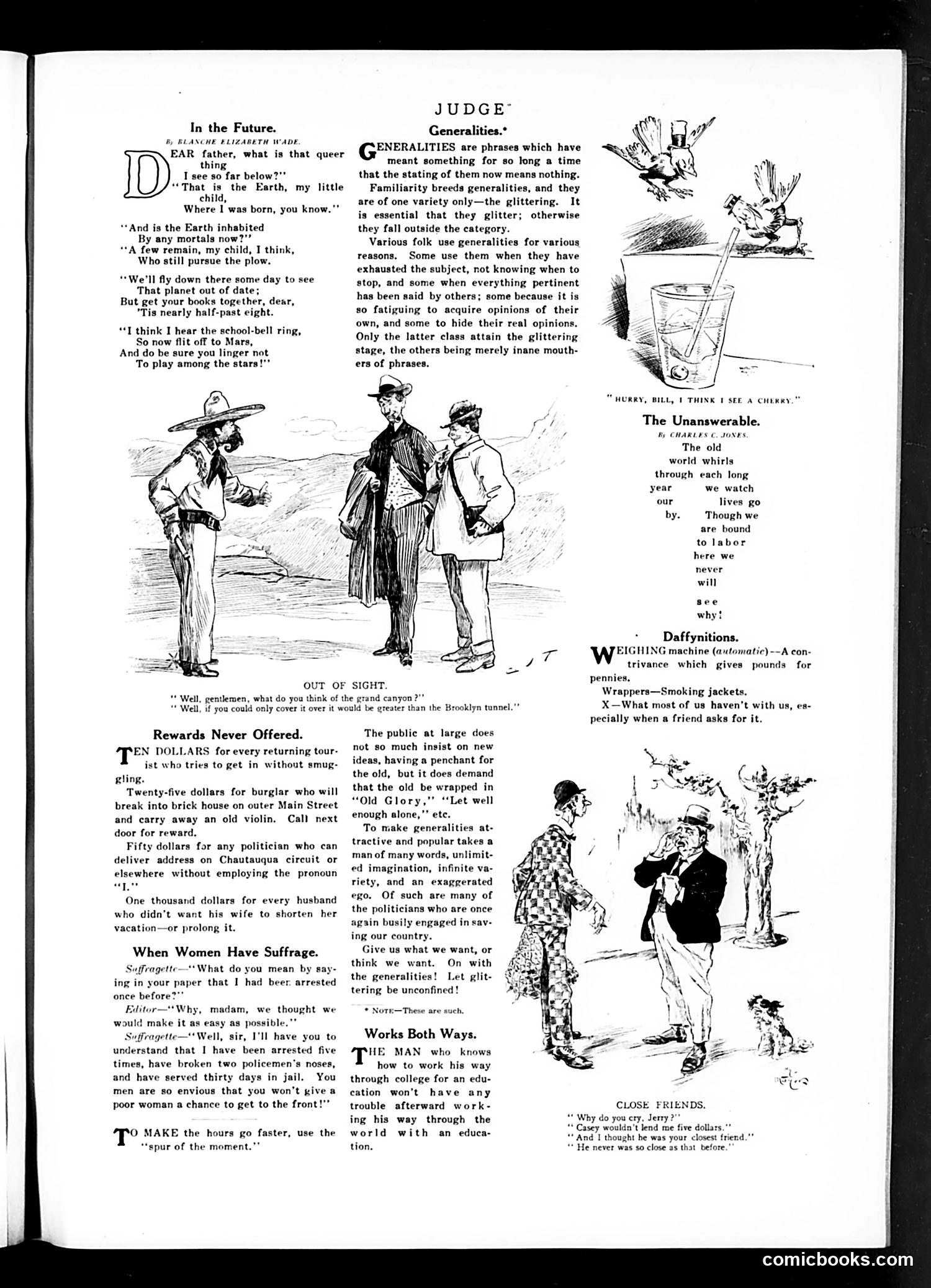
This page contains several satirical pieces typical of early-20th-century Judge magazine. The "Out of Sight" cartoon depicts three men discussing the Grand Canyon, with one suggesting it would be better as a tunnel—satirizing American pragmatism and commercialism over natural wonder. "Rewards Never Offered" is political satire listing absurdly high bounties for various offenses (burglars, politicians, husbands avoiding wives' vacations), mocking both crime and domestic/political frustrations of the era. "When Women Have Suffrage" presents a suffragette arrested, joking about women's voting rights—a contentious contemporary issue. The other pieces ("Judge Generalities," "The Unanswerable," "Works Both Ways") are brief witticisms and social commentary typical of the magazine's format, offering commentary on contemporary language use, gender relations, and social pretensions.
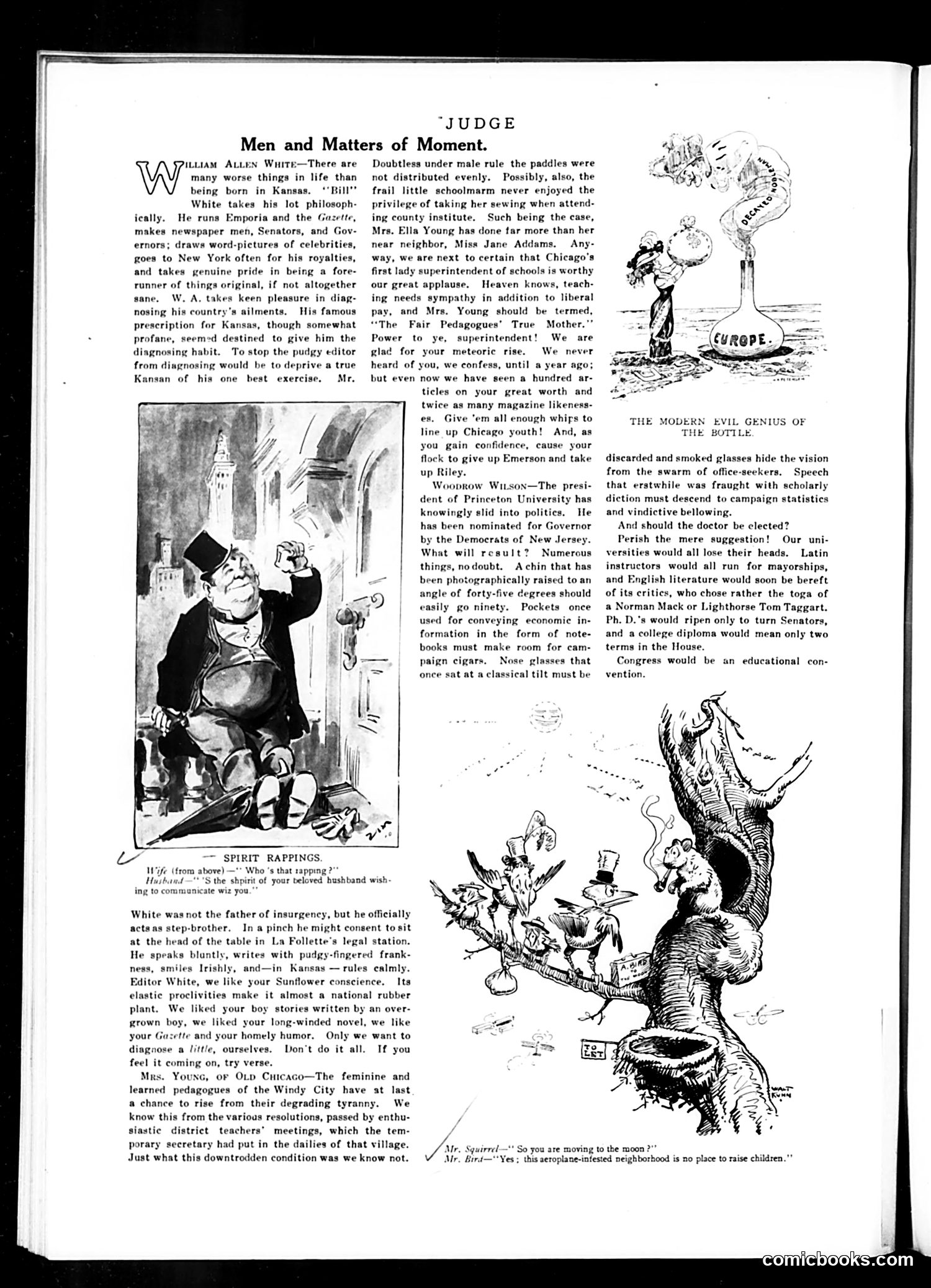
This page features satirical commentary on several prominent figures: **William Allen White** (Kansas newspaper editor): Judge praises his conscience and writing but gently mocks his tendency to diagnose America's problems, suggesting he channel this urge into poetry instead. **Mrs. Ella Young** (Chicago schools superintendent): The piece celebrates her recent appointment as the city's first female superintendent, positioning her as having accomplished more than the famous Jane Addams. It's congratulatory satire on women finally breaking through male-dominated institutional leadership. **Woodrow Wilson** (Princeton president): The main satirical target. Judge predicts his Democratic nomination for New Jersey Governor will require him to abandon scholarly pretension—discarding glasses, replacing notebooks with campaign cigars, and replacing refined speech with "vindictive bellowing." The cartoons show satirical monsters representing European politics ("The Modern Evil Genius of the Bottle") and a devil offering temptations, suggesting politics as corrupting influence on academics. The "Spirit Rapping" illustration is a separate joke about spiritualism séances.
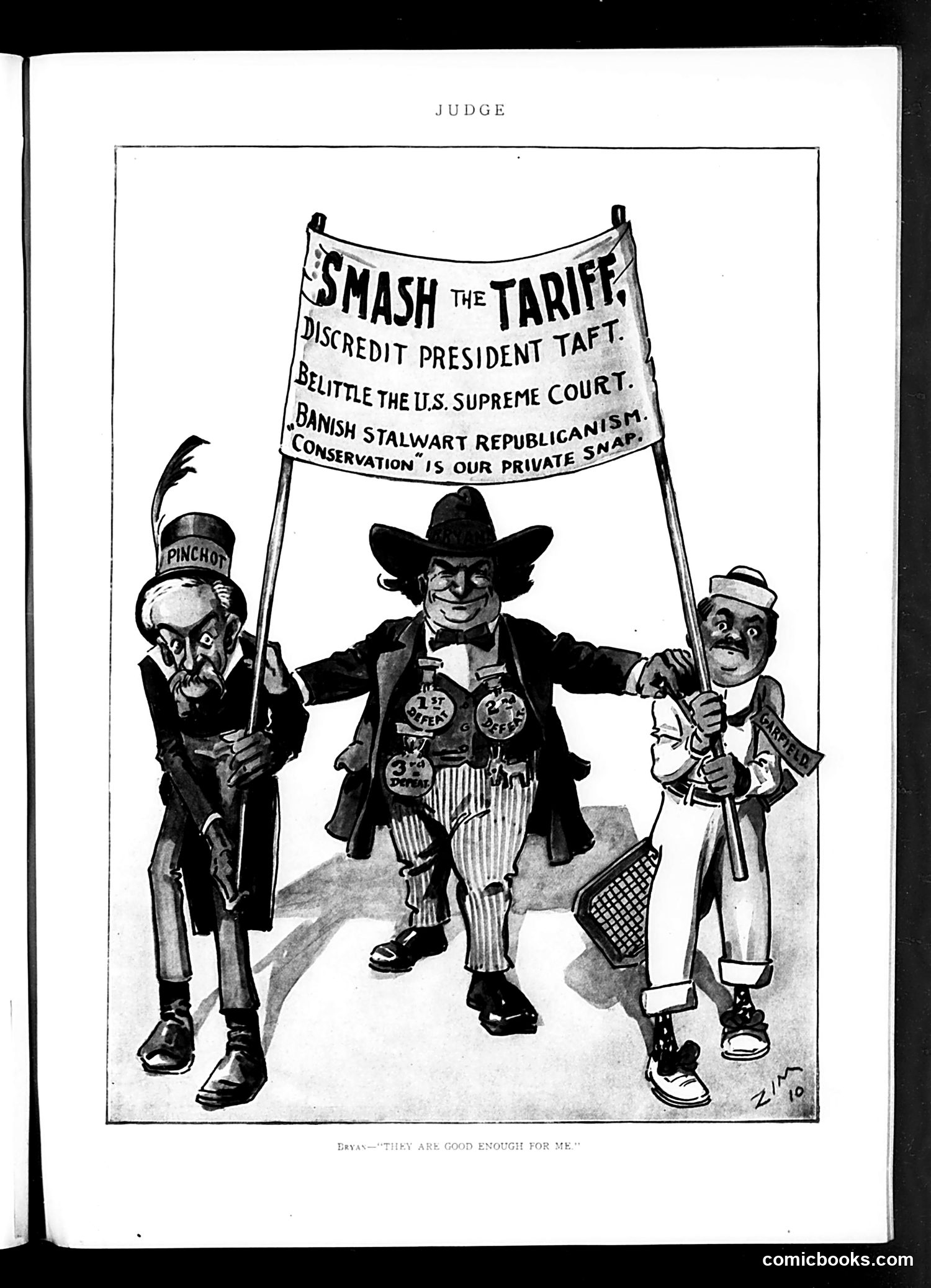
This Judge magazine cartoon satirizes President William Howard Taft's political vulnerabilities. Three caricatured figures—labeled "Pinchot" (left), a central cowboy figure representing Taft, and another figure (right)—hold a banner demanding Taft be discredited and the U.S. Supreme Court "belittled." The cartoon references the Pinchot-Ballinger controversy, a major 1909-1910 scandal involving conservation policy disputes that damaged Taft's presidency and split the Republican Party between progressive and conservative factions. The banner's text mocks Republican claims that "conservation is our private snap," suggesting the party exploited the issue for political gain. The caption reads "They are good enough for me," implying the various attacks are acceptable political tools. This reflects contemporary frustration with Taft's handling of internal party conflicts.
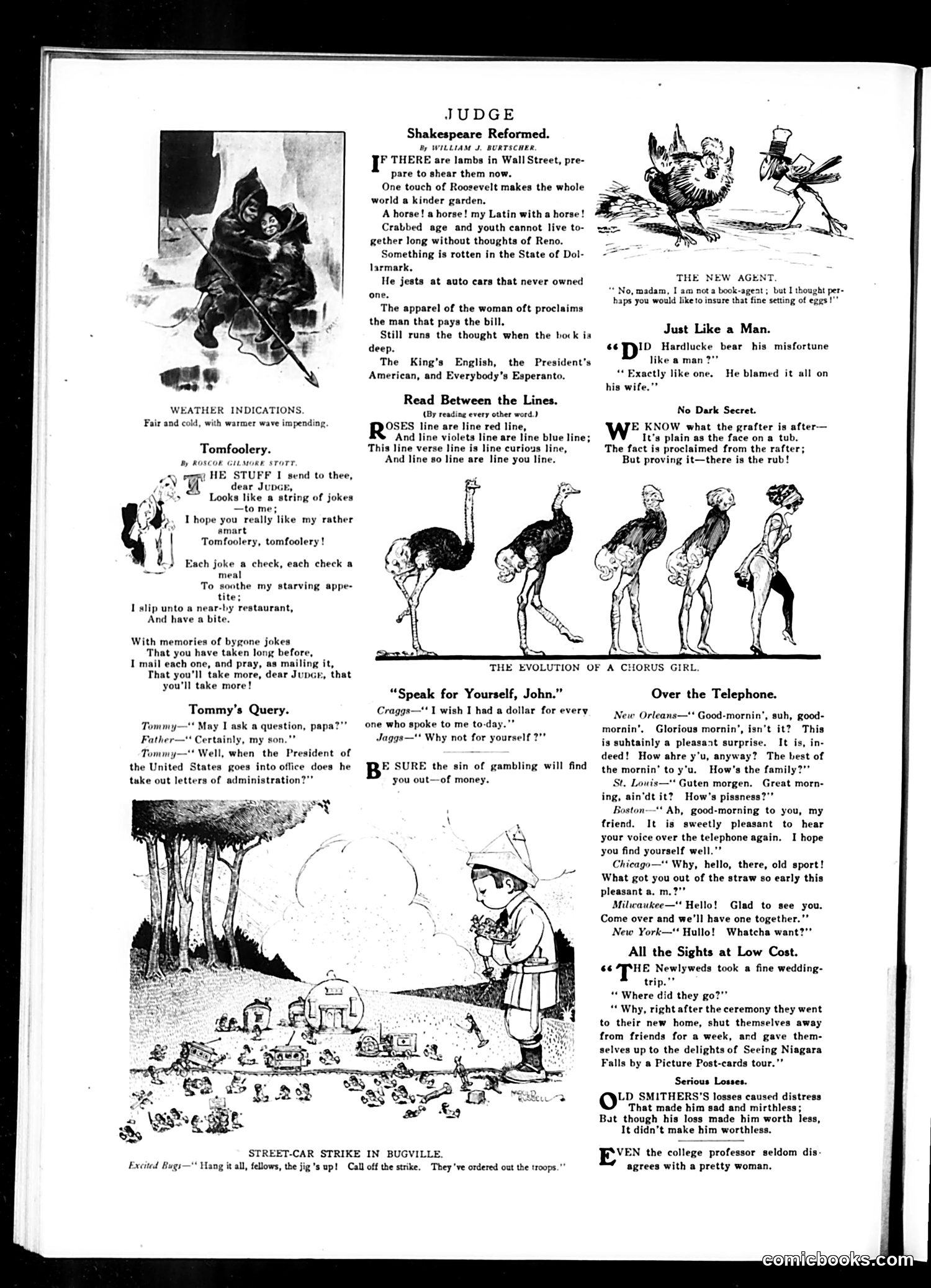
This page satirizes early-20th-century American society through parody and commentary. The opening section mocks Shakespeare by rewriting famous lines with contemporary references—Roosevelt, Wall Street, Reno (divorce destination), and automobile culture—suggesting these modern concerns have replaced timeless human themes. "The Evolution of a Chorus Girl" cartoon shows progressive stages of physical transformation, likely critiquing theatrical standards and female objectification in entertainment. Various comic snippets mock everyday absurdities: insurance salesmen posing as book agents, men blaming wives for their misfortunes, and regional telephone greetings that stereotype Americans by location (Southern dialect, German "Guten morgen," etc.). "Serious Losses" contains wordplay about a man named Smithers whose financial losses make him "worth less" but not "worthless"—a pun on economic and moral value. The street-car strike reference reflects labor unrest of the era. Overall, the page uses humor to critique consumerism, gender roles, regional stereotypes, and modern anxieties replacing classical concerns.
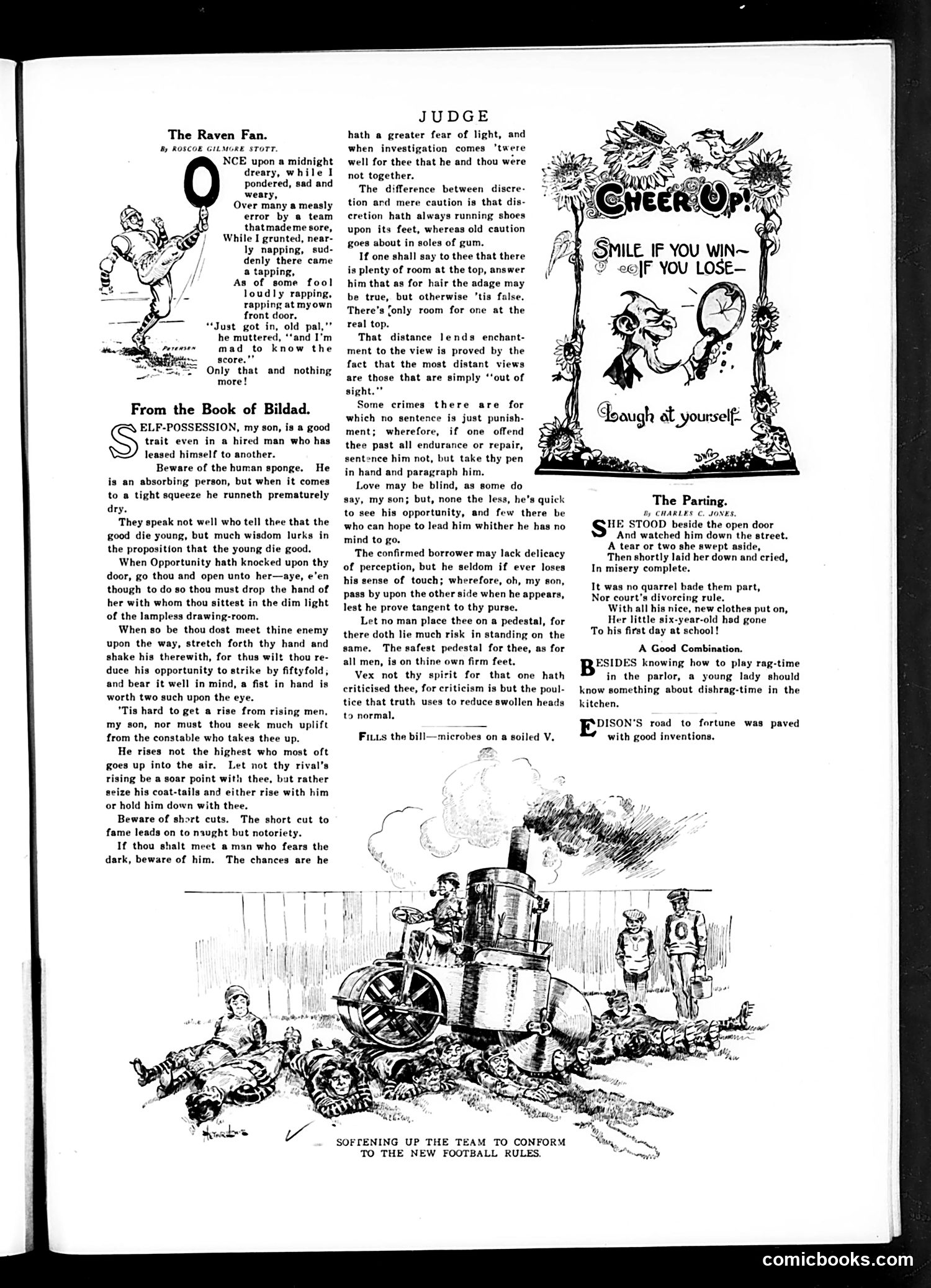
This page contains three satirical pieces typical of early-20th-century Judge magazine: **"The Raven Fan"** parodies Poe's "The Raven," with a frustrated sports fan disturbed by someone wanting to discuss a disappointing team performance—a joke about baseball or similar team sports fans obsessing over poor play. **"From the Book of Bildad"** offers mock-biblical wisdom mocking human nature: the self-absorbed "human sponge," the dangers of opportunity, advice about rivals and enemies, and warnings about borrowers. It's general social satire on human weakness and hypocrisy. **The cartoon "Softening Up the Team"** satirizes new football rules by depicting a steamroller literally flattening players into compliance—dark humor suggesting rule changes brutalizing players into conformity. **"The Parting"** and **"A Good Combination"** appear to be sentimental or humorous short pieces of typical magazine filler. The overall tone reflects Judge's mix of sports commentary, life advice parody, and illustrated social satire aimed at educated, urban readers.
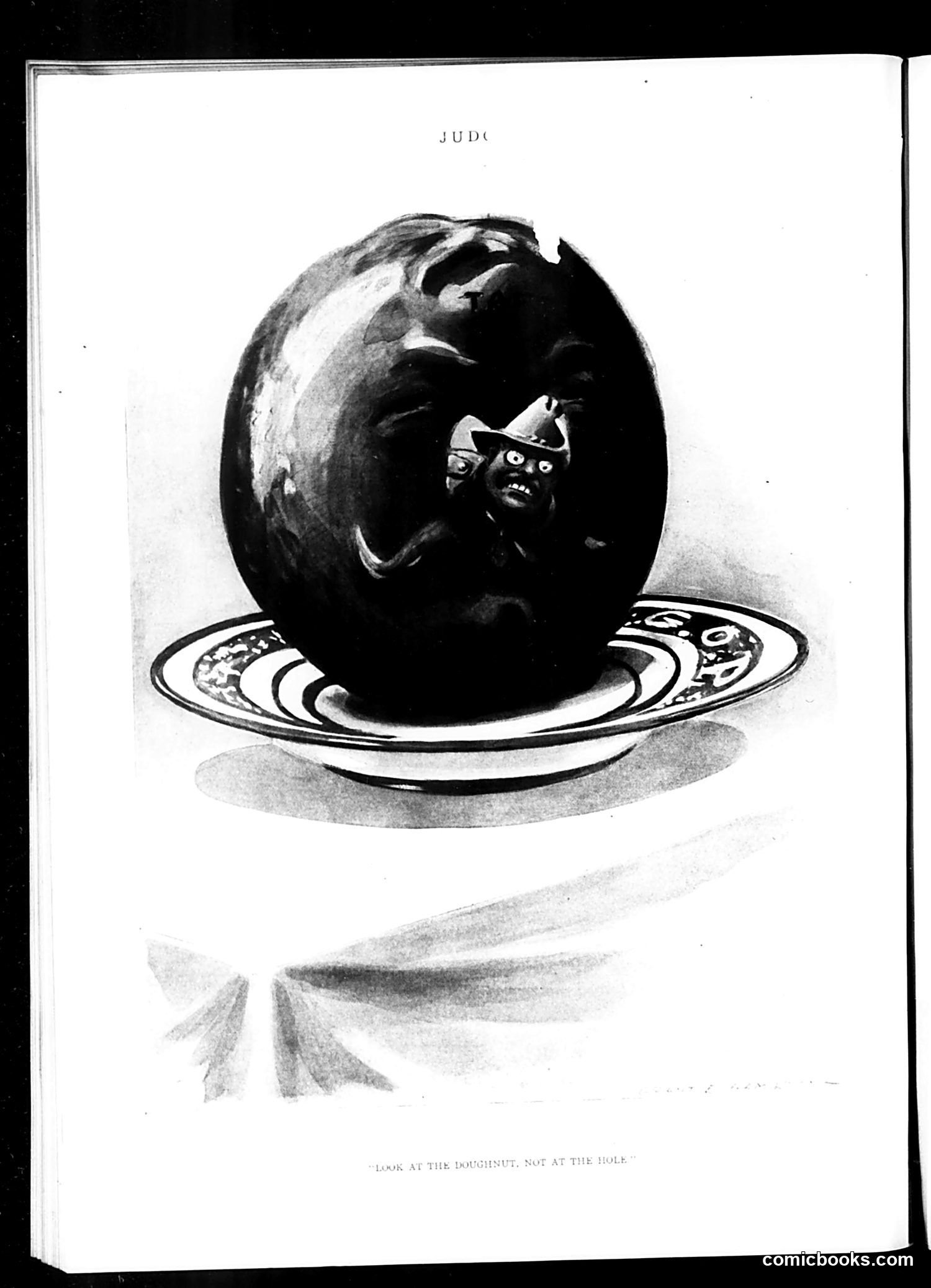
This satirical cartoon depicts a grotesque caricatured face emerging from or contained within a large spherical object, set on a decorative plate. The caption reads "LOOK AT THE DOUGHNUT, NOT AT THE HOLE." The title "JUDO" suggests this is political satire using a judo metaphor—a technique of redirecting an opponent's force. The cartoon likely critiques a political figure or public personality, suggesting that observers are being deliberately distracted from something substantive (the "hole"/truth) by focusing on surface appearance or a misleading narrative (the "doughnut"). Without additional context identifying the specific figure or date, the exact political target remains unclear, though the grotesque caricature style was typical of Judge magazine's satirical approach.
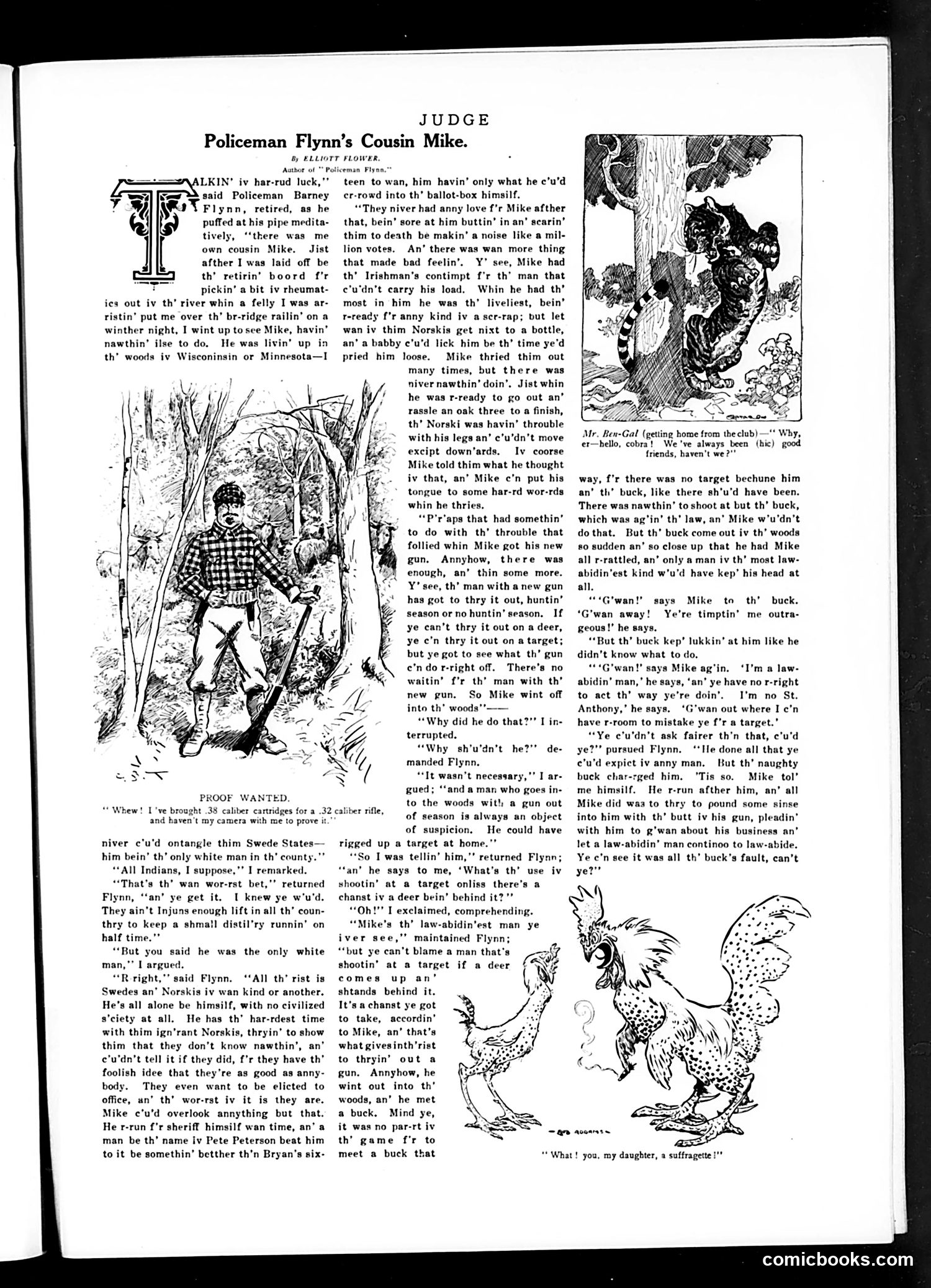
This is a dialect-heavy humorous story in *Judge* magazine, told by Irish-American Policeman Flynn about his cousin Mike, who moved to the Wisconsin/Minnesota wilderness. The narrative mocks both Irish and Scandinavian immigrant stereotypes. The satire targets: - **Scandinavian immigrants** ("Swedes," "Norskis") portrayed as politically ambitious despite being culturally unfit, and as weak drinkers compared to Irish men - **Mike's superiority complex** as an Irishman among Scandinavians—he runs for sheriff and disdains their weakness - **Immigrant tensions** and cultural prejudice in rural America The story culminates in Mike taking his new rifle into the woods during off-season, leading (implied) to a hunting accident. The accompanying illustrations show a hunter in the woods and a rooster, likely foreshadowing the story's punchline about target confusion or accidental shooting. The humor relies heavily on phonetic Irish dialect and ethnic caricature typical of early-20th-century American satirical magazines.
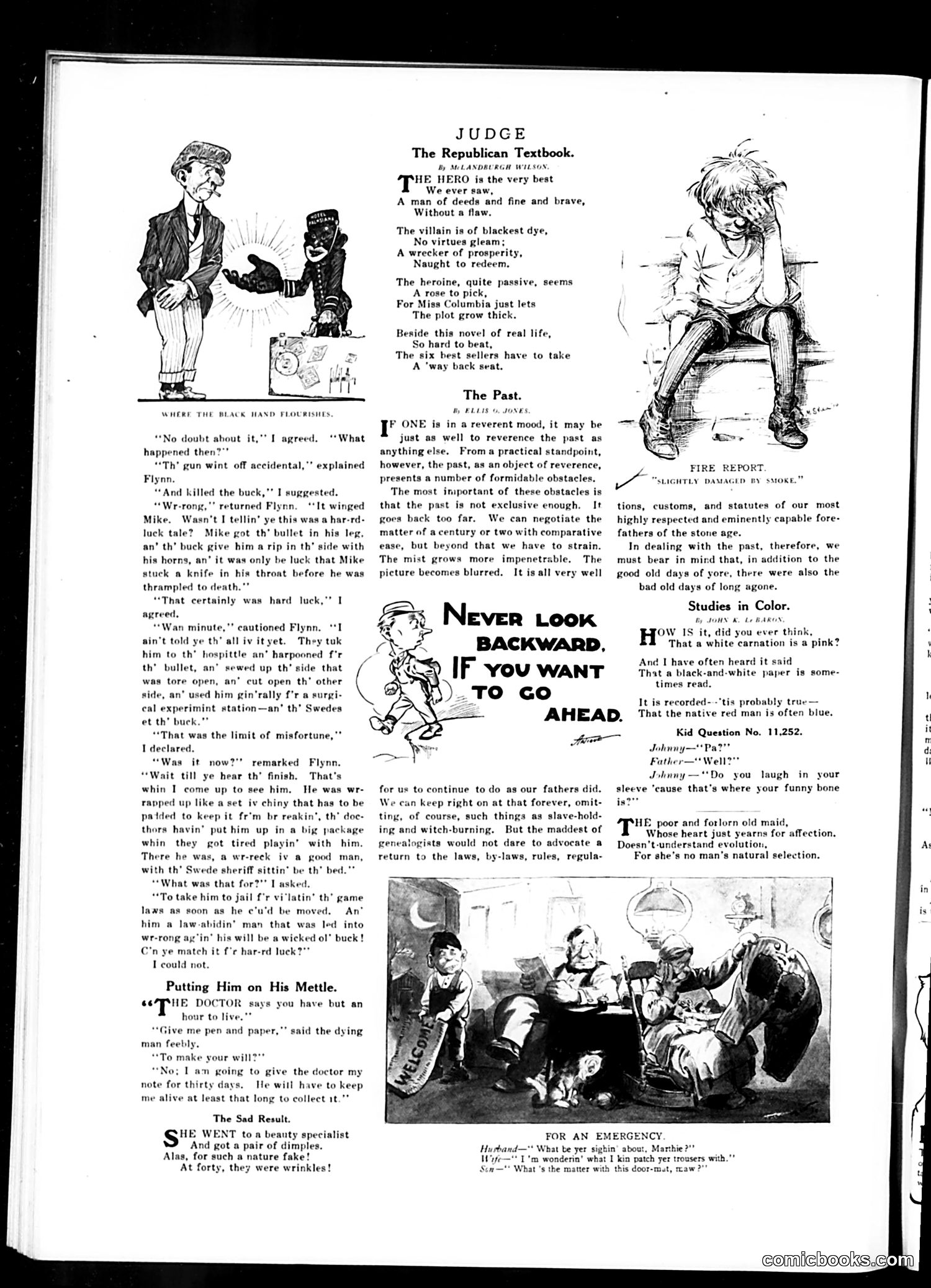
This page contains several satirical pieces mocking Republican ideology and American society circa early 1900s. **"The Republican Textbook"** parodies GOP campaign rhetoric by reducing political narratives to melodramatic formulas: heroes are flawless, villains purely evil, heroines passive. The satire suggests Republicans oversimplify complex reality into simplistic moral tales. **"The Past"** critiques conservative reverence for "the old ways." It argues that while some historical practices (like slavery and witch-burning) should be abandoned, conservatives naively want to return to an idealized past without acknowledging its genuine horrors. **"Never Look Backward"** reinforces this theme through ironic juxtaposition—claiming progress requires forward movement while conservatives cling to tradition. The humor pieces (doctor accepting a note for payment, hard-luck Irish immigrant tale) appear unrelated to politics, suggesting Judge mixed political commentary with general comedy. The "Studies in Color" section appears to be a light word-play feature. Overall, this page targets Republican traditionalism as intellectually dishonest and socially regressive.
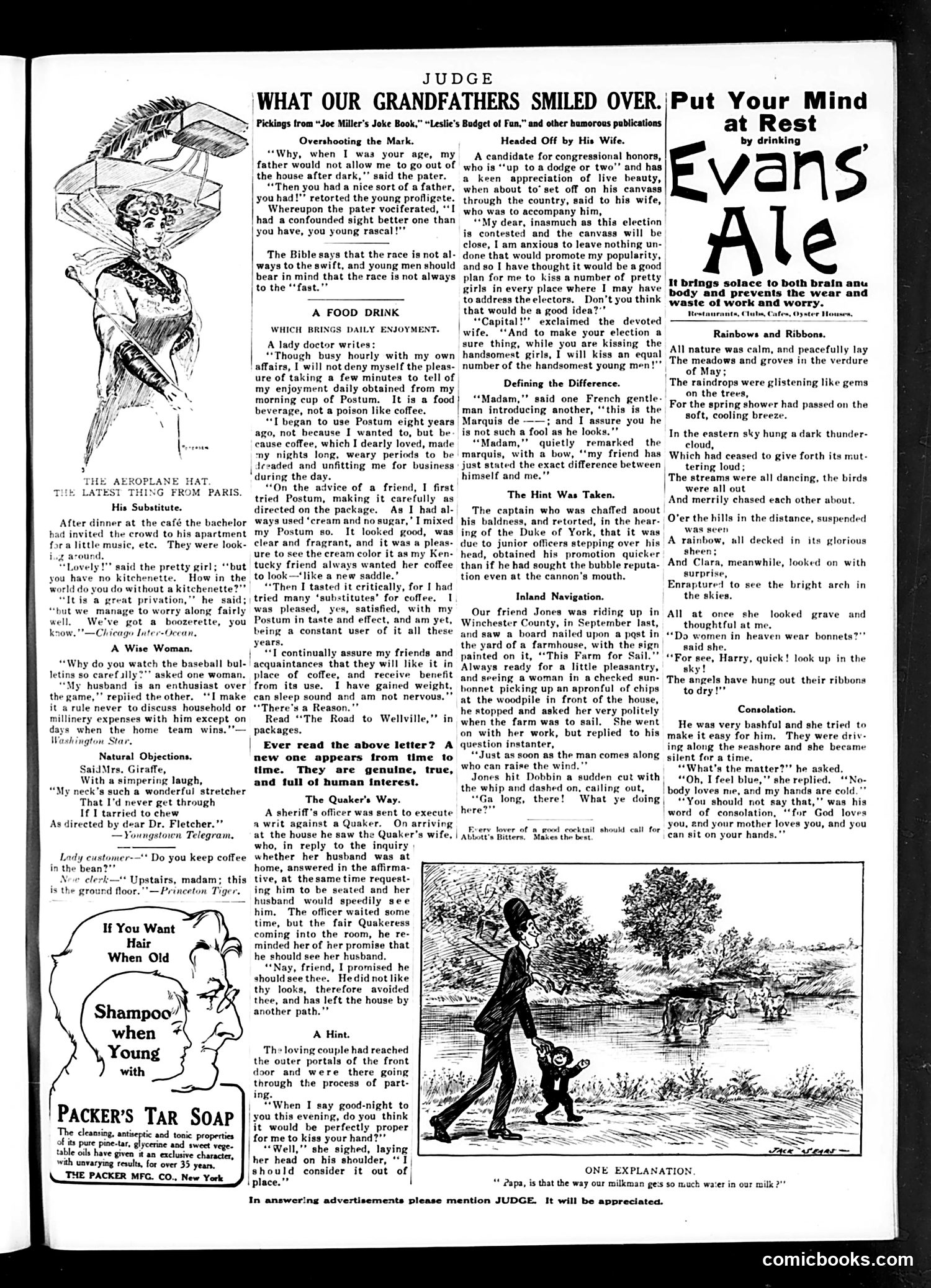
This page collects vintage jokes and humorous anecdotes, presented as nostalgic humor from earlier generations. The content includes: **Jokes and Anecdotes:** - A young man defending his wild behavior by claiming his father was worse - A doctor praising Postum (a coffee substitute) for improving sleep and health - A woman strategically timing household discussions with her husband around baseball game outcomes - Various puns about giraffes, kitchenettes, and Quakers **The Satire:** The page mocks both outdated morality (stern fathers) and emerging consumer culture (coffee substitutes, modern apartment conveniences). The "Postum" advertisement cleverly disguises itself as a testimonial letter, reflecting early 20th-century advertising practices. **Modern Context:** These jokes rely on period-specific references (Fletcherism/chewing fads, Quaker stereotypes) that modern readers need historical knowledge to fully appreciate. The humor is generally gentle, domestic, and family-oriented—typical Judge magazine fare from this era.
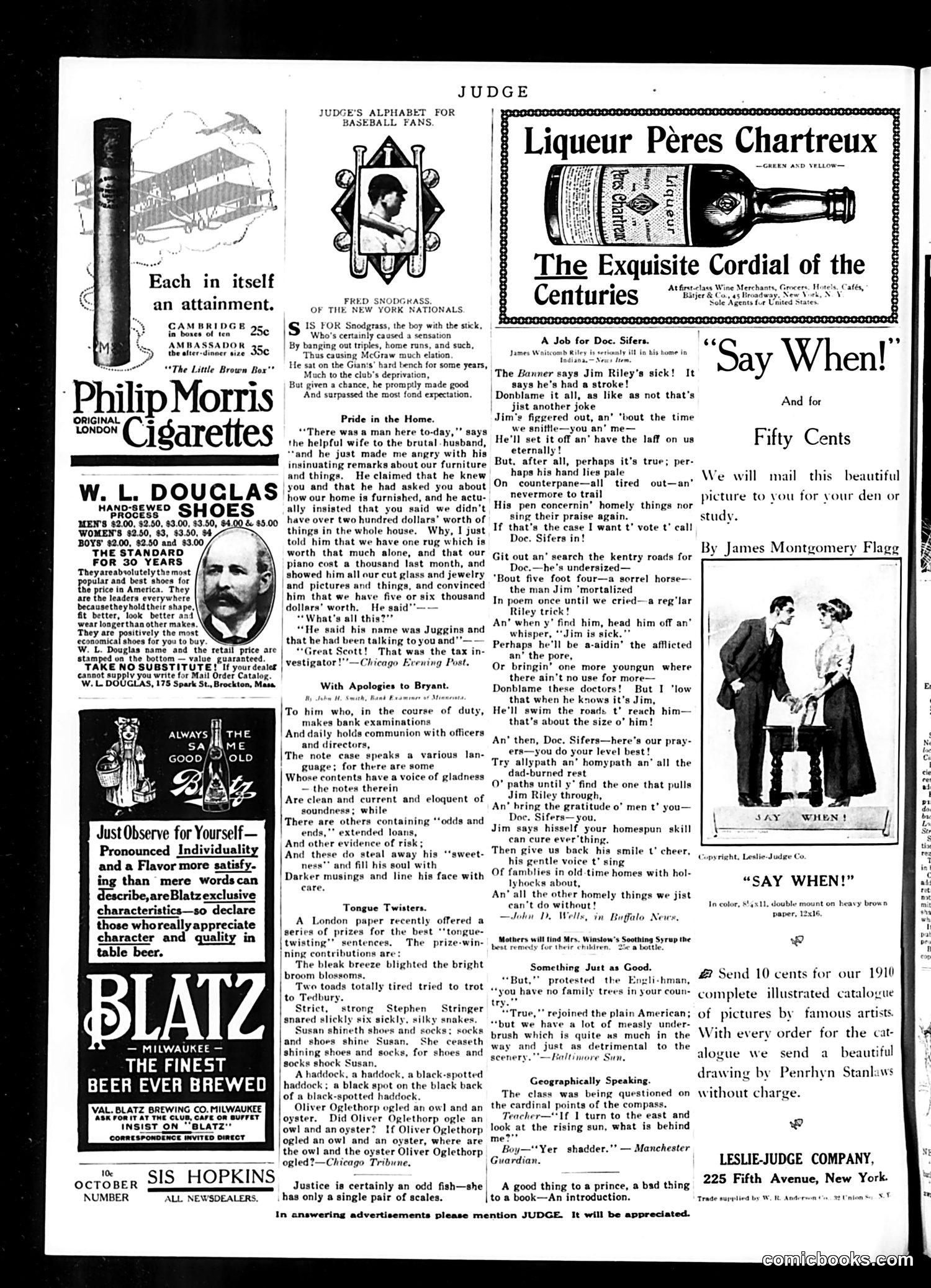
This October issue is primarily **advertising and filler content**, not political satire. The page features: **Main content:** - A "Judge's Alphabet for Baseball Fans" entry on Fred Snodgrass of the New York Nationals—a straightforward sports tribute with no satirical edge - Several humorous prose pieces ("Pride in the Home," "With Apologies to Bryant," "Tongue Twisters") that are light social humor, not political commentary - A brief joke about Justice being "an odd fish" with one pair of scales **Advertising dominates:** Philip Morris Cigarettes, W.L. Douglas Shoes, Blatz Beer, Liqueur Pères Chartreux, and other products fill most space. The one substantial visual cartoon appears to be "Say When!"—depicting what seems to be a domestic or social scene—but lacks enough context here to interpret its specific satirical point. Overall, this is a typical mixed entertainment/advertising magazine page rather than a page of concentrated political or social commentary.
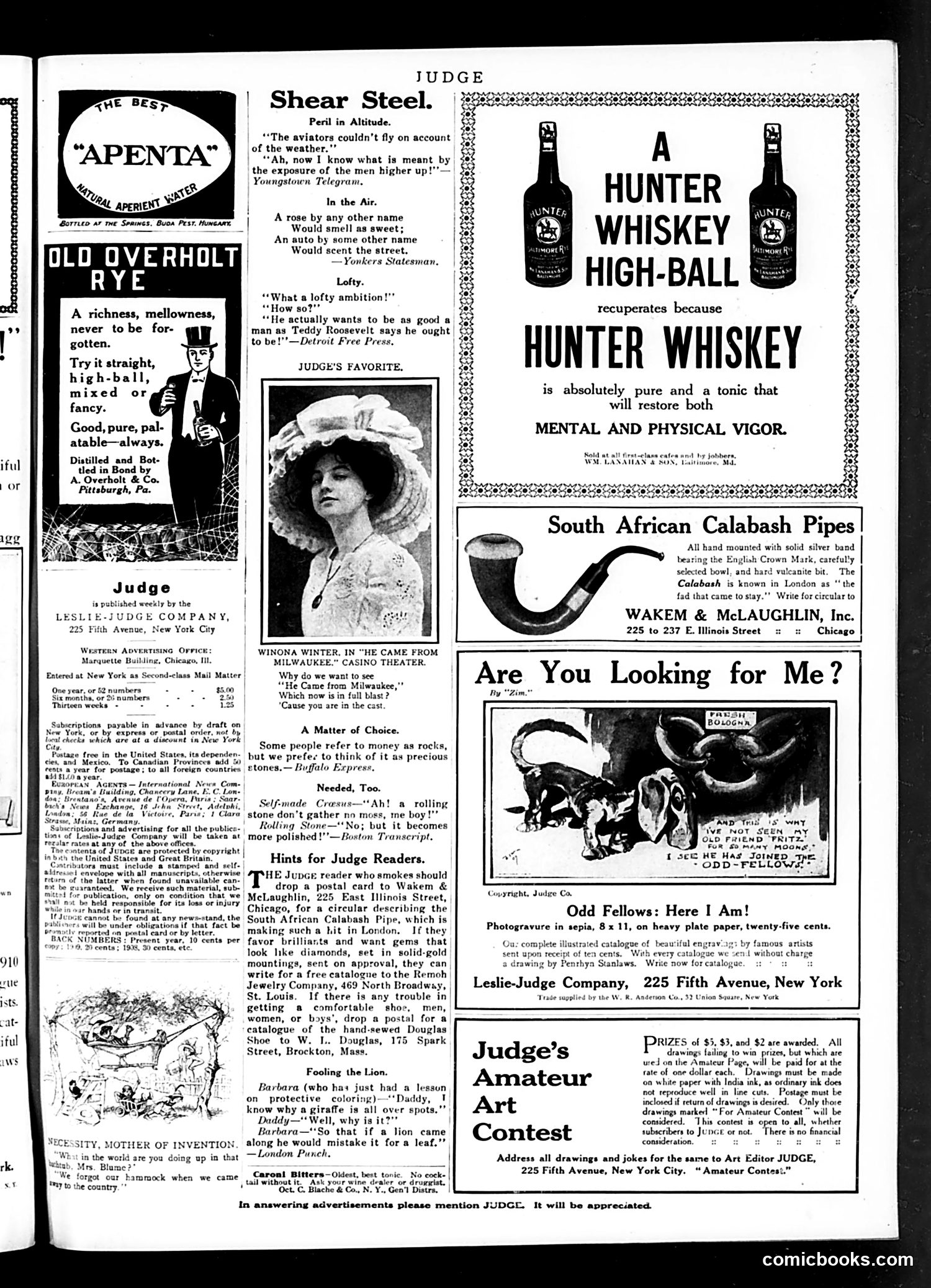
This is primarily an **advertising and humor page** from Judge magazine, not a political cartoon. The content consists of: **Main Elements:** 1. **Advertisements** dominating the page: Old Overholt Rye whiskey, Hunter Whiskey, South African Calabash pipes, and other consumer products—typical of early 20th-century magazine monetization. 2. **Brief humorous quips** under "Shear Steel" (the column header), including puns about aviators, roses, and ambition. These are light social commentary rather than sharp satire—jokes about class pretension and wealth. 3. **"Judge's Favorite"** features actress Winona Winter, reflecting the magazine's entertainment coverage. 4. **Illustrations** include a small cartoon about a child misunderstanding protective coloring in animals, and an "Odd Fellows" membership recruitment piece. The page reflects Judge's formula: mixing paid advertisements with mild humor targeting middle-class readers, rather than delivering pointed political satire.
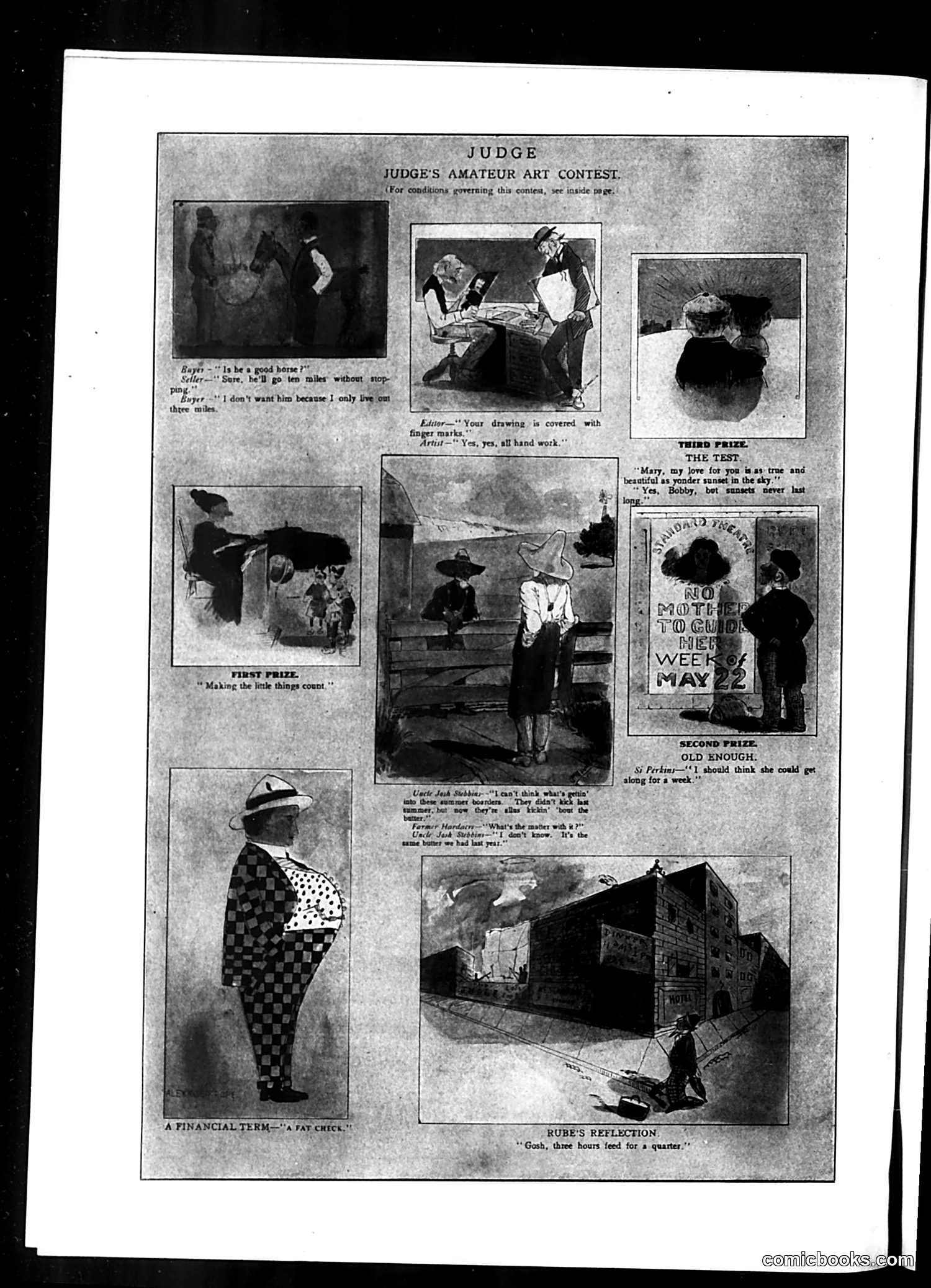
This page showcases Judge magazine's amateur art competition, displaying several cartoon submissions judged for humor and technique. The entries represent typical early-20th-century American comic scenarios: **First Prize** ("Making the little things count") depicts a domestic scene with exaggerated figures, emphasizing composition. **Second Prize** ("Old Enough") shows a young couple, with commentary about a woman's marriageability—likely satirizing courting customs and gender expectations of the era. **Third Prize** ("The Test") features romantic dialogue mocking sentimental love declarations, suggesting sunsets fade like romantic passion. Other sketches include "A Financial Term: A Fat Chick" (visual pun on stock market language) and "Rube's Reflection" (rural character commentary on feed prices). The contest itself mocks amateur artists' earnestness while celebrating the magazine's satirical tradition—poking fun at domestic life, courtship, romance clichés, and rural/urban character types typical of period humor.