
Judge, 1910-10-08 · page 4 of 16
Judge — October 8, 1910 — page 4: what you’re looking at
What you’re looking at
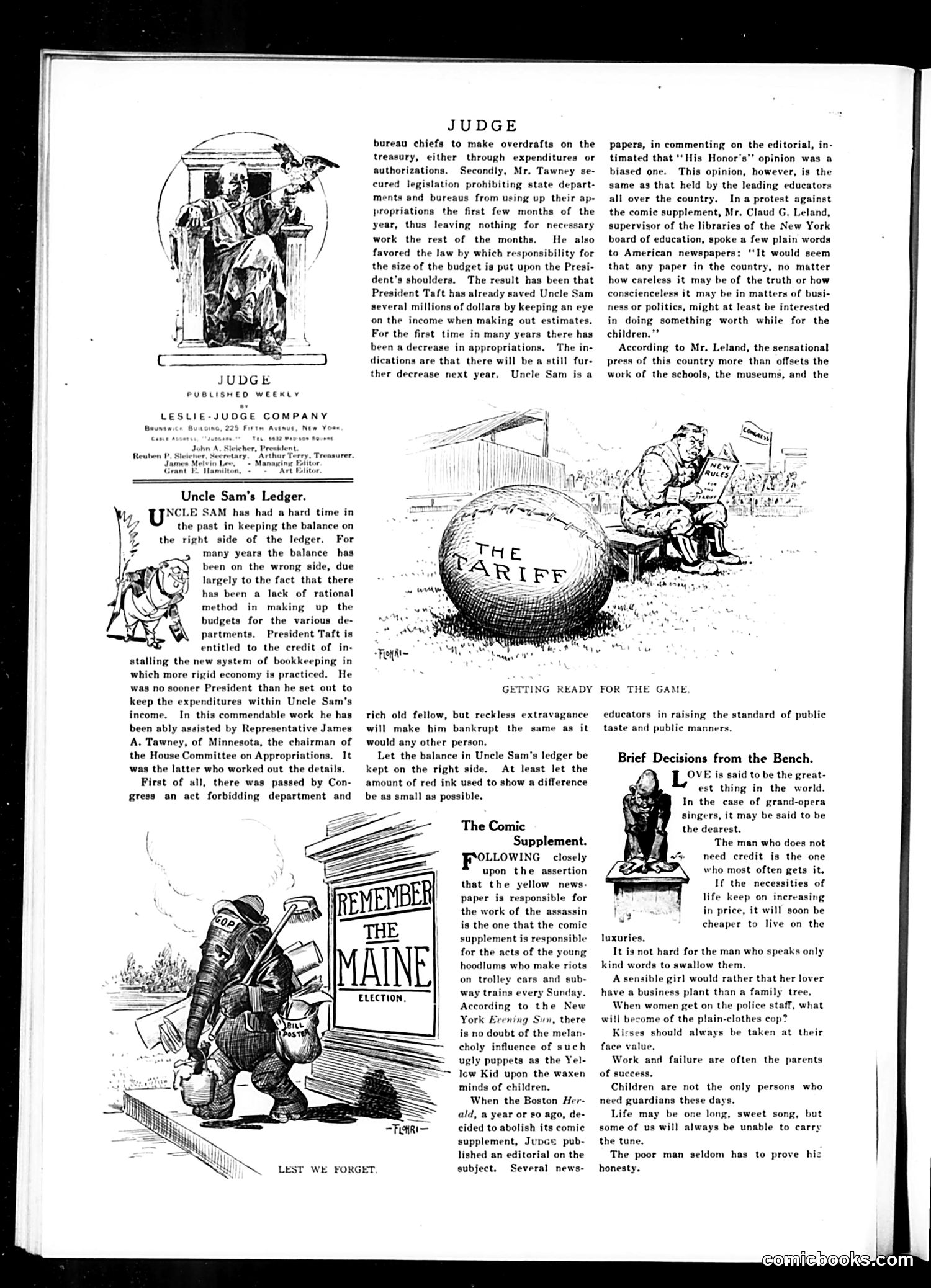
The page contains three distinct political cartoons: 1. **"Uncle Sam's Ledger"** criticizes President Taft's budget management, suggesting his accounting methods lack "rational method." The cartoon implies Taft is responsible for budget imbalances that should be corrected. 2. **"Getting Ready for the Game"** depicts a large sphere labeled "The Tariff" with Uncle Sam preparing for confrontation, likely referencing ongoing tariff debates during the Taft administration. 3. **"Lest We Forget"** shows a figure commemorating the Maine (USS Maine explosion, 1898), with a sign reading "Remember the Maine Election"—linking the historic incident to contemporary electoral politics. The page also includes "Brief Decisions from the Bench," a humor column offering satirical observations on social behavior and morality, unrelated to the cartoons above.
📄 Transcribed text from this page (OCR, searchable)
Machine-transcribed from the original scan — historical spelling and the odd misread are preserved.
PUBLISHED WEEKLY LESLIE-JUDGE COMPANY Firtw Avenue, New Your A. Sleicher, Pr Arthur Terry, Treasurer. L Manaseini Fetitor ‘Art Falitor Uncle Sam's Ledger. ‘CLE SAM has had a hard time in the past in keeping the balance on the right side of the ledger. For many years the balance has been on the wrong side, due largely to the fact that there has been a lack of rational method in making up the budgets for the various de- partments. President Taft is entitled to the credit of in- stalling the new system of bookkeeping in which more rigid economy is practiced. He was no sooner President than he set out to keep the expenditures within Uncle Sam's income. In this commendable work he has been ably assisted by Representative James A. Tawney, of Minnesota, the chairman of the House Committee on Appropriations. It was the latter who worked out the details. First of all, there was passed by Con- gress an act forbidding department and LEST WE FORGET. JUDGE bureau chiefs to make overdrafts on the treasury, either through expenditures or authorizations. Secondly, Mr. Tawney se- cured legislation prohibiting state depart- ments and bureaus from using up their ap- propriations the first few months of the year, thus leaving nothing for necessary work the rest of the months. He also favored the law by which responsibility for the size of the budget is put upon the Presi- dent's shoulders, The result has been that President Taft has already saved Uncle several millions of dollars by keeping an on the income when making out estimates. For the first time in many years there has been a decrease in appropriations. The in- dications are that there will be a still fur- ther decrease next year. Uncle Sam is a GETTING READY rich old fellow, but reckless extravagance will make him bankrupt the same as it would any other person. Let the balance in Uncle Sam's ledger be kept on the right side. At least let the amount of red ink used to show a difference be as small as possible. The Comic Supplement. OLLOWING closely upon the assertion that the yellow news- paper is responsible for the work of the assassin is the one that the comic supplement is responsible for the acts of the young hoodlums who make riots on trolley cars and sub- way trains every Sunday. According to the New York Evening Sun, there is no doubt of the melan- choly influence of such ugly puppets as the Yel- lew Kid upon the waxen minds of children. When the Boston Her- ald, a year or 80 ago, de- cided to abolish its comic supplement, Jun pub- lished an editorial on the subject. Several news- papers, in commenting on the editorial, in- timated that ‘His Honor’s"’ opinion was a biased one. This opinion, however, is the same as that held by the leading educators all over the country. Ina protest against the comic supplement, Mr. Claud G. Leland, supervisor of the libraries of the New York board of education, spoke a few plain words to American newspapers: ‘It would seem that any paper in the country, no matter how careless it may be of the truth or how conscienceless it may be in matters of bus ness or politics, might at least be interested in doing something worth while for the children."" According to Mr. Leland, the sensational press of this country more than offsets the work of the schools, the museums, and the FOR THE GAME educators in raising the standard of public taste and public manners. Brief Decisions from the Bench. OVE is said to be the great- est thing in the world. In the case of grand-opera singers, it may be said to be the dearest. The man who does not need credit is the one who most often gets it. If the necessities of life keep on increasing % in price, it soon be aa cheaper to live on the luxuries. It is not hard for the man who speaks only kind words to swallow them. A sensible girl would rather that her lover have a business plant than a family tree. When women get on the police staff, what ome of the plain-clothes cop? should always be taken at their face value, Work and failure are often the parents of success. Children are not the only persons who need guardians these days. Life may be one long, sweet song, but some of us will always be unable to carry the tune. The poor man seldom has to prove hiz honesty.