
A complete issue · 20 pages · 1910
Judge — August 27, 1910
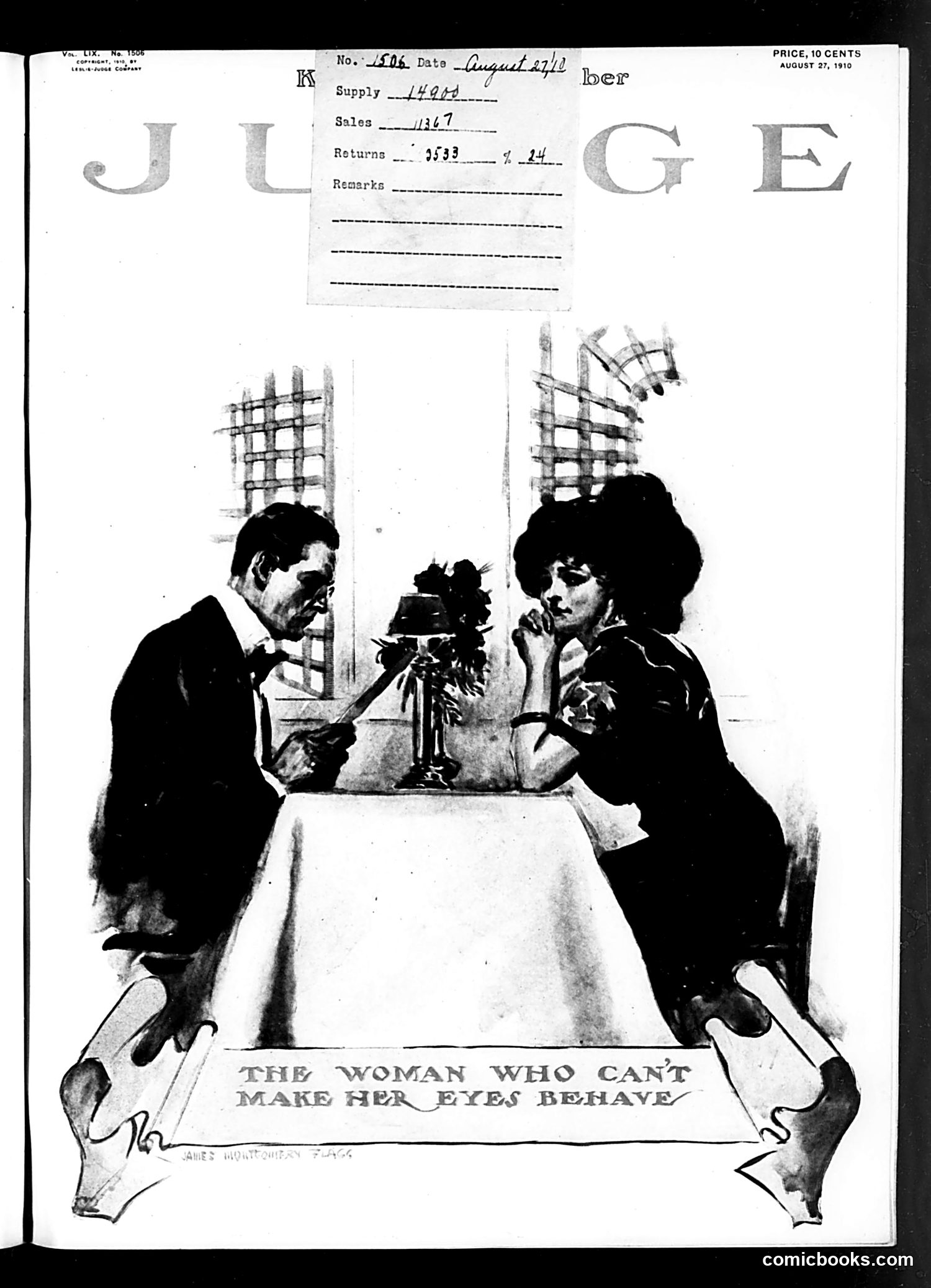
This is a Judge magazine cover from August 27, 1913. The cartoon depicts a romantic dinner scene where a man and woman sit across from each other at a candlelit table. The title suggests the satire concerns a woman whose eyes or gaze are uncontrollable or misbehaving—likely flirting or looking away inappropriately during the intimate moment. The joke appears to play on early 20th-century social anxieties about female propriety and "modern woman" behavior. A woman who "can't make her eyes behave" represents loss of feminine restraint or decorum—she cannot maintain proper courtship etiquette. This reflects period concerns about changing gender roles and women's increasing social independence during the Progressive Era.
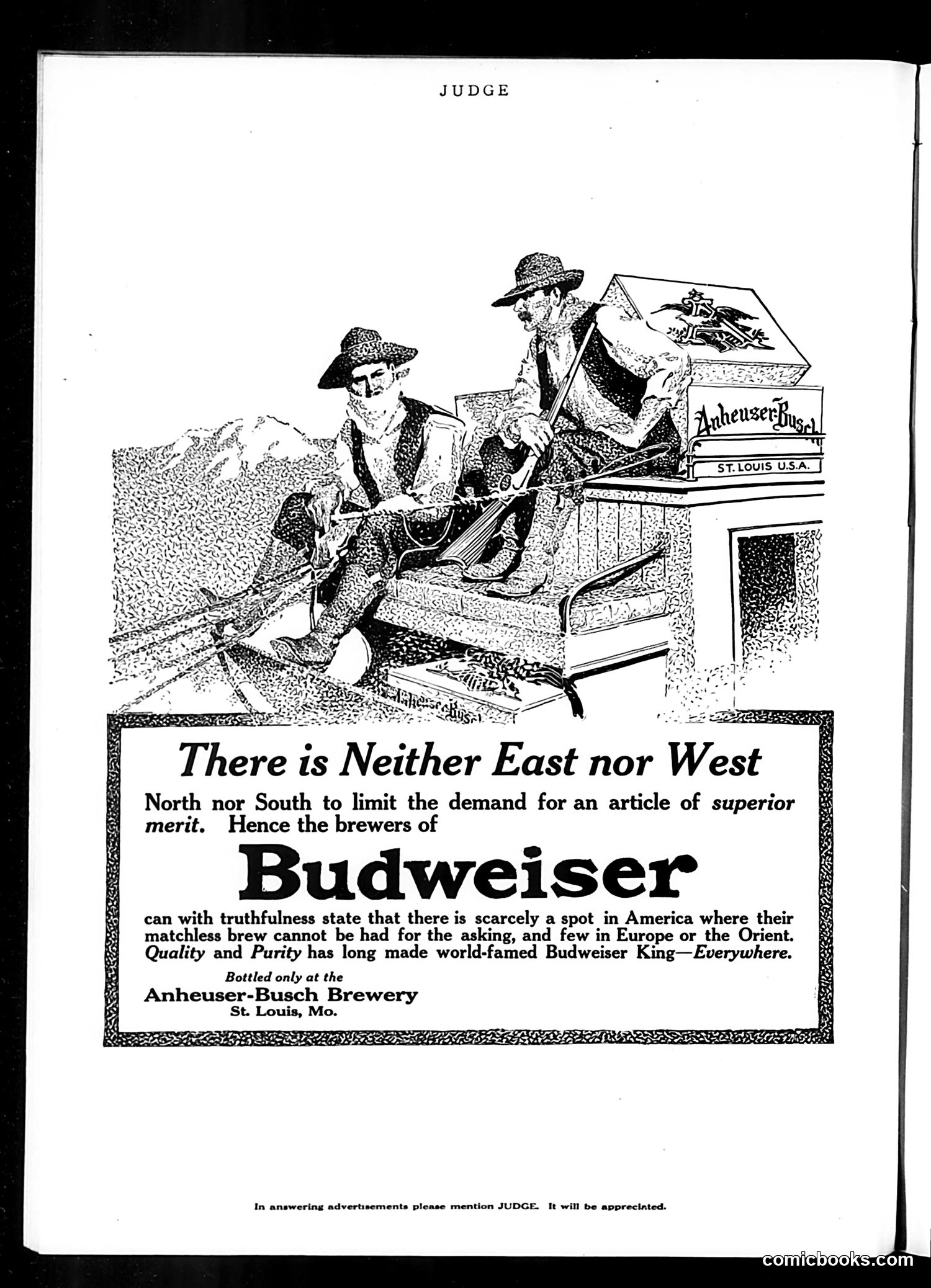
This page is primarily a **Budweiser beer advertisement**, not political satire. The ad features two men in period clothing (appearing to be miners or laborers based on their attire and pickaxes) discovering a Budweiser box, suggesting the product's ubiquitous availability. The headline "There is Neither East nor West, North nor South" plays on Rudyard Kipling's famous line about class divisions, here repurposed to claim Budweiser's universal market reach—"scarcely a spot in America where their matchless brew cannot be had for the asking." The ad emphasizes "Quality and Purity" as reasons for the beer's worldwide fame. This appears from the Prohibition era or early 20th century, when such advertising was common in Judge magazine, which mixed satire with commercial content.
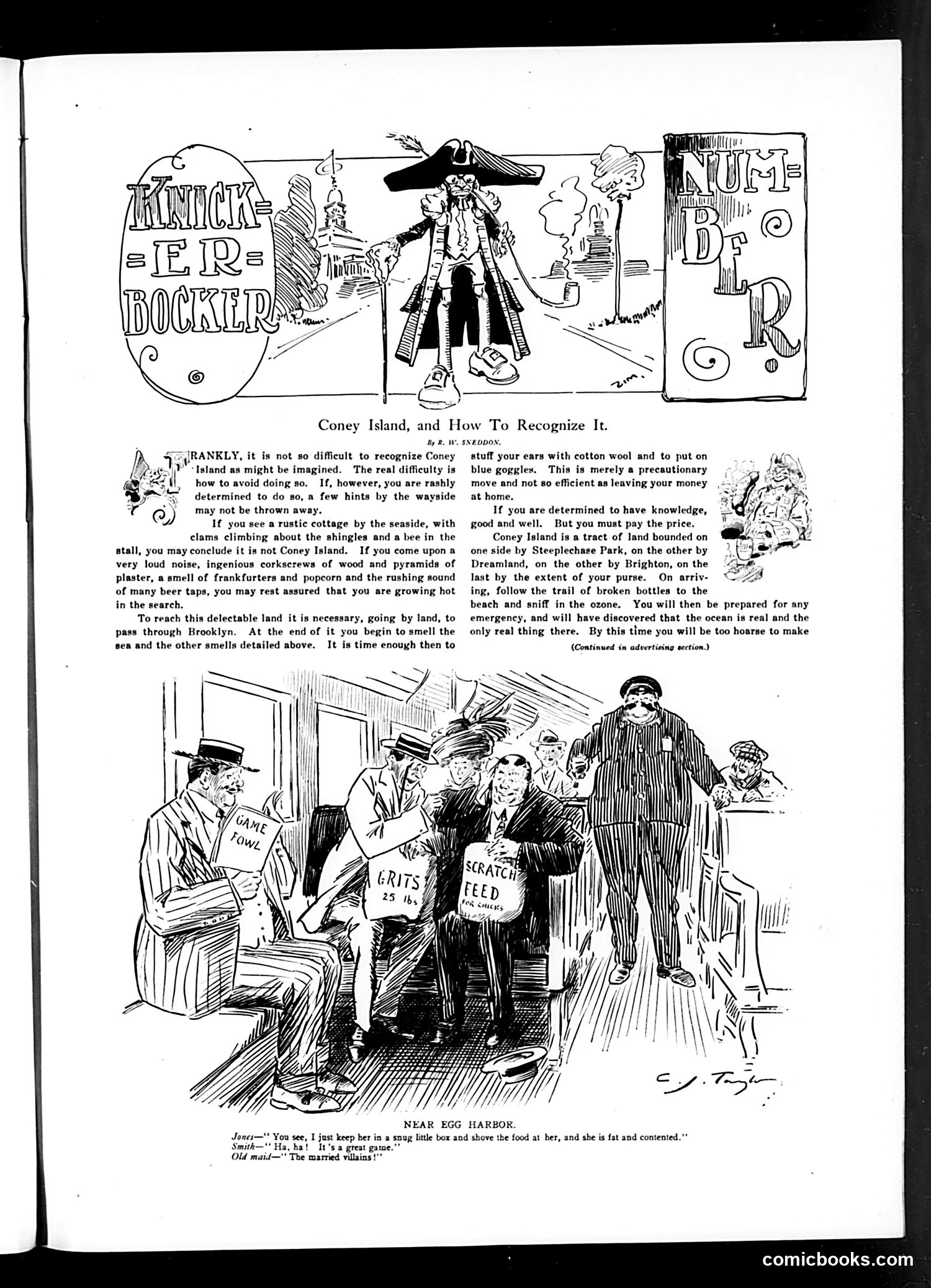
**Top Section:** A humorous guide to recognizing Coney Island, illustrated by a theatrical character in a tricorn hat labeled "Number Bro[cker]." The piece mocks Coney Island's chaotic sensory experience—noise, crowds, heat, and commercialism—advising readers how to identify they've arrived (broken bottles, loud vendors, competing attractions). **Bottom Cartoon:** "Near Egg Harbor" depicts what appears to be food vendors or merchants hawking provisions to travelers, with labels visible on containers reading "GAME FOWL," "GRITS," and "SCRATCH FEED." The caption suggests a humorous domestic scenario about keeping a woman "in a snug little box" and feeding her. Both pieces use satire to mock 19th-century American leisure culture and commercial exploitation of working-class entertainment destinations and food vendors.
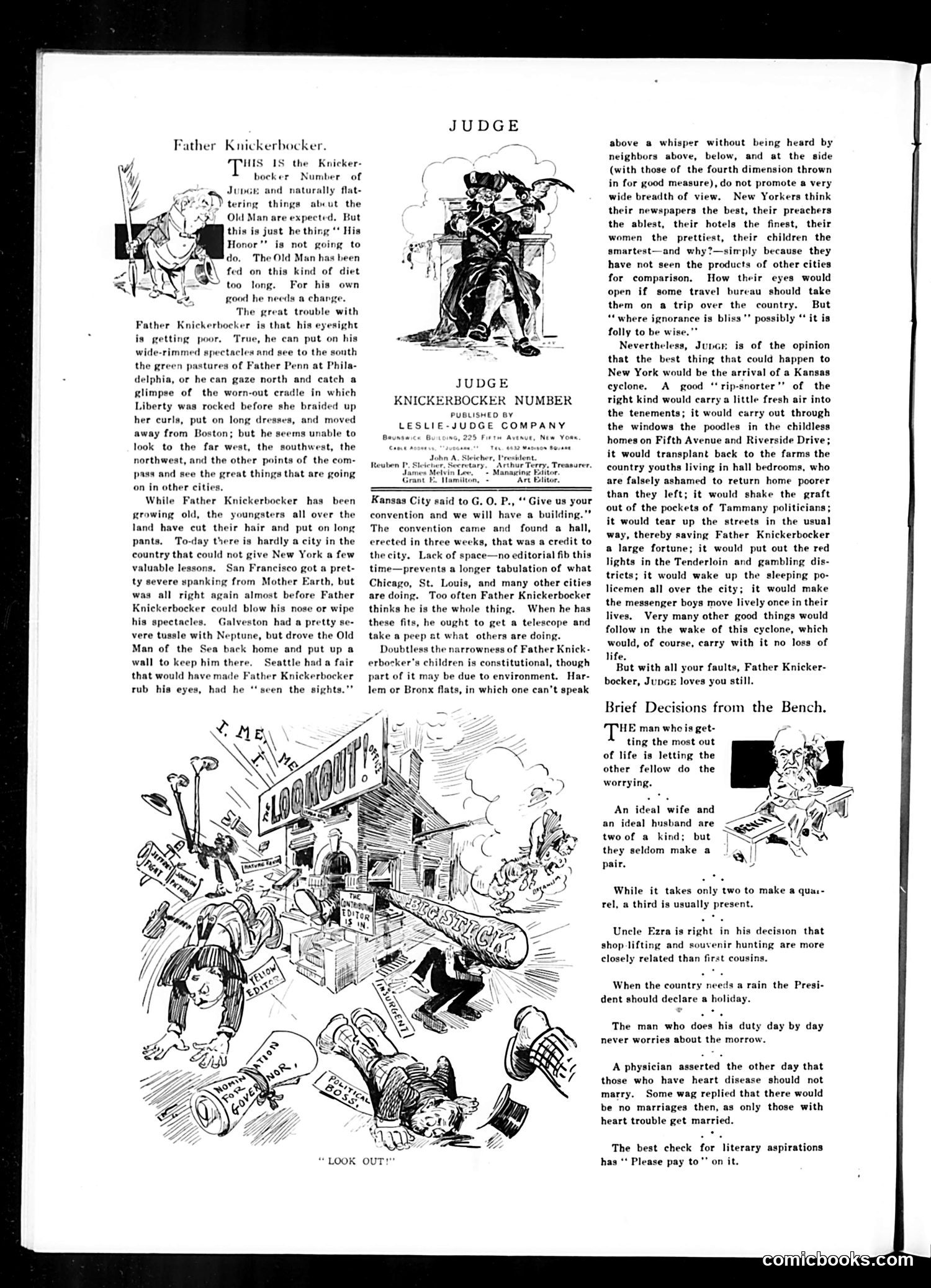
**Main Content: "Father Knickerbocker" Column** The text discusses Father Knickerbocker (a personification of New York City) and his failing eyesight, using this as metaphor for New York's problems. The author suggests New York needs a "telescope" to see what other cities are accomplishing—a critique that New York is becoming complacent and losing awareness of competitors. **"Look Out!" Cartoon** The large cartoon depicts urban chaos with figures being thrown around, suggesting the cyclone/disaster metaphor referenced in the text about a potential Kansas cyclone arriving in New York. **"Brief Decisions from the Bench"** Short satirical aphorisms about marriage, duty, and life—typical Judge magazine humor. The overall message critiques New York's provincial self-satisfaction and suggests it needs broader perspective to remain competitive among American cities.
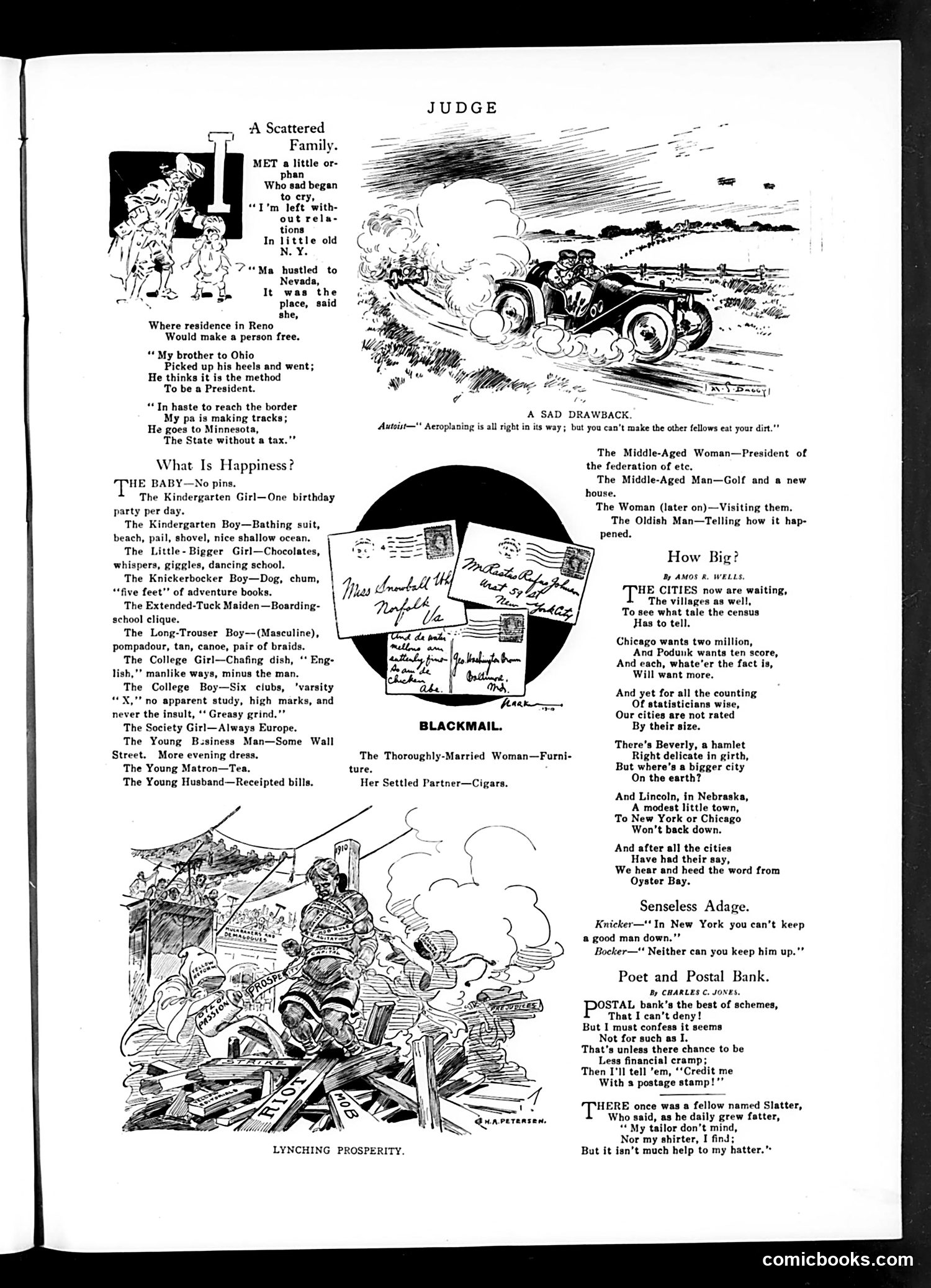
The main cartoon shows a speeding automobile kicking up dust, with the caption criticizing aeroplaning (early aviation) as acceptable but questioning whether "you can't make the other fellows eat your dirt"—satirizing reckless drivers who endanger pedestrians. "Lynching Prosperity" depicts a chaotic pile of materials and people, apparently critiquing economic mismanagement or social disorder destroying prosperity. The "Blackmail" section features handwritten letters, likely satirizing correspondence or communication scandals. Other sections mock contemporary concerns: scattered families emigrating, urban growth statistics, and social pretensions. The humor targets early 20th-century anxieties about modernization, immigration, city expansion, and automobile culture—technologies and social changes disrupting traditional American life. The tone is broadly conservative, mocking both progressive optimism and contemporary social problems.
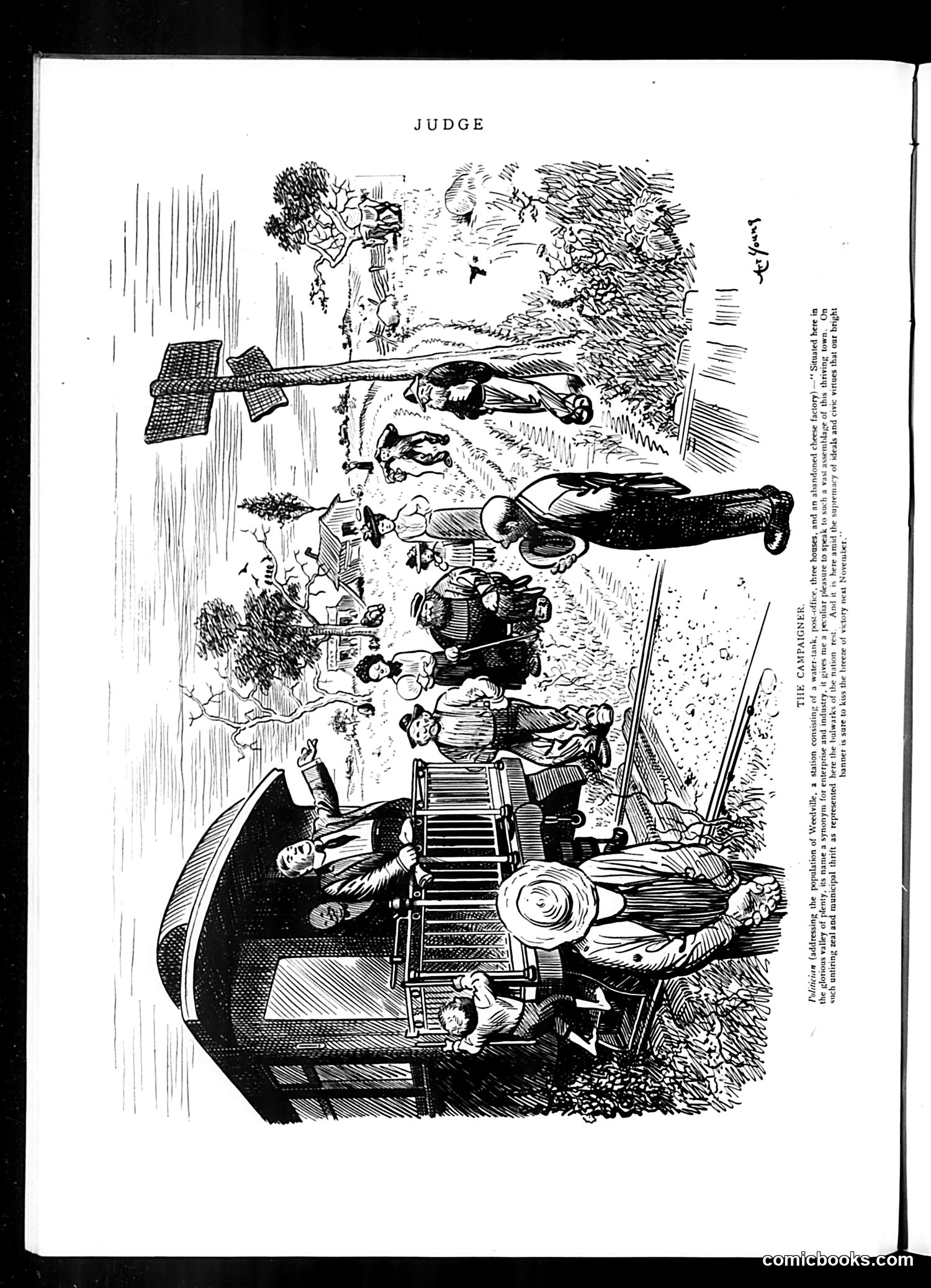
This appears to be a satirical cartoon titled "JUDGE" showing a courtroom or legal proceeding scene. The image depicts multiple figures in what seems to be a trial or judicial setting, with various characters positioned around what appears to be a judge's bench or witness stand. However, **without being able to read the accompanying text clearly** in this reproduction, I cannot definitively identify the specific political figures, the particular legal case being satirized, or the precise point of the satire. The cartoon clearly comments on some aspect of the American legal system or a specific trial that was topical when published, but determining which case or figures are caricatured requires legible caption text that isn't clearly readable here. The artistic style and composition suggest this is commentary on justice or courtroom proceedings of its era.
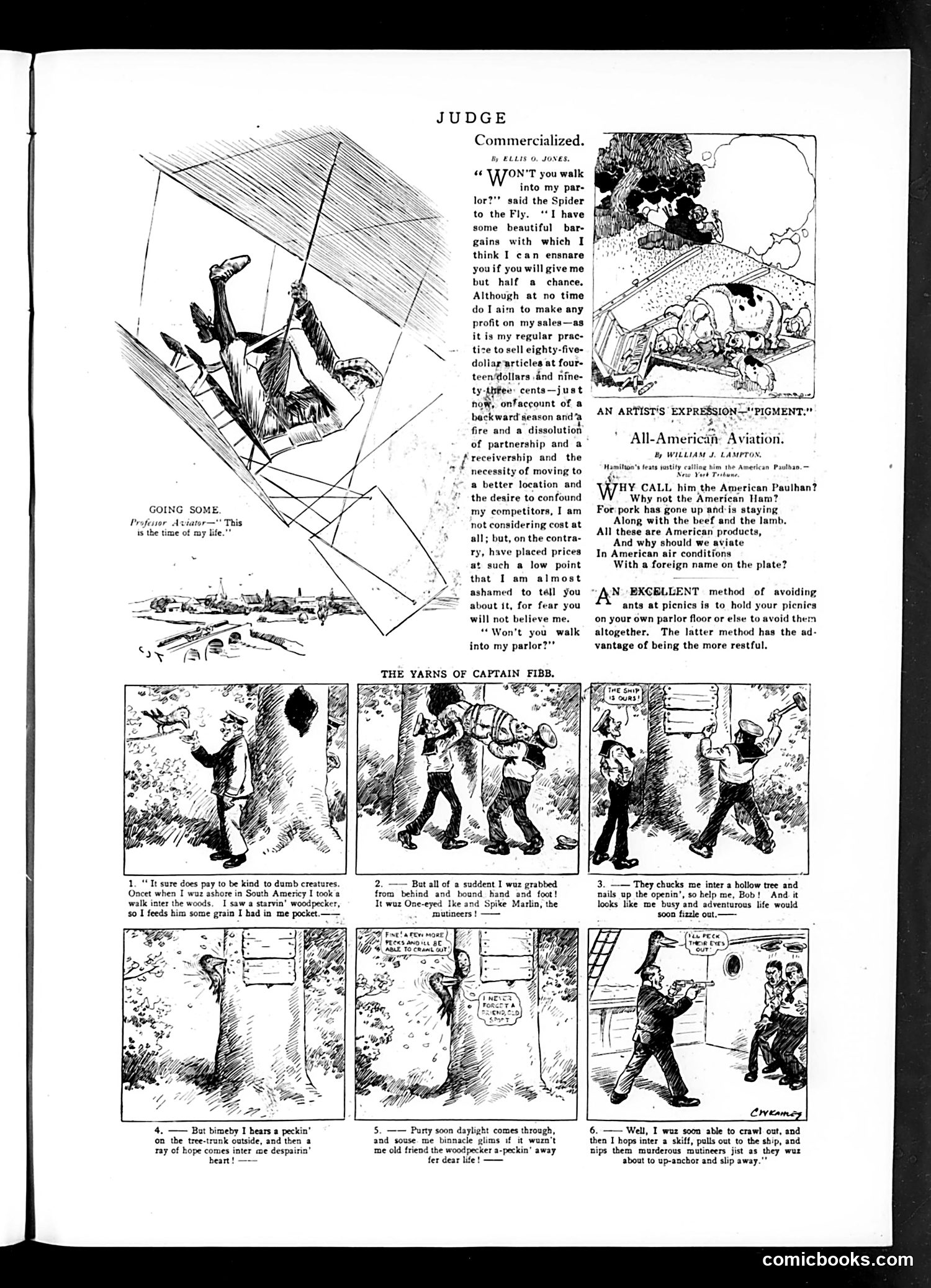
This page contains three distinct pieces of satire and humor: **"Commercialized"** mocks exploitative sales tactics through the classic Spider-and-Fly fable. A merchant uses deliberately deceptive language—claiming to sell at losses while citing endless excuses (bankruptcy, relocation, competition)—to justify inflated prices. The satire targets predatory commercial practices masquerading as generosity. **"All-American Aviation"** critiques the naming of early aviation achievements. It questions why Americans call pioneering aviator Hamilton the "American Paulhan" (referencing French aviator Louis Paulhan) rather than giving him an American name. The poem sarcastically suggests using American products' names instead, mocking the era's tendency to diminish American accomplishments through foreign nomenclature. **"The Yarns of Captain Fibb"** is a humorous tall tale about a sailor whose kindness to a woodpecker leads to rescue from mutineers—the bird pecks him free from a hollow tree. It's lighthearted adventure fiction with no political content. The page exemplifies Judge's mix of economic criticism, nationalist sentiment, and entertainment humor.
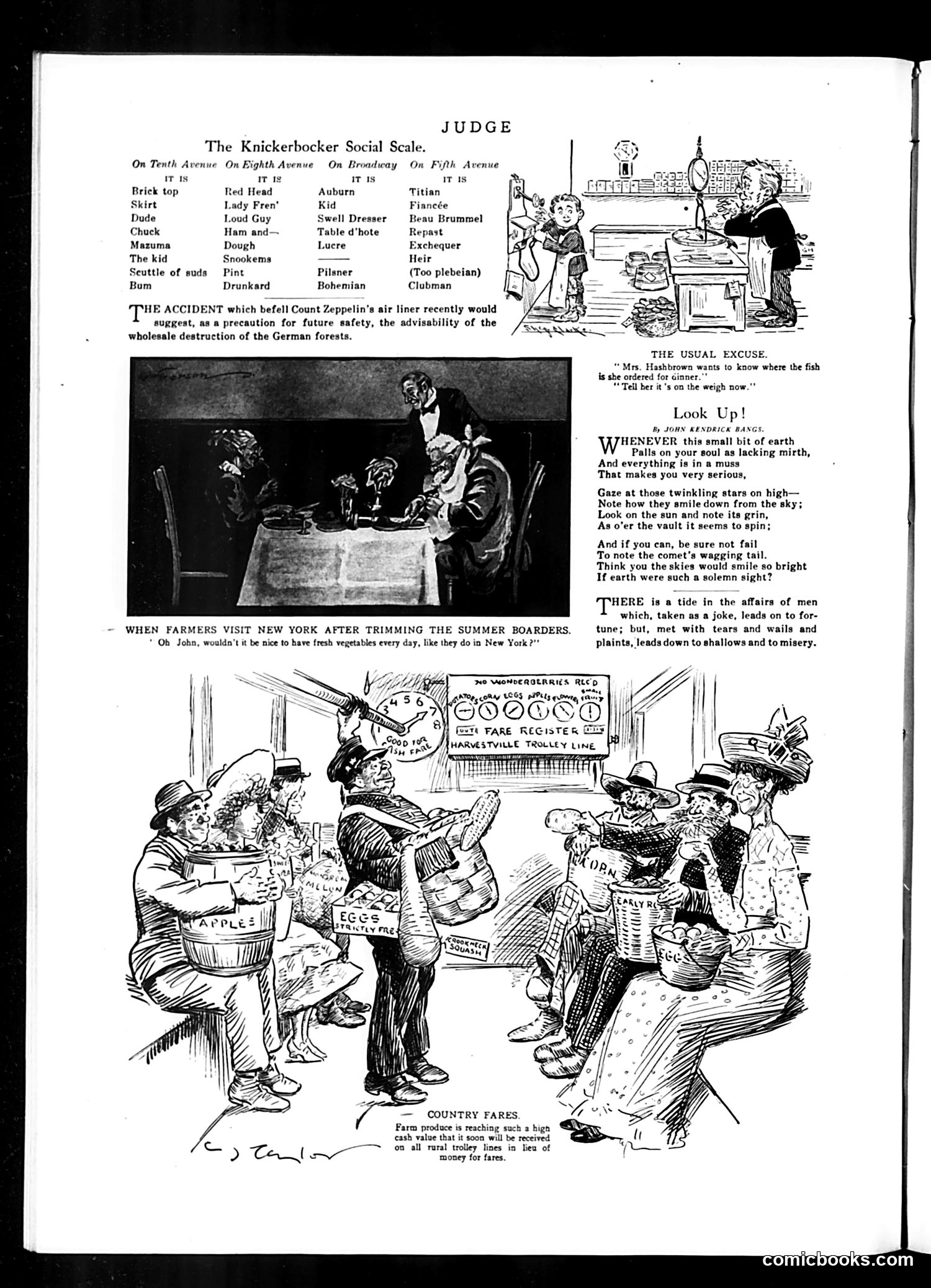
This page contains satirical commentary on early 20th-century American social class distinctions and contemporary issues. **"The Knickerbocker Social Scale"** mocks how New York City neighborhoods reflect social hierarchy. The same concepts—drinking, courting, money—are renamed to sound progressively more refined as one moves from working-class Tenth Avenue ("Brick top," "Bum") through middle-class areas to wealthy Fifth Avenue ("Fiancée," "Clubman"). The joke is that the underlying reality is identical; only the vocabulary changes with social pretension. **"Country Fares"** cartoon satirizes farmers visiting New York after hosting wealthy summer boarders. It suggests that farm produce has become so valuable during wartime that rural trolley lines might soon accept vegetables instead of cash as payment—commenting on agricultural commodity inflation. The **Zeppelin reference** alludes to recent German airship accidents, using dark humor to suggest forest destruction as a safety precaution. **"Look Up!"** is an inspirational poem about finding perspective through observing nature, unrelated to the satire above it. The overall page reflects Judge's approach: mocking class affectation, commenting on wartime economics, and mixing humor with moral reflection.
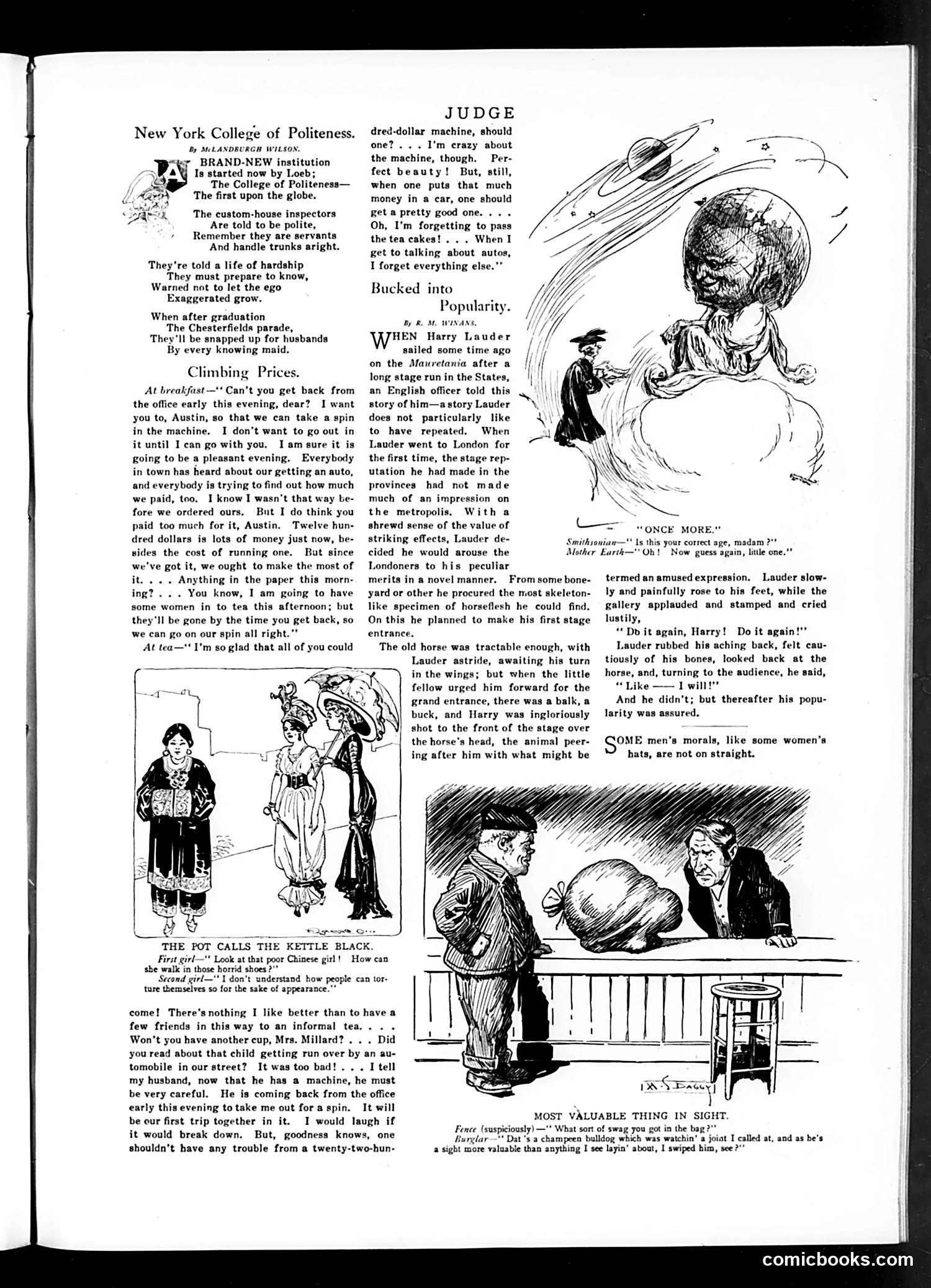
This page contains three satirical pieces: **"New York College of Politeness"** mocks a new institution supposedly founded by someone named Loeb, training custom-house inspectors in politeness. The satire suggests this is absurdly necessary—these workers notoriously treated the public rudely, so a "college" teaching basic courtesy to government servants is presented as laughably inadequate reform. **"Climbing Prices"** depicts a wife pestering her husband about an expensive automobile purchase ($1,200), showing how automobile ownership created new social anxieties and status-seeking among the middle class. **"Bucked into Popularity"** recounts Harry Lauder (a famous Scottish entertainer of the era) arriving in London on a skeletal horse for dramatic effect. The horse bucked him off onto the stage. Rather than being humiliated, Lauder's mishap accidentally charmed London audiences, creating his popularity through comedic accident rather than talent—poking fun at both theatrical pretension and audience taste. The cartoons satirize consumer culture, class pretension, and social climbing in early 20th-century America.
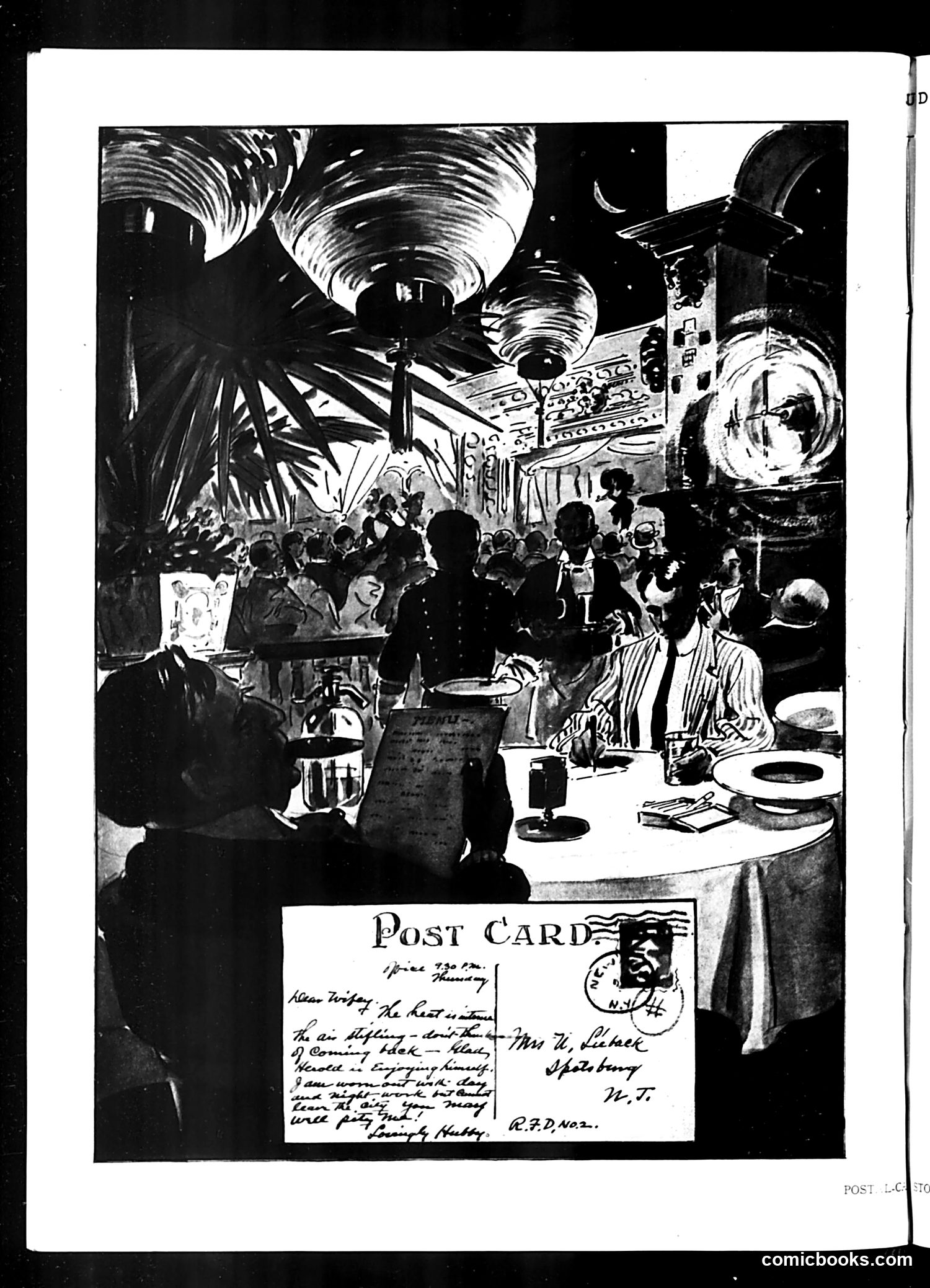
This page combines a satirical illustration with a postcard. The main image depicts an elaborate, ornate dining or banquet scene with elaborate hanging decorative elements (possibly palm fronds or theatrical set pieces) and well-dressed diners at tables. The style suggests early 20th-century high society or theatrical venue. The accompanying postcard below features handwritten text addressed to "Mrs. N. Lilback" in Statesbury, N.Y., with a postmark visible. The handwriting is difficult to read completely, but references something about "the best" and mentions a "day" and "Headley." Without clearer text visibility or caption information identifying specific figures or the satirical target, the exact political or social commentary remains unclear. The ornate setting and formal dress suggest satire about wealth, excess, or pretension in high society, but specific references cannot be confirmed from this image alone.
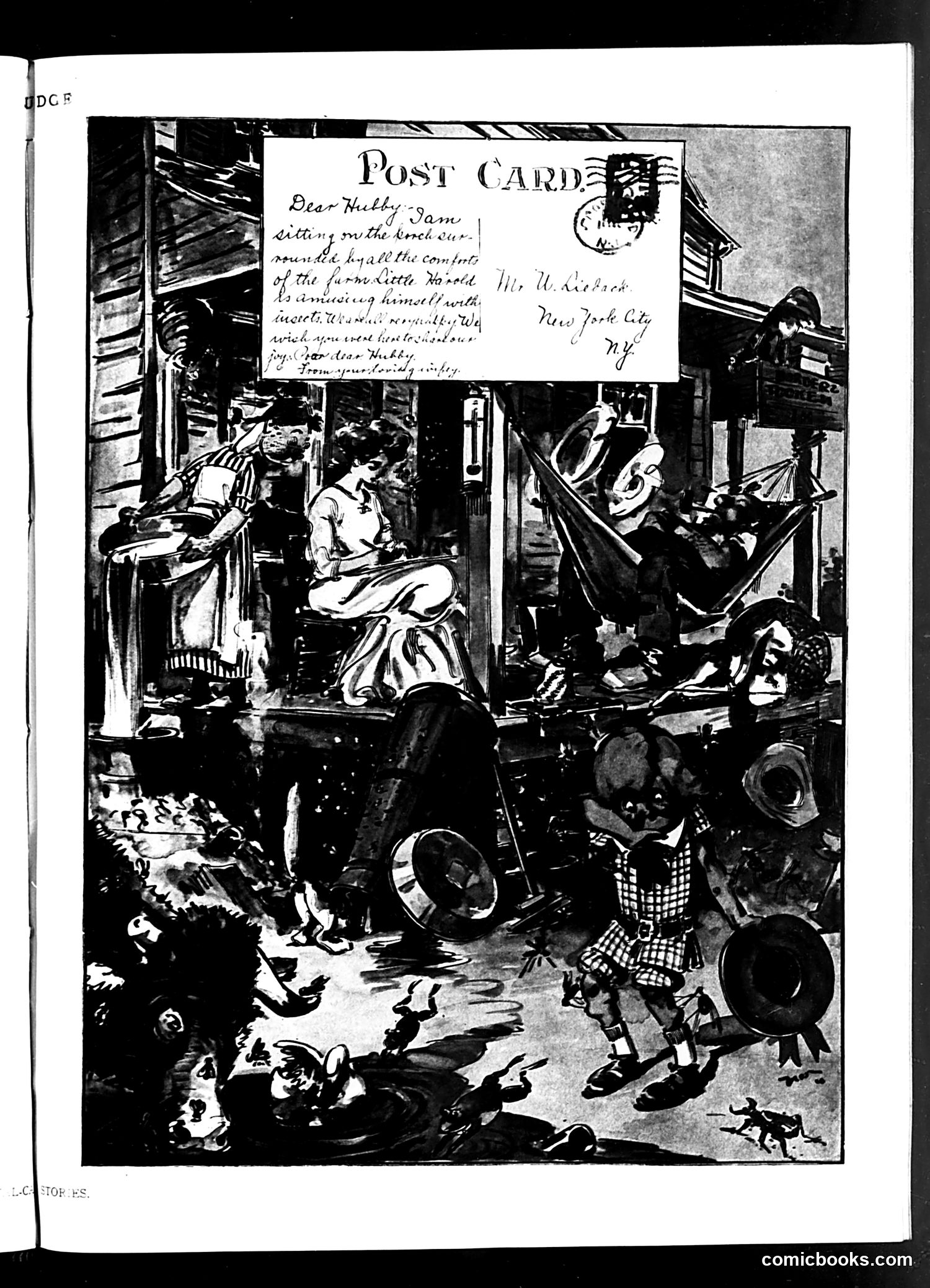
This page contains a postcard and an illustration. The postcard, addressed to "Dear Hubby" in New York City, describes someone sitting on a porch surrounded by farm life—mentioning "the contents of the farm," "little Wold," and references to livestock and rustic activities. The sender signs off "From your loving wifey." The illustration below appears to depict a chaotic rural or farm scene with multiple figures, some wearing hats, gathered around what seems to be domestic activity or work. Without clearer detail or a visible date, the specific satirical target remains unclear, though the postcard's juxtaposition with the farm scene suggests commentary on rural domestic life or the contrast between city and country living—common Judge magazine themes.
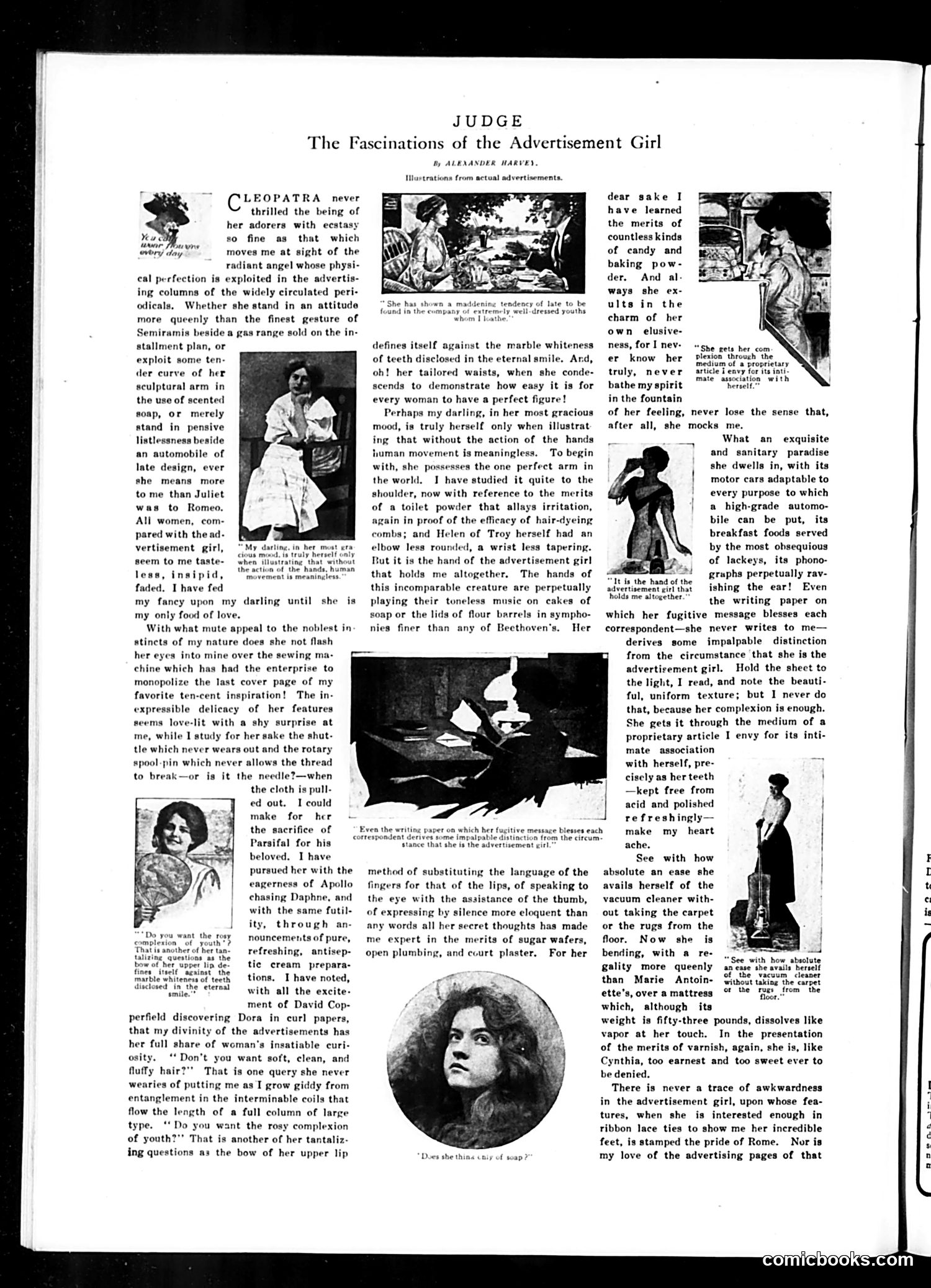
This is a satirical essay by Alexander Harvey mocking the obsessive male consumer captivated by idealized women in magazine advertisements. The author presents himself as absurdly infatuated with these advertising models—comparing his passion to Cleopatra, Romeo, and Parsifal—celebrating their "perfect arms," gleaming teeth, and elegant hands posed over products (sewing machines, soap, hair dye, cream preparations). The satire targets both advertising's manipulative use of female beauty and male consumers' gullible susceptibility to it. By elevating these anonymous product-endorsers to mythic status while remaining ignorant of their actual identities, the piece ridicules how advertising exploits desire and how men mistake commercial artifice for genuine feminine charm. The numerous photographic illustrations from actual advertisements reinforce the joke: these mass-produced images are presented as objects of near-religious devotion.
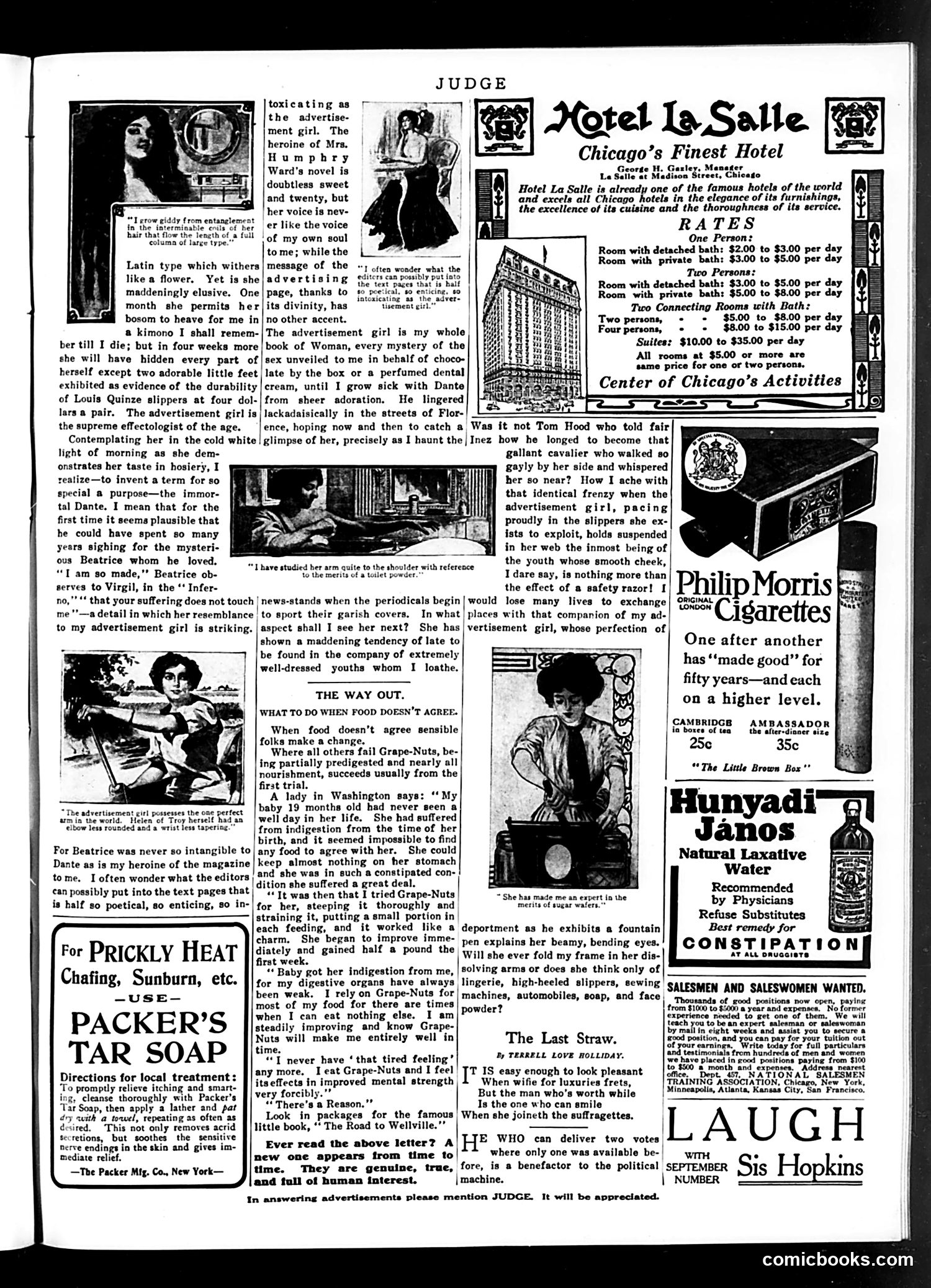
This page is primarily **advertising**, not satire or political content. The main feature is a lengthy literary piece titled "JUDGE" (the magazine's masthead) that wryly romanticizes an unnamed **advertisement model**—the woman who poses for commercial products in magazine ads. The author (likely the magazine's editor) compares his obsession with this ever-changing model to Dante's pursuit of Beatrice. The satire is **self-directed and meta**: it mocks his own irrational infatuation with an advertisement girl whose appearance constantly shifts as she models different products (hosiery, slippers, beauty items, etc.). She's "maddeningly elusive"—never the same twice, always selling something. The joke reflects early 20th-century anxieties: the power of advertising imagery, consumer culture's grip on male desire, and the unreality of commercial idealization. The piece humorously suggests that advertising girls—real women transformed into fantasy objects—are more compelling than actual romantic love. The rest of the page contains **genuine advertisements** (Hotel La Salle, Philip Morris cigarettes, Parker's Tar Soap, etc.).
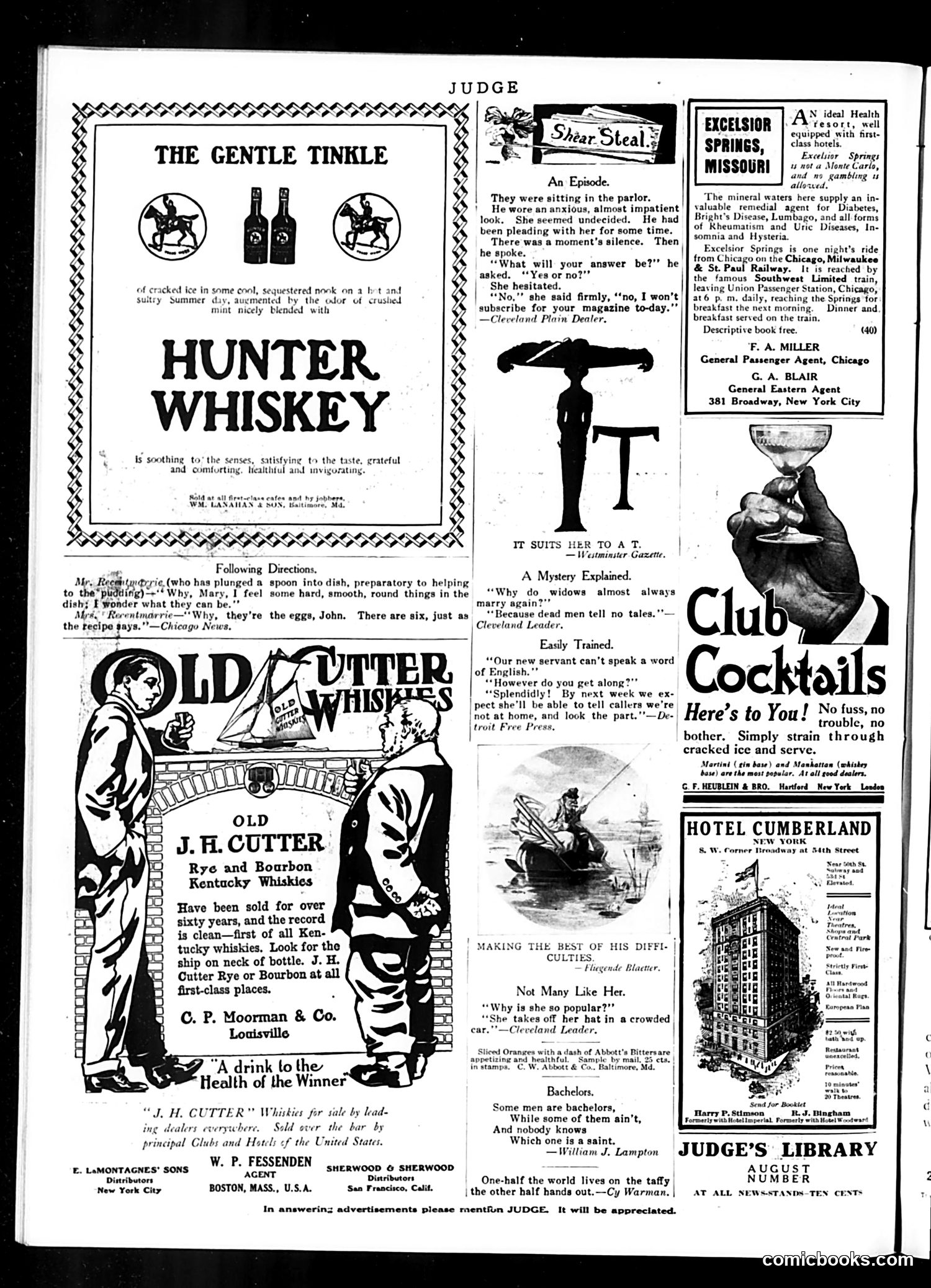
This page from Judge magazine (early 20th century) consists primarily of **whiskey and spirits advertisements** mixed with short comic sketches and quips. **Main Content:** The title piece "The Gentle Tinkle" presents a brief joke: a man pressures a woman in the parlor, and his "pleading" is revealed as urging her to **subscribe to a magazine**—not proposing marriage. The humor relies on reader expectations being subverted. **Other sketches** are brief satirical observations: widows remarrying (because "dead men tell no tales"), servant training, and social commentary on bachelors and popularity. **Advertising dominates:** Multiple full-page whiskey ads (Hunter, Old J.H. Cutter, etc.) appear alongside ads for a health resort in Missouri and the Hotel Cumberland. **The satire is light:** Judge's humor here targets domestic life, servant behavior, and social pretense rather than political figures. The page reflects early 1900s American leisure culture and magazine advertising conventions.
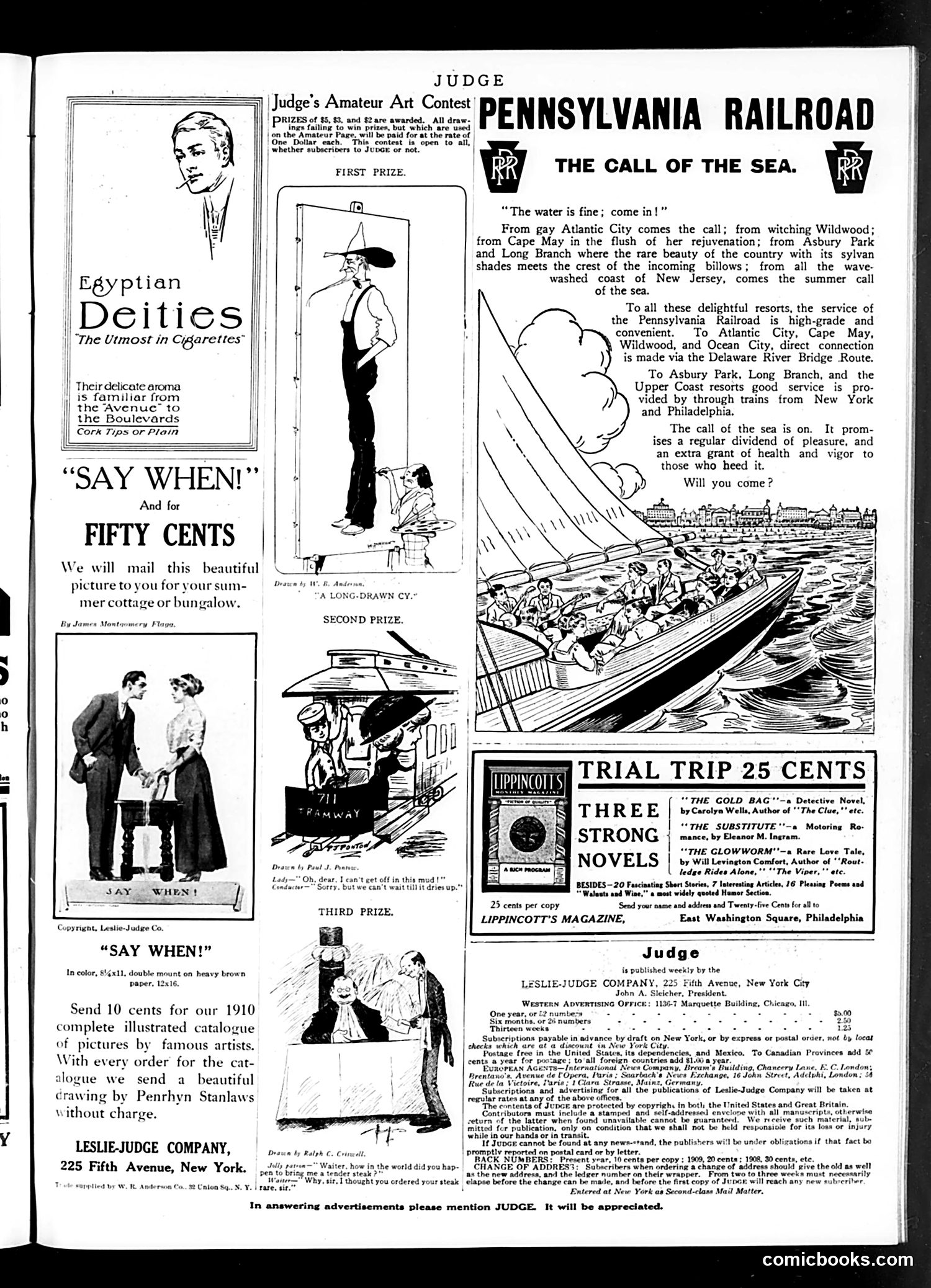
This page is primarily **advertising and contest information** rather than political satire. The main content includes: **Judge's Amateur Art Contest**: The magazine solicited drawings from readers, offering small cash prizes ($5, $3, $2, and $1). Three sample prize-winning submissions are shown—simple humorous sketches with captions like "A Long-Drawn Cry" and dialogue about a couple kissing. **Pennsylvania Railroad Advertisement**: "The Call of the Sea" promotes beach resorts (Atlantic City, Cape May, Asbury Park) accessible by rail, with romantic imagery of couples in a sailboat. **Side Advertisements**: Egyptian Deities cigarettes, a "Say When!" picture offer (reproductions of artwork by Penrhyn Stanlaws for 50 cents), and Lippincott's Magazine offering three novels for 25 cents. The page reflects early 1910s consumer culture and leisure marketing—appealing to middle-class readers with affordable art, travel, and reading material. There is no significant political satire visible.
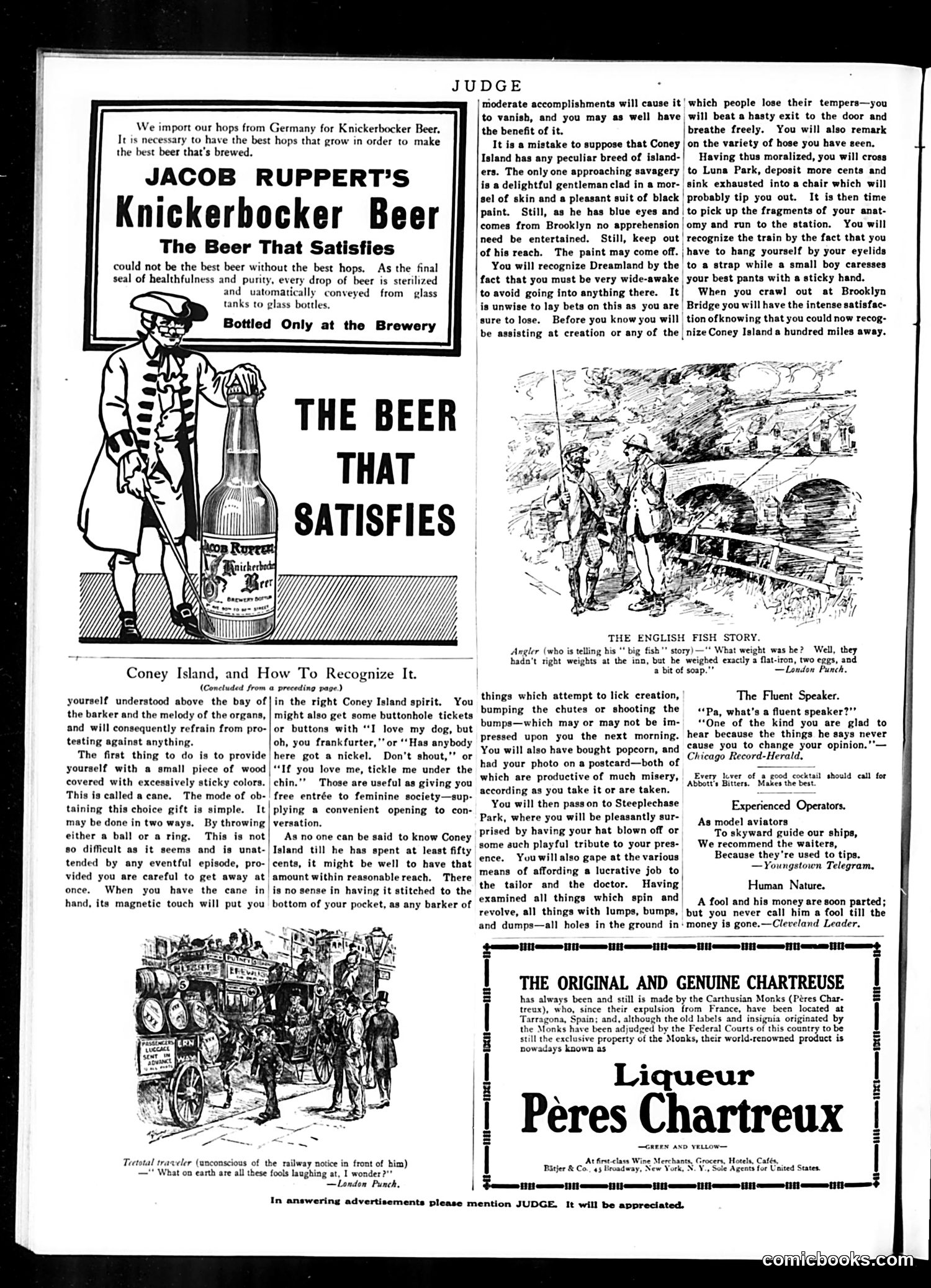
This page is primarily **advertising disguised as editorial content**. The main feature is Jacob Ruppert's Knickerbocker Beer advertisement, which dominates the left side with a cartoon of a man in colonial dress holding a beer bottle. The right side contains a humorous article titled "Coney Island, and How To Recognize It"—a satirical guide mocking tourists visiting the famous amusement park. The satire targets: - **Gullible visitors** falling for carnival games and barker tricks - **Cheap souvenirs** (the sticky cane won from ball-toss games) - **Dangerous amusement rides** that cause injury and embarrassment - **Working-class tourism**, implied through references to frankfurters and modest spending The tone is **condescending mockery** of ordinary people's entertainment choices, typical of Judge magazine's upper-class perspective. The scattered jokes (the "English Fish Story," "The Fluent Speaker") are unrelated fillers common in period magazines. **Context:** This reflects early 1900s class attitudes toward mass entertainment and commercialized leisure.
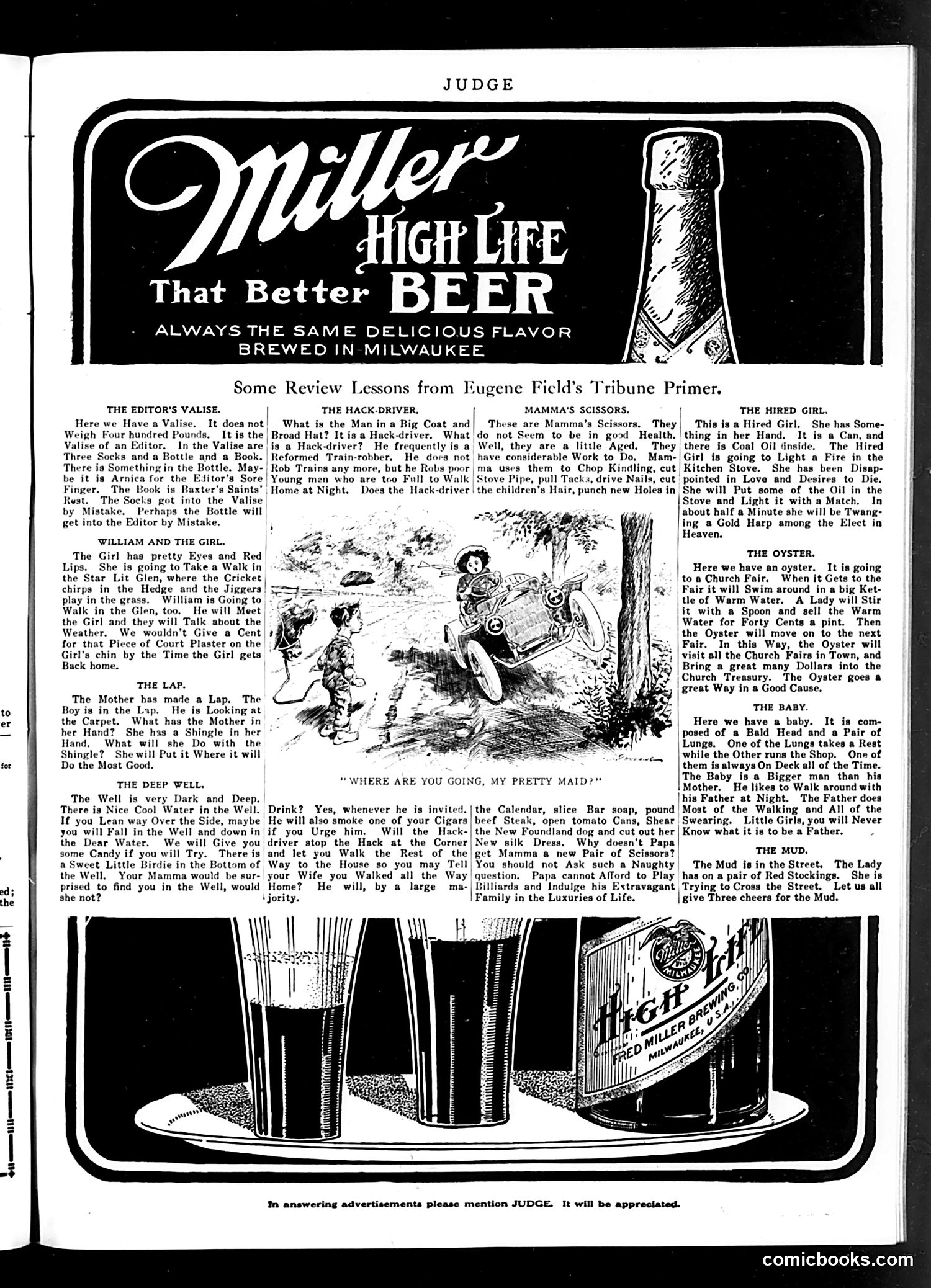
This page parodies Eugene Field's "Tribune Primer," a children's educational text, using absurdist humor to mock genteel instruction manuals. The satirical "lessons" describe mundane or ridiculous scenarios in overly formal language: a hired girl committing suicide via coal oil, a hack driver (reformed train robber) robbing drunk passengers, a mother beating a boy with a shingle, and an oyster being reused at multiple church fairs as a fundraising scheme. The humor targets both Victorian moral instruction and everyday American hypocrisy—the contradiction between proper behavior and actual conduct. References like "Baxter's Saints' Rest" (religious literature) underscore the gap between preached virtue and practiced vice. The Miller High Life beer advertisement frames the page, creating ironic juxtaposition between the product's claims of quality and the cynical worldview presented in the satire.
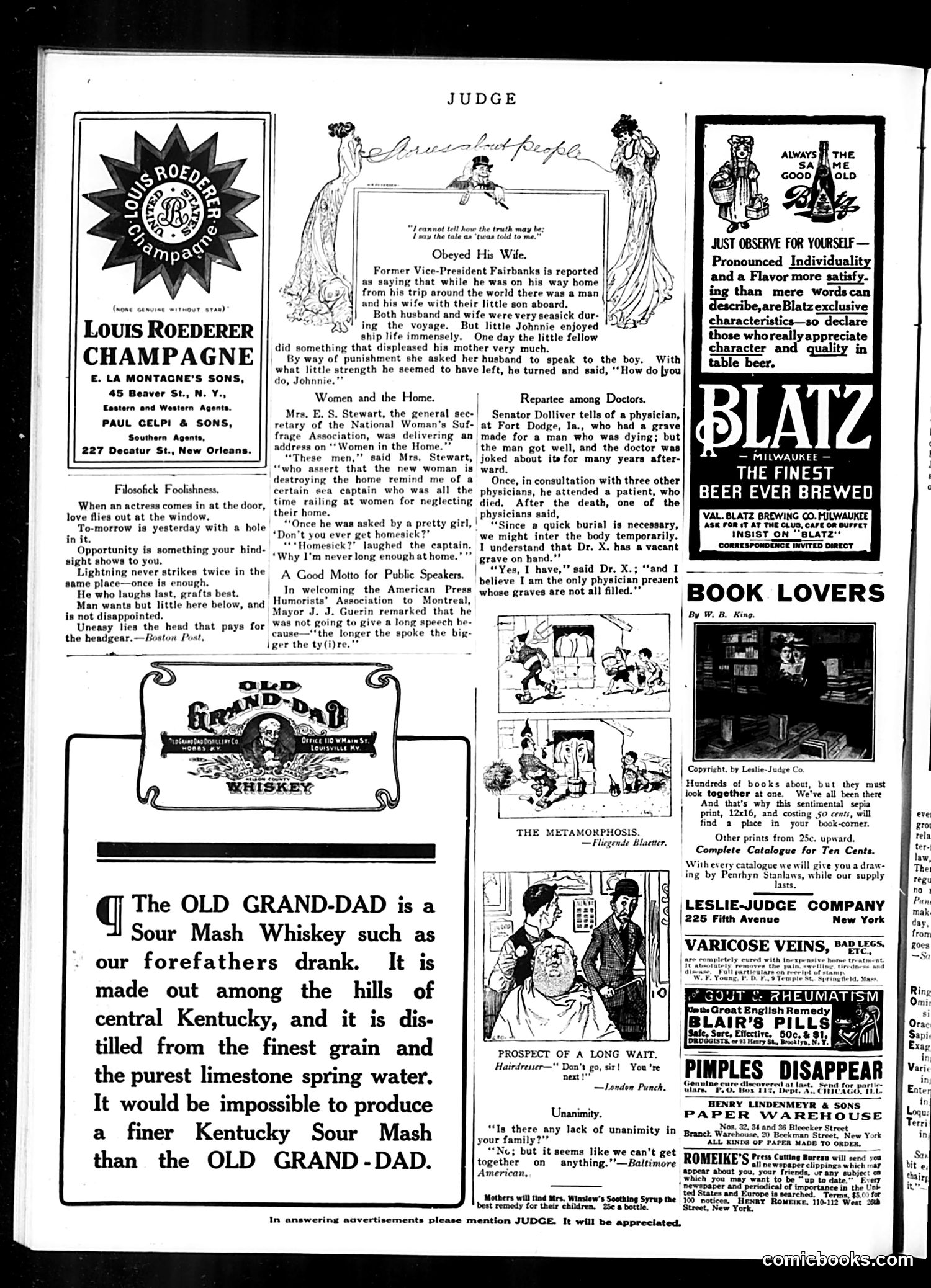
This page is primarily **advertisements and filler content** rather than political satire. The dominant feature is a large whiskey ad for "Old Grand-Dad," a Kentucky sour mash whiskey claiming authenticity to pre-Prohibition era drinks. The page includes scattered humor pieces labeled "Filosofick Foolishness"—cynical one-liners mocking conventional wisdom (e.g., "He who laughs last, grafts best"). Several anecdotes appear, including a story about Former Vice-President **Fairbanks** whose seasick wife overshadows her husband's authority, and a tale about **Senator Dolliver** joking with fellow physicians about graves. There are also **product ads** for Blatz beer, champagne, and medical remedies (varicose veins, pimples). The cartoons visible—"The Metamorphosis" and "Prospect of a Long Wait"—are generic humorous illustrations without clear political content. Overall, this represents Judge functioning as a **general-interest humor magazine with substantial advertising**, rather than focused political commentary.
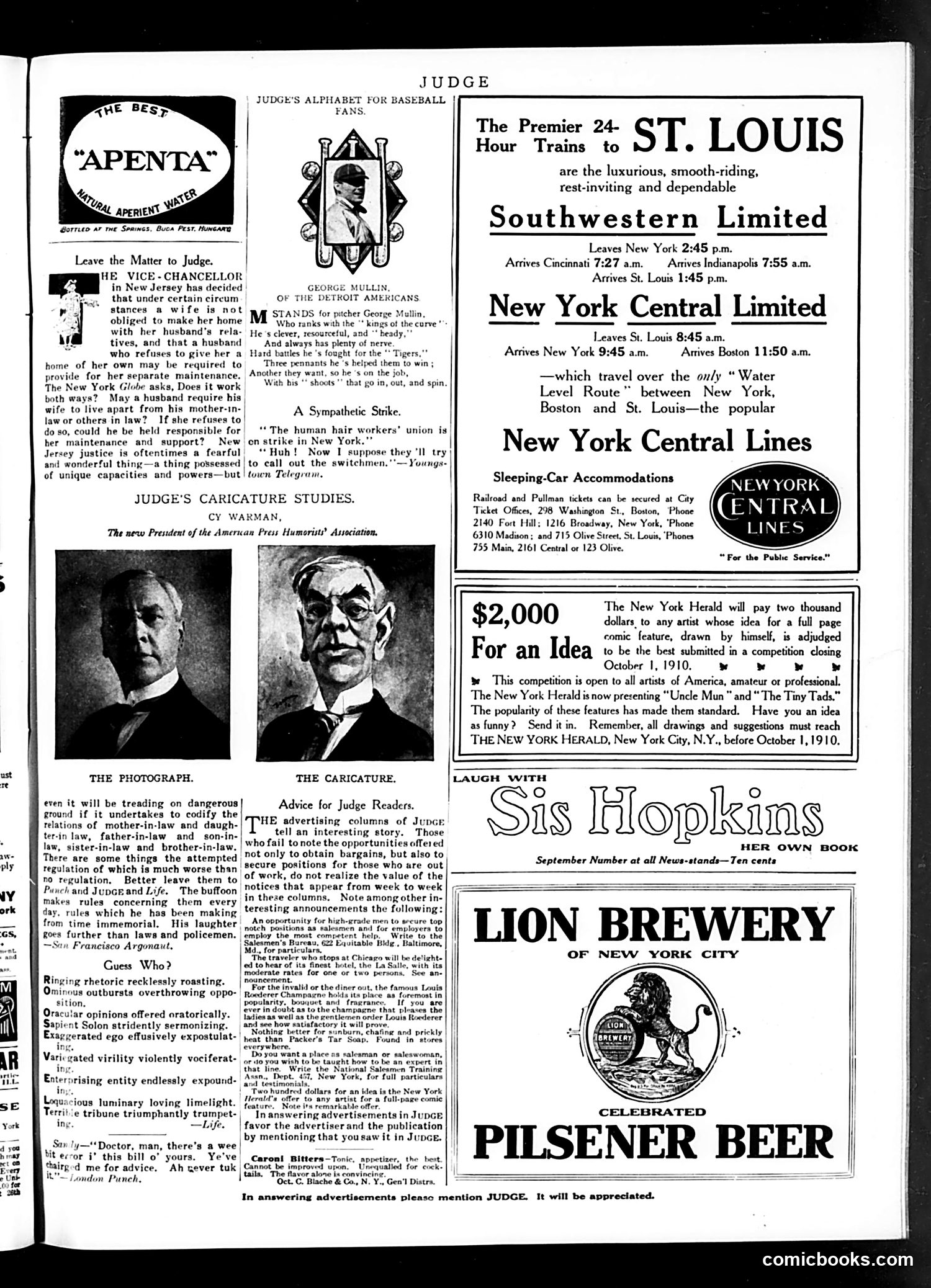
This page is primarily **advertising and announcements** with minimal editorial satire content. The main feature is "Judge's Caricature Studies," profiling **Cy Warman**, newly elected president of the American Press Humorists' Association. Two photographs show his face from different angles, labeled "The Photograph" and "The Caricature"—a humorous contrast suggesting exaggeration is the cartoonist's art. Smaller items include: - **"Leave the Matter to Judge"**: A brief satire on a New Jersey court ruling exempting wives from living with in-laws, questioning whether husbands get reciprocal rights—poking fun at inconsistent legal logic. - **"A Sympathetic Strike"**: A one-liner joke about human hair workers striking in New York, suggesting workers should support them by donning wigs. The page is otherwise dominated by railroad advertisements (New York Central Lines) and a $2,000 comic competition announcement from the New York Herald. The satire is light and situational rather than targeting specific political figures.
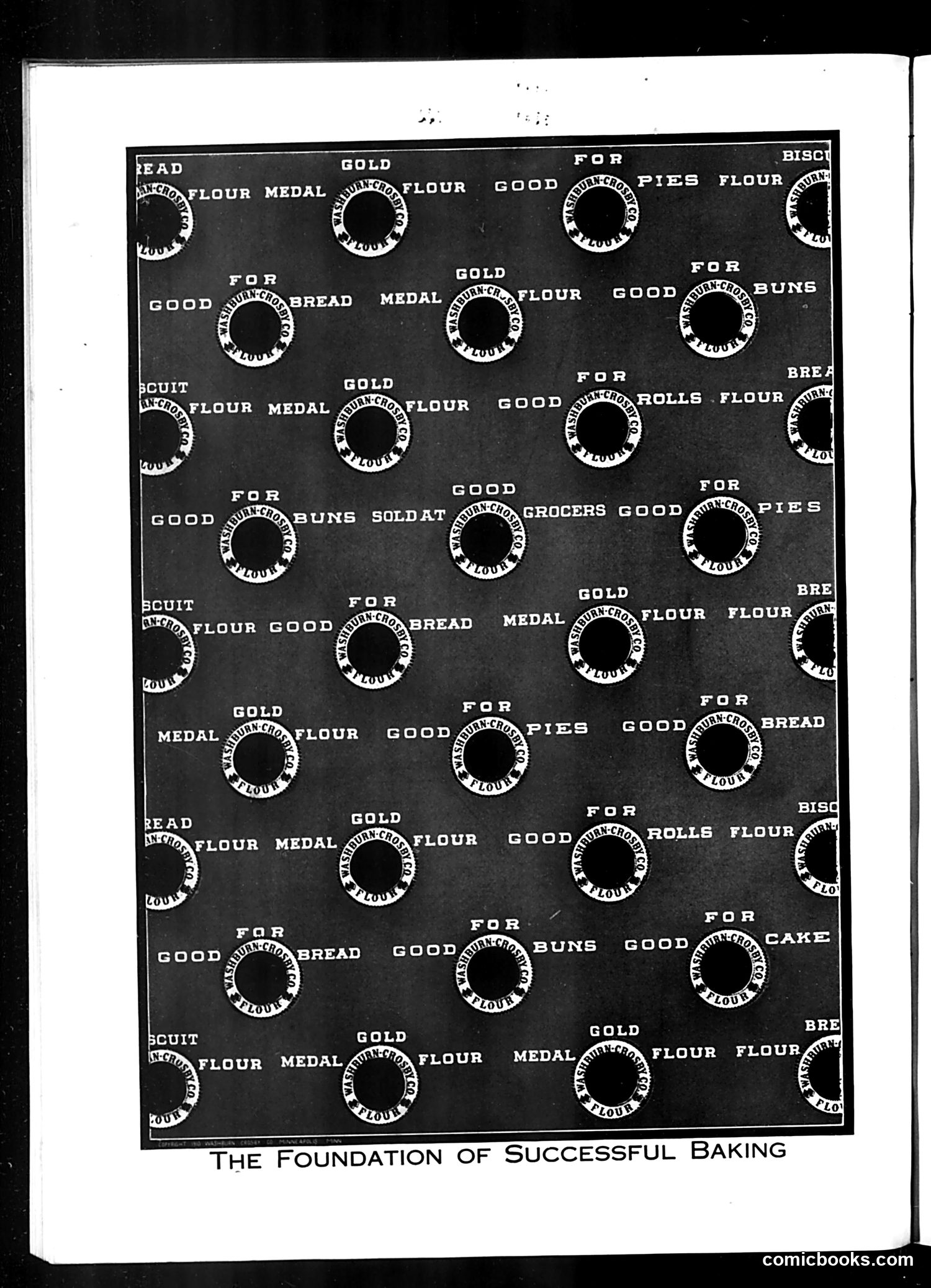
This appears to be a vintage advertisement rather than a political cartoon. It's a grid layout showcasing various medals or seals for "Gold Medal Flour" in different applications—bread, biscuits, pies, buns, rolls, and cake. The circular seals throughout the grid feature text reading "Gold Medal Flour" and are positioned alongside text describing baking uses ("For Good Bread," "For Pies," etc.). The repetitive pattern emphasizes the brand's versatility across multiple baking categories. The tagline "The Foundation of Successful Baking" presents Gold Medal Flour as essential to home baking success. This is straightforward product marketing designed to convince consumers that this flour brand guarantees quality results across all common baked goods. No satire or political commentary is evident—it's purely commercial advertising.