
Judge, 1910-08-27 · page 4 of 20
Judge — August 27, 1910 — page 4: what you’re looking at
What you’re looking at
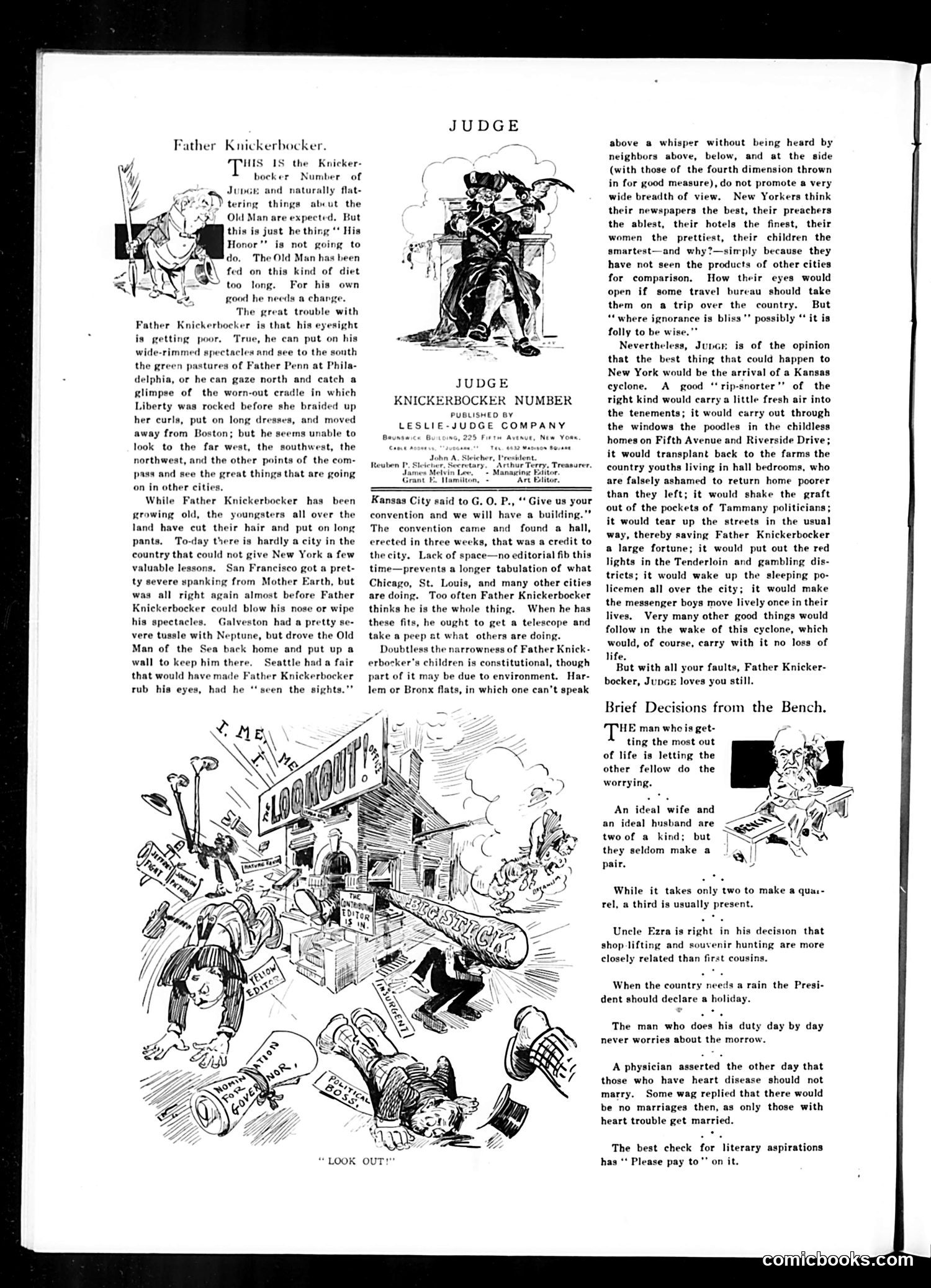
**Main Content: "Father Knickerbocker" Column** The text discusses Father Knickerbocker (a personification of New York City) and his failing eyesight, using this as metaphor for New York's problems. The author suggests New York needs a "telescope" to see what other cities are accomplishing—a critique that New York is becoming complacent and losing awareness of competitors. **"Look Out!" Cartoon** The large cartoon depicts urban chaos with figures being thrown around, suggesting the cyclone/disaster metaphor referenced in the text about a potential Kansas cyclone arriving in New York. **"Brief Decisions from the Bench"** Short satirical aphorisms about marriage, duty, and life—typical Judge magazine humor. The overall message critiques New York's provincial self-satisfaction and suggests it needs broader perspective to remain competitive among American cities.
📄 Transcribed text from this page (OCR, searchable)
Machine-transcribed from the original scan — historical spelling and the odd misread are preserved.
Father Knickerbock HIS IS the Knicker- bocker Number of and naturally flat- abeut the Jun LD tering things Old Man are expected. But this is just he thing ‘* His Honor’? is not going to do. The Old Man has been fed on this kind of diet too long. For his good he needs a chang The great trouble with Father Knickerbocker is that his getting poor. True, he can put on his -rimmed spectacles and see to the south the green pastures of Father Penn at Phila- delphia, or he can gaze north and catch a glimpse of the worn-out cradle in which Liberty was rocked before she braided up her curls, put on long dre and moved away from Boston; but he s unable to look to the far w the southwest, the northwest, and the other points of the com- pass and see the great things that are going on in other cities. While Father Knickerbocker has growing old, the youngsters all over the land have cut their hair and put on long pants. To-day there is hardly a city in the country that could not give New York a few valuable lessons. San Francisco got a pret- ty severe spanking from Mother Earth, but was all right again almost before Father Knickerbocker could blow his nose or wipe his spectacles. Galveston had a pretty se- vere tussle with Neptune, but drove the Old Man of the Sea back home and put up a wall to keep him there. Seattle had a fair that would have made Father Knickerbocker rub his eyes, had he en the sights.” own been JUDGE KNICKERBOCKER NUMBER PUBLISHED BY LESLIE-JUDGE COMPANY Kansas City said to G. O. P., “Give us your convention and we will have a building.” The convention came and found a hall, erected in three weeks, that was a credit to the city. Lack of space—no editorial fib this time—prevents a longer tabulation of what Chicago, St. Louis, and many other cities are doing. Too often Father Knickerbocker thinks he is the whole thing. When he has these fits, he ought to get a telescope and take a peep at what others are doing. Doubtless the narrowness of Father Knick- erbocker’s children is constitutional, though part of it may be due to environment. Har- lem or Bronx flats, in which one can’t speak “LOOK OUT!” above a whisper without being heard by neighbors above, below, and at the side (with those of the fourth dimension thrown in for good measure), do not promote a very wide breadth of view. New Yorkers think their newspapers the best, their preachers the ablest, their hotels the finest, their women the prettiest, their children the smartest—and why?—sirply because they have not seen the products of other cities for comparison. How their eyes would open if some travel bureau should take them on a trip over the country. But “* where ignorance is bliss "’ possibly “* it is folly to be wise."* 88, is of the opinion that the best thing that could happen to New York would be the arrival of a Kansas cyclone. A good ‘‘rip-snorter" of the right kind would carry a little fresh air into the tenements; it would carry out through the windows the poodles in the childless homes on Fifth Avenue and Riverside Drive; it would transplant back to the farms the country youths living in hall bedrooms, who are falsely ashamed to return home poorer than they left; it would shake the graft out of the pockets of Tammany politicians; it would tear up the streets in the usual way, thereby saving Father Knickerbocker a large fortune; it would put out the red lights in the Tenderloin and gambling dis- tricts; it would wake up the sleeping po- licemen all over the city; it would make the messenger boys move lively once in their lives, Very many other good things would follow in the wake of this cyclone, which would, of course, carry with it no loss of life. But with all your faults, Father Knicker- bocker, JupcE loves you still. Brief Decisions from the Bench. HE man whois get- ting the most out of life is letting the other fellow do the worrying. An ideal wife and an ideal husband are << two of a kind; but they seldom make a pair. While it takes only two to make a qua:- rel, a third is usually present. Uncle Ezra is right in his decision that shop lifting and souvenir hunting are more closely related than first cousins. When the country needs a rain the Presi- dent should declare a holiday. The man who does his duty day by day never worries about the morrow. A physician asserted the other day that those who have heart disease should not marry. Some wag replied that there would be no marriages then, as only those with heart trouble get married. The best check for literary aspirations has “* Please pay to’ on it.