
Judge, 1910-08-27 · page 5 of 20
Judge — August 27, 1910 — page 5: what you’re looking at
What you’re looking at
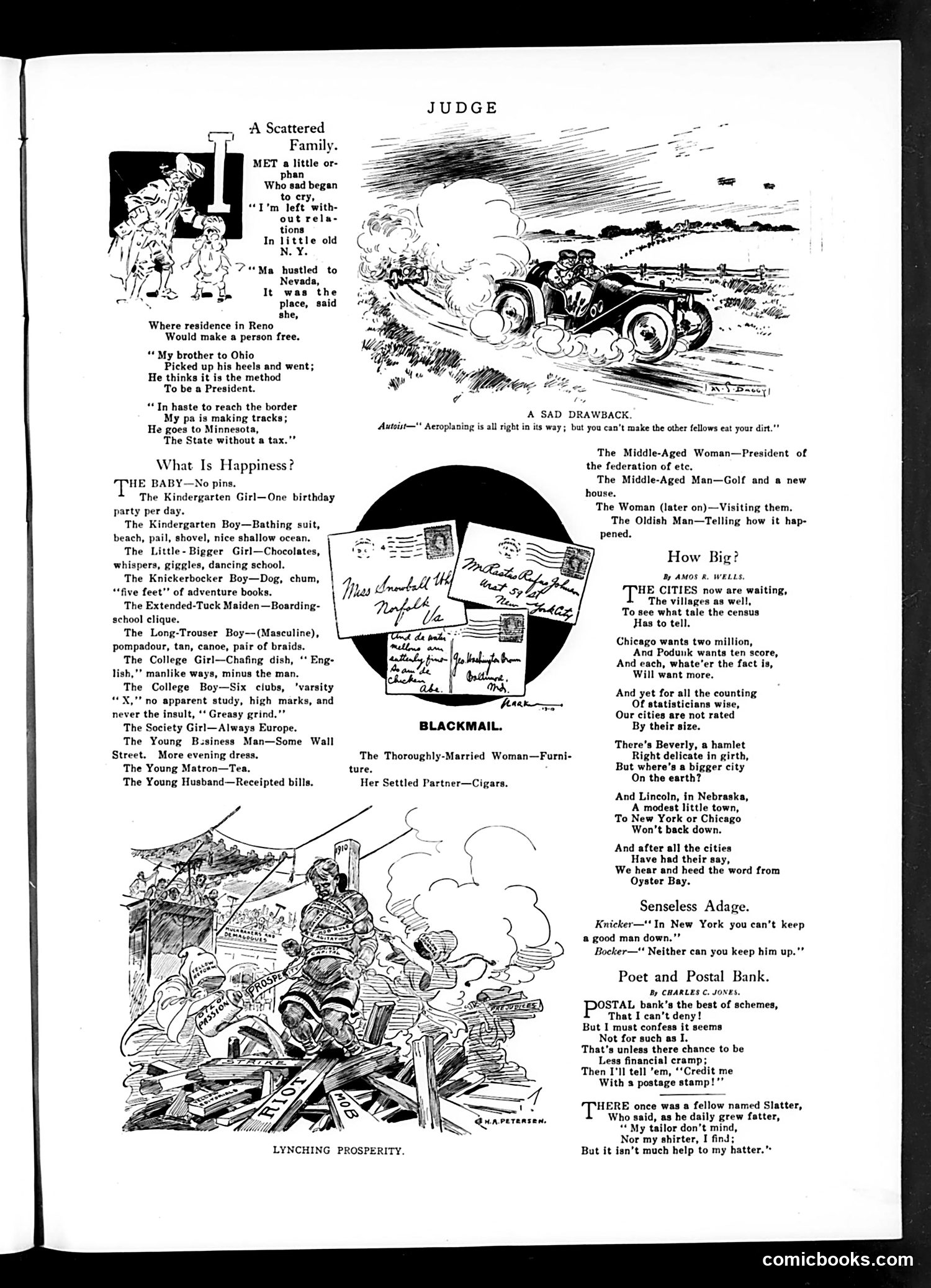
The main cartoon shows a speeding automobile kicking up dust, with the caption criticizing aeroplaning (early aviation) as acceptable but questioning whether "you can't make the other fellows eat your dirt"—satirizing reckless drivers who endanger pedestrians. "Lynching Prosperity" depicts a chaotic pile of materials and people, apparently critiquing economic mismanagement or social disorder destroying prosperity. The "Blackmail" section features handwritten letters, likely satirizing correspondence or communication scandals. Other sections mock contemporary concerns: scattered families emigrating, urban growth statistics, and social pretensions. The humor targets early 20th-century anxieties about modernization, immigration, city expansion, and automobile culture—technologies and social changes disrupting traditional American life. The tone is broadly conservative, mocking both progressive optimism and contemporary social problems.
📄 Transcribed text from this page (OCR, searchable)
Machine-transcribed from the original scan — historical spelling and the odd misread are preserved.
A Scattered Family. MET a little or- phan Who sad began to ery, “I'm left with- out rela- tions In little old 7 “Ma hustled to Nevada, Where residence in Reno Would make a person free. “« My brother to Ohio Picked up his heels and went; He thinks it is the method To be a President. “*In haste to reach the border My pa is making tracks; He goes to Minnesota, The State without a tax."” What Is Happiness? THE BABY —No pins. The Kindergarten Girl—One birthday party per day. The Kindergarten Boy—Bathing suit, beach, pail, shovel, nice shallow ocean. The Little- Bigger Girl—Chocolates, whispers, giggles, dancing school. The Knickerbocker Boy—Dog, chum, “five feet’ of adventure books. The Extended-Tuck Maiden—Boarding- school clique. The Long-Trouser Boy—(Masculine), pompadour, tan, canoe, pair of braids. The College Girl—Chafing dish, ‘ Eng- lish,” manlike ways, minus the ma The College Boy—Six clubs, ‘varsity “X,"" no apparent study, high marks, and never the insult, ‘‘ Greasy grind.”” The Society Girl—Always Europe. The Young Bzsiness Man—Some Wall Street. More evening dres: The Young Matron—Tea. The Young Husband—Receipted bills. LYNCHING PROSPERITY. ture. A SAD DRAWBACK. Auutoist—"* Aeroplaning is all right in its way; but you can't make the other fellows eat your dit The Middle-Aged Woman—President of the federation of etc. The Middle-Aged Man—Golf and a new house. The Woman (later on)—Visiting them. The Oldish Man—Telling how it hap- How Big? By AMOS &. WELLS. Ts! CITIES now are waiting, The villages as well, To see what tale the census Has to tell. Chicago wants two million, ‘And Podunk wants ten score, And each, whate'er the fact is, Will want more. And yet for all the counting Of statisticians wise, Our cities are not rated BLACKMAIL. By their size. There's Beverly, a hamlet Right delicate in girth, But where's a bigger city On the earth? And Lincoln, in Nebraska, A modest little town, To New York or Chicago Won't back down. And after all the cities Have had their say, We hear and heed the word from Oyster Bay. The Thoroughly-Married Woman—Furni- Her Settled Partner—Cigars. Senseless Adage. Knicker—'‘ In New York you can’t keep a good man down.’? Bocker—"‘ Neither can you keep him up."” Poet and Postal Bank. By CHARLES C. JONES. poster bank’s the best of schemes, That I can’t deny! But I must confess it seems Not for such as I. That's unless there chance to be Less financial cramp; Then I'll tell ’em, ‘‘Credit me With a postage stamp!”” HERE once was a fellow named Slatter, as he daily grew fatter, lor don’t mind, Nor my shitter, I find; But it isn’t much help to my hatter.” comicbooks.com