
A complete issue · 16 pages · 1910
Judge — July 23, 1910
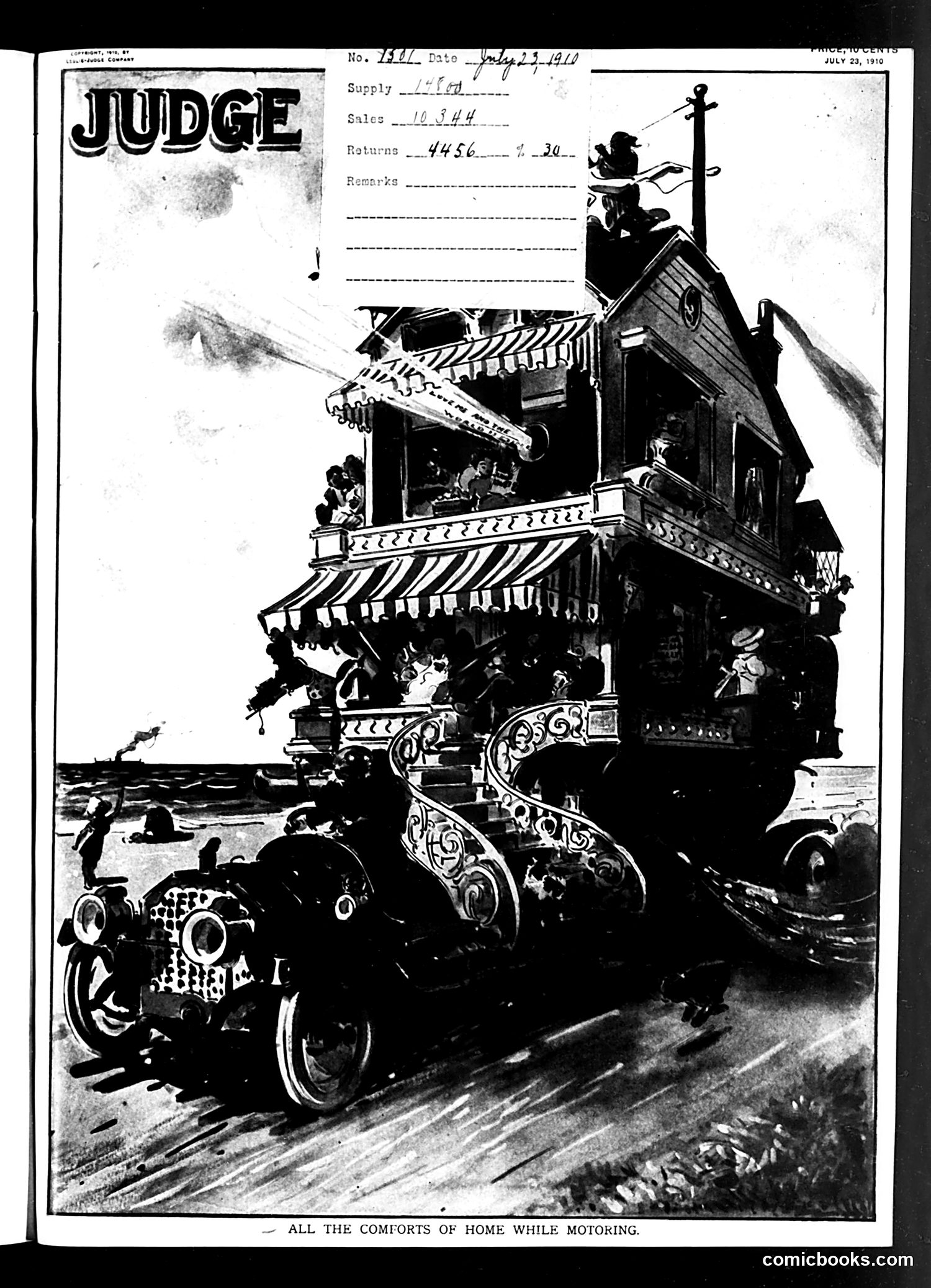
This satirical illustration titled "All the Comforts of Home While Motoring" depicts an elaborate, multi-story Victorian mansion impossibly perched atop an early automobile. The structure includes multiple levels, ornate balconies, a church steeple, and numerous people visible in windows and on balconies. The satire mocks the emerging automobile culture and wealthy Americans' desire for luxurious travel. It suggests the absurdity of motorists attempting to transport their domestic comforts—their homes themselves—while traveling. The joke satirizes both automotive excess and the reluctance of the wealthy elite to abandon their lavish living standards, even temporarily, for modern transportation. It's a commentary on class pretension during the early automobile era.
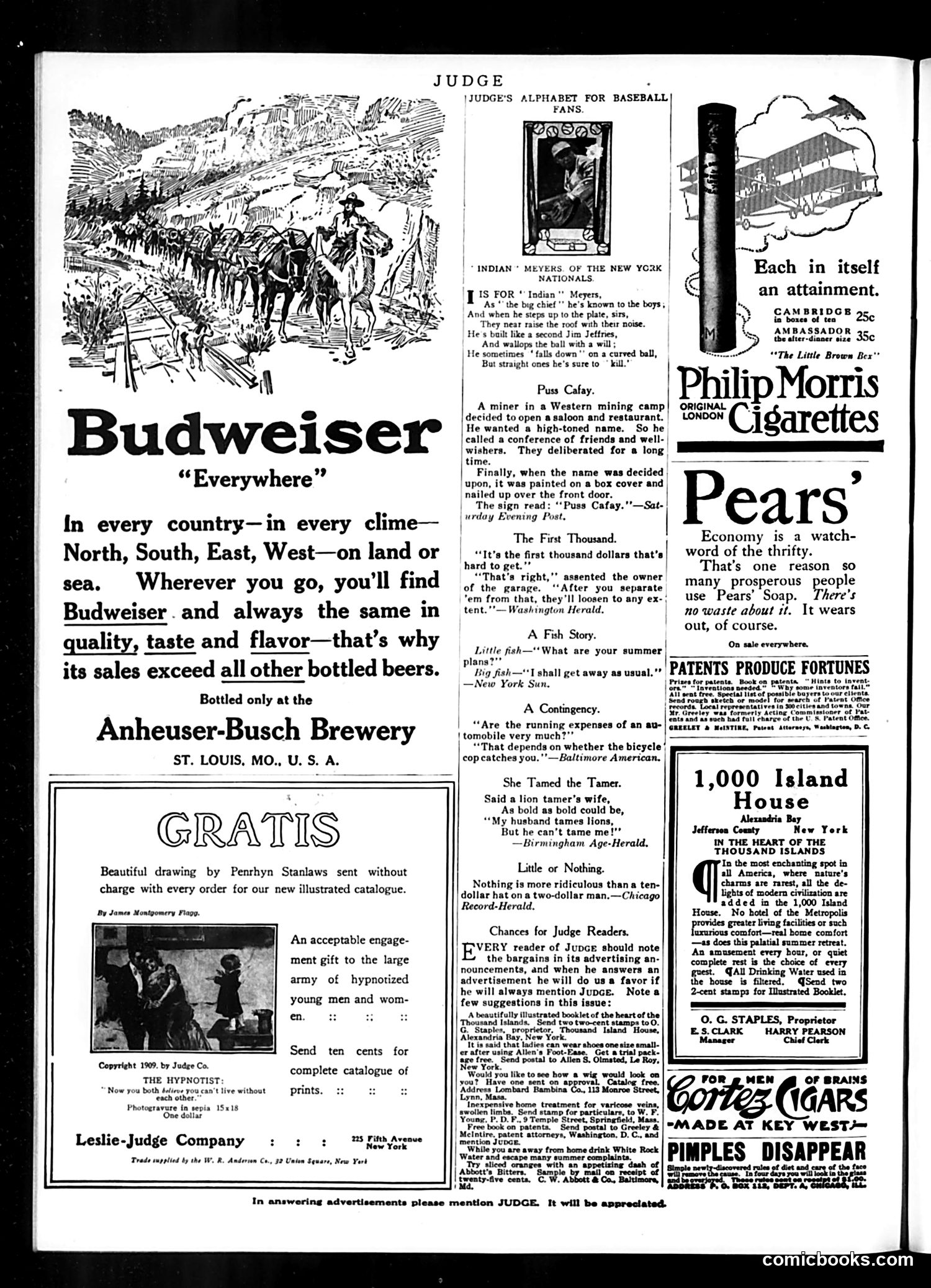
This page is primarily **advertisements** interspersed with brief humor items, not political cartoons. The main content includes ads for Budweiser beer, Philip Morris cigarettes, Pears' soap, and other products. The large illustration at left shows a Western scene with horses and riders—context for a Budweiser ad claiming global availability. The "Judge's Alphabet for Baseball" section contains short jokes about baseball players, using "Indian" as wordplay (likely referencing a player nicknamed "Indian"). Other brief humor items include puns about miners, fish, and taming lions—typical light magazine filler of the era. The Leslie-Judge Company advertisement offers a free illustrated catalog. This appears to be a **standard magazine issue** blending advertising revenue with light humor, rather than focused satirical commentary.
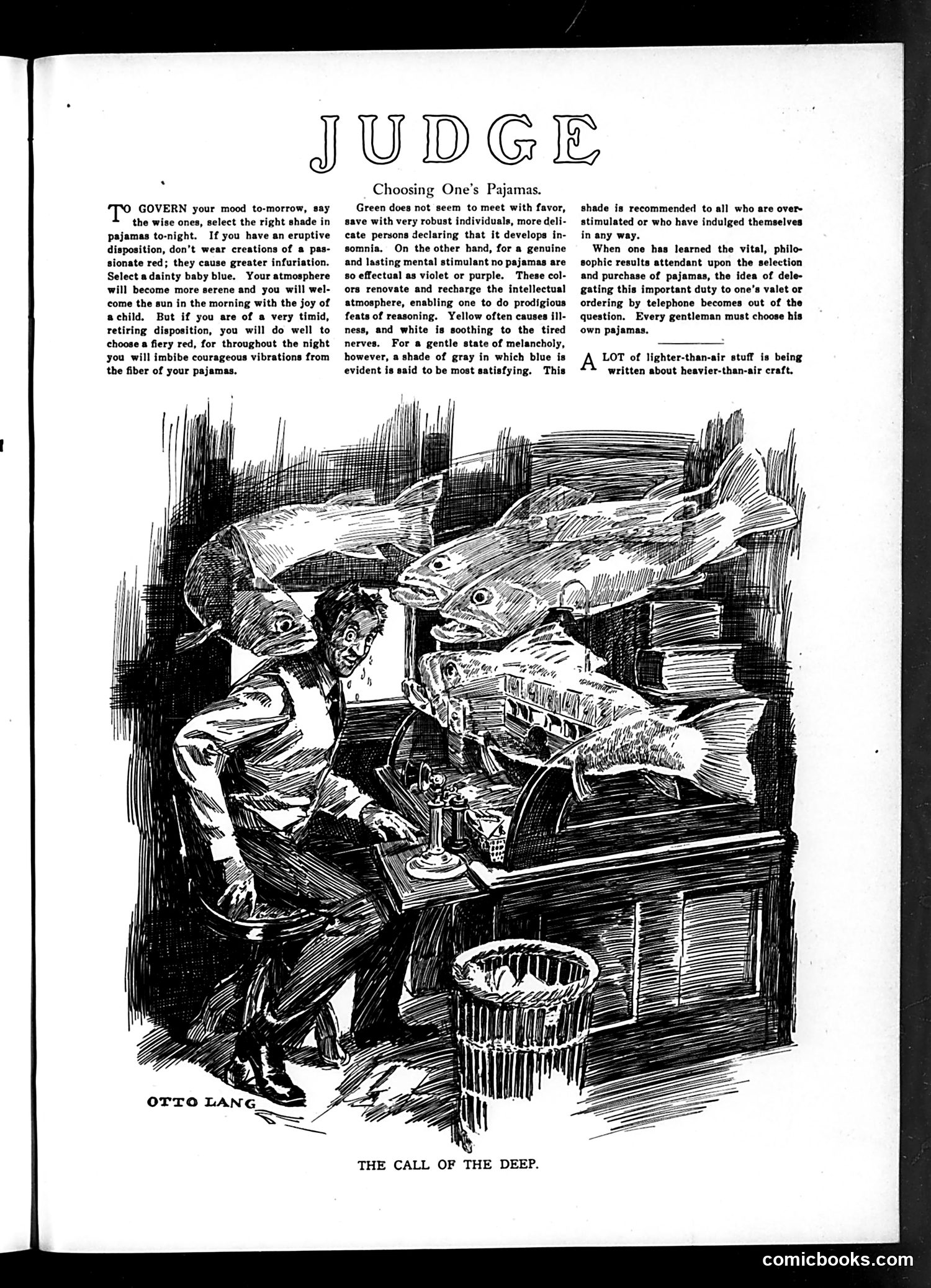
This page contains a humorous article titled "Choosing One's Pajamas" offering advice on selecting nightwear colors based on mood and personality. The accompanying illustration by Otto Lang, captioned "The Call of the Deep," depicts a surreal scene: a man at a desk surrounded by oversized fish appearing to emerge from or encircle his workspace. The cartoon likely satirizes the article's somewhat absurd, overwrought tone about pajama selection. The fish imagery creates visual humor through incongruity—mixing mundane domestic concerns (pajamas) with fantastical elements (marine creatures). This appears to be typical of Judge magazine's blend of social commentary and absurdist humor targeting middle-class anxieties about proper etiquette and personal choices.
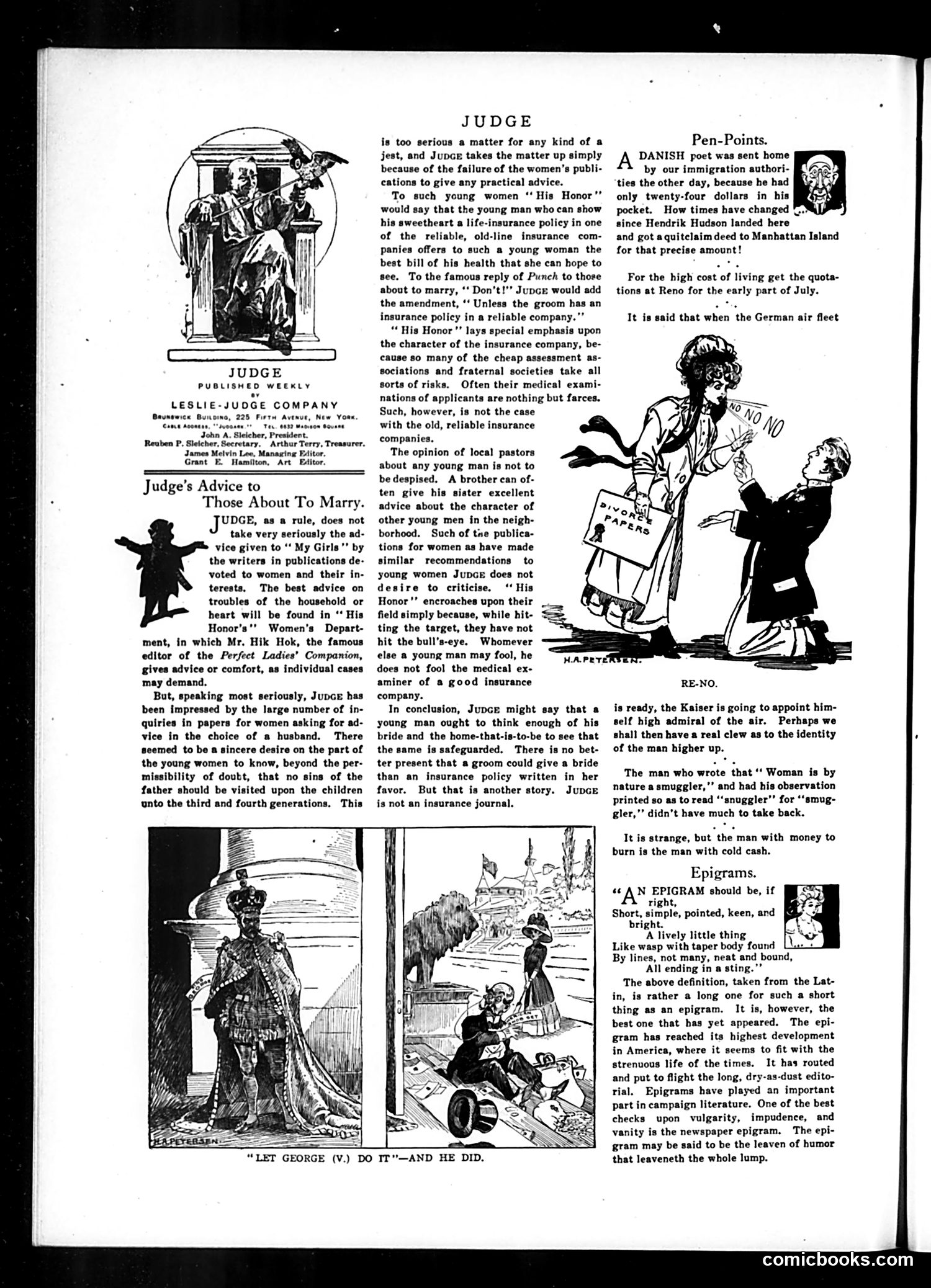
This page contains editorial content and advertisements rather than political cartoons. The main article, "Judge's Advice to Those About to Marry," offers satirical commentary on marriage preparation, specifically advising young men to ensure their prospective brides have life-insurance policies from reliable companies—a humorous dig at mercenary motives in marriage. The "Pen-Points" section references a Danish immigrant who arrived with only twenty-four dollars, later changing his name to "Hendrik Hudson" after landing in Manhattan, mocking the Americanization of immigrant names. The bottom section includes illustrations captioned "Let George (V.) Do It—And He Did," likely referencing King George V during WWI, suggesting British leadership in the war effort.
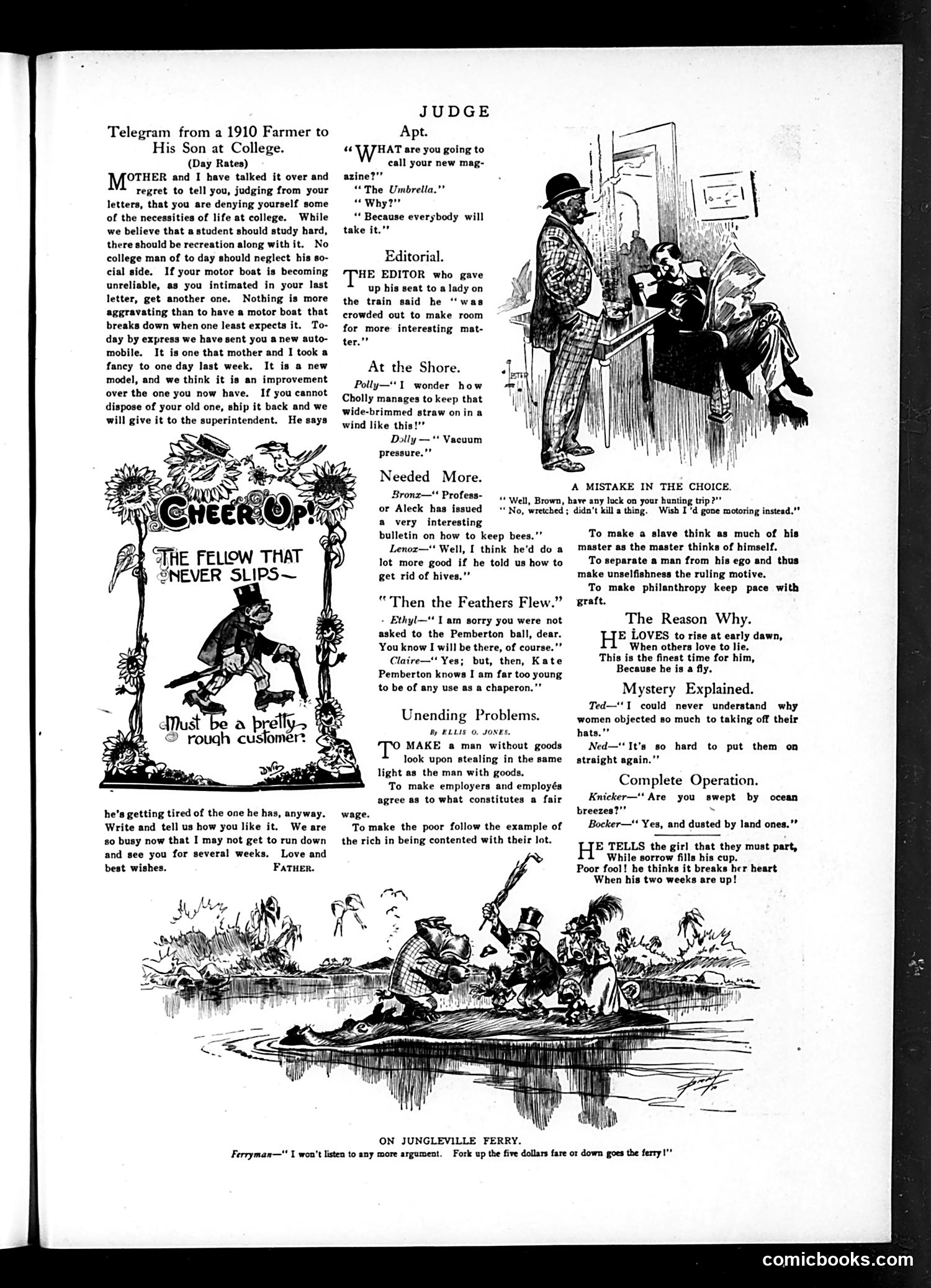
This page contains several satirical pieces typical of early 1900s humor magazines: **"A Mistake in the Choice"** (top right cartoon): Shows a man defending his choice of a motorcar over a horse, claiming the automobile won't kill things—apparently satirizing both new automobile enthusiasm and perhaps debates about their safety versus traditional horses. **"The Fellow That Never Slips"** (left): A decorative piece about maintaining customer loyalty, using ornamental design. **Various short humor pieces** include editorial commentary on social issues like labor disputes ("Unending Problems"), relationships ("The Reason Why"), and romantic complications ("Complete Operation"). **"On Jungleville Ferry"** (bottom): A scene-based joke about ferry operations and arguments. The page reflects turn-of-century American concerns: technology adoption, labor relations, courtship customs, and class dynamics—presented through Judge's typical satirical wit and illustration style.
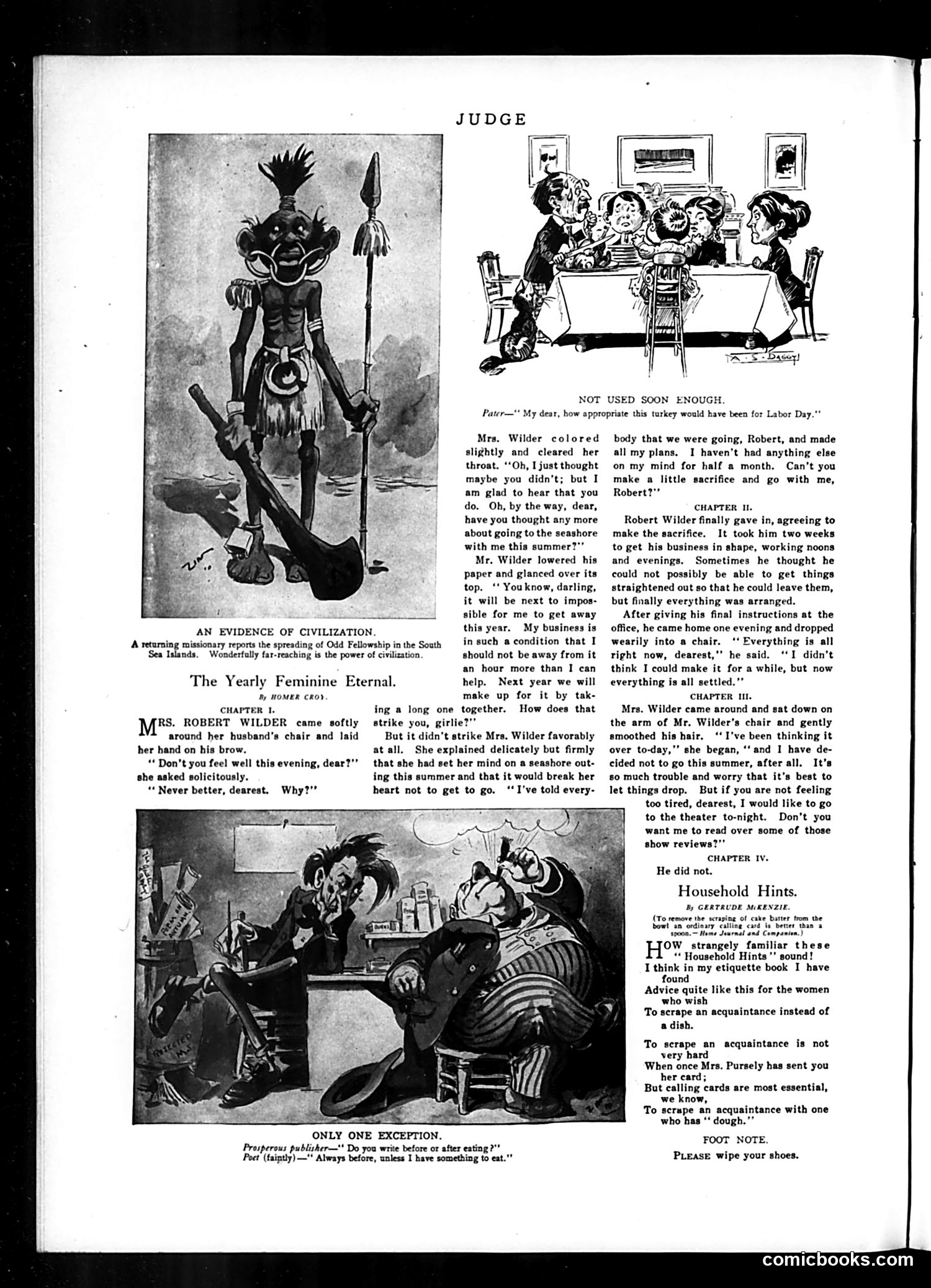
This page from Judge satirizes married life and gender dynamics of the era. "The Yearly Feminine Eternal" depicts a recurring marital pattern: Mrs. Wilder pressures her husband Robert into a seashore vacation, he reluctantly agrees after weeks of sacrifice and business reorganization, then she abruptly cancels to attend the theater instead—leaving him frustrated and exhausted. The satire targets wives' perceived capriciousness and emotional manipulation, portraying women as self-centered and indifferent to their husbands' efforts and feelings. This reflects period attitudes about domestic gender roles and frustrations. The page also includes unrelated cartoons: "An Evidence of Civilization" (about missionary work spreading Odd Fellowship), "Only One Exception" (a starving poet joke), and "Household Hints" (satirizing women seeking wealthy acquaintances through calling cards). These pieces reflect Judge's typical content: social satire targeting both genders, though with misogynistic undertones common to early 20th-century humor publications.
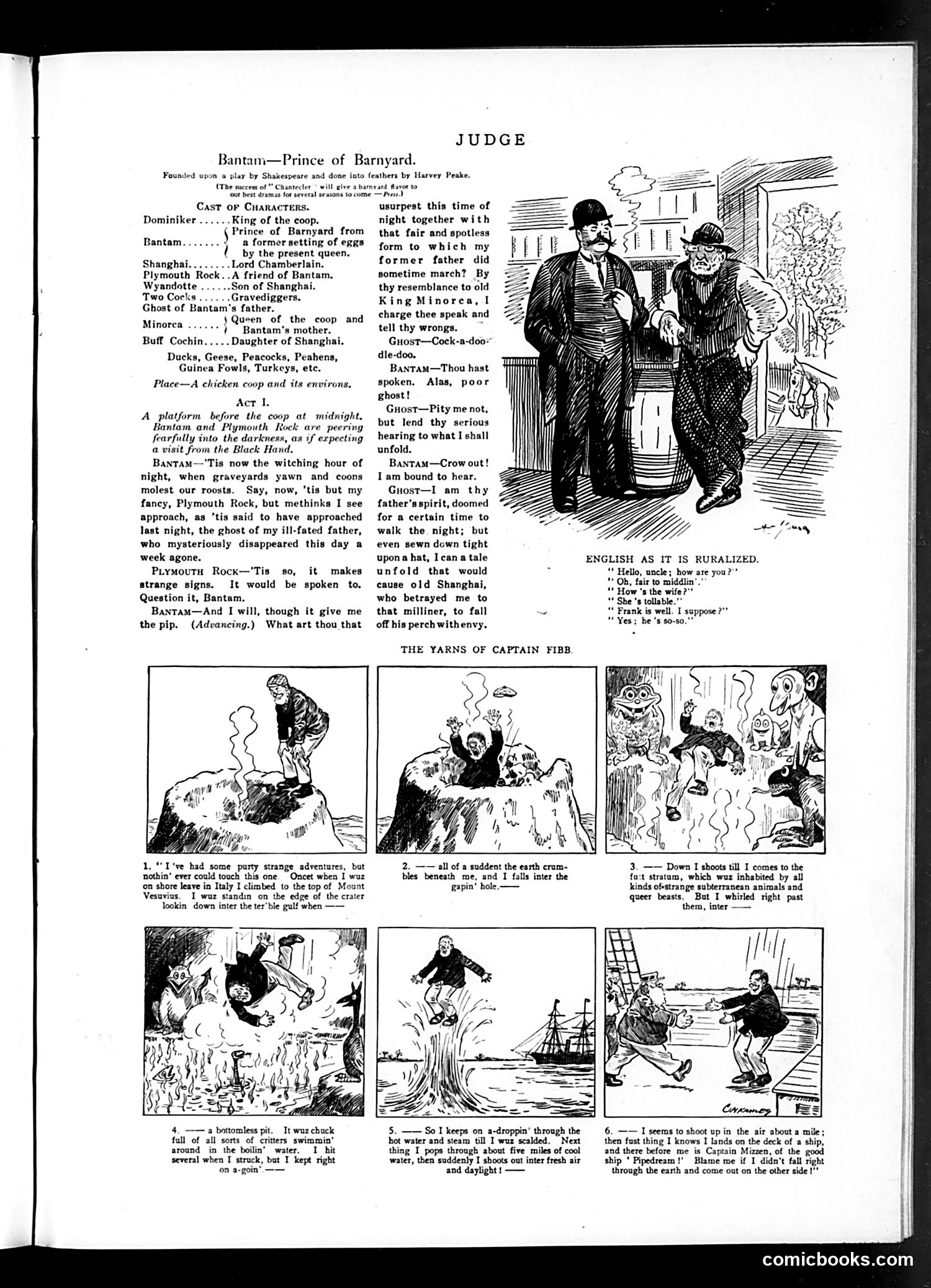
This page contains two distinct satirical pieces: **"Bantam—Prince of Barnyard"** is a parody of Shakespeare's *Hamlet*, reimagined with barnyard fowl as characters. The setup mimics the famous ghost scene, with Bantam (the prince) confronted by his father's spirit in a chicken coop at midnight. The satire mocks both Shakespeare's dramatic conventions and contemporary theatrical adaptations by applying them absurdly to poultry—replacing existential drama with barnyard gossip about betrayal by "old Shanghai" and a milliner. The joke relies on the incongruity of elevated Shakespearean language describing chicken concerns. **"The Yarns of Captain Fibb"** is a tall-tale comic strip mocking exaggerated adventure narratives. An old sea captain recounts an implausibly elaborate journey through Mount Vesuvius involving bottomless pits, subterranean creatures, and impossible physics—each panel escalating the absurdity. The humor targets credulous audiences who accept such obviously fabricated stories. The page's minor "English as It Is Ruralized" section satirizes rural dialect speech patterns using phonetic spelling.
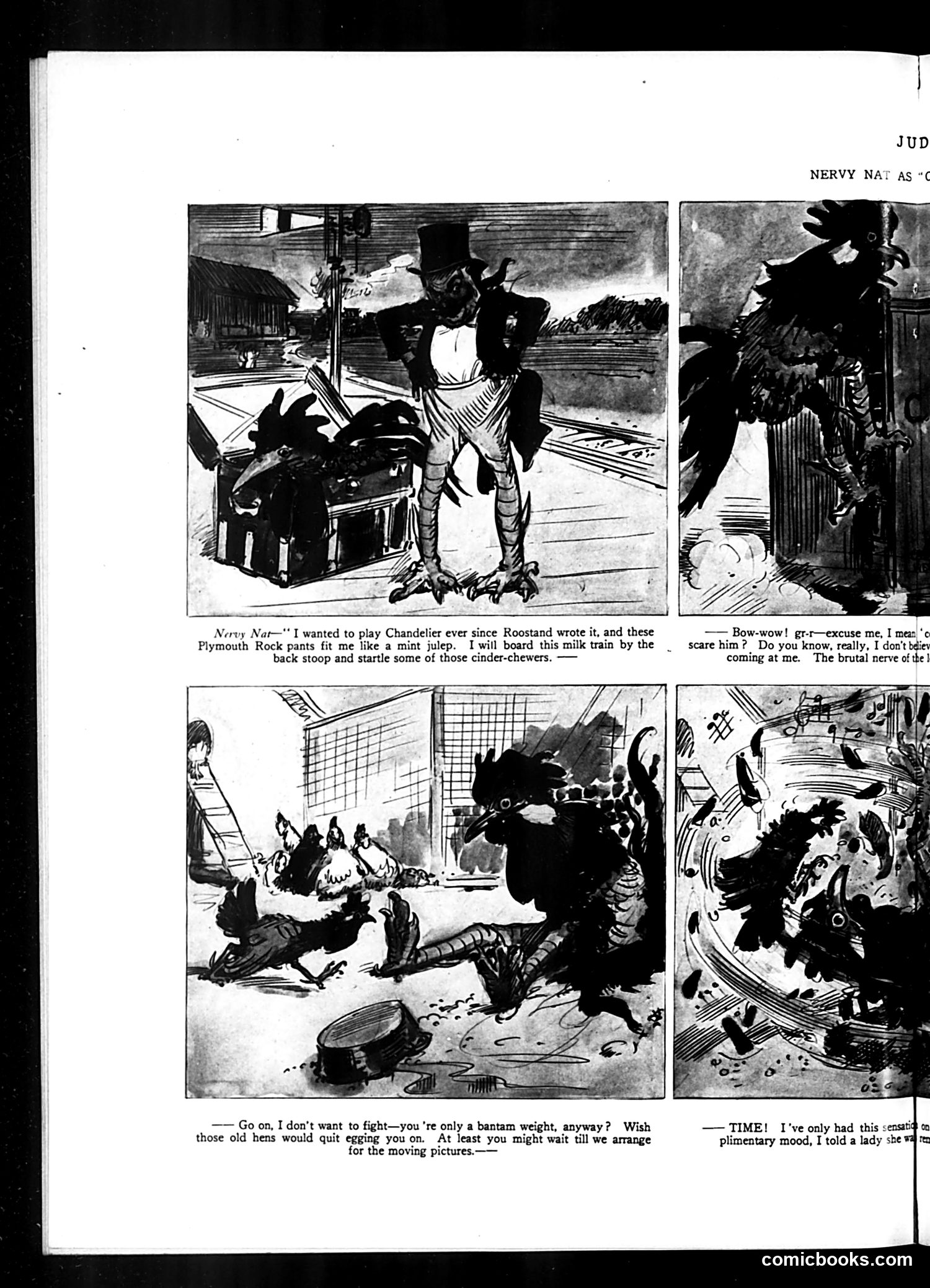
This appears to be a multi-panel comic strip titled "Nervy Nat" satirizing theatrical pretension and aggressive behavior. The protagonist (Nervy Nat) is depicted as an obnoxious character who wants to play the lead role in "Chandelier" (likely referencing Edmond Rostand's famous play). The humor hinges on Nat's absurd reasoning—claiming Plymouth Rock pants fit him "like a mint julep" (mixing metaphors ridiculously)—and his aggressive, antagonistic behavior toward others, particularly seeming to threaten "cinder-chewers" (a derogatory term, possibly referring to poor or working-class people). The subsequent panels show confrontations: someone warning him not to fight, references to "moving pictures" (early film), and complaints about his rudeness and timing. The satire targets theatrical arrogance, social climbing, and obnoxious male behavior disguised as sophistication—common Judge magazine targets of the early 20th century.
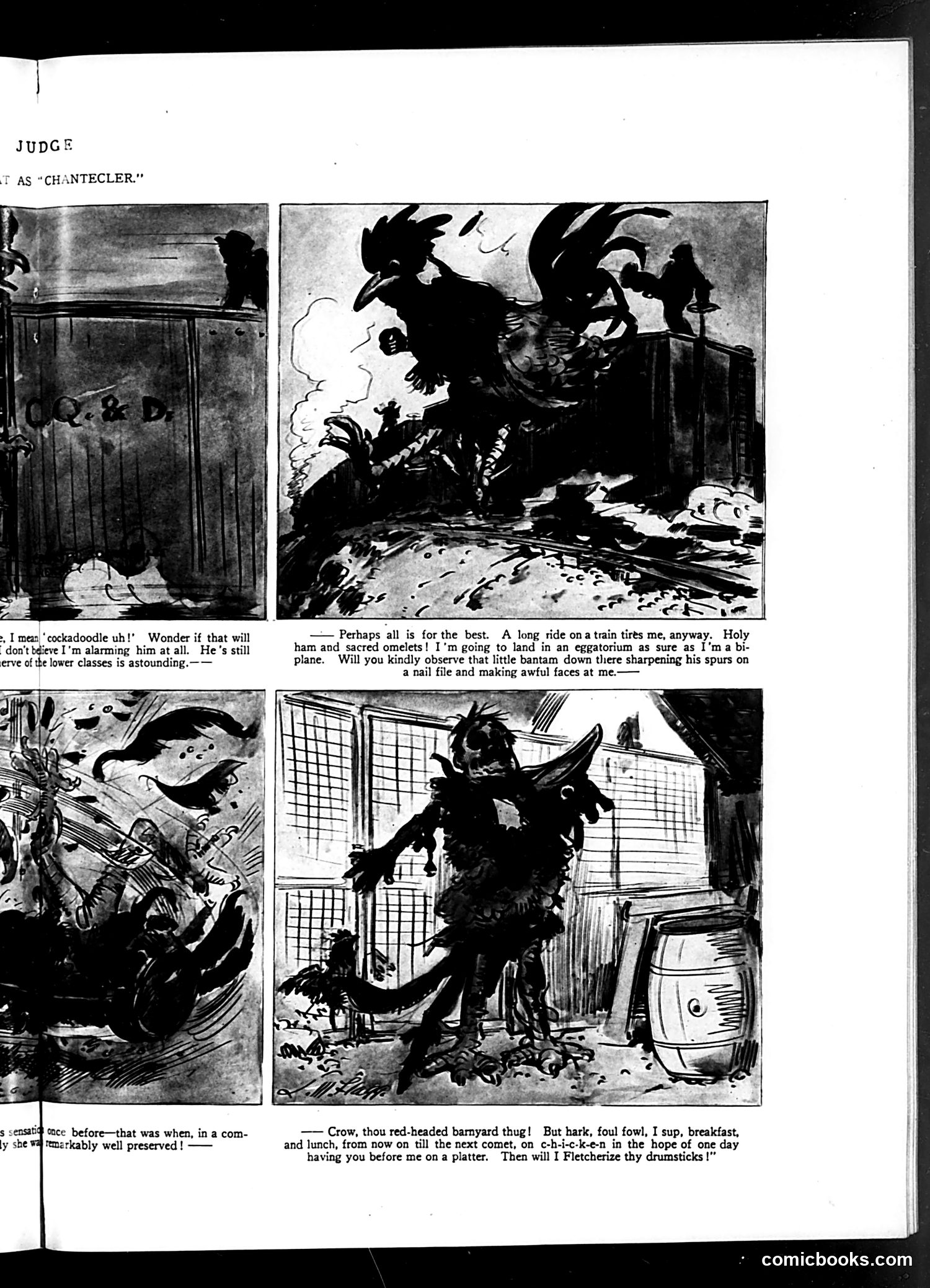
This page satirizes Edmond Rostand's theatrical hit "Chantecler" (1910), a play featuring a rooster as protagonist. The comic shows a character's theatrical preparations and encounters with actual barnyard fowl. The satire mocks both the pretentious French play and the character's affected, verbose manner. References to "eggatorium," "holy ham and sacred omelets," and theatrical declarations about eating chicken ("c-h-i-c-k-e-n") parody the play's grandiose tone. The character threatens to "Fletcherize" (chew thoroughly, per health fad Fletcherism) the rooster's drumsticks. The bottom panels show slapstick comedy as actual roosters assault the would-be actor—deflating his theatrical pomposity through physical humor. Judge ridicules both the intellectual pretensions of the original French drama and American audiences' hunger for such "highbrow" entertainment, suggesting reality (and roosters) matter more than artistic affectation.
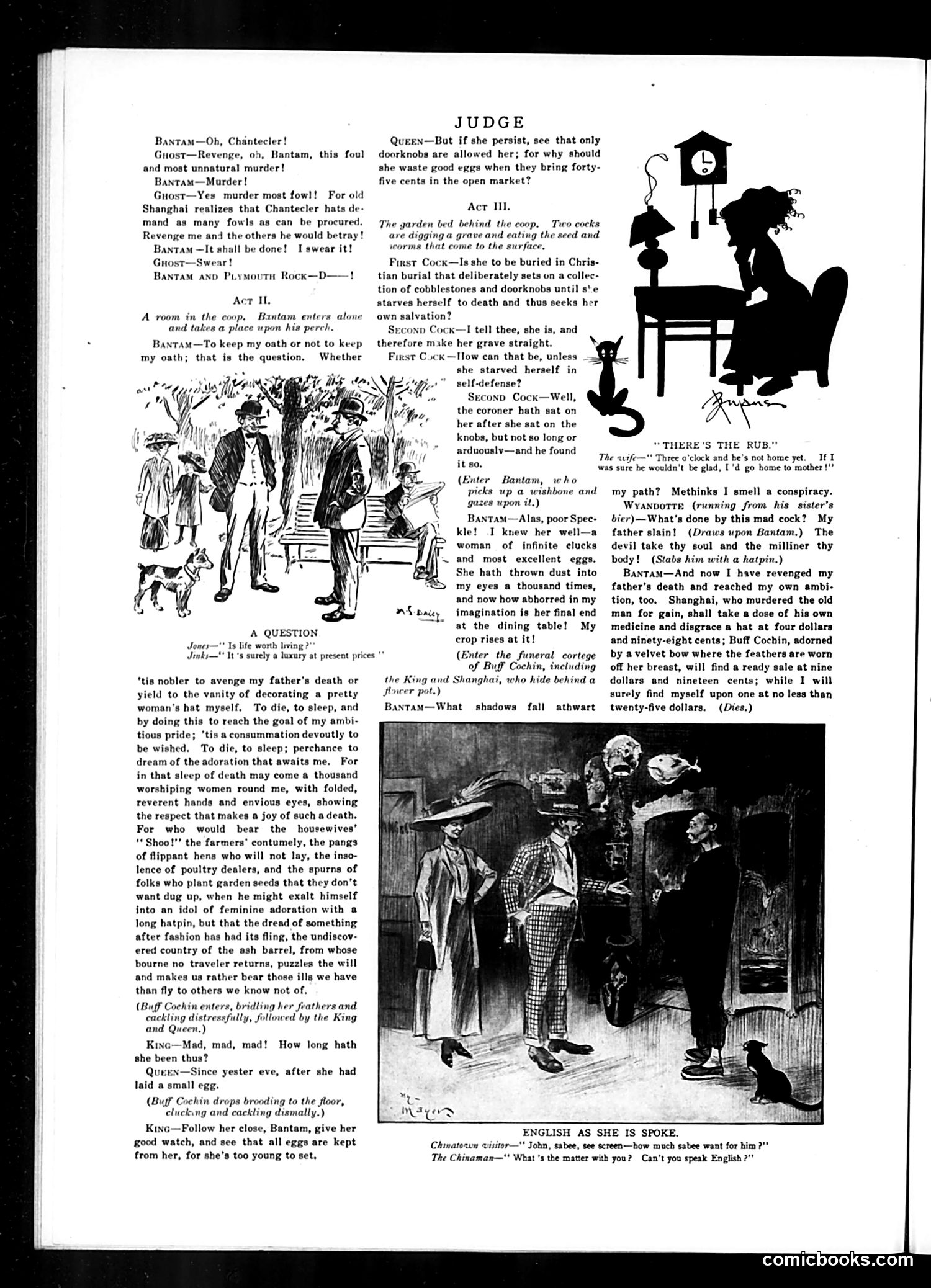
This page parodies Shakespeare's *Hamlet*, transplanting the Danish prince's tragic revenge tale into a chicken coop. The plot involves roosters debating whether to avenge a fellow bird's death, with references to feather-adorned women's hats—a contemporary fashion obsession. The satire targets **early 1900s hat fashion**, specifically the use of bird feathers and whole birds as millinery decoration. The joke: roosters face an existential dilemma because demand for feathered hats threatens their species. The Buff Cochin hen's madness and death parody Ophelia's tragedy, while the mock-philosophical soliloquies mock both Shakespeare and the vanity of fashionable women who wear such elaborate headpieces. The bottom cartoon, "English as She Is Spoke," satirizes a Chinese woman's difficulty with English language—likely commenting on immigrant experiences or Orientalist attitudes of the era. The satire ultimately ridicules women's fashion excess through absurdist humor.
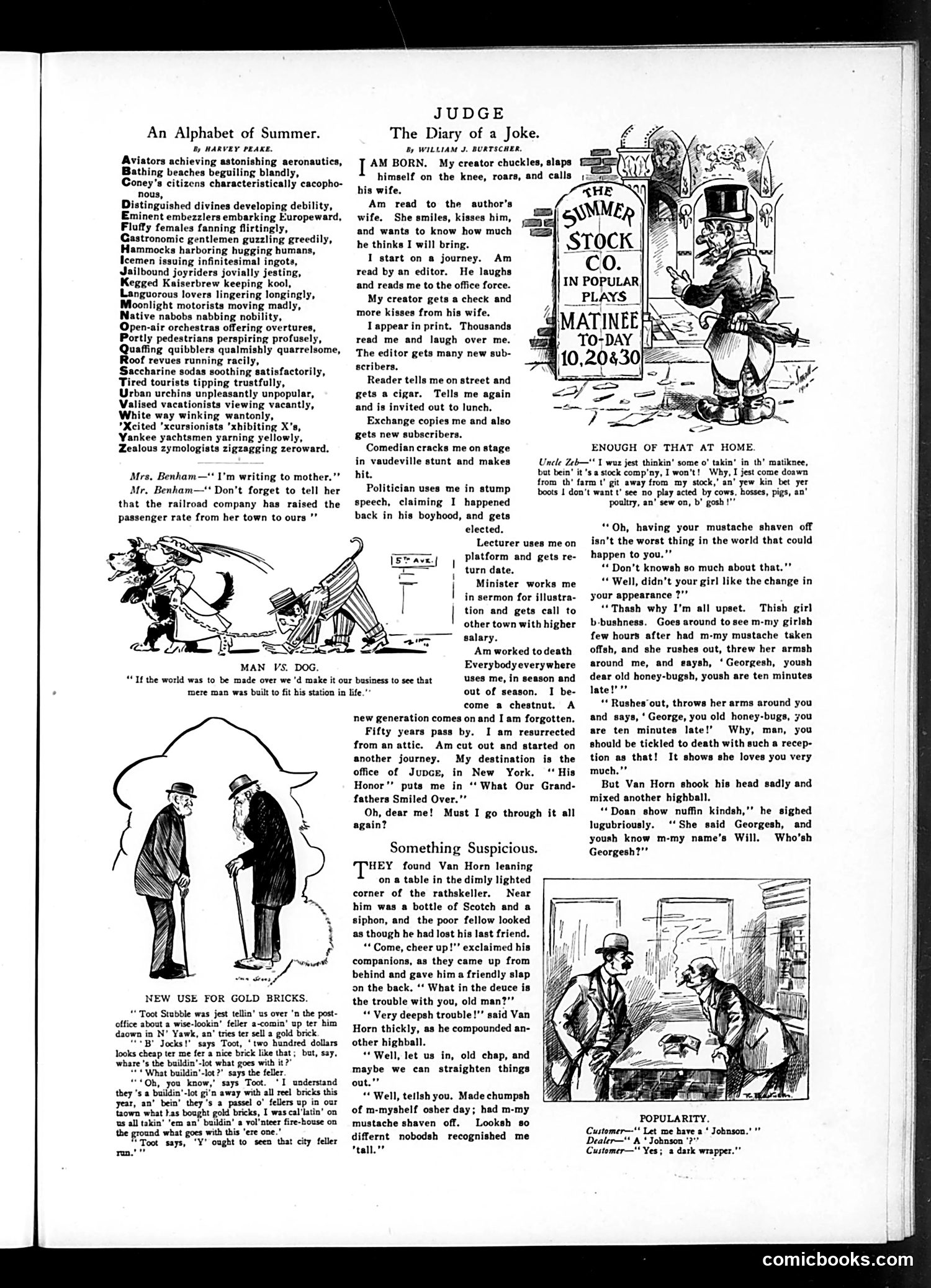
This page from Judge magazine contains three distinct humorous pieces typical of early 20th-century American satire: **"An Alphabet of Summer"** is a lighthearted alliterative list mocking summer activities and types—from aviators to zymologists—capturing urban leisure culture's pretensions and excess. **"The Diary of a Joke"** traces how a single joke circulates through society, gaining value as it passes from creator to editor to performer to politician, each profiting while the joke becomes exhausted ("chestnut"). **"Enough of That at Home"** satirizes stock company theater, with Uncle Zeb reluctant to see farm animals represented on stage when he deals with them daily—poking fun at rural audiences' disconnect from theatrical productions. The remaining sketches—"Man vs. Dog," "New Use for Gold Bricks," and others—are brief comedic vignettes about everyday situations. The "Gold Bricks" piece satirizes gullible rural people being sold worthless schemes, a recurring American stereotype of the era. Overall, the page reflects Judge's focus on mocking urban pretension, rural naïveté, and the commercialization of entertainment.
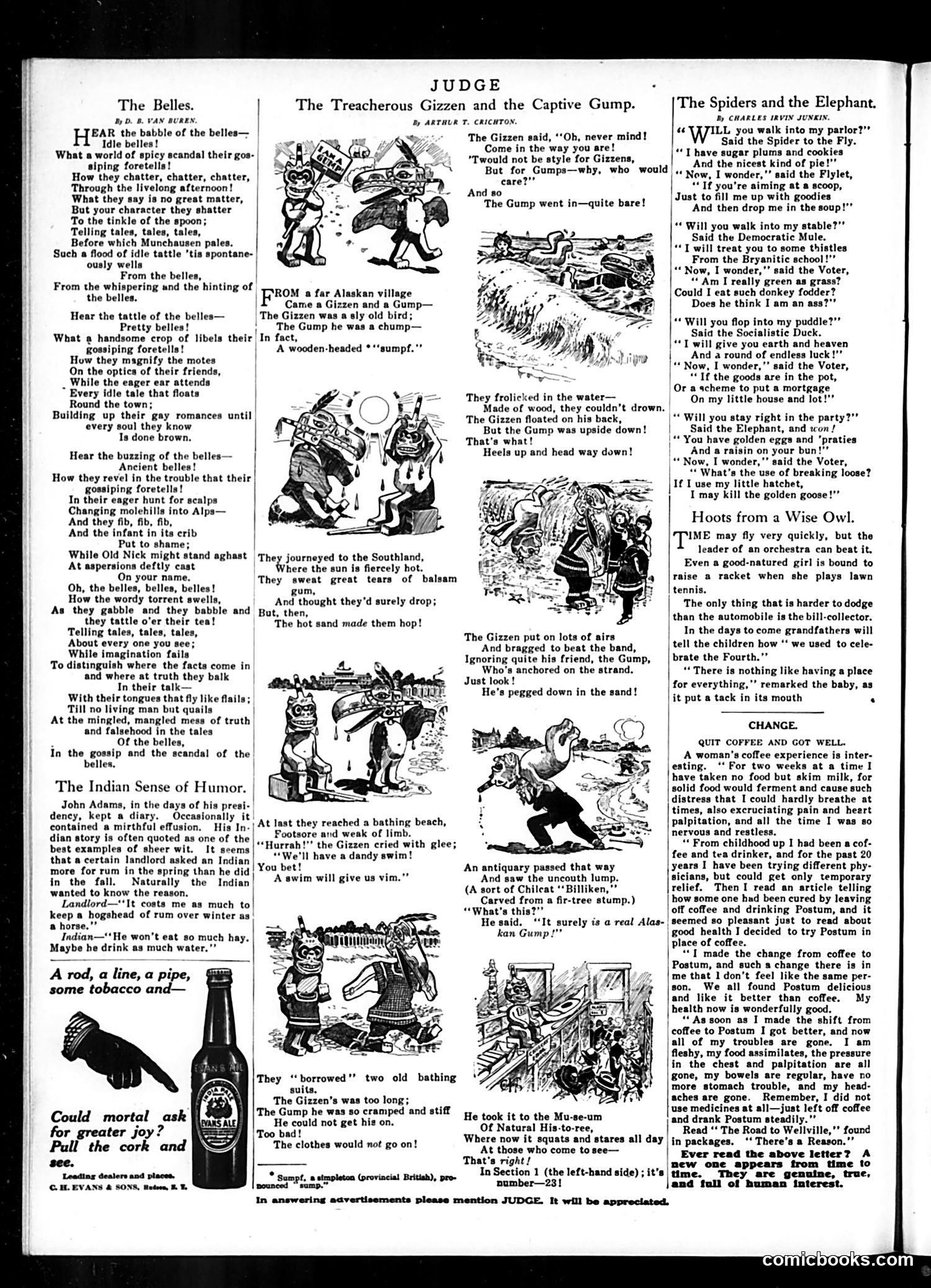
This page contains three separate pieces of satirical content: **"The Belles"** (left): A poem satirizing gossiping women. The verse attacks fashionable women ("belles") for spreading rumors and scandal through constant chatter at tea gatherings, exaggerating minor faults into major accusations, and blurring fact with fiction. The satire critiques their idle talk as destructive to reputations. **"The Treacherous Gizzen and the Captive Gump"** (center): A whimsical illustrated story about two characters—the boastful, vain "Gizzen" and the simple, wooden "Gump"—traveling from Alaska to the South. The Gizzen shows-off and ignores his companion. The satire appears to mock pretension and vanity, though the allegorical meaning is unclear without additional context. **"The Indian Sense of Humor"** (bottom left): A brief anecdote presenting Native American wit, depicting an Indian logically responding to a landlord's pricing explanation with practical reasoning. The page also includes a tobacco advertisement. Overall, these represent typical Judge magazine content: social satire targeting Victorian-era behavior.
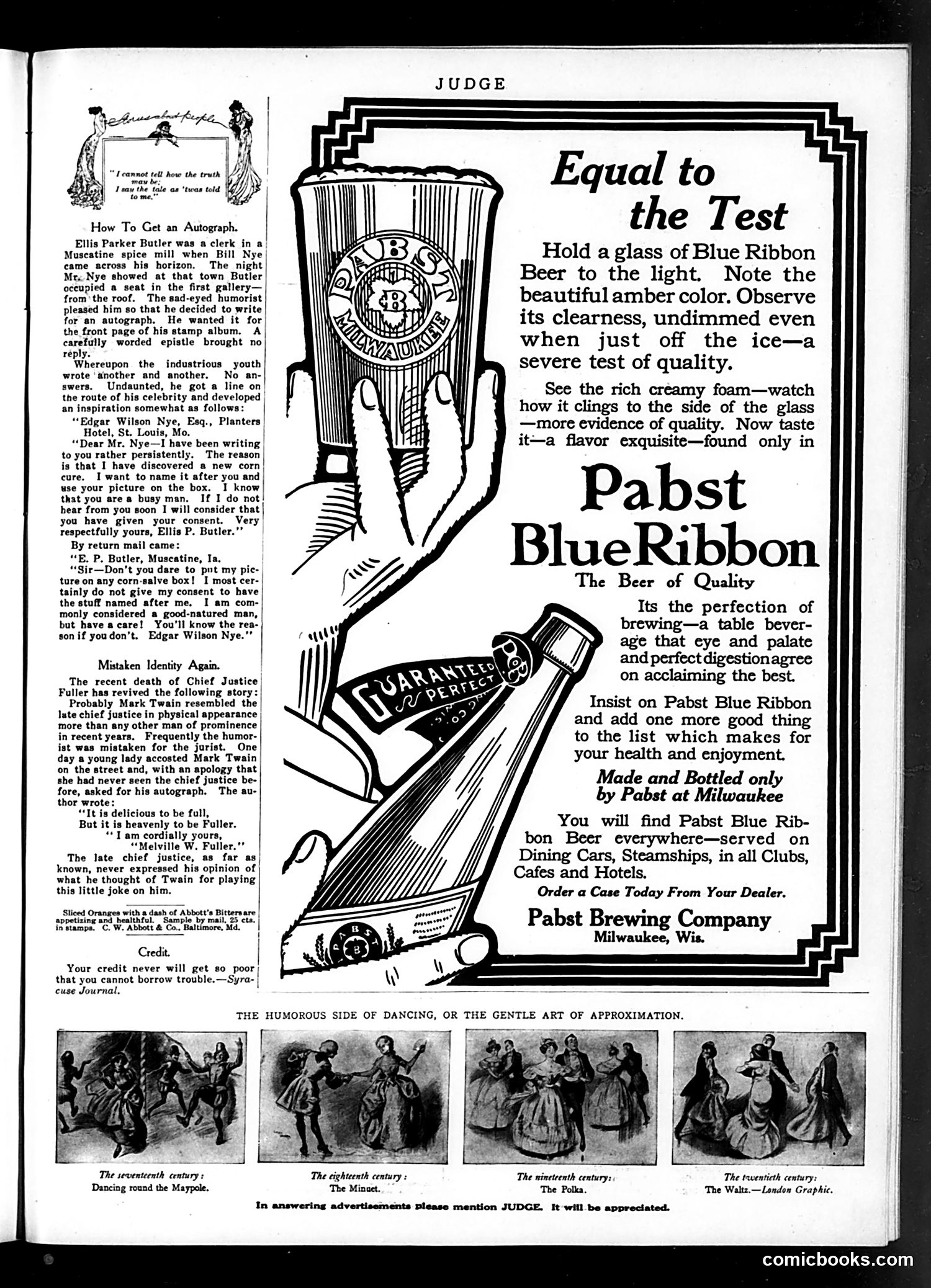
This page mixes humor and advertising. The main content includes two anecdotes about obtaining autographs through clever deception: 1. **Ellis Parker Butler's corn-cure scheme**: A young writer tricks humorist Bill Nye into responding by falsely claiming he wants to name a corn remedy after him. Nye's indignant reply grants the autograph the writer sought. 2. **Mark Twain impersonating Chief Justice Fuller**: A woman mistakes Twain for the recently deceased Chief Justice Fuller and asks for his autograph. Twain responds by signing Fuller's name with a witty pun ("It is delicious to be full, / But it is heavenly to be Fuller"). Both stories satirize the celebrity-autograph obsession of the era and demonstrate how clever subterfuge can manipulate famous people into compliance. The **Pabst Blue Ribbon advertisement** dominates the right side, emphasizing beer quality through visual and sensory tests (color, clarity, foam, taste). Below is a historical dance sequence showing changing dance styles across centuries, from the Maypole to the Waltz.
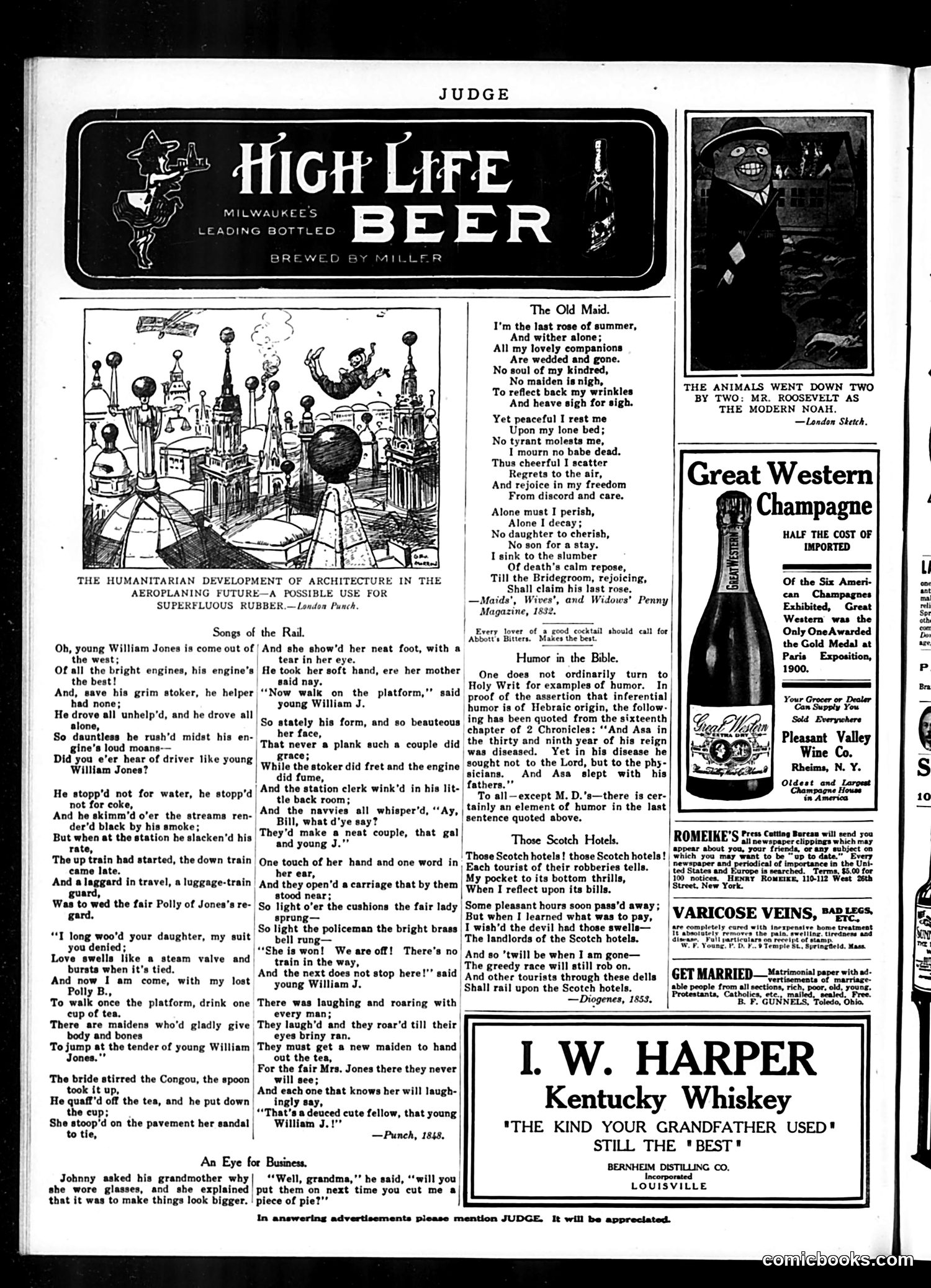
This page is primarily **advertising and light humor** rather than political commentary. The main cartoon, "The Humanitarian Development of Architecture in the Aeroplaning Future," depicts a fantastical futuristic cityscape with flying machines and spheres—satirizing overly optimistic predictions about technological progress and urban development. It's labeled a reprint from London's *Punch*, suggesting British satirical commentary on modern aspirations. The right sidebar includes a small cartoon about "Mr. Roosevelt as the Modern Noah," referencing Theodore Roosevelt's conservation efforts through a biblical metaphor—his animal preservation policies compared to Noah's ark. The page is dominated by **product advertisements** (High Life beer, I.W. Harper whiskey, Great Western Champagne) interspersed with sentimental poetry and light comic verse about romance and railway travel. The "Humor in the Bible" section offers mild wordplay rather than serious satire. Overall, this reflects *Judge*'s typical blend of genteel humor, advertising, and light social observation rather than hard-hitting political satire.
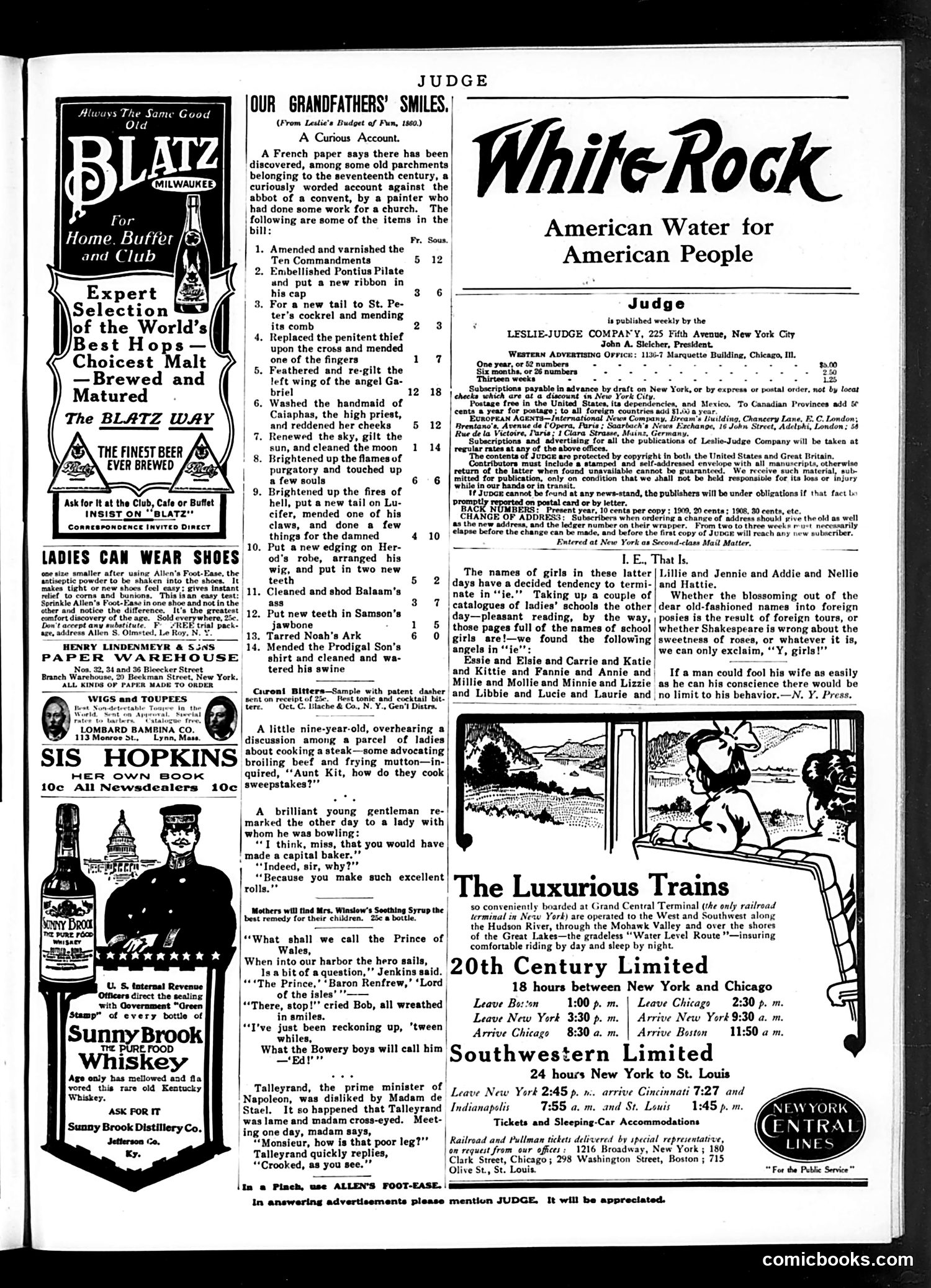
This is primarily an **advertising page** from Judge magazine, with a historical reprinted humor section. **The Main Content:** "Our Grandfathers' Smiles" reprints a humorous 1860s-era bill supposedly from a 17th-century painter who "repaired" religious artwork—the joke being absurdly irreverent items like fixing St. Peter's rooster's tail, gilding the devil's claws, and putting teeth back on Herod. It's religious mockery dressed as historical curiosity, typical of 19th-century anti-clerical humor. **The Advertisements:** Pages like this were common—showing period whiskeys, patent medicines, shoe powders, and the White Rock water brand (still extant today). The copy reflects early-1900s marketing: gender stereotypes ("Ladies Can Wear Shoes"), dubious medical claims, and casual casual drinking culture. **No Political Cartoon:** Despite the "JUDGE" masthead, this isn't satirical commentary—just ads, reprinted old jokes, and puns. The page represents how magazines subsidized content through advertising.
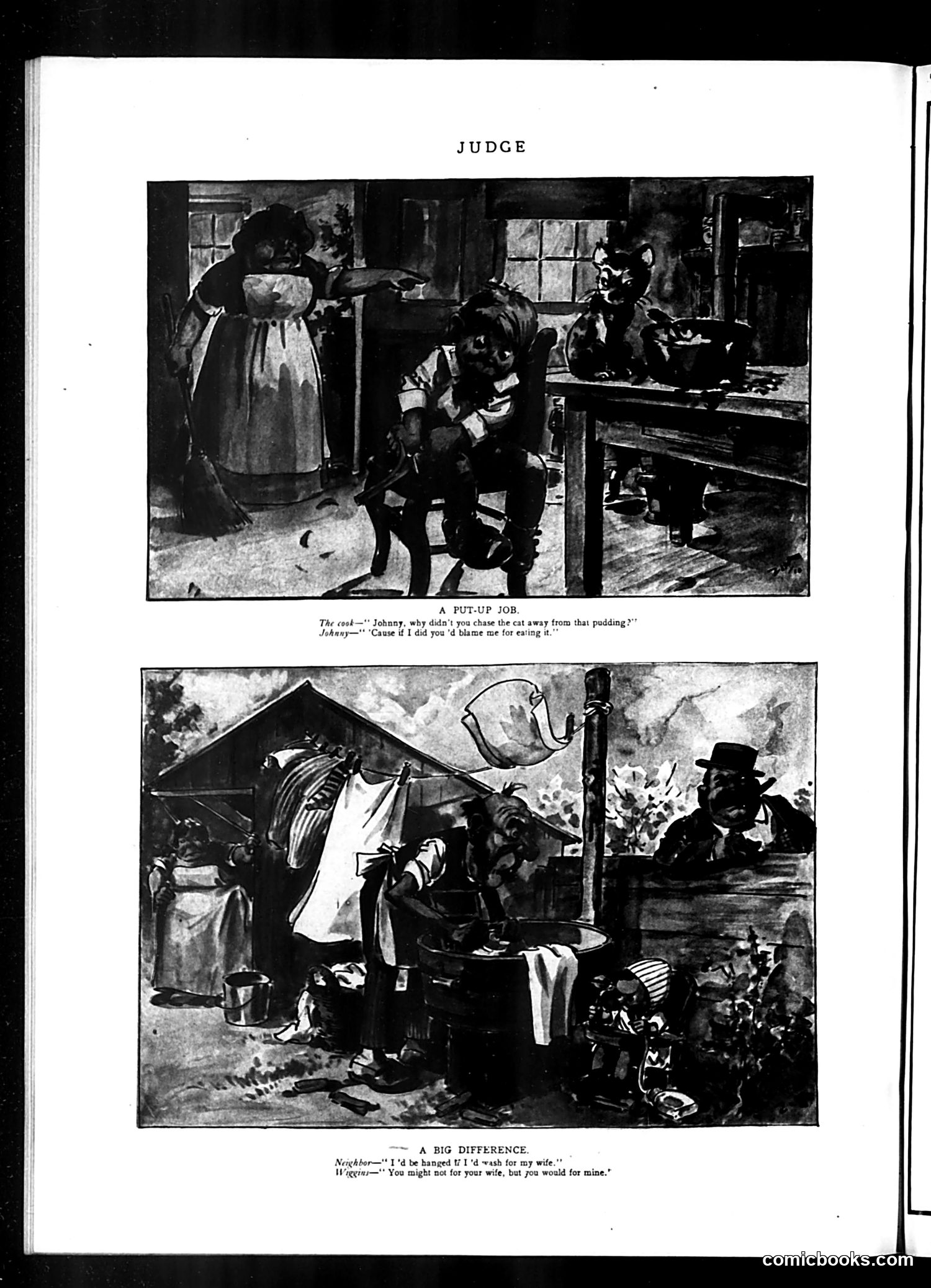
This page contains two domestic humor cartoons typical of early Judge magazine satire. **"A Put-Up Job"** depicts a cook accusing a boy (Johnny) of not stopping a cat from eating pudding. The joke plays on blame-shifting: Johnny deliberately allows the cat access so he won't be accused of theft himself—a cynical commentary on how servants or children in households were routinely blamed for missing food. **"A Big Difference"** shows two neighbors discussing laundry. One claims he wouldn't wash for his own wife, but the other cheekily suggests he *would* wash for his neighbor's wife—implying an affair or inappropriate attraction. This is marital infidelity humor, common to the era. Both cartoons reflect working-class and domestic anxieties: servants' precarious positions and marital suspicion. The humor relies on viewers understanding period household hierarchies and gender dynamics.