
A complete issue · 16 pages · 1910
Judge — May 28, 1910
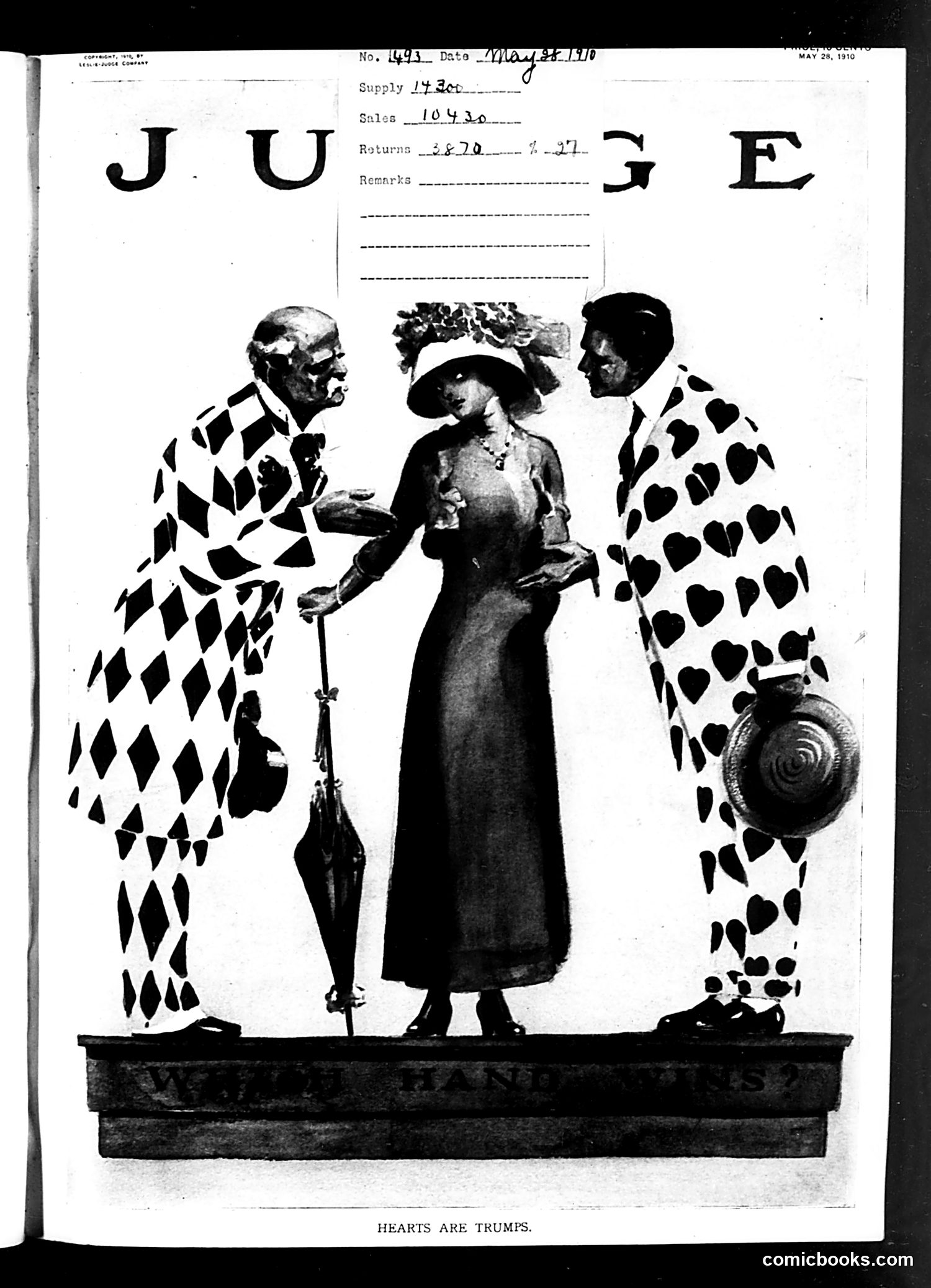
This Judge magazine page from May 24, 1910 depicts a woman in elegant dress flanked by two men in suits patterned with playing card suits (diamonds and hearts). The caption "Hearts Are Trumps" is a pun on card games. The cartoon appears to satirize romantic or matrimonial competition—the two men are vying for the woman's attention, with "hearts" (love/romance) being the winning "trump" card. The playing card patterns on their clothing reinforce the card-game metaphor. The page header shows supply/sales/returns figures, suggesting this accompanied broader Judge content. Without additional context, the specific identities of these figures remain unclear, though the piece likely comments on contemporary courtship dynamics or a recognizable romantic triangle from 1910 society or entertainment.
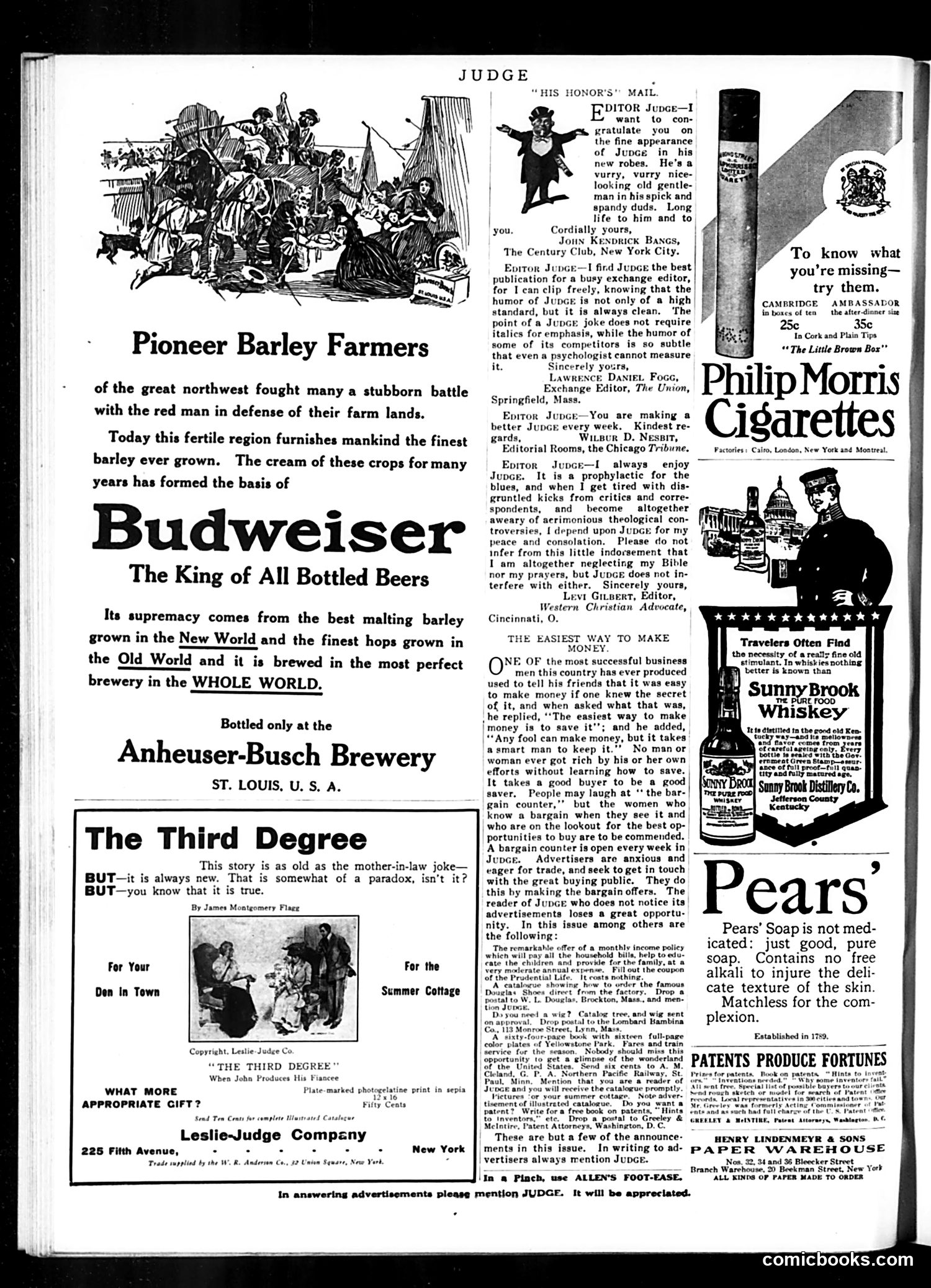
This page is primarily **advertising**, with one cartoon titled "The Third Degree" by James Montgomery Flagg occupying the lower left. The cartoon depicts what appears to be an **interrogation scene** with two panels—"for Your Dan in Town" and "for the Summer Cottage." The joke likely plays on the phrase "third degree" (police interrogation tactics), suggesting that questioning differs depending on context or setting. The cartoon's precise satirical target is unclear from the image alone, but Flagg's work typically satirized social pretension, class differences, or gender dynamics. The side-by-side comparison format suggests contrasting behaviors or hypocrisy based on circumstances. The page is dominated by advertisements for Budweiser, Philip Morris cigarettes, Pears' soap, and other products typical of early 20th-century publications.
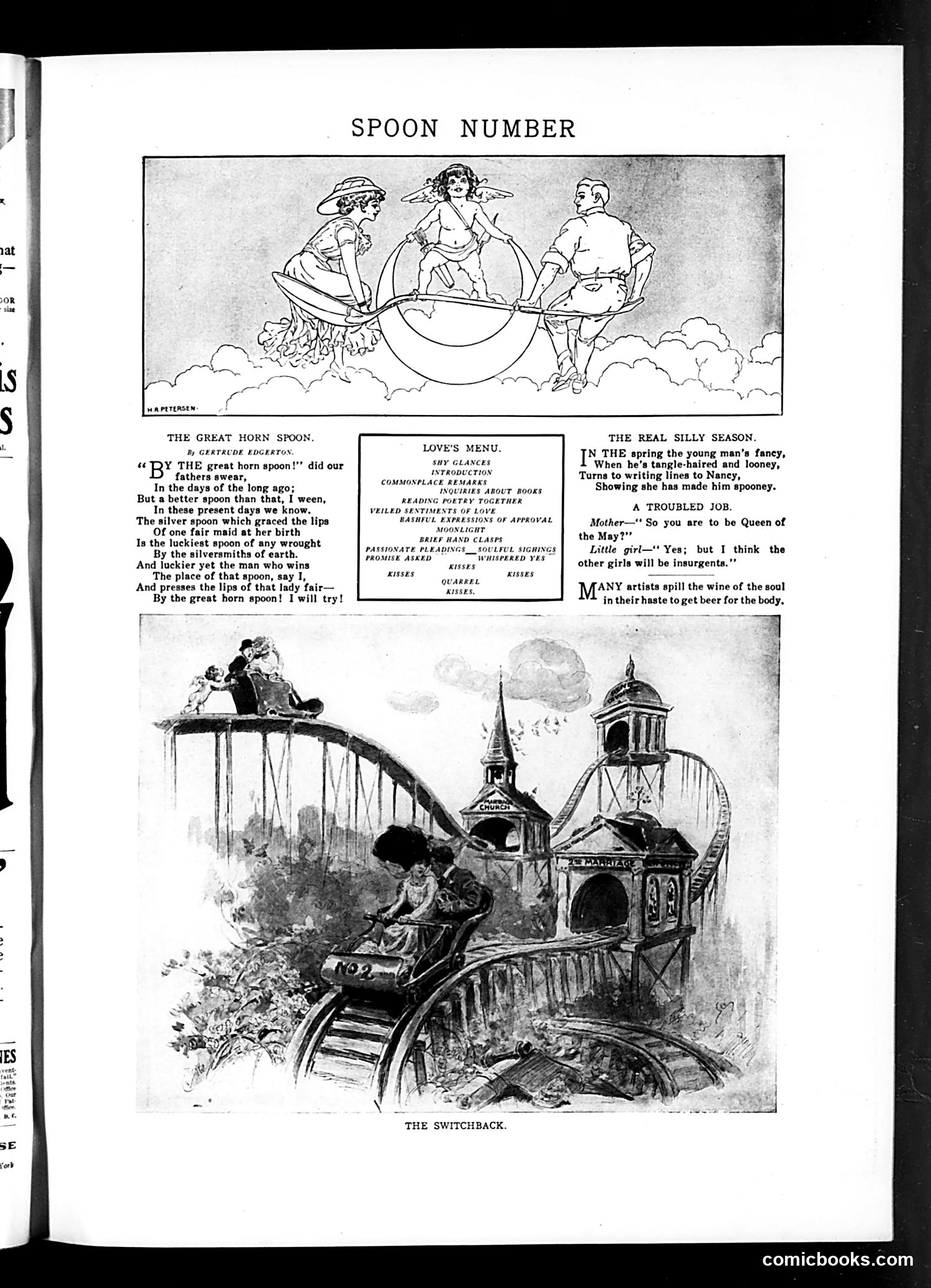
This page from *Judge* magazine contains two main illustrations and accompanying humorous verse. **"The Great Horn Spoon"** (top): Three figures hold an enormous spoon above clouds. The poem by Gertrude Edgerton celebrates the "horn spoon" as a symbol of luck and romance, with the closing line promising "By the great horn spoon! I will try!" **"Love's Menu"** (center): A mock restaurant menu listing romantic items like "sly glances," "commonplace remarks," and "kisses." **"The Real Silly Season"** (right): Commentary on spring romance, featuring a girl's job interview where she'd rather write love letters to "Nancy" than work. **"The Switchback"** (bottom): An illustration of a roller coaster ride near fantastical architecture, likely satirizing amusement parks or reckless entertainment. The overall theme appears to be romantic foolishness and frivolous spring behavior.
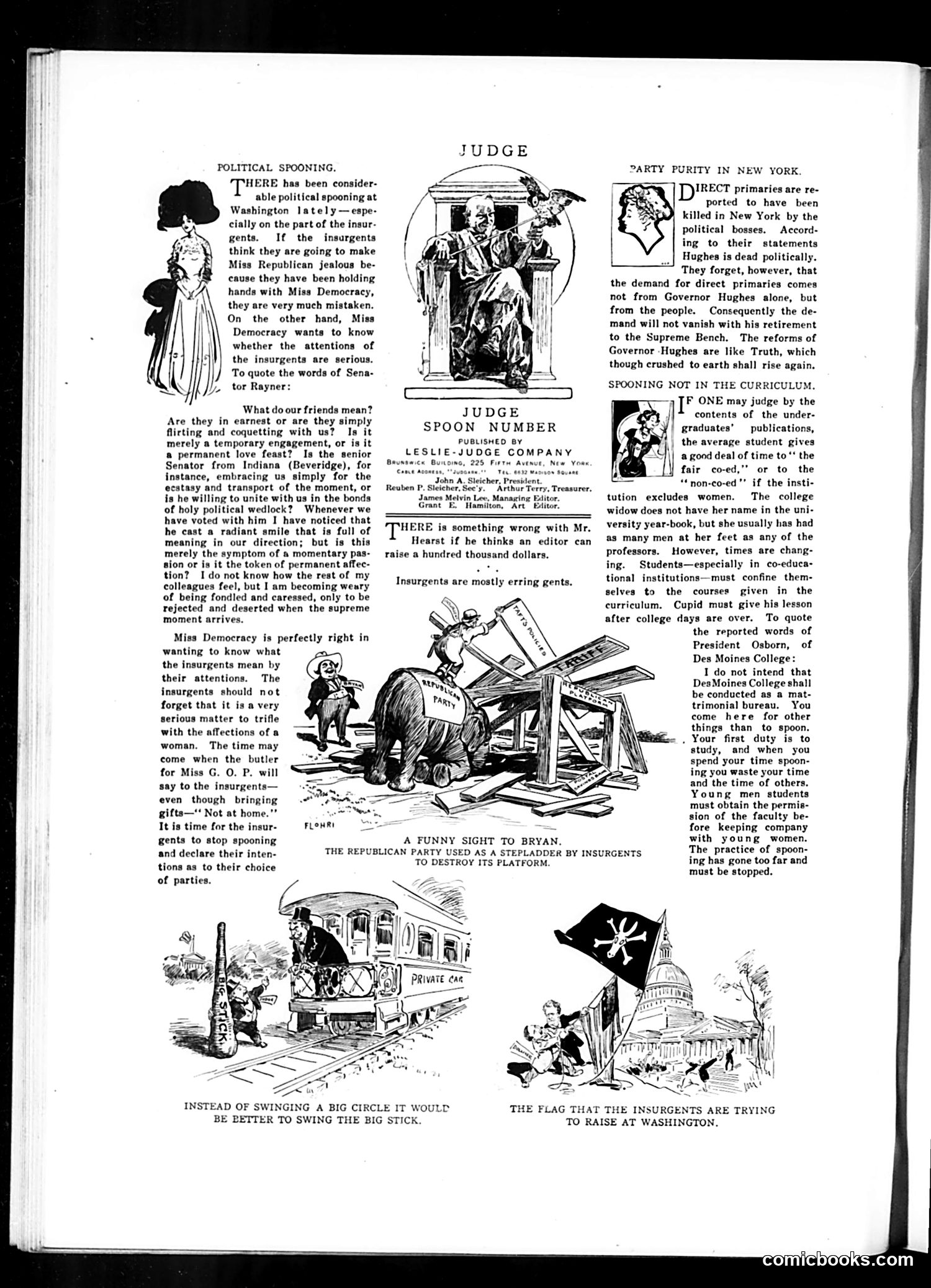
This page satirizes political instability and the Progressive/insurgent movement challenging the Republican Party establishment around 1912. **"Political Spooning"** critiques whether insurgent Republicans (progressives) genuinely seek reform or merely want power—questioning their seriousness versus opportunism. **"Spoon Number"** features a judge figure, likely representing judicial authority or public judgment. **"Party Purity in New York"** mocks claims that Hughes (Charles Evans Hughes, Republican candidate) is politically "dead" to insurgents, while actually he remains relevant to their demands. **"Spooning Not in Curriculum"** satirizes college students wasting time courting instead of studying—a metaphor for political distraction. The bottom cartoons attack insurgents using mockery: depicting them as destructive ("swinging the big stick") and raising a suspicious flag at Washington, suggesting disloyalty or radicalism. The satire targets both progressive reformers and Republican establishment dysfunction.
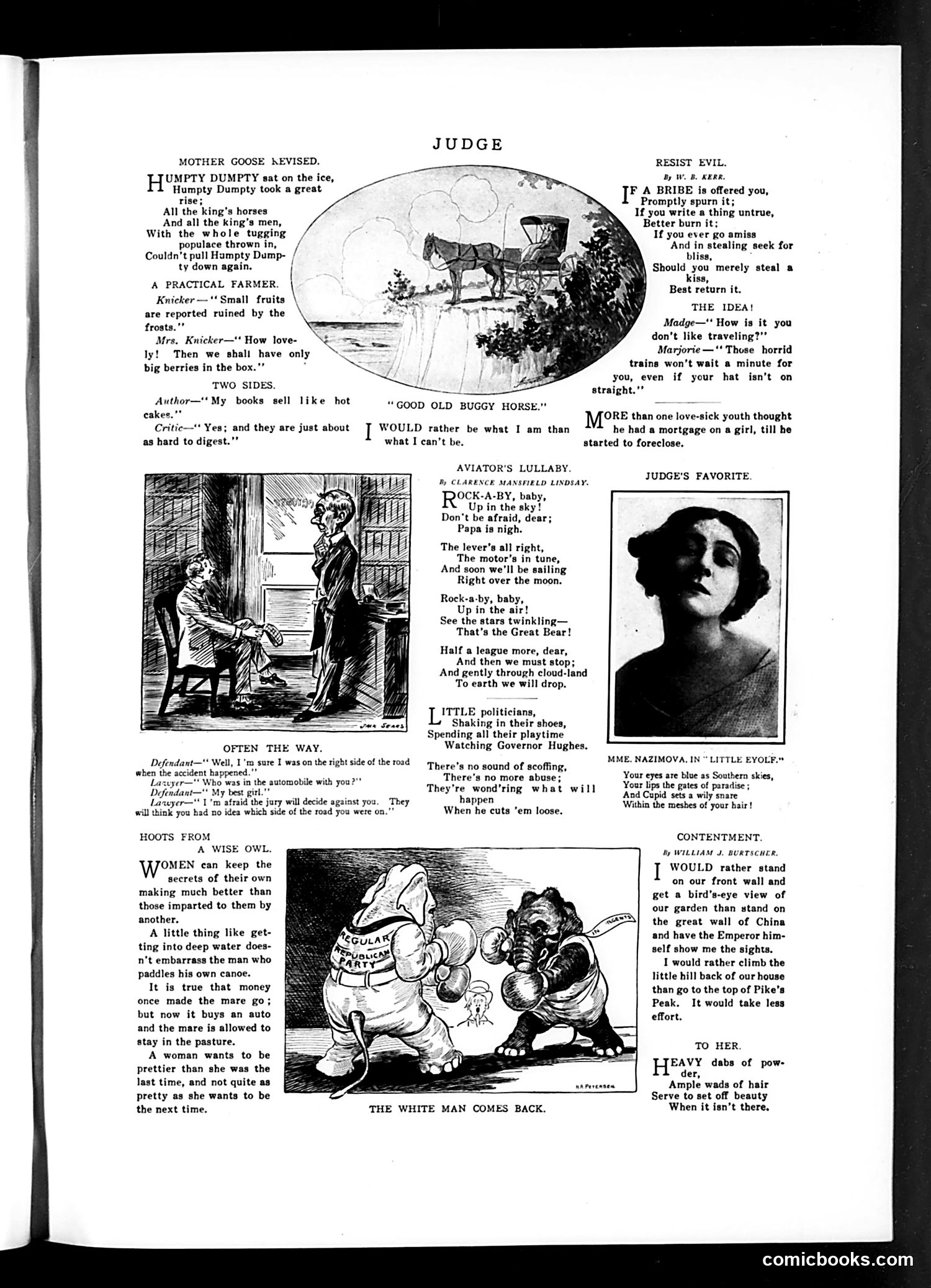
This page contains miscellaneous literary content and illustrations rather than coherent political satire. The items include: **"Mother Goose Revised"** and **"A Practical Farmer"** — brief humorous dialogues with no clear political target. **"The White Man Comes Back"** — A cartoon showing two figures (possibly caricatured as racial stereotypes based on the exaggerated features visible) exchanging or competing over goods. The title suggests commentary on colonialism or racial dynamics, though the specific context remains unclear without additional historical markers. **"Aviator's Lullaby"** and other poems appear to be general humor rather than satire. The page functions primarily as filler content—jokes, verses, and illustrations—typical of Judge's miscellaneous entertainment rather than focused political commentary.
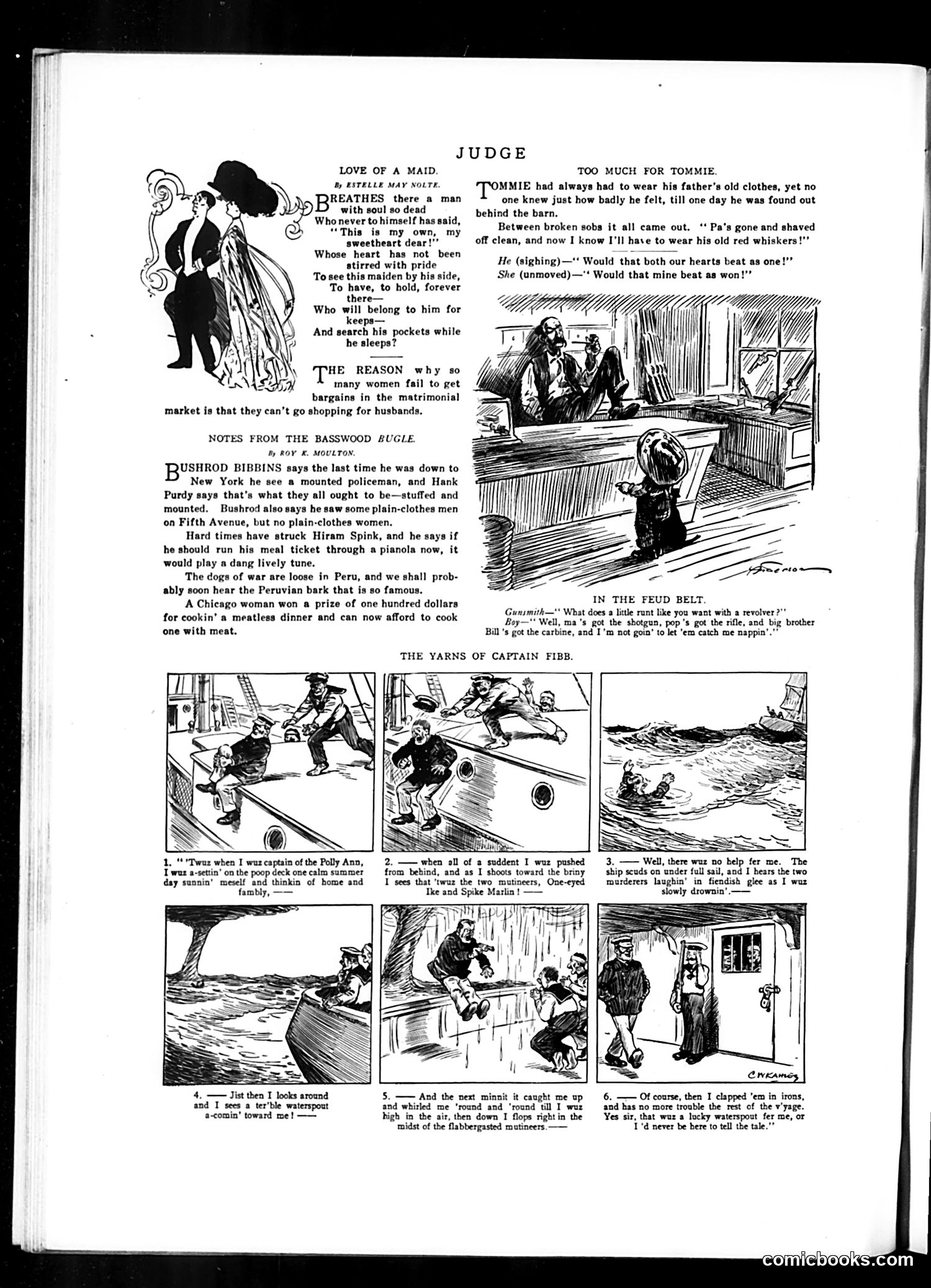
This page contains several humor pieces reflecting early 20th-century American life: **"Too Much for Tommie"** satirizes poverty and class anxiety. A poor boy is devastated discovering he must wear his father's old whiskers—a humiliating mark of family poverty. The joke hinges on Depression-era shame about hand-me-downs. **"Love of a Maid"** mocks romantic idealism versus mercenary marriage reality. While he sighs about hearts beating as one, she unmoved wants his wallet—reflecting cynicism about women's matrimonial motivations. **"Notes from Basswood Bugle"** offers rural Americana humor: mounted police ("stuffed and mounted"), plain-clothes women not existing, and a feud-belt family where even the boy needs a gun because family members monopolize the weapons. **"Captain Fibb's Yarns"** parodies tall-tale fisherman stories—improbable adventures (waterspout rescue, mutineers) told with exaggerated dialect and ridiculous coincidences, lampooning travelers' outlandish boasting. The tone throughout is gentle mockery of American social pretense, poverty, and rural eccentricity.
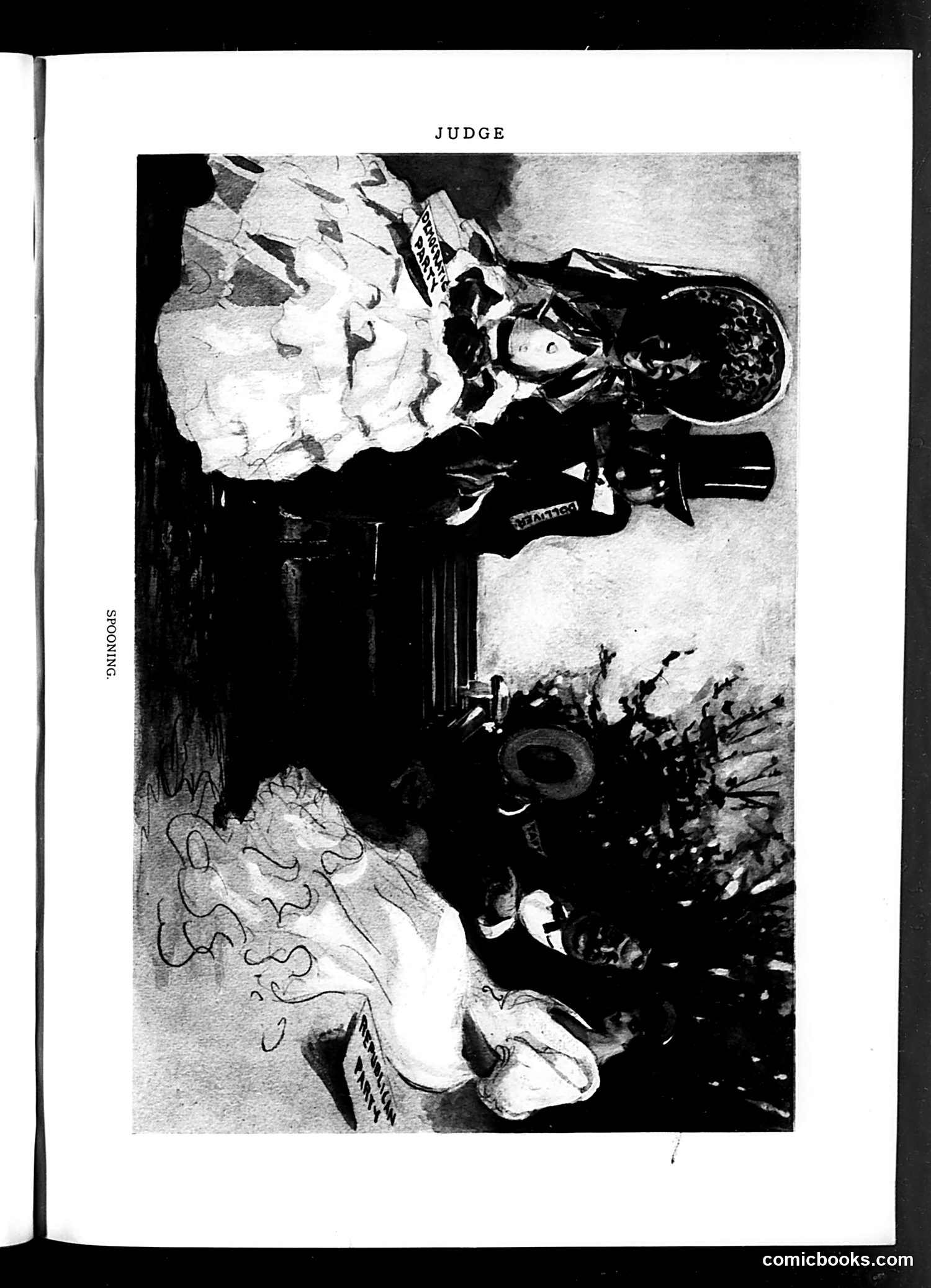
The image appears to be rotated 90 degrees, making interpretation challenging. The OCR text reads "SPOONING," a Victorian-era euphemism for romantic kissing or intimate behavior between couples. The cartoon likely depicts a couple in an affectionate embrace, rendered as social satire. Given *Judge* magazine's focus on ridiculing contemporary manners and morality, this probably mocks either: - Excessive public displays of affection - Courtship customs of the era - Specific social figures or celebrities engaged in scandalous behavior The fragmented OCR text suggests the page quality is poor. Without clearer text or being able to identify specific caricatured figures, I cannot definitively state which public figures or events this satirizes. The satirical point appears directed at romantic behavior itself, but the specific target remains unclear from the available information.
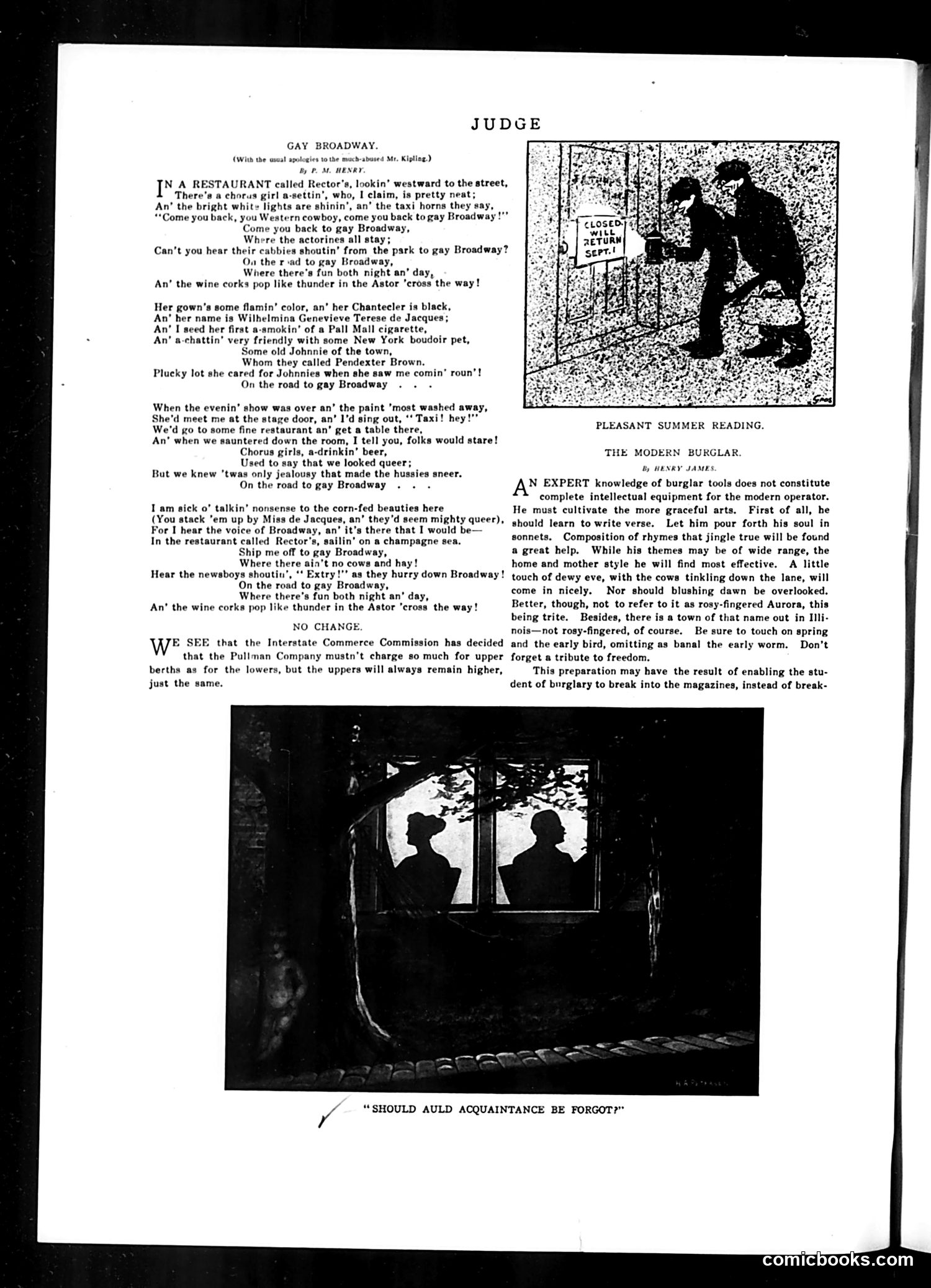
This page contains two distinct pieces: **"Gay Broadway"** (top): A Rudyard Kipling parody by P.M. Henry satirizing turn-of-the-century Manhattan nightlife. The poem romanticizes a cowboy's infatuation with a Broadway chorus girl named Wilhelmina at Rector's restaurant—a real, famous dining establishment. The satire mocks the glamorization of Broadway excess: champagne, taxi horns, stage-door encounters, and the "bright white lights" luring visitors. It's gentle social commentary on urban temptation and theatrical culture. **"The Modern Burglar"** (right): A humorous advice piece suggesting that successful burglars need literary cultivation—sonnets, poetry about nature—beyond mere tool expertise. It's satirical self-help, poking fun at both would-be criminals and pretentious literary affectation by suggesting a burglar might break into *magazines* instead of homes after mastering verse composition. The accompanying illustrations are period silhouettes, typical of Judge's visual style. The overall tone is lighthearted social satire on contemporary urban life and human folly.
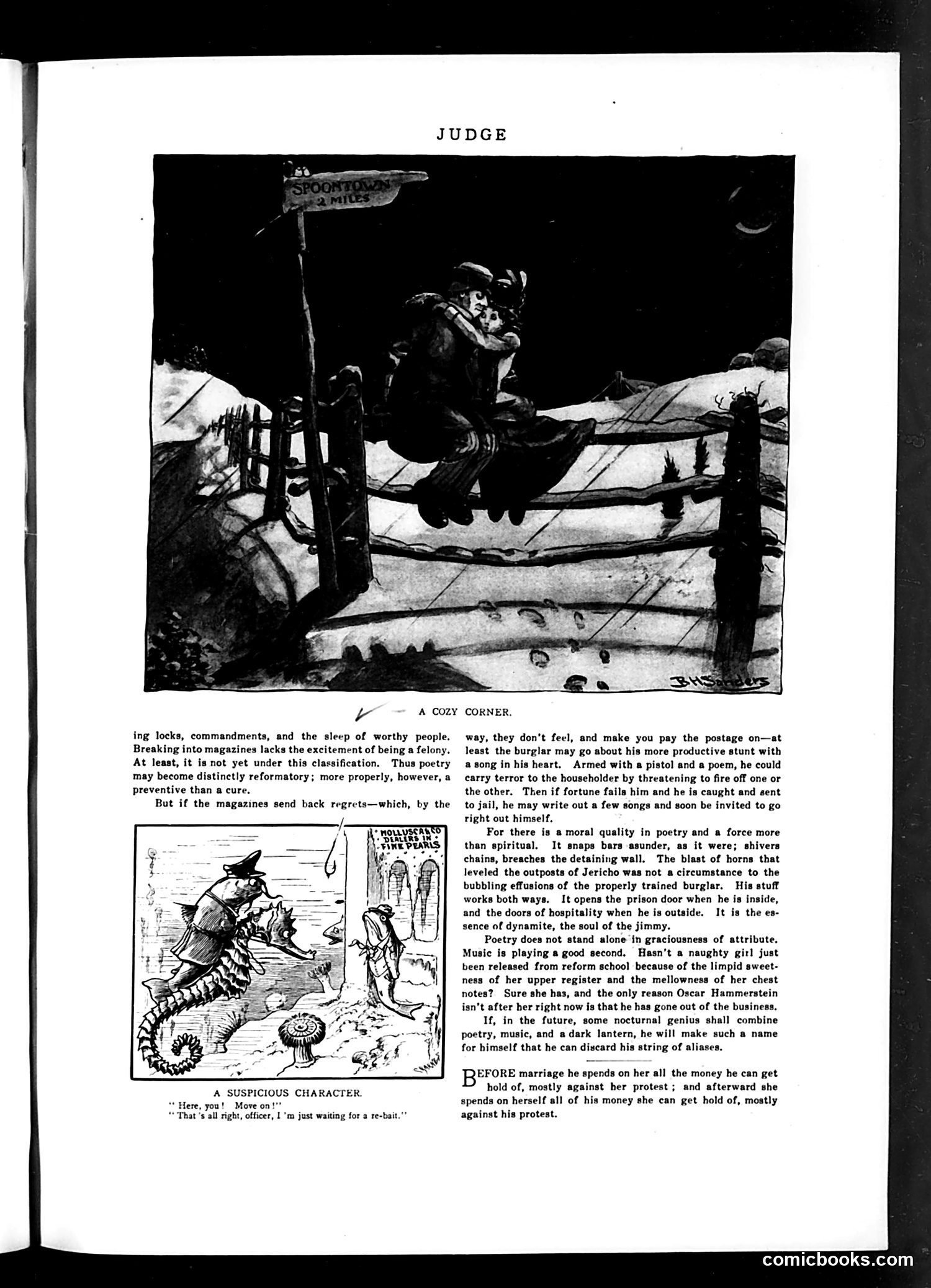
This page contains two cartoons satirizing crime and social hypocrisy in early 20th-century America. **"A Suspicious Character"** depicts a vagrant loitering near water, claiming to await "a re-bait"—wordplay suggesting he's waiting to steal fishing bait or engage in petty crime. The police officer's suspicion reflects class anxieties about urban poor. **"A Cozy Corner"** presents dark satire about criminals who weaponize poetry and music. The lengthy accompanying text mocks the notion that artistic sensitivity could reform or even aid criminals—suggesting a burglar armed with "a pistol and a poem" might threaten homeowners, or that poetry could help criminals escape prison (referencing the Biblical walls of Jericho). The satire ridicules both sentimental reform ideology and the notion that artistic talent excuses criminality. The final paragraph pivots to marital satire: couples' reversed spending patterns before and after marriage, mocking both male courtship extravagance and female financial independence.
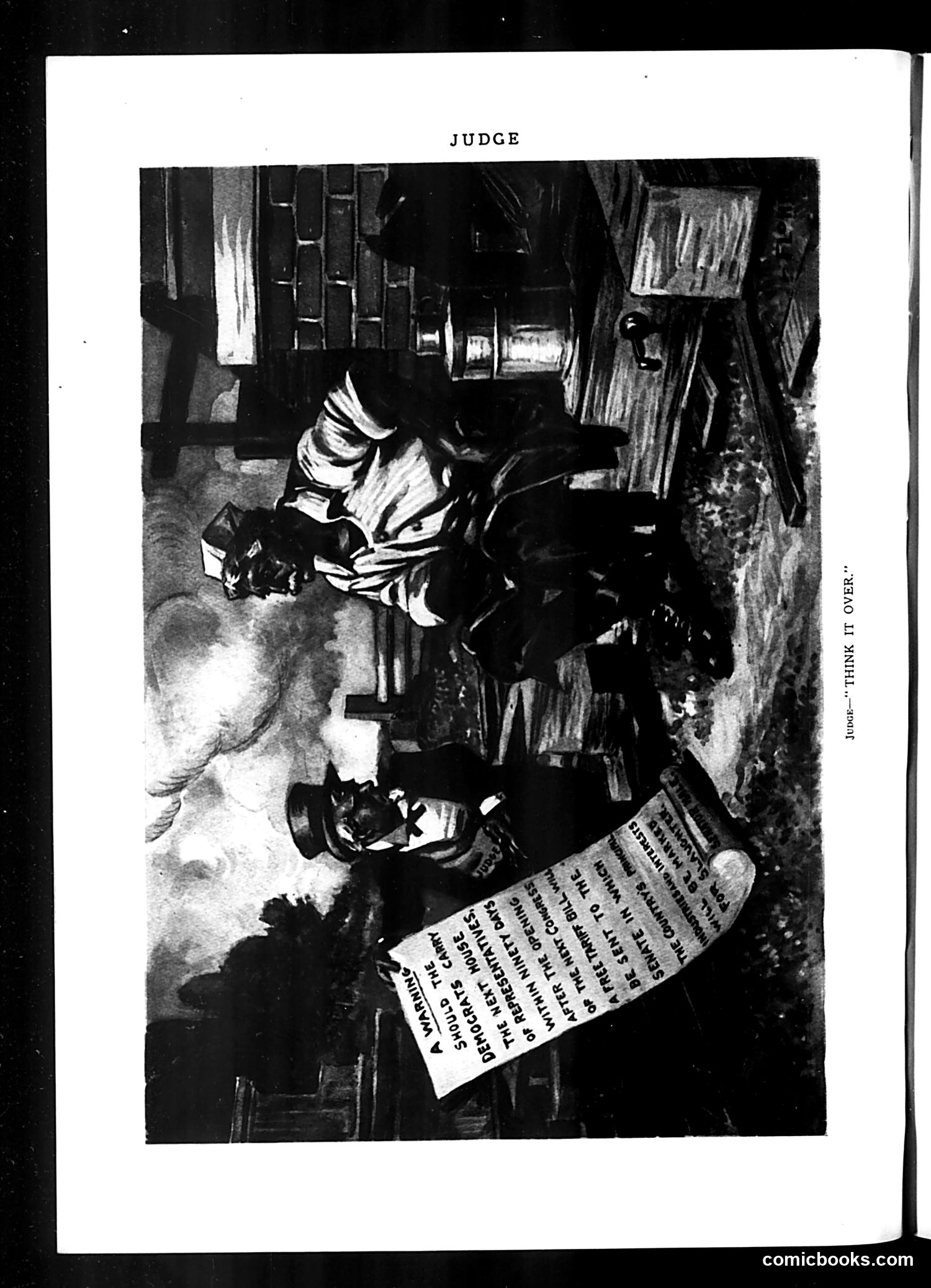
This page is titled "JUDGE" and contains a black-and-white photograph (rotated 90 degrees) showing what appears to be a person in formal attire examining or holding a document. The image quality and orientation make specific details difficult to discern clearly. The OCR text "«YAAO LI ANIH" appears corrupted and doesn't provide meaningful context. Without legible accompanying text or captions visible in the image, I cannot definitively identify the figures, political references, or satirical intent of this particular cartoon or content. To accurately explain the satire and historical context to modern readers, clearer text and image orientation would be necessary. The page appears to be from Judge's early satirical commentary, but the specific subject remains unclear from this reproduction.
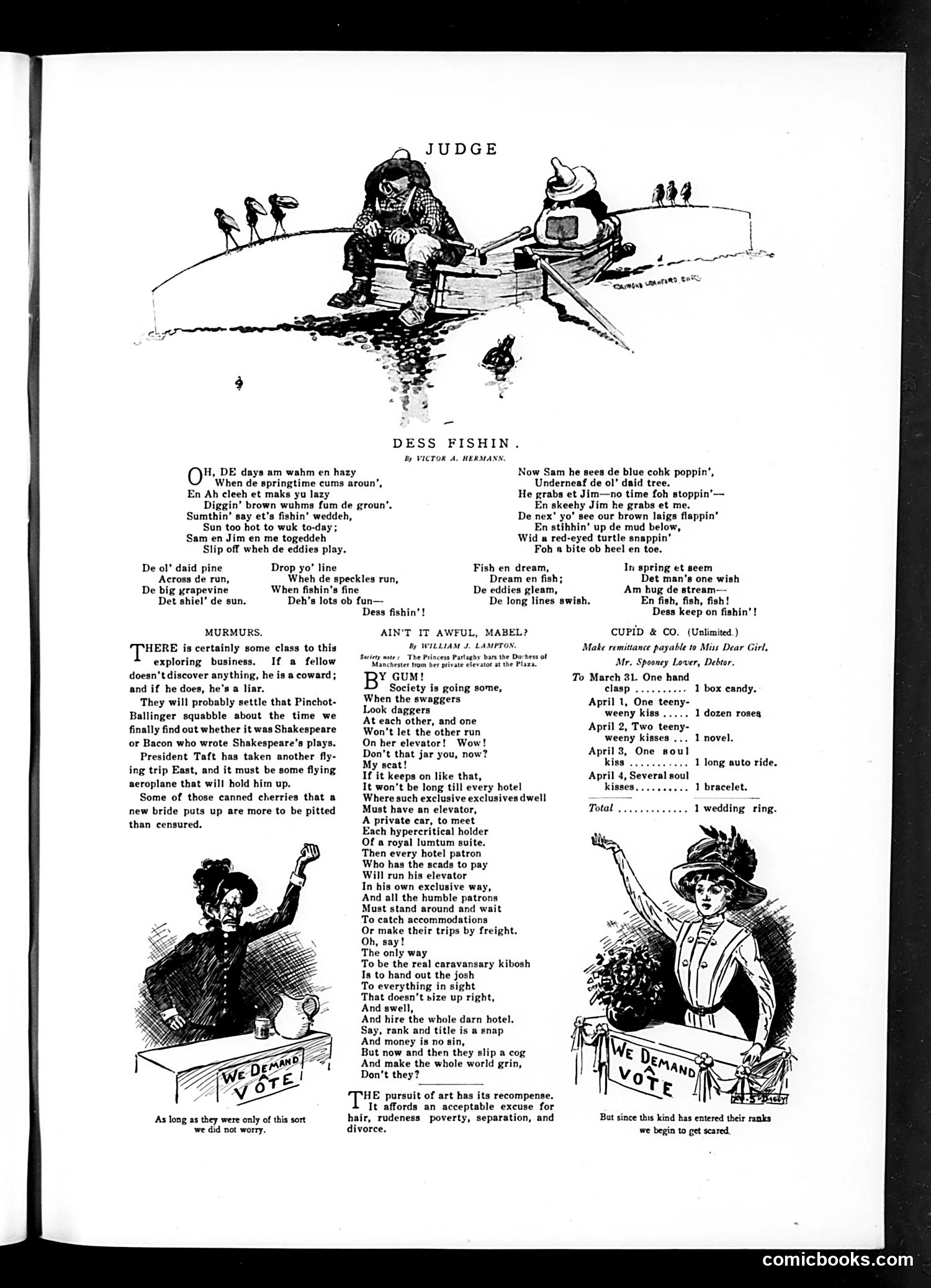
This page contains three satirical pieces reflecting early 1900s American society: **"Dess Fishin'"** is a dialect poem celebrating working-class leisure—men escaping labor for fishing, depicted with humor and warmth rather than mockery. **"Murmurs"** offers brief political jabs: references to the **Pinchot-Ballinger controversy** (a conservation scandal under President Taft), Shakespeare authorship debates, and Taft's frequent travel. These suggest frustration with ongoing political disputes that never resolve. **"Ain't It Awful, Mabel?"** satirizes wealthy society women, apparently referencing a real incident where Princess Parlaghy and the Duchess of Manchester quarreled over elevator access at the Plaza Hotel. The satire mocks aristocratic exclusivity and petty status-consciousness—women so preoccupied with social hierarchy they fight over private elevators, necessitating hotels provide exclusive transportation for the wealthy while common patrons use freight. The illustrated sidebar shows women demanding voting rights, suggesting this reflects pre-suffrage tensions.
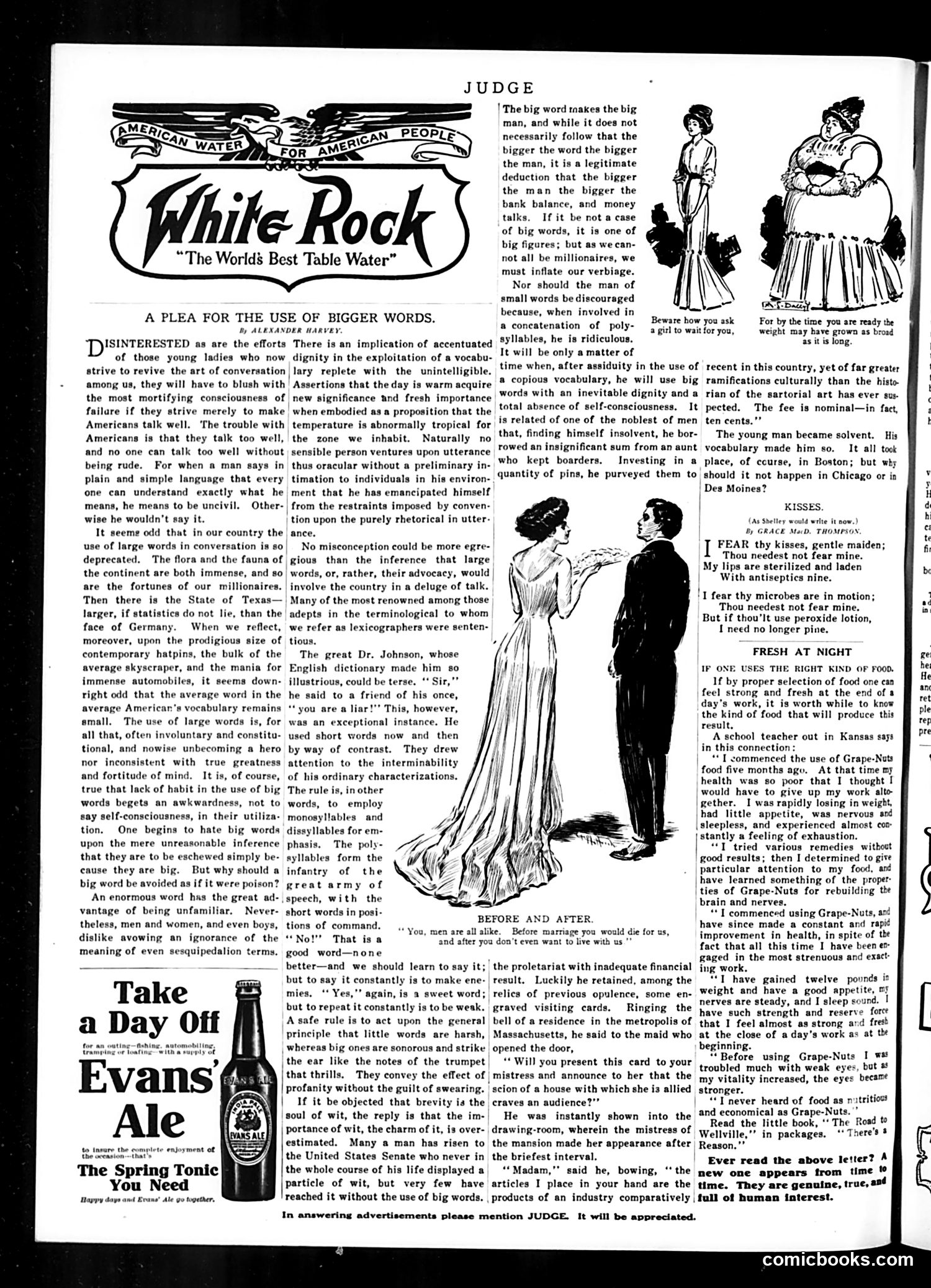
This page from *Judge* magazine presents a satirical essay arguing that Americans should use bigger, more complex vocabulary in conversation. **The Main Satire:** The piece mocks American pretentiousness by praising unnecessarily elaborate speech. The author (Alexander Harvey) argues that using obscure, polysyllabic words demonstrates sophistication and superiority—even though most people don't understand them. The satire lies in endorsing this absurd social convention: using incomprehensible language to appear cultured while simultaneously insulting one's audience's intelligence. **Key Target:** American social climbers and aspirational speakers who adopt grandiose vocabulary not for clarity but for status. Harvey illustrates this through references to America's size (Texas, skyscrapers, automobiles) to mock the correlation between physical bigness and linguistic pretension. **The Irony:** The essay itself employs the verbose style it discusses—proving the point through example. Modern readers might recognize this as satirizing performative intellectualism, similar to modern critiques of "corporate speak" or affected academic jargon used primarily to intimidate rather than communicate.
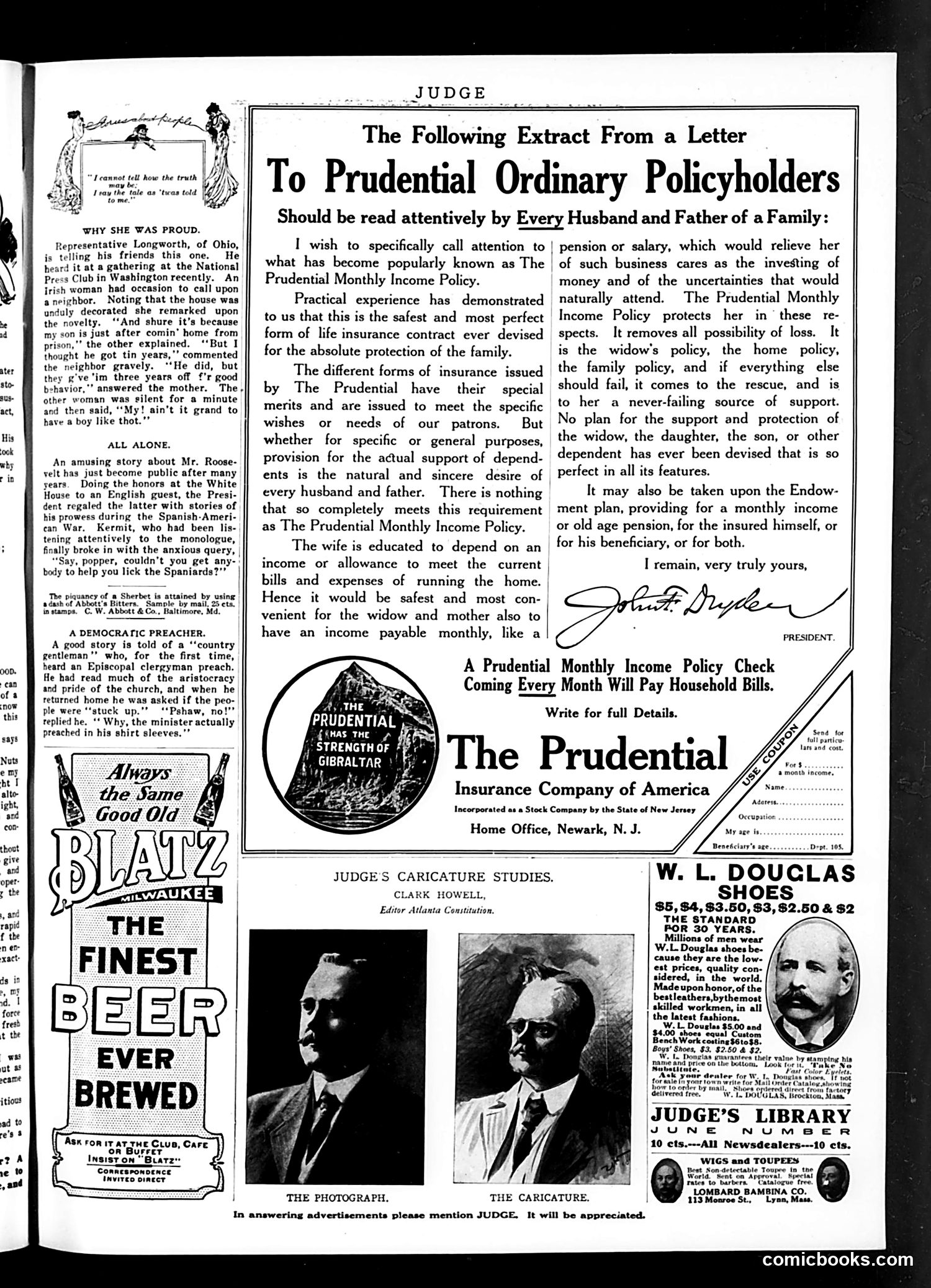
This page is primarily **advertising**, featuring a major advertisement for The Prudential Insurance Company's "Monthly Income Policy." The ad occupies most of the center and right side. The page includes several **humorous anecdotes** in the left column: 1. A story about Representative Longworth of Ohio recounting an Irish mother's pride that her son received time off prison for "good behavior" 2. A joke about Theodore Roosevelt boasting about Spanish-American War exploits to an English guest, with his son Kermit asking if he "couldn't get anybody to help you"—satirizing Roosevelt's self-aggrandizement 3. A brief tale about a "country gentleman" surprised that an Episcopal clergyman preaches in shirtsleeves, mocking class pretensions The cartoons labeled "The Photograph" and "The Caricature" at bottom appear to be Judge's signature feature—contrasting realistic versus satirical renderings, though subjects are unclear from this reproduction. The page also contains period advertisements for Blatz beer and W.L. Douglas shoes.
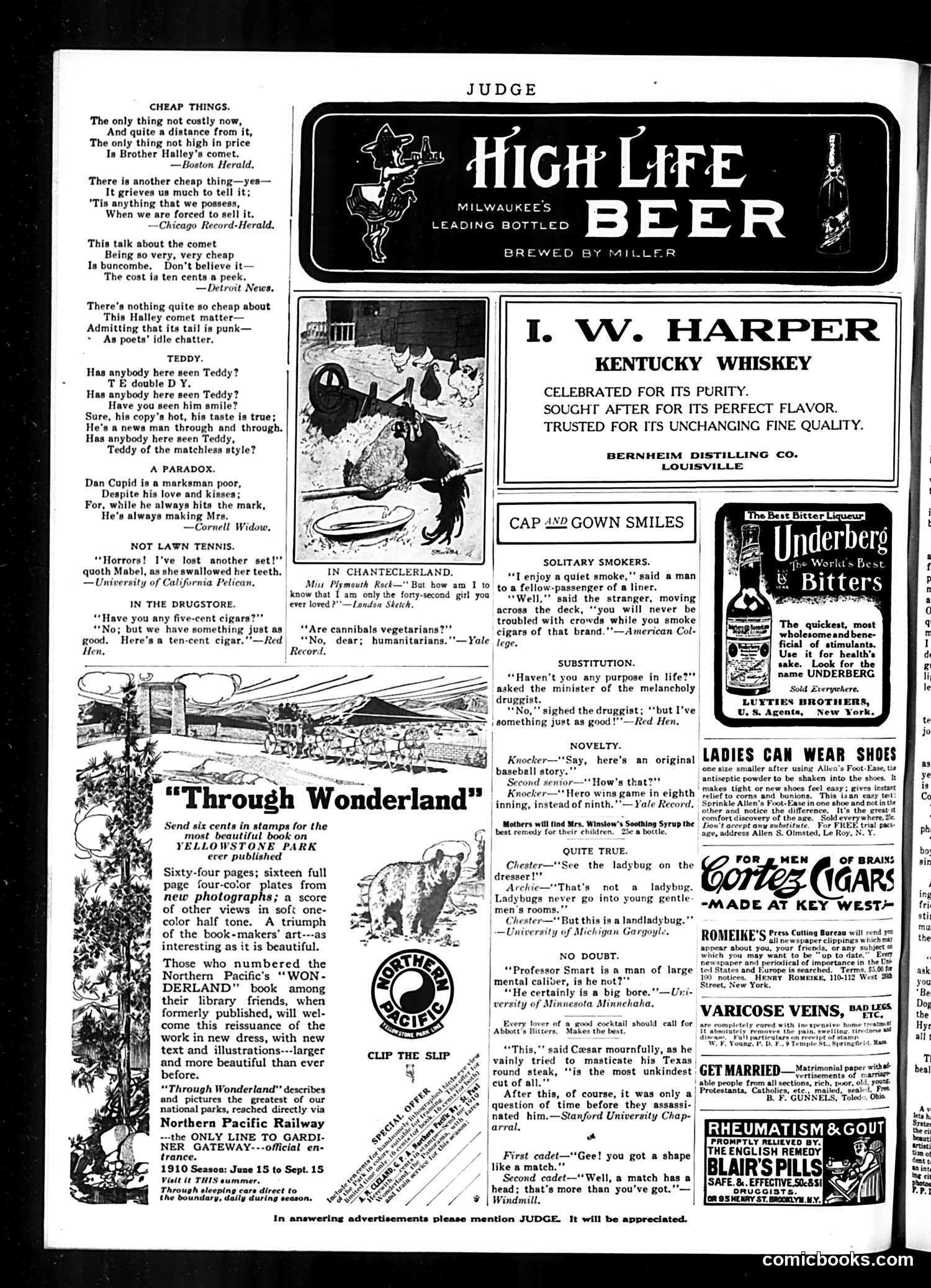
This page from *Judge* magazine is primarily **advertising**, with some humorous content filling the margins. The advertisements promote products like High Life beer, I.W. Harper whiskey, and various patent medicines—typical early 1900s consumer goods often containing dubious claims. The scattered jokes and short verses address everyday ironies: Halley's Comet (briefly visible in 1910) supposedly being "cheap," a woman's dentures falling out, missing teeth, tedious cigar quality complaints. There's a brief reference to "Teddy," likely Theodore Roosevelt, celebrated as a "news man." The page reflects the era's advertising satire mixed with vaudeville-style humor—puns, mild absurdism, and recurring jokes about substitution and quality. The *Northern Pacific Railway* advertisement for "Through Wonderland" (Yellowstone Park) represents 1910s travel marketing. For modern readers: this captures pre-WWI consumer culture, when patent medicines were unregulated and advertising humor was built on cynicism about product quality and everyday disappointments.
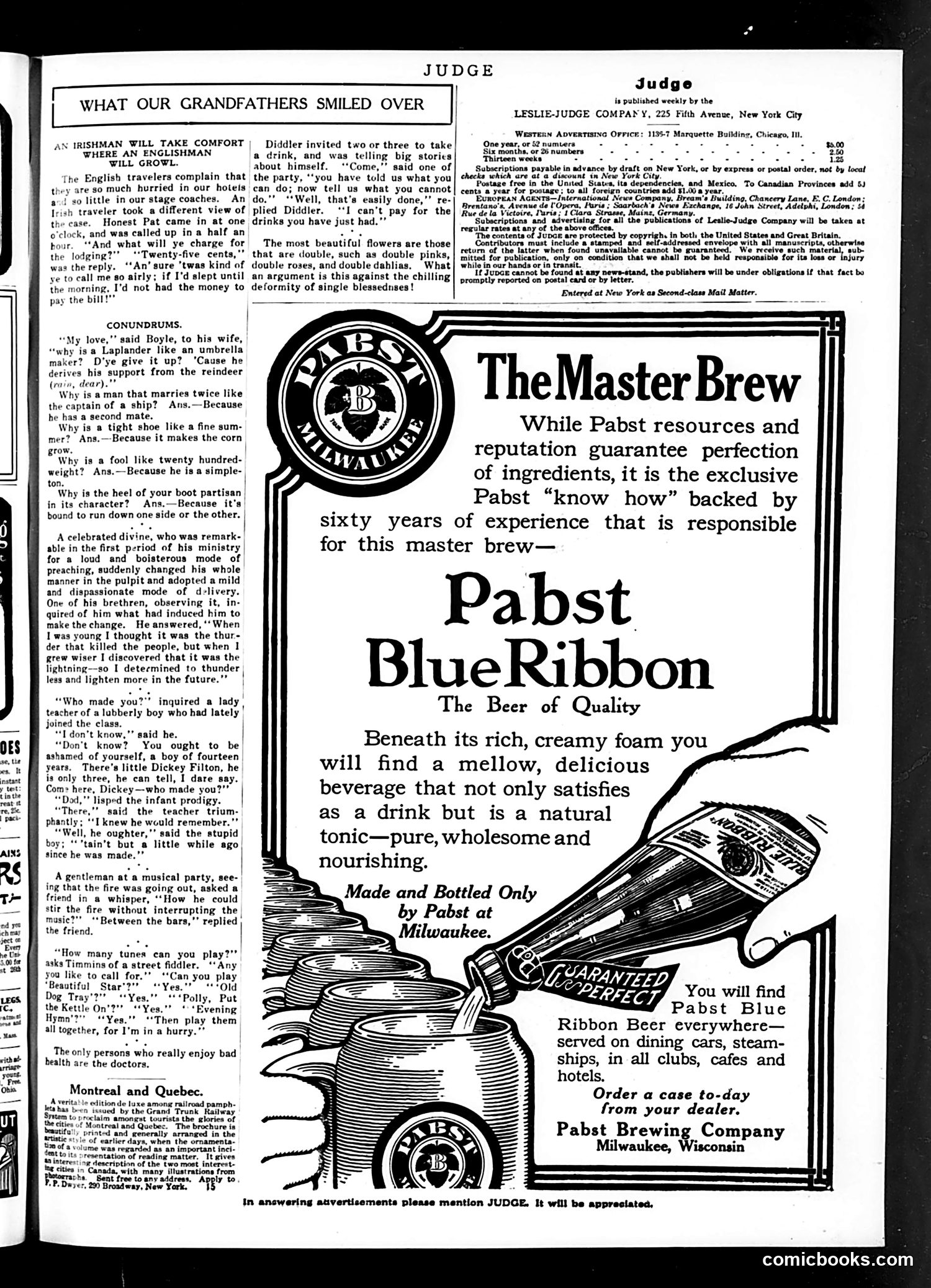
This page from *Judge* magazine contains primarily **humorous anecdotes and riddles** rather than political satire. The pieces rely on Victorian-era wordplay and ethnic humor typical of the period. **Main Contents:** 1. **Irish stereotype humor**: An anecdote contrasts an Irish traveler's cheerful acceptance of early hotel checkout with English complainers—playing on ethnic stereotypes about Irish optimism versus English grumpiness. 2. **Conundrums (riddles)**: Pun-based jokes with answers relying on homophones and double meanings ("reindeer/rain dear," "simple-ton"). 3. **Anecdotes**: Including stories about a boy who doesn't know his creator, a preacher who softens his approach, and a musician at a party. **The Advertisement**: The right half features a **Pabst Blue Ribbon beer advertisement**, emphasizing quality, "sixty years of experience," and availability in dining establishments. The page reflects 19th-century humor sensibilities—heavy reliance on puns, ethnic stereotypes, and gentle domestic humor—rather than sharp political commentary.
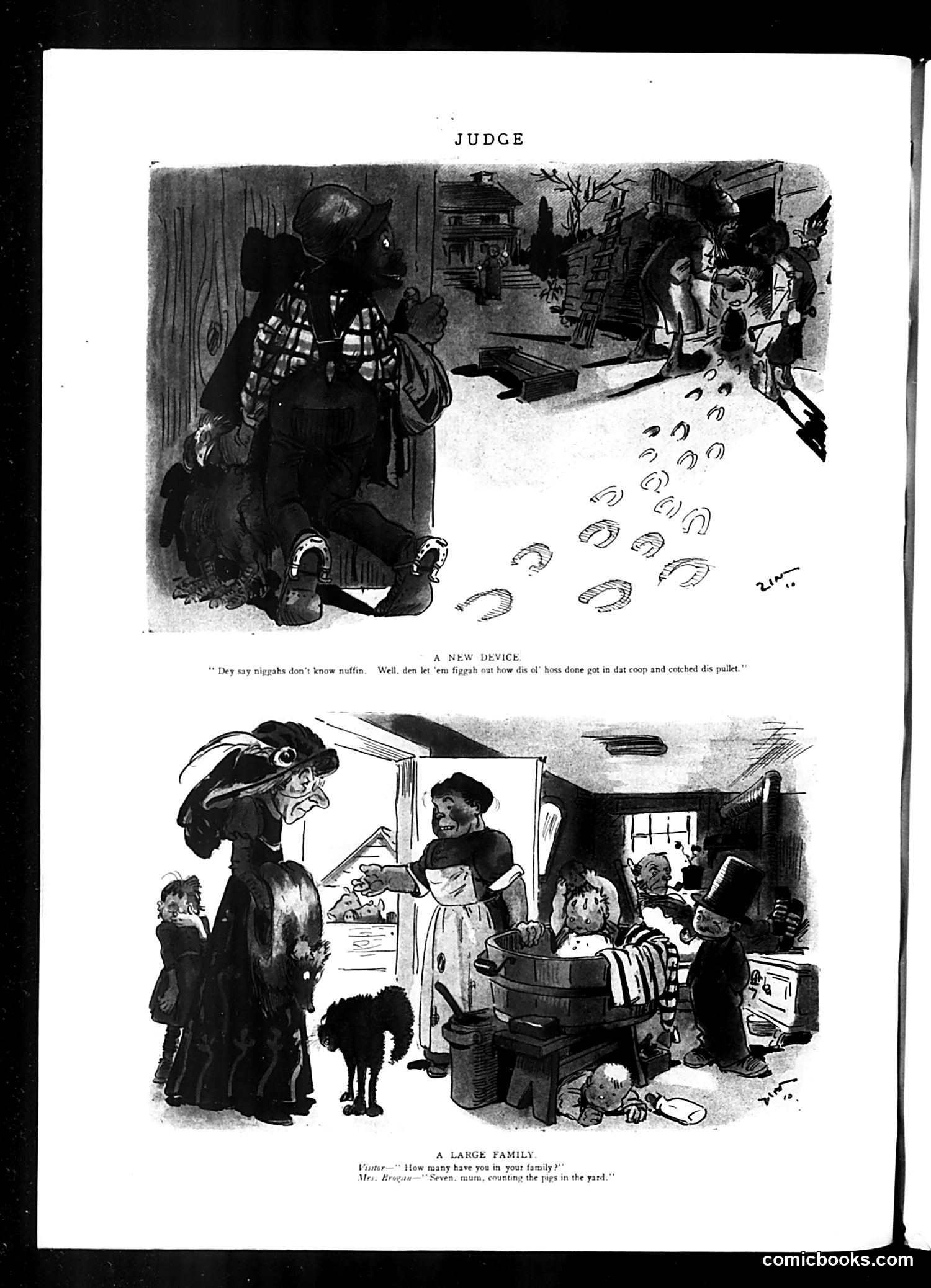
This page contains two racist cartoons typical of late 19th/early 20th-century American satire. **Top cartoon ("A New Device"):** Depicts a Black man in exaggerated dialect claiming he cannot solve how a horse entered a chicken coop. The "joke" relies on racist stereotypes about Black intelligence. **Bottom cartoon ("A Large Family"):** Shows a poor Black woman telling a visitor she has "seven" children, then clarifying she means "seven, mum, counting the pigs in the yard"—conflating her children with livestock for comedic effect. Both cartoons use dehumanizing caricature and offensive dialect to mock Black poverty and family structures. They reflect the deeply racist editorial stance *Judge* magazine maintained, presenting bigotry as humor for its white audience. The content is historically significant as documentation of systemic racism normalized in mainstream American media.