
Judge, 1910-05-28 · page 9 of 16
Judge — May 28, 1910 — page 9: what you’re looking at
What you’re looking at
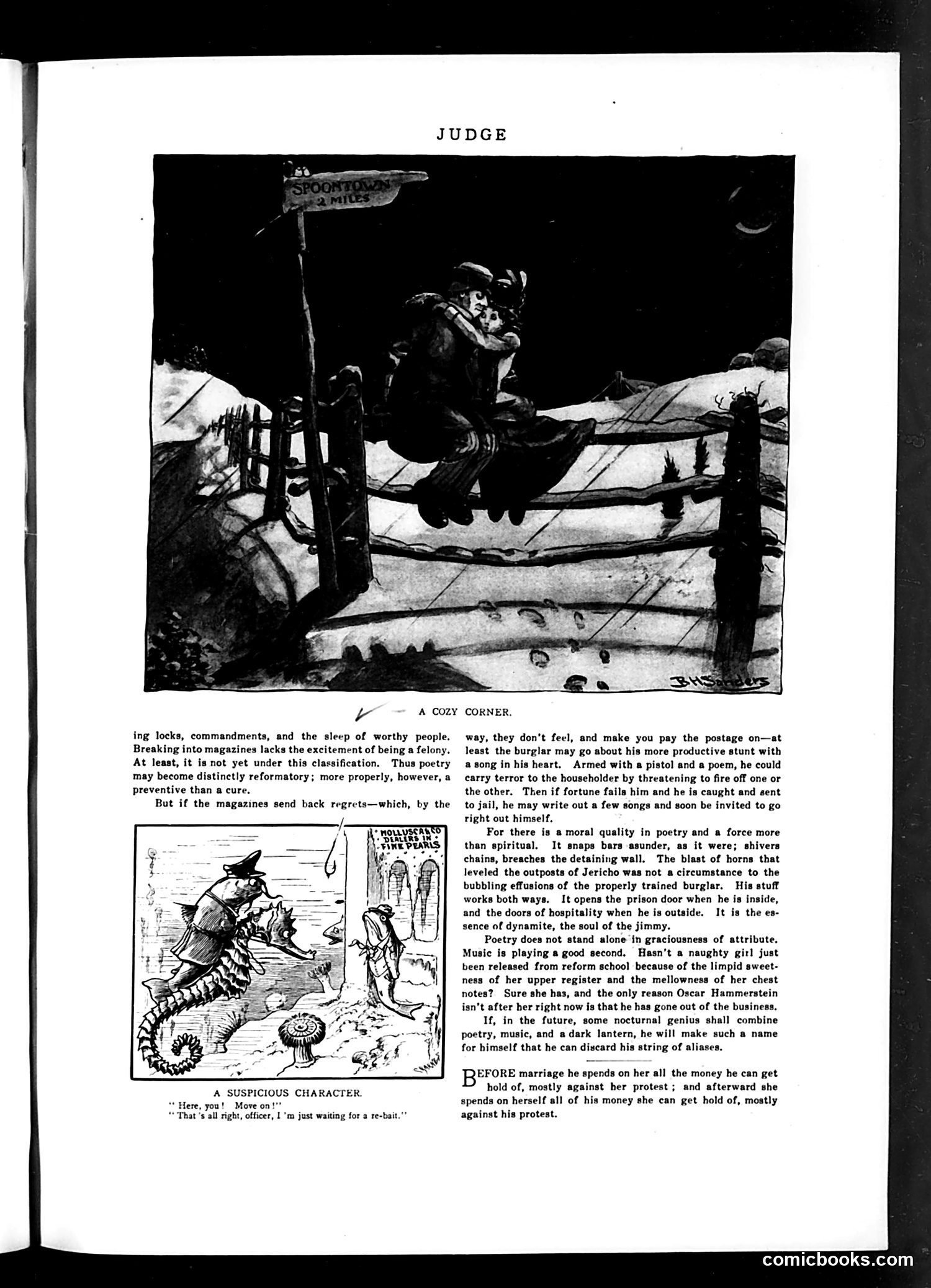
This page contains two cartoons satirizing crime and social hypocrisy in early 20th-century America. **"A Suspicious Character"** depicts a vagrant loitering near water, claiming to await "a re-bait"—wordplay suggesting he's waiting to steal fishing bait or engage in petty crime. The police officer's suspicion reflects class anxieties about urban poor. **"A Cozy Corner"** presents dark satire about criminals who weaponize poetry and music. The lengthy accompanying text mocks the notion that artistic sensitivity could reform or even aid criminals—suggesting a burglar armed with "a pistol and a poem" might threaten homeowners, or that poetry could help criminals escape prison (referencing the Biblical walls of Jericho). The satire ridicules both sentimental reform ideology and the notion that artistic talent excuses criminality. The final paragraph pivots to marital satire: couples' reversed spending patterns before and after marriage, mocking both male courtship extravagance and female financial independence.
📄 Transcribed text from this page (OCR, searchable)
Machine-transcribed from the original scan — historical spelling and the odd misread are preserved.
+ ing locks, commandments, and the sleep of worthy people. Breaking into magazines lacks the excitement of being a felony. At least, it is not yet under this classification. Thus poetry may become distinctly reformatory; more properly, however, a preventive than a cure. But if the magazines send back regrets—which, by the * MOLLUSCA' HORS IN ee PEARLS A SUSPICIOUS CHARACTER. “* Here, you! More on!”” “That 's all right, officer, I 'm just waiting for a re-bait."” A COZY CORNER. way, they don’t feel, and make you pay the postage on—at least the burglar may go about his more productive stunt with song in his heart. Armed with a pistol and a poem, he could carry terror to the householder by threatening to fire off one or the other. Then if fortune fails him and he is caught and sent to jail, he may write out a few songs and soon be invited to go right out himself. For there is a moral quality in poetry and a force more than spiritual, It snaps bars asunder, as it were; shivers chains, breaches the detaining wall. The blast of horns that leveled the outposts of Jericho was not a circumstance to the bubbling effusions of the properly trained burglar. His stuff works both ways. It opens the prison door when he is inside, and the doors of hospitality when he is outside. It is the es- sence of dynamite, the soul of the jimmy. Poetry does not stand alone in graciousness of attribute. Music is playing a good second. Hasn't a naughty girl just been released from reform school because of the limpid sweet- ness of her upper register and the mellowness of her chest notes? Sure she has, and the only reason Oscar Hammerstein isn’t after her right now is that he has gone out of the business. If, in the future, some nocturnal genius shall combine poetry, music, and a dark lantern, he will make such a name for himself that he can discard his string of aliases. BEFORE marriage he spends on her all the money he ean get hold of, mostly against her protest ; and afterward she spends on herself all of his money she can get hold of, mostly against his protest. comicbooks.com