
Judge, 1910-05-28 · page 12 of 16
Judge — May 28, 1910 — page 12: what you’re looking at
What you’re looking at
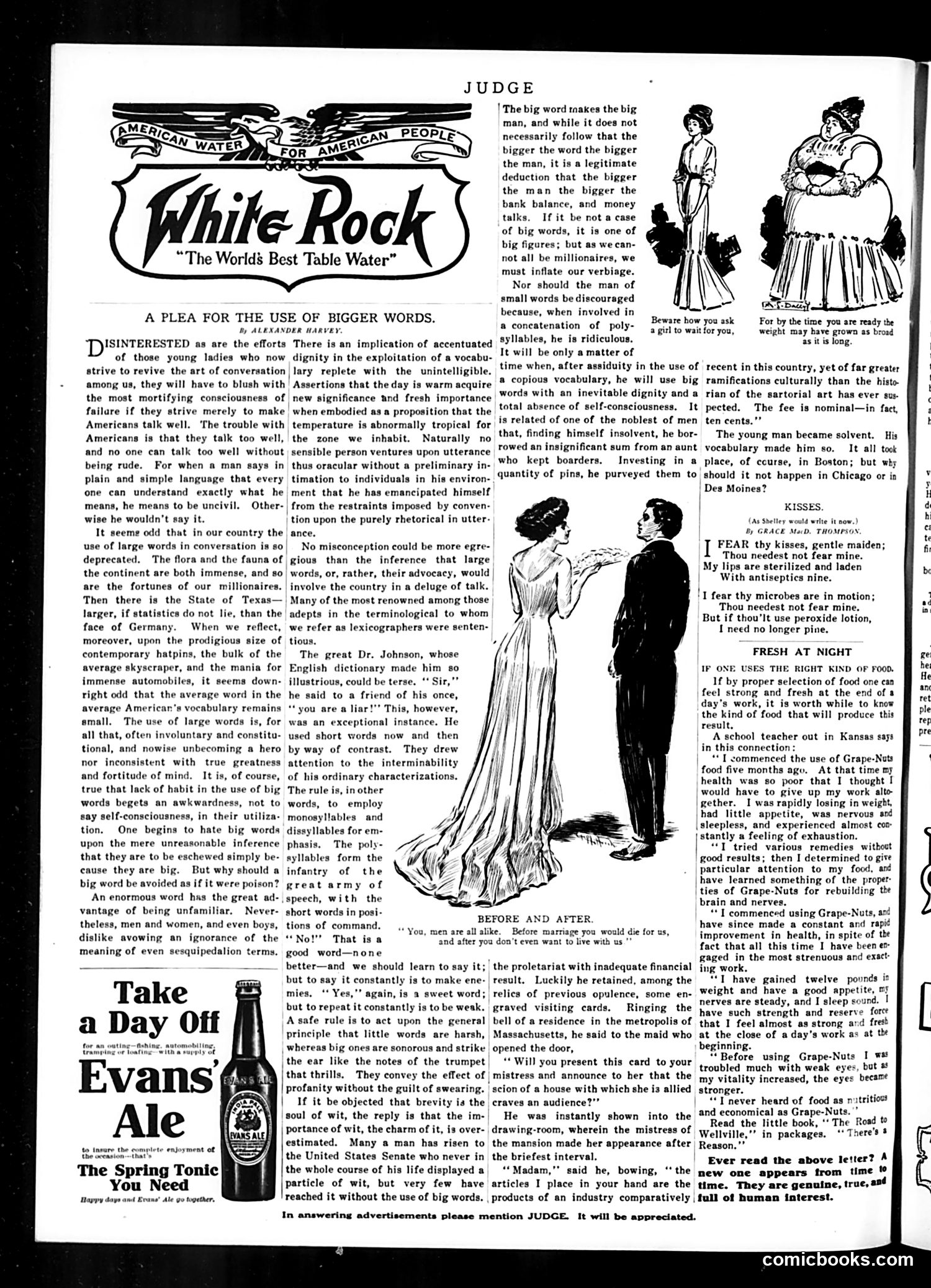
This page from *Judge* magazine presents a satirical essay arguing that Americans should use bigger, more complex vocabulary in conversation. **The Main Satire:** The piece mocks American pretentiousness by praising unnecessarily elaborate speech. The author (Alexander Harvey) argues that using obscure, polysyllabic words demonstrates sophistication and superiority—even though most people don't understand them. The satire lies in endorsing this absurd social convention: using incomprehensible language to appear cultured while simultaneously insulting one's audience's intelligence. **Key Target:** American social climbers and aspirational speakers who adopt grandiose vocabulary not for clarity but for status. Harvey illustrates this through references to America's size (Texas, skyscrapers, automobiles) to mock the correlation between physical bigness and linguistic pretension. **The Irony:** The essay itself employs the verbose style it discusses—proving the point through example. Modern readers might recognize this as satirizing performative intellectualism, similar to modern critiques of "corporate speak" or affected academic jargon used primarily to intimidate rather than communicate.
📄 Transcribed text from this page (OCR, searchable)
Machine-transcribed from the original scan — historical spelling and the odd misread are preserved.
JUDGE A PLEA FOR THE USE OF BIGGER WORDS. By ALEXANDER HARVEY. ISINTERESTED as are the efforts of those young ladies who now strive to revive the art of conversation among us, they will have to blush with the most mortifying consciousness of failure if they strive merely to make Americans talk well. The trouble with Americans is that they talk too well, and no one can talk too well without being rude. For when a man says in plain and simple language that every ‘one can understand exactly what he means, he means to be uncivil. Other- wise he wouldn't say it. It seeme odd that in our country the use of large words in conversation is so depreca The flora and the fauna of the continent are both immense, and so are the fortunes of our millionaires. Then there is the State of Texas— larger, if statistics do not lie, than the face of Germany. When we reflect, moreover, upon the prodigious size of contemporary hatpins, the bulk of the average skyscraper, and the mania for immense automobiles, it seems down- right odd that the average word in the average American's vocabulary remains small. The use of large words is, for all that, often involuntary and constitu- tional, and nowise unbecoming a hero nor inconsistent with true greatness and fortitude of mind. It is, of course, true that lack of habit in the use of big words begets an awkwardness, not to say self-consciousness, in their utiliza- tion. One begins to hate big words upon the mere unreasonable inference that they are to be eschewed simply be- cause they are big. But why should a big word be avoided as if it were poison? ‘An enormous word has the great ad- vantage of being unfamiliar. Never- men and women, and even boys, dislike avowing an ignorance of the meaning of even sesquipedalion terms. aypy days and Evans’ Ale go together, There is an implication of accentuated dignity in the exploitation of a vocabu- |lary replete with the unintelligible. Assertions that the day is warm acquire new significance und fresh importance when embodied as a proposition that the temperature is abnormally tropical for the zone we inhal Naturally no sensible person ventures upon utterance thus oracular without a preliminary in- timation to individuals in his environ- ment that he has emancipated himself from the restraints imposed by conven- | tion upon the purely rhetorical in utter- ance. No misconception could be more egre- gious than the inference that large words, or, rather, their advocacy, would involve the country in a deluge of talk. Many of the most renowned among those adepts in the terminological to whom we refer as lexicographers were senten- tious. The great Dr. Johnson, whose English dictionary made him so illustrious, could be terse. ‘* Sir,"” he said to a friend of his once, ** you are a liar!" This, however, was an exceptional instance. He used short words now and then by way of contrast. They drew attention to the interminability of his ordinary characterizations. The rule is, in other words, to employ monosyllables and dissyllables for em- phasis, The poly- iA syllables form the / infantry of the great army of speech, with the short words in posi- tions of command. “No!” That is a good word—none better—and we should learn to say but to sa: constantly is to make ene- mies. ‘ Yes," again, is a sweet wor but to repeat it constantly is to be weal A safe rule is to act upon the general principle that little words are harsh, whereas big ones are sonorous and strike jthe ear like the notes of the trumpet | that thrill | profanity without the guilt of swearing. | If it be objected that brevity is the soul of wit, the reply is that the im- portance of wit, the charm of it, is over- estimated. Many a man has risen to the United States Senate who never in the whole course of his life displayed a [partite of wit, but very few have reached it without the use of big words. and after yor They convey the effect of | | The big word rakes the big man, and while it does not necessarily follow that the bigger the word the bigger the man, it is a legitimate deduction that the bigger the man the bigger the bank balance, and money tal If it be not a case of big words, it is one of big figures; but as we can- not all be millionaires, we must inflate our verbiage. Nor should the man of small words be discouraged because, when involved in a concatenation of poly- syllables, he is ridiculous. It will be only a matter of time when, after assiduity in the use of a copious vocabulary, he will use big words with an inevitable dignity and a total absence of self-consciousness. It is related of one of the noblest of men that, finding himself insolvent, he bor- rowed an insignificant sum from an aunt who kept boarders. Investing in a Beware how a girl to wait quantity of pins, he purveyed them to & BEFORE AND AFTER. “You, men are all alike Before marriage you would die for us, va don't even want to live with us"? the proletariat with inadequate financial result. Luckily he retained, among the relics of previous opulence, some en- graved visiting cards, Ringing the bell of a residence in the metropolis of Massachusetts, he said to the maid who opened the door, “Will you present this card to your mistress and announce to her that the scion of a house with which she is allied craves an audience?” He was instantly shown into the drawing-room, wherein the mistress of the mansion made her appearance after the briefest interval. “Madam,” said he, bowing, “the articles I place in your hand are the products of an industry comparatively you ask for you, For by the time you are ready the weight may have grown as broad as it is long. recent in this country, yet of far greater ramifications culturally than the histo- rian of the sartorial art has ever sus. pected. The fee is nominal—in fact, ten cents."" The young man became solvent. His vocabulary made him so. It all took place, of ccurse, in Boston; but why should it not happen in Chicago or in | Des Moines? | KISSES. (As Sbettey would write it pow.) By GRACE MacD. THOMPSON. ] FEAR thy kisses, gentle maiden; Thou needest not fear mine. My lips are sterilized and laden With antiseptics nine. '1 fear thy microbes are in motion; Thou needest not fear mine. But if thou’lt use peroxide lotion, I need no longer pine. FRESH AT NIGHT IF ONE USES THE RIGHT KIND OF FOOD. If by proper selection of food one can feel strong and fresh at the end of 3 day's work, it is worth while to know the kind of food that will produce this result, A school teacher out in Kansas in this connection: *T commenced the use of Grape-Nuts food five months agu. At that time my health was so poor that I thought I would have to give up my work alto gether. I was rapidly losing in weight, had little appetite, was nervous and (sleepless, and experienced almost com stantly a feeling of exhaustion. “I tried various remedies withost good results; then I determined to give particular attention to my food, and |have learned something of the proper | ties of Grape-Nuts for rebuilding the brain and nerves, I commenced using Grape-Nuts, have since made a constant and rapié improvement in health, in spite of the fact that all this time I have been em gaged in the most strenuous and exact: ing work, ; “T have gained twelve pounds it weight and have a good appetite, nerves are steady, and I sleep sound. have such strength and reserve force that I feel almost as strong fresb at the close of a day’s work at the beginning. “Before using Grape-Nuts I ws troubled much with weak eyes, but # my vitality increased, the eyes became stronger. 7 “T never heard of food as nutritiows and economical as Grape-Nuts. ” Read the little book, ‘* The Road Wellville,”” in packages. ‘* There's * Reason. Ever read the above letter? A mew one appears trom time time. They are genuine, true, an¢ fall of human interest. ") In answering advertisements please mention JUDGE. It will be appreciated. comicbooks.com