
A complete issue · 16 pages · 1910
Judge — February 12, 1910
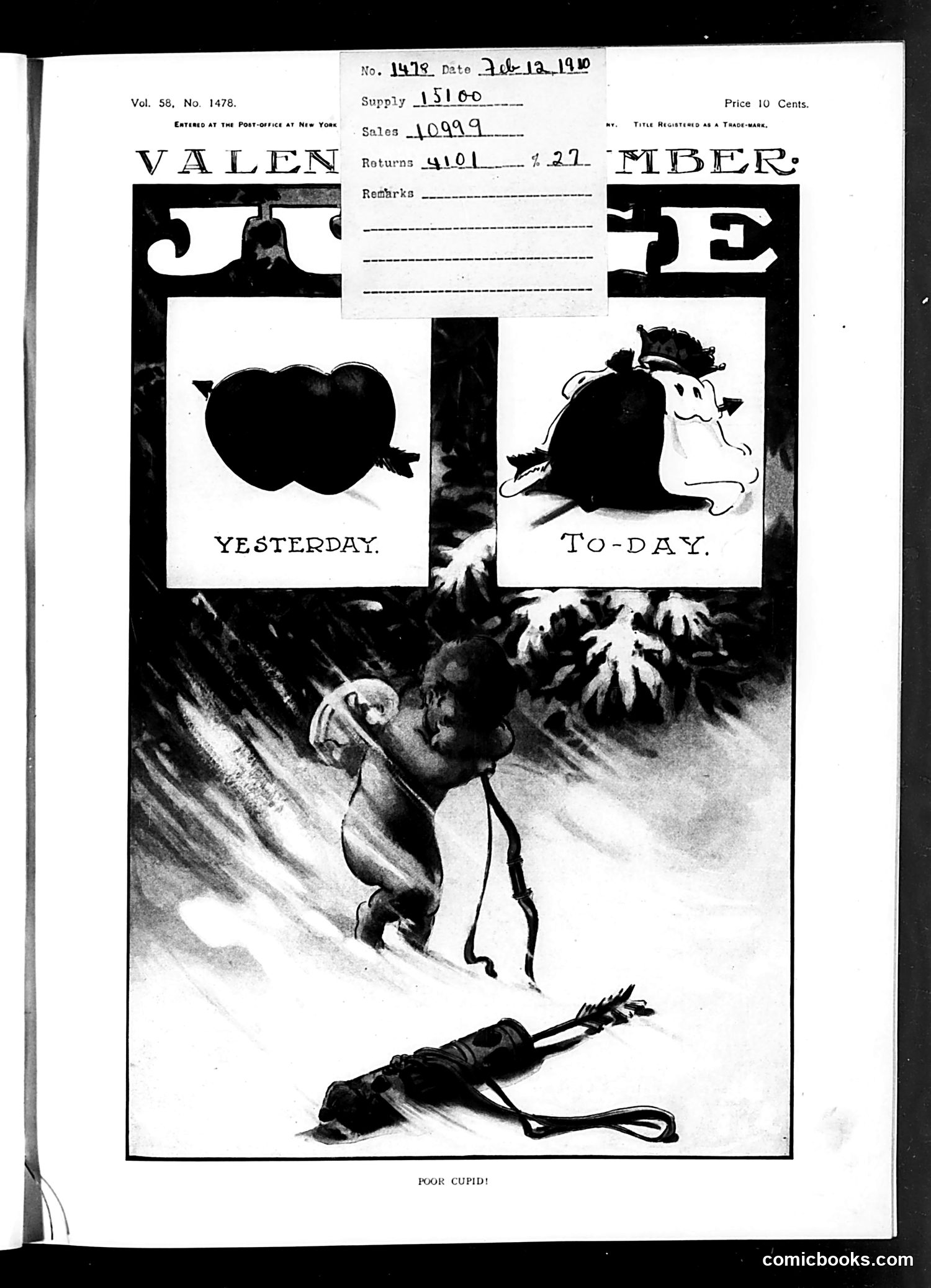
This Judge magazine page (dated December 12, 1910) presents a visual joke titled "Poor Cupid!" The cartoon shows Cupid's decline across two panels: "Yesterday" displays a plump, healthy apple; "To-Day" shows a withered, diseased fruit. Below, Cupid lies defeated on the ground, his bow broken. The satire appears to critique the deterioration of romance or love in modern society—likely referencing contemporary social changes like urbanization, commercialism, or shifting gender relations of the Progressive Era. The apple symbolizes love's former vitality, now corrupted or "diseased." The classical figure of Cupid, rendered powerless, suggests romantic ideals have become obsolete or corrupted by modernity. The specific social critique remains unclear without additional context.
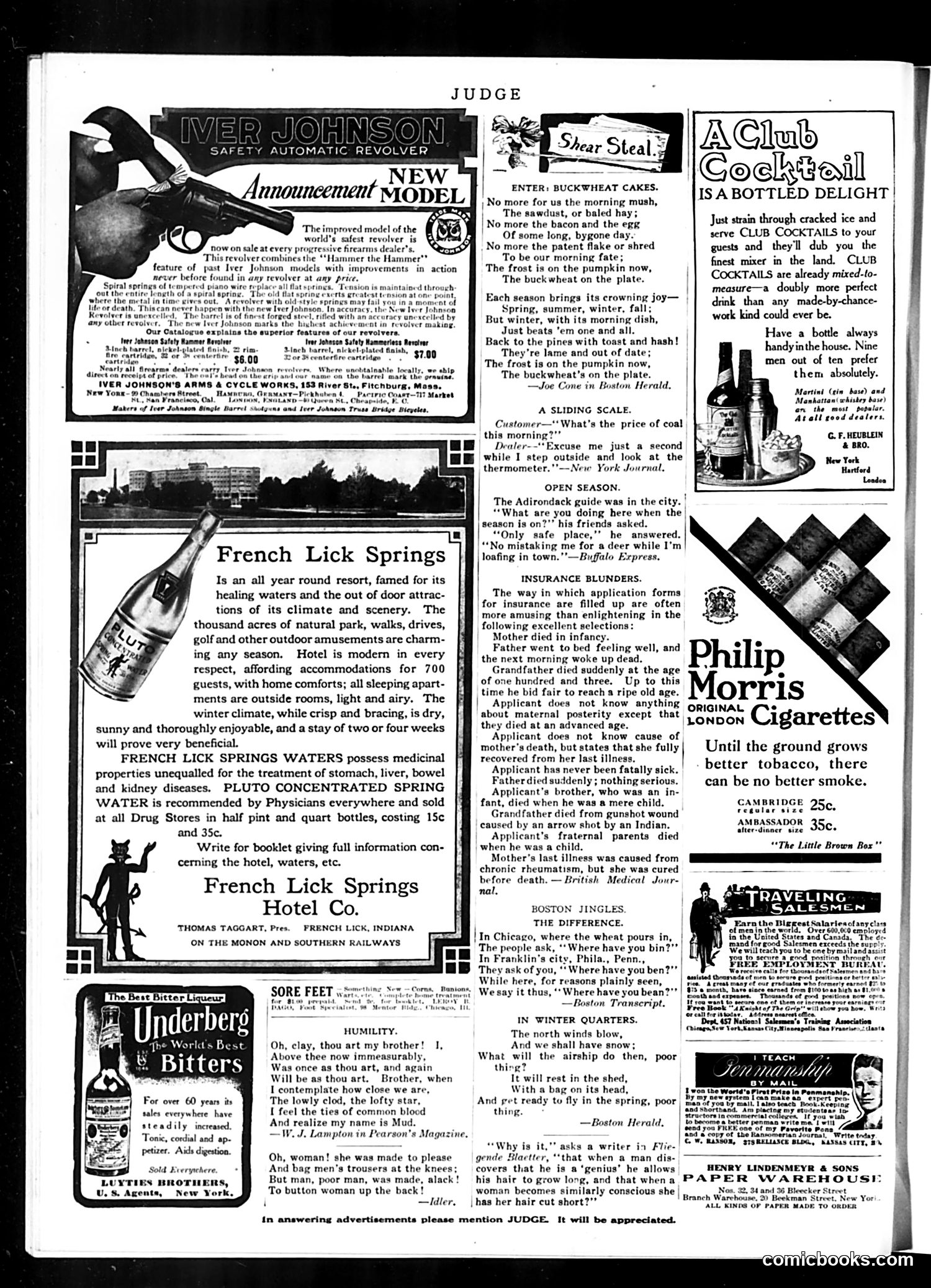
This page is primarily **advertising**, with minimal editorial content. The advertisements include: - **Iver Johnson Safety Revolver** (top left): Promotes a new "Hammer the Hammer" revolver model - **French Lick Springs Hotel** (center): Resort advertisement emphasizing healing mineral waters - **Philip Morris Cigarettes** (right): Claims superiority until "better tobacco" grows - **Underberg Bitters** (bottom left): Patent medicine marketed for digestive health - **Club Cocktails** (top right): Bottled spirits advertisement The page also contains brief humorous anecdotes and verse, including jokes about insurance claims and seasonal observations. These are typical of Judge's satirical filler content. There are **no identifiable political cartoons or caricatures** on this page—it reflects early 20th-century consumer advertising and light humor rather than political satire.
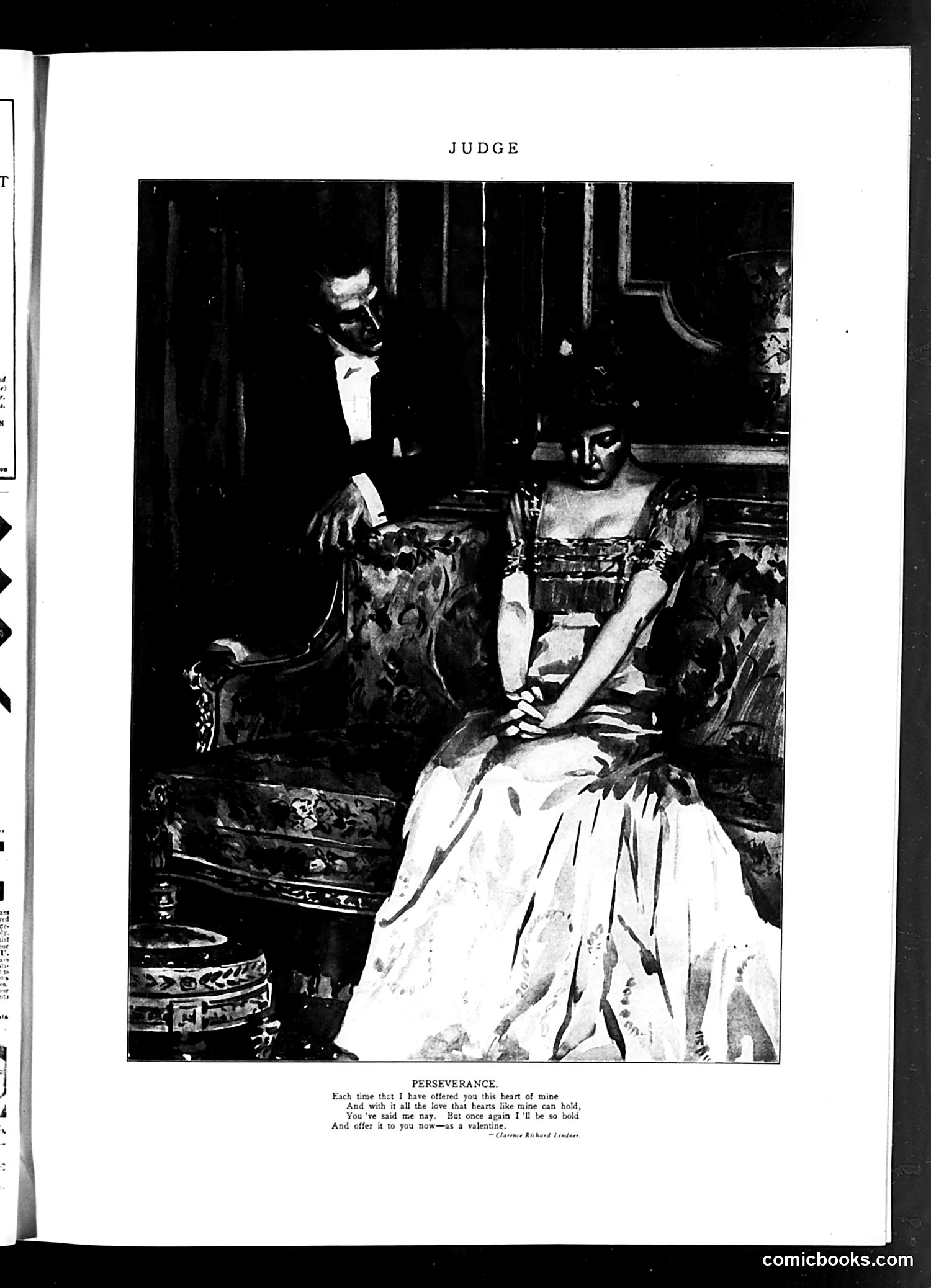
This page depicts a formal scene titled "Judge" with a subtitle "Perseverance" and includes a quoted verse by Clarence Richard Lindsay. The black-and-white illustration shows an elegantly dressed man in formal attire (tuxedo and mask) speaking with a seated woman in an elaborate gown. The accompanying poem references repeatedly offering one's heart with devoted love, ultimately presenting it "as a valentine." This appears to be romantic satire commentary on persistence in courtship or wooing, likely mocking either excessive romantic persistence or the conventional gestures of romantic pursuit during the era when Judge magazine was published. Without additional context about the specific historical moment or identifiable individuals depicted, the exact satirical target remains unclear, though it comments on social courtship customs.
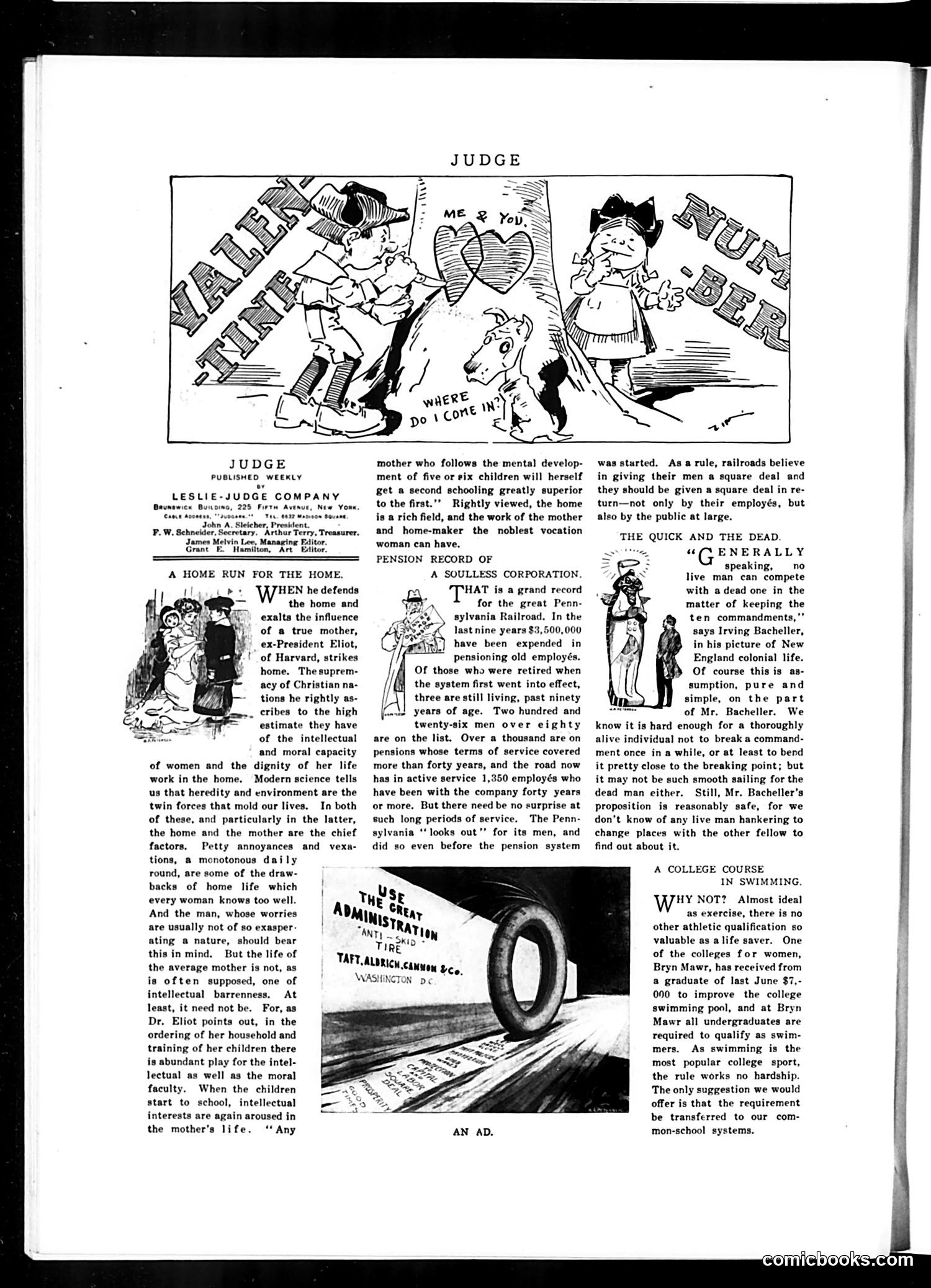
The top cartoon satirizes judicial corruption or favoritism. A figure labeled "JUDGE" sits surrounded by petitioners—one labeled "ME & YOU" (a heart), another saying "WHERE DO I COME IN?"—suggesting judges distribute favor inequitably rather than impartially. The figures labeled "AFTER" and "BEFORE" on either side likely reference how one's status changes based on a judge's decision. Below are three unrelated articles: one criticizing railroad company pension practices (a Progressive-era labor concern), another about avoiding dead bodies in social protocol, and a college swimming initiative. The middle section contains a period advertisement for "The Great Admiral" telescope. The page reflects early 20th-century concerns about institutional corruption, labor rights, and social etiquette.
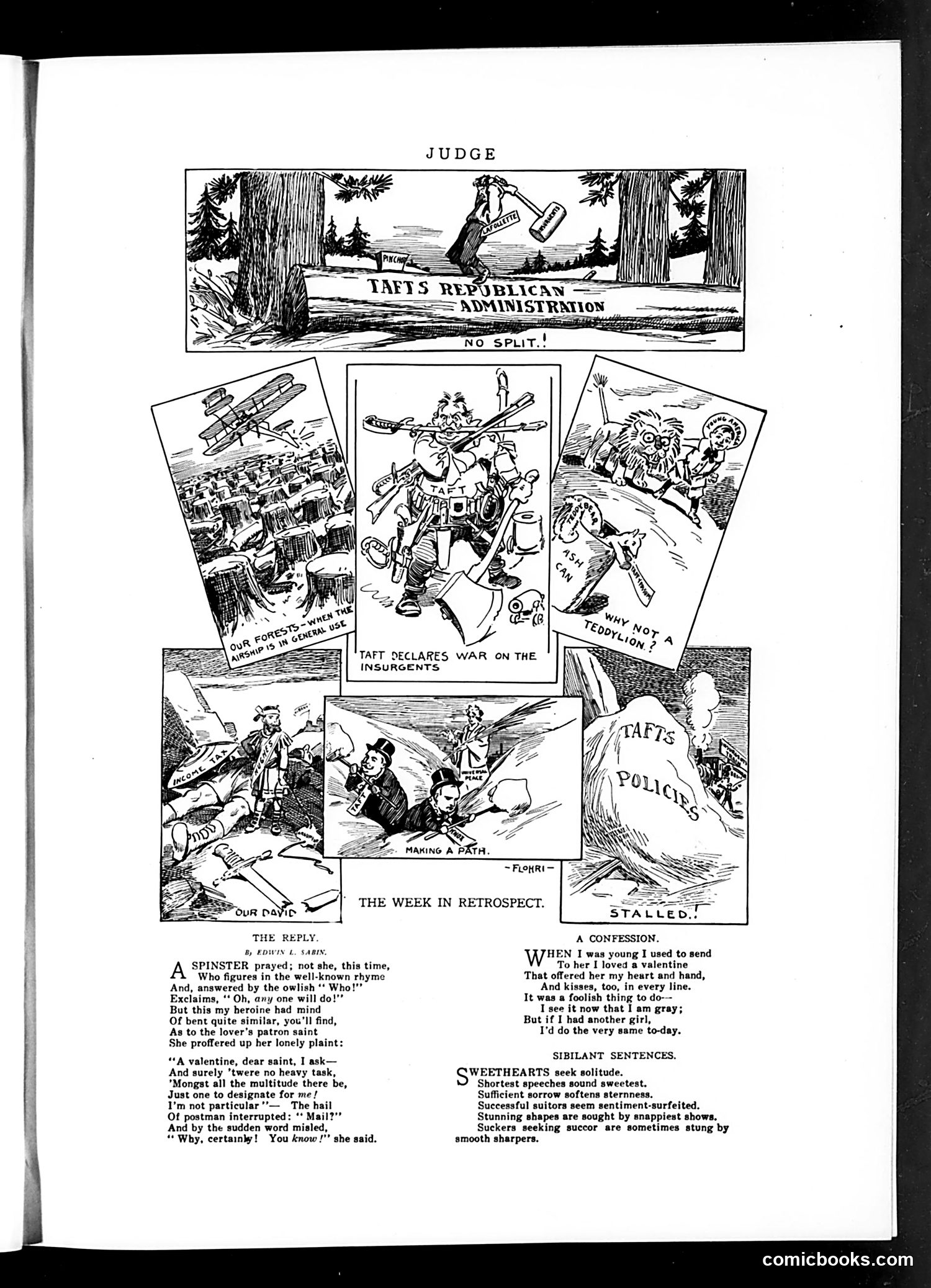
This page satirizes President William Howard Taft's Republican administration during what appears to be a domestic political crisis. The top panel shows a log being split with "Taft's Republican Administration" and "No Split!" — suggesting internal party fractures despite claims of unity. The central comic strip depicts Taft "declaring war on the insurgents" (likely progressive Republican rebels), with subsequent panels showing the administration's struggle: "Making a Path," "The Week in Retrospect," and "Taft's Policies Stalled." The imagery mocks Taft's inability to control his party or implement policy effectively. The accompanying poems below reinforce themes of political failure and weakness. This likely references the 1909-1910 Ballinger-Pinchot controversy or broader progressive-conservative Republican splits that would culminate in the 1912 party schism.
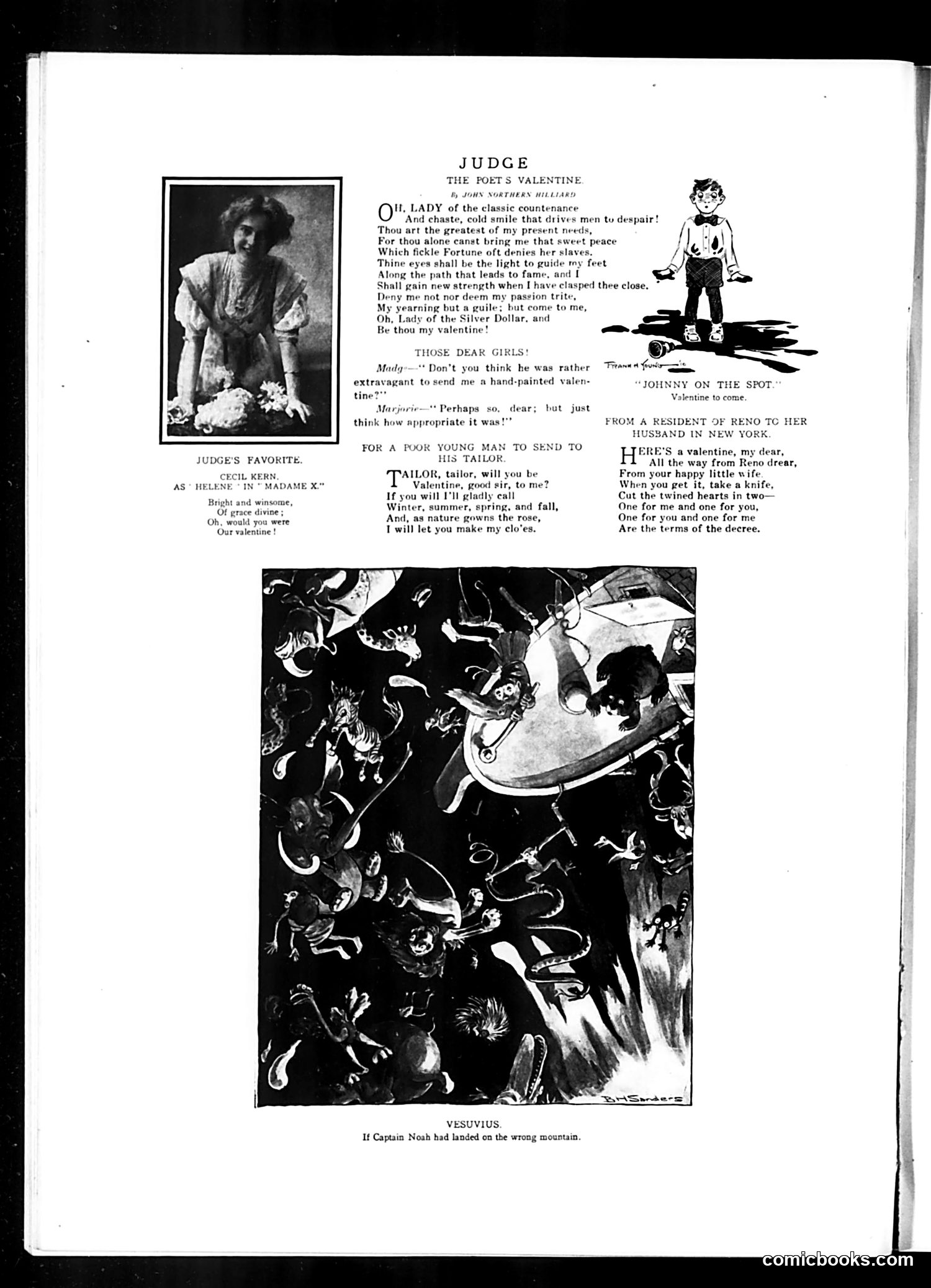
This page collects humorous Valentine's Day verses satirizing various social types and contemporary issues circa 1910s-1920s. **Key Satires:** 1. **"The Poet's Valentine"**: Mocks romantic poets who claim to worship women while actually lusting after wealth—the "Lady of the Silver Dollar" reveals mercenary motivations beneath flowery language. 2. **The Tailor verse**: Social commentary on poor young men's financial desperation; a tailor receives a Valentine because the suitor owes him money and needs to maintain their relationship. 3. **Vesuvius cartoon**: Absurdist biblical humor—depicts what would happen if Noah's ark landed on a volcano instead of a mountain, showing chaos and animals. 4. **Reno Valentine**: Sharp satire on divorce. A wife in Reno (then America's divorce capital) sends her estranged husband a Valentine instructing him to cut a symbolic heart in two—dark comedy about marital dissolution becoming commonplace and commercialized. The page collectively mocks materialism, debt, romantic hypocrisy, and the era's increasingly casual attitude toward divorce.
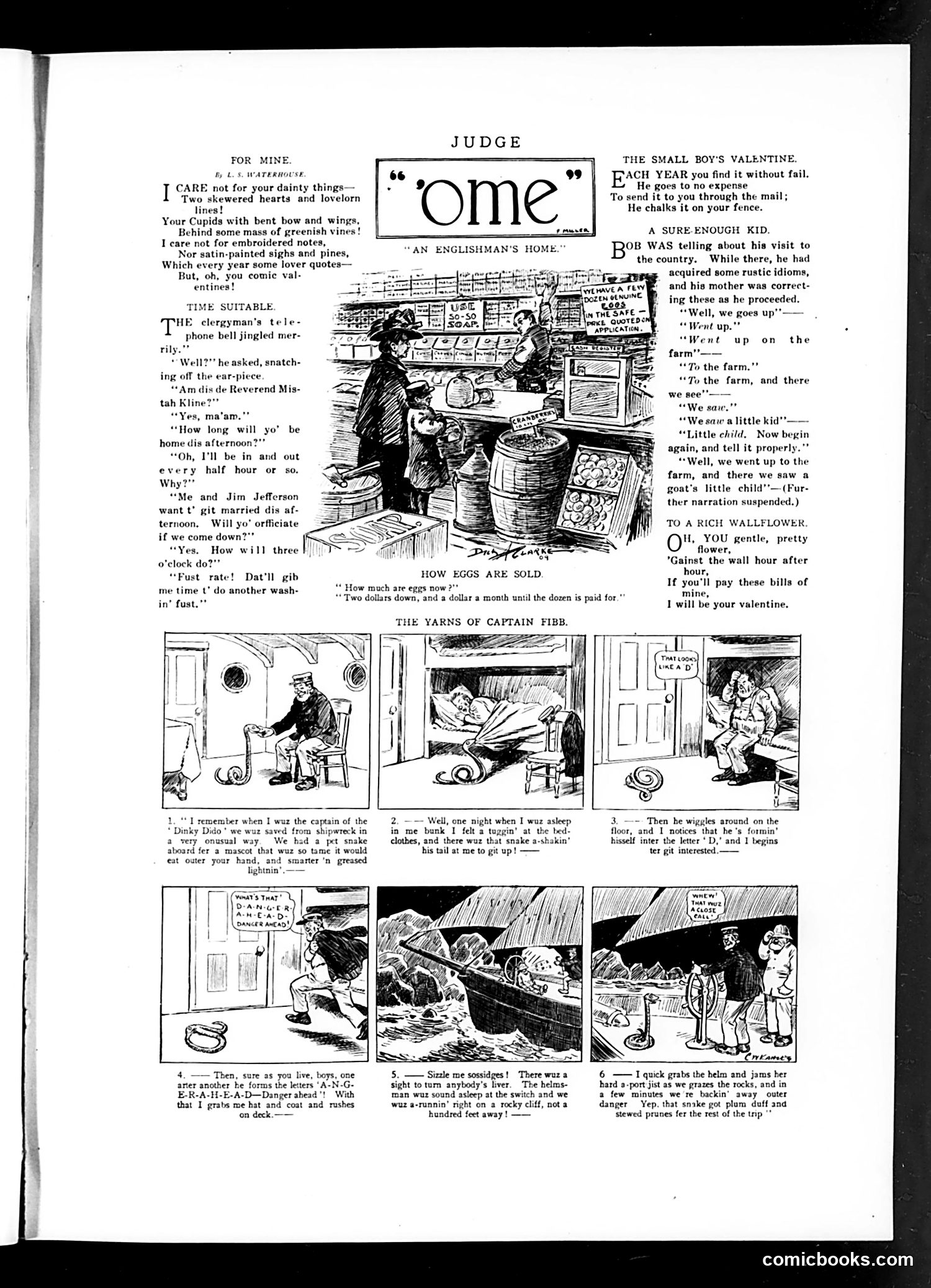
This page contains several humorous pieces typical of early 20th-century American satirical magazines: **"The Small Boy's Valentine"** mocks a child's crude courtship method—chalk messages on fences—contrasted with fancy store-bought valentines. The joke is innocent rustic behavior versus commercial sentimentality. **"Time Suitable"** depicts a clergyman agreeing to perform a hasty wedding for two men (Jim Jefferson and an unnamed partner) that afternoon, satirizing impulsive marriages and clergy's casual approach to solemnizing wedlock. **"How Eggs Are Sold"** jokes about installment-plan pricing for groceries—paying "two dollars down, and a dollar a month until the dozen is paid for"—mocking working-class economic struggles and consumer debt. **"The Yarns of Captain Fibb"** is a tall-tale comic strip about a ship's mascot snake that cleverly prevents disasters by forming warning letters ("AHEAD," "D"). It's pure absurdist humor with no deeper satirical intent. The overall page emphasizes comic valentines, class humor, and working-class vernacular speech as sources of amusement.
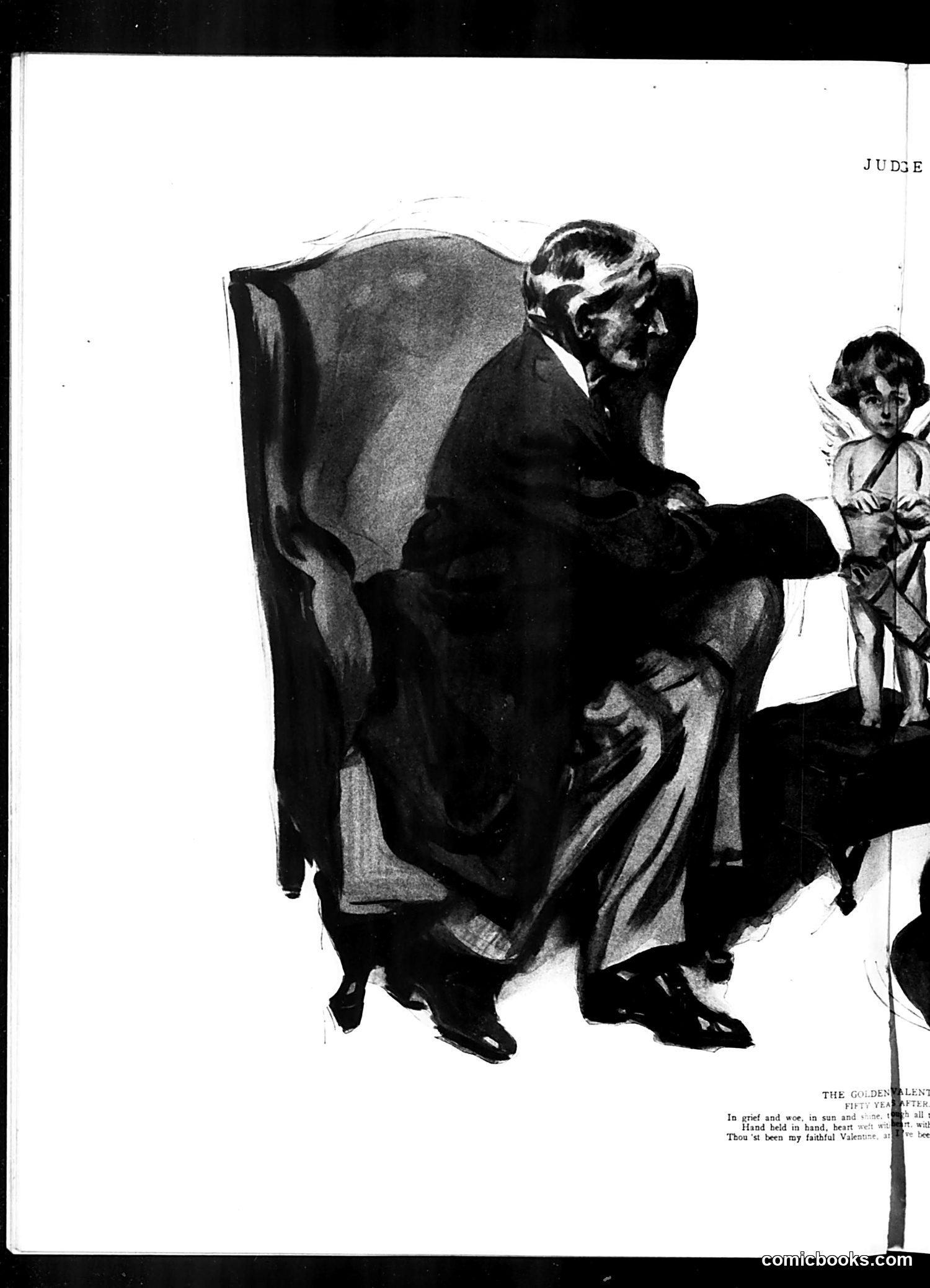
This page shows a political cartoon titled "JUDGE" depicting a seated judge in formal robes with his head in his hand in a gesture of despair or distress. A cherub or young figure appears on the right side of the image. The OCR'd text references grief, woe, and someone being "faithful," suggesting a romantic or personal betrayal narrative. However, **the specific identity of the judge and the particular scandal or event being satirized are unclear from this image alone**. The composition and pose suggest the cartoon mocks a prominent judicial figure experiencing public humiliation or personal disappointment, likely commenting on a contemporary scandal or hypocritical situation involving a judge. Without additional context or caption clarity, the exact historical reference remains uncertain.
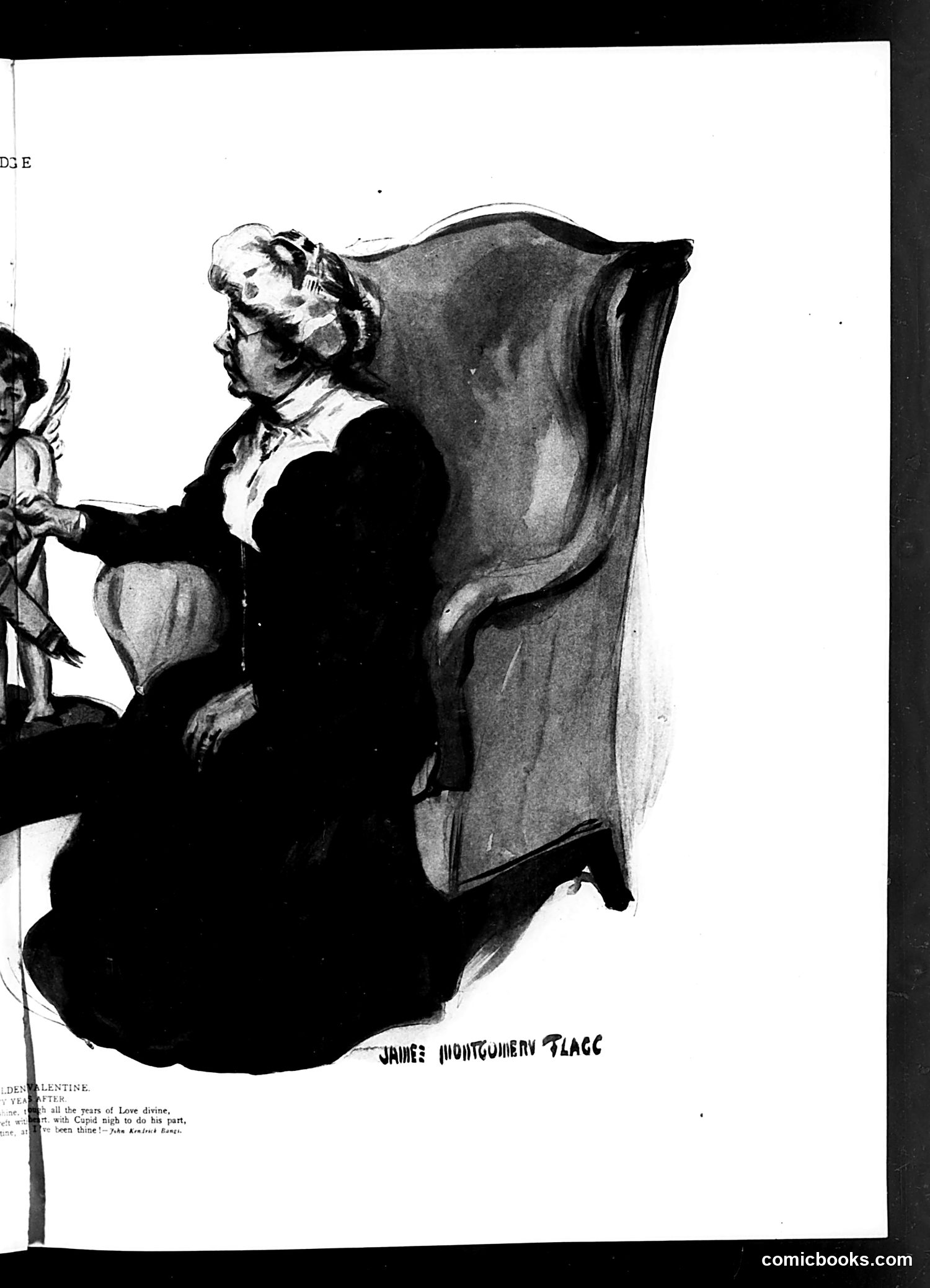
This is a black and white illustration by James Montgomery Flagg signed at bottom. The image shows a woman seated in an elegant chair, gazing upward in a romantic, dreamy manner. The accompanying text appears to be a Valentine's Day verse crediting John Kendrick Bangs, a popular humorist of the era. The poem references "years of Love divine" and "Cupid," establishing a romantic theme. The satire likely mocks Victorian sentimentality and overly romantic Valentine's Day sentiments—a common target of *Judge* magazine's humor. Flagg's exaggerated portrayal of the woman's wistful expression and theatrical pose emphasizes the melodrama of period romance conventions, inviting readers to laugh at such earnest emotional displays. Without a specific date visible, the exact historical context remains unclear, though this appears consistent with early 20th-century American satirical approaches to sentiment and courtship.
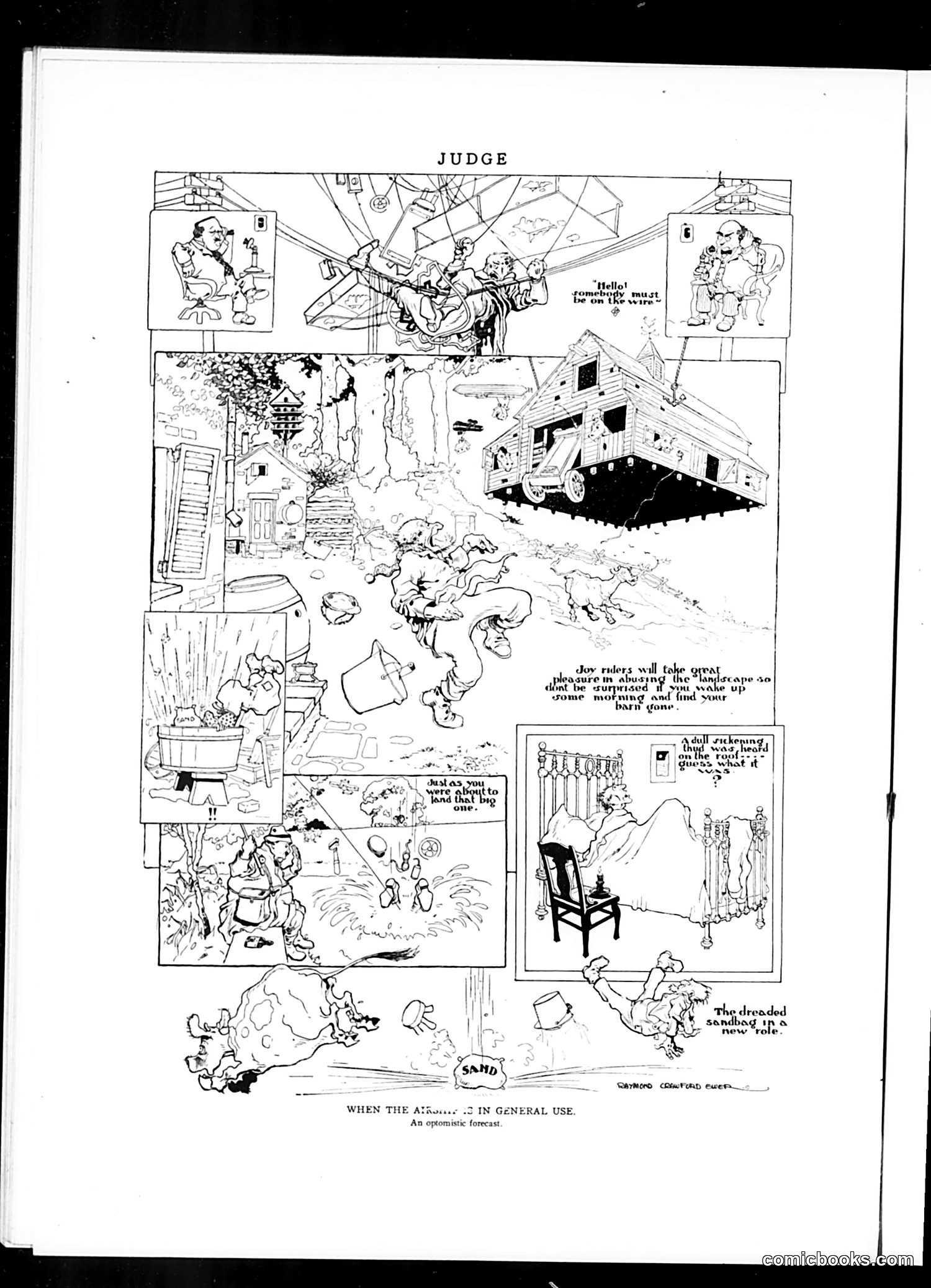
This is a satirical forecast imagining widespread civilian aircraft use. The cartoon shows chaos: planes crashing into houses, destroying barns, scattering livestock, and disrupting daily life. A judge figure appears at top left, and various domestic scenes depict the havoc—a destroyed home, animals fleeing, property damage. The satire mocks optimistic predictions about aviation's future by presenting darkly comic consequences: joy riders carelessly endangering rural property, aircraft noise and debris, the "dreaded sandstorm" from landing planes. The subtitle calls this an "optimistic forecast"—ironic, since it depicts disaster. This reflects early 1900s anxieties about aircraft technology. Most people had never seen a functional airplane; the cartoon expresses skepticism about aviation's promised benefits while highlighting legitimate concerns about safety, property rights, and rural disruption from emerging technology.
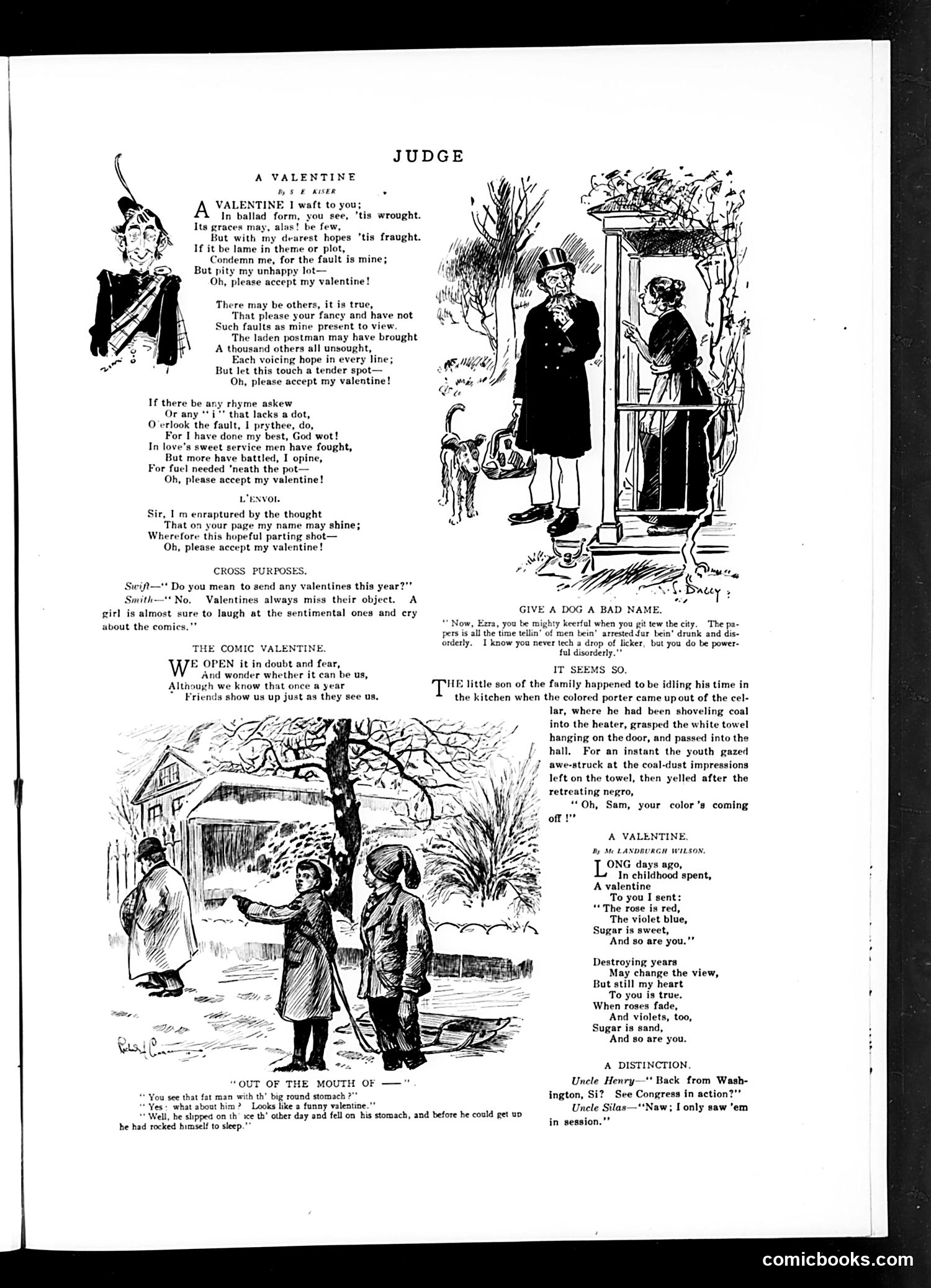
This page collects Valentine's Day humor and verses typical of late 19th/early 20th-century satirical magazines. **Main Content:** - Multiple sentimental Valentine poems in earnest style, mocking their overwrought romanticism - "Cross Purposes" joke: the humor lies in the paradox that sentimental valentines fail—girls laugh at them, yet men avoid sending them - "Give a Dog a Bad Name" cartoon: A white child watching a Black porter carry a coal-dusty towel assumes the dust is the man's skin "coming off"—racist humor based on the period's pseudoscientific color anxiety - "It Seems So" sketch: dark humor about a child mistaking coal dust on a towel for the porter's skin - Bottom section includes nostalgic verses comparing youthful romance to aging, and a dialect joke about Congress being as inactive as a sleeping man **Context:** The racist cartoon reflects the casual prejudice typical of Judge's era. The Valentine jokes target sentimental excess—a perennial target of satirical magazines.
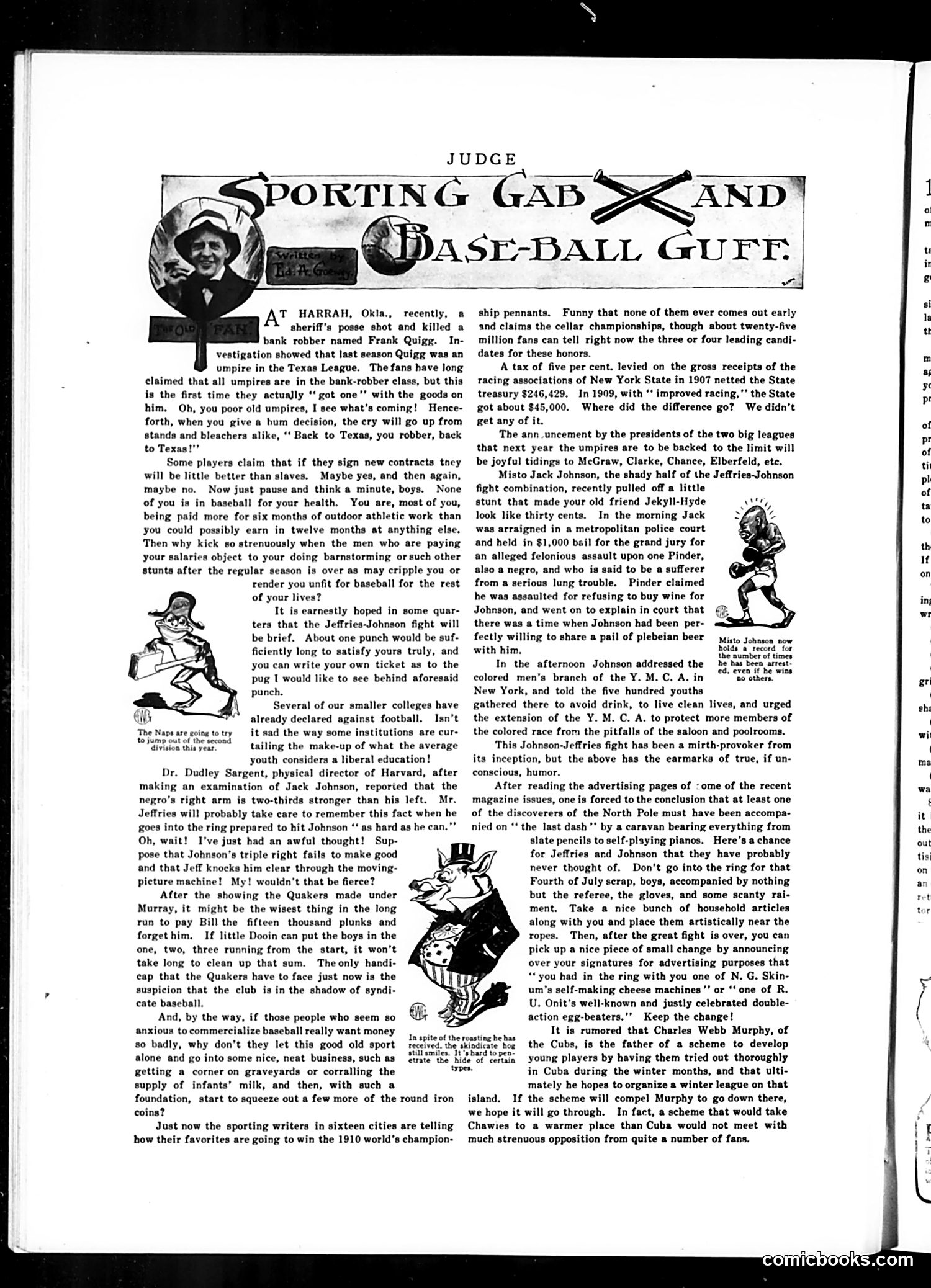
This page from Judge magazine (circa 1909-1910) contains sports commentary with three main satirical points: **The Umpire Joke**: A bank robber named Frank Quigg, killed in Oklahoma, had previously worked as a Texas League umpire. The writer jokes that fans have long suspected umpires of being criminals—now they have proof. **The Jeffries-Johnson Fight**: References the upcoming heavyweight boxing match between white champion Jim Jeffries and Black challenger Jack Johnson. The satire mocks the hype and racial tension surrounding this highly publicized bout. Harvard's Dr. Sargent examined Johnson and found his right arm two-thirds stronger than his left; the writer jokes Jeffries should watch out, and absurdly suggests Johnson might knock Jeffries through a movie projector. **Baseball Commercialism**: The writer criticizes players complaining about contracts while earning good money, and attacks the trend toward "syndicate baseball" (corporate ownership), sarcastically suggesting greedy baseball promoters should instead monopolize graveyards or baby formula. The tone is cynical about sports professionalism and racial spectacle.
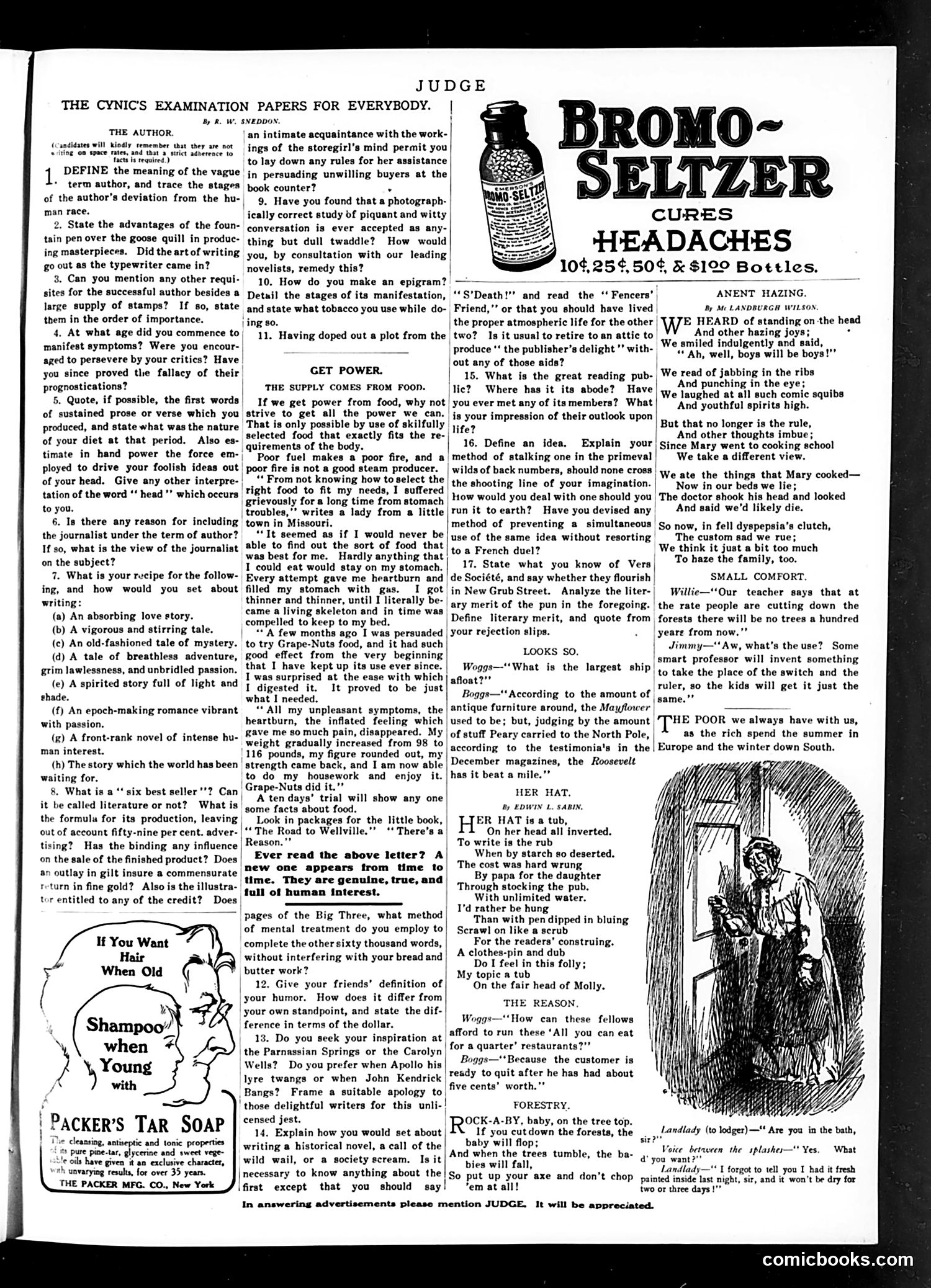
This page from **Judge** magazine presents "The Cynic's Examination Papers for Everybody," a satirical mock-exam about writing and authorship by R.W. Sneddon. The humor targets the pretensions of authors and the publishing industry. The examination questions ridicule romantic and literary clichés—asking candidates to define recipes for "absorbing love stories," "epoch-making romance," and "the story which the world has been waiting for." This mocks the formulaic, mass-produced nature of popular fiction. Questions about tobacco use while composing epigrams and the "deviation from the human race" that authorship causes suggest authors were viewed as eccentric, possibly dissolute characters. The satirical tone implies contemporary literature relied on gimmicks (binding, illustration, advertising) rather than genuine merit. The page also contains period advertisements (Bromo-Seltzer, Parker's Tar Soap) and several unrelated short comic pieces typical of Judge's miscellaneous format.
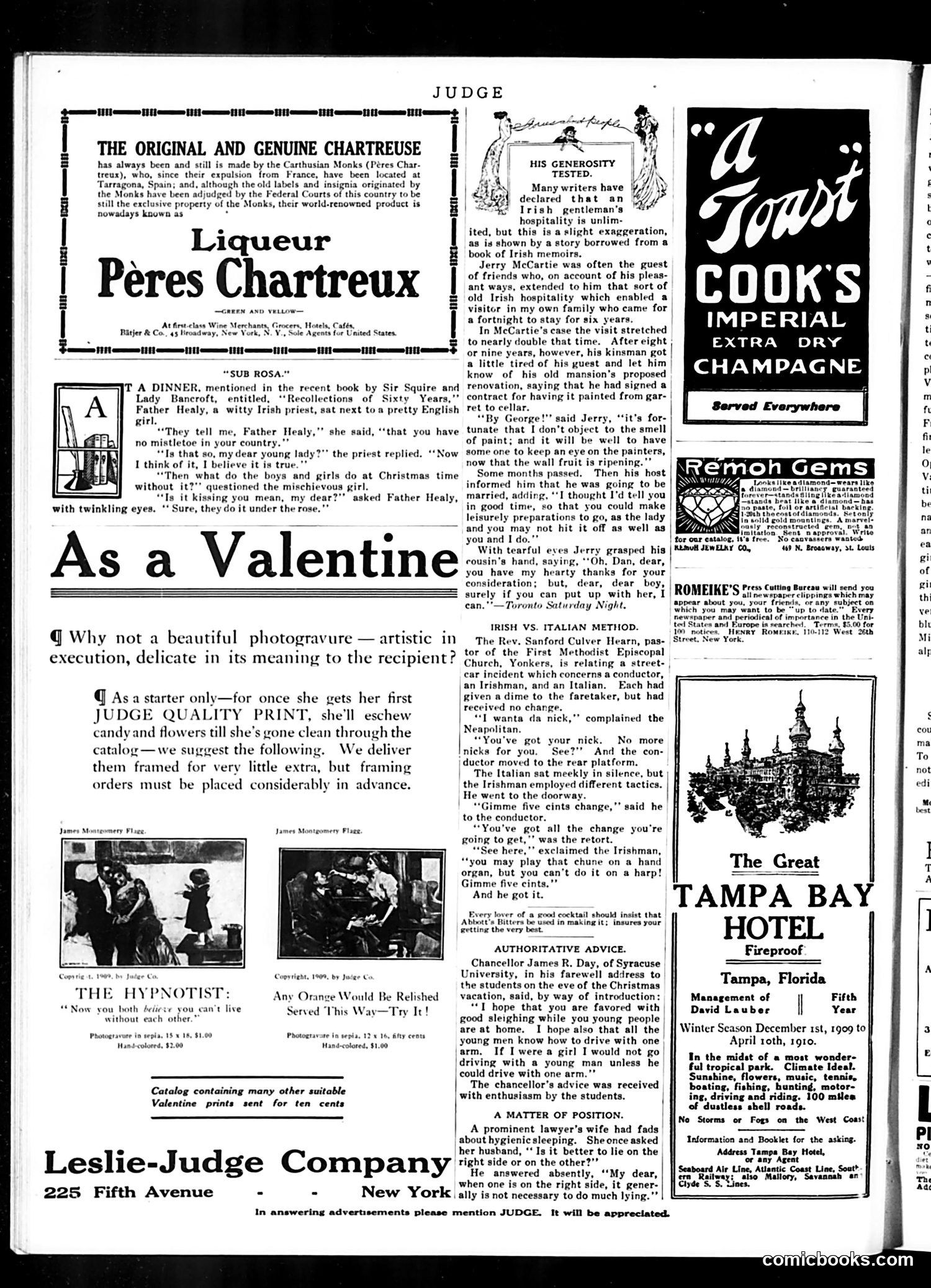
This page mixes advertisements with satirical content typical of Judge magazine's format. **Main content:** The centerpiece is a humorous anecdote titled "As a Valentine" about Irish hospitality. It tells how Jerry McCartie, an overstaying houseguest, cleverly avoids leaving by expressing concern that his host will miss him during home renovations—prompting the exasperated host to insist Jerry stay longer anyway. The joke satirizes both Irish visitors' notorious tendency to overstay their welcome and the social awkwardness of actually telling someone to leave. **Additional humor:** Smaller pieces include a priest's witty exchange about Christmas kissing customs ("under the rose," meaning secretly), and a comparative anecdote about Irish versus Italian methods of handling streetcar fares. **Advertisements:** The page includes ads for Chartreuse liqueur, champagne, hotels, and Judge's own "quality" photogravure prints for Valentine's Day—suggesting romantic gift-giving for the modern reader. The satirical tone targets Irish stereotypes and social conventions of the Edwardian era.
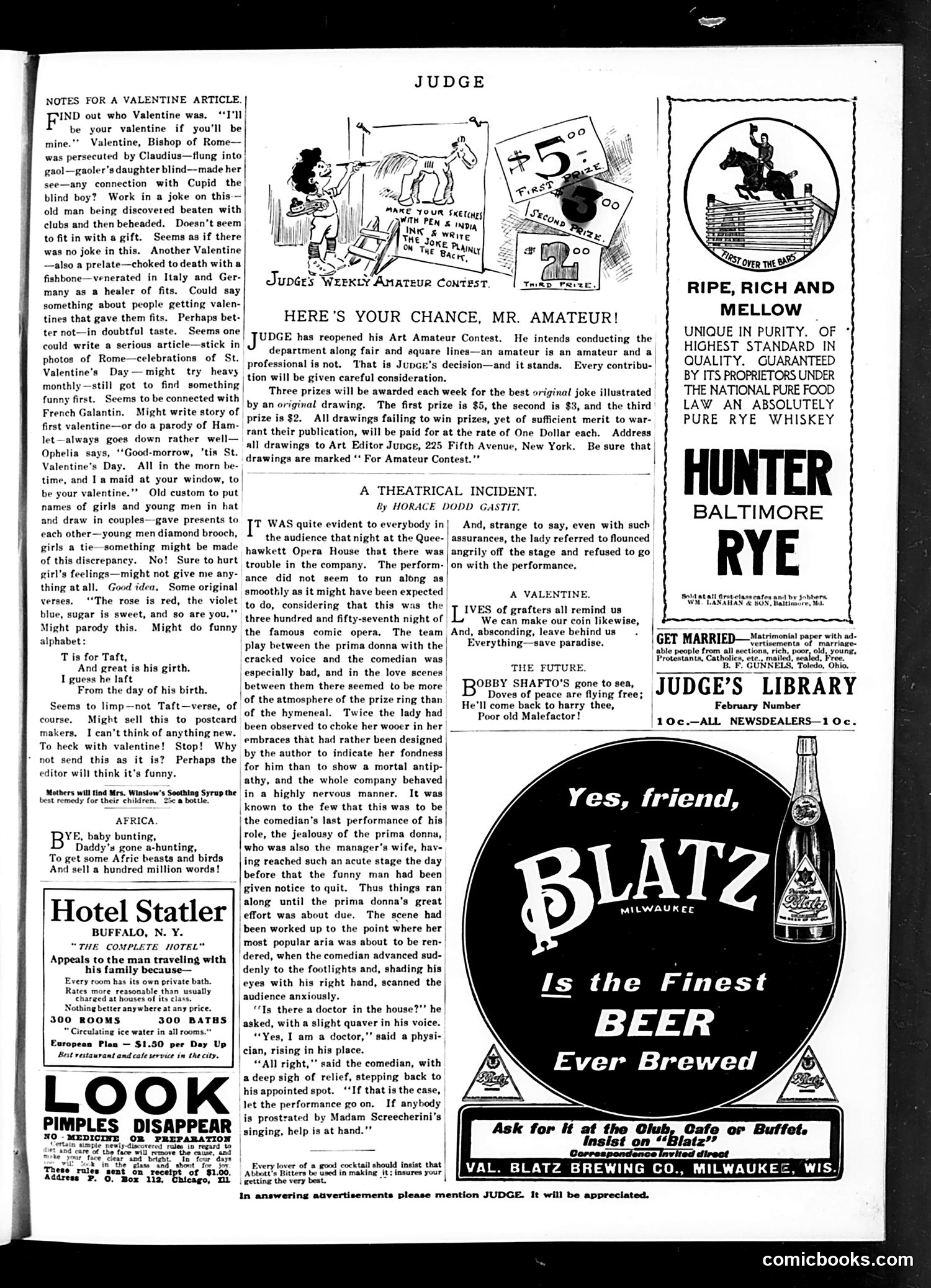
This page from Judge magazine (appears to be early 1900s based on President Taft reference) is primarily **humorous notes and advertisements** rather than political satire. The main content shows editorial brainstorming for a Valentine's Day article, where a writer lists random joke ideas—some crude (old men beaten with clubs), some pun-based (people "getting fits" from valentines). A notable reference: a parody alphabet verse mocking President **William Howard Taft's weight** ("great is his girth"). Below are three unrelated short pieces: a colonial-style poem about African hunting, and two theatrical anecdotes about opera performance mishaps. The page is largely filled with **period advertisements** for hotels, patent medicines, and beer—typical Judge content. These ads reveal the magazine's audience: traveling businessmen and middle-class readers. The humor is genteel, domesticated, and mostly apolitical—focused on relationships, bodily humor, and light social observation rather than sharp political commentary.
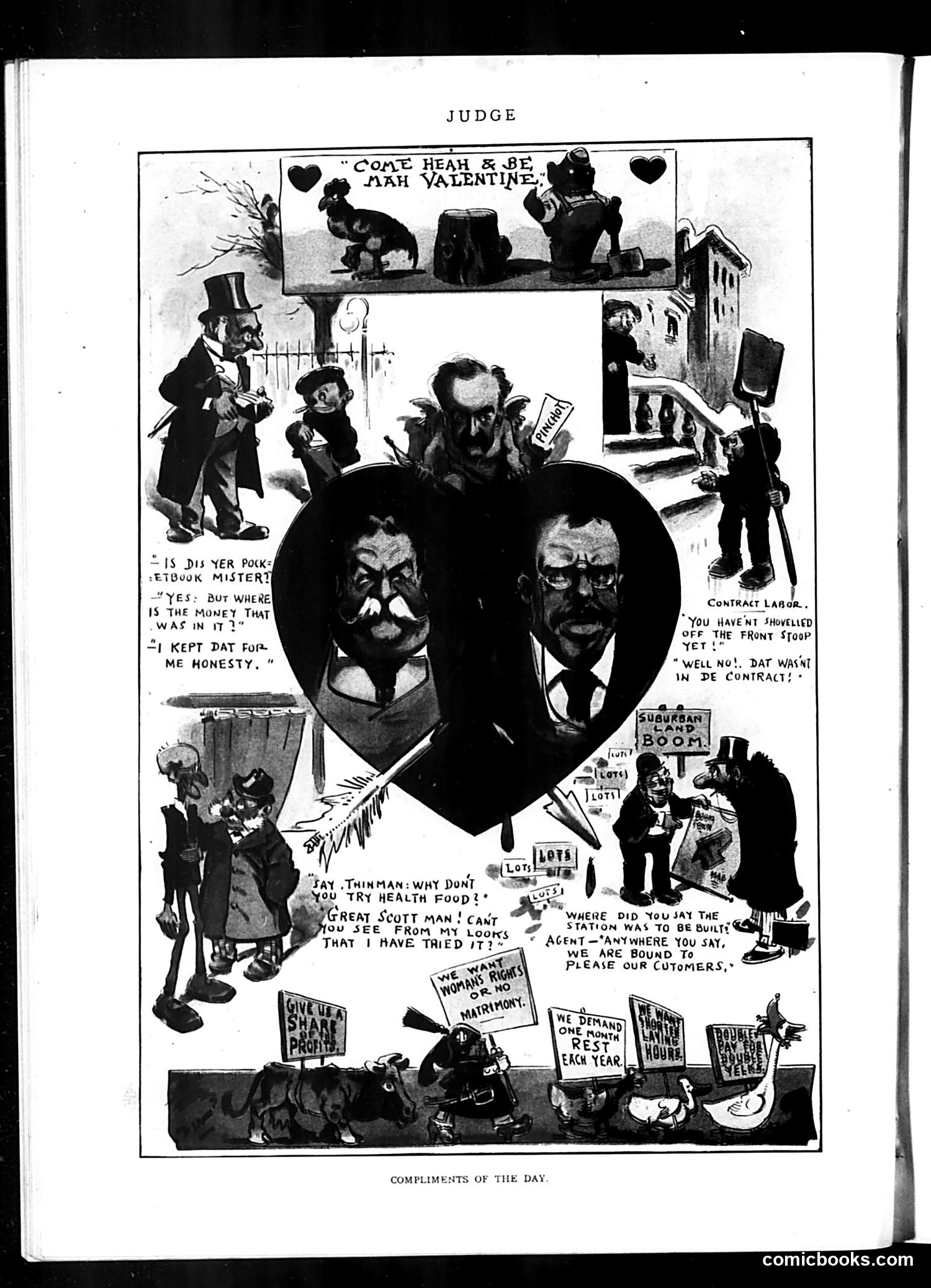
This satirical cartoon attacks urban corruption and labor exploitation in early 20th-century America. The two large caricatured faces dominate the center—likely representing corrupt politicians or business leaders engaged in dishonest dealings. The surrounding vignettes mock various social ills: - **"Pocketbook Mystery"** depicts theft and embezzlement by trusted officials - **"Contract Labor"** shows workers exploited with unfulfilled agreements - **"Health Food"** ridicules false wellness claims - **"Suburban Boom"** satirizes real estate schemes with misleading promises ("anywhere you say, we are bound to please our customers") - **Bottom protest signs** demand labor reforms: "Give us our rights," "Women want no matrimony," "We demand one day rest each year" The title "Come Heah & Be Nah Valentine" appears to be a pun on Valentine's Day, reframing corrupt dealings as "love" (ironic affection for money/power). The overall message: systematic dishonesty permeates business, labor, and politics, victimizing workers and consumers through broken contracts and false promises.