
Judge, 1910-02-12 · page 4 of 16
Judge — February 12, 1910 — page 4: what you’re looking at
What you’re looking at
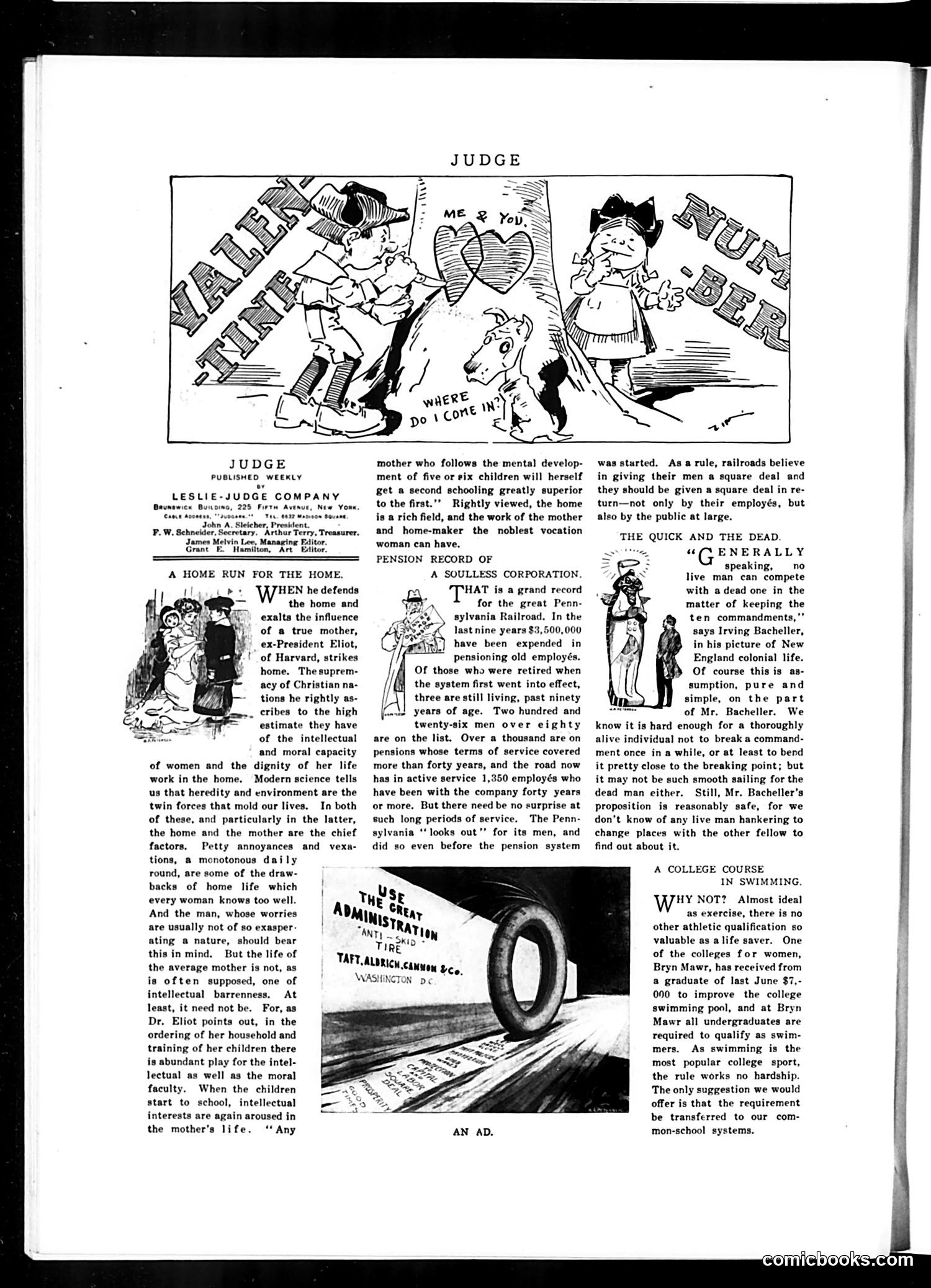
The top cartoon satirizes judicial corruption or favoritism. A figure labeled "JUDGE" sits surrounded by petitioners—one labeled "ME & YOU" (a heart), another saying "WHERE DO I COME IN?"—suggesting judges distribute favor inequitably rather than impartially. The figures labeled "AFTER" and "BEFORE" on either side likely reference how one's status changes based on a judge's decision. Below are three unrelated articles: one criticizing railroad company pension practices (a Progressive-era labor concern), another about avoiding dead bodies in social protocol, and a college swimming initiative. The middle section contains a period advertisement for "The Great Admiral" telescope. The page reflects early 20th-century concerns about institutional corruption, labor rights, and social etiquette.
📄 Transcribed text from this page (OCR, searchable)
Machine-transcribed from the original scan — historical spelling and the odd misread are preserved.
sya PUBLISHED WEEKLY ey LESLIE-JUDGE COMPANY Firtw ¥ Tes. an John A. Sleicher, Presiclent. P. W. Schneider, Secretary. Arthur Teri vin Lee, Managing Fai Hamilton, Art Edi /, Treasurer. A HOME RUN FOR THE HOME, HEN he defends the home and exalts the influence of a true mother, ex-President of Harvard, strikes home. The suprem- acy of Christian na- tions he rightly as- _ eribes to the high estimate they have of the intellectual and moral capacity of women and the dignity of her life work in the home. Modern science tells us that heredity and environment are the twin forces that mold our lives. In both of these, and particularly in the latter, the home and the mother are the chief factors. Petty annoyances and vexa- tions, a monotonous daily round, are some of the draw- backs of home life which every woman knows too well. e And the man, whose worries are usually not of so exasper- | me s ating a nature, should bear Thi ° this in mind, But the life of M the average mother is not, as APT ALIRCN canon be. is often supposed, one of intellectual barrenness, At least, it need not be. For, as Dr. Eliot points out, in the ordering of her household and training of her children there is abundant play for the intel- lectual as well a3 the moral faculty. When the children art to school, intellectual terests are again aroused in “Any the mother’s life. WASHINGTON mother who follows the mental develop- ment of five or eix children will herself get a second schooling greatly superior to the first.” Rightly viewed, the home is a rich field, and the work of the mother and home-maker the noblest vocation woman can have. PENSION RECORD OF A SOULLESS CORPORATION THat is a grand record for the great Penn- sylvania Railroad. In the last nine years $3,500,000 have been expended in pensioning old employés. Of those who were retired when the system first went into effect, / three are still living, past ninety kK years of age. Two hundred and twenty-six men over eighty are on the list. Over a thousand are on pensions whose terms of service covered more than forty years, and the road now has in active service 1,350 employés who have been with the company forty years or more. But there need be no surprise at such long periods of service. The Penn- sylvania ‘‘ looks out’’ for its men, and did so even before the pension system aN was started. Asa rule, railroads believe in giving their men a square deal and they should be given a square deal in re- turn—not only by their employés, but algo by the public at large. THE QUICK AND THE DEAD. “ ENERALLY speaking, no live man can compete with a dead one in the matter of keeping the ten commandments,”’ says Irving Bacheller, in his picture of New England colonial life. Of course this is as- sumption, pure and simple, on the part of Mr. Bacheller, We know it is hard enough for a thoroughly alive individual not to break a command- ment once in a while, or at least to bend it pretty close to the breaking point; but it may not be such smooth sailing for the dead man either. Still, Mr. Bacheller’s proposition is reasonably safe, for we don’t know of any live man hankering to change places with the other fellow to find out about it. A COLLEGE COURSE IN SWIMMING. HY NOT? Almost ideal as exercise, there is no other athletic qualification so valuable as alife saver. One of the colleges for women, Bryn Mawr, has received from a graduate of last June $7,- 000 to improve the college swimming pool, and at Bryn Mawr all undergraduates are required to qualify as swim- mers. As swimming is the most popular college sport, the rule works no hardship. The only suggestion we would offer is that the requirement be transferred to our com- mon-school systems.