
Judge, 1910-02-12 · page 12 of 16
Judge — February 12, 1910 — page 12: what you’re looking at
What you’re looking at
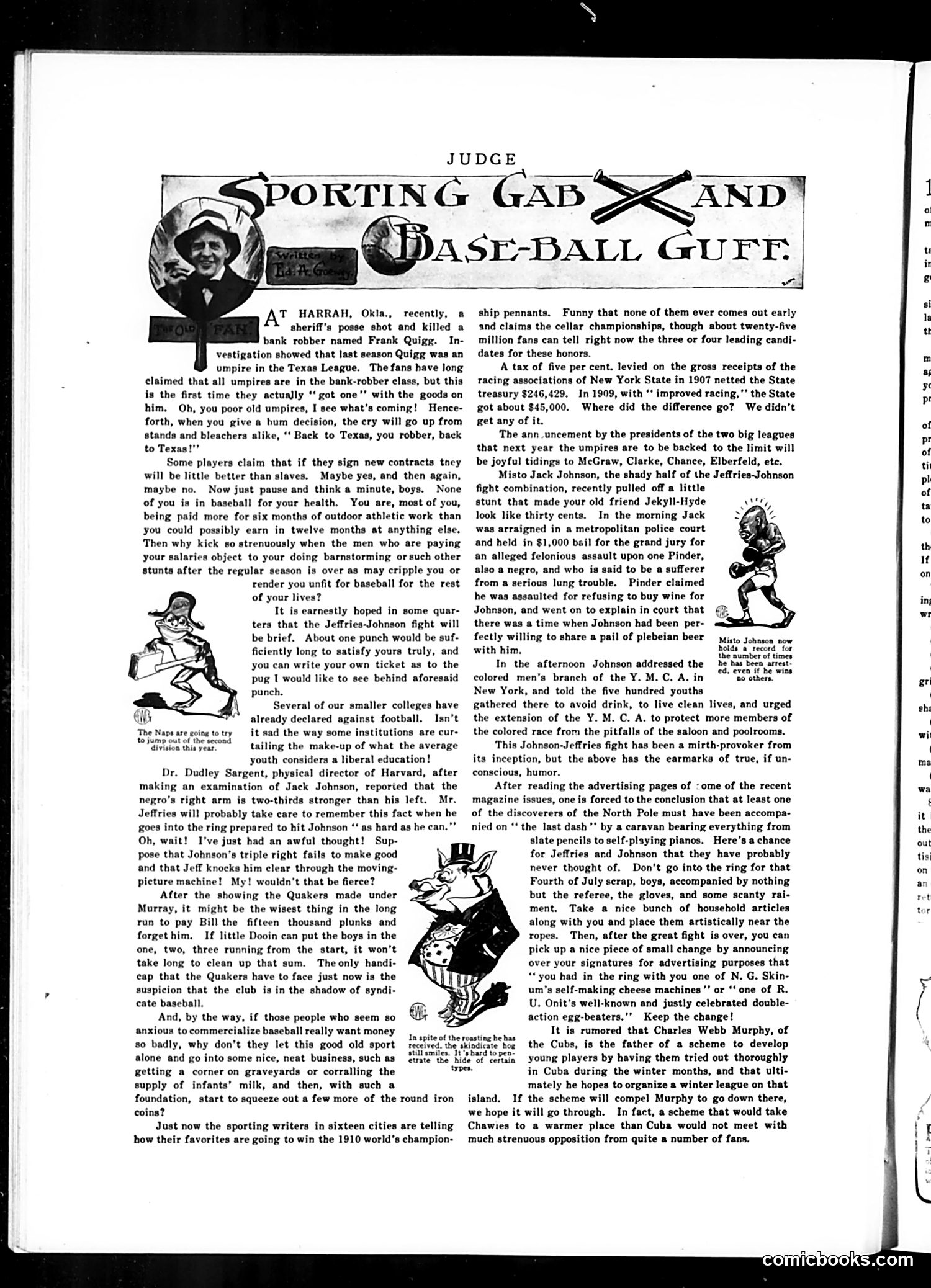
This page from Judge magazine (circa 1909-1910) contains sports commentary with three main satirical points: **The Umpire Joke**: A bank robber named Frank Quigg, killed in Oklahoma, had previously worked as a Texas League umpire. The writer jokes that fans have long suspected umpires of being criminals—now they have proof. **The Jeffries-Johnson Fight**: References the upcoming heavyweight boxing match between white champion Jim Jeffries and Black challenger Jack Johnson. The satire mocks the hype and racial tension surrounding this highly publicized bout. Harvard's Dr. Sargent examined Johnson and found his right arm two-thirds stronger than his left; the writer jokes Jeffries should watch out, and absurdly suggests Johnson might knock Jeffries through a movie projector. **Baseball Commercialism**: The writer criticizes players complaining about contracts while earning good money, and attacks the trend toward "syndicate baseball" (corporate ownership), sarcastically suggesting greedy baseball promoters should instead monopolize graveyards or baby formula. The tone is cynical about sports professionalism and racial spectacle.
📄 Transcribed text from this page (OCR, searchable)
Machine-transcribed from the original scan — historical spelling and the odd misread are preserved.
JUDGE PORTING GAD S<AND 7 ASE-BALL GUFE a T HARRAH, Okla., recently, a sheriff's posse shot and killed a bank robber named Frank Quigg. In- vestigation showed that last season Quigg was an umpire in the Texas League. The fans have long claimed that all umpires are in the bank-robber class, but this is the first time they actually ‘got one’? with the goods on him. Oh, you poor old umpires, I see what's coming! Hence- forth, when you give a hum decision, the cry will go up from stands and bleachers alike, ‘‘ Back to Texas, you robber, back to Texas!" Some players claim that if they sign new contracts they will be little better than slaves. Maybe yes, and then again, maybe no. Now just pause and think a minute, boys. None of you is in baseball for your health. You are, most of you, being paid more for six months of outdoor athletic work than you could possibly earn in twelve months at anything else. Then why kick so strenuously when the men who are paying your salaries object to your doing barnstorming or such other stunts after the regular season is over as may cripple you or render you unfit for baseball for the rest of your lives? It is earnestly hoped in some quar- ters that the Jeffries-Johnson fight will be brief. About one punch would be suf- ficiently long to satisfy yours truly, and you can write your own ticket as to the pug I would like to see behind aforesaid punch. Several of our smaller colleges have already declared against football. Isn’t it sad the way some institutions are cur- tailing the make-up of what the average youth considers a liberal education! Dr. Dudley Sargent, physical director of Harvard, after making an examination of Jack Johnson, reporied that the negro’s right arm is two-thirds stronger than his left. Mr. Jeffries will probably take care to remember this fact when he goes into the ring prepared to hit Johnson ‘‘ as hard as he can.”* Oh, wait! I've just had an awful thought! Sup- pose that Johnson's triple right fails to make good and that Jeff knocks him clear through the moving- picture machine! My! wouldn't that be fierce? After the showing the Quakers made under Murray, it might be the wisest thing in the long run to pay Bill the fifteen thousand plunks and forget him. If little Dooin can put the boys in the one, two, three running from the start, it won't take long to clean up that sum. The only handi- cap that the Quakers have to face just now is the suspicion that the club is in the shadow of syndi- cate baseball. And, by the way, if those people who seem so anxious to commercialize baseball really want money so badly, why don’t they let this good old sport alone and go into some nice, neat business, such as getting a corner on graveyards or corralling the supply of infants’ milk, and then, with such a foundation, start to squeeze out a few more of the round iron ‘The Naps are going to try to jump out ¢ division this year. coins? Just now the sporting writers in sixteen cities are telling how their favorites are going to win the 1910 world’s champion- Jn spite of the roasting he has teceived. the skindicate hog still smiles. It's bard to pen erate the hide of certain types. ship pennants. Funny that none of them ever comes out early ‘and claims the cellar championships, though about twenty-five million fans can tell right now the three or four leading candi- dates for these honors. A tax of five per cent. levied on the gross receipts of the racing associations of New York State in 1907 netted the State treasury $246,429. In 1909, with ‘ improved racing,”’ the State got about $45,000. Where did the difference go? We didn’t get any of it. ‘The ann-uncement by the presidents of the two big leagues that next year the umpires are to be backed to the limit will be joyful tidings to McGraw, Clarke, Chance, Elberfeld, ete. Misto Jack Johnson, the shady half of the Jeffries-Johnson fight combination, recently pulled off a little stunt that made your old friend Jekyll-Hyde look like thirty cents. In the morning Jack was arraigned in a metropolitan police court and held in $1,000 bail for the grand jury for an alleged felonious assault upon one Pinder, also a negro, and who is said to be a sufferer from a serious lung trouble. Pinder claimed he was assaulted for refusing to buy wine for Johnson, and went on to explain in court that there was a time when Johnson had been per- fectly willing to share a pail of plebeian beer with him. In the afternoon Johnson addressed the colored men's branch of the Y. M.C. A. in New York, and told the five hundred youths gathered there to avoid drink, to live clean lives, and urged the extension of the Y. C. A. to protect more members of the colored race from the pitfalls of the saloon and poolrooms. This Johnson-Jeffries fight has been a mirth-provoker from its inception, but the above has the earmarks of true, if un- conscious, humor. After reading the advertising pages of :ome of the recent magazine issues, one is forced to the conclusion that at least one of the discoverers of the North Pole must have been accompa- nied on ‘the last dash ’* by a caravan bearing everything from slate pencils to self-playing pianos, Here’s a chance for Jeffries and Johnson that they have probably never thought of. Don’t go into the ring for that Fourth of July scrap, boys, accompanied by nothing but the referee, the gloves, and some scanty rai- ment. Take a nice bunch of household articles along with you and place them artistically near the ropes. Then, after the great fight is over, you can pick up a nice piece of small change by announcing over your signatures for advertising purposes that “* you had in the ring with you one of N. G. Skin- um’ If-making cheese machines "’ or ‘‘ one of R. U. Onit’s well-known and justly celebrated double- action egg-beaters."’ Keep the change! It is rumored that Charles Webb Murphy, of the Cubs, is the father of a scheme to develop young players by having them tried out thoroughly in Cuba during the winter months, and that ulti- mately he hopes to organize a winter league on that island. If the scheme will compel Murphy to go down there, we hope it will go through. In fact, a scheme that would take Chawies to a warmer place than Cuba would not meet with much strenuous opposition from quite a number of fans. as J. even if he wins no others.