
A complete issue · 16 pages · 1910
Judge — January 15, 1910
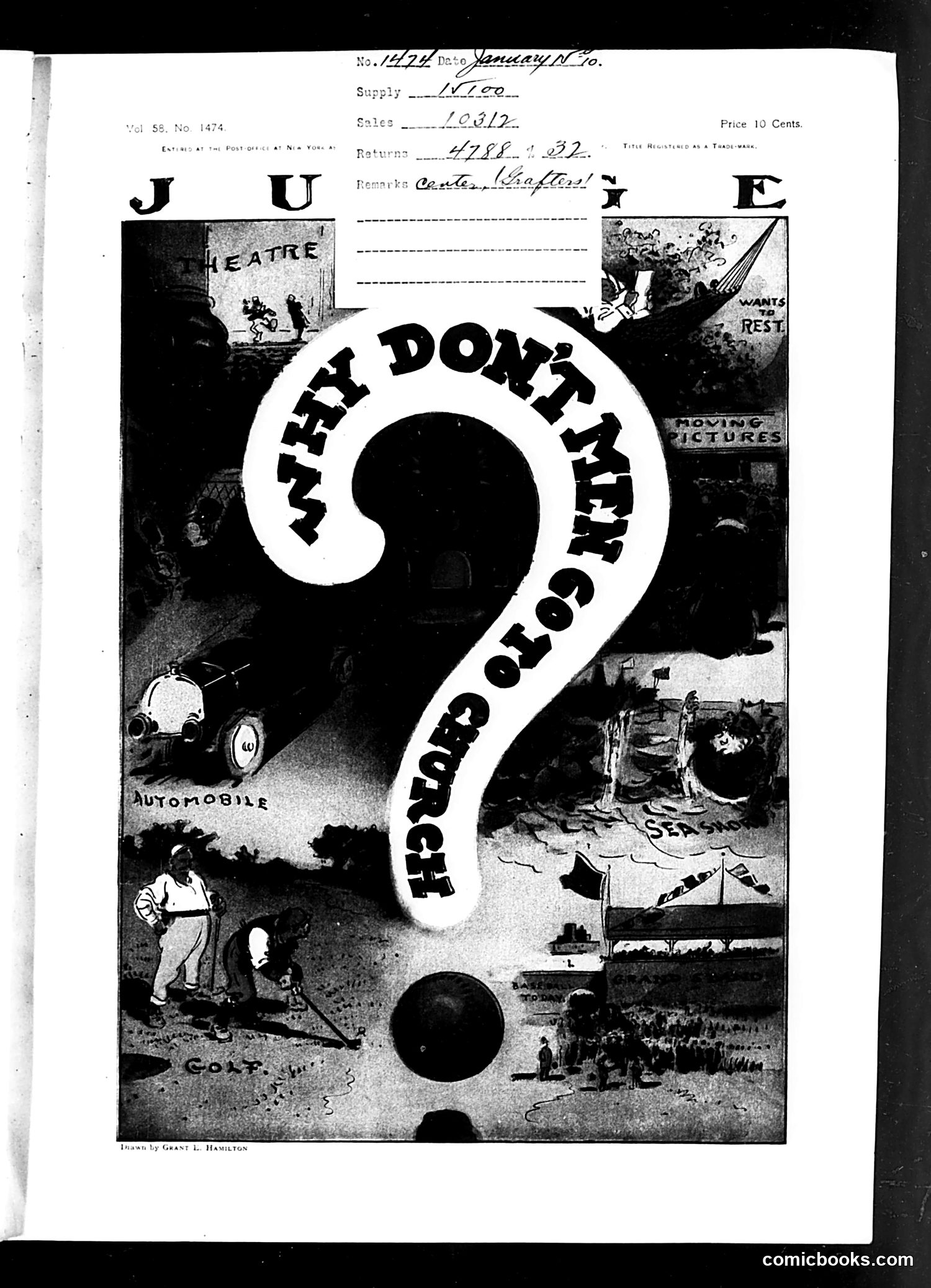
This Judge magazine page features a large question mark as its central design element, surrounding various scenes of American life: theater, automobiles, golf, and what appears to be military or industrial activity. The title "WHY DON'T THEY?" suggests satirical commentary on contemporary social or political failures—likely criticizing government or institutional inaction regarding visible problems. The collage of images represents different sectors of American society, implying the question applies broadly across multiple domains. Without clearer text identifying specific targets, the satire appears to mock widespread societal problems that remain unaddressed despite being obvious to observers. The date (January 1930) suggests possible references to economic or social issues of the Great Depression era, though the specific critique remains unclear from this reproduction alone.
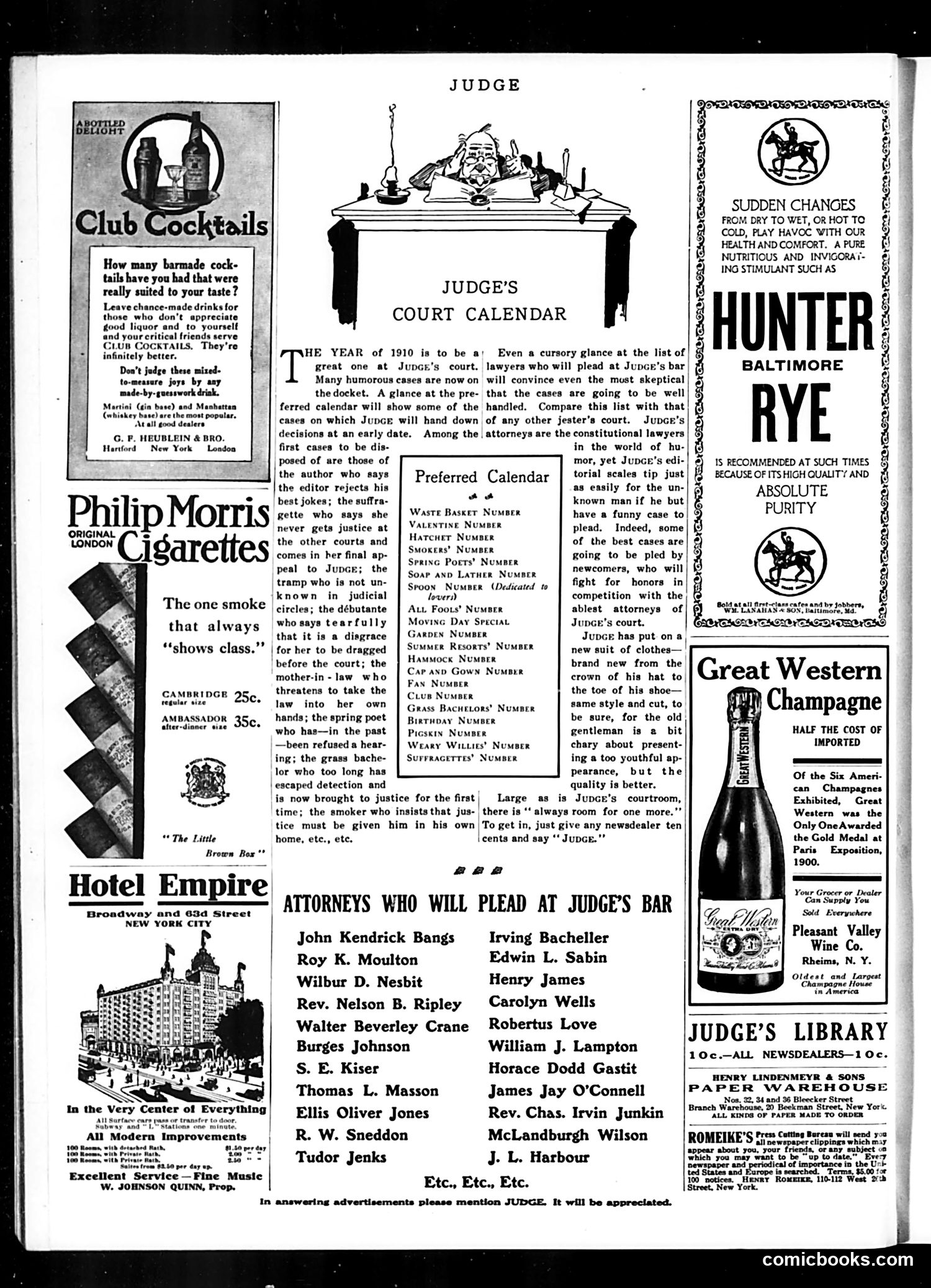
This page is primarily **advertising and court-related content** rather than political satire. The central feature is "Judge's Court Calendar" for 1910, listing prominent attorneys expected to argue cases before the judge that year—essentially a professional directory. The cartoon at the top shows a judge at his bench surrounded by legal documents and items, but carries no clear political message—it appears to be generic courtroom humor about judicial work volume. The advertisements (Philip Morris cigarettes, Hotel Empire, Club Cocktails, Hunter Rye whiskey, and Great Western Champagne) dominate the page, reflecting *Judge*'s reliance on luxury product advertising for revenue in the early 20th century. The legal content functions as editorial framing for these advertisements rather than as satirical commentary.
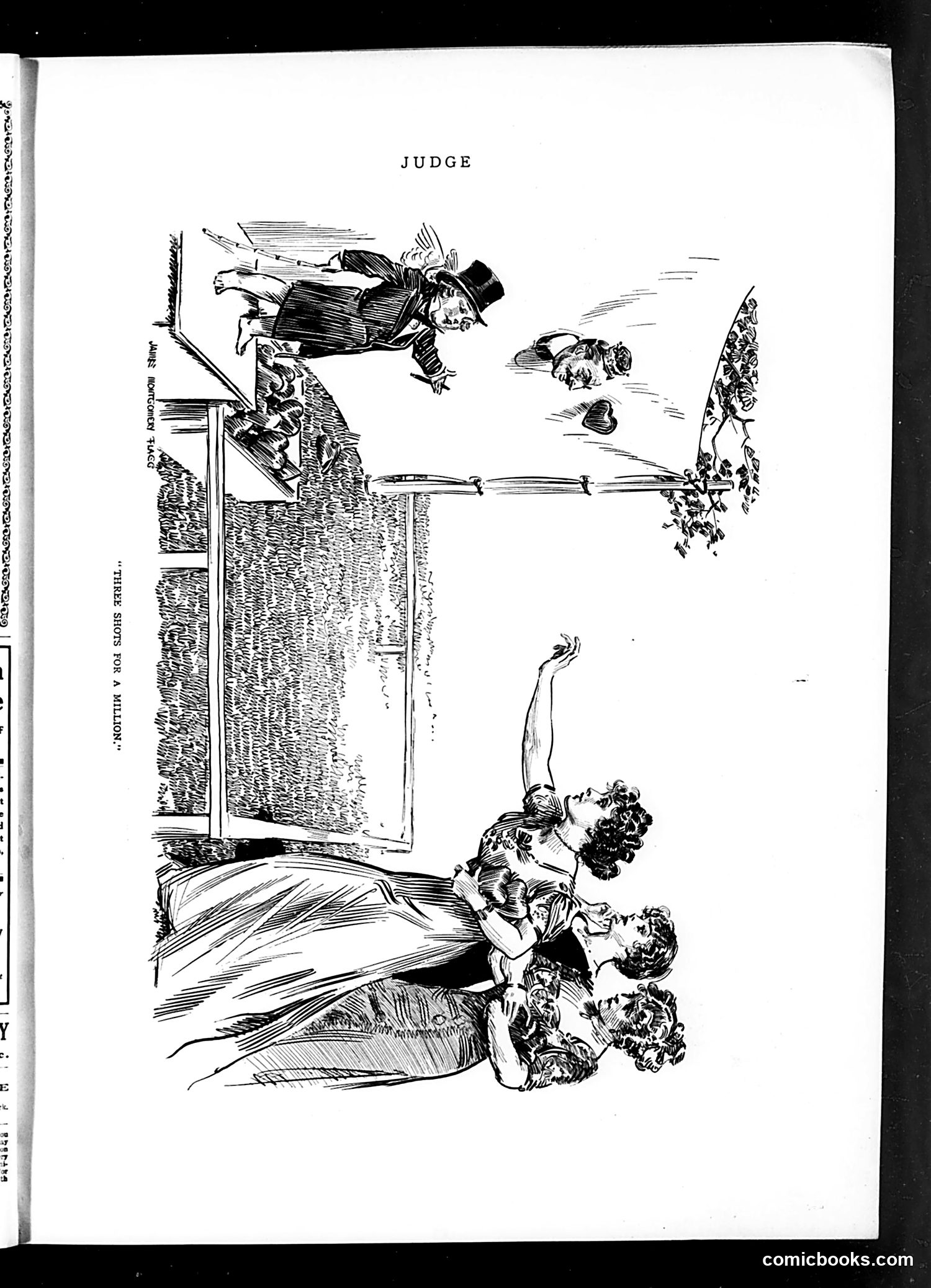
This page shows a satirical cartoon titled "Judge" depicting a figure in formal attire (wearing a top hat) being ejected or thrown from what appears to be a courtroom or official building. The figure is shown in an undignified, tumbling position through the air. The cartoon likely critiques judicial corruption, misconduct, or an unpopular court decision from the era when *Judge* magazine was published (late 19th/early 20th century). The exaggerated physical removal suggests public outrage at a judge's actions or rulings. Without additional context about the specific date or historical event referenced, I cannot definitively identify which judge or case this depicts. The satirical point appears to be that incompetent or corrupt judges deserve public removal and ridicule.
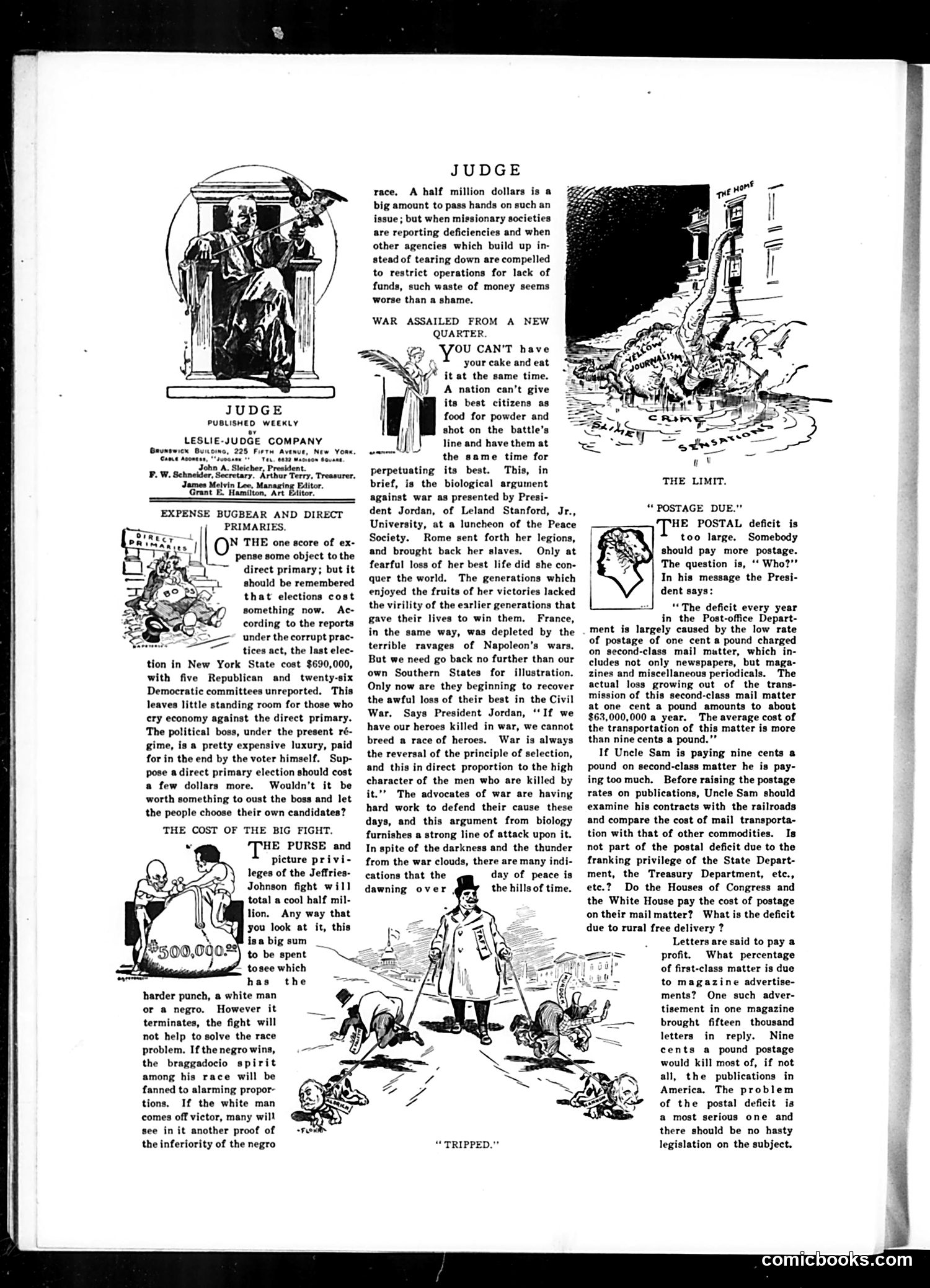
This page contains several satirical cartoons addressing post-WWI American issues: **"The Limit"** critiques postal service inefficiency, showing mail delivery failures overwhelming the system. **"Postage Due"** satirizes the postal deficit, arguing that transportation costs exceed revenue, making second-class mail unprofitable. The cartoon questions why Congress subsidizes mail delivery while criticizing other government spending. **"Tripped"** (bottom cartoon) appears to mock a political figure stumbling amid difficulties, likely representing post-war economic or social chaos. The "Expense Bugbear" section critiques government waste, noting that election costs in New York reached $600,000—an enormous sum for the era—suggesting politicians' self-interest. Overall, these cartoons reflect Progressive-era concerns about governmental efficiency, fiscal responsibility, and political corruption.
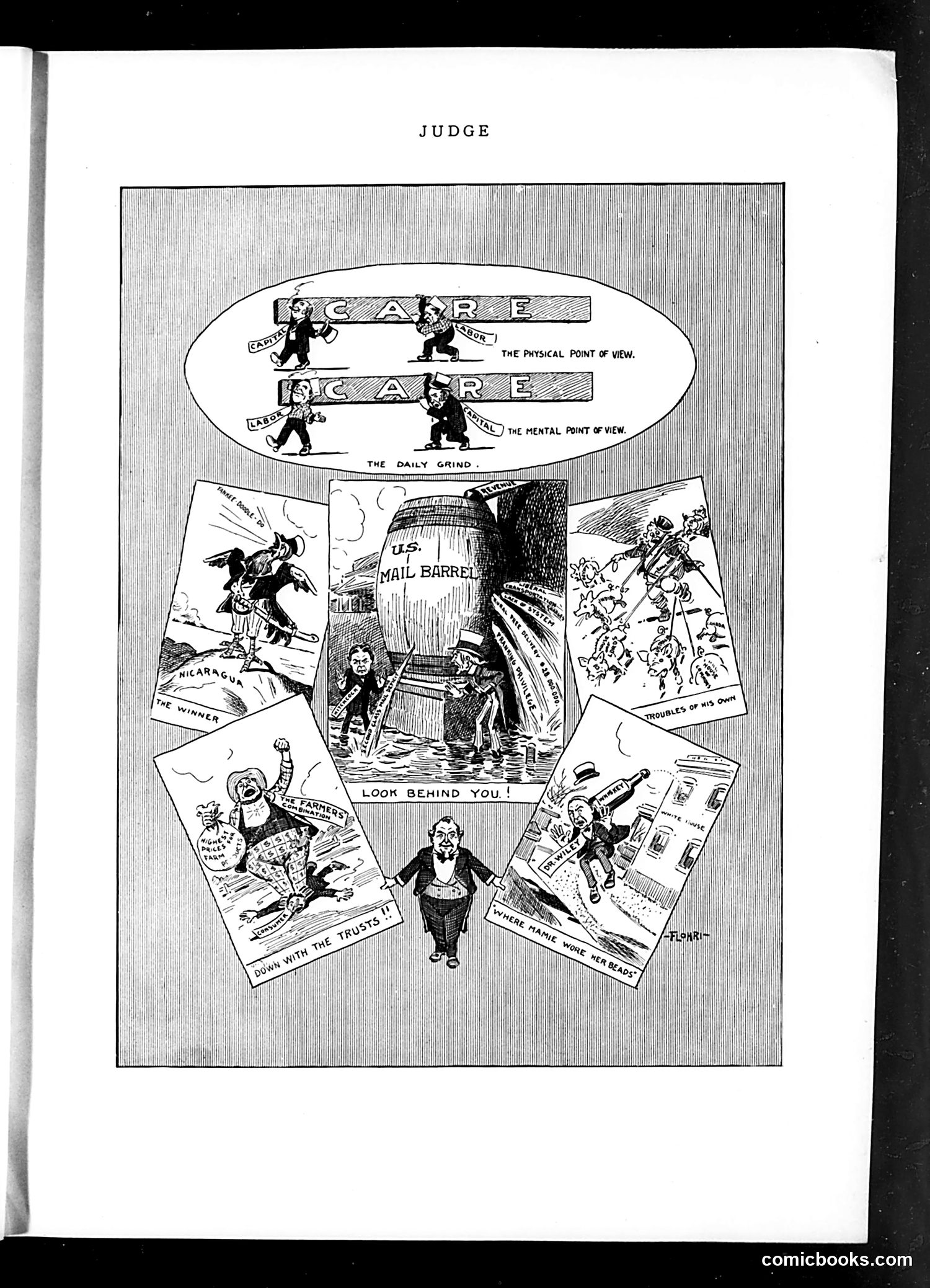
This page titled "Judge" presents a satirical diagram about judicial perspective and bias. At the top, two parallel scenes labeled "Care" show the same situation viewed from "The Physical Point of View" and "The Mental Point of View"—illustrating how judges' preconceptions shape their interpretation of identical facts. The central image depicts a "Mail Barrel" with the caption "Look Behind You!"—suggesting judges fail to see what's literally behind them, implying willful blindness to inconvenient evidence. The surrounding smaller cartoons appear to satirize specific judicial decisions or trends, though without clearer labels it's difficult to identify the exact cases referenced. Overall, the satire critiques judicial bias, suggesting that judges see what they expect or want to see rather than objective truth—a timeless critique of how authority figures rationalize predetermined outcomes.
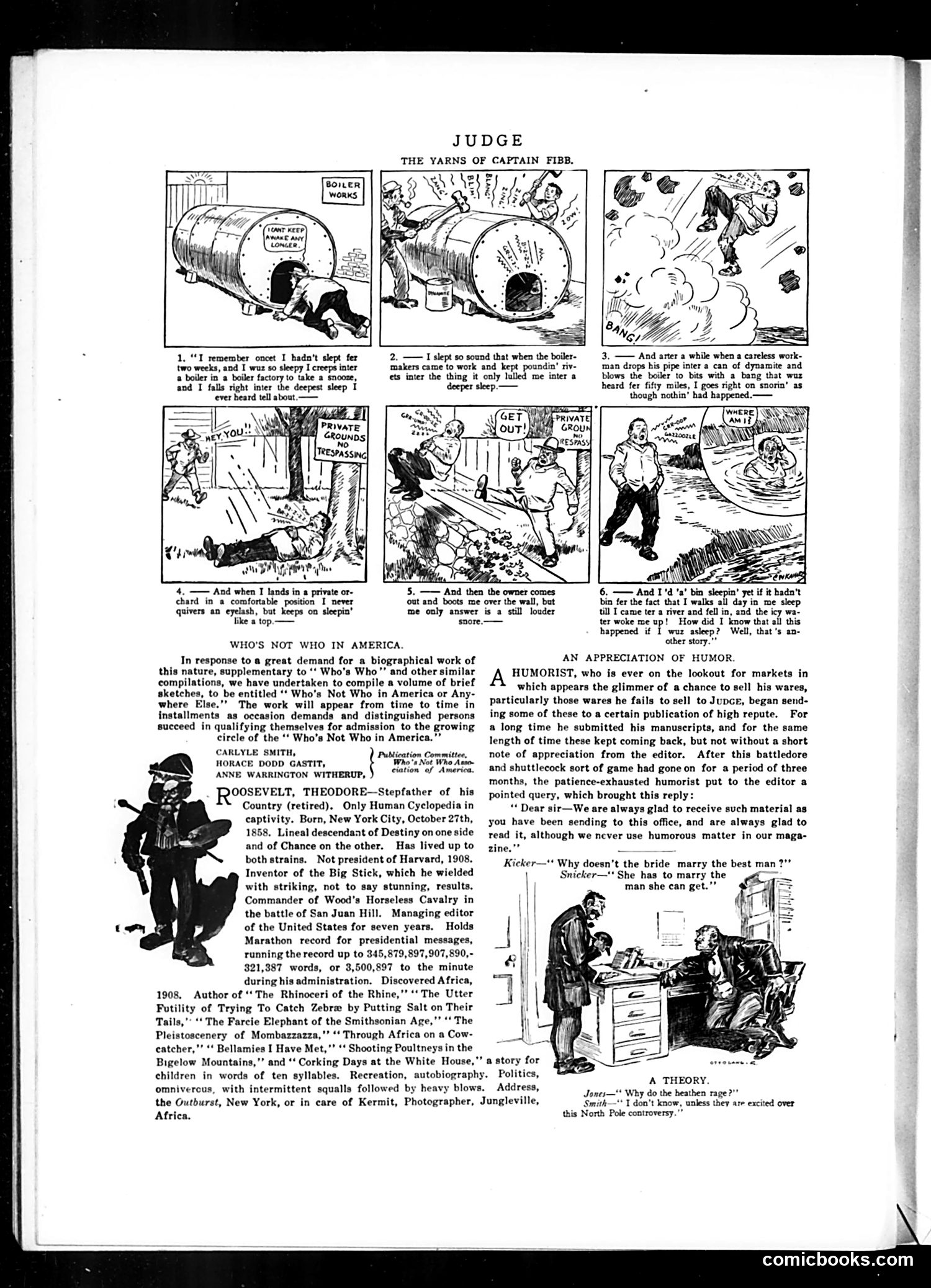
**"The Yarns of Captain Fibb"** is a tall-tale comic strip mocking exaggerated adventure narratives. The six panels depict an implausible story: a man sleeps so deeply in a factory boiler that he remains unconscious through riveting, explosion, and being kicked over a wall—only waking when he falls in a river. The humor relies on absurdist escalation and the ridiculous premise that someone could sleep through industrial noise and dynamite. **"Who's Not Who in America"** is satire targeting **Theodore Roosevelt**, the retired former president. The mock-encyclopedia entry mockingly inflates his accomplishments (inventor of the "Big Stick," discoverer of Africa in 1908, prolific author of nonsensically-titled books) while implying self-aggrandizement. The exaggerated word counts for his presidential messages satirize his known verbosity. This reflects early-20th-century political ridicule of Roosevelt's outsized public persona and prolific output. The page's humor depends on readers recognizing Roosevelt's contemporary prominence and recognizing the absurdity of the biographical inflation.
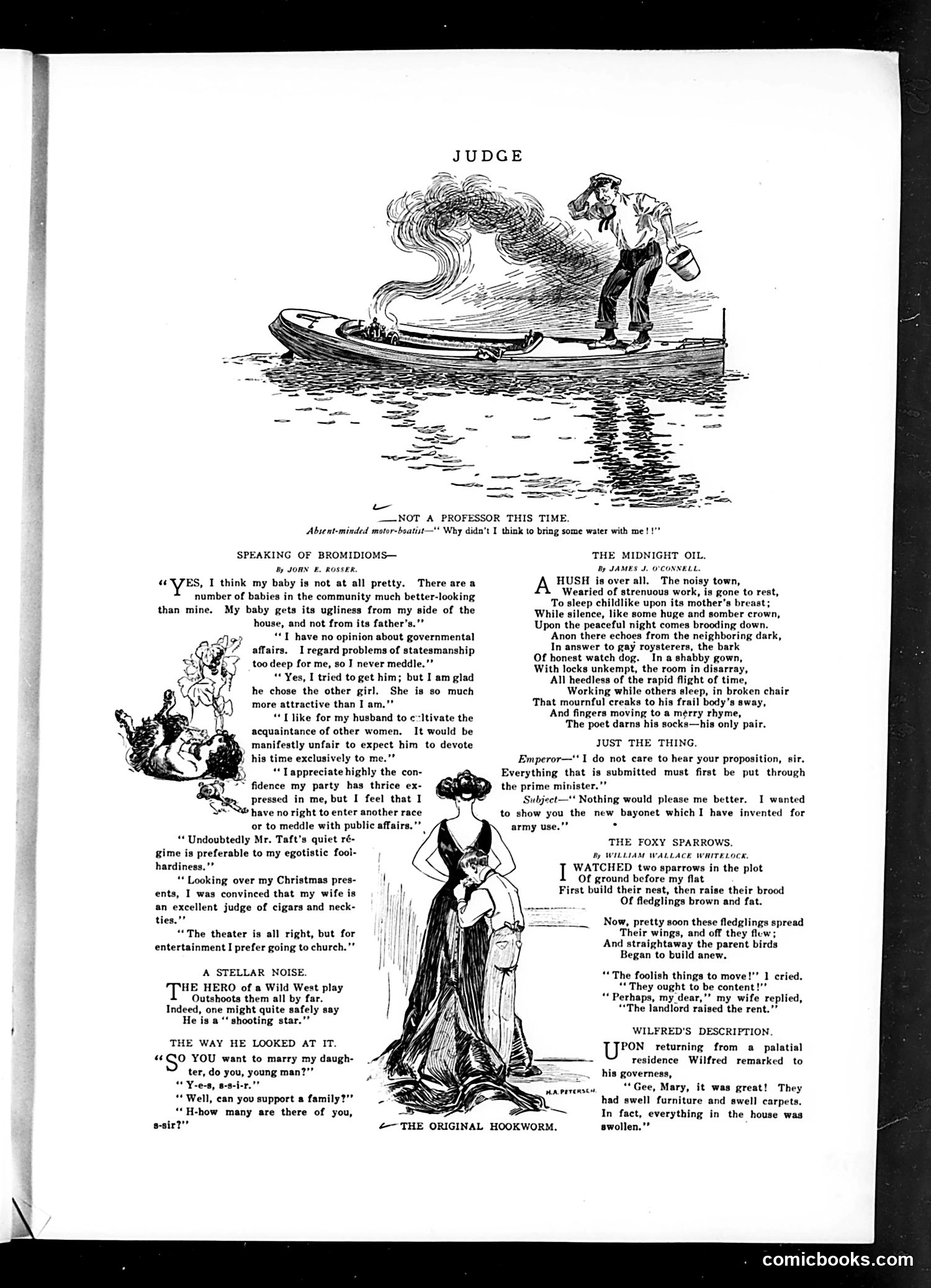
This page from *Judge* (a satirical weekly) contains several unrelated humor pieces typical of the era. **Top cartoon**: An absent-minded man in a motorboat realizes he forgot to bring drinking water—a commentary on the carelessness of early automobile/motorboat enthusiasts unprepared for new technology. **"Speaking of Bromidiums"**: A satirical collection of clichéd, insincere statements people make. The references to "Mr. Taft" and "my party" suggest this critiques politicians (likely President William Howard Taft) who make hollow claims of modesty while seeking re-election—the bromidium being an overused, tired platitude. **Other pieces**: "The Foxy Sparrows" uses birds rebuilding their nest as metaphor for tenants facing rent increases; "Wilfred's Description" jokes on a child's malapropism (swollen furniture for "swell"); poems and brief comedic dialogues fill the remaining space. The page reflects early 20th-century American satirical humor targeting political hypocrisy, social pretension, and domestic life.
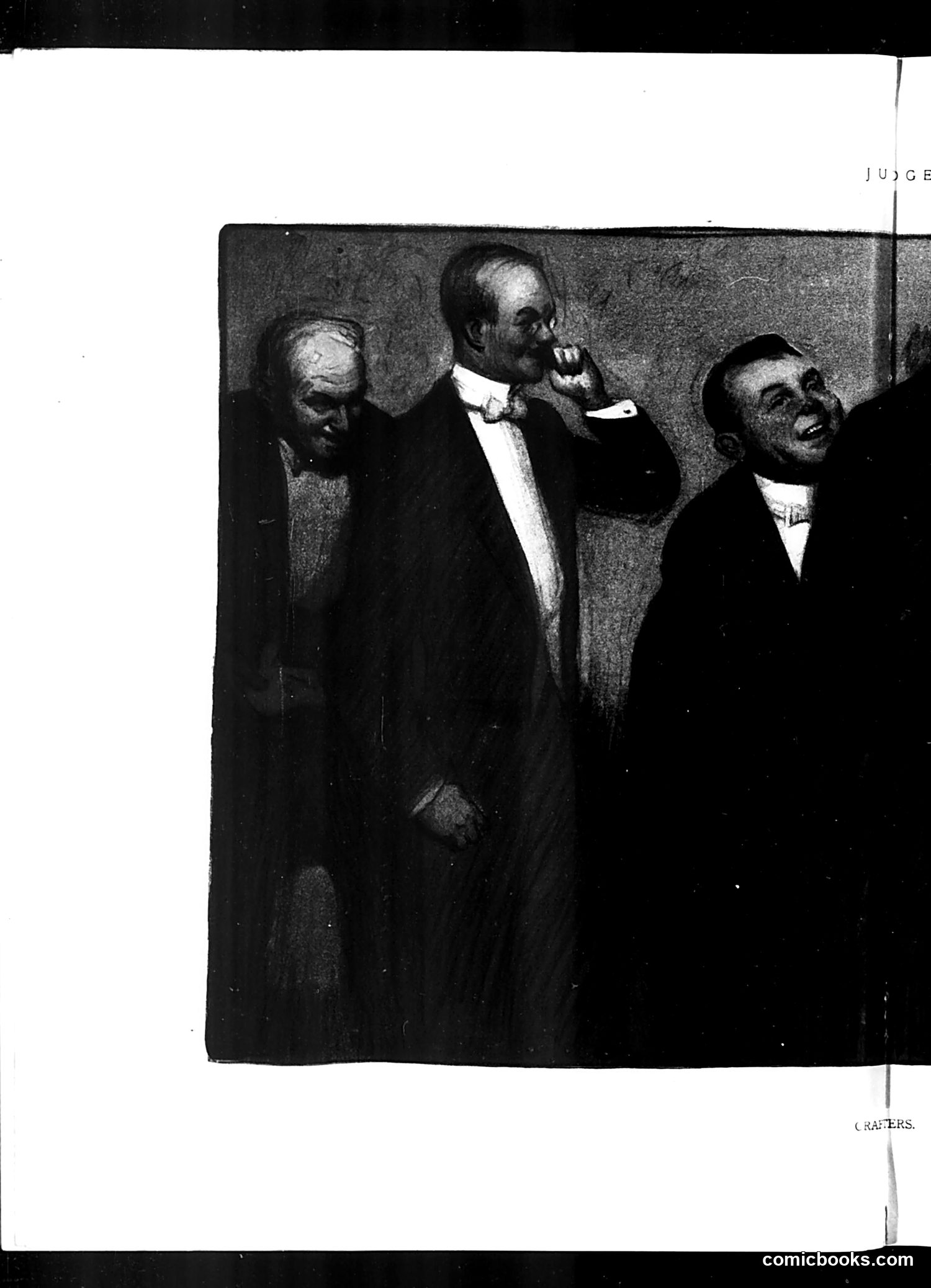
I can see this is a black and white illustration from Judge magazine showing three men in formal attire (tuxedos with bow ties). The men appear to be caricatured with exaggerated facial features typical of satirical art from this era. The caption reads "JUDGES" and "GRAFTERS." However, without additional context from the page—such as a title, date, or accompanying text—I cannot definitively identify who these specific figures represent or what particular political scandal or event this cartoon references. The word "grafters" suggests commentary on corruption or bribery, likely targeting public officials, but I cannot determine which judges or historical moment is being satirized without more information. The style and printing suggest this is from the early-to-mid 20th century.
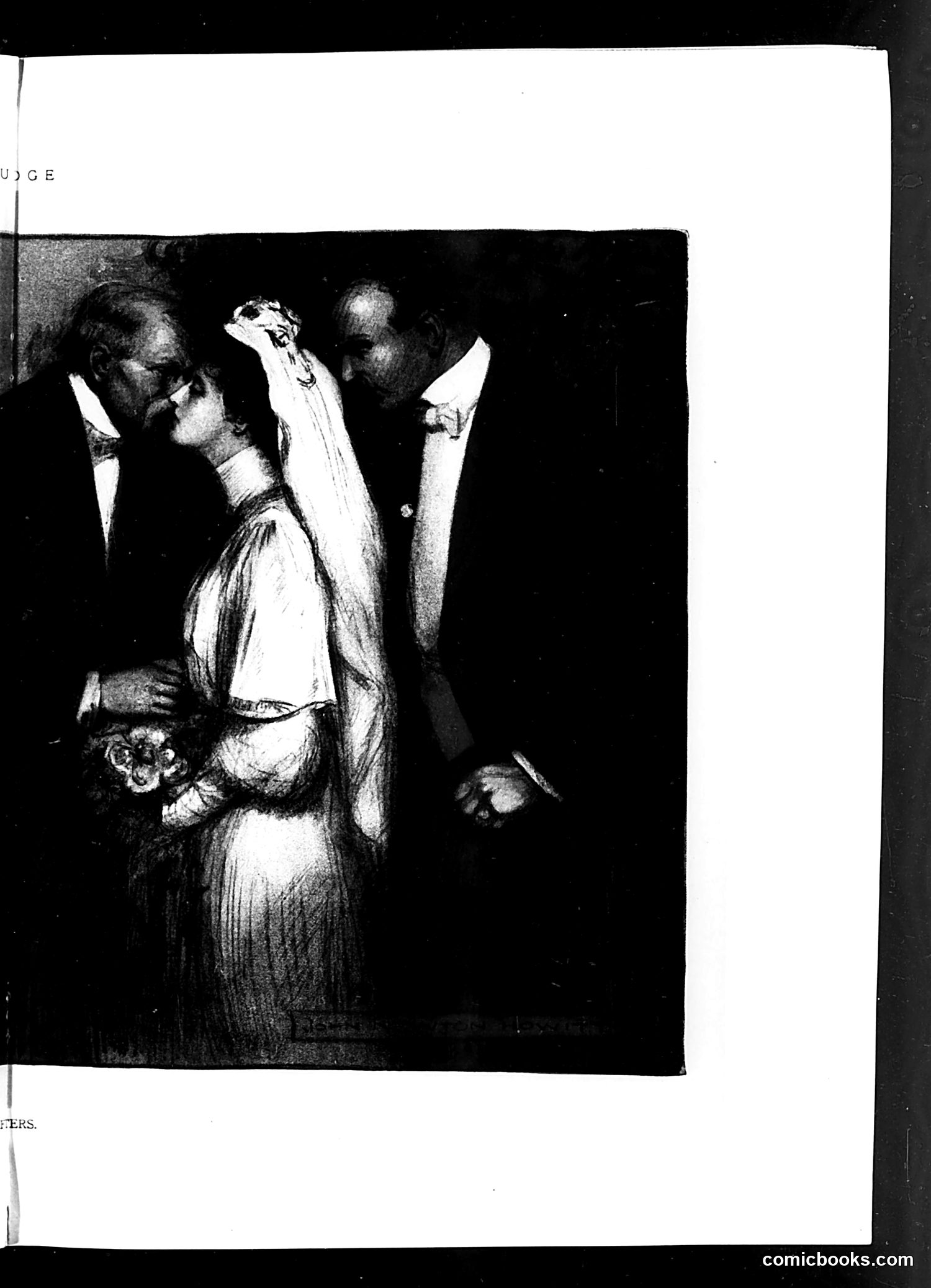
I can see this is a black and white illustration from Judge magazine showing three men in formal attire (tuxedos) surrounding a woman in an elaborate white dress who appears distressed or in an exaggerated pose. However, the OCR text provided only contains "comicbooks.com" with no actual article or caption text visible on the page. Without the accompanying text or caption, I cannot reliably identify the specific figures, the political or social context, or the satirical point being made. The formal dress and dramatic composition suggest this may comment on high society, a scandal, or social dynamics of the era, but I cannot assert specific details without supporting textual evidence. To provide accurate analysis, the actual caption or article text would be needed.
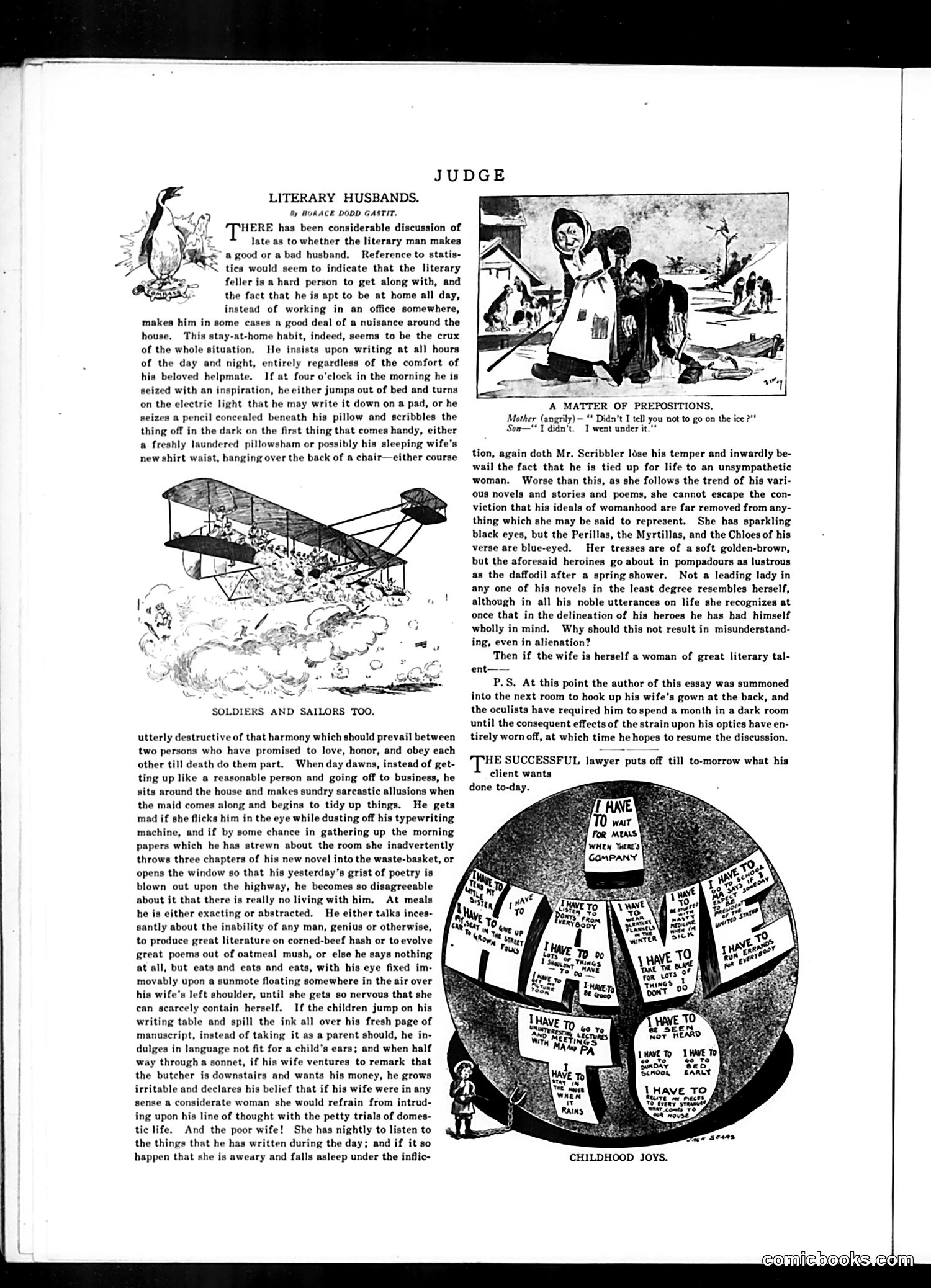
This essay satirizes the domestic friction caused by live-in literary men. The author argues that writers make poor husbands because they work from home, creating chaos: they write at odd hours (even on their wives' clothing), scatter papers everywhere, become irritable over household interruptions, and demand sympathy for artistic struggles while showing no consideration for domestic life. The satire critiques both the writer's self-absorbed artistic temperament and the wife's impossible position—she must endure his creative tantrums, listen nightly to his work, and reconcile his idealized literary heroines with reality. The cartoons supporting this ("Soldiers and Sailors Too," "A Matter of Prepositions," "Childhood Joys") appear to illustrate related domestic absurdities. The piece reflects late 19th/early 20th-century anxieties about professional men working at home and gender tension in artistic marriages.
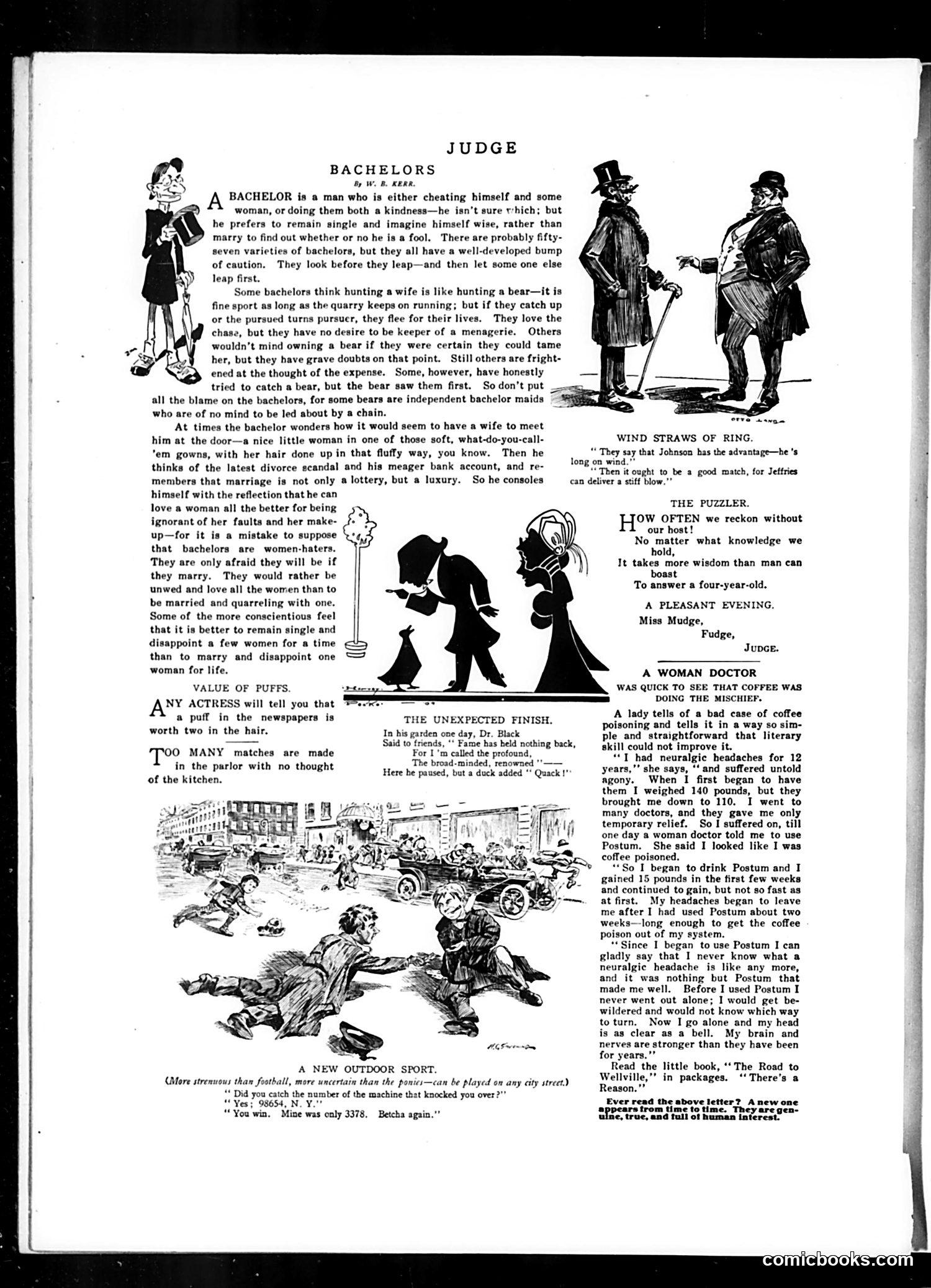
This page from the satirical magazine *Judge* contains several humorous pieces about social conventions of the era: **"Bachelors" (main article)**: A satirical essay by W.B. Kerr mocking unmarried men. It compares wife-hunting to bear-hunting, suggesting bachelors fear commitment due to expense, divorce scandals, and loss of freedom. The piece suggests some women ("independent bachelor maids") are equally reluctant to marry. **"Wind Straws of Ring"**: A brief joke referencing boxers Johnson and Jeffries, playing on "wind" (endurance) as a boxing advantage. **"The Unexpected Finish"**: A light poem where Dr. Black boasts of fame until a duck interrupts with a "quack"—punning on his pretensions. **"A New Outdoor Sport"**: A cartoon mocking pedestrians hit by automobiles, with a joke about calculating odds from accident numbers. **"A Woman Doctor"**: An advertisement disguised as testimonial, promoting Postum (a coffee substitute) as a cure for headaches and neuralgia allegedly caused by coffee poisoning—reflecting early 20th-century health claims. The overall tone satirizes bachelor anxieties, modern conveniences, and emerging medical practices.
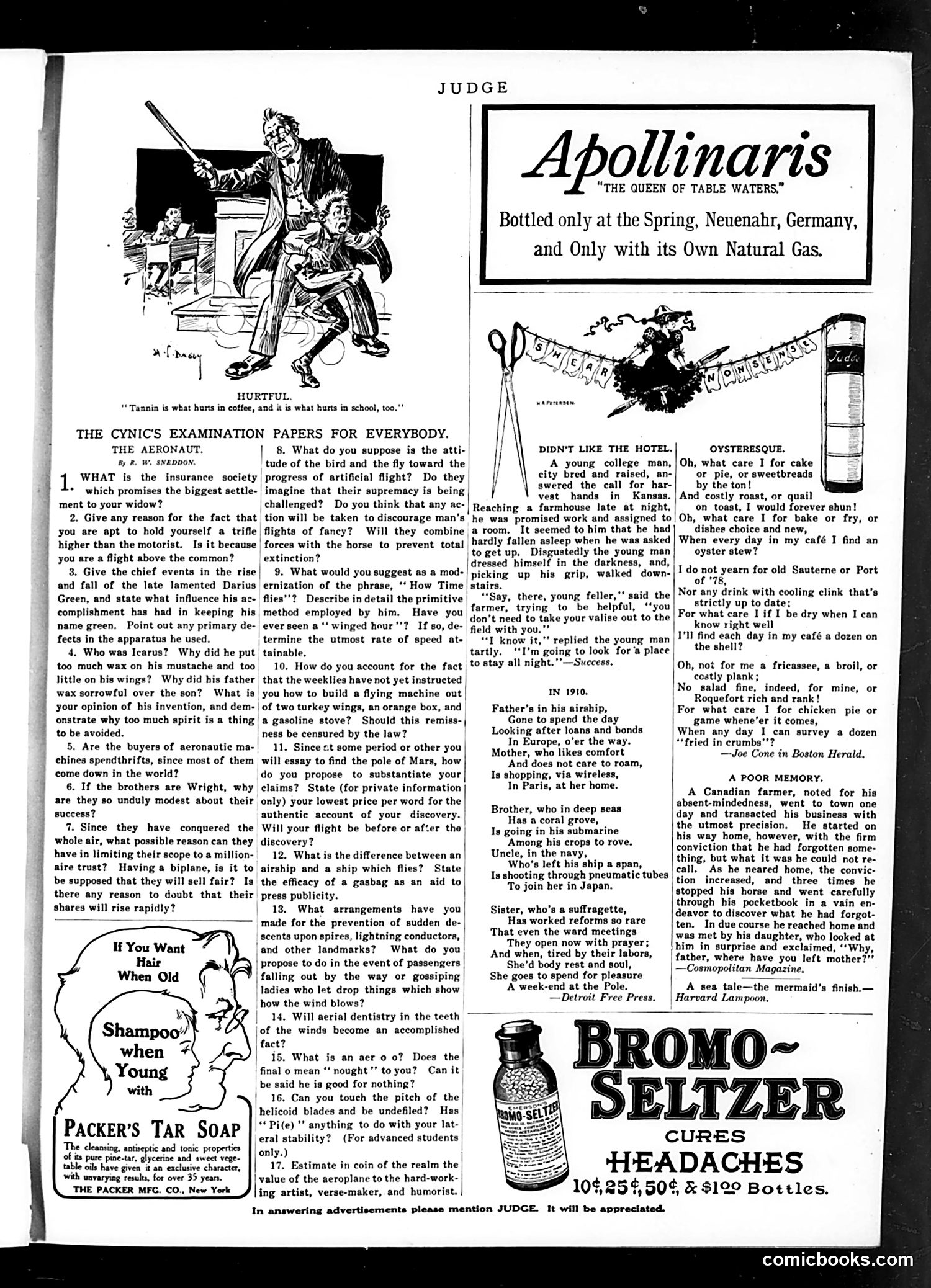
This page from **Judge** (a satirical American magazine) contains several distinct elements: **Main Cartoon**: "The Aeronaut" section presents a satirical examination on aviation, mocking the Wright Brothers' recent achievements. The questions use wordplay and absurdist humor—asking about "flights of fancy," whether birds oppose "artificial flight," and whether aerial dentistry will work "in the teeth of the winds." The satire targets both the public's fascination with early aviation and the pretentious pseudo-intellectual discourse surrounding it. **"Didn't Like the Hotel"**: A brief humorous anecdote about a city college student hired for farm harvest work, mocking his urban sensibilities when rural life demands early rising. **Advertisements**: The page includes ads for Apollinaris mineral water, Packer's Tar Soap, and Bromo-Seltzer—typical early 20th-century patent medicines and consumer goods. The humor assumes readers followed contemporary aviation developments and appreciated satirical attacks on technological enthusiasm and social pretension.
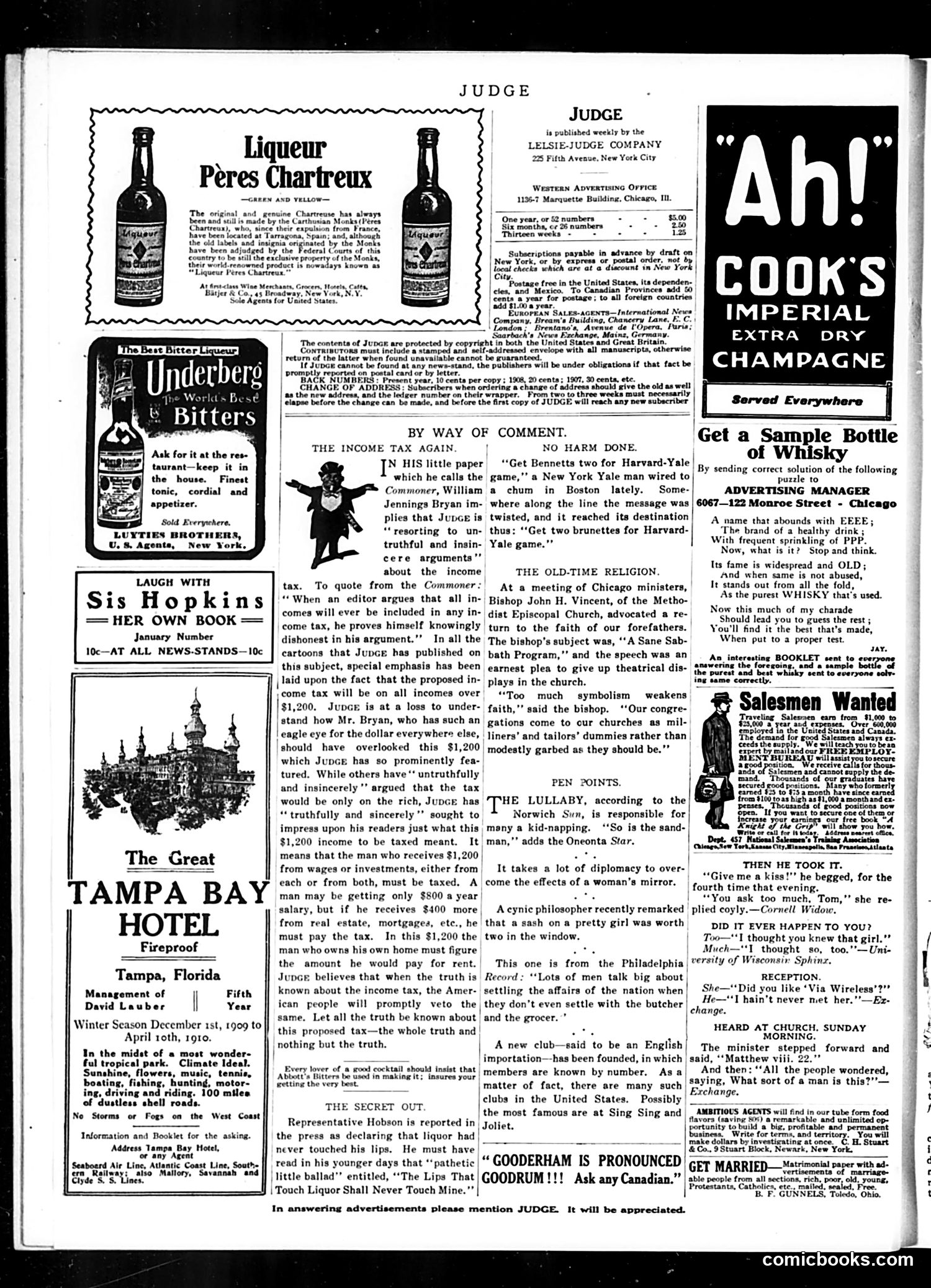
This page is primarily **advertisements and magazine notices** rather than political cartoons. However, it contains one notable satirical article: ## "THE INCOME TAX AGAIN" Judge magazine defends itself against criticism from William Jennings Bryan's publication, *The Commoner*. Bryan accused Judge of "untruthful and insincere" arguments about the proposed income tax. Judge responds by emphasizing it has **truthfully highlighted the $1,200 threshold**—the income level above which the tax would apply—arguing this detail is crucial because it affects working- and middle-class Americans, not just the wealthy. Judge implies Bryan overlooked this threshold while claiming to champion ordinary people, suggesting hypocrisy or carelessness in Bryan's tax criticism. The page also includes advertisements for liqueurs, champagne, whiskey, hotels, and a recruitment notice—typical of this era's magazine format.
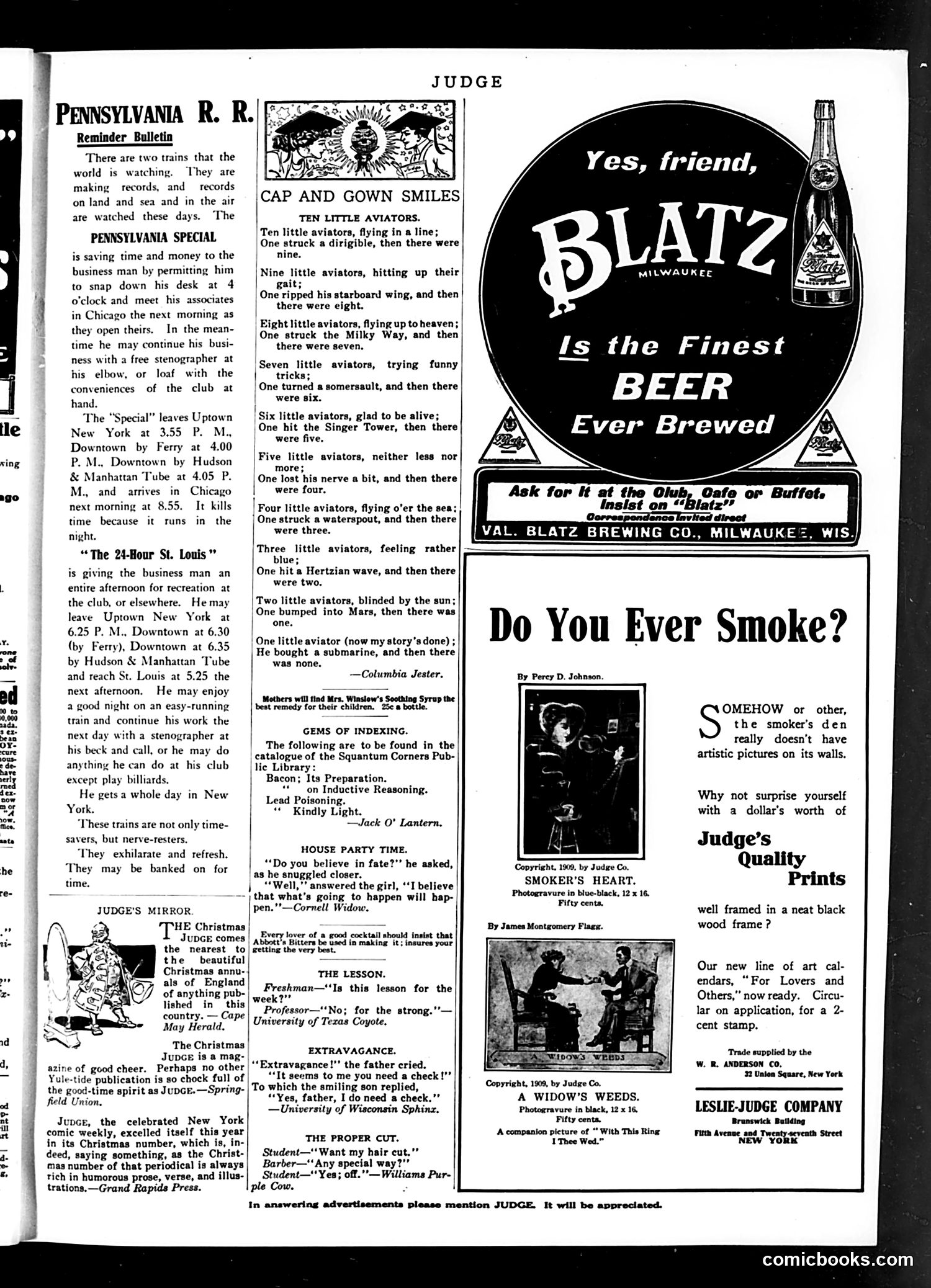
This page from Judge magazine primarily contains **light humor and advertisements** rather than political satire. The main content is a **children's counting-out rhyme titled "Cap and Gown Smiles: Ten Little Aviators"** (sourced from Columbia Jester). It's a darkly comic parody of "Ten Little Indians," where each stanza describes an aviator dying in increasingly absurd ways—striking dirigibles, the Milky Way, the Singer Tower, waterspouts, and eventually a submarine. This reflects early 20th-century anxieties about aviation's dangers when it was still a nascent, risky technology. The page also includes several **short humor pieces** ("The Lesson," "Extravagance," "The Proper Cut," and "House Party Time") that are gentle domestic and romance jokes with no political content. **Advertisements** fill much of the page, including the prominent Blatz beer ad and Judge's Quality Prints (art calendars). The "Do You Ever Smoke?" section by Percy D. Johnson is a subtle advertisement disguised as editorial content, suggesting readers purchase framed art prints for their smoking rooms. Overall, this is a typical issue page mixing entertainment, light humor, and advertising.
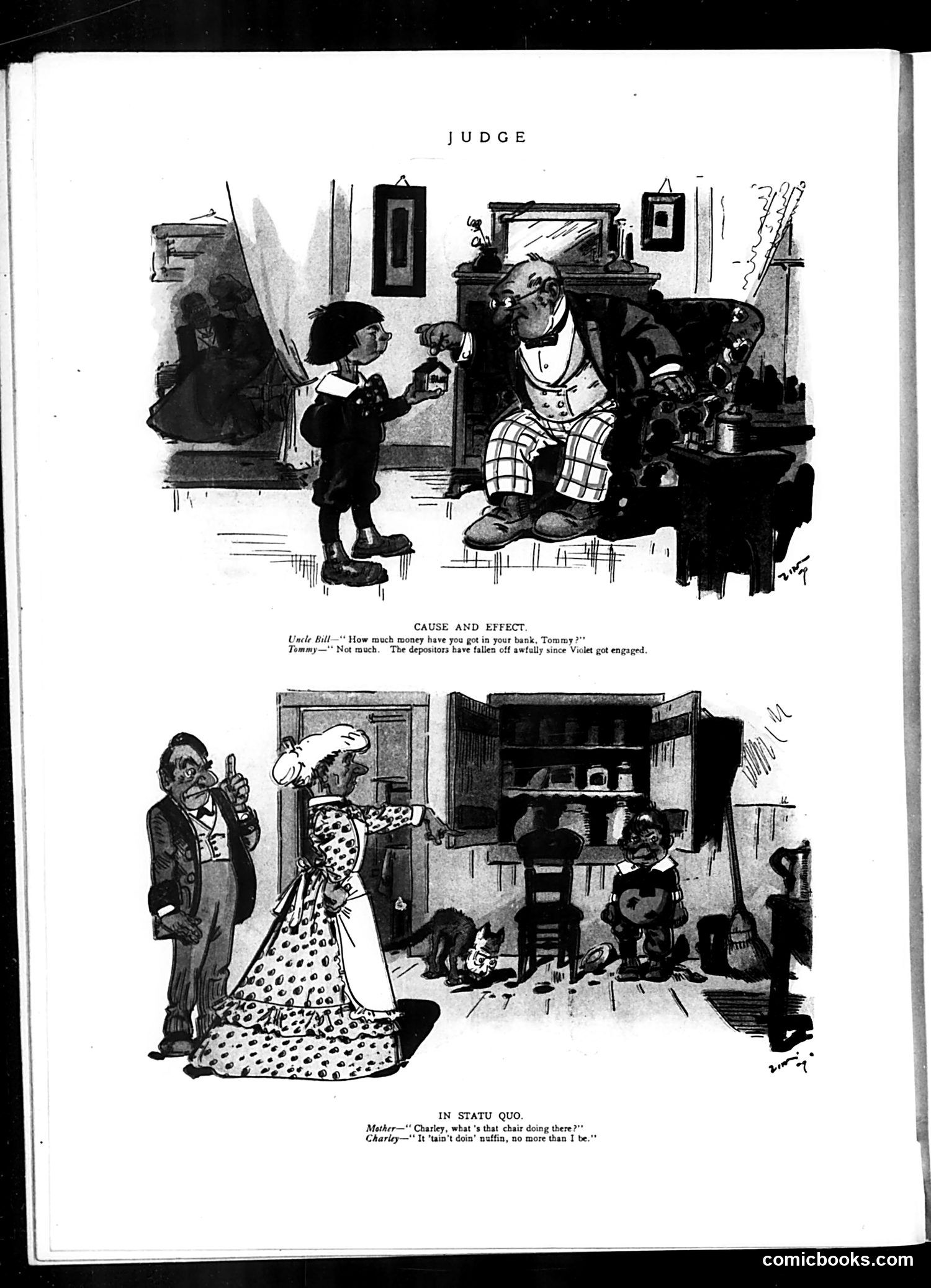
This page contains two satirical cartoons about money and domestic life. **"Cause and Effect"** depicts a judge questioning a boy about his bank savings. The joke plays on a double meaning: Tommy's bank account has depleted because his sister Violet's engagement has caused depositors to withdraw funds—likely suggesting the family's financial troubles stem from wedding expenses or the fiancé's poor reputation. **"In Statu Quo"** shows a mother questioning a boy about a chair's presence. His response—that the chair does nothing, "no more than I be"—is self-deprecating humor suggesting the boy is equally useless, comparing himself unfavorably to inanimate furniture. It's a joke about childhood idleness. Both cartoons use child characters to highlight adult financial concerns and domestic dynamics in a humorous, slightly cynical way typical of Judge's satirical style.