
Judge, 1910-01-15 · page 10 of 16
Judge — January 15, 1910 — page 10: what you’re looking at
What you’re looking at
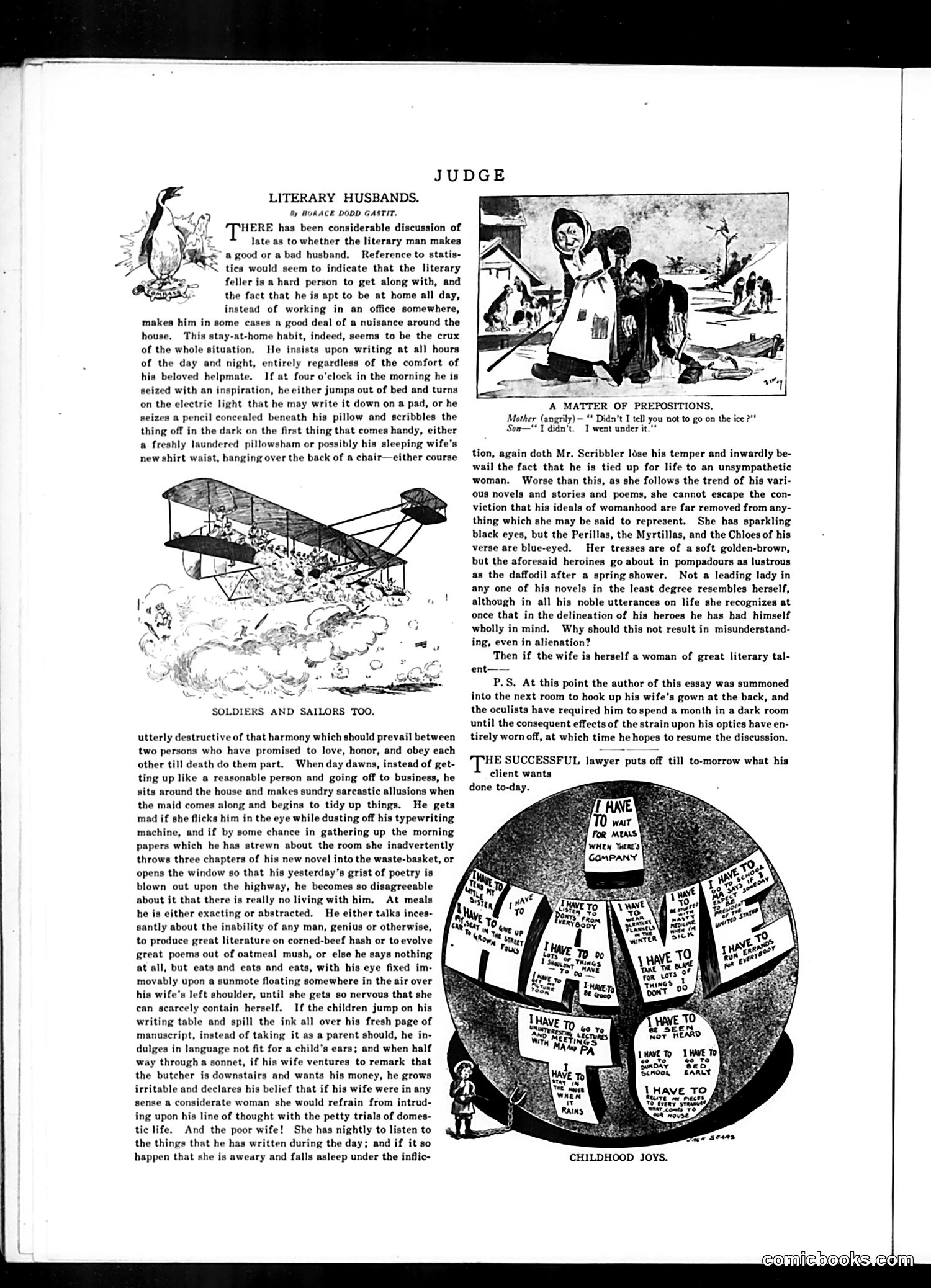
This essay satirizes the domestic friction caused by live-in literary men. The author argues that writers make poor husbands because they work from home, creating chaos: they write at odd hours (even on their wives' clothing), scatter papers everywhere, become irritable over household interruptions, and demand sympathy for artistic struggles while showing no consideration for domestic life. The satire critiques both the writer's self-absorbed artistic temperament and the wife's impossible position—she must endure his creative tantrums, listen nightly to his work, and reconcile his idealized literary heroines with reality. The cartoons supporting this ("Soldiers and Sailors Too," "A Matter of Prepositions," "Childhood Joys") appear to illustrate related domestic absurdities. The piece reflects late 19th/early 20th-century anxieties about professional men working at home and gender tension in artistic marriages.
📄 Transcribed text from this page (OCR, searchable)
Machine-transcribed from the original scan — historical spelling and the odd misread are preserved.
LITERARY HUSBANDS. Net ay by HORACE DODD GasTIT. Wwe i Hiaictal has been considerable discussion of J late as to whether the literary man makes a good or abad husband. Reference to statis- tics would seem to indicate that the literary feller is a hard person to get along with, and the fact that he is apt to be at home all day, instead of working in an office somewhere, makes him in some cases a good deal of a nuisance around the house. This stay-at-home habit, indeed, seems to be the crux of the whole situation. He insists upon writing at all hours of the day and night, entirely regardless of the comfort of his beloved helpmate. If at four o'clock in the morning he is seized with an inspiration, he either jumps out of bed and turns on the electric ht that he may write it down on a pad, or he seizes a pencil concealed beneath his pillow and scribbles the thing off in the dark on the first thing that comes handy, either a freshly laundered pillowsham or possibly his sleeping wife's new shirt waist, hanging over the back of a chair—either course SOLDIERS AND SAILORS TOO. utterly destructive of that harmony which should prevail between two persons who have promised to love, honor, and obey each other till death do them part. When day dawns, instead of get- ting up like a reasonable person and going off to business, he sits around the house and makes sundry sarcastic allusions when the maid comes along and begins to tidy up things. He gets mad if she flicks him in the eye while dusting off his typewriting machine, and if by some chance in gathering up the morning papers which he has strewn about the room she inadvertently throws three chapters of his new novel into the waste-basket, or opens the window so that his yesterday's grist of poetry is blown out upon the highway, he becomes go disagreeable about it that there is really no living with him. At meals he is either exacting or abstracted. He either talks inces- santly about the inability of any man, genius or otherwise, to produce great literature on corned-beef hash or to evolve great poems out of oatmeal mush, or else he says nothing at all, but eats and eats and eats, with his eye fixed im- movably upon a sunmote floating somewhere in the air over his wife's left shoulder, until she gets so nervous that she can scarcely contain herself. If the children jump on his writing table and spill the ink all over his fresh page of manuscript, instead of taking it as a parent should, he in- dulges in language not fit for a child’s ears; and when half way through a sonnet, if his wife ventures to remark that the butcher is downstairs and wants his money, he grows irritable and declares his belief that if his wife were in any sense a considerate woman she would refrain from intrud- ing upon his line of thought with the petty trials of domes- tic life. And the poor wife! She has nightly to listen to the things that he has written during the day; and if it so happen that she is aweary and falls asleep under the inflic- JUDGE A MATTER OF PREPOSITIONS. Mother (angrily)—‘ Didn't I tell you not to go on the ice 2”” Son—" I didn't. I went under it."* tion, again doth Mr. Scribbler lose his temper and inwardly be- wail the fact that he is tied up for life to an unsympathetic woman. Worse than this, as she follows the trend of his vari- ous novels and stories and poems, she cannot escape the con- viction that his ideals of womanhood are far removed from any- thing which she may be said to represent. She has sparkling black eyes, but the Perillas, the Myrtillas, and the Chloes of his verse are blue-eyed. Her tresses are of a soft golden-brown, but the aforesaid heroines go about in pompadours as lustrous as the daffodil after a spring shower. Not a leading lady in any one of his novels in the least degree resembles herself, although in all his noble utterances on life she recognizes at once that in the delineation of his heroes he has had himself wholly in mind. Why should this not result in misunderstand- ing, even in alienation? Then if the wife is herself a woman of great literary tal- ent—— P.S. At this point the author of this essay was summoned into the next room to hook up his wife’s gown at the back, and the oculists have required him to spend a month in a dark room until the consequent effects of the strain upon his optics have en- tirely worn off, at which time he hopes to resume the discussion. (THE SUCCESSFUL lawyer puts off till to-morrow what his client wants done to-day. een Row HEARD CHILDHOOD JOYS.