
Judge, 1910-01-15 · page 4 of 16
Judge — January 15, 1910 — page 4: what you’re looking at
What you’re looking at
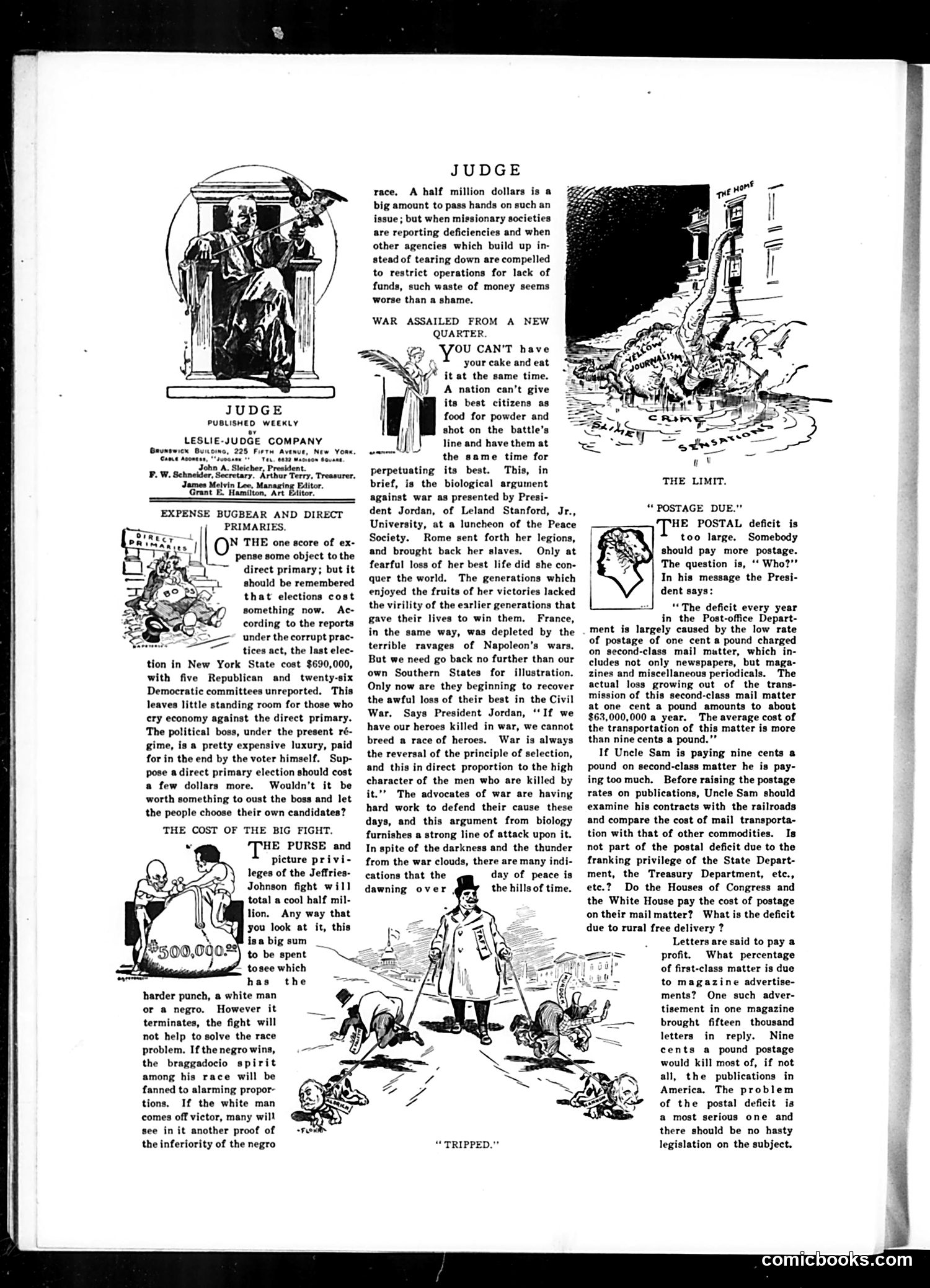
This page contains several satirical cartoons addressing post-WWI American issues: **"The Limit"** critiques postal service inefficiency, showing mail delivery failures overwhelming the system. **"Postage Due"** satirizes the postal deficit, arguing that transportation costs exceed revenue, making second-class mail unprofitable. The cartoon questions why Congress subsidizes mail delivery while criticizing other government spending. **"Tripped"** (bottom cartoon) appears to mock a political figure stumbling amid difficulties, likely representing post-war economic or social chaos. The "Expense Bugbear" section critiques government waste, noting that election costs in New York reached $600,000—an enormous sum for the era—suggesting politicians' self-interest. Overall, these cartoons reflect Progressive-era concerns about governmental efficiency, fiscal responsibility, and political corruption.
📄 Transcribed text from this page (OCR, searchable)
Machine-transcribed from the original scan — historical spelling and the odd misread are preserved.
PUBLISHED WEEKLY . LESLIE-JUDGE COMPANY Baurveiex Buiicine, 228 Fete Avenue, New Yous, Cane Aeeeeee, "hoesane Tec John A. Sleicher, Presid: P. W. Schneider, Secretary. Arthur Terry, Treasurer. James Melvin Lee, Managing Editor. Grant E. Hamilton, Art Editor. EXPENSE BUGBEAR AND DIRECT PRIMARIES. N THE one score of ex- pense some object to the ~~ direct primary; but it should be remembered that elections cost something now. Ac- cording to the reports under the corrupt prac- tices act, the last elec- tion in New York State cost $690,000, with five Republican and twenty-six Democratic committees unreported. This leaves little standing room for those who cry economy against the direct primary. The political boss, under the present ré- gime, is a pretty expensive luxury, paid for in the end by the voter himself. Sup- pose adirect primary election should cost a few dollars more. Wouldn't it be worth something to oust the boss and let the people choose their own candidates? THE COST OF THE BIG FIGHT. . ‘HE PURSE and picture privi- leges of the Jeffries- Johnson fight will total a cool half mil- lion. Any way that you look at it, this isa big sum to be spent — I! has harder punch, a white man or a negro, However it terminates, the fight will not help to solve the race problem. If the negro wins, the braggadocio spirit among his race will be fanned to alarming propor- tions. If the white man comes off victor, many will see in it another proof of the inferiority of the negro QUARTER. sy G YOU CAN'T have S 20 ¢, £ your cake and eat JUDGE race, A half million dollars is a big amount to pass hands on such an issue; but when missionary societies are reporting deficiencies and when other agencies which build up in- stead of tearing down are compelled to restrict operations for lack of funds, such waste of money seems worse than a shame. WAR ASSAILED FROM A NEW it at the same time. |} A nation can’t give its best citizens as food for powder and shot on the battle’s line and have them at the same time for perpetuating its best. This, in brief, is the biological argument against war as presented by Presi- dent Jordan, of Leland Stanford, University, at a luncheon of the Peace Society. Rome sent forth her legions, and brought back her slaves. Only at fearful loss of her best life did she con- quer the world. The generations which enjoyed the fruits of her victories lacked the virility of the earlier generations that gave their lives to win them. France, in the same way, was depleted by the terrible ravages of Napoleon's wars, But we need go back no further than our own Southern States for illustration. Only now are they beginning to recover the awful loss of their best in the Civil War. Says President Jordan, ‘If we have our heroes killed in war, we cannot breed a race of heroes. War is always the reversal of the principle of selection, and this in direct proportion to the high character of the men who are killed by it.” The advocates of war are having hard work to defend their cause these argument from biology furnishes a strong line of attack upon it. In spite of the darkness and the thunder from the war clouds, there are many indi- cations that the day of peace is dawning over , the hills of time. “TRIPPED.” THE LIMIT. “POSTAGE DUE." ‘HE POSTAL deficit is too large. Somebody should pay more postage. The question is, ‘‘ Who?” In his message the Presi- dent says: “The deficit every year in the Post-office Depart- ment is largely caused by the low rate of postage of one cent a pound charged on second-class mail mutter, which in- cludes not only newspapers, but maga- zines and miscellaneous periodicals. The actual loss growing out of the trans- mission of this second-class mail matter at one cent a pound amounts to about $63,000,000 a year. The average cost of the transportation of this matter is more than nine cents a pound.’” If Uncle Sam is paying nine cents a pound on second-class matter he is pay- ing too much. Before raising the postage rates on publications, Uncle Sam should examine his contracts with the railroads and compare the cost of mail transporta- tion with that of other commodities. Is not part of the postal deficit due to the franking privilege of the State Depart- ment, the Treasury Department, ete., ete.? Do the Houses of Congress and the White House pay the cost of postage on their mail matter? What is the deficit due to rural free delivery ? Letters are said to pay a profit. What percentage of first-class matter is due to magazine advertise- ments? One such adver- tisement in one magazine brought fifteen thousand letters. in reply. Nine cents a pound postage would kill most of, if not all, the publications in America. The problem of the postal deficit ia a most serious one and there should be no hasty legislation on the subject.