
A complete issue · 16 pages · 1909
Judge — September 25, 1909
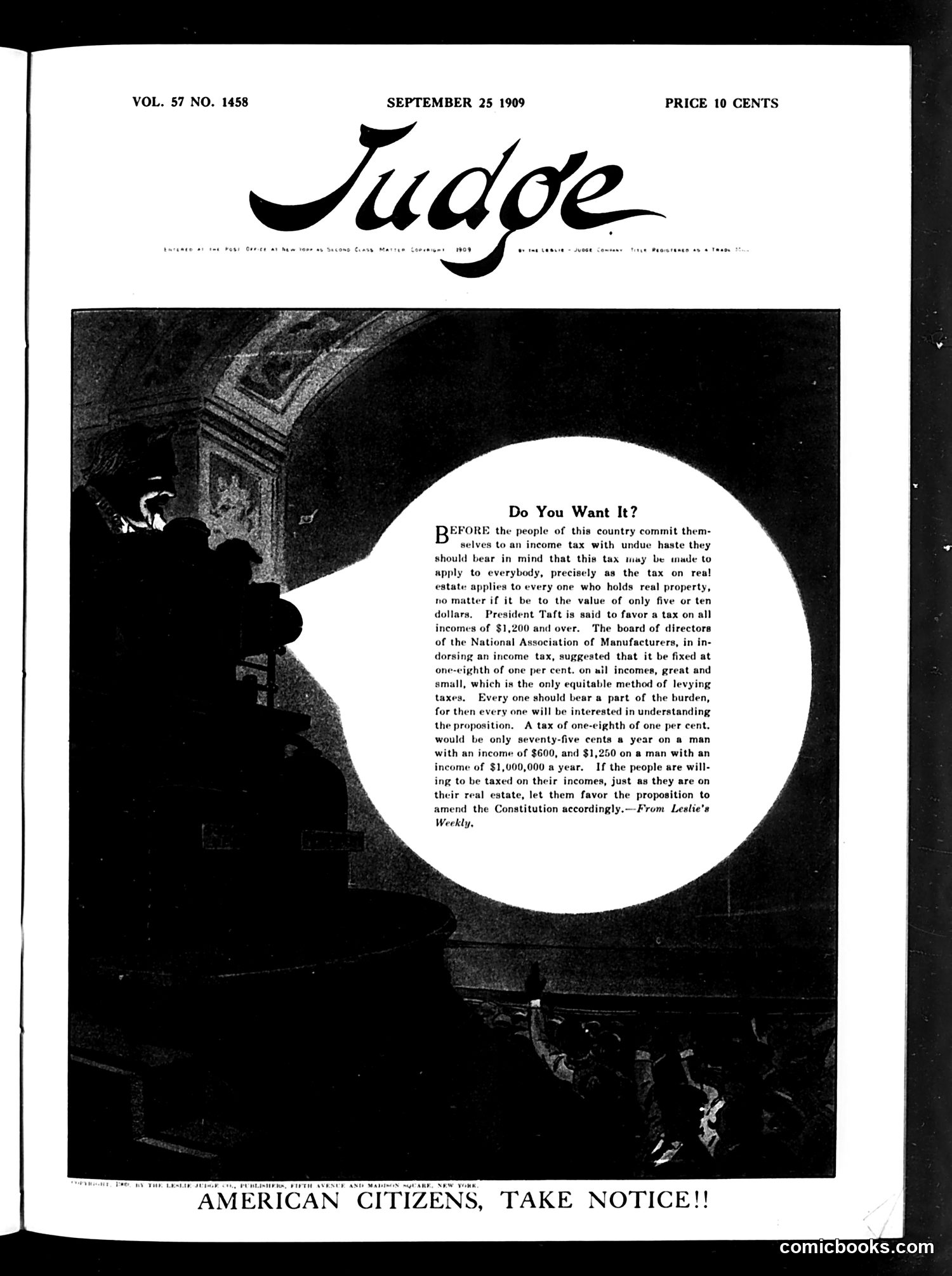
This page uses a dramatic silhouette illustration to promote debate over a proposed federal income tax. The headline "Do You Want It?" frames the central question. The article discusses President Taft's support for an income tax on incomes over $1,200 annually. It presents arguments in favor, noting the tax would be "equitable" and burden-sharing. The piece cites the National Association of Manufacturers' suggestion of a one-eighth of one percent rate. The striking visual—showing a figure peering through a large circular opening at shadowy scenes below—appears designed to make readers contemplate the proposal's implications. The caption "AMERICAN CITIZENS, TAKE NOTICE!!" emphasizes the urgency of public consideration. The page is primarily editorial commentary rather than humor, appealing to citizens to engage with this significant constitutional and fiscal question before Congress.
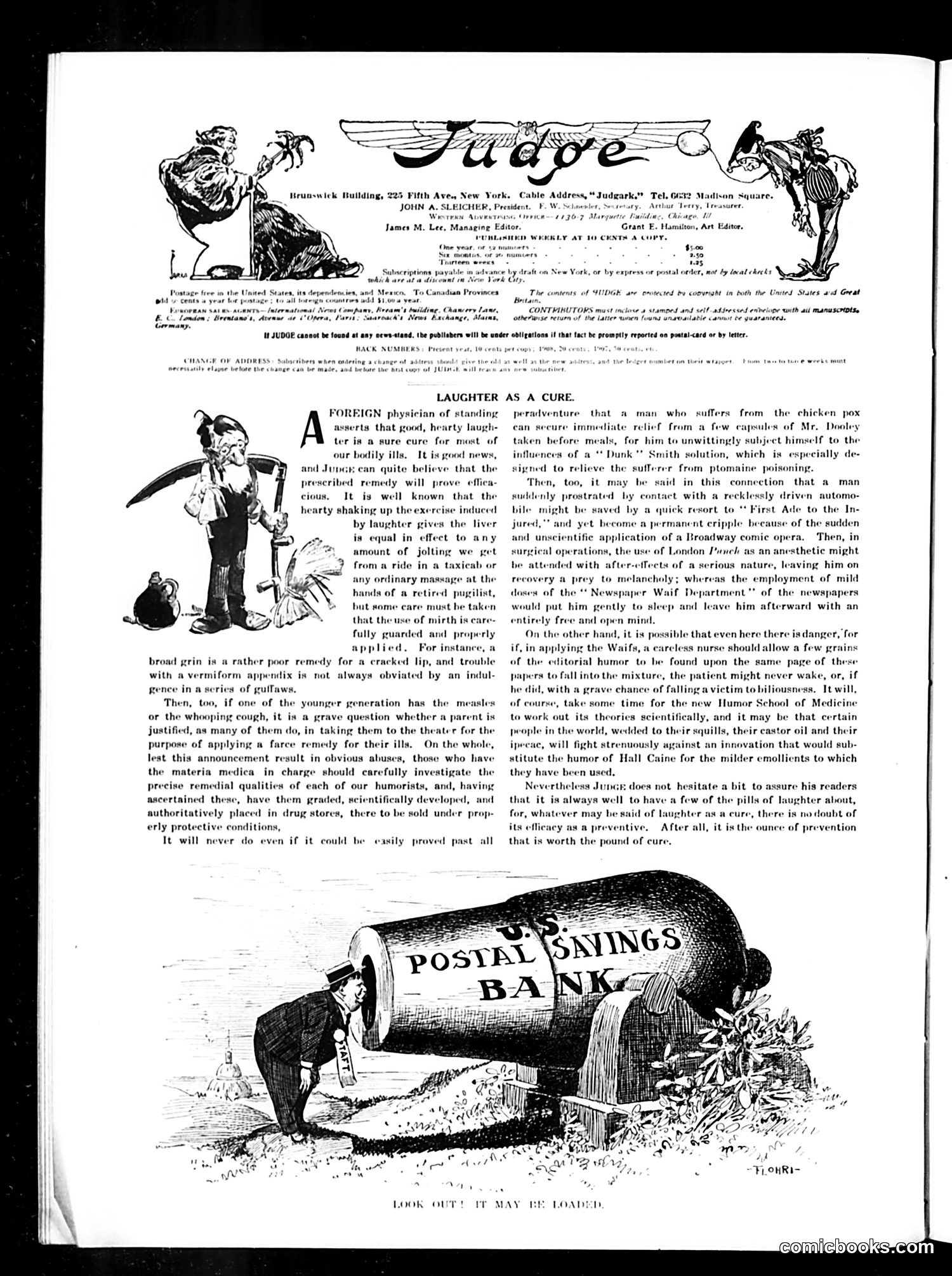
This page contains an article titled "LAUGHTER AS A CURE" discussing therapeutic benefits of humor and laughter for physical ailments. The text argues that hearty laughter aids digestion and various illnesses, referencing remedies like "Dooley" capsules and "Hunk" Smith solutions, as well as theatrical entertainment's medicinal value. The main cartoon below shows a "POSTAL SAVINGS BANK" depicted as an enormous cannon or tube, with two figures (appearing to be common citizens or workers) operating it. The caption reads "LOOK OUT! IT MAY BE LOADED!" This appears to satirize the U.S. Postal Savings System—a government banking service for ordinary citizens—suggesting skepticism about its safety or reliability. The cannon metaphor implies the system is potentially dangerous or unpredictable to users.
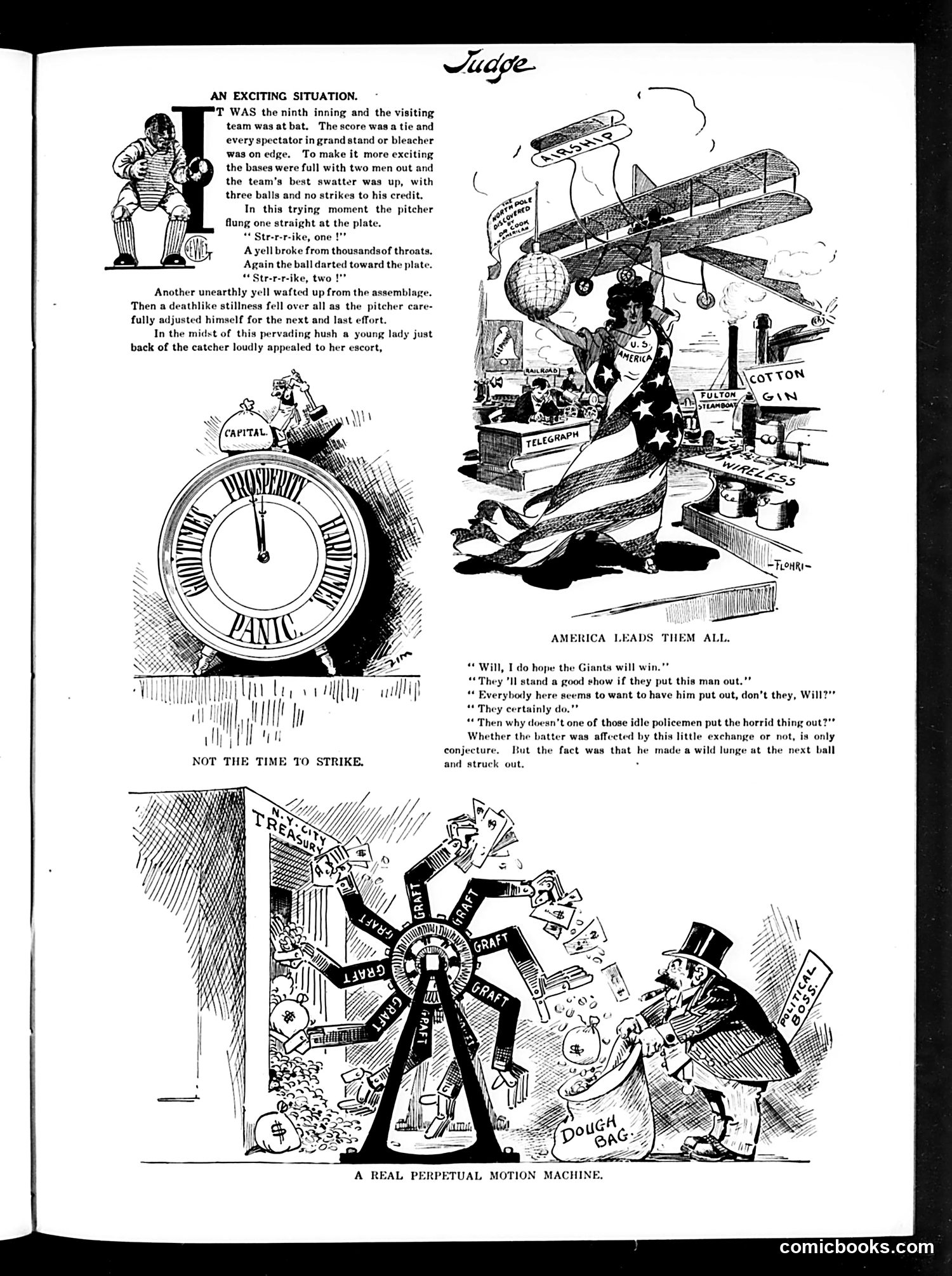
This page contains three satirical cartoons commenting on American economics and labor during what appears to be the early 20th century. **"An Exciting Situation"** depicts a baseball game as metaphor for economic tension—the ninth inning represents a critical moment. **"America Leads Them All"** shows Uncle Sam (recognizable by his star-spangled outfit) overseeing American industrial and agricultural products (telegraph, cotton gin, etc.), suggesting American superiority. The dialogue implies confidence in American competitiveness. **"A Real Perpetual Motion Machine"** depicts a gear-like figure labeled "GRAFT" with money flowing outward, while a figure labeled "DOUGH BAG" feeds it—satirizing corruption where bribery and kickbacks create self-perpetuating wealth extraction at the Treasury's expense. The "Not the Time to Strike" panic clock warns against labor disruption during economically sensitive moments.
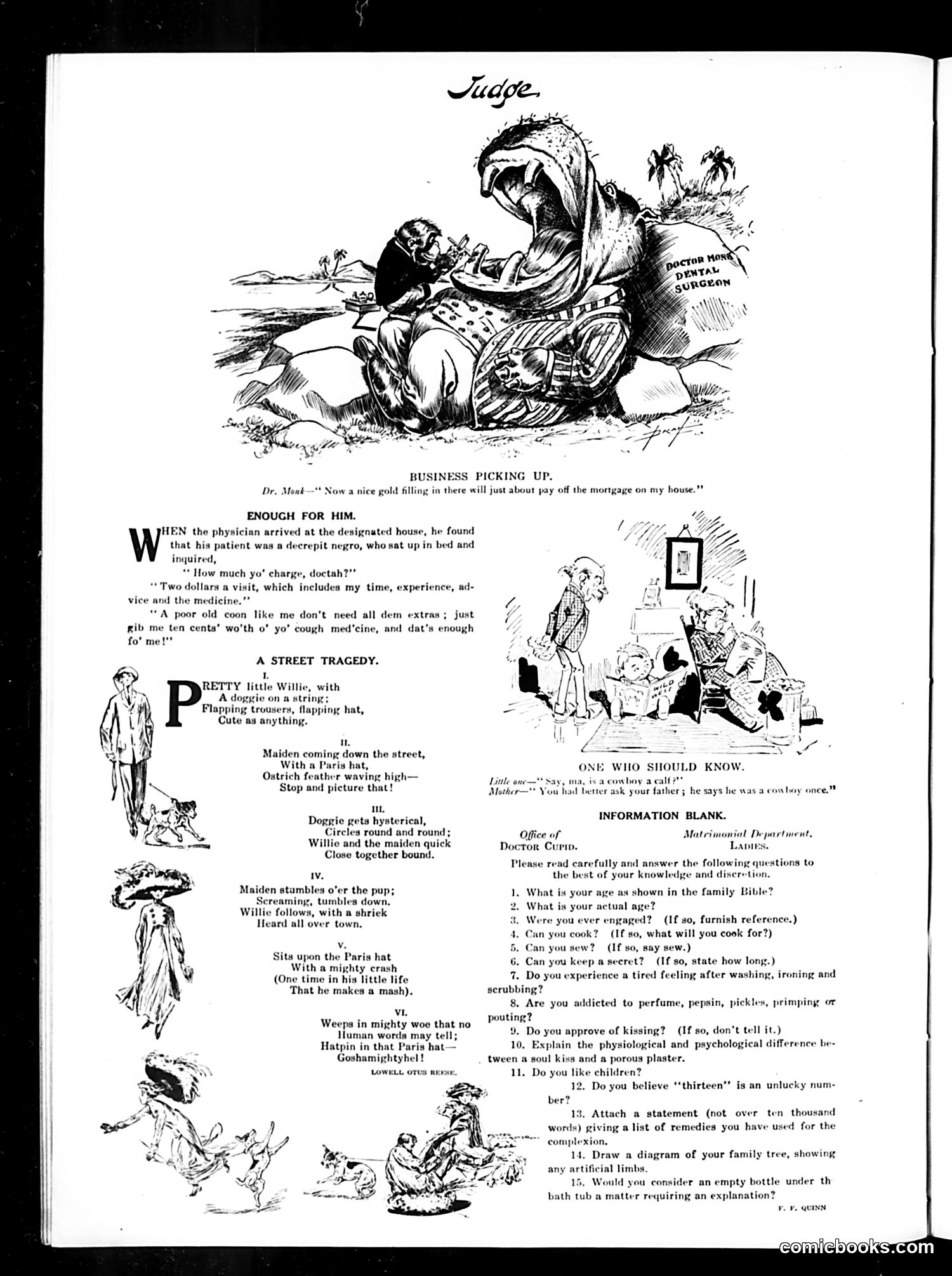
The page contains three distinct satirical pieces: **"Business Picking Up"** (top): A hippo—likely representing a dentist or medical professional—confronts a patient about payment. The satire targets aggressive bill collection practices and doctors' financial demands during what appears to be economic hardship. **"Enough for Him"** (middle right): A physician visits a poor patient who explicitly refuses expensive medical care, requesting only basic treatment "at cost" instead. This critiques healthcare pricing and the poor's inability to afford comprehensive medical services. **"A Street Tragedy"** (left): A narrative poem about "Pretty little Willie," depicting urban poverty, crime, and moral decay affecting children. The accompanying illustrations show deteriorating circumstances. **"Information Blank"** (bottom right): A satirical questionnaire for women, mocking matrimonial advertisements and dating practices of the era through absurd, intrusive questions about cooking, kissing, and family medical history.
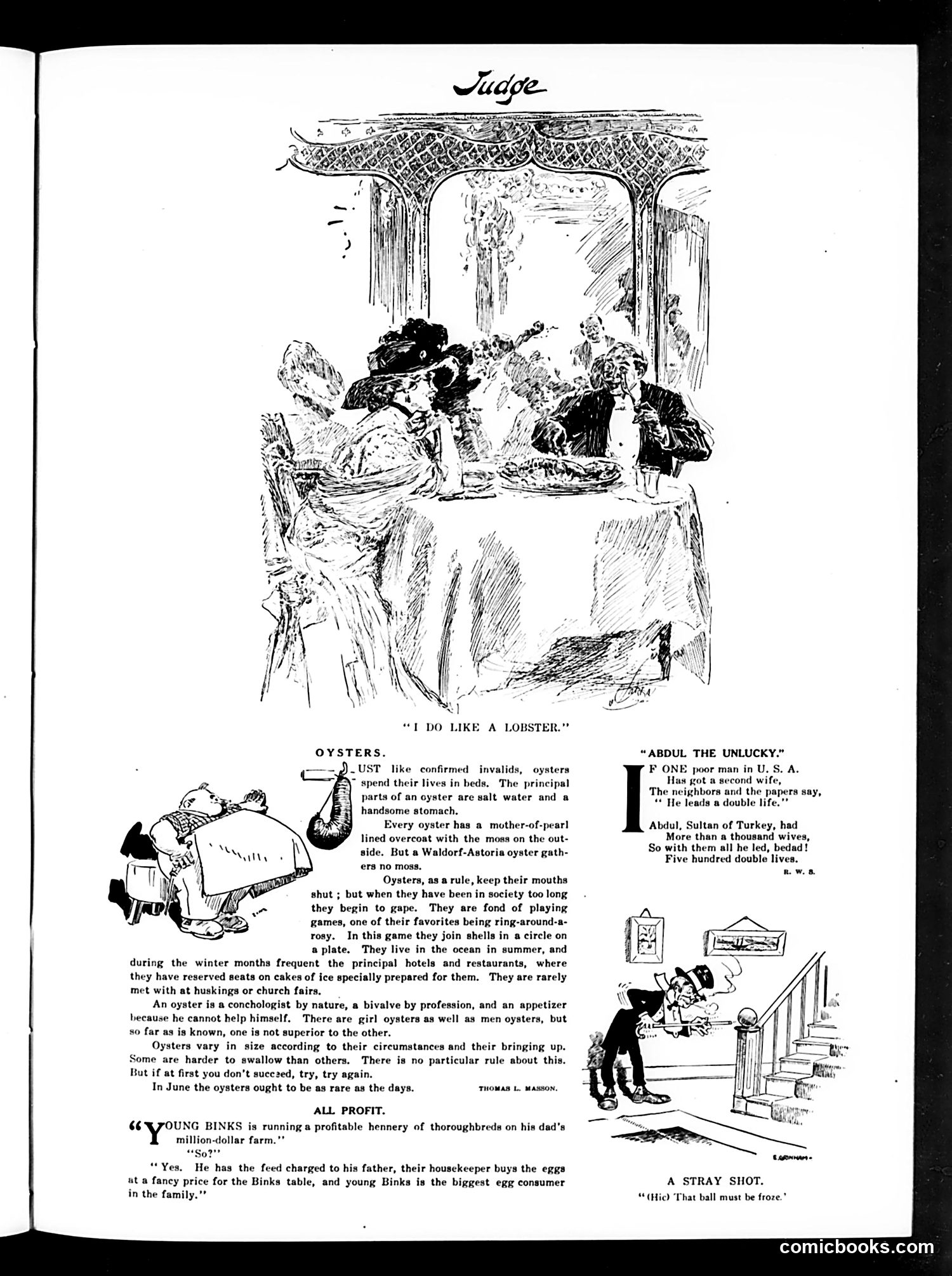
This page contains three separate humorous pieces: **"Judge" (top cartoon):** A dining scene where someone declares "I DO LIKE A LOBSTER," apparently judging the meal or companion. The joke's specifics are unclear without additional context. **"Oysters" (left column):** Educational satire about oyster behavior and consumption. It describes oysters as "confirmed invalids" living in beds, notes they're popular at fashionable hotels and restaurants, and includes commentary on oyster social habits—they allegedly enjoy "ring-around-a-rosy" games. The humor appears to anthropomorphize oysters as upper-class society members. **"All Profit!" and "A Stray Shot" (right side):** Brief satirical pieces about a young man profiting from a hennery using expensive feed, and a shooting incident. These are minor jokes rather than substantive social commentary. The page emphasizes lifestyle satire typical of Judge magazine's upper-class humor.
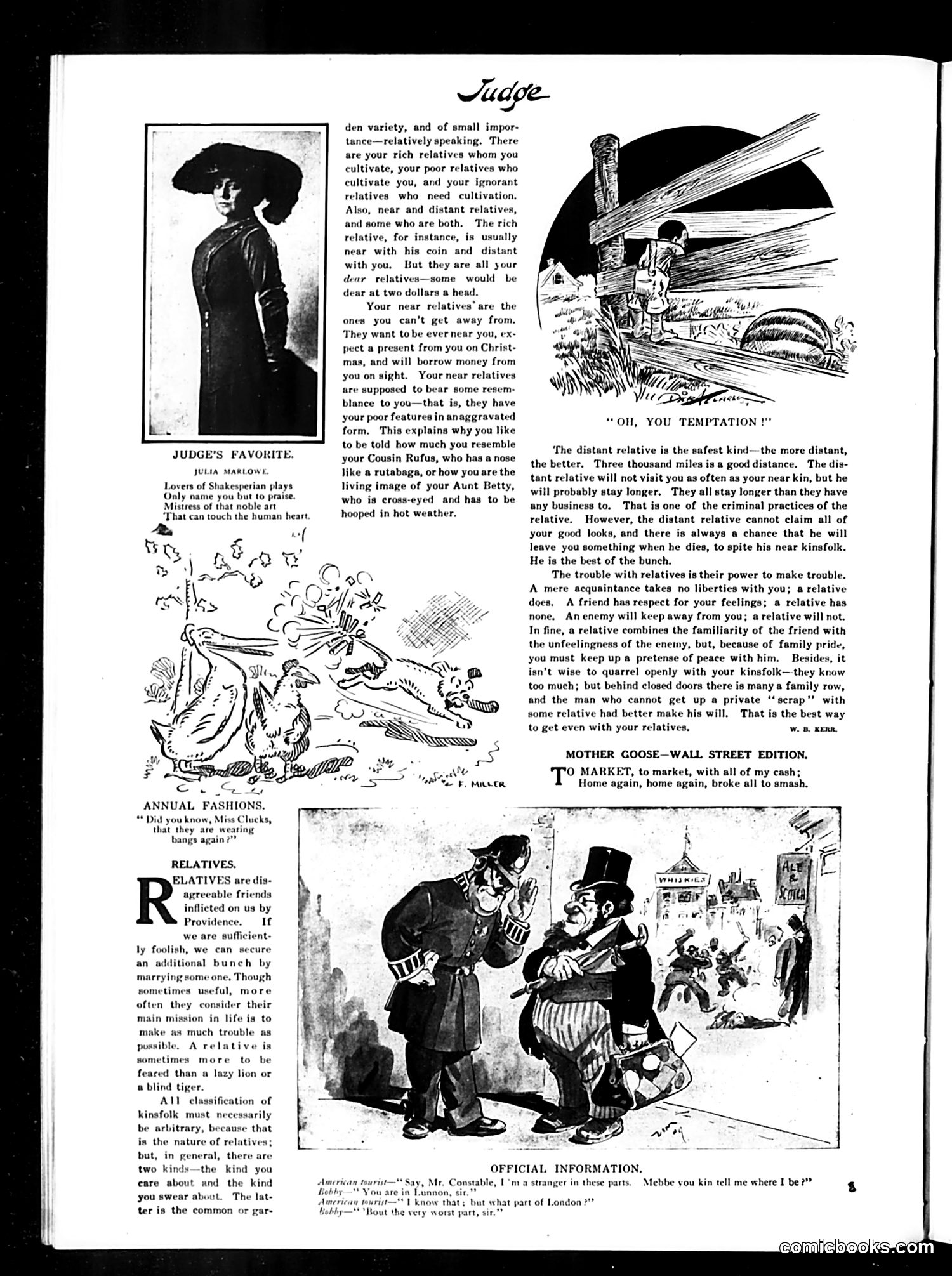
This page contains several satirical pieces typical of Judge's early 20th-century social commentary: **"Judge's Favorite"** (top left) offers a humorous taxonomy of relatives, distinguishing between rich, poor, near, and distant kinfolk. The satire mocks how people cultivate relationships based on money and obligation rather than genuine affection—"dear at two dollars a head." **"Annual Fashions"** jests at women's fashion trends, specifically the return of bangs hairstyles. **"Official Information"** (bottom cartoon) shows a comic exchange between an American tourist and a London police constable. The humor relies on the constable's implication that the tourist has landed in London's worst neighborhood—a gentle jab at both American naïveté abroad and London's notorious slum districts. **"Mother Goose—Wall Street Edition"** applies a nursery rhyme to stock market losses, suggesting investors spend their capital recklessly. The page primarily focuses on domestic social humor rather than overt political satire.
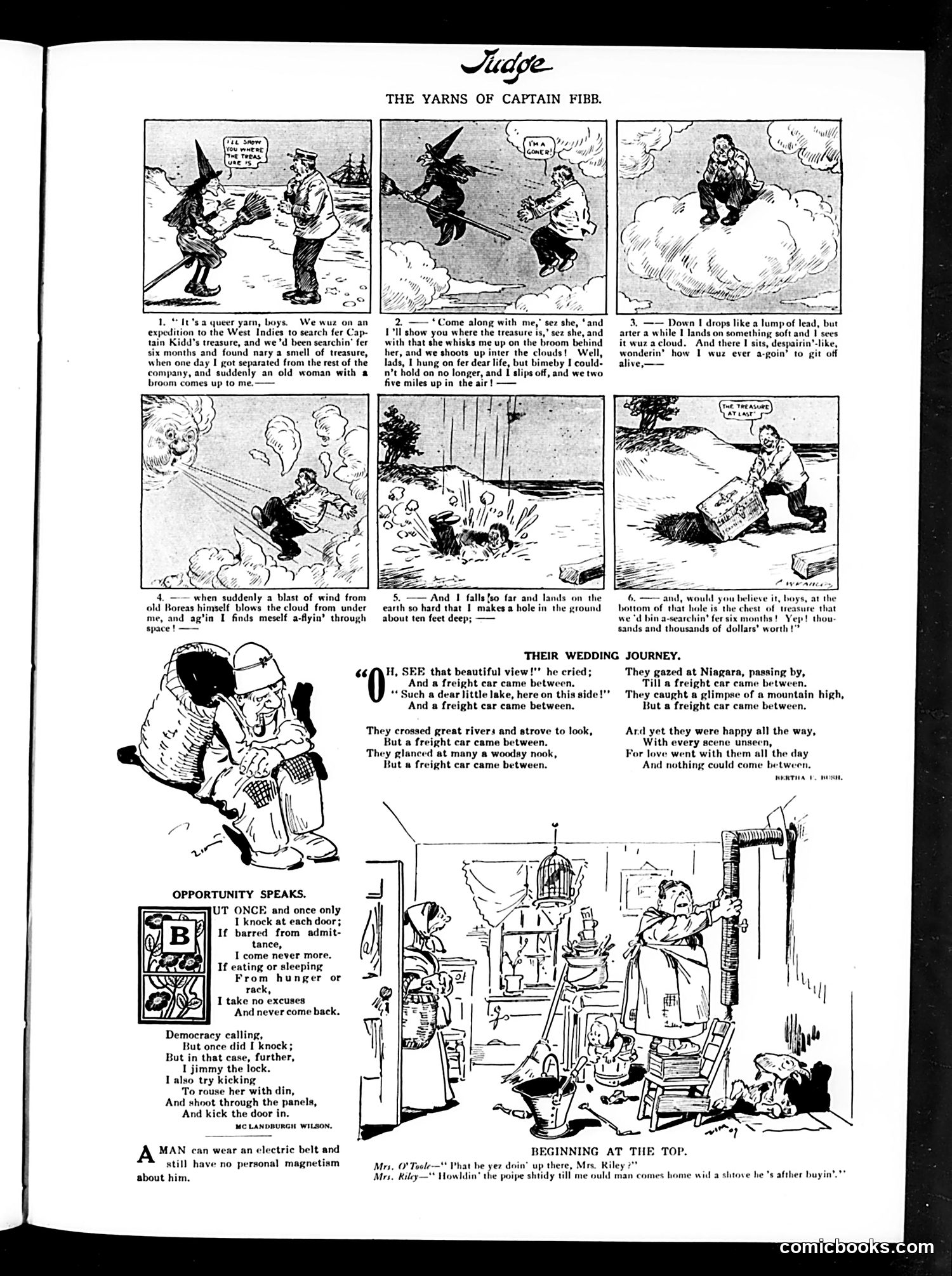
This page contains three distinct pieces from Judge magazine: **"The Yarns of Captain Fibb"** is a tall-tale comic strip mocking exaggerated seafaring adventure stories. Captain Fibb spins an absurd narrative about searching for Captain Kidd's treasure, encountering a witch on a broomstick, falling through clouds, and miraculously landing atop buried treasure—satirizing the implausible adventure yarns popular in period fiction. **"Their Wedding Journey"** uses repetition to humorously comment on industrial progress interrupting romantic travel. A newlywed couple repeatedly tries viewing natural scenery—lakes, rivers, Niagara Falls—but freight trains constantly obstruct their view. The irony: they remain happy because love transcends these modern intrusions. This gently critiques how railroads fragment the American landscape. **"Opportunity Speaks"** features a poem contrasting Democracy's aggressive tactics (jimmying locks, shooting through panels) with Opportunity's single knock, satirizing political corruption. The final vignette shows working-class Irish characters (indicated by dialect), likely satirizing immigrant laborers.
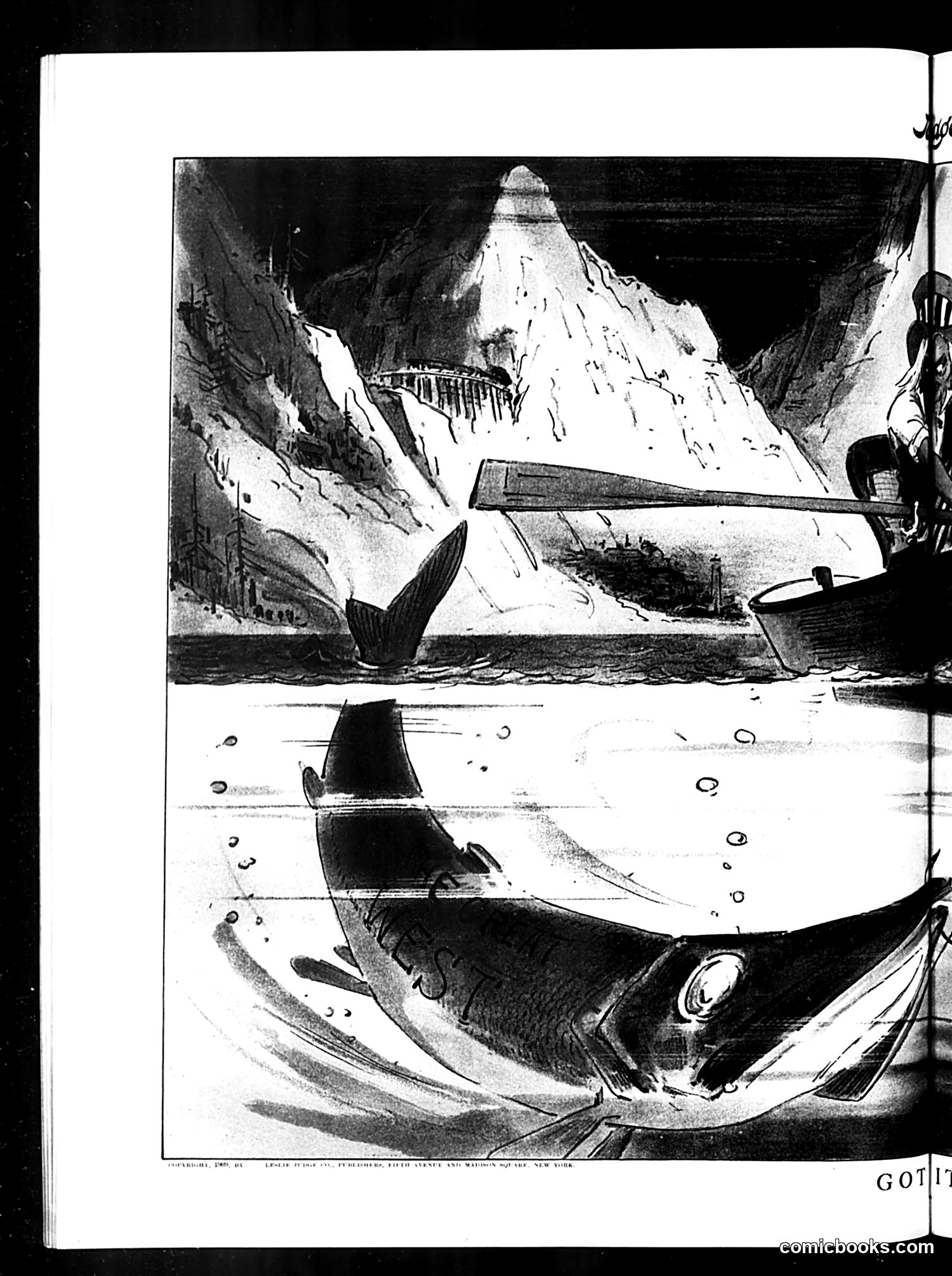
This appears to be a maritime-themed political cartoon from Judge magazine, though the OCR text provides minimal context. The image shows a dramatic scene with a large white iceberg or cliff formation dominating the composition, small sailing vessels below, and what appears to be a whale or large sea creature in the foreground water. Without clearer text or caption visible, the specific political allegory remains uncertain. However, given Judge's satirical nature, this likely comments on a contemporary maritime disaster, naval policy, or uses the ocean/ice imagery metaphorically for political danger or foolish navigation—a common Judge trope. The dramatic composition suggests cautionary commentary on leadership or national peril, but I cannot identify specific figures or confirm the exact satirical target without legible captions.
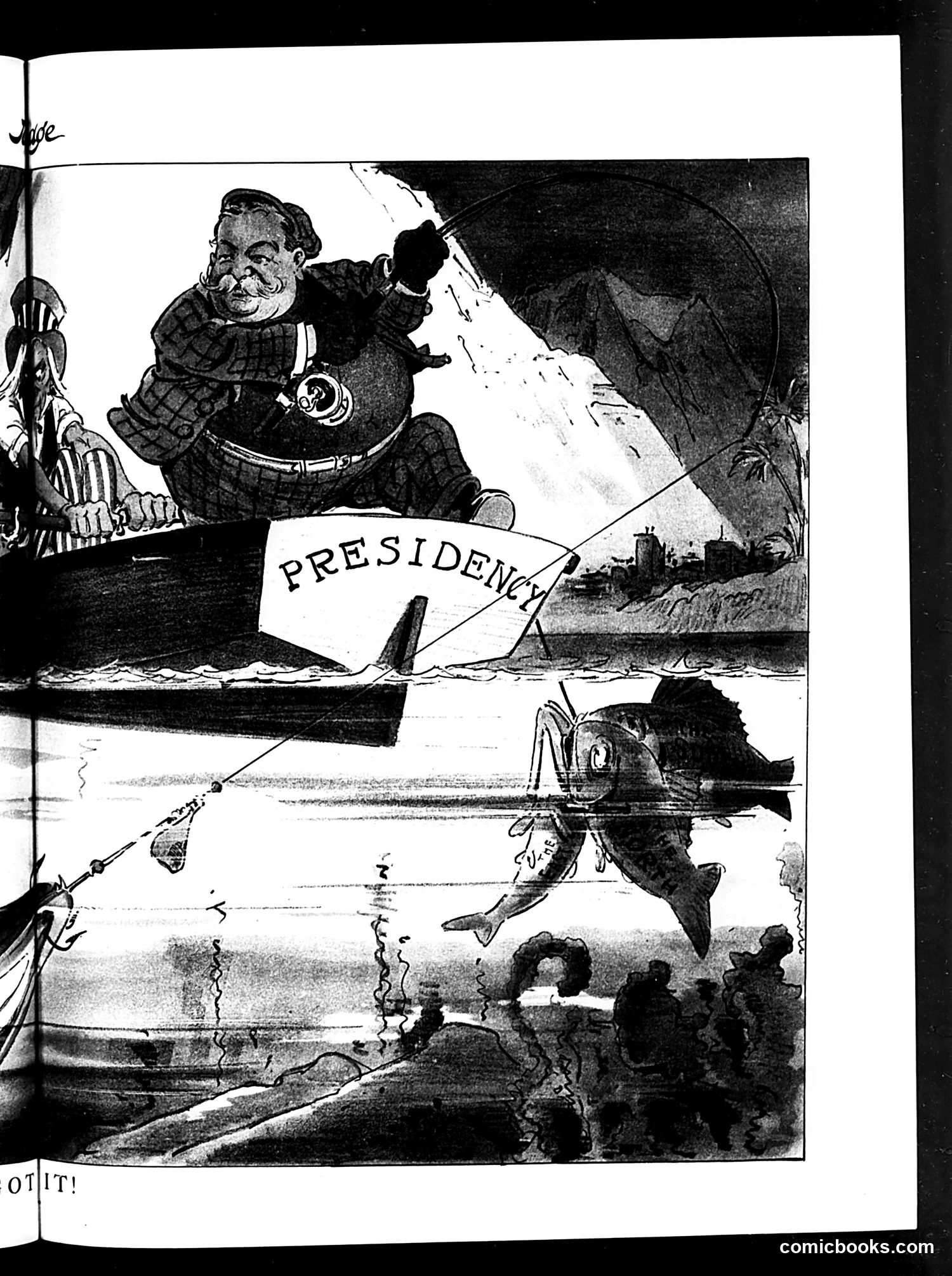
This two-panel cartoon depicts the "Presidency" as a sinking ship. In the top panel, a portly, caricatured political figure (identity unclear from visible text) sits in a boat labeled "PRESIDENCY," desperately bailing water while a storm rages. The bottom panel shows the ship fully submerged, with figures drowning below. The satire suggests the presidency or current administration is in crisis and collapse. The exaggerated caricature and desperate bailout effort mock the leader's inability to manage the situation. This appears to be commentary on a specific political crisis or failed presidency, though without dating or clearer identification, the exact historical reference remains unclear. The drowning figures may represent the public suffering consequences of failed leadership.
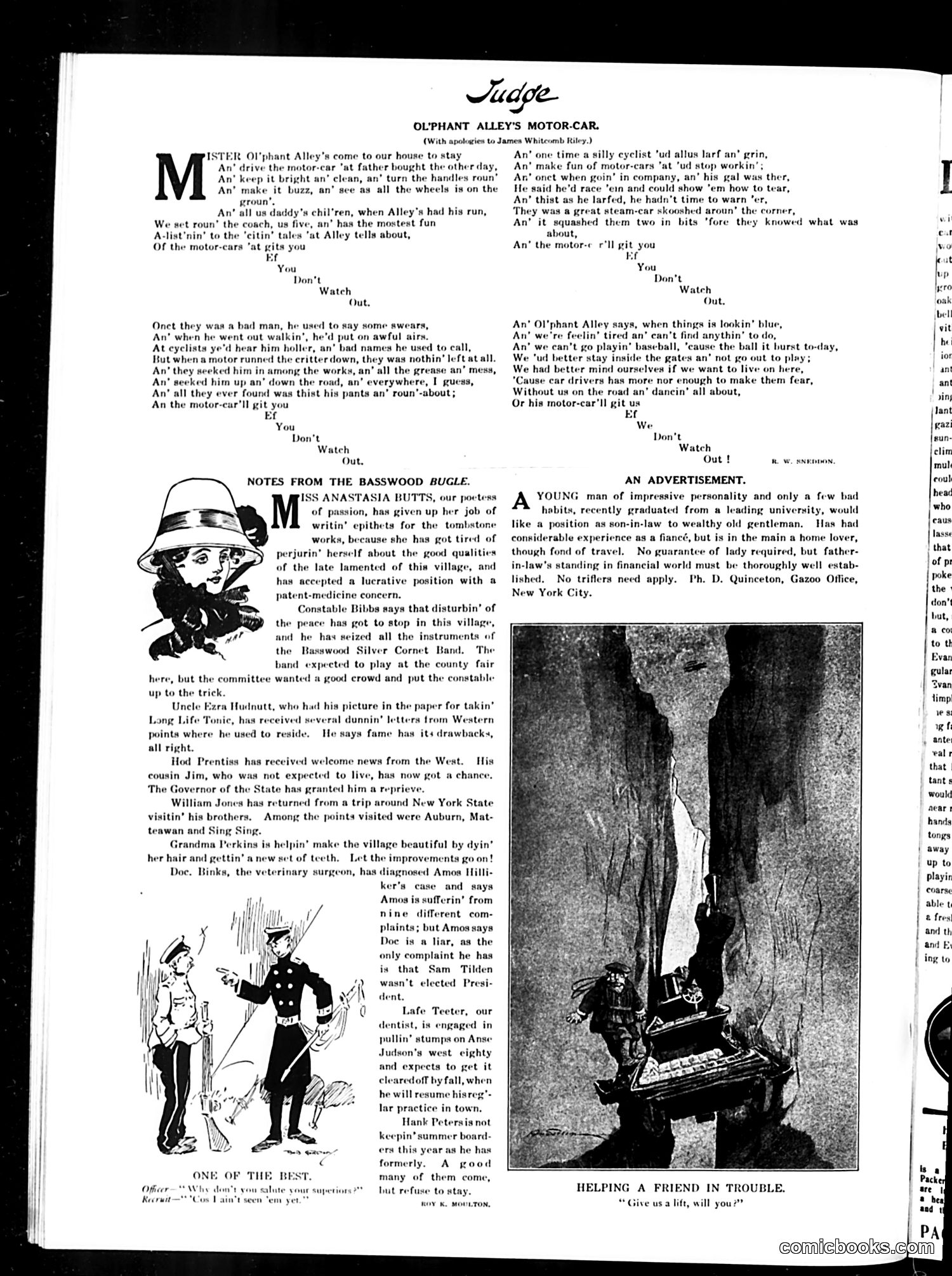
This page parodies James Whitcomb Riley's dialect poetry style to satirize early automobile dangers. The main poem, narrated by a rural child, describes how motor-cars fatally strike people—a cyclist who mocked them, and later a couple. The dark humor plays on anxieties about this new technology: automobiles were genuinely deadly hazards in the early 1900s, yet the poem treats vehicular deaths almost casually, with the repeated refrain "An' the motor-car'll git you / Ef / You / Don't / Watch / Out." The "Notes from the Basswood Bugle" section provides small-town gossip, including a constable confiscating a band's instruments and a man receiving a reprieve from execution—likely referencing actual recent cases, though specific identities are unclear from context alone. The cartoon humor relies on readers' familiarity with Riley's sentimental rural voice to make the dark subject matter absurdist and satirical, rather than genuinely tragic.
This humorous story depicts a romantic mishap at a rural hay-wagon ride—a popular social activity in turn-of-the-century American countryside entertainment. The narrator, a city visitor, attempts romantic flirtation with two local girls, Daphne and Evangeline, during a pastoral outing. He's forcibly removed by a jealous rural suitor ("a strapping bumpkin") who objects to the city boy's advances toward "his gal." The satire targets the contrast between urbane, sentimental romanticism ("her eyes reminded me of the distant stars") and rough rural masculinity. The "city dude" is portrayed as presumptuous and ineffectual—easily overpowered by actual country men. The story also mocks Gus, the molasses salesman, who boasts of whip-cracking expertise inherited from his great-grandfather, then gets drunk on cider—representing urban pretension colliding with rural reality. The humor derives from city people's naive assumptions about romantic conquest in unfamiliar rural settings, where actual social bonds (established escorts) trump sentimental appeals.
This page from Judge (1909 jubilee issue) is primarily **advertising with satirical humor pieces**, not a political cartoon. The main cartoon shows a well-dressed man in a top hat greeting a small boy, captioned "MISREADING THE SIGNS," with the joke being the boy mistakes loafers sleeping on grass for a suffragette meeting—a topical reference to women's suffrage activism of the era. Other humor pieces mock contemporary social concerns: rigid corseting ("Wordsworth Up to Date"), excessive drinking, and hypochondria. One piece jokes about a boy thinking he has symptoms of love after smoking a cigar. The page is dominated by **advertisements** for champagne, wine, hotels, collars, and patent medicines—typical Judge content. The humor reflects early 1900s anxieties about women's fashion, feminism, modern medicine, and social propriety rather than partisan politics.
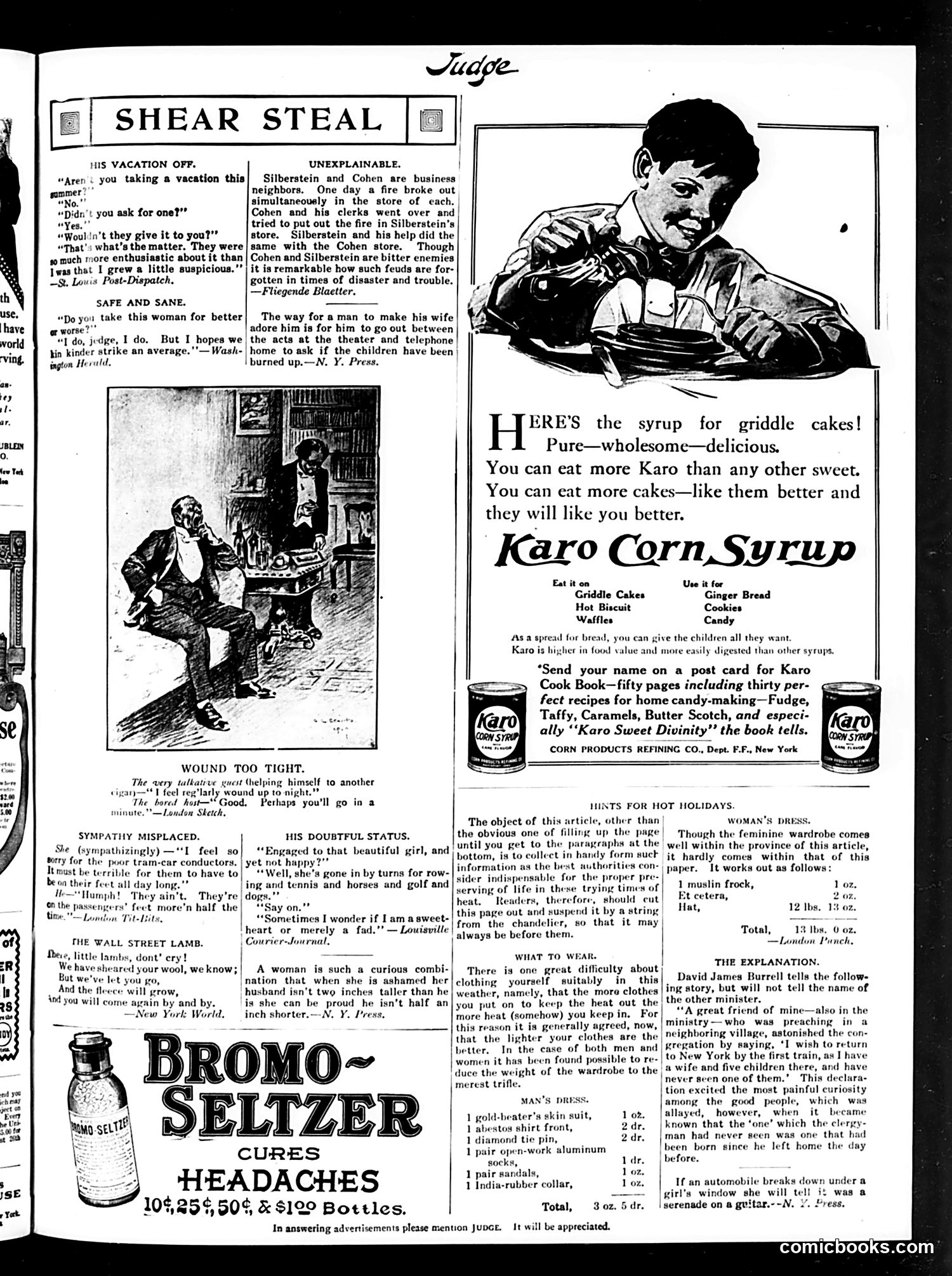
This page from Judge contains several short satirical jokes typical of early 20th-century humor magazines, plus period advertisements. The cartoons mock everyday frustrations: an employee suspicious that his boss *wants* him to take vacation (implying corporate insincerity), a groom settling for an "average" marriage, and a man wound so tight by conversation he can finally leave. "The Wall Street Lamb" satirizes naive investors being fleeced by Wall Street. The most socially interesting piece is "Unexplainable," which notes that bitter business rivals Silberstein and Cohen temporarily forget their animosity during a fire emergency—seemingly referencing how disasters transcend ethnic or business rivalries, though the point remains understated. The ads (Karo Corn Syrup, Bromo-Seltzer) and fashion advice occupy significant space, as advertising heavily subsidized such magazines. The humor is gentle, domestic, and relies on observational comedy rather than sharp political critique.
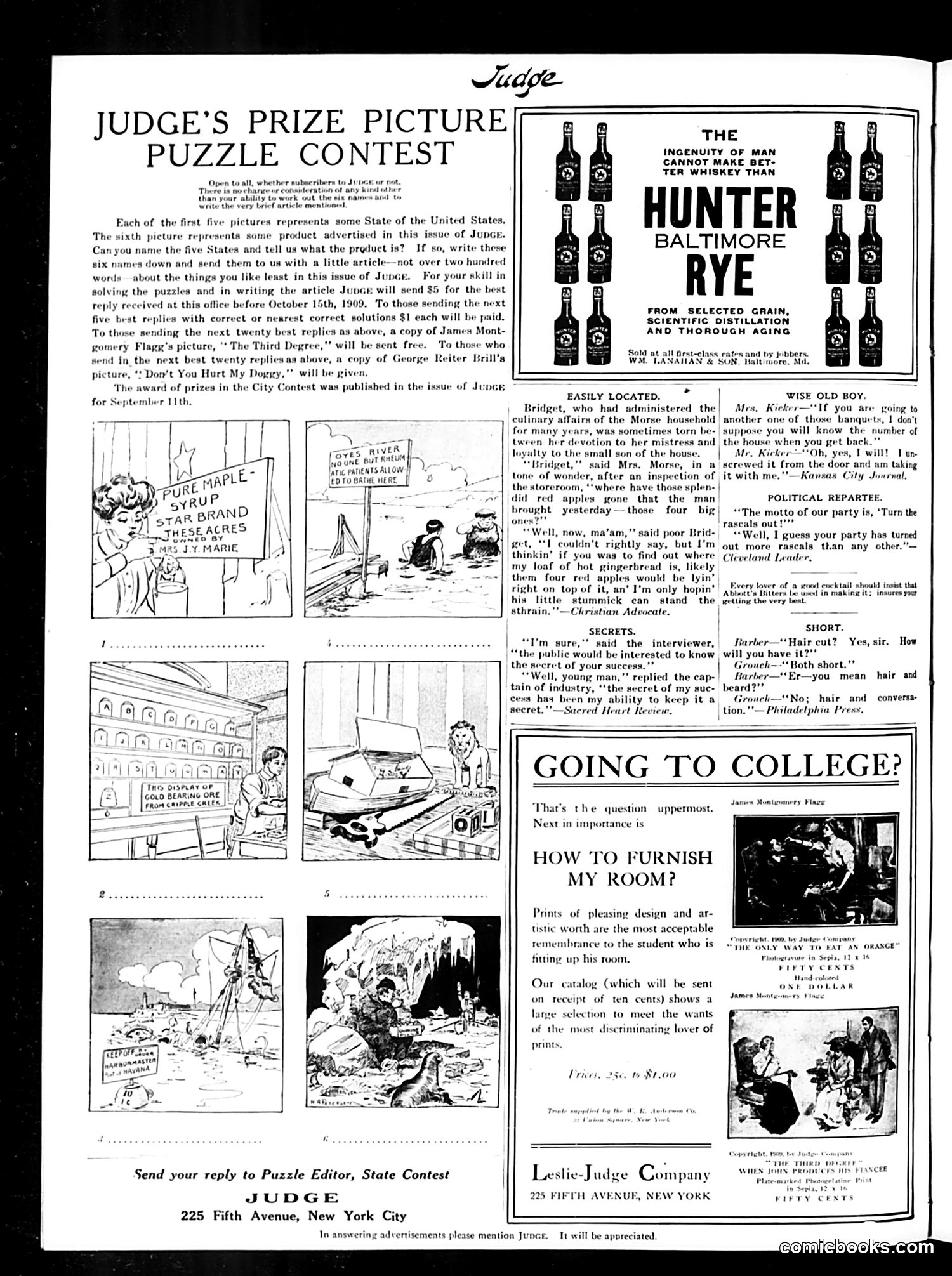
This page combines a **puzzle contest** with period **humor snippets** and advertising. **The Puzzle Contest:** Readers must identify five U.S. states and products advertised in the issue, then write a 200-word article. Prizes included original artwork by James Montgomery Flagg and George Reiter Brill. This was a common early-1900s magazine engagement tactic. **The Cartoons/Jokes:** Six small comic illustrations accompany brief humorous anecdotes—typical Judge fare satirizing domestic life, class differences, and human foibles. One features "Bridget," an Irish servant character (common ethnic stereotype of the era), confused about apples. Another mocks politicians claiming moral reform. The "Short" joke plays on a barber's misunderstanding of a customer's request. **Advertising:** Hunter Baltimore Rye whiskey dominates the right side, using pseudo-scientific claims about "scientific distillation." **Context for Modern Readers:** This reflects turn-of-the-century magazine culture emphasizing reader participation, ethnic humor considered acceptable then, and advertising's early marketing language blending pseudo-science with aspiration.
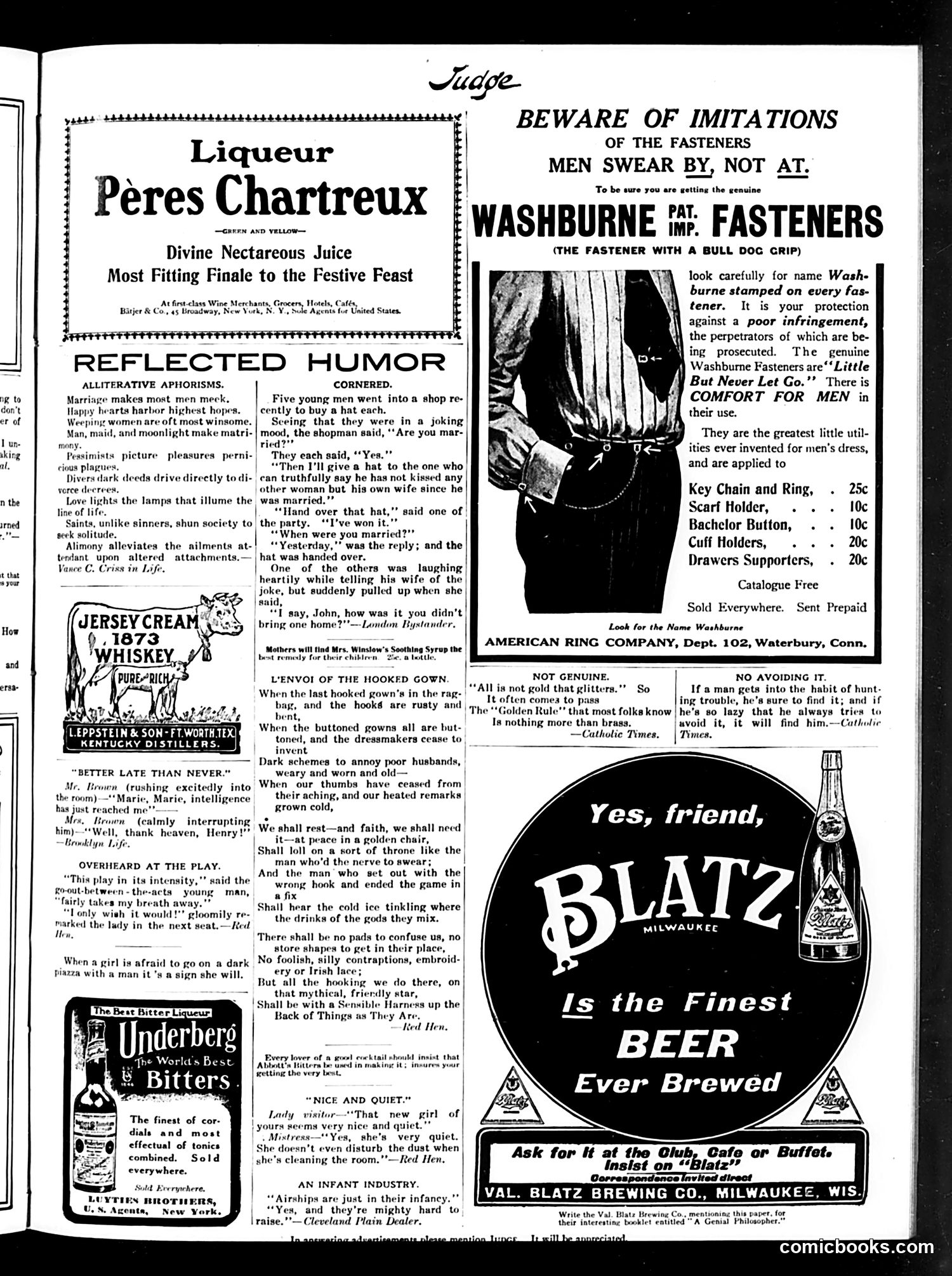
This is primarily an **advertising and humor page** from an early 20th-century American satirical magazine. The page contains several elements: **Main Content:** A "Reflected Humor" section featuring short jokes and aphorisms—brief, witty observations about marriage, women, and human nature typical of the era. These include jokes about newlyweds, clothing fashions, and courtship. **Notable Satire:** A poem titled "L'Envoi of the Hooked Gown" humorously laments women's complicated clothing (hooked fasteners), depicting husbands as weary and annoyed by dress-related complications. This reflects genuine contemporary frustration with Victorian/Edwardian women's fashion complexity. **Advertisements:** The page is dominated by period product ads (liqueurs, whiskey, bitters, beer) and a prominent warning against counterfeit "Washburne Fasteners"—an early consumer-protection advertisement. **Context for Modern Readers:** The humor reflects early 1900s gender dynamics, obsession with clothing mechanics, and advertising's nascent role in consumer culture. The "hooked gown" references real technical frustrations with period fashion.
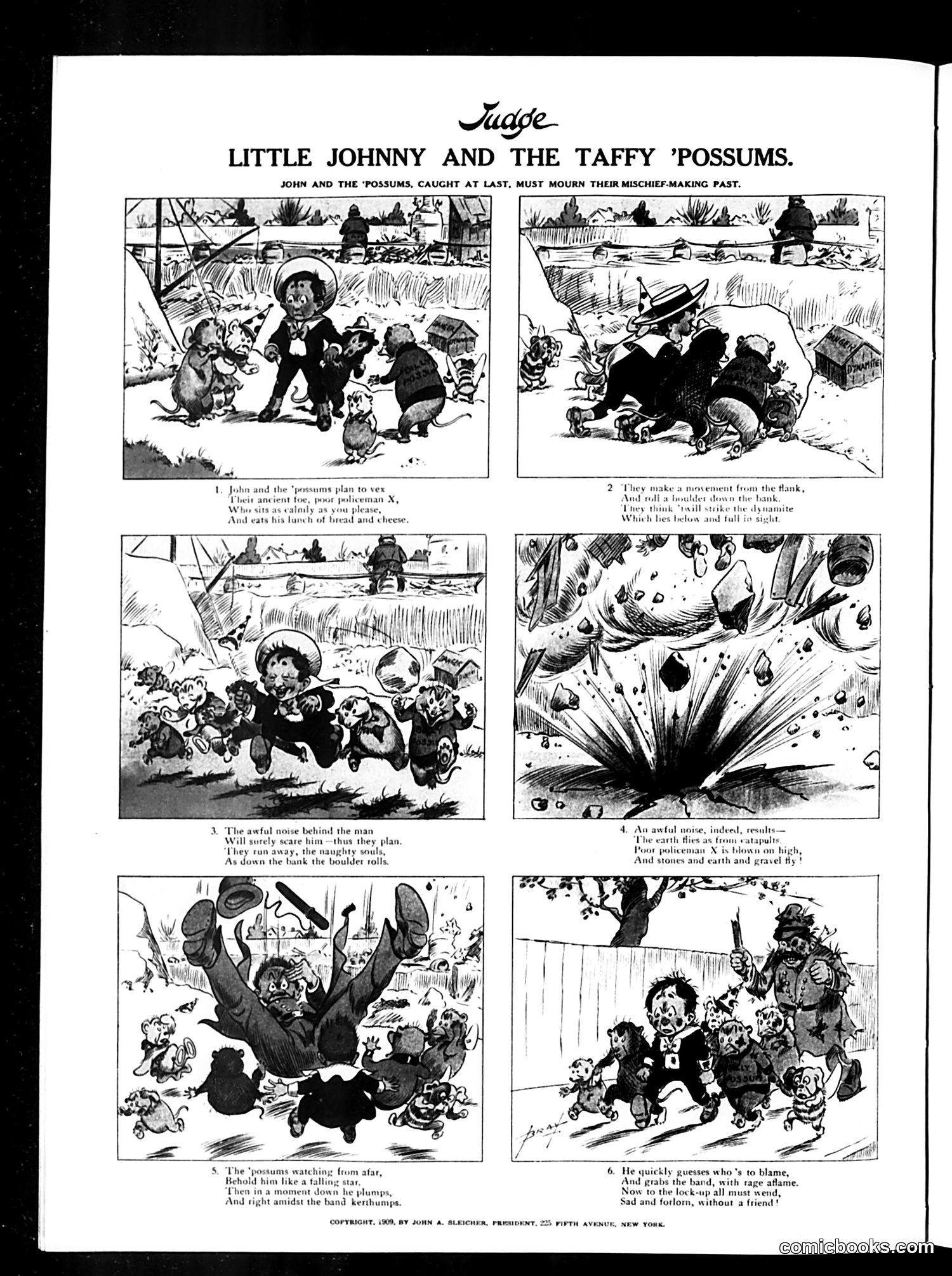
This is a humorous six-panel comic strip about a boy named Johnny and mischievous possums who steal taffy. The narrative follows their troublemaking: the possums plan theft, execute a heist by rolling down a bank, cause an explosion (panel 4), and attempt escape before Johnny catches them. In the final panel, Johnny confronts the band and decides to punish them. The satire appears to mock Victorian-era children's moral tales, where misbehavior must be punished. The "taffy 'possums" personify animal troublemakers, common in Gilded Age humor. The escalating chaos—from petty theft to explosions—exaggerates consequences for comic effect, satirizing overly serious moral instruction in contemporary literature for children.