
Judge, 1909-09-25 · page 6 of 16
Judge — September 25, 1909 — page 6: what you’re looking at
What you’re looking at
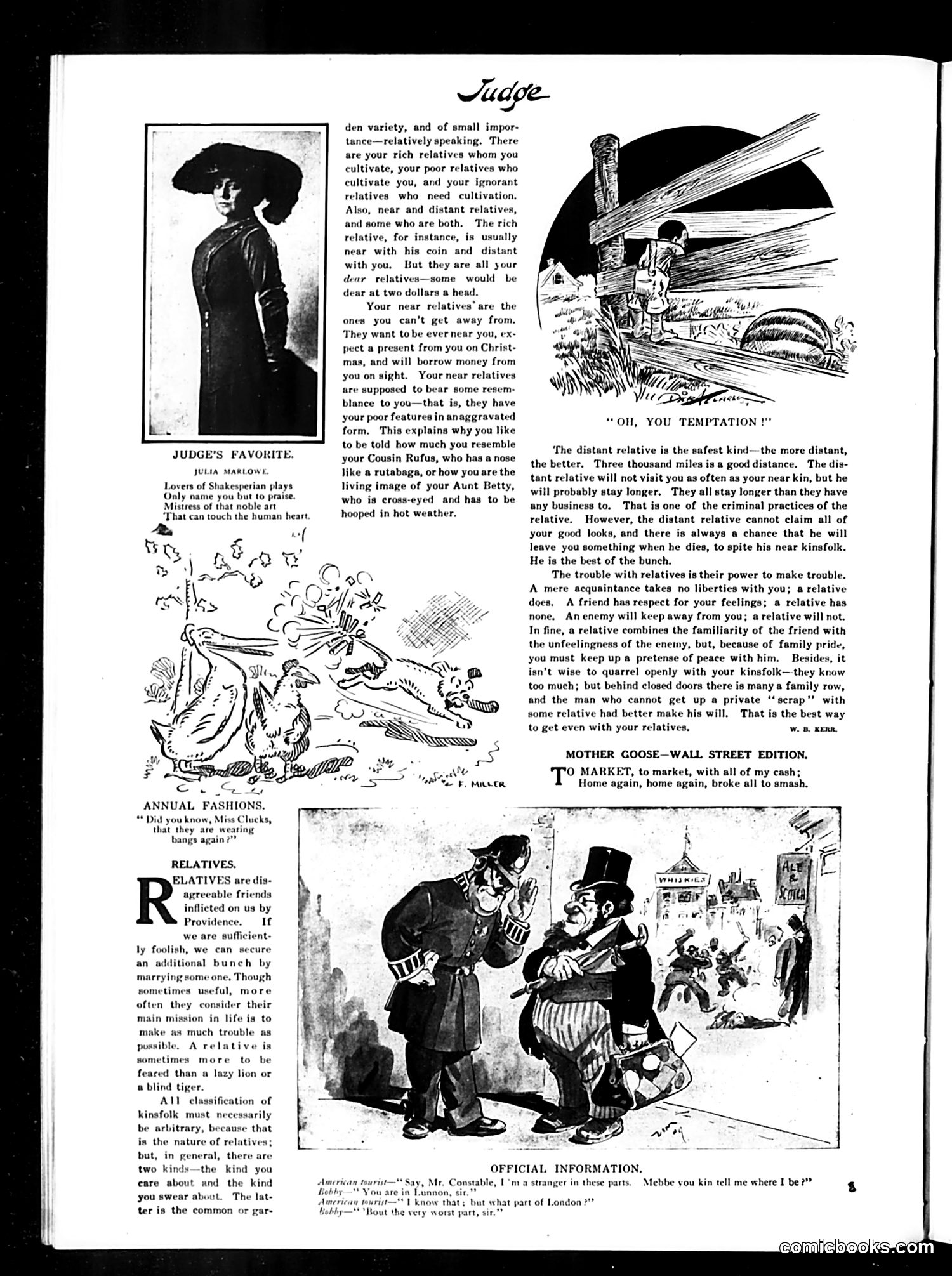
This page contains several satirical pieces typical of Judge's early 20th-century social commentary: **"Judge's Favorite"** (top left) offers a humorous taxonomy of relatives, distinguishing between rich, poor, near, and distant kinfolk. The satire mocks how people cultivate relationships based on money and obligation rather than genuine affection—"dear at two dollars a head." **"Annual Fashions"** jests at women's fashion trends, specifically the return of bangs hairstyles. **"Official Information"** (bottom cartoon) shows a comic exchange between an American tourist and a London police constable. The humor relies on the constable's implication that the tourist has landed in London's worst neighborhood—a gentle jab at both American naïveté abroad and London's notorious slum districts. **"Mother Goose—Wall Street Edition"** applies a nursery rhyme to stock market losses, suggesting investors spend their capital recklessly. The page primarily focuses on domestic social humor rather than overt political satire.
📄 Transcribed text from this page (OCR, searchable)
Machine-transcribed from the original scan — historical spelling and the odd misread are preserved.
uage- den variety, and of small impor- tance—relatively speaking. There are your rich relatives whom you cultivate, your poor relatives who cultivate you, and your ignorant relatives. who need cultivation. Also, near and distant relatives, and some who are both. The rich relative, for instance, is usually near with his coin and distant with you. But they are all your dear relatives—some would be dear at two dollars a head. Your near relatives’ are the ones you can't get away from. They want tobe ever near you pect a present from you on Chi mas, and will borrow money from you on sight. Your near relativ are supposed to bear some resem- blance to you—that is, they have your poor features in anaggravated “OM, YOU TEMPTATION form. This explains why you like caia rE to be told how much you resemble ‘The distant relative is the safest kind—the more distant, eee nneen your Cousin Rufus, who hat arose the better. Three thousand miles isa good distance. The dis- Lovers of Shakesperian plays living image of your Aunt Betty, bewing relative will not visit you as often as your near kin, but he Creo Shekerea es ee eee ee yet aid haa te be Will Probably stay longer. ‘They all stay longer than they have ress of that noble art i any business to, That is one of the criminal practices of the That can touch the human heart. hooped in hot weather. relative. However, the distant relative cannot claim all of your good looks, and there is always a chance that he will leave you something when he dies, to spite his near kinsfolk. He is the best of the bunch. The trouble with relatives is their power to make trouble. A mere acquaintance takes no liberties with you; a relative does. A friend has respect for your feelings; a relative has none. An enemy will keep away from you; a relative will not. In fine, a relative combines the familiarity of the friend with the unfeelingness of the enemy, but, because of family pride, you must keep up a pretense of peace with him. Besides, it isn't wise to quarrel openly with your kinsfolk—they know too much; but behind closed doors there is many a family row, and the man who cannot get up a private ‘scrap’ with some relative had better make his will. That is the best way to get even with your relatives. Ww. B. KERR, MOTHER GOOSE—WALL STREET EDITION. 0 MARKET, to market, with all of my cash; Home again, home again, broke all to smash. ANNUAL FASHIONS. - Ez “ Did you know, } “luc! i = ia “ @ that th * be bangs again ? RELATIVES. ELATIVES are dis- agreeable friends inflicted on us by Providence. If we are sufficient- ly foolish, we can secure an additional bunch by marrying some one. Though sometimes useful, more often they consider their n sion in life is to make as much trouble as possible, A relatiy sometimes mo feaced than a a blind tiger. All classificat kinsfolk must be arbitrary, becau: is the nature of relatives; but, in general, there are two kinds—the kind you OFFICIAL INFORMATION. eare about and the kind ewe tournst—"* Say, Mr. Constable, I'm a stranger in these parts. Mebbe you kin tell me where I be?” Bobby —** You are in Lunnon, sir.” you swear about. The lat American tourist—"* 1 know that; but what part of London?” ter is the common or gar- Hobhy—* Mout the very worst part, sir.”