
A complete issue · 44 pages · 1908
Judge — December 5, 1908
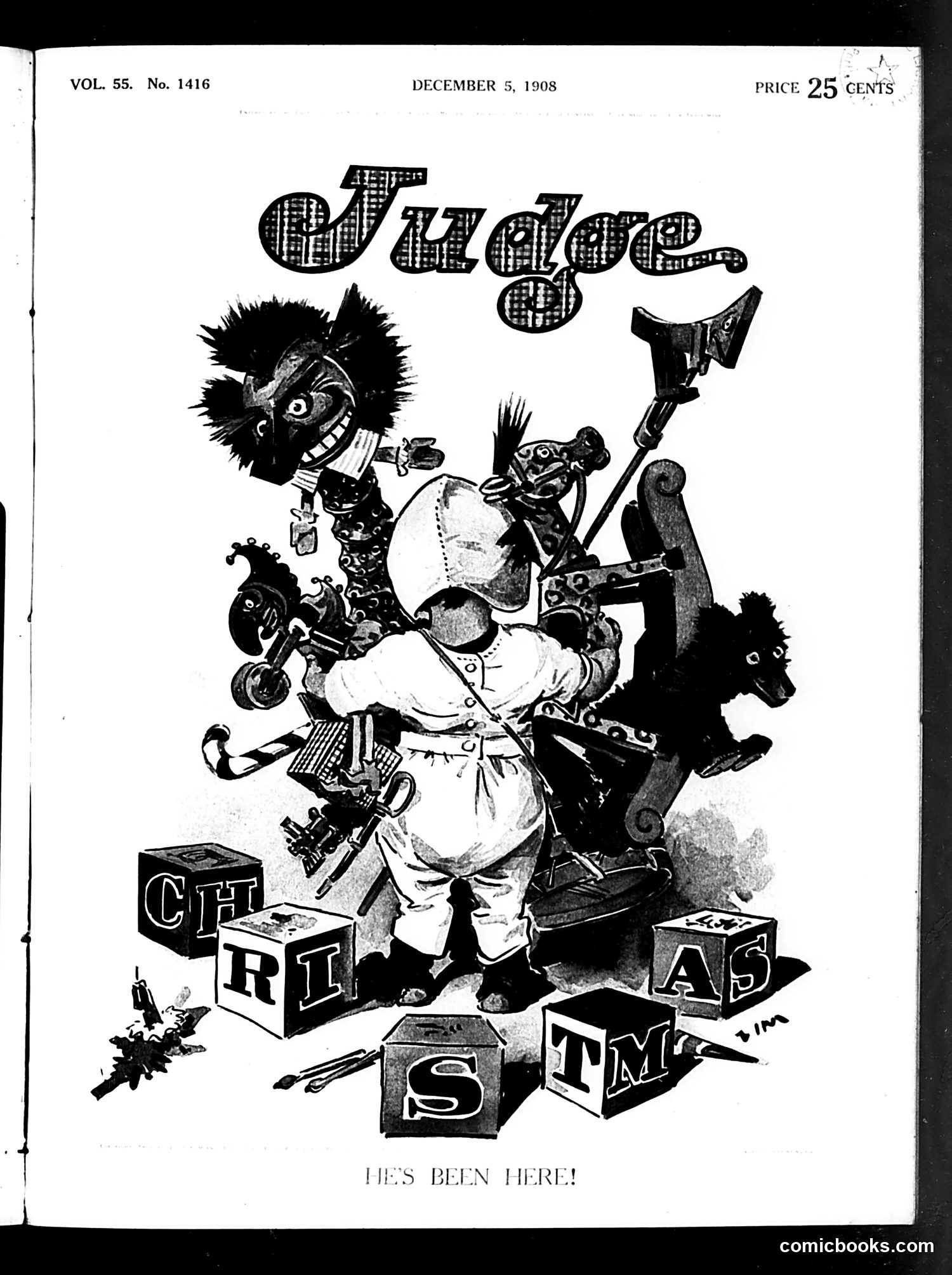
This is a Christmas-themed satirical cover featuring a jolly figure (Santa Claus) overflowing with toys and gifts labeled "CHRISTMAS." The blocks at the base spell out "CHRISTMAS" and the caption reads "HES BEEN HERE!" The satire appears to celebrate commercial Christmas abundance—Santa arriving laden with consumer goods represented by the toy blocks and mechanical playthings. The exaggerated, almost chaotic composition suggests satirizing either: 1. The commercialization of Christmas and consumer excess in early 1900s America 2. The prosperity and abundance of American capitalism during this period The grotesque facial expression and overstuffed presentation likely critique the materialism and frivolity associated with holiday consumption, though the exact political target remains somewhat unclear from the image alone.
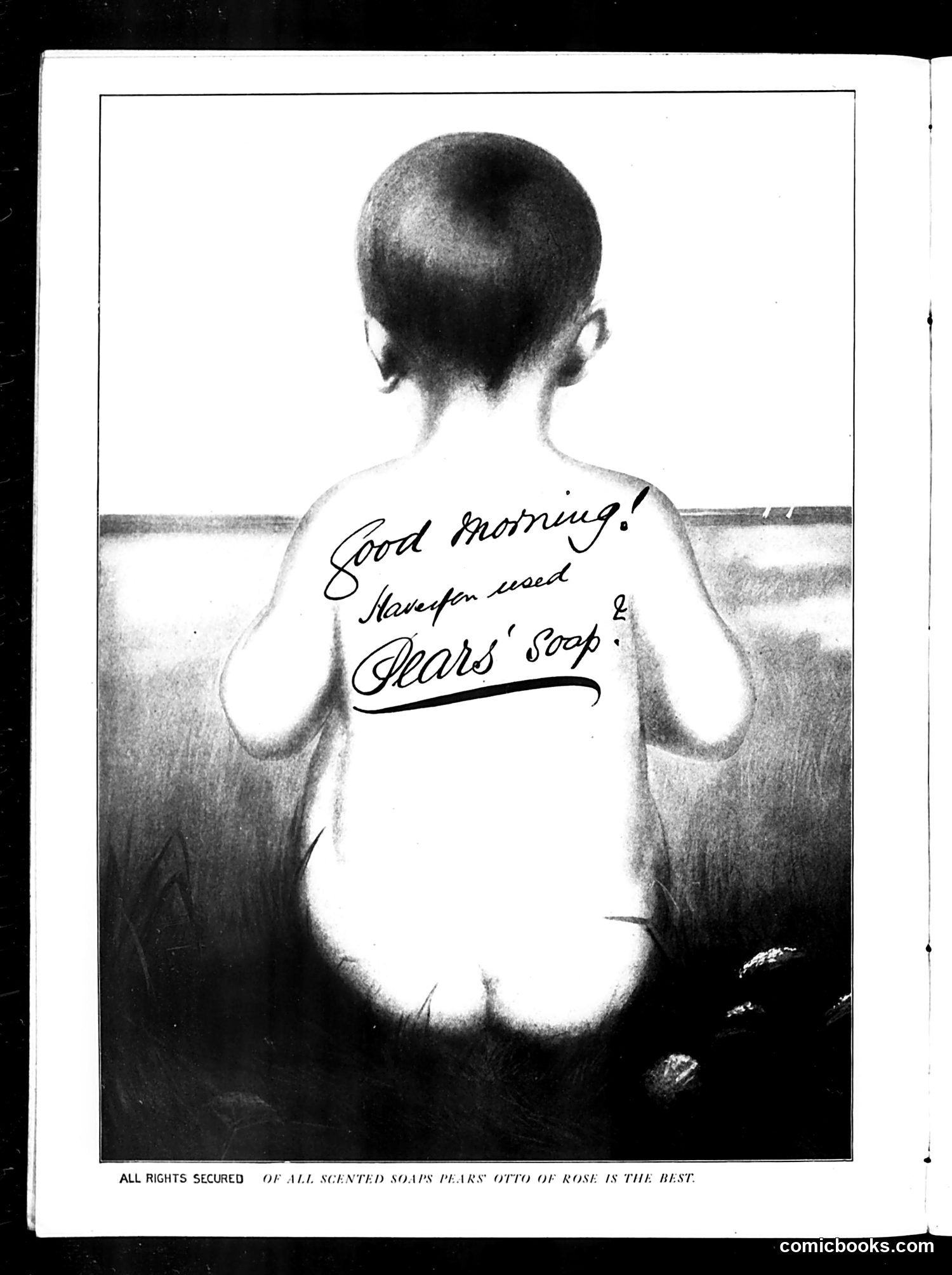
This is a **Pears' Soap advertisement** disguised as satirical content, not a political cartoon. The image shows a baby viewed from behind with text written on its back reading "Good morning! Haven't used Pears' Soap?" The "satire" is a gentle product endorsement playing on the era's obsession with hygiene and cleanliness as markers of respectability and good parenting. The caption at bottom states "Of all scented soaps Pears' Otto of Rose is the best," making the advertising purpose explicit. The joke relies on suggesting that even infants should use this premium soap—an exaggeration meant to be humorous while promoting the product's superiority. This reflects late 19th/early 20th-century consumer culture where advertisements increasingly appeared in prestigious publications like *Judge*.
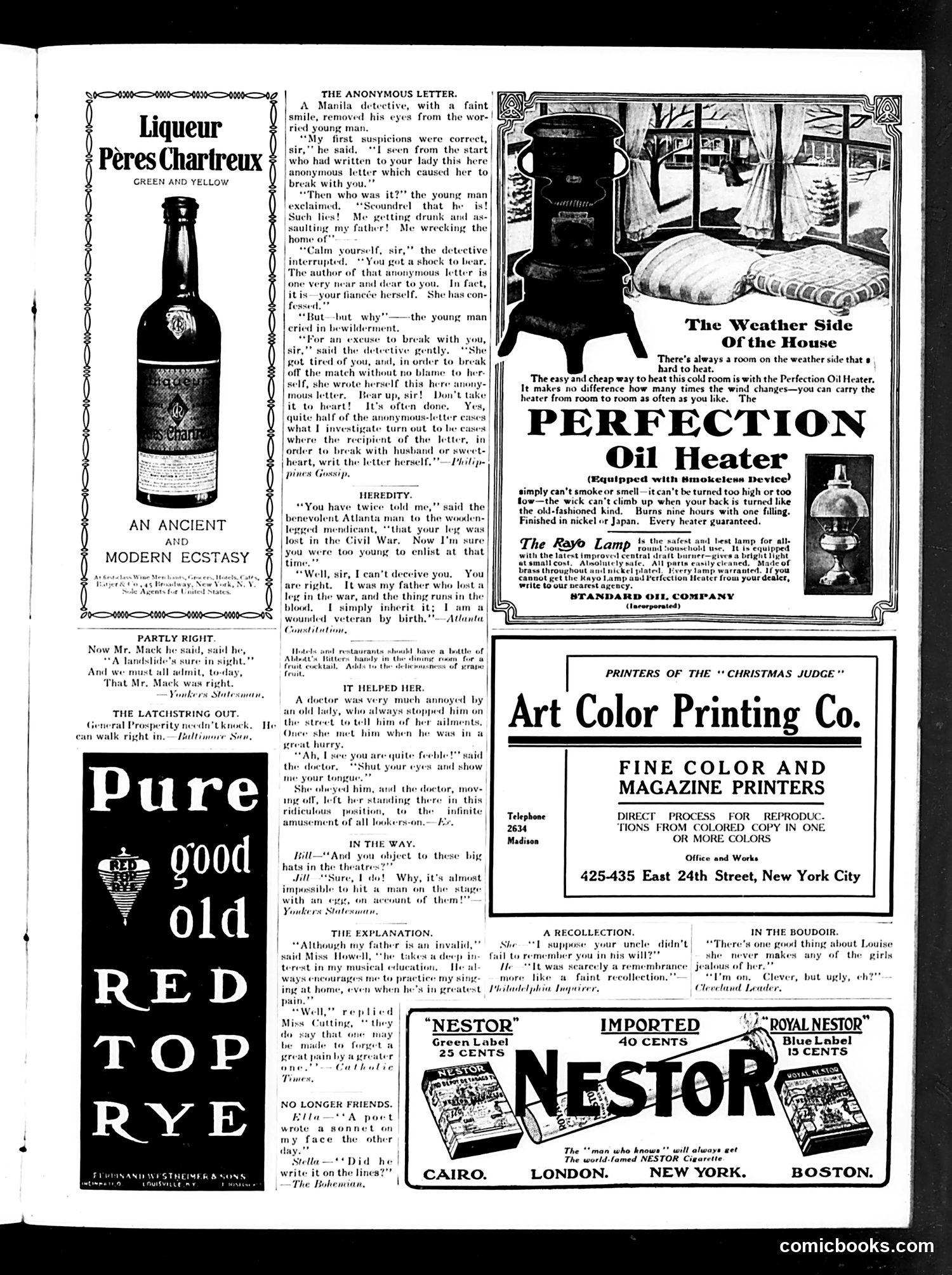
This page is primarily **advertising**, not political satire. It contains multiple full-page and half-page ads for commercial products popular in the early 20th century: - **Liqueur Pères Chartreux** (French liqueur) - **Perfection Oil Heater** (home heating device) - **Rayo Lamp** (oil lamp) - **Red Top Rye** (whiskey) - **Art Color Printing Co.** (printing services) - **Nestor Cigarettes** (tobacco, three varieties shown) The page also includes several brief fictional anecdotes or jokes (titled "The Anonymous Letter," "It Helped Her," etc.) typical of Judge's humor format. There is **no political cartoon or satire** on this page—it's a standard advertising and miscellaneous content page from the magazine.
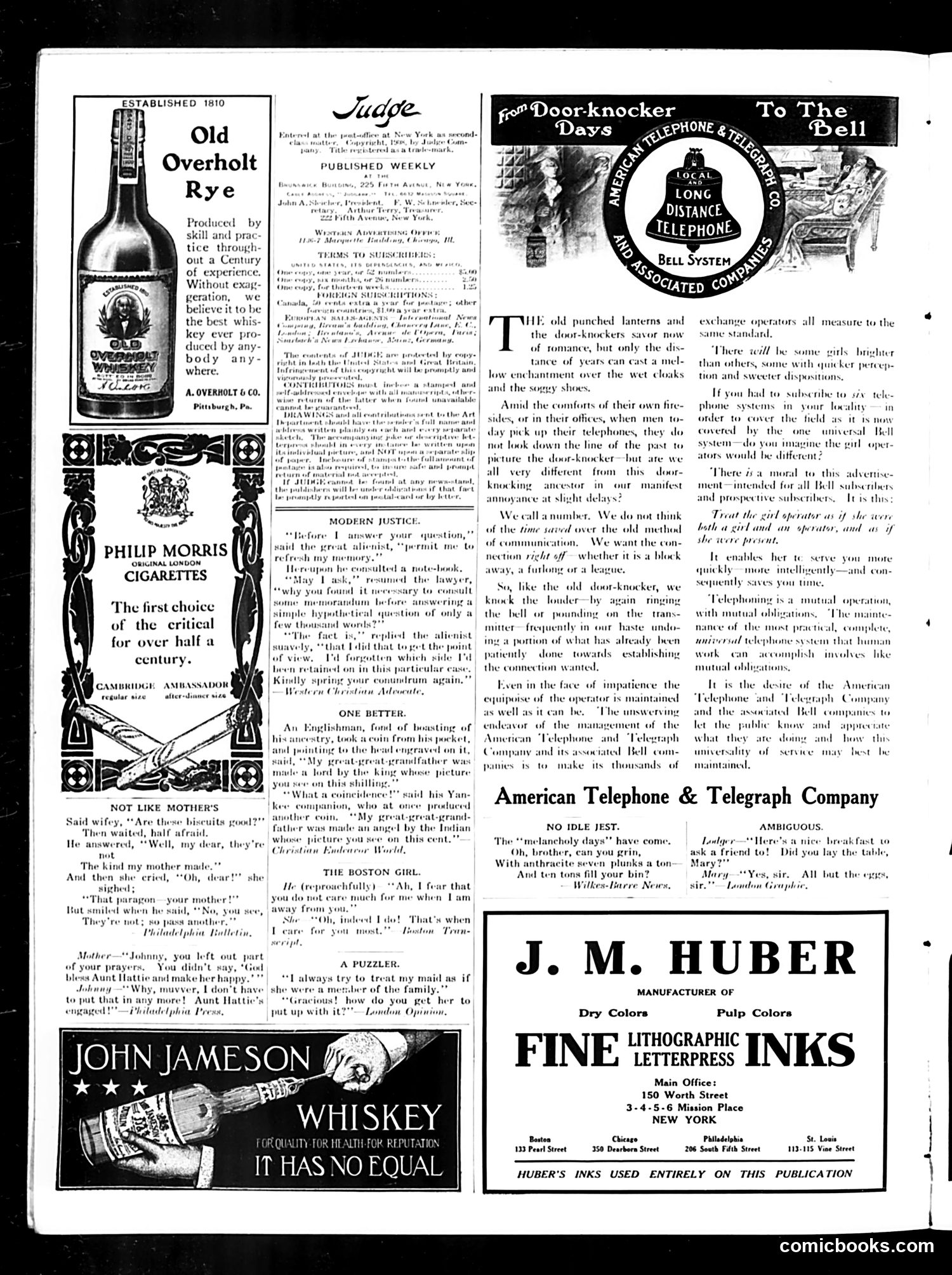
This page is predominantly **advertising and editorial content** rather than political satire. The main cartoon element is a John Jameson Whiskey advertisement featuring a figure pouring liquor, with the tagline "FOR QUALITY FOR HEALTH FOR REPUTATION / IT HAS NO EQUAL." The editorial content includes a piece titled "From Door-knocker Days to the Bell" about the American Telephone & Telegraph Company's development, presented as corporate history rather than satire. Other advertisements include Philip Morris cigarettes and Old Overholt Rye whiskey. The humor content consists of brief **joke exchanges** (labeled "One Better," "The Boston Girl," "A Puzzler," "Ambiguous," and "No Idle Jest")—typical light comedy filler for the era, with no apparent political commentary or social satire evident on this particular page.
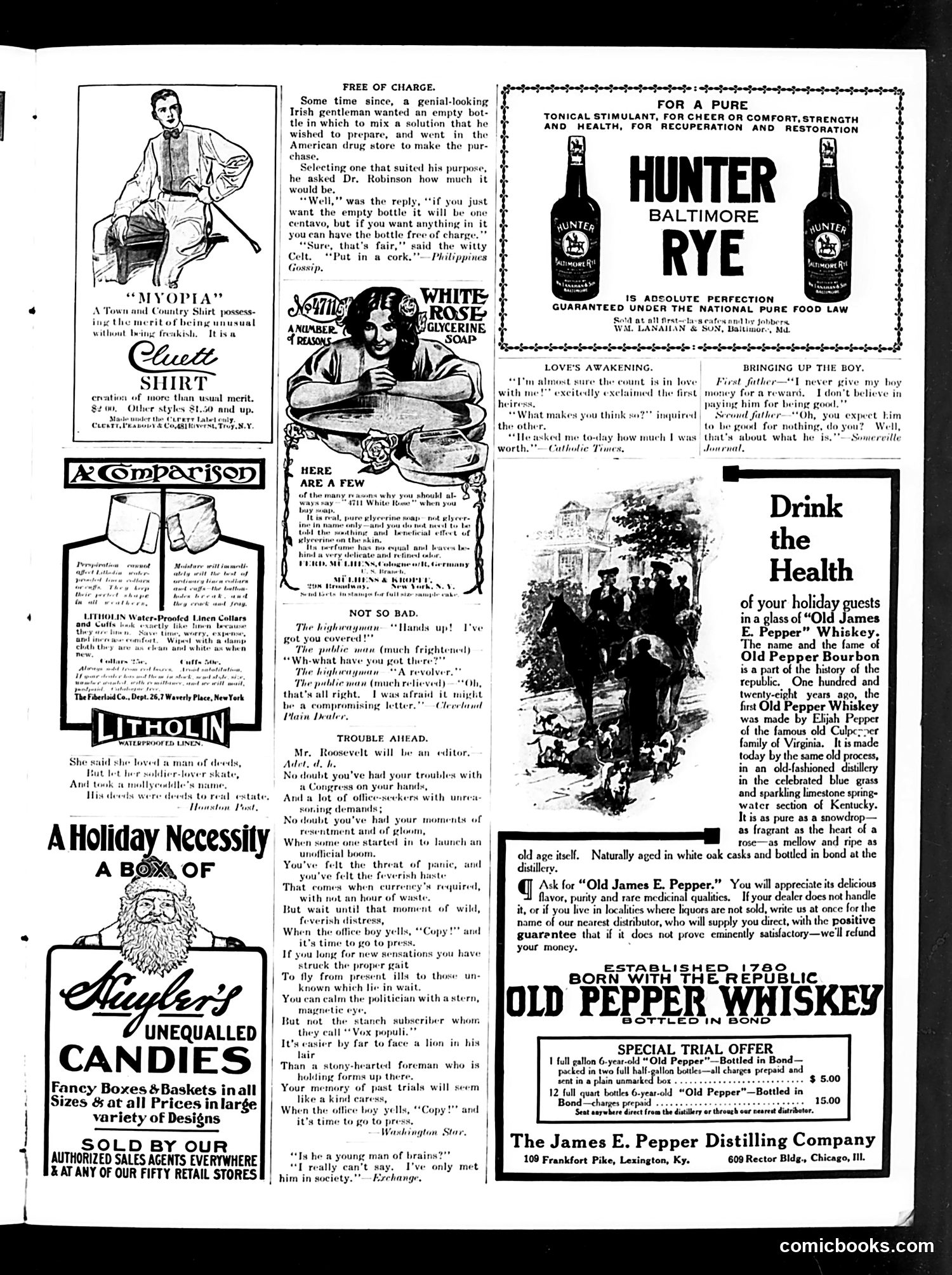
This page is primarily **advertising**, not political satire. It contains multiple product advertisements from the early 20th century, including: - **Cluett shirt** (menswear) - **White Rose Glycerine Soap** - **Litholin** (skincare product) - **Stuyler's Candies** (holiday gift) - **Hunter Baltimore Rye** (whiskey) - **Old Pepper Whiskey** (bourbon, established 1786) The only narrative content is short humorous fiction pieces ("Love's Awakening," "Bringing Up the Boy," "Trouble Ahead") typical of Judge's satirical magazine format. The advertisements reflect early 1900s consumer culture and patent medicines/tonics marketed as health products—reflecting an era before strict FDA regulations. The whiskey ads notably market alcohol explicitly as a "health" and "stimulant" product.
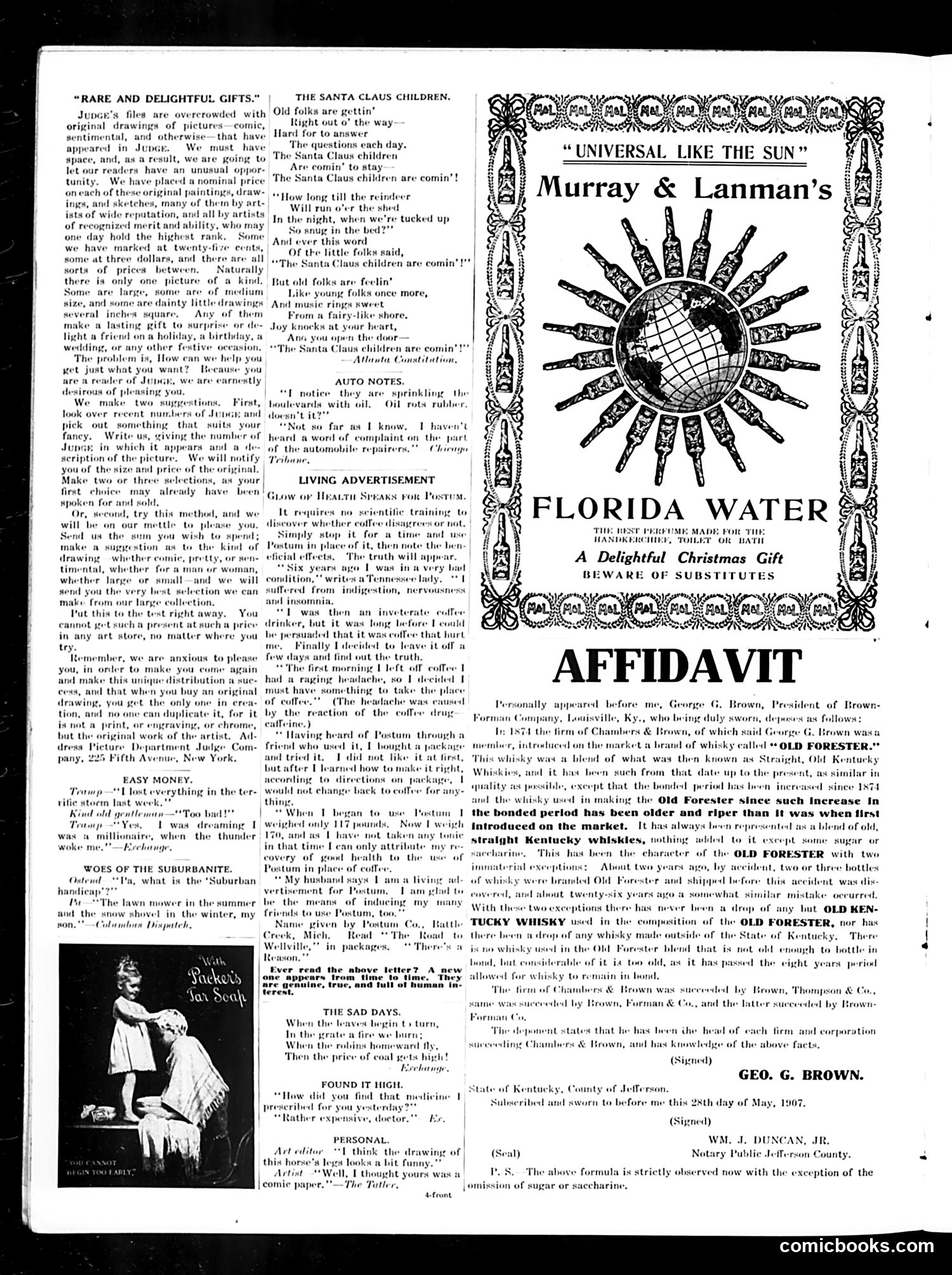
This page is primarily **advertising and filler content** rather than political satire. The main cartoon titled "The Santa Claus Children" is a sentimental poem about elderly people becoming more youthful and joyful during Christmas—a nostalgic cultural commentary on how the holiday spirit rejuvenates adults. The accompanying illustration (bottom left) shows an older woman in a cheerful pose, embodying this theme. The bulk of the page contains **commercial advertisements**: Judge magazine offers framed artworks and drawings for purchase; Florida Water perfume advertises itself as a gift; and an extended affidavit touts Old Forester whiskey's quality and longevity (claiming unbroken production since 1874 with no additives except sugar). The small "Easy Money" joke at bottom left is a brief gag about someone struck by lightning during a storm. There is **no significant political satire** or social commentary on this page—it represents typical early-1900s magazine content mixing light humor with paid advertising.
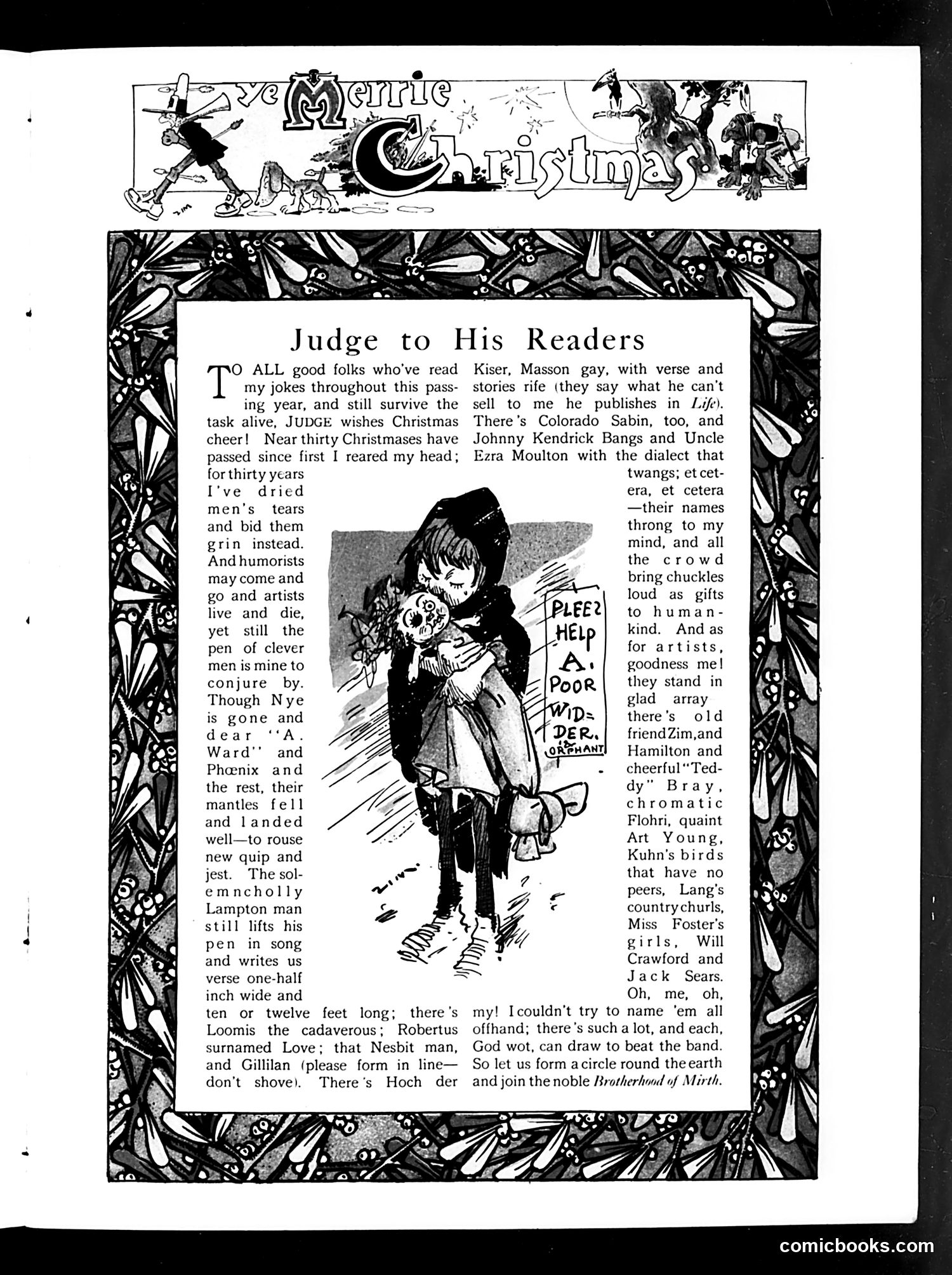
This is Judge magazine's editorial greeting from its editor (the "Judge" persona), celebrating thirty years of publishing satirical humor. The accompanying illustration shows a beggar child—a sentimental Christmas figure invoking charity. The text is primarily a nostalgic roll call of contemporary humorists and illustrators who contributed to Judge, including Eugene Field ("Nye"), Bill Nye, and cartoonist Eugene Zimmerman. The editor acknowledges departed predecessors while praising current talent. The satire is gentle—this reads as insider celebration rather than political commentary. Judge positions itself as America's premier humor publication, part of a "Brotherhood of Mirth" uniting talented writers and artists. The contrasting image of poverty with this self-congratulatory text creates mild irony: while Judge's witty contributors prosper, the broader world contains need. This appears to be a holiday morale-booster for readers and contributors alike.
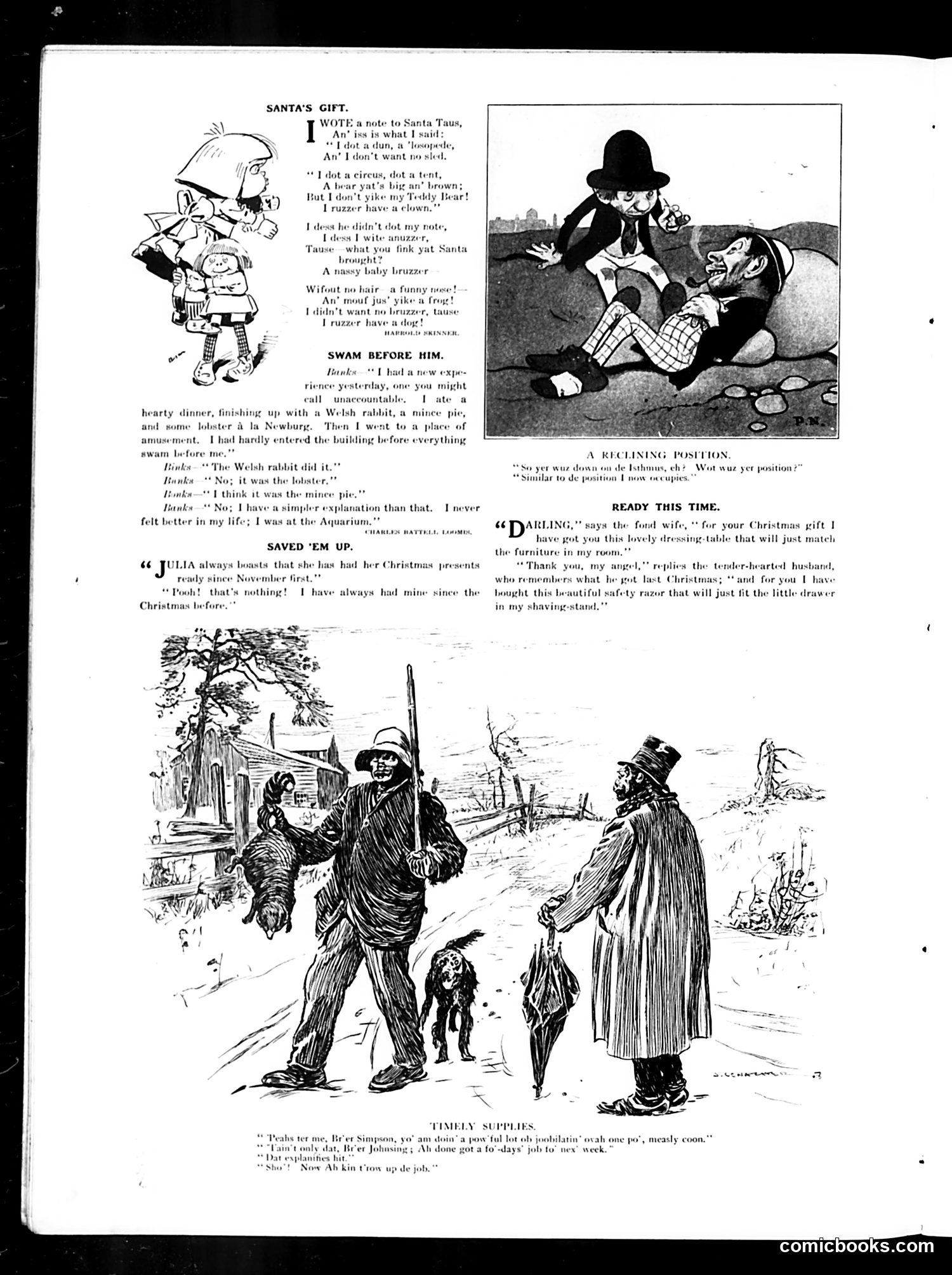
This page contains multiple humorous sketches with racist caricatures typical of early-20th-century American satire. The top section mocks a child's letter to Santa using stereotypical dialect, listing rejected gift ideas (gun, circus, teddy bear, etc.). "Swam Before Him" depicts a dining experience where the protagonist ate various foods culminating in lobster, which caused digestive distress—a common joke format of the era. "Ready This Time" shows a husband presenting his wife with a safety razor as a Christmas gift, satirizing either unromantic gift-giving or domestic relationships. "Timely Supplies" (bottom) appears to reference employment and economic conditions using offensive racial stereotypes and dialect, likely commenting on labor or economic hardship during a specific historical period. The sketches rely on period-typical stereotyping and crude humor that would be considered deeply offensive today. Without clearer publication date visibility, the specific historical context remains partially unclear.
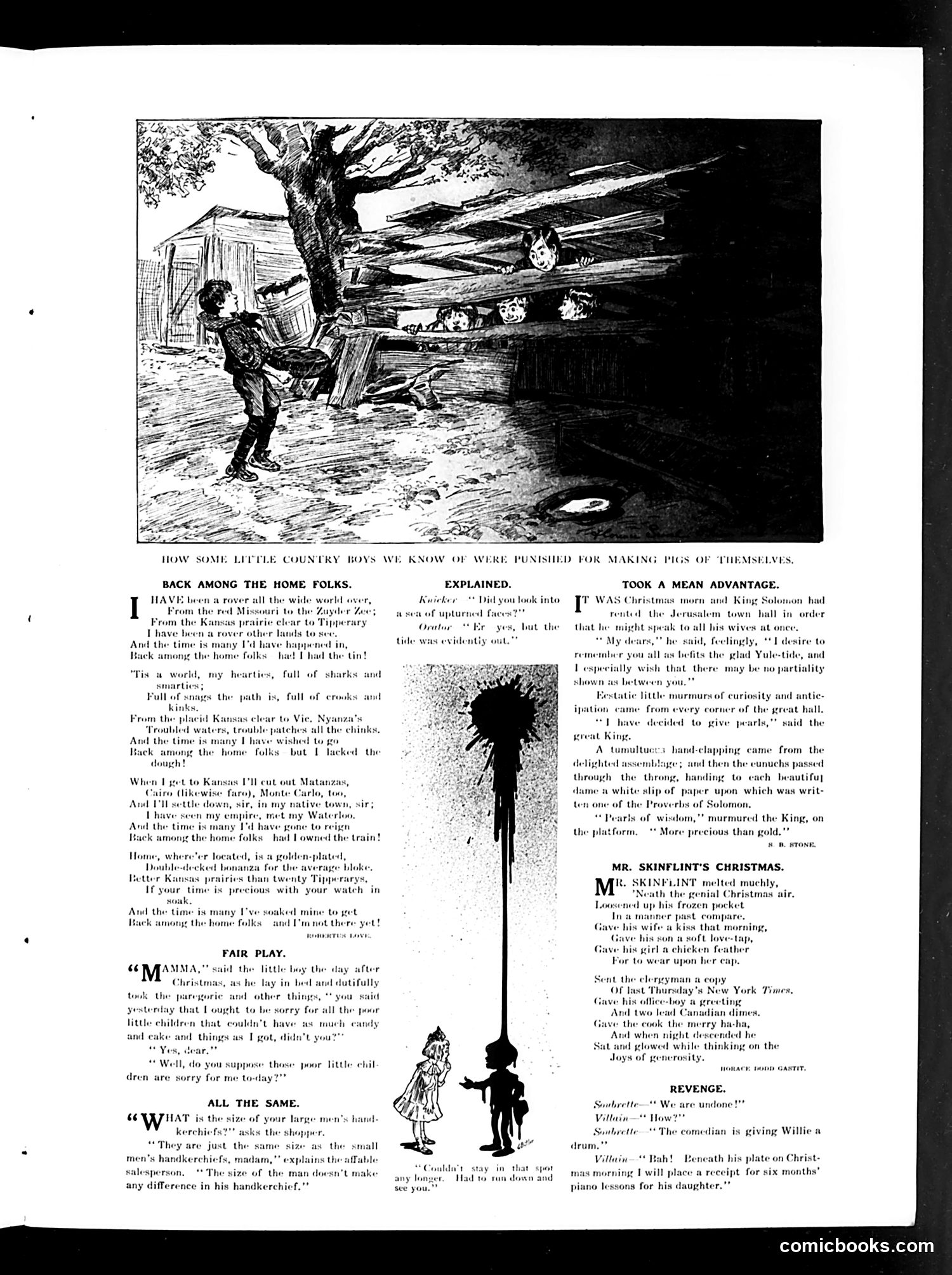
This page contains several humorous short stories and comic vignettes typical of Judge's satirical style: **"Back Among the Home Folks"** is a nostalgic poem about travelers returning home, contrasting their exotic adventures abroad with the comfort of domestic life—poking gentle fun at Americans' wanderlust and tendency to exaggerate their exploits. **"Fair Play"** depicts a child's logic: after receiving Christmas gifts while poor children got nothing, the child asks if those poor children are now "sorry" for *him*—satirizing wealthy families' shallow charitable thinking. **"All the Same"** mocks a shopper's complaint that large men's handkerchiefs cost the same as small ones, with a salesman's deadpan response about equal pricing regardless of size—humor based on consumer absurdity. **"Mr. Skinflint's Christmas"** shows a miserly man grudgingly giving small gifts then basking in self-satisfaction—satire of hollow generosity and moral hypocrisy among the wealthy. The page's main illustration (top) appears to depict a rural or frontier scene, likely accompanying the "Home Folks" narrative about returning from adventurous travels.
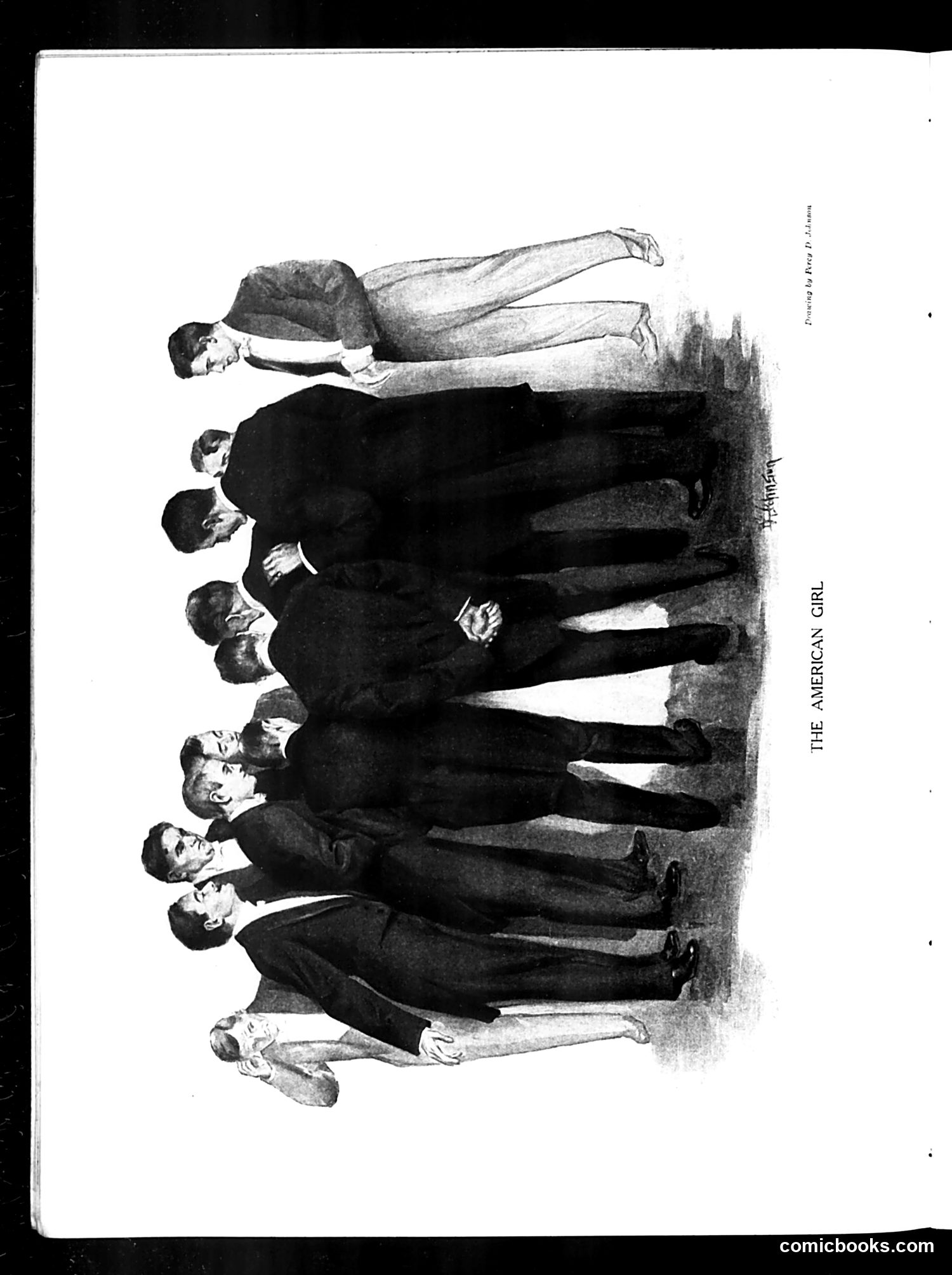
This appears to be a page title or caption reading "THE AMERICAN GIRL" with what looks like a subtitle "Drawn by [artist name - unclear from OCR]." The image shows a group of men in formal dark suits standing together, with one figure at the top in lighter clothing posed horizontally. The composition and title suggest this is satirizing or commenting on American women, though the specific satirical point is unclear without additional context. Given Judge magazine's typical content (political and social satire from the late 19th/early 20th century), this likely critiques contemporary attitudes toward women or American femininity. The contrast between the formal businessmen and the isolated figure above may suggest commentary on gender relations or women's place in American society, but the exact meaning requires more historical context to determine with certainty.
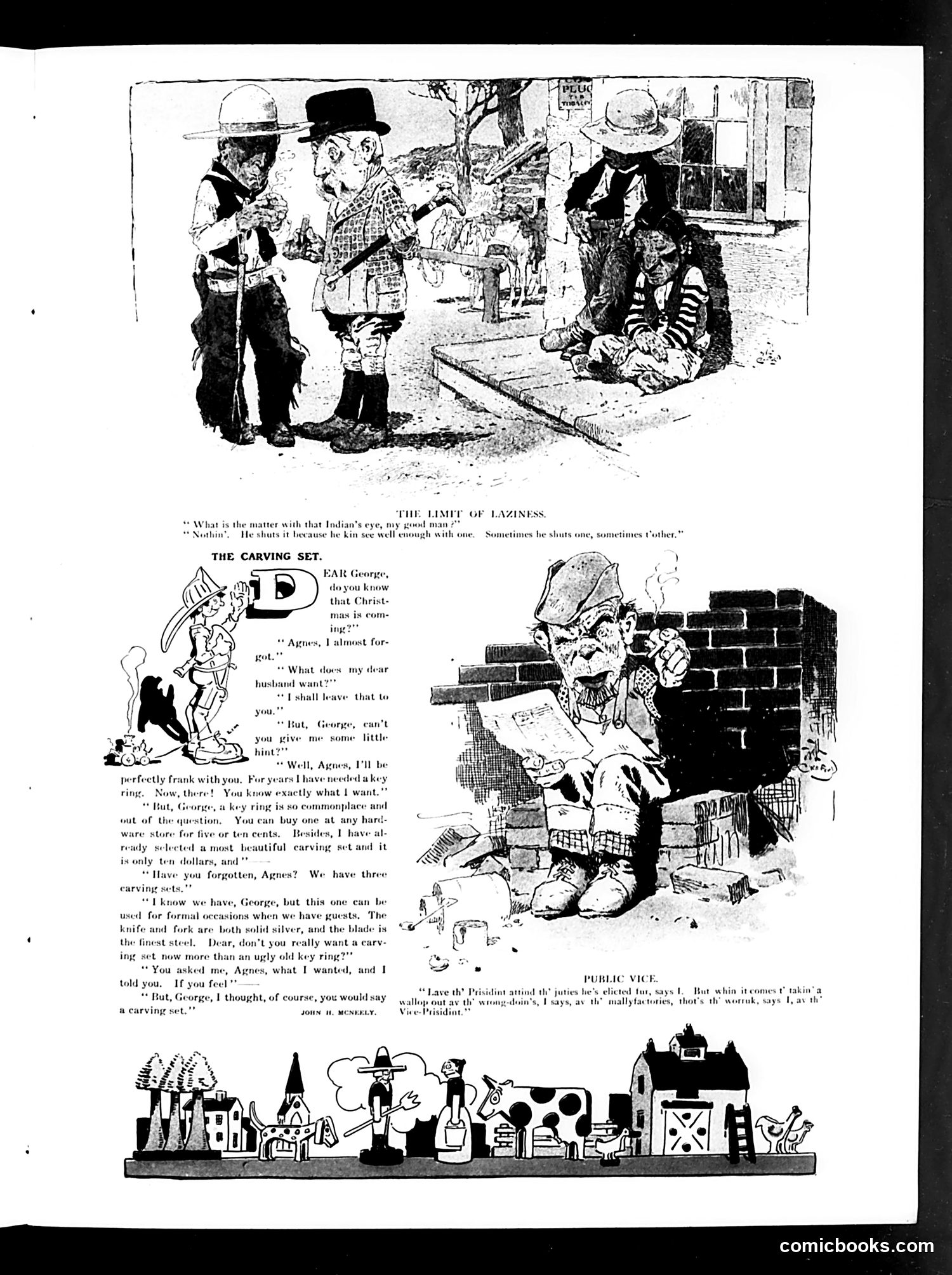
**"The Limit of Laziness"** (top): Depicts a confrontation between what appears to be a law enforcement officer and a Native American man, with onlookers. The caption suggests racial stereotyping common to the era—the joke relies on derogatory characterizations of Native Americans as lazy or unreliable. **"The Carving Set"** (middle): A domestic comedy about a husband (George) and wife (Agnes) discussing a carving set. Agnes hints she wants one; George claims ignorance of her desires, then reveals he's already selected one. The humor turns on marital miscommunication and gift-giving expectations. **"Public Vice"** (bottom right): A caricatured figure with exaggerated features discusses political accountability, using heavy dialect ("thot's th' worrak"). This appears to satirize public discourse about corruption or industrial malfeasance, likely referencing contemporary factory or manufacturing scandals, with the speaker criticizing selective enforcement against workers versus powerful interests. The page demonstrates Judge's mix of domestic humor and social satire typical of early 20th-century American cartooning.
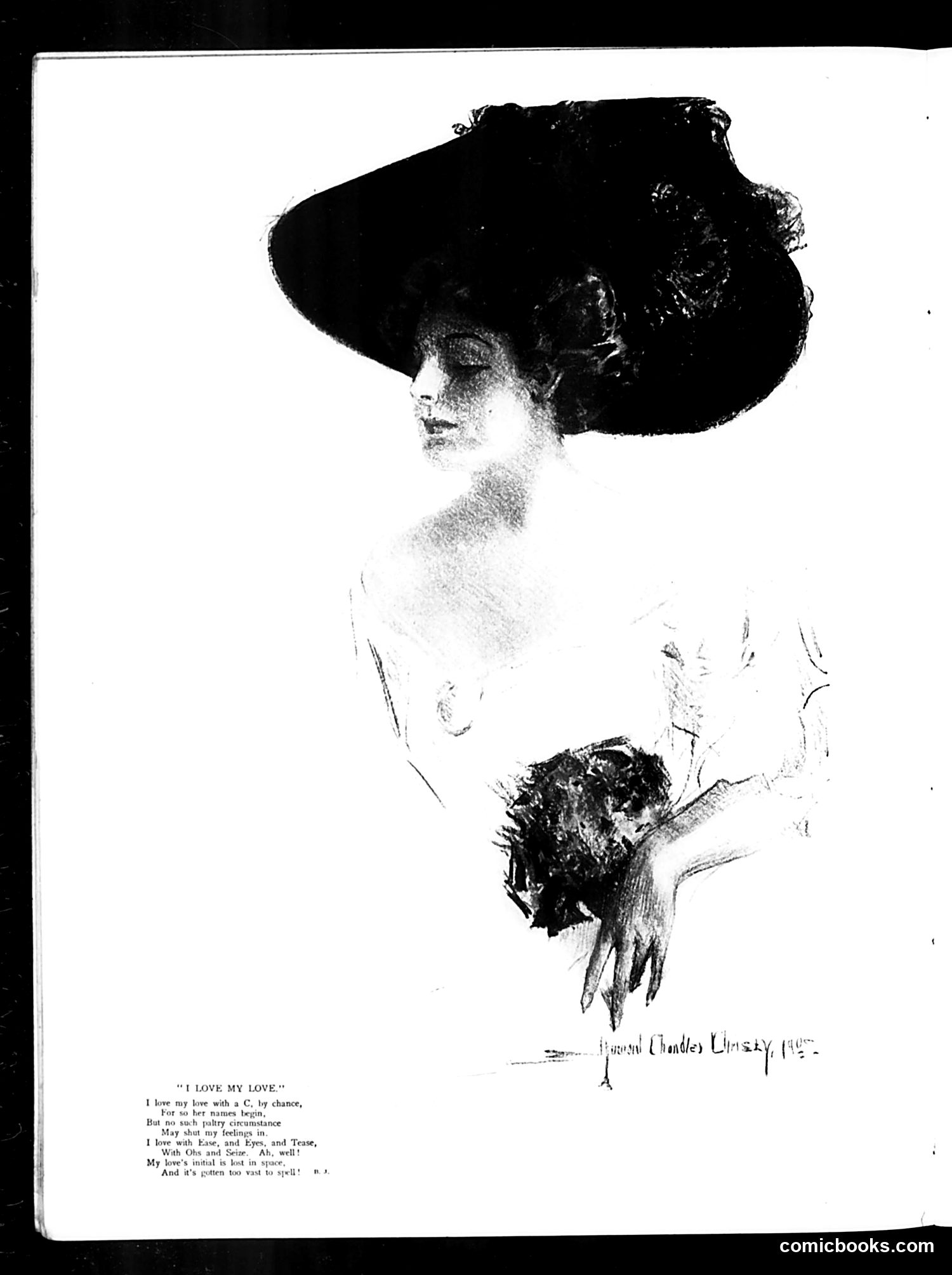
This page features an elegant illustration by Harold Chandler Christy (signed and dated 1912) depicting a fashionable woman in profile wearing a large, dramatic hat and holding flowers. Below is a poem titled "I Love My Love," a word-play game popular in the early 1900s where each line begins with successive letters of the alphabet. The satire appears gentle rather than political—it's a commentary on romantic sentimentality and the elaborate fashion of the Edwardian era. The juxtaposition of the sophisticated illustration with the somewhat absurd alphabetical love poem creates gentle humor, poking fun at overwrought romantic expressions and the pretensions of fashionable society. The drawing style exemplifies Judge magazine's focus on stylish social commentary aimed at upper-class readers.
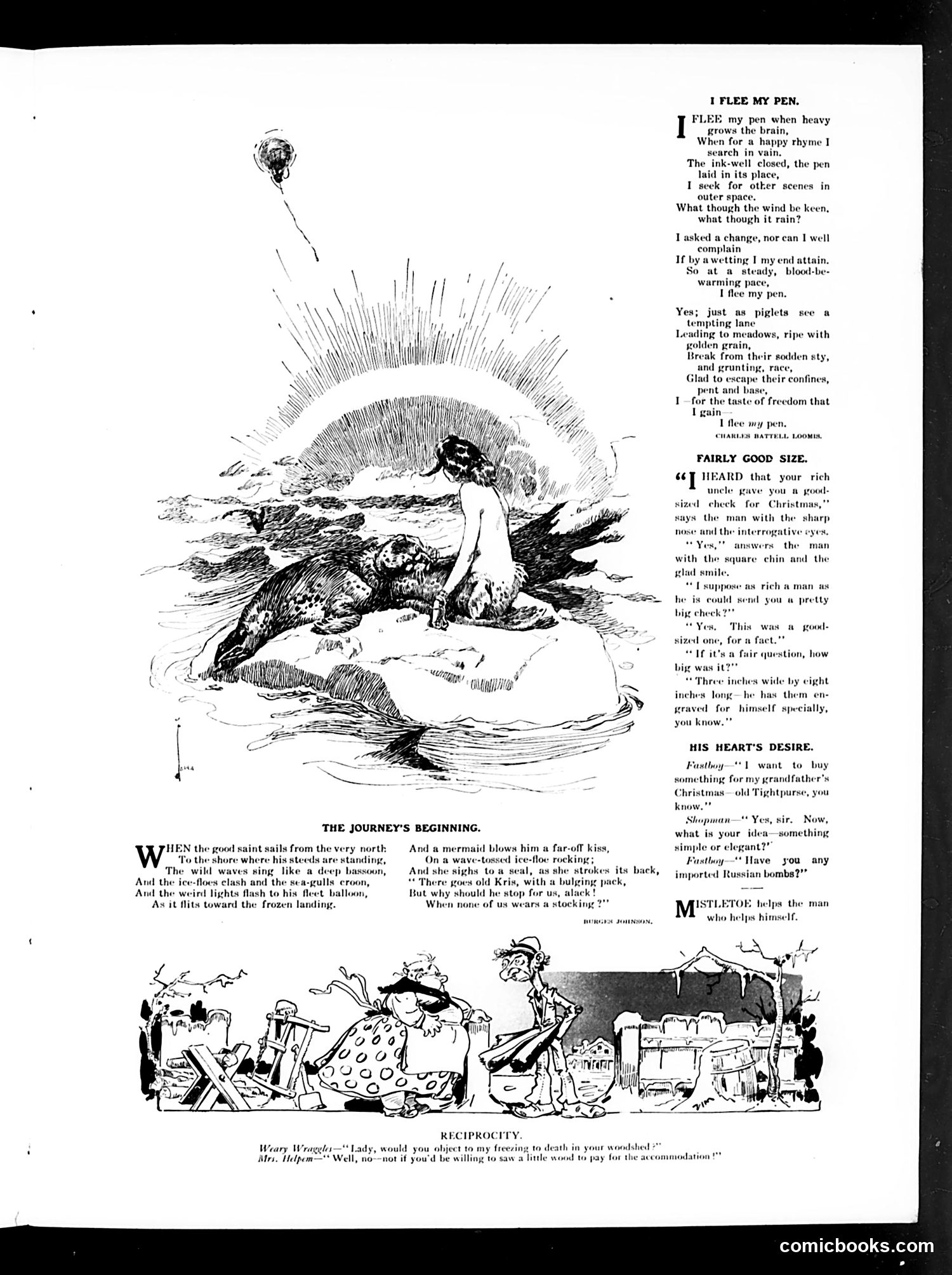
This page contains multiple humorous pieces typical of Judge's satirical format: **"I Flee My Pen"** is a poem by Charles Hattell Loomis describing a writer's need to escape mental fatigue by leaving his desk for outdoor activity—comparing himself to piglets breaking free from a sty. **"Fairly Good Size"** depicts a comic dialogue about a wealthy uncle's Christmas gift: an engraved cheek (likely a bank check). The joke hinges on the irony that a rich man gave money rather than a tangible gift, with the added humor that the cheek was "engraved for himself specially"—suggesting the uncle had it custom-made, emphasizing his miserliness. **"His Heart's Desire"** satirizes a grandfather's reputation as a miser ("Tightpurse"), with a grandson asking a shopman for "imported Russian bombs" as a gift—dark humor suggesting violence against the stingy old man. **"The Journey's Beginning"** appears to be a longer narrative poem about a saint's journey. **"Reciprocity"** shows a bargaining dialogue about freezing someone to death in exchange for firewood—crude frontier humor about economic trade-offs.
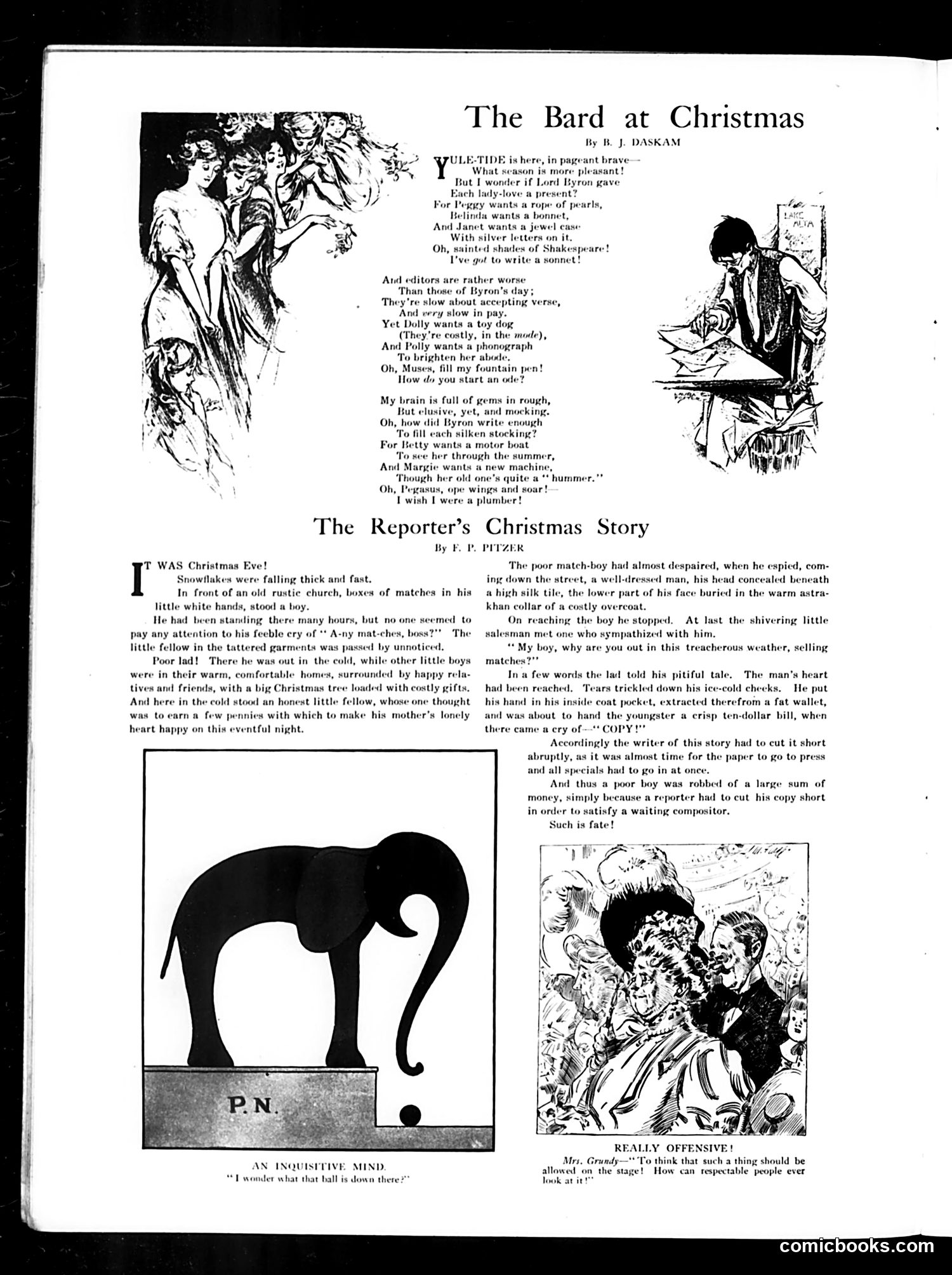
This satirical piece mocks newspaper production deadlines by telling a sentimental Christmas story that gets deliberately cut short for practical reasons. The narrative follows a classic Victorian trope: a poor match-boy selling wares on Christmas Eve encounters a wealthy gentleman who, moved by sympathy, reaches into his wallet to give the boy substantial money. However, the story abruptly ends mid-scene with the cry "COPY!"—indicating the newspaper's deadline. The satire's punch line reveals the real villain: not poverty or indifference, but editorial necessity. The writer explicitly states the story was cut short because "a reporter had to cut his copy short in order to satisfy a waiting compositor" before press time. The accompanying elephant cartoon titled "An Inquisitive Mind" appears unrelated—likely filler content. This works as satire on how *Judge* magazine itself operated: sentimental stories took backseat to production logistics, and readers got interrupted narratives. It's self-aware mockery of the publication's own constraints.
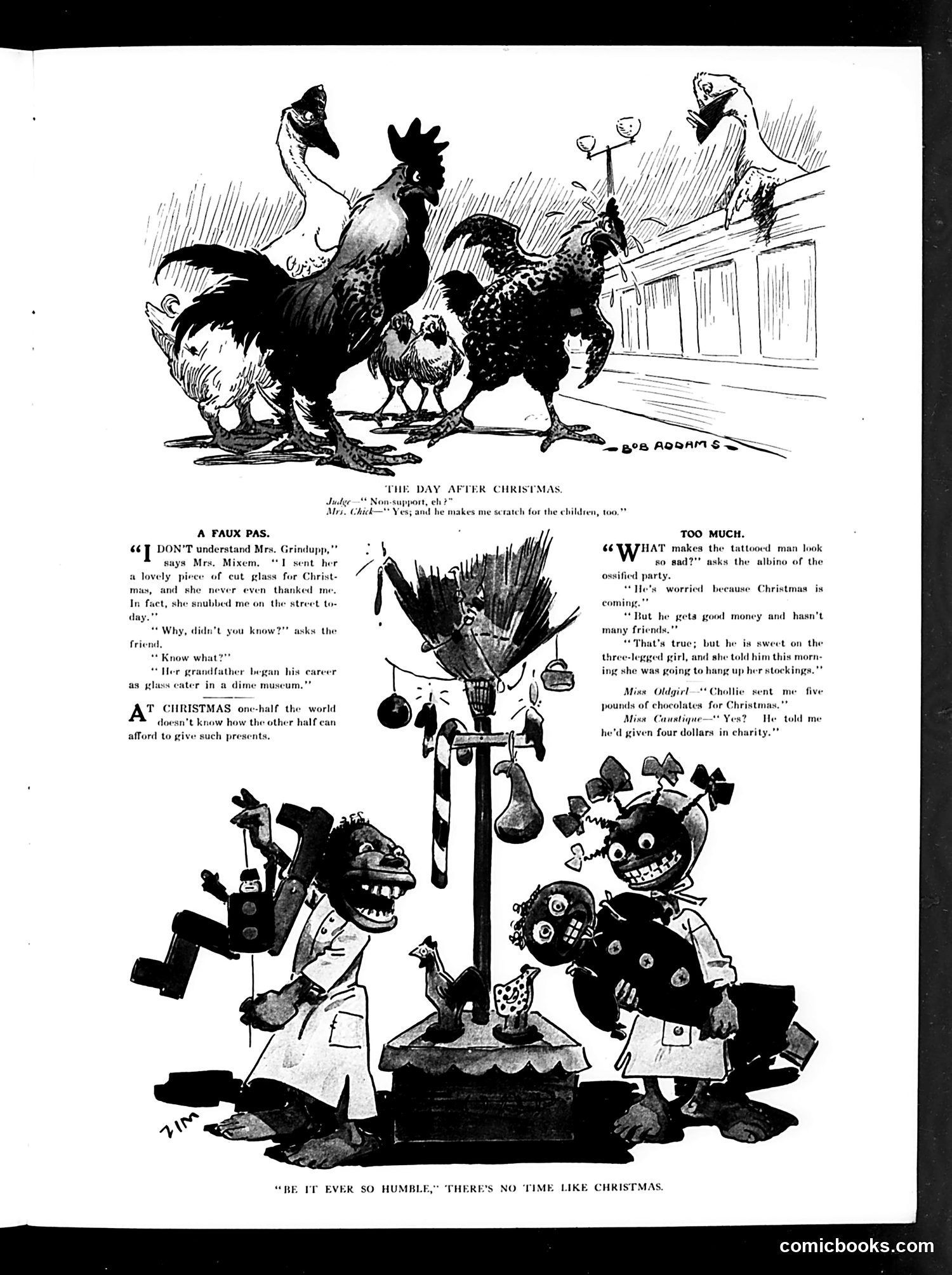
This page contains three separate satirical pieces about Christmas-season social dynamics: **"The Day After Christmas"** (top): Shows barnyard fowl in domestic chaos, satirizing post-holiday disorder and the mess children create after receiving presents. **"A Faux Pas"** (left): Mocks social climbing and pretension. Mrs. Mixem is snubbed by Mrs. Grundy after sending her a cheap gift—apparently Mrs. Grundy's grandfather was a "glass cater in a dime museum" (a carnival worker), making her sensitive about her lower-class origins. The joke targets both snobbery and embarrassing family secrets. **"Too Much"** (right): Features a "tattooed man" and "albino" (carnival/circus freaks) discussing Christmas anxieties. A man worries his girlfriend will only hang up stockings if he gives her money, and another brags falsely about charitable giving. The satire targets male anxiety, materialism, and shallow virtue-signaling during the holidays. The page satirizes Christmas excess, social pretense, and the gap between charitable ideals and actual behavior.
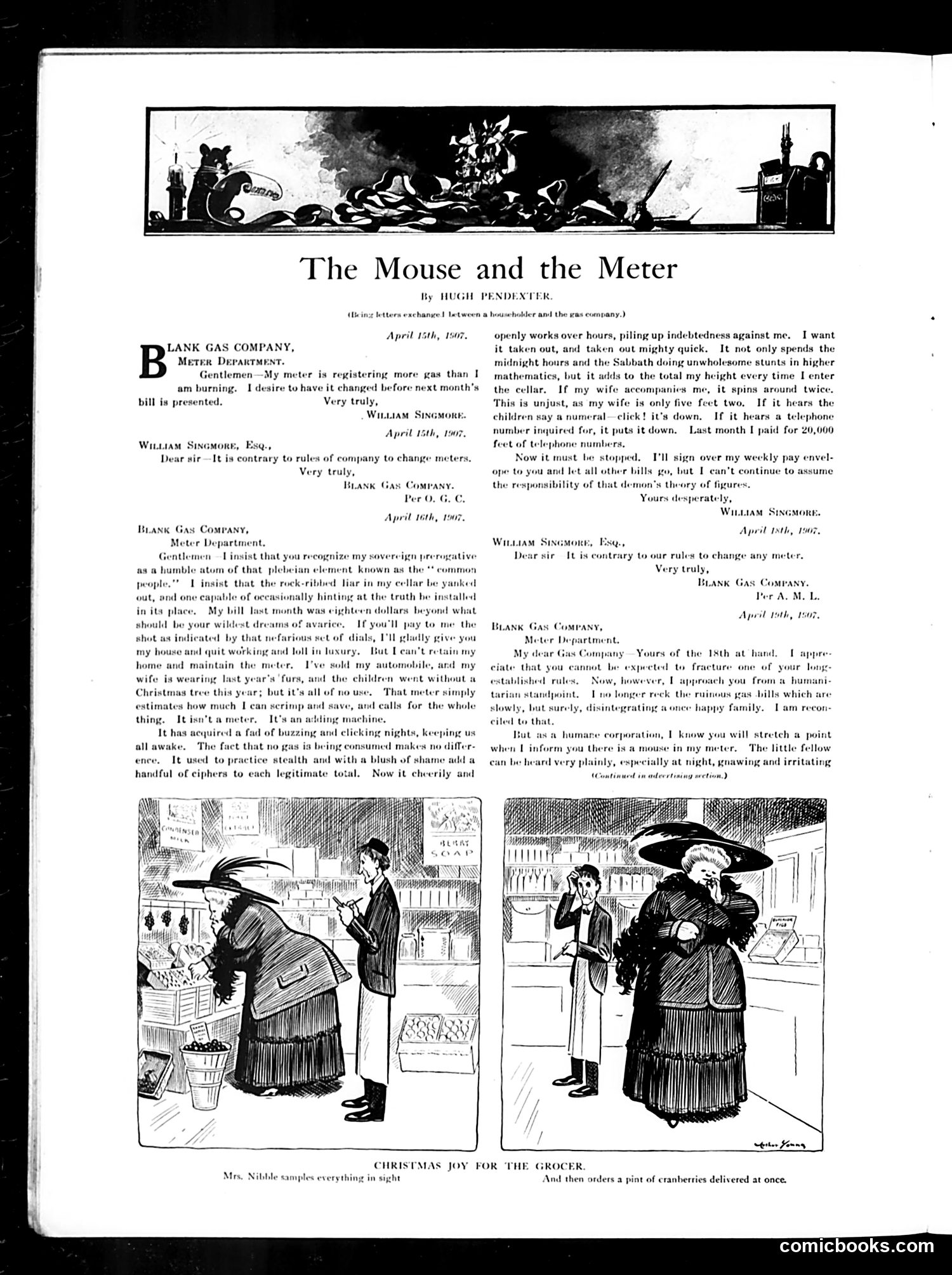
This 1907 satirical piece by Hugh Pendexter mocks the frustration of dealing with a gas utility company's inflexible bureaucracy. **The Setup:** A householder (William Singmore) complains his gas meter is registering excessive consumption, requesting it be replaced before the next bill arrives. The gas company repeatedly refuses, citing company policy against changing meters. **The Satire:** Singmore's letters escalate hilariously—he claims the meter malfunctions absurdly: it spins when his wife (five feet tall) enters the cellar, registers phantom "telephone numbers," and works overtime like a malicious creature. He's sold his car and made his family go without Christmas gifts to afford the bills, yet the company won't investigate or help. **The Point:** This ridicules corporate indifference and rigid rule-following that ignores customer problems. The meter becomes a "mouse"—a small pest the company refuses to catch. The accompanying cartoons show a woman shopping at a grocer; the satire suggests even everyday transactions involve similar corporate frustration. This reflects Progressive Era complaints about unregulated utility monopolies prioritizing profits over service.
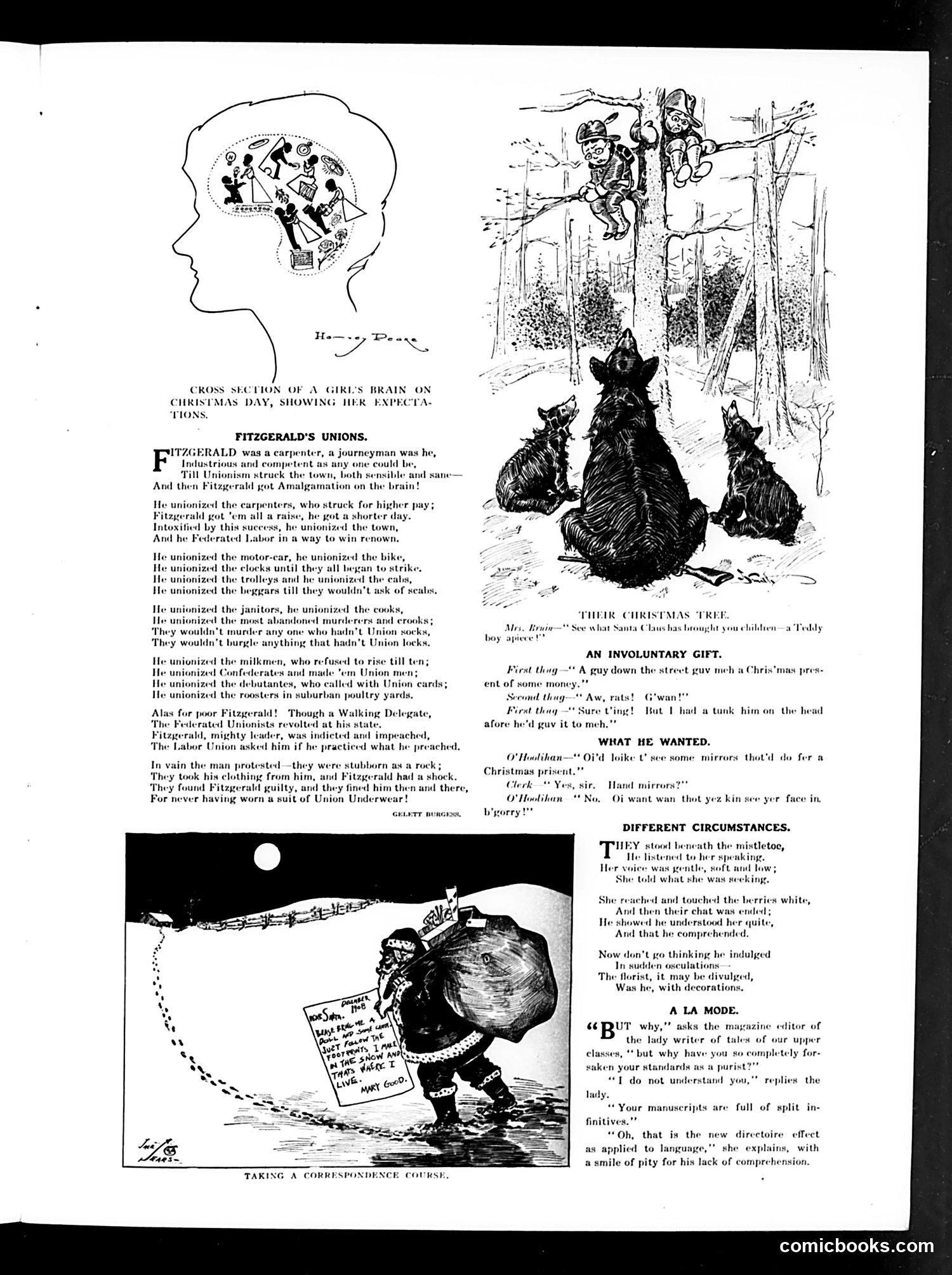
This page contains multiple satirical pieces typical of early 20th-century American humor: **"Fitzgerald's Unions"** mocks labor organizing excess—apparently about a character who unionizes everything from carpenters to streetcar workers to underwear, suggesting satirical criticism of aggressive unionization efforts as overreaching and absurd. **The head diagram** jokes that a girl's Christmas thoughts are entirely consumed by material expectations—a common satirical target of gender stereotypes in this era. **"Their Christmas Tree"** shows dogs beneath a tree, playing on sentimental holiday imagery while the dogs appear indifferent to "Union" concerns. **"An Involuntary Gift" and related pieces** present working-class dialogue (Irish accents suggested by spelling like "b'gorry") about street toughs and modest gift-giving, likely satirizing petty crime or poverty. **"A La Mode"** critiques a female writer who dismisses grammatical standards (split infinitives) as merely fashionable "directoire effect"—mocking pretentious artistic attitudes and possibly women's intellectual pretensions. The overall tone reflects Judge's typical blend of labor politics, gender commentary, and class-based humor.
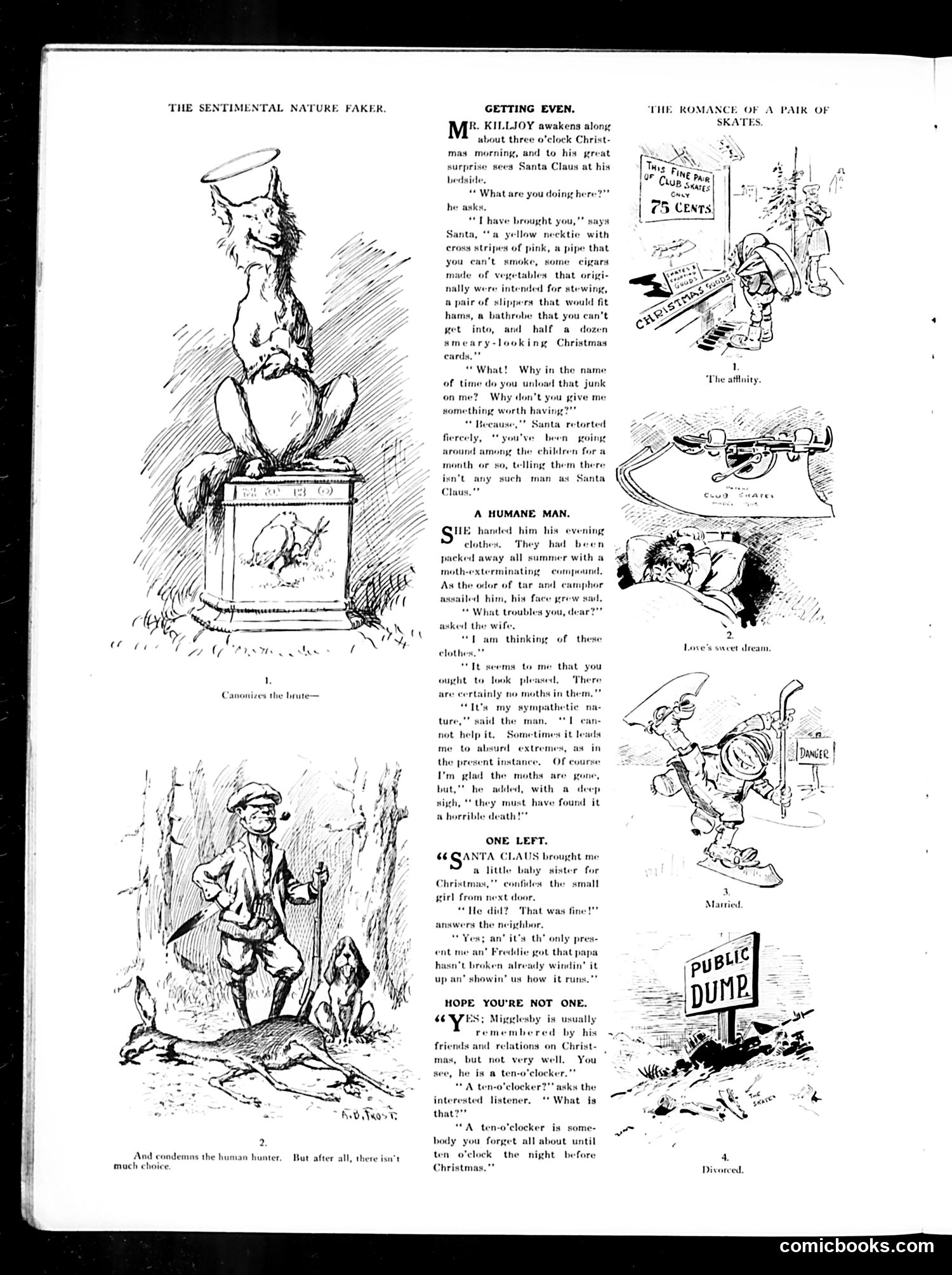
This page contains several standalone humor pieces mocking domestic life and Christmas customs: **"Getting Even"**: A husband receives worthless Christmas gifts (ugly tie, unsmokable cigars, ill-fitting bathrobe) from "Santa." He retaliates by telling children Santa doesn't exist, undermining the gift-giver's credibility. **"A Humane Man"**: A husband hoards moth-eaten clothes, claiming sympathy for the moths that infest them—satirizing false sentimentality masking poor household management. **"One Left"**: A child receives a baby sister as a gift, noting it's the only present her father hasn't already broken. **"Hope You're Not One"**: Defines a "ten-o'clocker" as someone so forgettable you don't remember them until the night before Christmas, when obligated to send greetings. The overall theme: domestic disappointment and hypocrisy during the holiday season. These are cynical jabs at marriage, gift-giving, and social pretense dressed as humor.
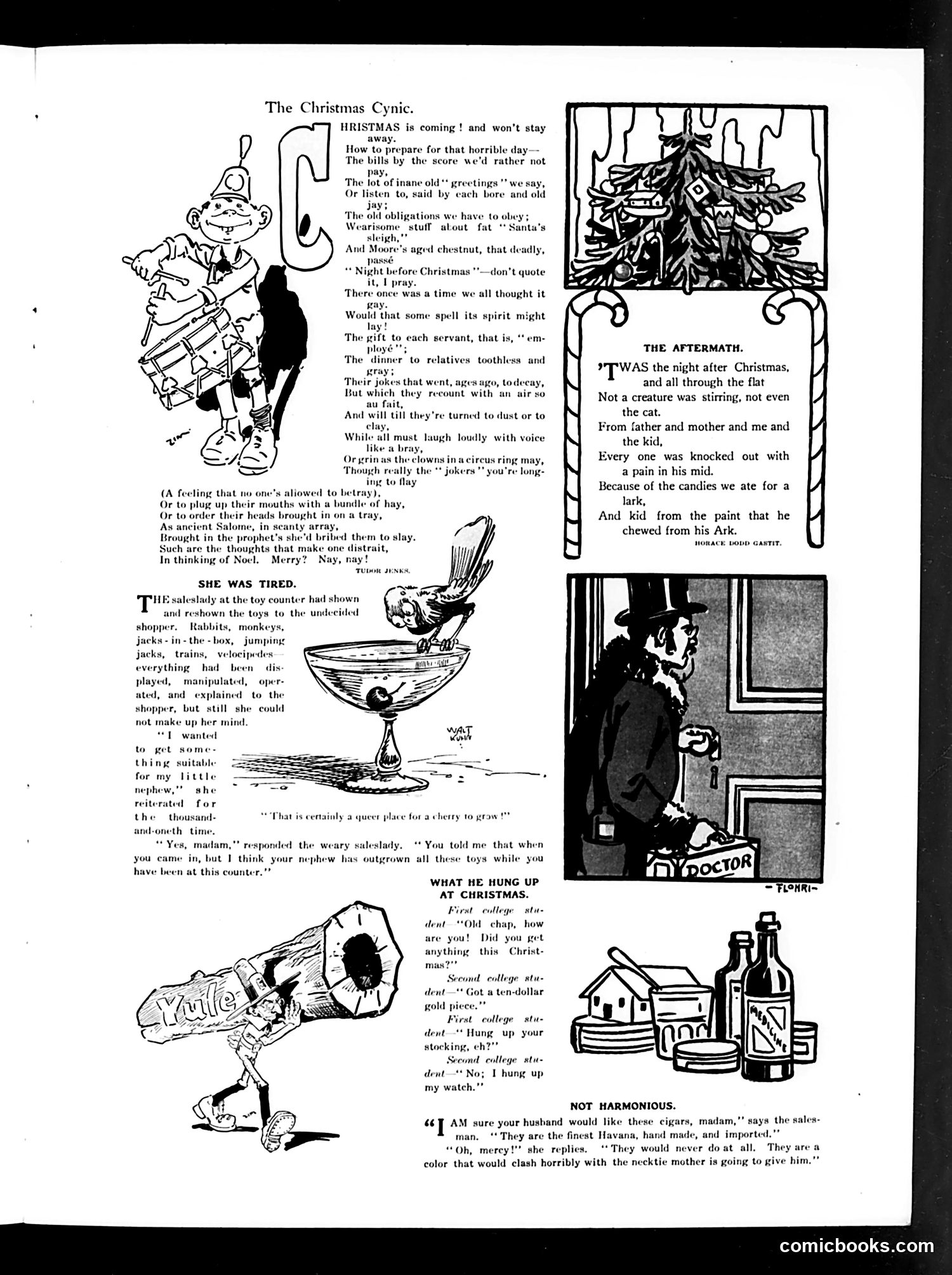
This page collects several interconnected Christmas-themed satirical pieces mocking the holiday's commercialism and social obligations. **"The Christmas Cynic"** (main poem): Bitterly catalogs forced Christmas traditions—paying bills, obligatory family dinners with tedious relatives, mandatory laughter at old jokes. The speaker fantasizes about silencing these bores (invoking Salome's beheading of John the Baptist as dark precedent). **"The Aftermath"**: Humorous comeuppance—the family suffers stomach pain from holiday candy and paint-flavored toys (children's toys were apparently toxic). **"She Was Tired"**: A weary toy-counter saleswoman endures an indecisive customer for the thousandth time, unable to help them choose a gift for their nephew. **"What He Hung Up"**: College students compare Christmas gifts—contrasting materialistic expectations (money, gold) with practical ones (a watch). **"Not Harmonious"**: A wife rejects fine imported cigars as a gift for her husband because their color would clash with the tacky necktie his mother is giving him—satirizing female consumer culture and poor taste. The overall message: Christmas reveals human selfishness, materialism, and exhaustion.
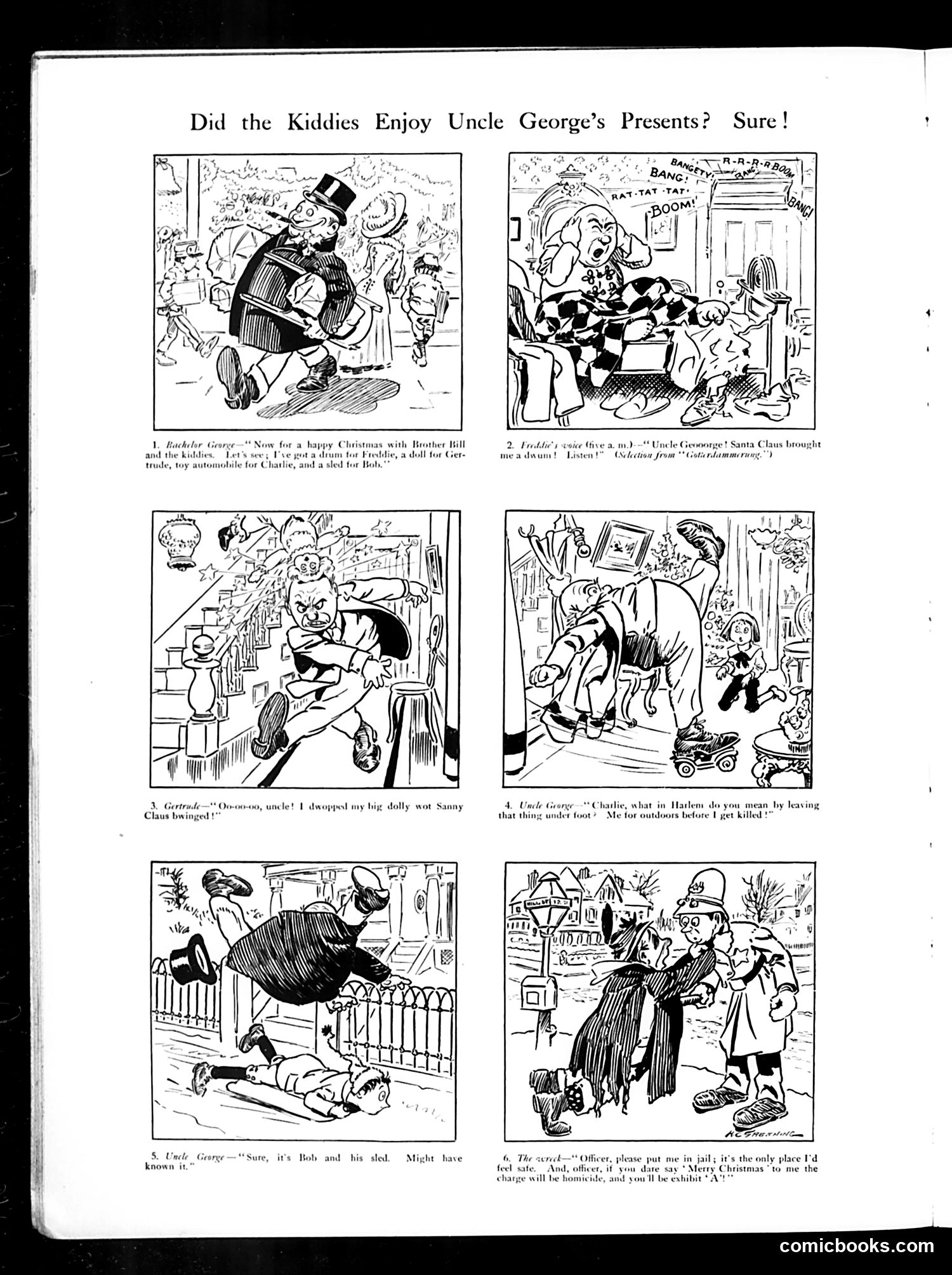
This is a six-panel comic strip titled "Did the Kiddies Enjoy Uncle George's Presents? Sure!" depicting the chaotic aftermath of Christmas gifts from "Uncle George." Each panel shows escalating disaster: children receive dangerous or impractical toys—a drum, a doll, toy automobiles, and a sled—that cause mayhem throughout a house. The children destroy furniture, knock over an adult, create noise, and generally wreak havoc. The satire targets gift-giving practices: the joke is that "Uncle George" gives thoughtless, age-inappropriate, or genuinely dangerous presents that create bedlam rather than joy. The ironic title ("Sure!") emphasizes this—the gifts are technically "enjoyed," but the consequences are destructive. This reflects early 20th-century anxieties about consumerism and parenting, mocking both gift-givers who don't consider consequences and the broader commercialization of Christmas.
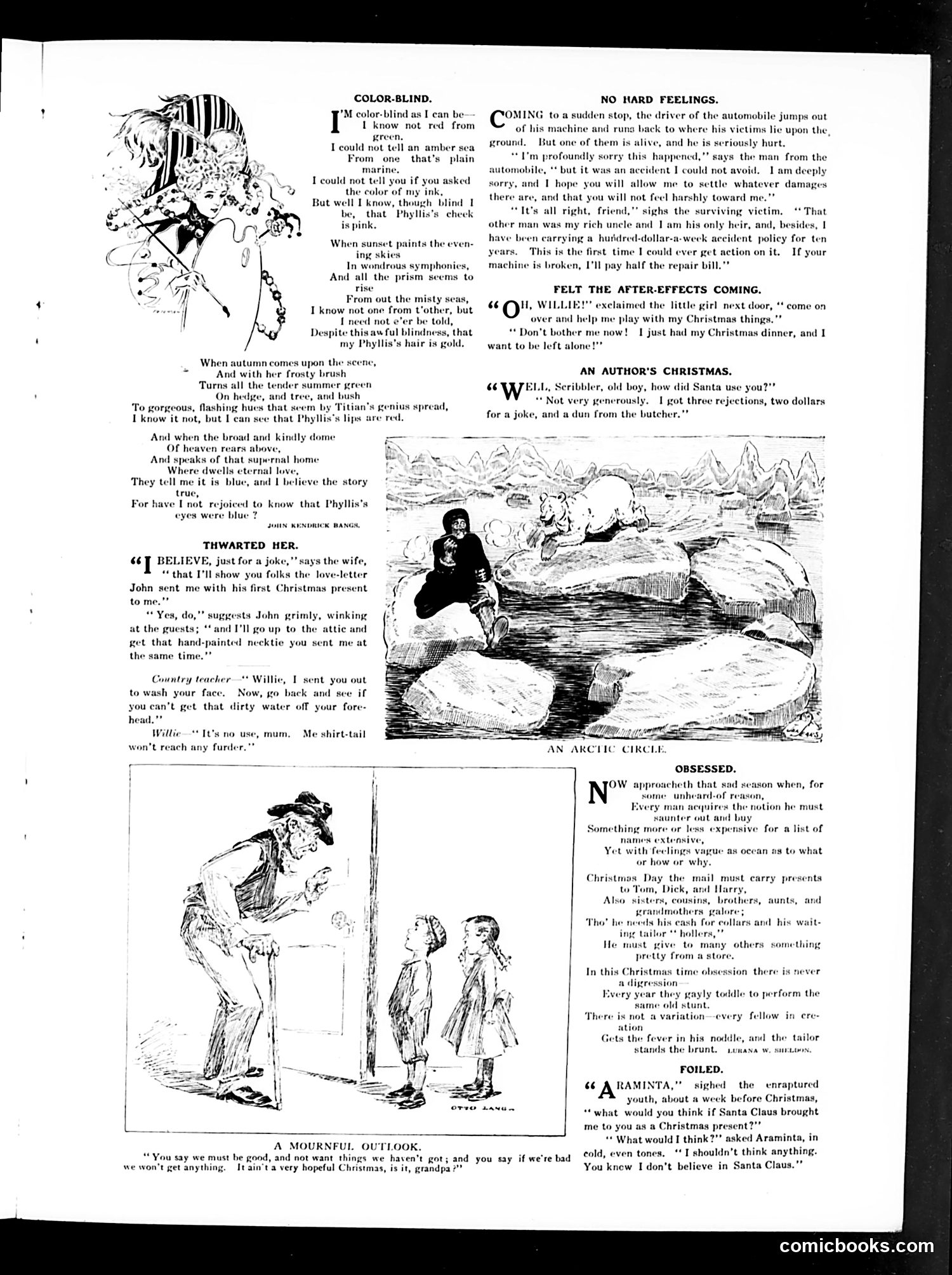
This page collects several Christmas-themed short stories and jokes typical of early 20th-century satirical magazines. **"Color-Blind"** is a sentimental poem by John Kendrick Bangs about a man who cannot distinguish colors yet perceives his beloved Phyllis's beauty through love—her rosy cheeks, golden hair, blue eyes—suggesting emotional sight transcends physical limitation. **"Thwarted Her"** and **"No Hard Feelings"** are brief humorous anecdotes: the first about a wife's plan to humiliate her husband with an ugly necktie backfiring; the second about an accident victim philosophically accepting a driver's apology because he's the heir to the driver's insurance settlement. **"An Author's Christmas"** mocks literary rejection through a writer's modest expectations. **"Obsessed"** satirizes holiday shopping mania—the compulsion to buy gifts for everyone regardless of expense. **"Foiled"** presents a young man's romantic plan defeated when the girl pragmatically reveals she doesn't believe in Santa Claus, implying she won't accept fantasies. The page represents Judge's characteristic blend of sentimental verse and domestic comedy targeting middle-class readers.
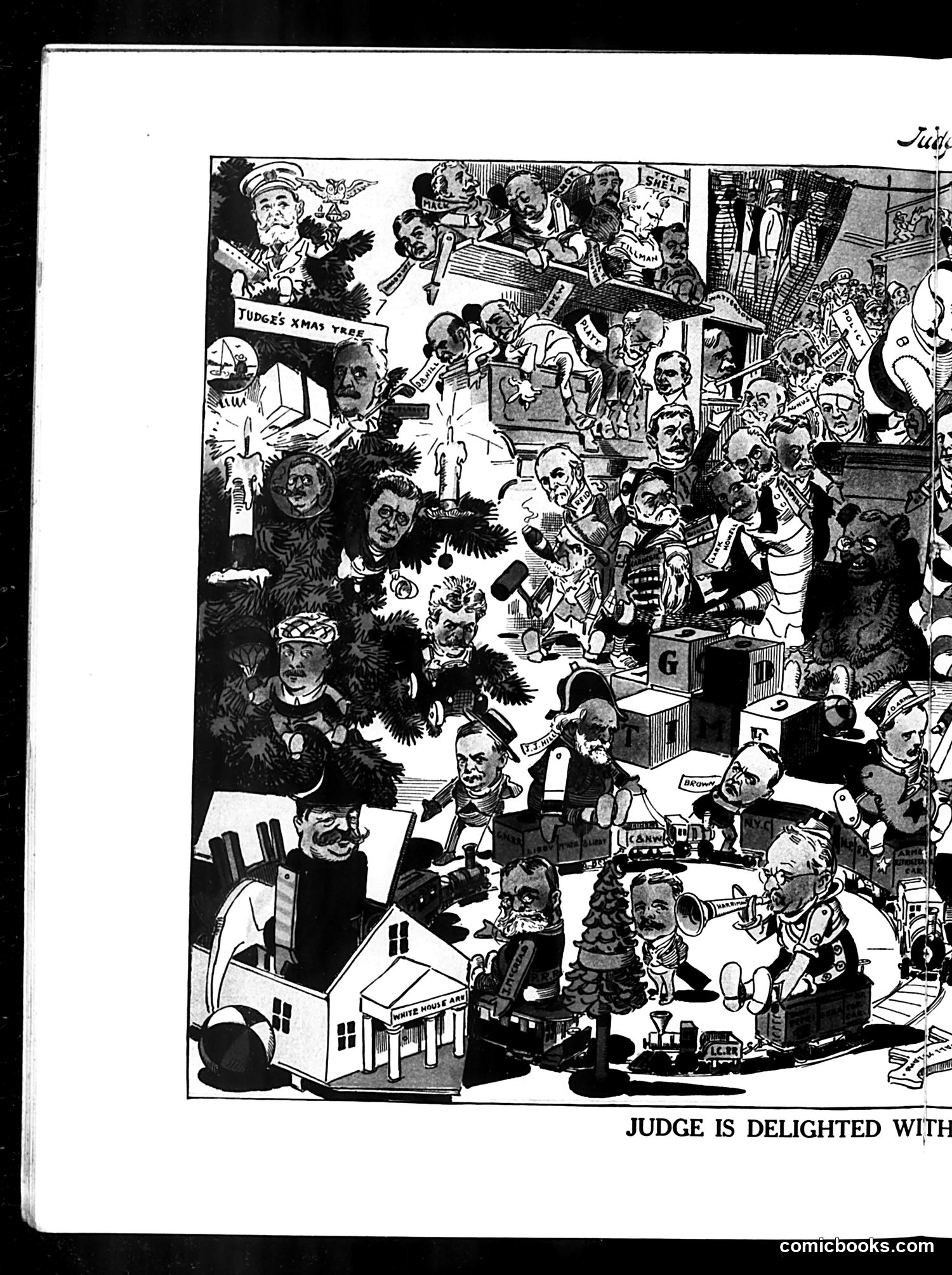
This appears to be a chaotic Christmas or holiday-themed satirical cartoon from *Judge* magazine. The caption "JUDGE IS DELIGHTED WITH" (text cut off) suggests the publication is mocking something about the holiday season or contemporary politics. The image depicts a crowded, frenetic scene filled with numerous caricatured figures—many appear to be politicians, military officers, and public figures—engaged in various activities around holiday imagery (a Christmas tree visible). The exaggerated facial features and caricature style was typical of early 20th-century political satire. However, without the complete caption text or a visible date, I cannot definitively identify which specific political figures or events are being satirized. The overall tone suggests *Judge* is critiquing some aspect of holiday or political excess through this densely packed, absurdist composition.
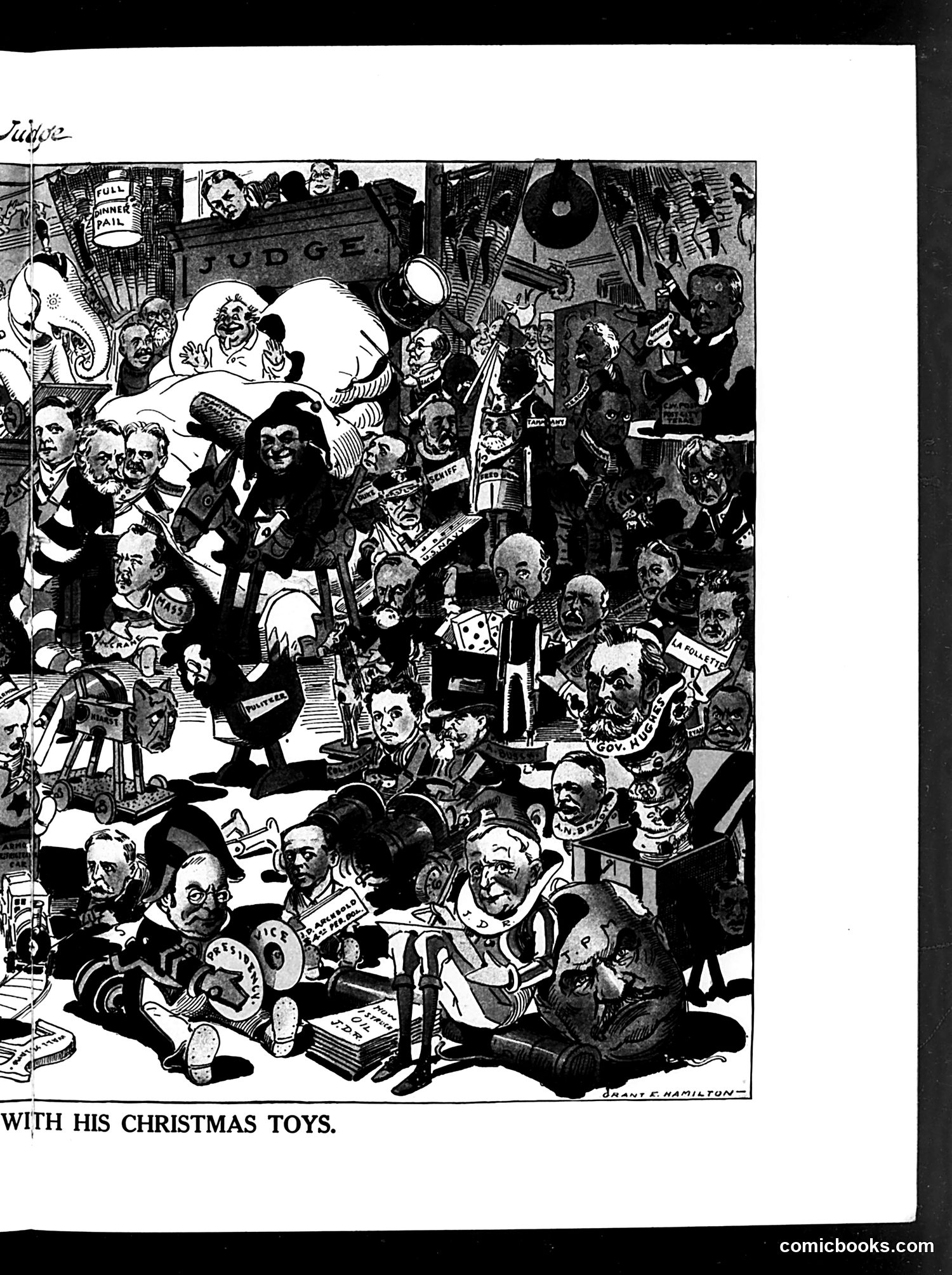
This is a densely packed satirical cartoon titled "With His Christmas Toys," signed by Grant Hamilton. It depicts a large central figure (likely a political leader or powerful industrialist) surrounded by numerous caricatured men in formal dress, appearing almost childlike or puppet-like. The composition suggests these figures are toys or subordinates being manipulated by the central authority. The cartoon satirizes power dynamics and control—the title's ironic reference to "Christmas toys" implies these are playthings for someone in authority. The men's exaggerated features and cramped positioning suggest they're treated as objects rather than individuals. Without the publication date visible, the specific political context remains unclear, but the imagery targets the concentration of power and the dehumanization of those beneath it.
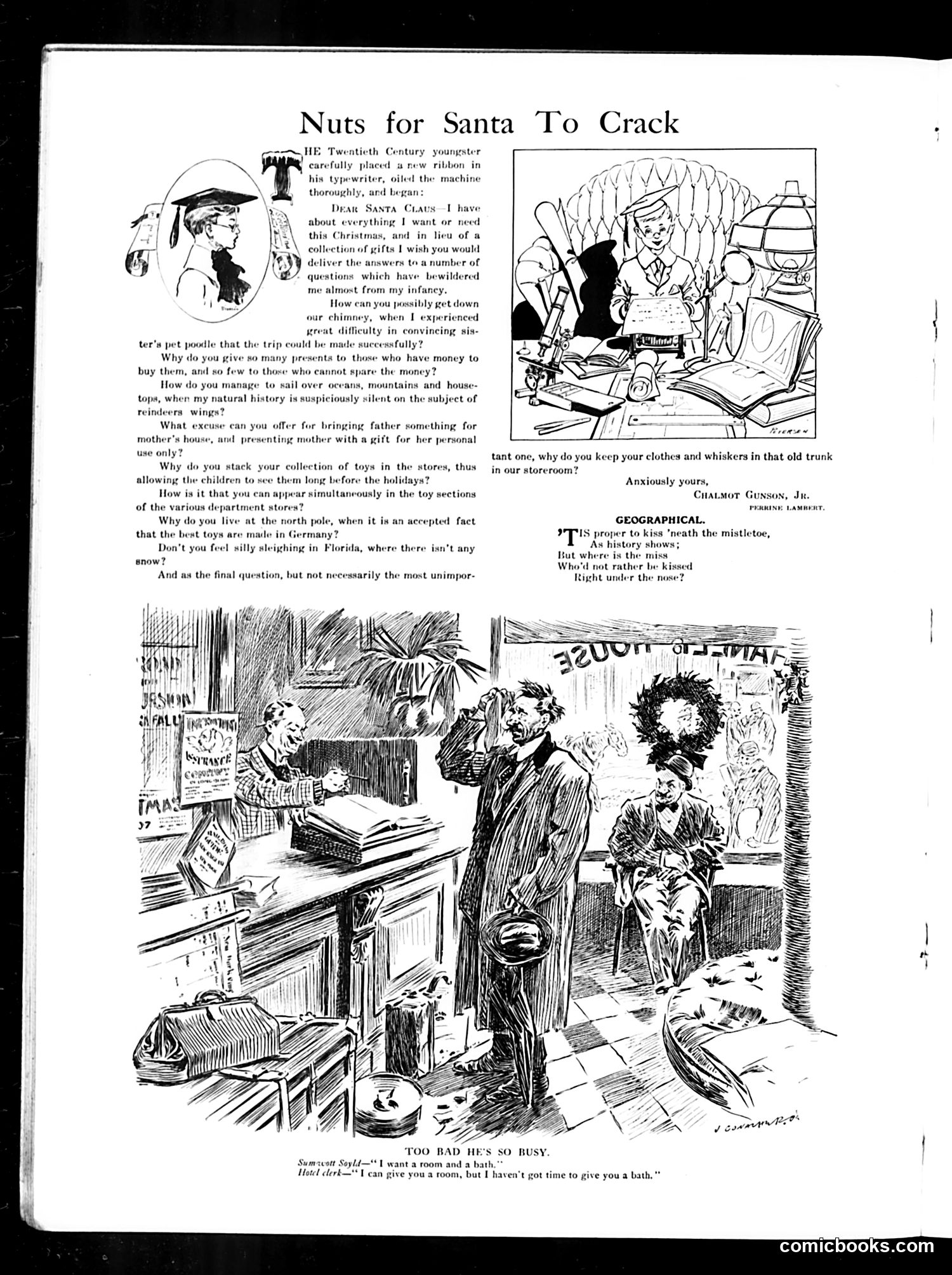
This page contains two satirical pieces from *Judge* magazine (an American humor publication). **"Nuts for Santa To Crack"** (top): A young boy writes a letter to Santa listing absurd, philosophical questions designed to expose logical contradictions in Christmas mythology. He asks how Santa delivers presents to poor people, how reindeer fly, why Santa appears simultaneously everywhere, and why German-made toys are superior if Santa makes them at the North Pole. The satire mocks both the implausibility of Santa and, implicitly, uncritical adult acceptance of the story. **"Too Bad He's So Busy"** (bottom): A hotel clerk refuses to provide a bath to a guest, claiming he's too busy—though he offers a room. The joke satirizes poor hospitality and absurd business excuses (the humor lies in the obvious inadequacy of this reasoning). Both pieces use comedic exaggeration to critique contemporary practices: childhood credulity and commercial/service-industry negligence.
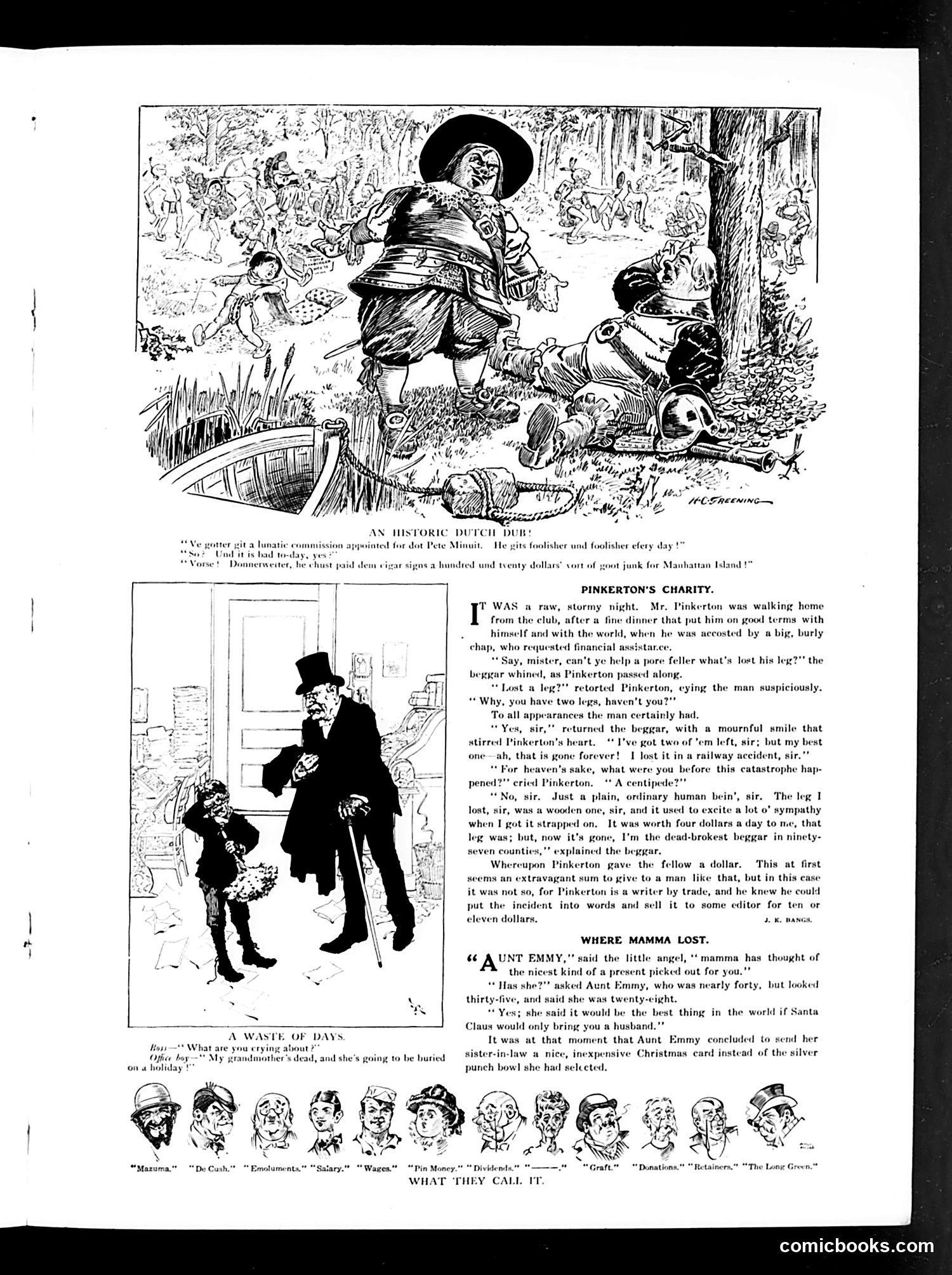
This page contains three separate satirical pieces: **"An Historic Dutch Dub"** (top): A cartoon mocking Dutch settlers, likely referencing Peter Minuit's famous 1626 land purchase from Native Americans. The joke satirizes the stereotypical "dumb Dutchman" character—the figure complains about being cheated on a real-estate deal while simultaneously bragging about swindling Native Americans, illustrating hypocrisy. **"Pinkerton's Charity"** (middle): A cynical story about a wealthy man (Pinkerton) who gives a beggar a dollar, believing he'll profit by selling the story to a magazine editor for ten dollars. The satire targets both the beggar's deception (his lost "wooden leg" was a scam) and the writer's opportunism—mocking how charitable acts become exploitable material. **"Where Mamma Lost"** (bottom): A brief piece about Aunt Emmy reconsidering an expensive gift after a child suggests Santa bring her a husband instead, humorously suggesting marriage is preferable to material goods. The bottom section, "What They Call It," lists slang terms for money/income (Mazuma, Graft, Donations, etc.).
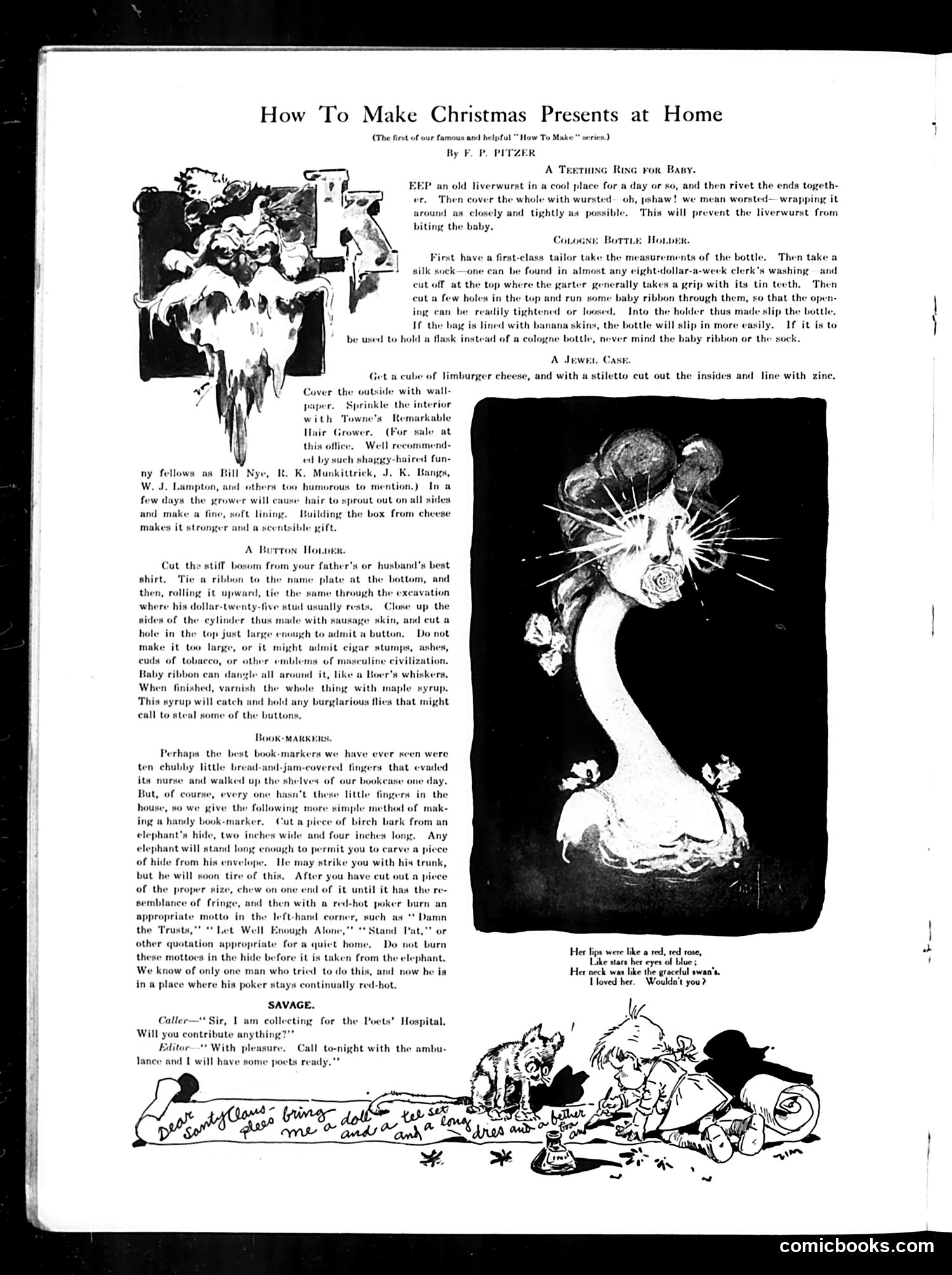
This page presents humorous DIY Christmas gift ideas by F.P. Pitzker for the "How To Make" series. The satirical humor targets both gift-giving conventions and absurd domestic creativity. **The Jokes:** The gifts are intentionally impractical and ridiculous—a liverwurst teething ring "to prevent the liverwurst from biting the baby," a cologne bottle holder made from a sock, a jewelry case from limburger cheese, and a button holder fashioned from a shirt bosom. The humor exploits the tension between economical home-crafting (practical during this era) and genuinely awful results. **The Bottom Section:** A brief comic dialogue references "Poets' Hospital" charity collection, with an editor's dark joke that he'd contribute only if an ambulance comes—implying poets are worthless or that solicitation is intrusive. **Context:** This reflects early 20th-century Judge magazine's satirical tone: gently mocking middle-class aspirations, penny-pinching, and sentimental domesticity while maintaining affectionate humor rather than viciousness.
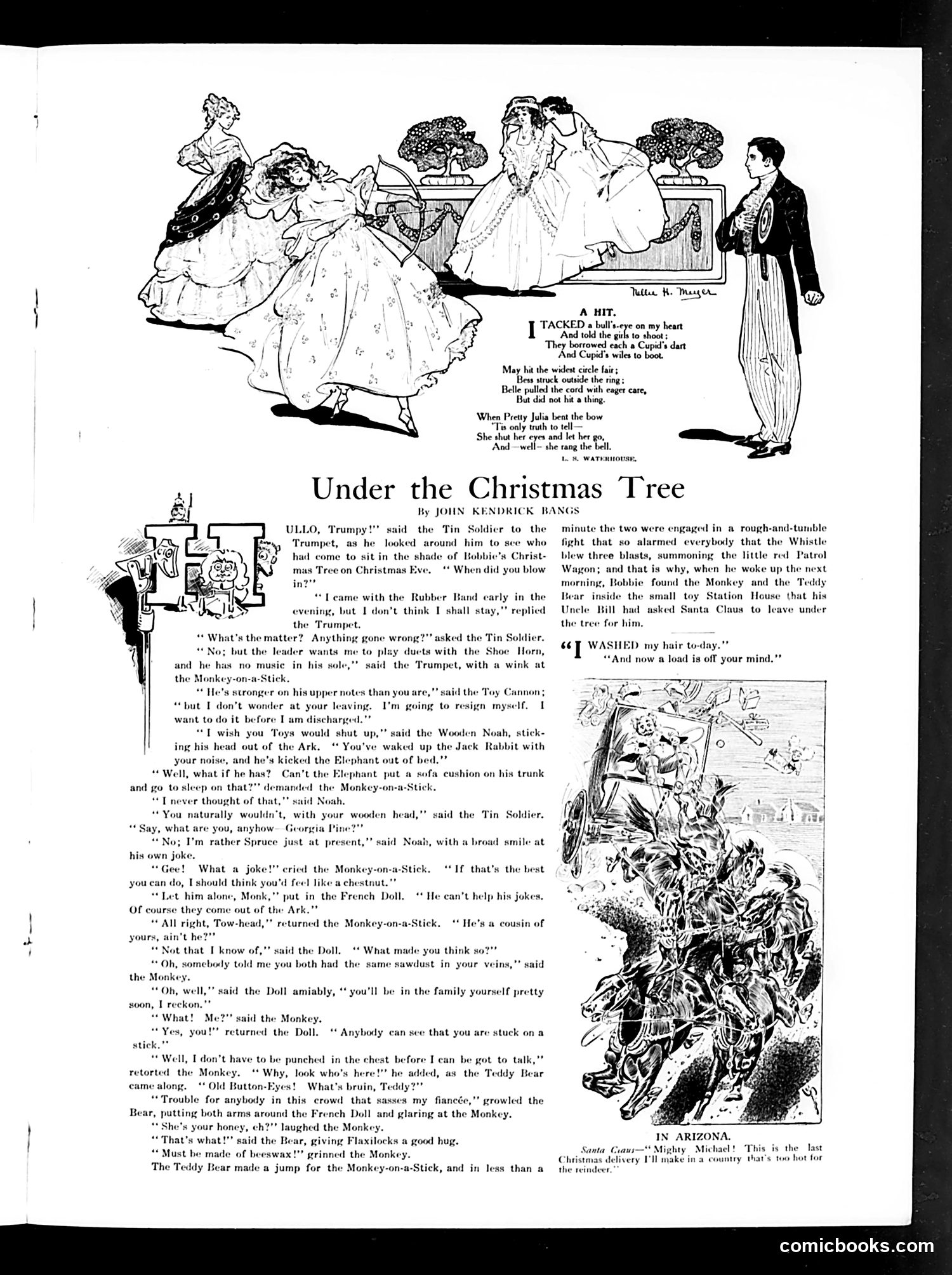
This page contains two separate pieces of Christmas-themed humor: **Main Story:** "Under the Christmas Tree" by John Kendrick Bangs is a whimsical children's tale featuring anthropomorphized toys—a Tin Soldier, Trumpet, Monkey-on-a-Stick, Teddy Bear, French Doll, and Wooden Noah—having comedic conversations under a Christmas tree. The humor relies on puns (a "Spruce" tree being stronger in "upper notes"), slapstick conflict (toys fighting), and innocent toy-character banter typical of early 20th-century children's literature. **Top Cartoon:** "A Hit" appears to depict young women at archery, likely a social commentary on the Edwardian-era "New Woman"—women engaging in athletic activities. The poem mocks their varying competence with bows, with one character closing her eyes while shooting (suggesting incompetence or frivolity). **Bottom Panel:** "In Arizona" shows Santa struggling with desert heat—straightforward visual humor about Christmas's incongruity in hot climates. The page showcases Judge's mix of satirical social commentary and lighthearted family entertainment.
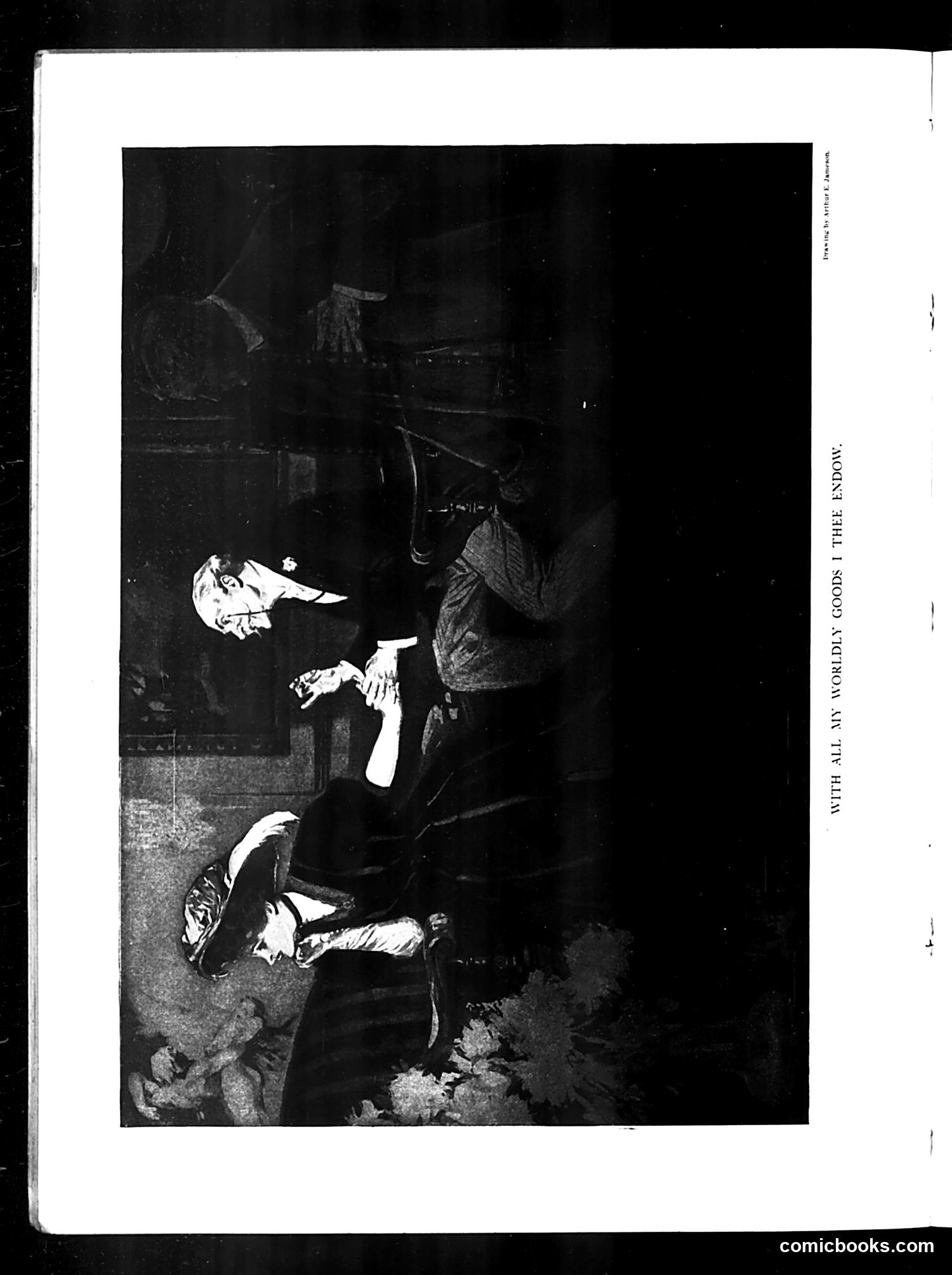
This page appears to be from *Judge* magazine and shows a dramatic black-and-white illustration. The caption reads "WITH ALL MY WORLDLY GOODS I THEE ENDOW." The image depicts what appears to be a wedding or marital scene, with figures in formal dress in an interior setting. The caption suggests this is satirizing traditional marriage vows, specifically the husband's promise to provide for his wife financially. Without clearer OCR text or visible identifying details, I cannot definitively identify which specific political or social figures this may caricature, nor can I determine the precise date or context of the satire. The image quality and OCR errors prevent confident identification of the cartoon's specific targets or the particular scandal or social commentary it references.
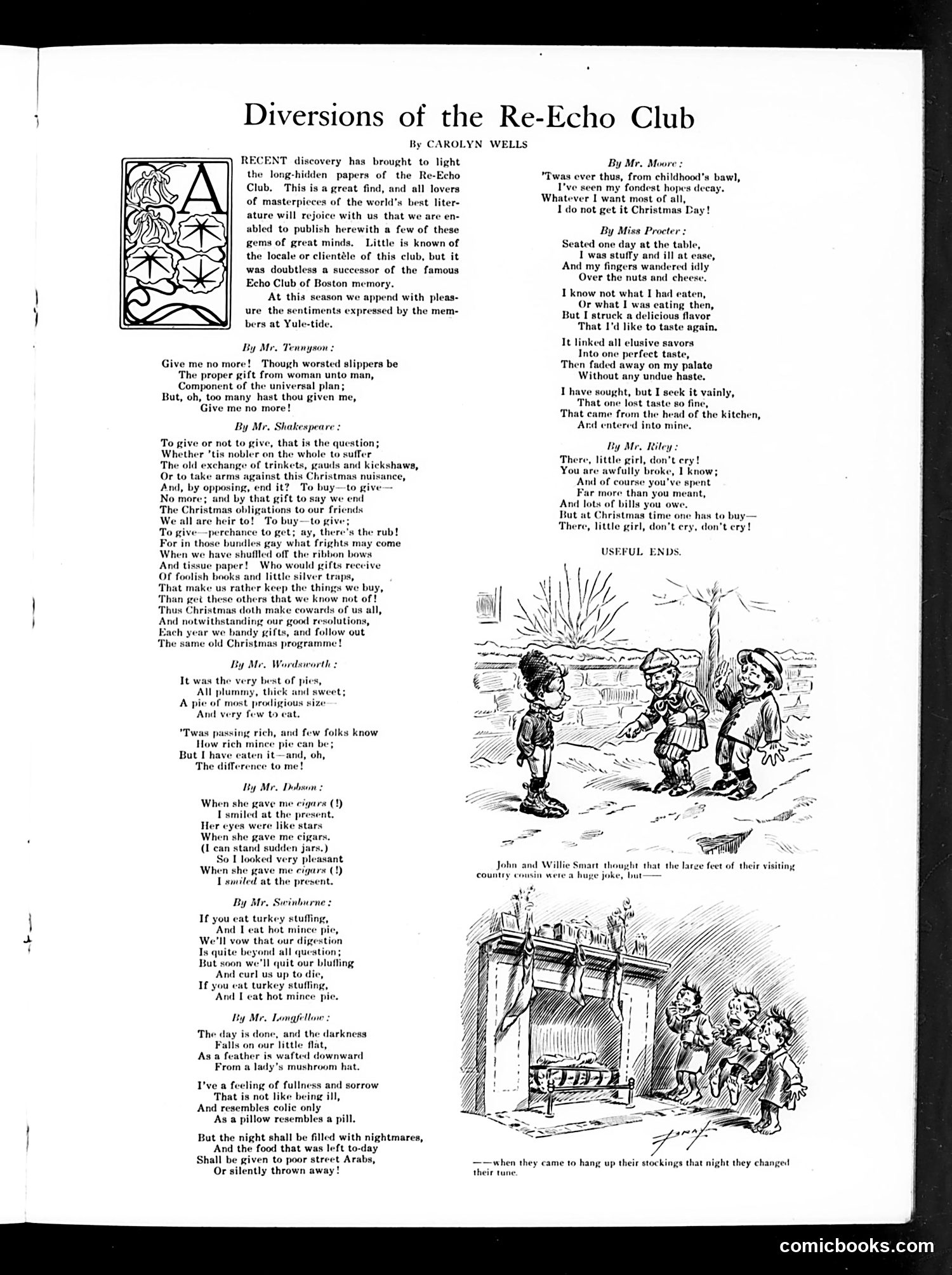
This humorous piece by Carolyn Wells parodies famous literary figures by having them comment on Christmas gift-giving anxieties. The "Re-Echo Club" is a fictional literary society that mimics the real Boston Echo Club, known for creative parodies. The satire works by placing well-known poets—Shakespeare, Tennyson, Wordsworth, Swinburne, and others—in the relatable position of complaining about holiday gift obligations. Shakespeare's passage reworks his "To be or not to be" soliloquy into a debate about whether to buy gifts. Tennyson laments receiving too many slippers. The joke is the contrast: these grand literary voices are reduced to griping about everyday Christmas consumerism—overeating, gift expenses, and social obligations. The accompanying illustrations show children and holiday scenes, reinforcing the domestic, mundane nature of the complaints. The final caption notes that children's attitudes changed once they hung their stockings, suggesting the piece is ultimately gentle satire on holiday grumbling versus festive sentiment.
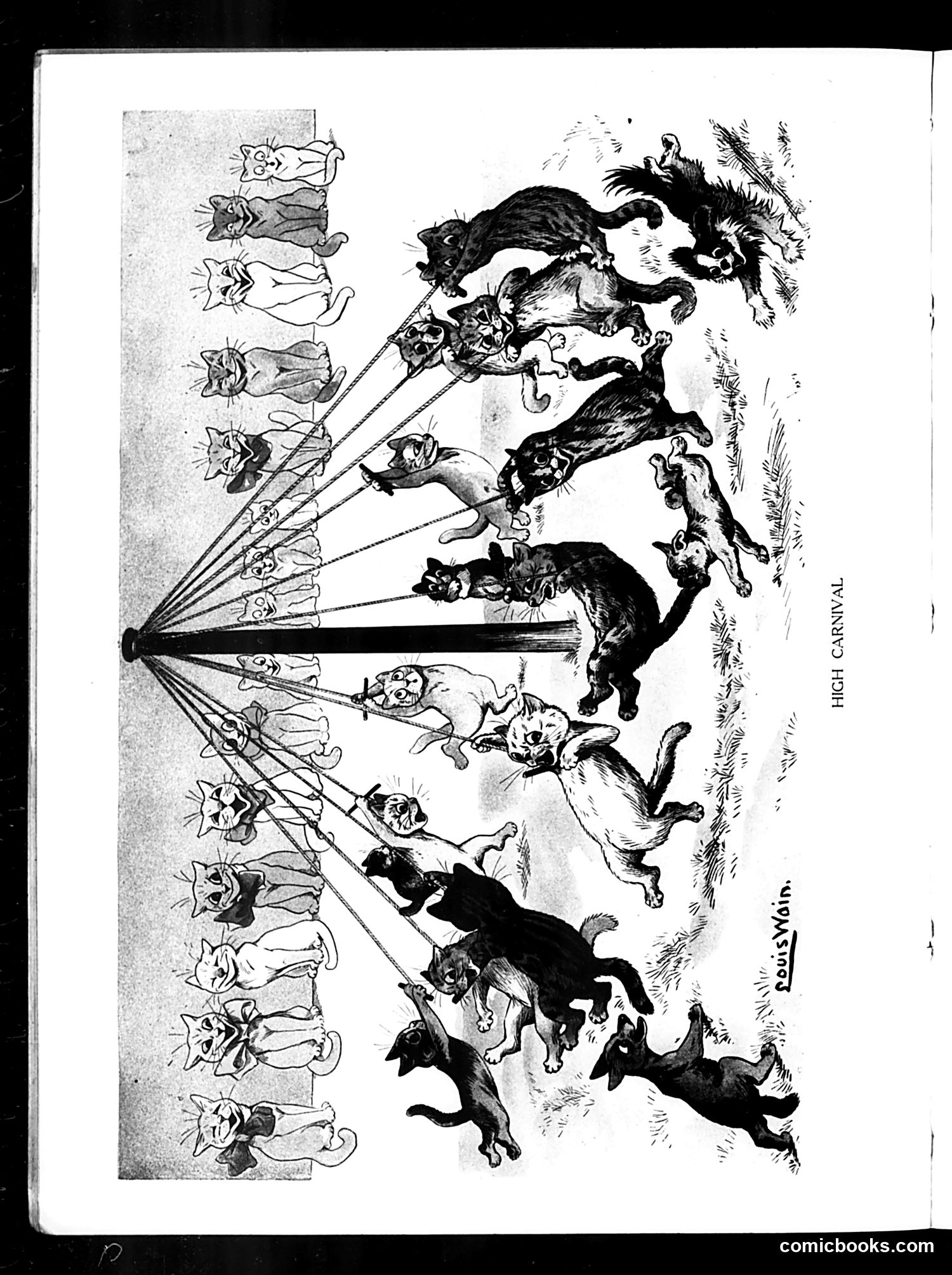
This satirical illustration depicts a chaotic scene of dogs on leashes being controlled by human figures arranged in a line on the left side. The title "HIGH CARNIVAL" suggests disorder or mayhem. The image appears to be political satire, likely showing powerful figures (the humans) controlling or manipulating subordinates or the public (represented by the dogs). The dogs' energetic, unruly behavior suggests they're difficult to manage despite being on leashes. Without clearer identification of the specific figures caricatured, the precise political context remains unclear, though the cartoon likely comments on power dynamics, control, or political manipulation prevalent during Judge magazine's era. The cartoonist's name appears to be "Lustig" based on the signature visible.
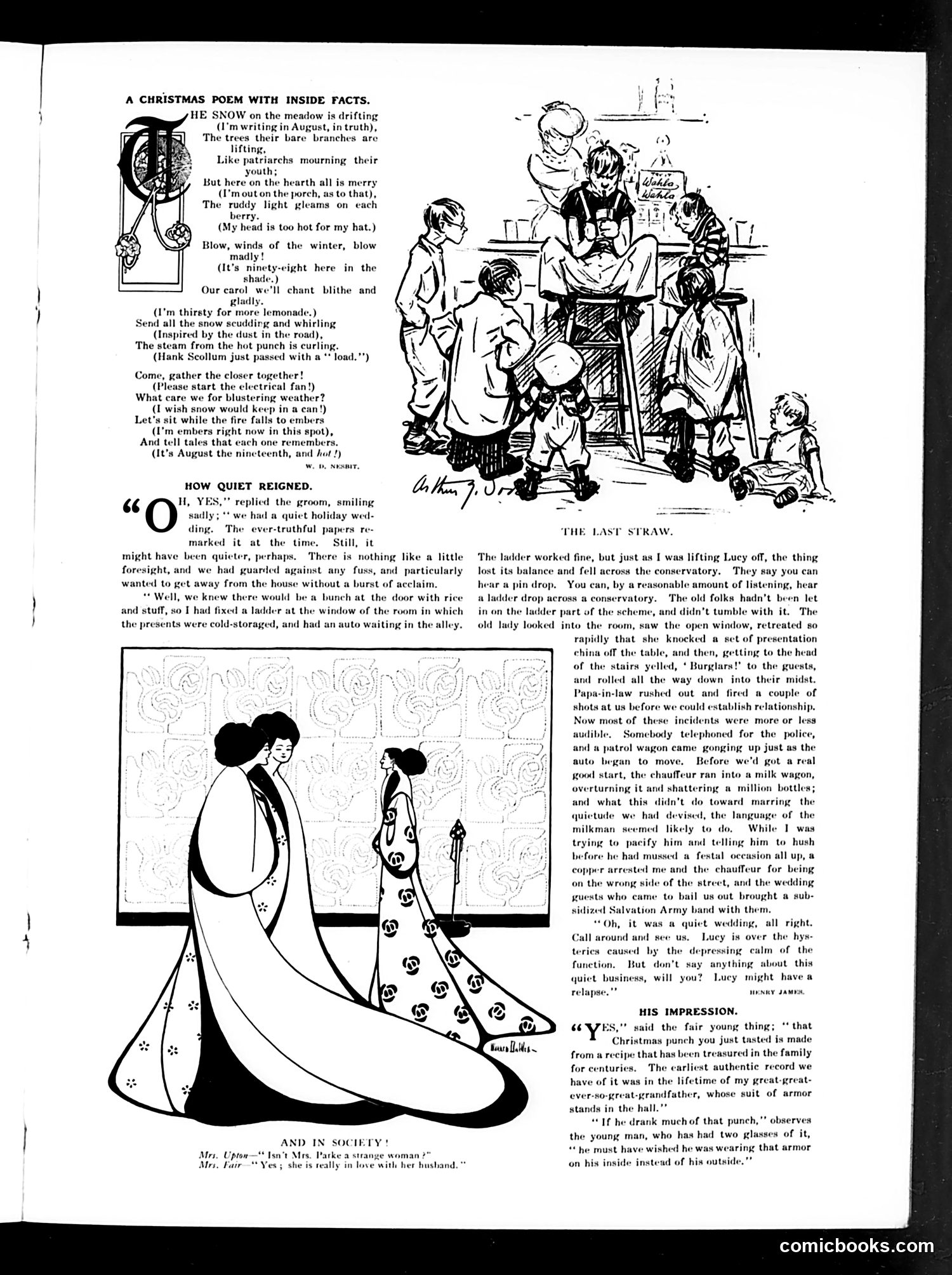
This page contains three separate humorous pieces satirizing early-20th-century domestic life: **"A Christmas Poem with Inside Facts"**: A mock-serious Christmas poem where the narrator claims to write about winter snow and holiday cheer while admitting (in parentheses) he's actually writing in August and is too hot/thirsty. The joke is the gap between romantic poetic pretense and uncomfortable reality. **"How Quiet Reigned"**: A newlywed groom describes his "quiet" wedding that went hilariously wrong—a ladder fell through a conservatory, his mother-in-law tumbled downstairs, police arrived, a milk wagon was hit. The satire mocks the era's desire for "proper" quiet weddings while depicting chaos. **"The Last Straw" and "His Impression"**: Brief anecdotes about a wedding reception mishap and a young man's reaction to drinking strong family punch while viewing a suit of armor. The humor comes from the contrast between genteel tradition and crude reality. The overall theme: **the gap between Victorian/Edwardian pretense and messy actual experience**—a common Judge magazine target.
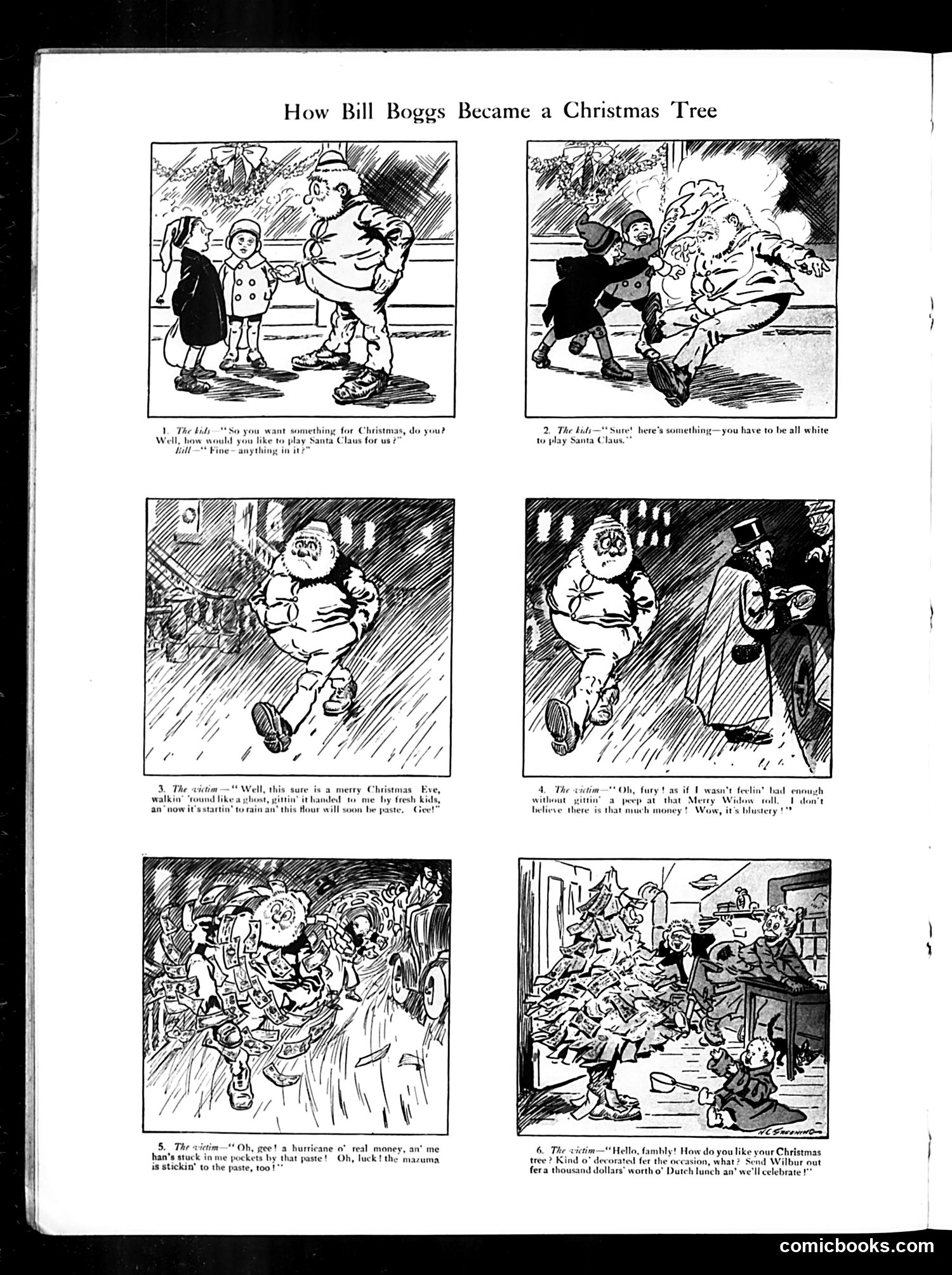
This is a six-panel comic strip satirizing wealth inequality and materialism during the Christmas season. Bill Boggs, a poor man, is initially asked by children what he wants for Christmas—he says "anything." He's then dressed as Santa Claus for a holiday performance. However, the subsequent panels show him becoming increasingly battered and mistreated, covered in bumps and bruises from being roughed up. By the final panels, he's somehow transformed into or decorated as an actual Christmas tree, surrounded by a wealthy family enjoying the holiday abundance. The satire appears to critique how poor people are exploited during Christmas—used for entertainment and labor, then discarded—while the wealthy enjoy the season's pleasures.
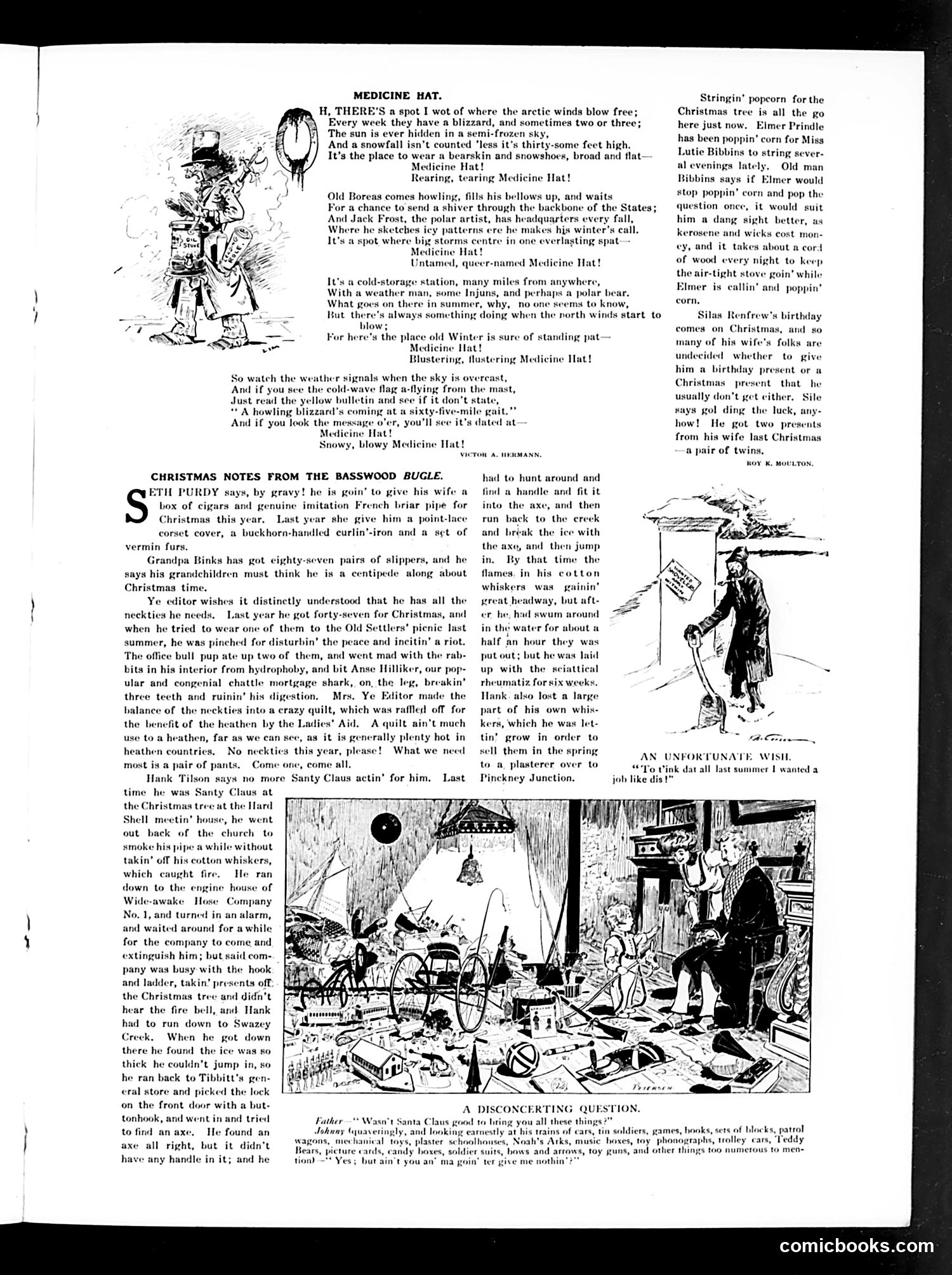
This page contains humorous rural/frontier sketches from early 20th-century America: **"Medicine Hat"** (top) is a comic poem celebrating the Canadian town of Medicine Hat for its extreme winter weather—constant blizzards, perpetual snow, and frigid temperatures. The satire gently mocks both the harsh climate and the boastful pride settlers take in enduring it. **"Christmas Notes from the Basswood Bugle"** (bottom) is a series of anecdotal jokes about rural holiday gift-giving. The humor centers on comedic domestic situations: a husband giving impractical gifts (cigars, pipes), a grandfather receiving 87 pairs of slippers, and an editor receiving so many neckties he raffles them off. The longest story describes Hank Tilson accidentally catching fire while dressed as Santa Claus at a church Christmas tree. The cartoons emphasize small-town life's absurdities and the gap between what people think they need and what they actually receive—typical American frontier humor of the era.
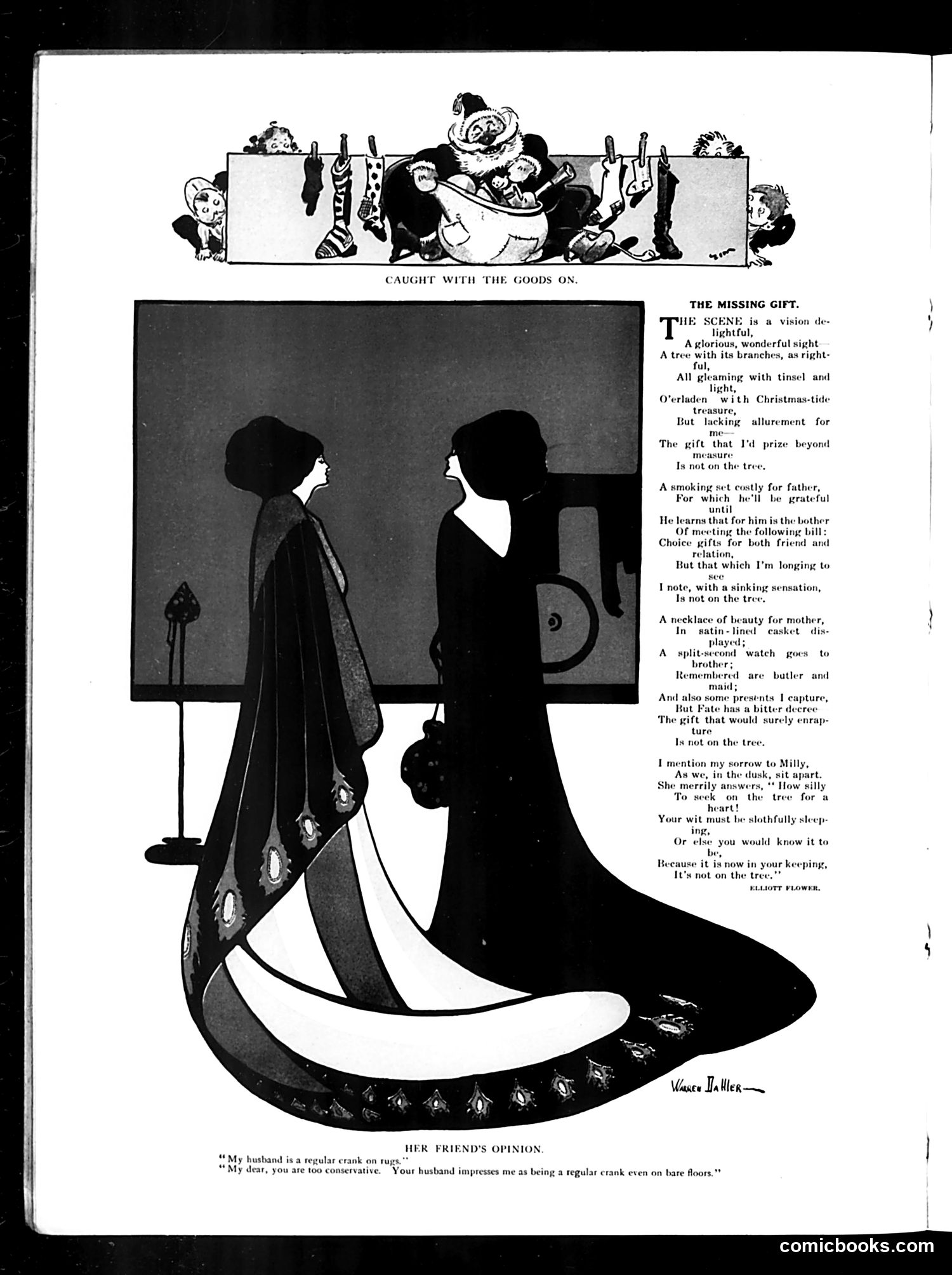
This page contains a humorous poem-illustration about Christmas gift-giving anxieties. The central image shows two silhouetted figures examining wrapped presents beneath a Christmas tree, illustrated in an Art Nouveau style by Valerie Haller. The poem's narrator laments that while the tree is laden with gifts for family members (expensive smoking sets for father, jewelry for mother, watches for servants), the one gift he truly desires is absent from the tree—though the poem never explicitly states what it is. The mystery itself is the joke: the reader expects a profound revelation, but the humor lies in the anticlimax and the narrator's melodramatic pining for something unspecified. The bottom cartoon ("Her Friend's Opinion") is a separate joke about domestic temperament: a woman defends her "crank" husband as merely particular about rugs, while her friend suggests he's difficult even in situations where there's nothing to be particular about. Both pieces satirize middle-class anxieties and marital dynamics in early 20th-century America.
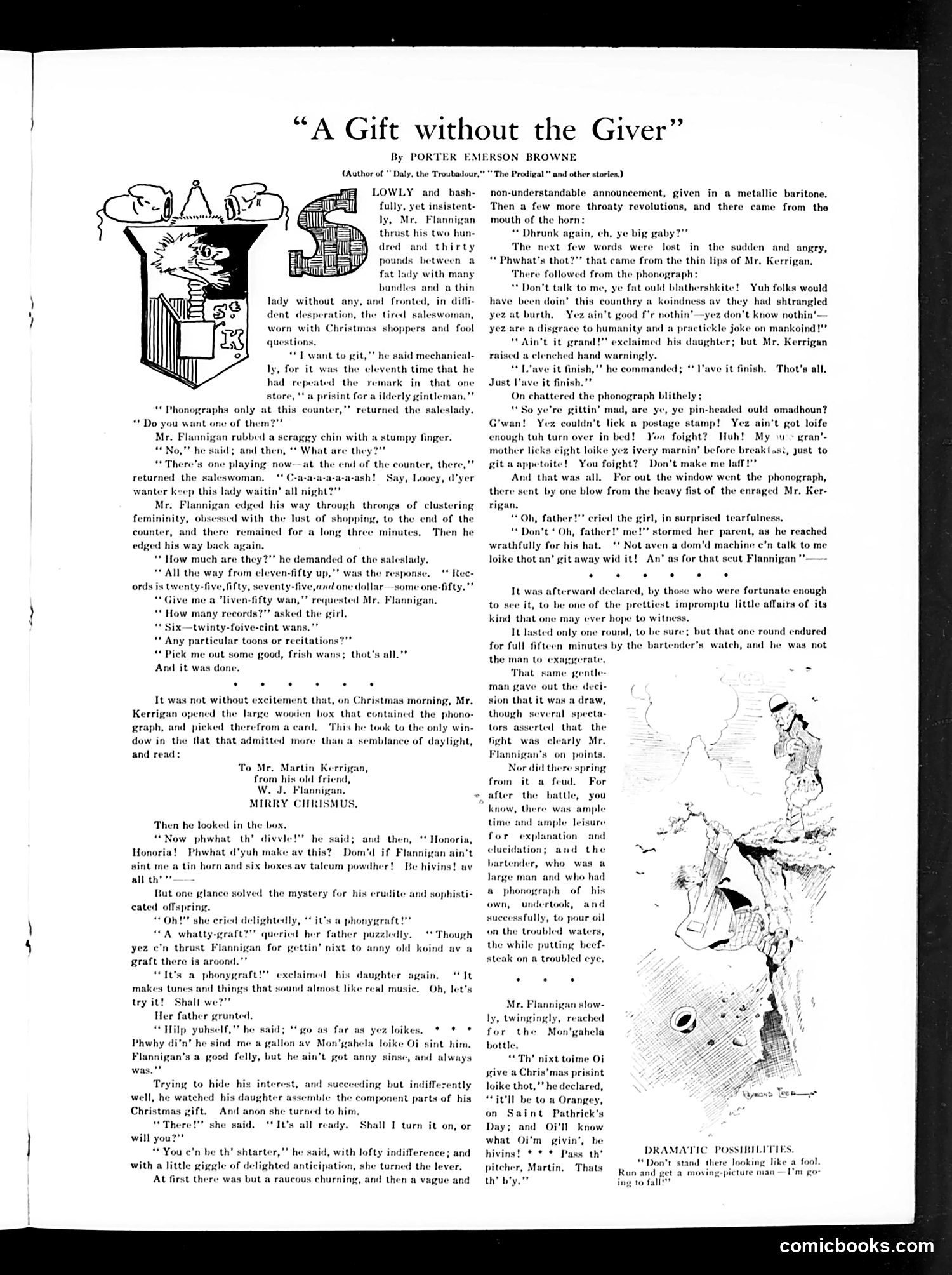
This page contains the opening of a short story by Porter Emerson Browne, not primarily a political cartoon. The narrative concerns Mr. Kerrigan, an Irish-American working-class man, who receives a phonograph as a Christmas gift from his friend W.J. Flannigan. The satire targets early 20th-century consumer culture and the phonograph craze. A phonograph is an expensive novelty—Kerrigan initially finds it baffling. The humor derives from ethnic Irish-American dialect humor (typical of the era, though offensive by modern standards) and the absurdity of Kerrigan's violent reaction when the recorded message on the phonograph insults him, prompting him to throw it out the window. The accompanying illustration shows dramatic action on city streets. The story mocks both the gift-giver's presumption and the recipient's volatile response to newfangled technology.
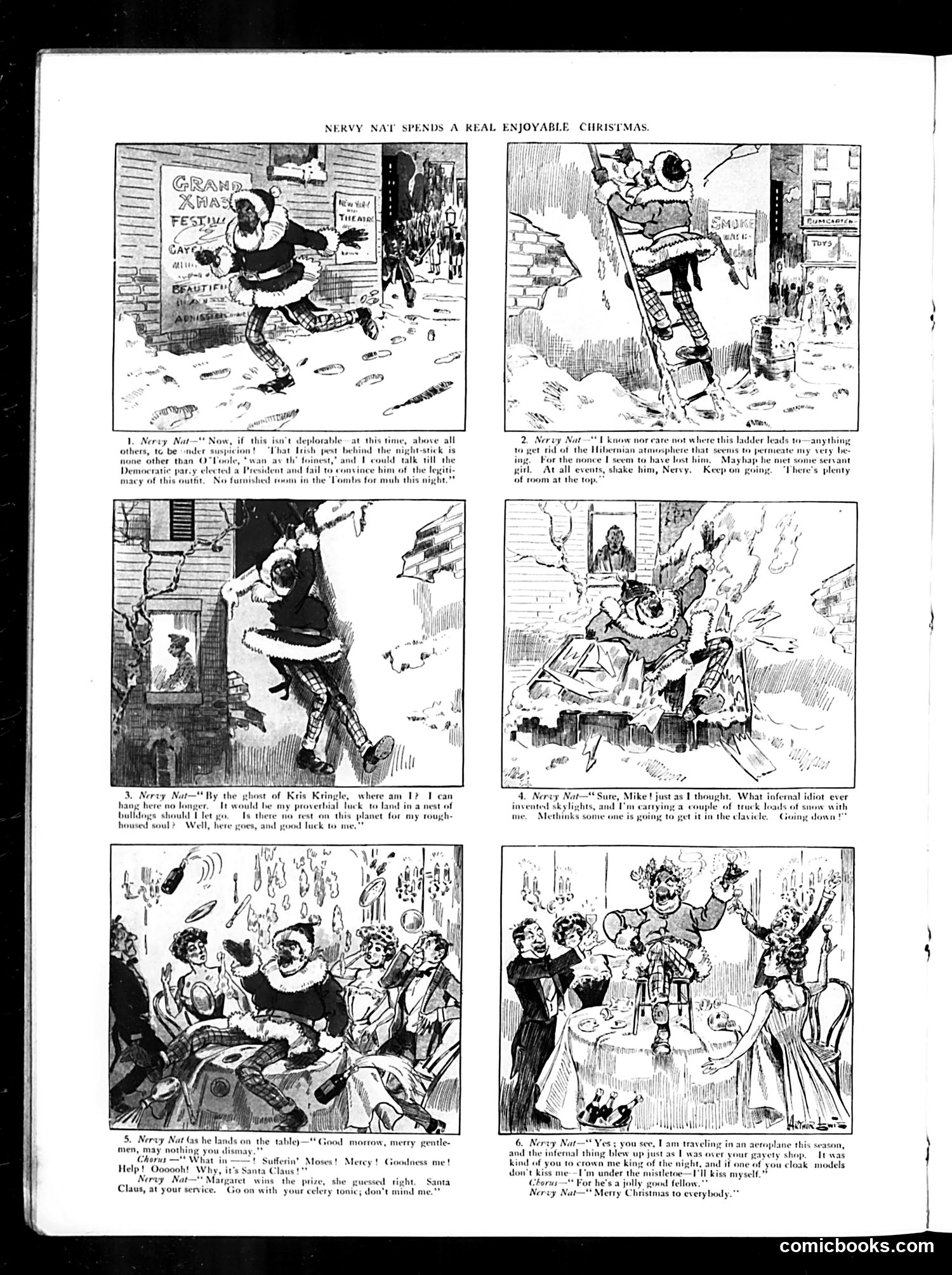
This is a six-panel comic strip following "Nervy Nat," a mischievous character, through Christmas Day adventures. Nat disrupts a department store display, crashes through snow on a ladder, encounters a ghost (invoking Kris Kringle folklore), causes chaos at a dinner party with exploding gifts and sky-lights, and finally crashes a fancy holiday gathering. The humor relies on physical comedy and property destruction—Nat's reckless behavior creates mayhem everywhere despite Christmas's supposed goodwill. The "nervy" title emphasizes his audacious, troublemaking nature. The strip satirizes the contrast between Christmas ideals (peace, charity, family) and reality when one person's thoughtless antics ruins civilized celebrations. The other characters' exasperation underscores how Nat's behavior spoils the season.
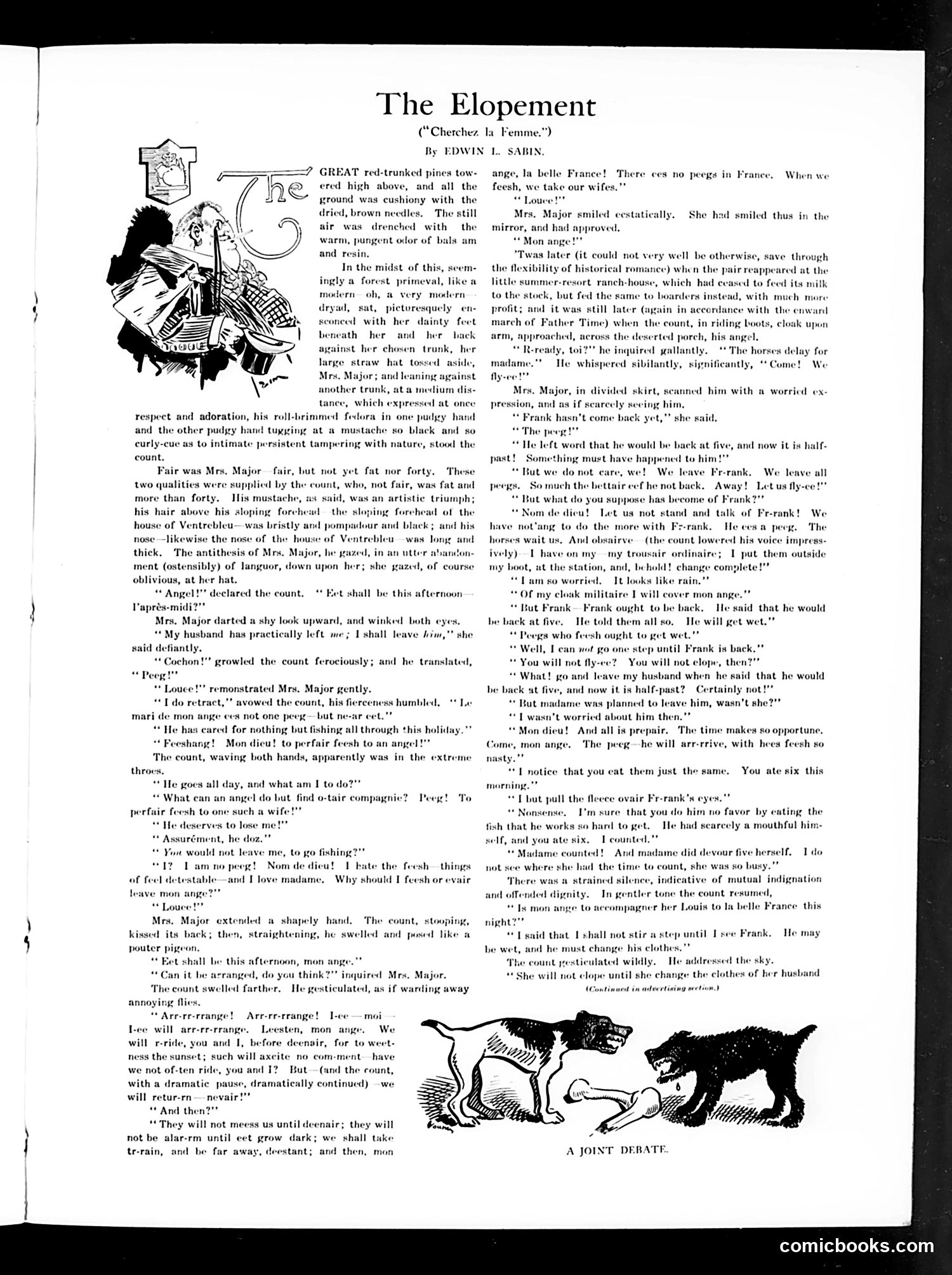
This satirical story by Edwin L. Sabin mocks the romantic elopement trope, particularly as deployed in period literature. The narrative centers on Mrs. Major, a middle-aged American woman at a summer ranch, and a Continental count with exaggerated French mannerisms (emphasized through phonetic spelling: "mon ange," "peeg," "Fr-rank"). The satire targets: 1. **Melodramatic romance conventions** - The count's theatrical wooing and the woman's conflicted passion parody overwrought literary romance 2. **Class pretension** - The count's aristocratic affectations (rolled fedora, sloping forehead caricature) suggest he's a ridiculous fortune-hunter 3. **Gender and marital comedy** - Mrs. Major's hesitation to abandon her husband (who's fishing) for romance undercuts the passionate elopement fantasy 4. **Phonetic humor** - Exaggerated French pronunciation ridicules European affectation The page's illustration shows two dogs in apparent "debate," titled "A Joint Debate" - likely commenting on the couple's argument. The story presents elopement not as romantic but as absurd theater among vain, self-interested characters.
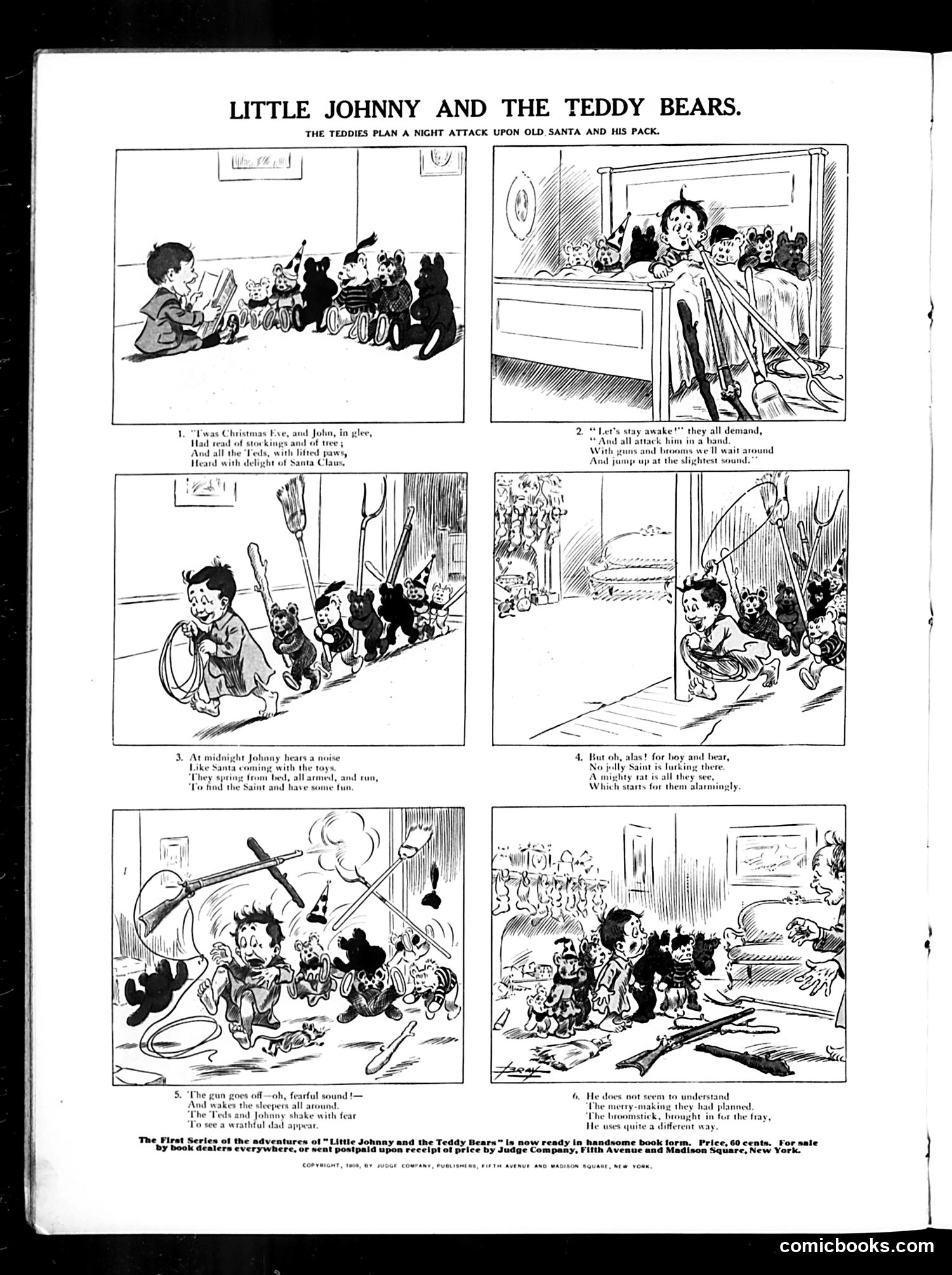
This is a humorous children's comic strip showing teddy bears staging a nighttime "attack" on Santa Claus and his reindeer. The narrative follows Little Johnny and his toy bears planning and executing a comedic ambush—armed with toy guns and brooms—to catch Santa in the act of delivering Christmas presents. The satire plays on children's fantasy logic: Johnny and his animated teddy bears treat Christmas Eve like a military operation, complete with weapons and strategic positioning. The comic treats the toys as sentient characters plotting mischief. The humor derives from the absurdity of toys rebelling against Santa and the exaggerated seriousness given to their "battle." This represents early 1900s Judge magazine's style of whimsical, lighthearted children's content mixing anthropomorphized toys with Christmas themes.
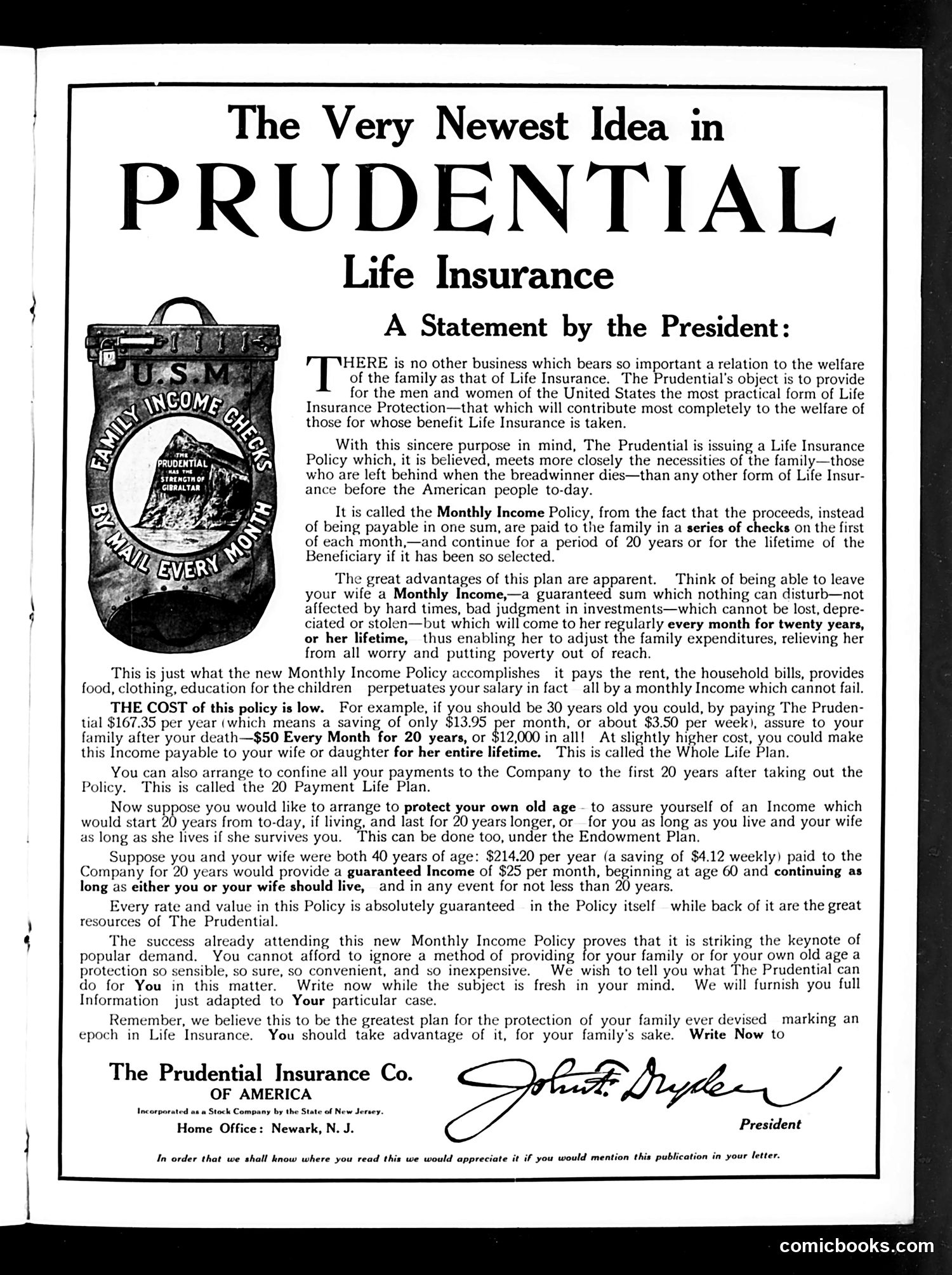
This page is **not a cartoon or satire**—it's a full-page advertisement for The Prudential Insurance Company's new "Monthly Income Policy," presented as a statement from the company president. The ad promotes life insurance as a financial protection tool, specifically targeting breadwinners concerned about their families' welfare after death. The "newest idea" is monthly payments to beneficiaries rather than lump-sum payouts, positioning this as more practical for managing household expenses. The modest cost examples ($3.50-$4.12 weekly premiums) and emphasis on guaranteed, stable income reflect early-20th-century anxieties about economic security and women's financial vulnerability as widows. The language appeals to masculine duty ("do for *You*") while implicitly assuming wives cannot manage lump sums independently. This appears in *Judge* likely because the magazine accepted paid advertising alongside satirical content—a common revenue model for period publications.
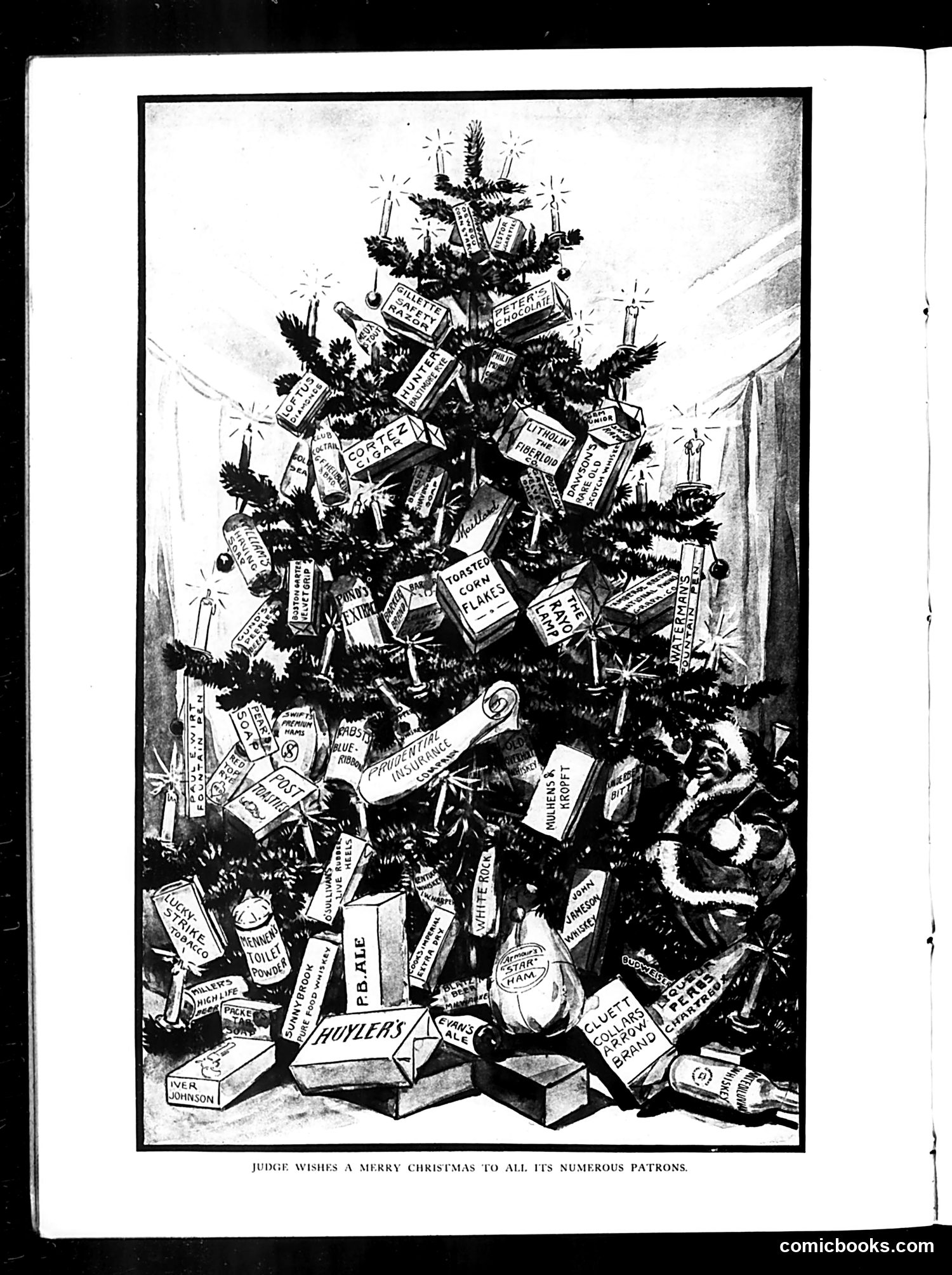
This is a seasonal greeting illustration rather than a political cartoon. It depicts a Victorian-style Christmas tree decorated with bottles of various alcoholic beverages and liqueurs—beer, ale, whiskey, gin, and other spirits are visible on the ornaments and gifts below. The bottles bear product names and brand labels, some legible as period products. The satire targets Judge magazine's wealthy, alcohol-consuming patrons during what appears to be the late 19th or early 20th century. By depicting their ideal Christmas tree made entirely of liquor bottles, the image humorously suggests that alcohol is the primary gift and pleasure for the magazine's readership—typically wealthy, educated men who could afford expensive spirits and Judge's subscription. The message is essentially: Judge celebrates Christmas by wishing its patron-audience abundant access to premium drinks.
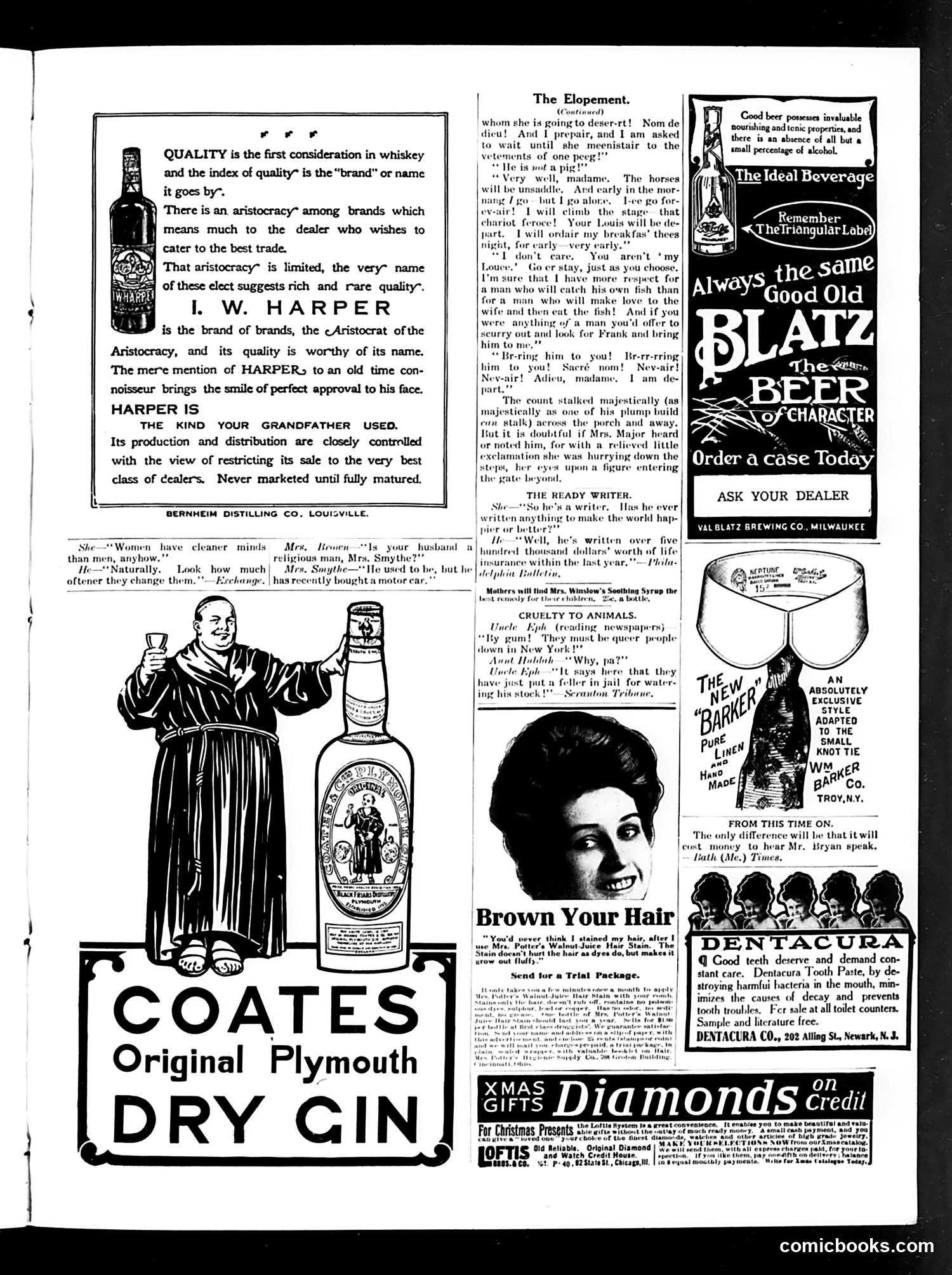
This page is primarily **advertising**, not political satire. It features multiple product advertisements typical of early 20th-century magazines, including whiskey (I.W. Harper), gin (Coates), beer (Blatz), and patent medicines (Dentacura tooth paste, Mrs. Winslow's Soothing Syrup). The only substantive content is "The Elopement," a serialized short story (continued from previous issue) about a woman planning to elope, featuring dialogue between characters discussing horses and travel arrangements. This appears unrelated to satire. There are brief conversational jokes in small text boxes ("Ready Writer" section) offering mild social commentary—one noting women change their minds, another about Bryan (likely William Jennings Bryan) now charging money for speeches—but these are minor fillers, not the page's focus. The page functions primarily as a **commercial vehicle**, demonstrating how Judge monetized content through advertising rather than editorial satire.
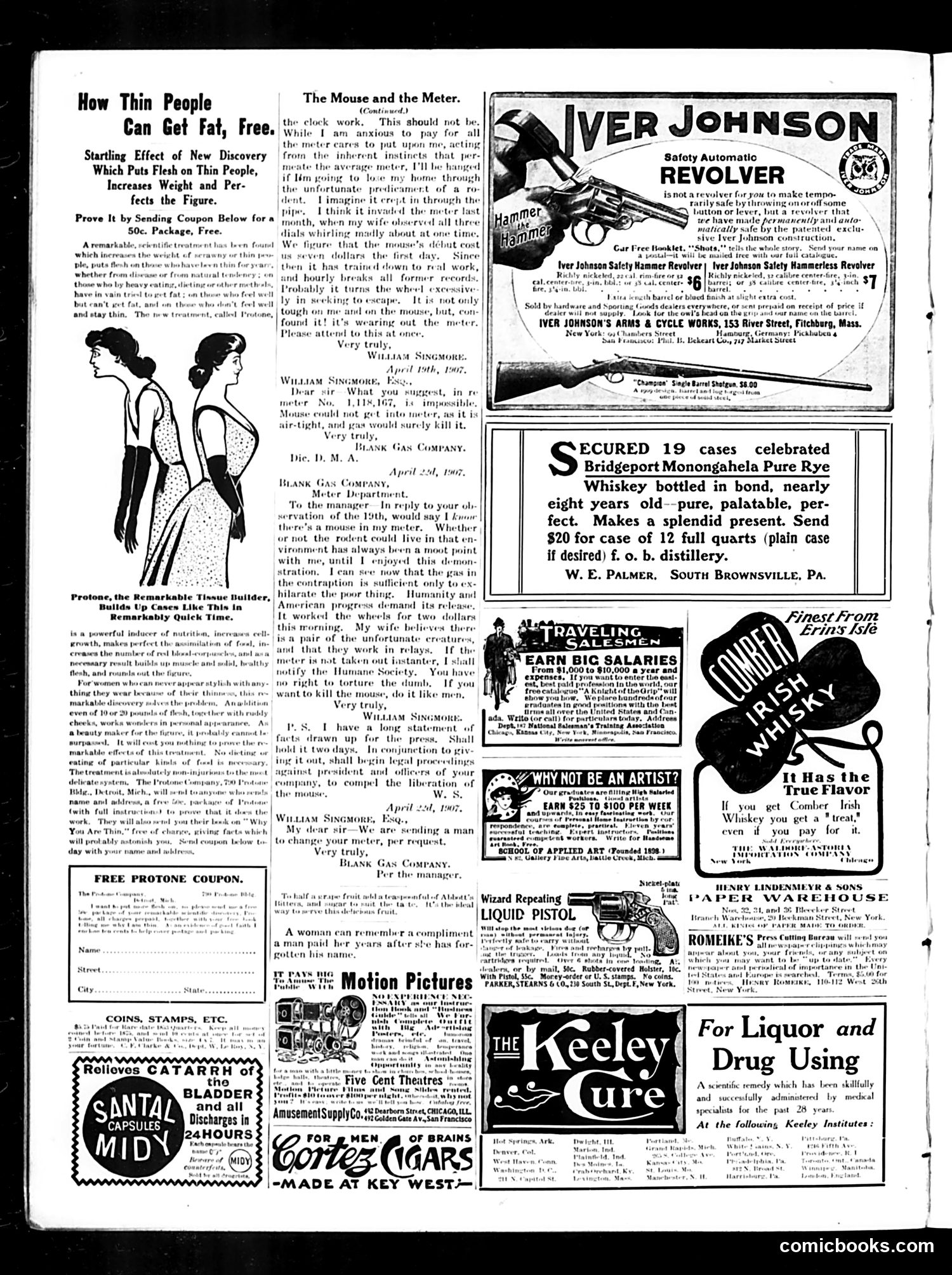
This page is primarily **advertising**, with a small satirical story at the top left. ## Main Content: "The Mouse and the Meter" The cartoon satirizes obsessive meter-reading. A man complains to a gas company about his meter, convinced a mouse has entered it and caused excessive charges. He describes the meter "whirling madly about at all times" and blames the rodent for his bills. The gas company's response (implied through his frustrated letters) treats his complaint seriously but incredulously. **The satire**: This mocks both consumer paranoia about utility companies and the companies' patronizing responses to legitimate concerns about billing accuracy. The absurdity—blaming a mouse for meter malfunction—lampoons how consumers grasped for explanations when faced with unexpectedly high bills. ## Surrounding Advertisements The page features typical early-1900s patent medicines and dubious products: weight-gain treatments ("Tissue Builder"), hair restoration, liquor sales, revolver advertisements, and Keeley Institute ads promoting cure for "liquor and drug using"—reflecting period attitudes toward addiction as treatable illness. The overall tone reflects 1907 consumer culture anxieties and skepticism.
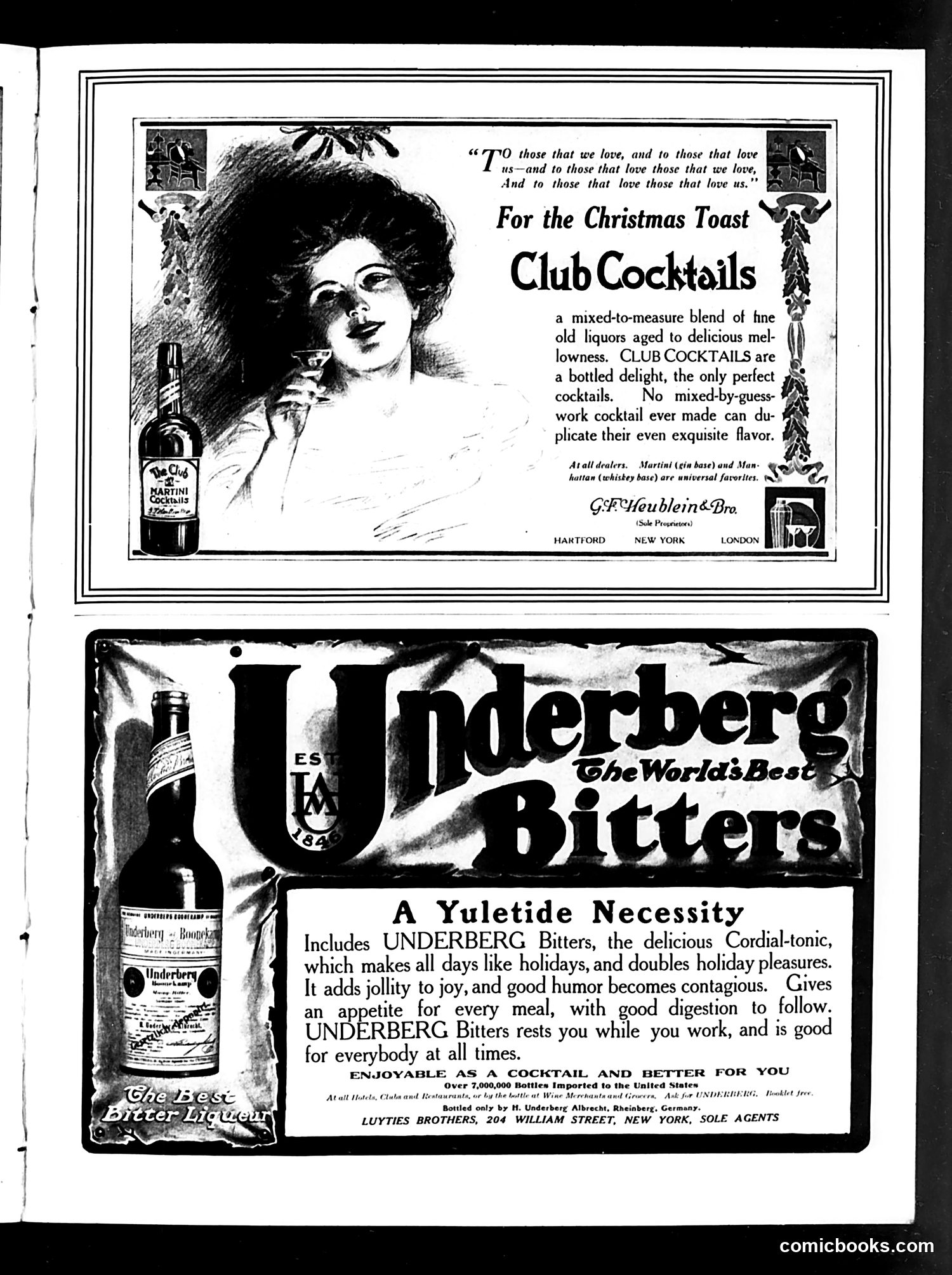
This page contains **two alcohol advertisements**, not political cartoons or satire. Both promote pre-Prohibition liquor brands as Christmas gifts. The top ad features **Club Cocktails** by G.F. Houblein & Bro., using a romanticized illustration of a woman with a cocktail bottle, accompanied by a sentimental Christmas toast about loved ones. The bottom ad promotes **Underberg Bitters**, a German digestive cordial marketed as a "Yuletide Necessity" that allegedly aids digestion, provides energy, and improves mood—framing medicinal bitters as essential holiday refreshment. Both advertisements reflect the pre-1920 American context when alcohol was legal and openly marketed with health and social benefits claims. The sentimental framing and medicinal language would become impossible after Prohibition's passage in 1919.
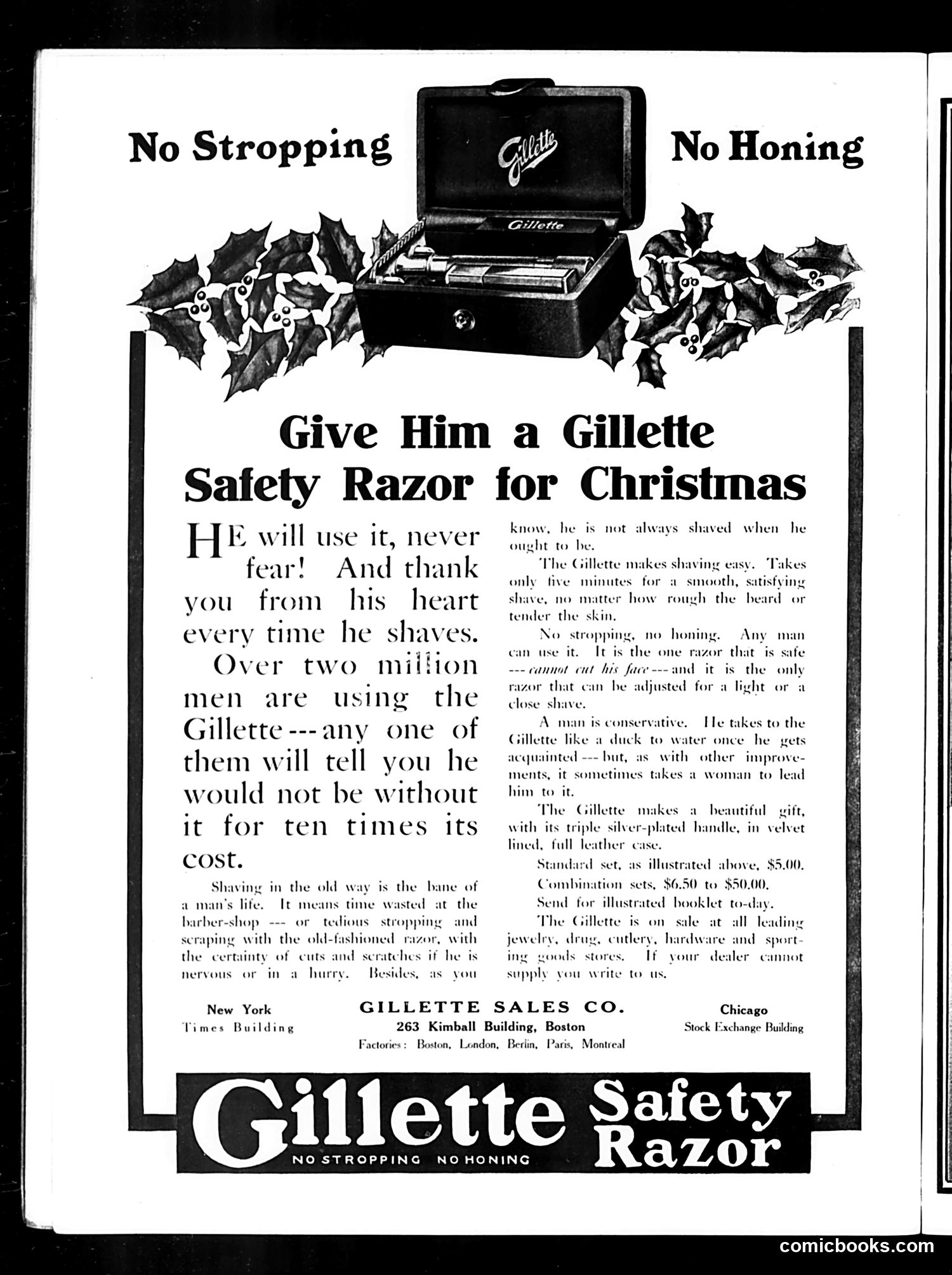
This is a full-page advertisement for Gillette Safety Razors, not a political cartoon or satirical content. It's a Christmas gift advertisement targeting male consumers. The ad emphasizes convenience and modernity: the safety razor eliminates tedious "stropping" and "honing" required by traditional straight razors. It positions the product as time-saving (five minutes versus barber visits) and safer ("cannot cut his face"). The humorous angle—relevant to the era—is the observation that men are conservative and resist new products until women encourage adoption ("it sometimes takes a woman to lead him to it"). The ad appeals to gift-givers by suggesting the razor is universally appreciated by existing users. The decorative holly illustrations and Christmas framing are standard period advertising design. This appears to be from *Judge* magazine's advertising section rather than editorial content.