
Judge, 1908-12-05 · page 37 of 44
Judge — December 5, 1908 — page 37: what you’re looking at
What you’re looking at
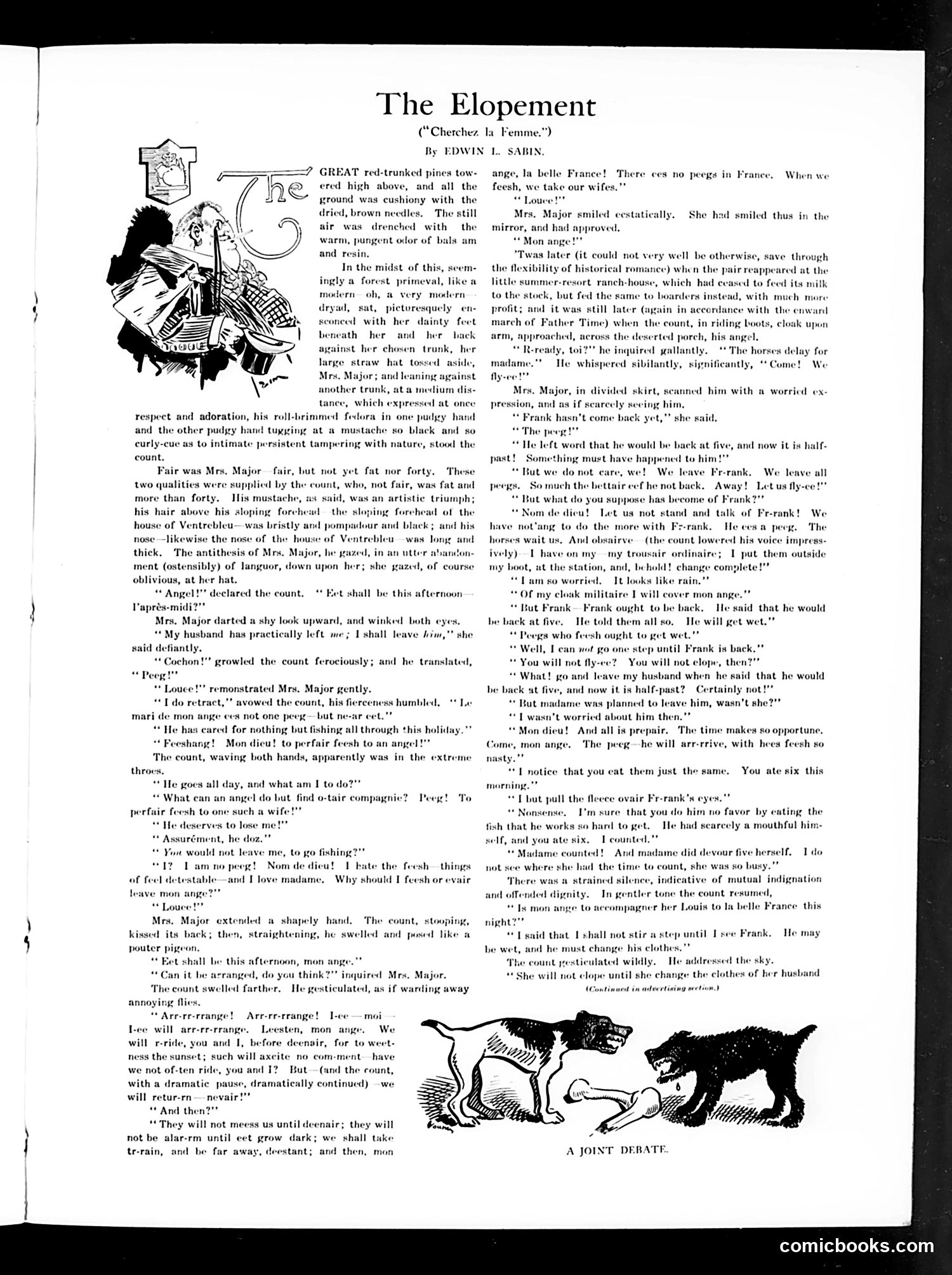
This satirical story by Edwin L. Sabin mocks the romantic elopement trope, particularly as deployed in period literature. The narrative centers on Mrs. Major, a middle-aged American woman at a summer ranch, and a Continental count with exaggerated French mannerisms (emphasized through phonetic spelling: "mon ange," "peeg," "Fr-rank"). The satire targets: 1. **Melodramatic romance conventions** - The count's theatrical wooing and the woman's conflicted passion parody overwrought literary romance 2. **Class pretension** - The count's aristocratic affectations (rolled fedora, sloping forehead caricature) suggest he's a ridiculous fortune-hunter 3. **Gender and marital comedy** - Mrs. Major's hesitation to abandon her husband (who's fishing) for romance undercuts the passionate elopement fantasy 4. **Phonetic humor** - Exaggerated French pronunciation ridicules European affectation The page's illustration shows two dogs in apparent "debate," titled "A Joint Debate" - likely commenting on the couple's argument. The story presents elopement not as romantic but as absurd theater among vain, self-interested characters.
📄 Transcribed text from this page (OCR, searchable)
Machine-transcribed from the original scan — historical spelling and the odd misread are preserved.
The Elopement (Cherchez, Ia. Femme.”) By EDWIN L. SABIN. in France, When we trunked pines tow- bove, and all the ground was cushiony with the dried, brown needles, The still air was drenched with the — mirror, and warm, pungent odor of balsam * Mon ange and resin, "Twas later (it could not very well be otherwi In the midst of this, seem- the flexibility of historical romance) when the pair reappeared at the ingly a forest primeval, like a litt which had ceased to feed its milk rv smiled ces smiled thus in the mroved. ave through ummer-resort: ranch-hous rh oh, a very modern to the stock, but fed the boarders instead, wi h more , Sat, picturesquely en- profit; and it was sti uygtin in accordance with the cnward / with her dainty feet march of Father Time) when the count, in riding boots, cloak upon th her and her back proached, across the deserted porch, his angel, against her chosen trunk, her he inquired gallantly. he horses delay for large straw i spered sibilantly, significantly, Come! We Mrs, Major; another trunk, at a medium dis- ajor, in divided skirt, seanned him with a worried ex- tance, which expressed at scarcely s respect and adoration, his roll-brimmed fedora in one pudgy sn’t come back y and the other pud; sing at a mustache so black and so curly-cue as to intimate persistent tampering with nature, stood the “THe left word that he would be back at five, and now it ix half- | count. ppened to him! Fair was Mrs. M but not yet fat nor forty. ‘These * But we do not care, We leave Fr-rank. We leave all two qualities were supplied by the count, who, not fair, was fat and — pegs, So much the bettair cef he not back. Away! Let us fly-ce more than forty, His must: yo artistic triumph; * But what do you suppose has become of his hair above his sloping. fc the Hof the “Nom de dieu! Let us not stand and talk rank! W house of Ventrebleu—was bristly and pomy ck; and his have not'ang to do the more with Fr-rank. He ces a peeg. ‘The nose —likewii of the house of Ventrebleu was long ait us, And obsairve (the count lowered his voice impress- thick. The esis of Mrs. Major, he gazed, in an utter a I have on my my trousair ord 3 1 put them outside ment (ostensibly) of languor, down upon her; she gazed, of t, ut the station, and, behold! change complete oblivious, at her hat. “Lam so worried, It looks like rain.’? “Angel !"’ declared the count.‘ Ket shall be this afternoon : Jouk militaire 1 will cover mon ange } Vaprés-midi?”” Frank ought to be back, 1 4 Mrs, Major darted a shy look upward, and winked both eyes. . He told them all so, He will “My husband has practically left me; [shall leave hin,” she who feesh ought to get wet." said defiantly, “Well, Lean nef go one step until Fran! “Cochon!”? growled the count ferociously; and he trans * You will not fly. You will not elope, then?” “Pe “What! so and leave my husband when he said that he would Louce!"" remonstrated Mrs. Major gently, he back at five, and now it is half-past? Certainly not “Tdo retract," avowed the count, his fierceness humbled, But madame was planned to leave him, wasn’t she i ces not one peg . “TL wasn't worried about him th d for nothing but fishing all through this holiday “Mon di And all is prepai » time makes so opportune. Mon dicu! to perfair feesh to an angel!” Come, mon ange. ‘The peeg—he will arr-rrive, with hees feesh so The count, waving both hands, apparently was in the extrem ” throes, I notice that you cat them just the same. You ate six this “He goes all day, and what am I to do?” morning.” What can an angel do but find o-tair compagnie To +P but pull the flecee ovair Fr-rank's eyes.” perfair feesh to oni “Nonsense, I'm sure that you do him no favor by eating the ** He deserves to lose met"? fish that he works so hard to get. He had searcely a mouthful hi “ Assurément, he doz." self, and you ate six. Le * You would not i And madame did devour five herself. 1 do “17 Lam no peeg! edicu! [hate the feesh things not see where s'time to count, aho was so busy of feel detest and I love madame, Why should I feesh or evair There was a strained silence, indicative of mutual leave mon a al dij y. In gentler tone t unt resumed, “Ly smpagner her Louis to la belle France this ) Mrs. Major extended a shapely hand, ‘The count, stoopiny kissed its back; then, straightening, he swelled and posed lik aid that [shall not stir a step until Psee Frank, He may 5 pouter pig nd he must change his clothes." He addressed the sky. ily until she change the clothes of her husband count yrestic Mrs. Major. She will not eloy if warding away inquire All be this afternoon, mon nit be i, do you thin ount swelled farther, He gesticulated, ing flies. “ Are-re-rrange! Arr-re-rrange! I-ce —moi nee. 1 We you and I, before deenair, for anno; mon a Lee will arrerr-rr: will r-ride, nt ‘and the count, ite no com we not of-ten ride, you and 1?) But with a ¢ ¢ pause, dramatically continued) we will retur-rn—nevair! And then?”* “They will not us until rm until cet grow dark; we si 1 air; they will I take t; and then, mon not be al tr-rain, A JOINT DEBATE. nd be far a comicbooks.com