
A complete issue · 16 pages · 1908
Judge — July 4, 1908
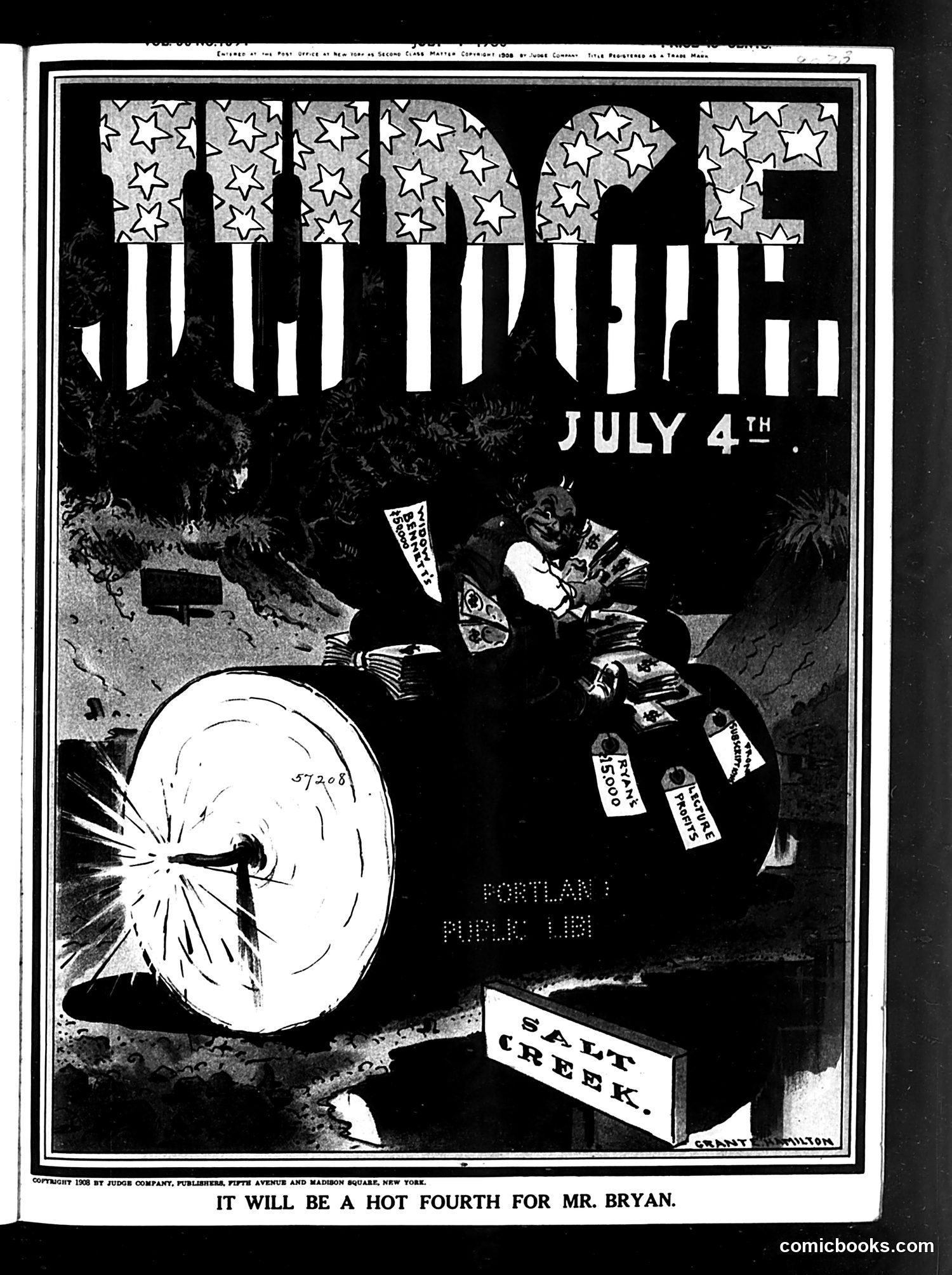
This 1908 *Judge* magazine cover satirizes William Jennings Bryan's presidential campaign. The cartoon depicts a caricatured figure (likely representing Bryan or his supporters) sitting atop an enormous firecracker labeled "SALT CREEK," surrounded by campaign materials and financial documents. The "FIRE" text in stars and stripes dominates above, while the caption reads "IT WILL BE A HOT FOURTH FOR MR. BRYAN." The satire suggests Bryan's campaign will "explode" or fail dramatically—the firecracker metaphor implies his candidacy is dangerously unstable. The scattered financial papers and campaign materials underscore concerns about his political and economic viability. This mocks Bryan's perennial candidacy and likely references the 1908 election.
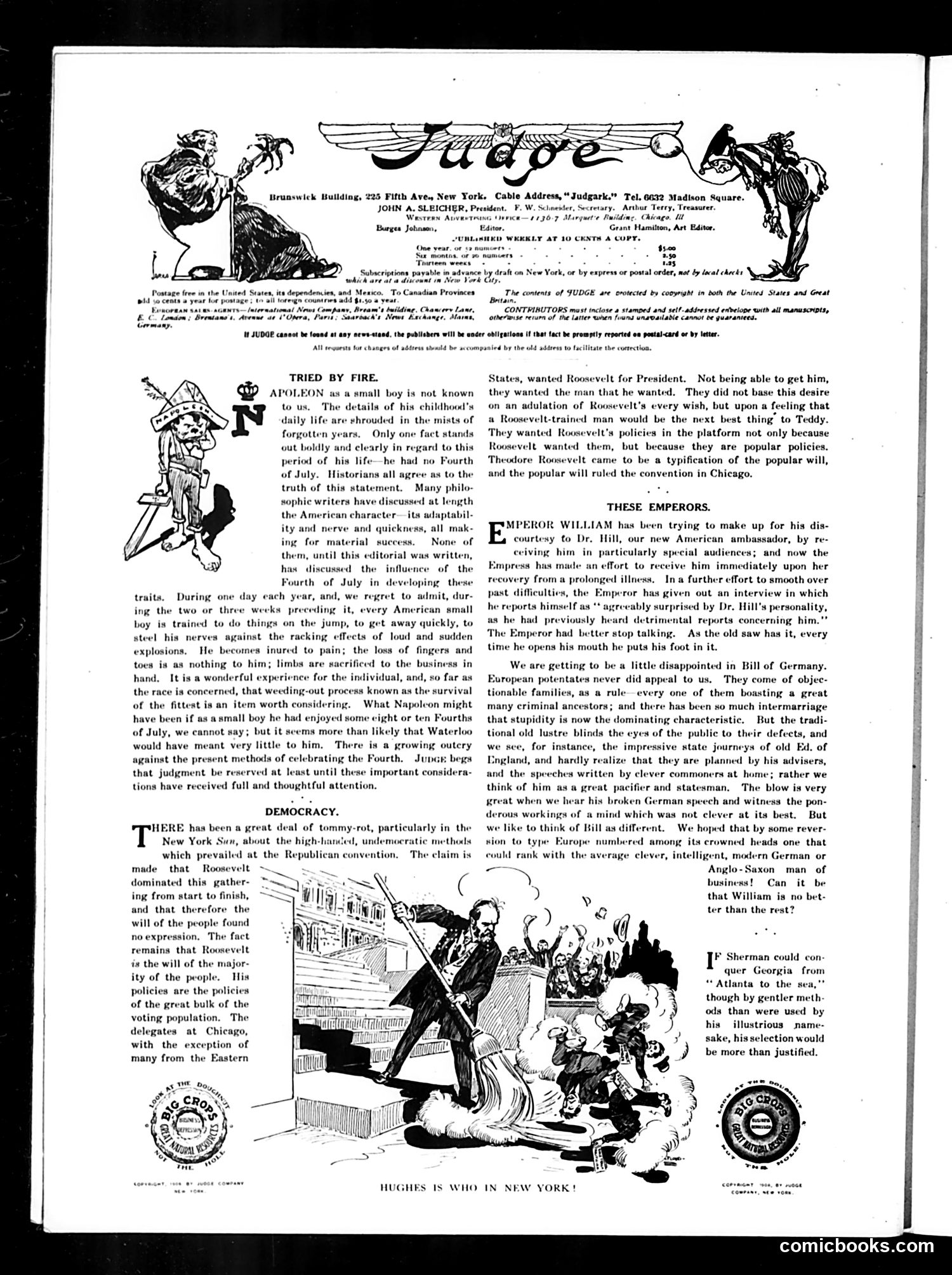
This page contains two political commentaries from Judge magazine (a Republican satirical publication). **"Tried by Fire"** discusses Napoleon as a metaphor for American character development—suggesting hardship builds strength, unlike the "Fourth of July" celebrations that paper over real national challenges. **"Democracy"** satirizes the Republican National Convention in New York. The cartoon shows Roosevelt being rejected by convention delegates who wanted someone else for president but "could not get him." The satire mocks the democratic process as chaotic and manipulated—delegates claiming to represent the people's will while actually pursuing backroom politics. The caption "Hughes is Who in New York!" suggests Charles Evans Hughes emerged as the compromise candidate, highlighting the gap between democratic ideals and convention realities. Both pieces critique American political hypocrisy.
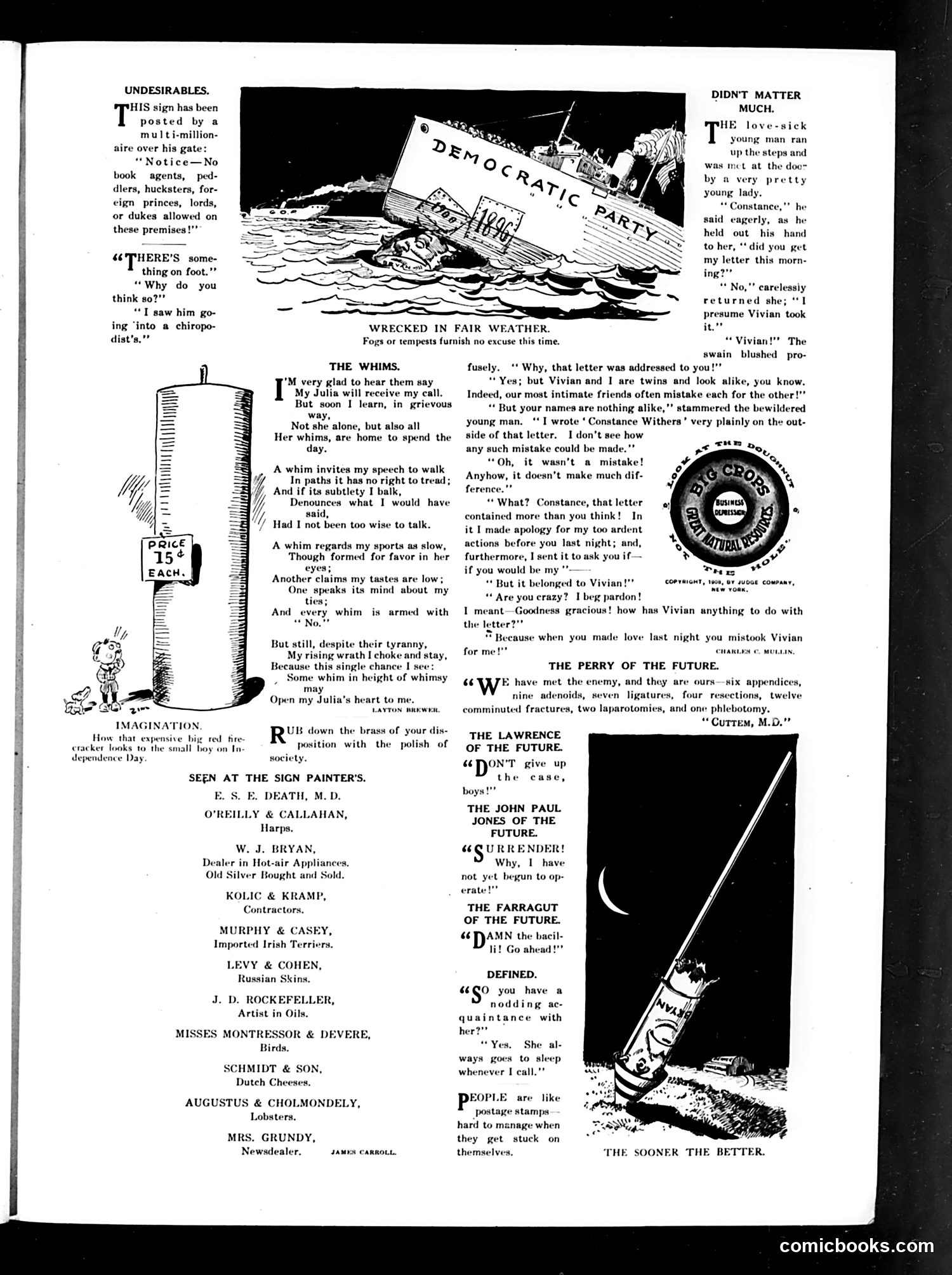
The main cartoon depicts a sinking ship labeled "DEMOCRATIC PARTY" with the caption "WRECKED IN FAIR WEATHER." This satirizes the Democratic Party's internal troubles or electoral failures occurring during peacetime conditions—suggesting their collapse wasn't due to external crisis but their own mismanagement or divisions. The remaining page content consists primarily of humor pieces and advertisements rather than additional political cartoons. These include brief comedic stories ("The Whims," "Didn't Matter Much," "The Perry of the Future") and business advertisements for local establishments (physicians, contractors, merchants). The overall message criticizes Democratic Party leadership, implying they squandered favorable circumstances through poor judgment or internal conflict.
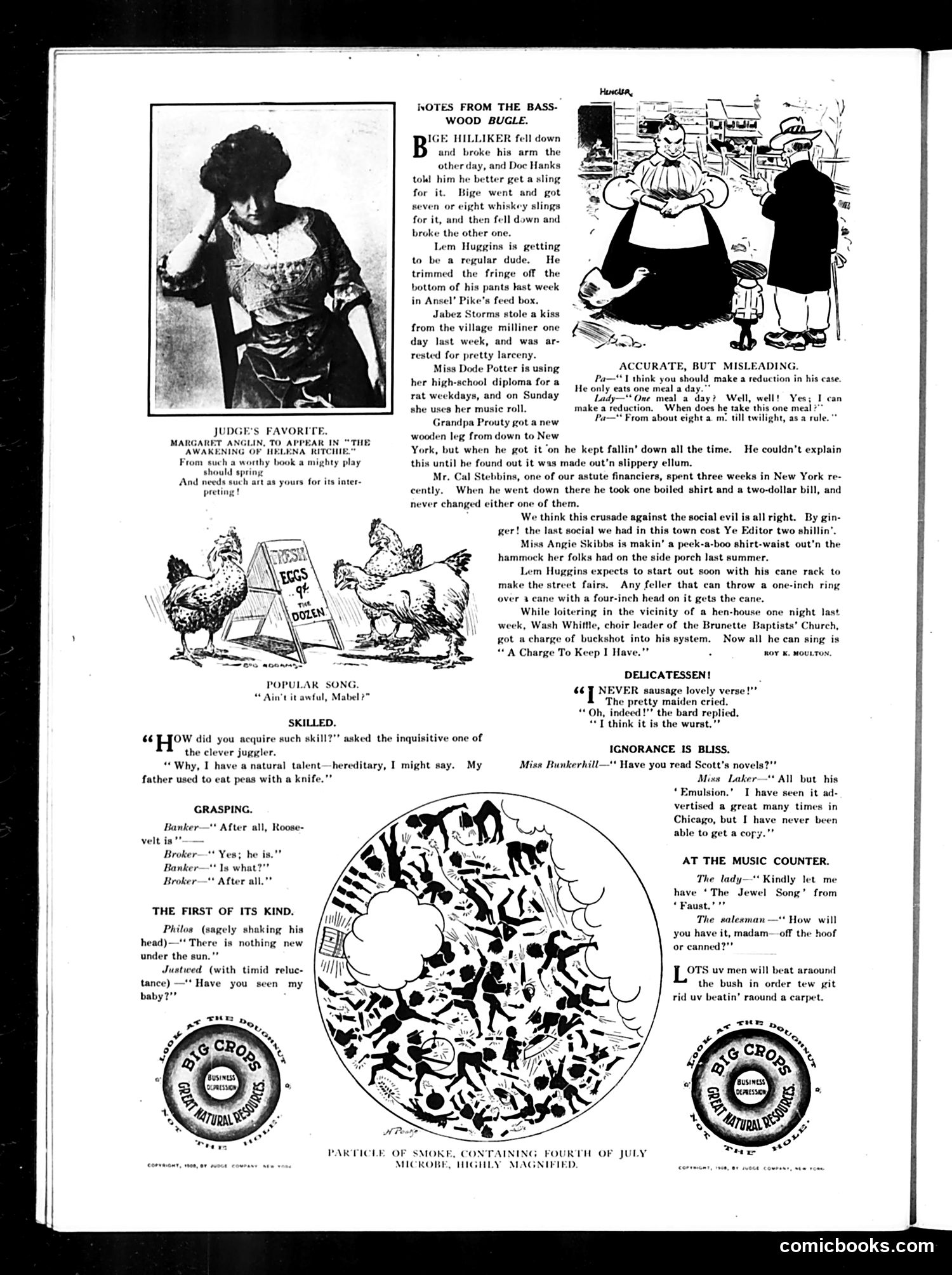
This page contains miscellaneous humor pieces rather than coherent political satire. The content includes: **"Notes from the Basswood Bugle"** — local gossip items poking fun at small-town characters (Lem Huggins, Miss Dode Potter, etc.) and their mishaps. **Illustrated jokes** featuring chickens with a "Big Cross" trademark, and a circular "Particle of Smoke" illustration—likely internal magazine recurring features or advertisements. **Dialogue humor pieces** titled "Skilled," "Grasping," "The First of Its Kind," "Delicatessens," and "Ignorance is Bliss"—simple wordplay and punchline jokes without clear political content. **"At the Music Counter"** — a brief comic exchange about sheet music. The page emphasizes rural/provincial humor and domestic situations typical of early 20th-century satirical magazines, with no identifiable major political figures or events.
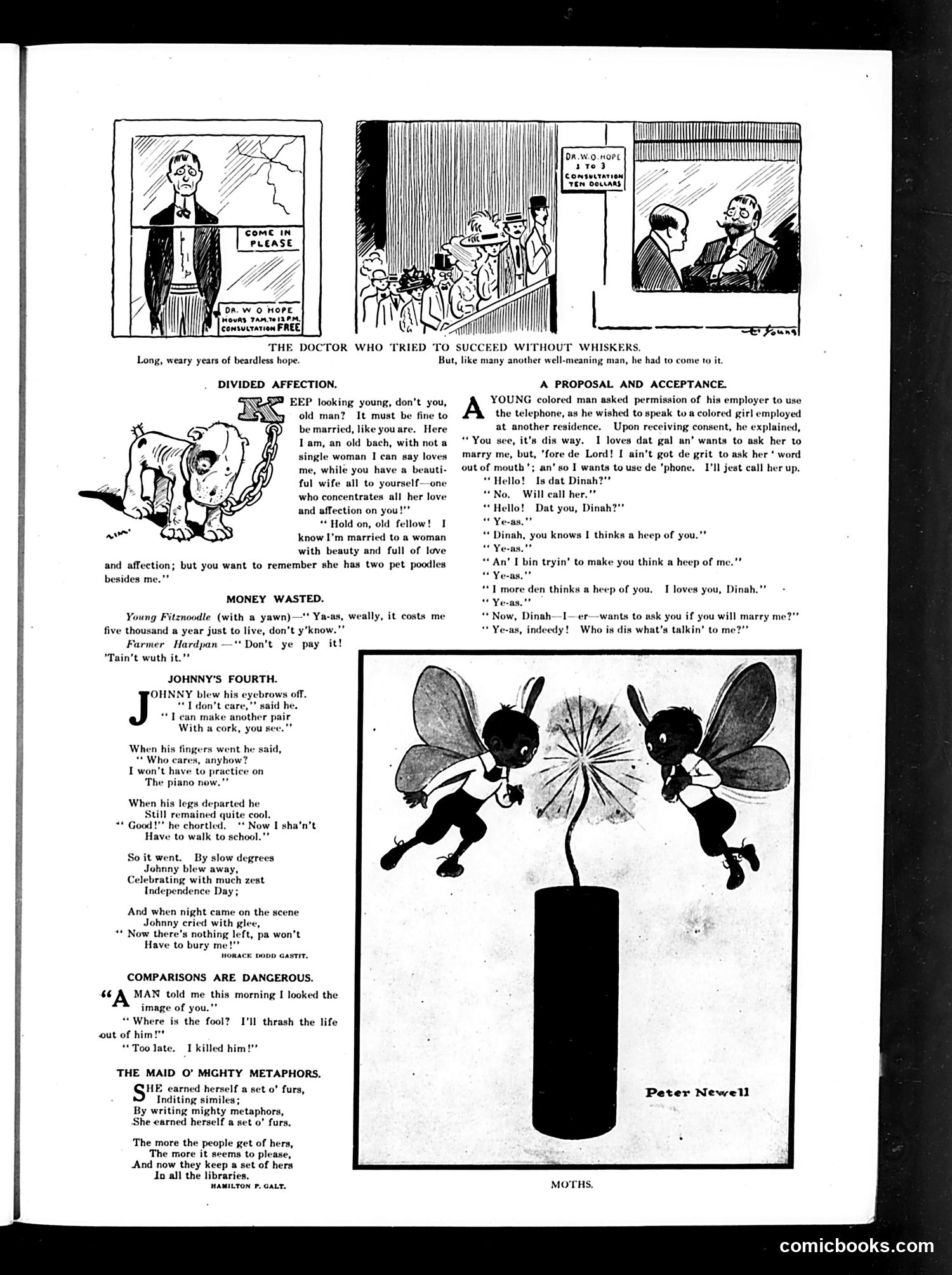
This page contains several humorous anecdotes and illustrations rather than political commentary. **"The Doctor Who Tried to Succeed Without Whiskers"** (top) satirizes a doctor's failed attempt at professional credibility—suggesting facial hair was considered essential to medical authority at the time. **"Divided Affection"** mocks a man's attempt to convince his wife that loving multiple people (including "pet poodles") is acceptable—clearly absurd domestic humor. **"A Proposal and Acceptance"** presents a romantic exchange where a young man proposes via telephone to a woman named Dinah, playing on the novelty of telephone courtship. **"Johnny's Fourth"** tells of a child's destructive Fourth of July celebration. **"Comparisons Are Dangerous"** and other sections contain brief joke verses on romance and domestic life. Peter Newell's **"Moths"** illustration shows whimsical insect characters. These are entertainment pieces rather than political satire.
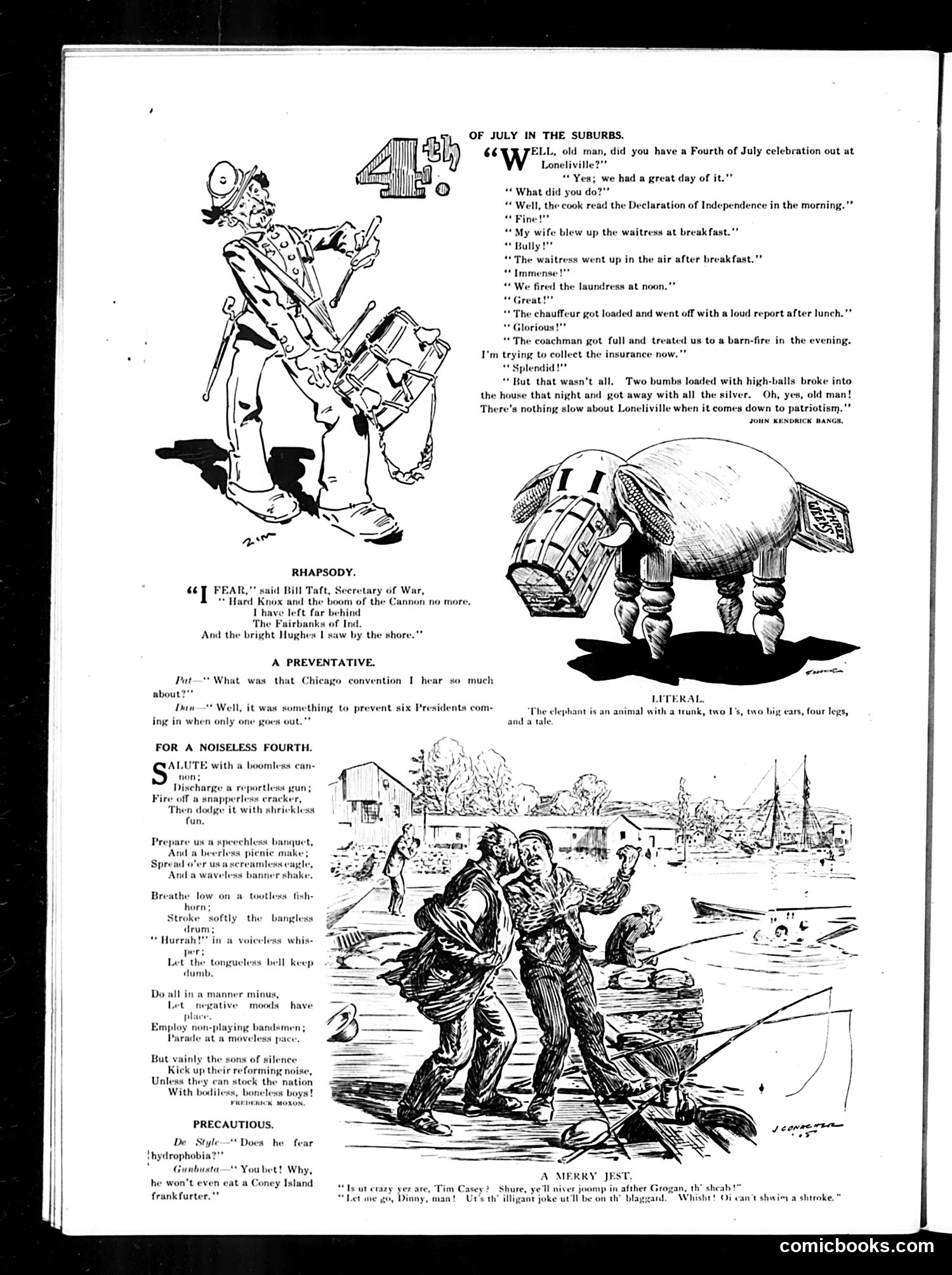
This page satirizes suburban Fourth of July celebrations among the wealthy. The main piece mocks upper-class holiday excess: a man brags about firing household staff (cook, waitress, laundress, chauffeur, coachman) throughout the day under the guise of patriotic "celebration," culminating in burglars stealing silver. The joke is that suburban patriotism masks domestic chaos and servant mistreatment. The "Rhapsody" appears to reference William Howard Taft (Secretary of War) and political figures like James Fairbanks and Charles Evans Hughes. "For a Noiseless Fourth" is humorous verse proposing a paradoxical silent celebration—suggesting complaints about Fourth of July noise pollution. Minor jokes address political conventions and fear of rabies ("hydrophobia"). The page uses caricature and irony to critique nouveau-riche suburban pretension dressed up as patriotism.
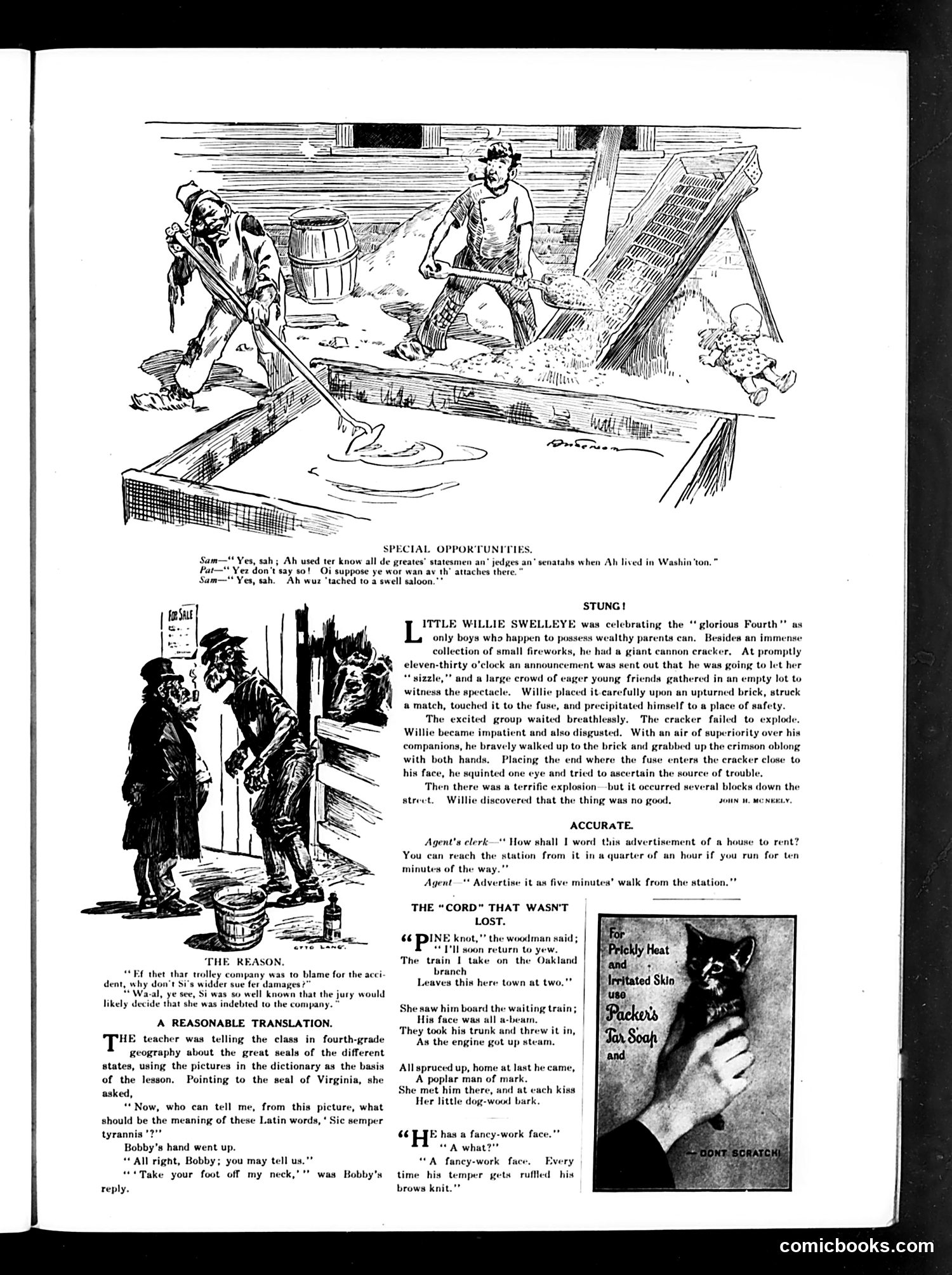
This page contains several unrelated humor pieces typical of early 20th-century satirical magazines: **Top cartoon**: Shows wealthy boys with fireworks on Independence Day. "Little Willie Swelleye" places a giant firecracker near his face to investigate why it won't ignite—it then explodes, the joke being his comeuppance for arrogant stupidity. **"The Reason"**: A brief joke about a widow not suing a trolley company after an accident, because the jury would assume she already owed them money (implying poor reputation). **"A Reasonable Translation"**: A schoolboy humor piece where a teacher asks students to translate Latin ("Sic semper tyrannis"—"thus always to tyrants"), and a boy rudely replies "Take your foot off my neck." **"The Cord That Wasn't Lost"**: A sentimental poem about a woodman leaving his sweetheart, using clever nature puns (poplar/popular, dog-wood bark). **Right side**: Contains a Packer's Tar Soap advertisement. The page is primarily **light domestic humor and advertising**, not political satire.
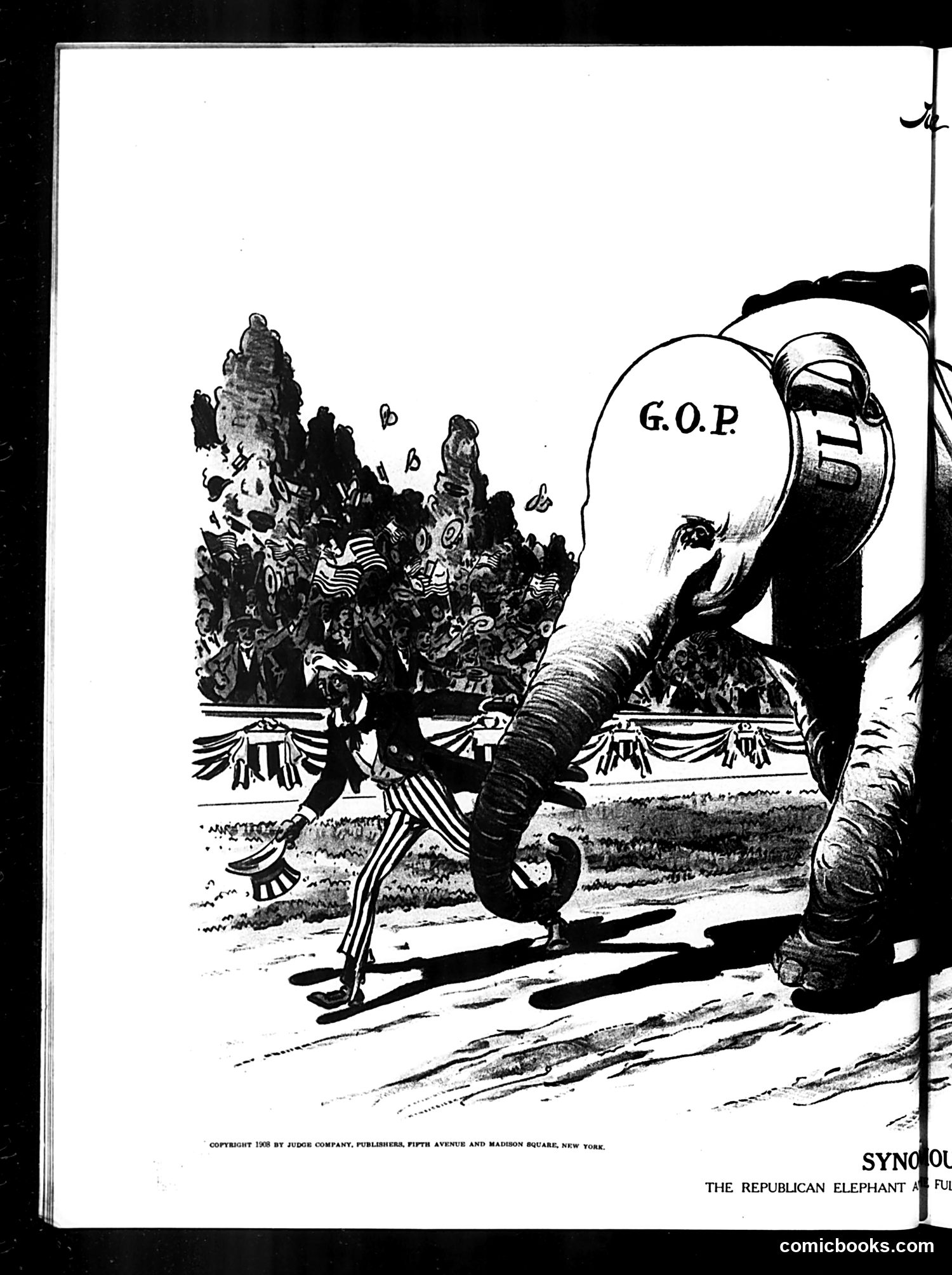
This appears to be a Judge magazine political cartoon titled "Symbol: The Republican Elephant at [text cut off]." The image shows a large elephant labeled "G.O.P." (Grand Old Party, the Republican Party's nickname) holding what appears to be a ballot or political document in its trunk. In the background, a crowd of figures waves American flags beneath a decorated platform or pavilion, suggesting a political rally or convention. The cartoon uses the elephant as the established Republican Party symbol. The satire likely comments on Republican political power, campaign tactics, or party control during an election period. The specific political context—which year or election—is unclear from the visible text, though the copyright shows 1908.
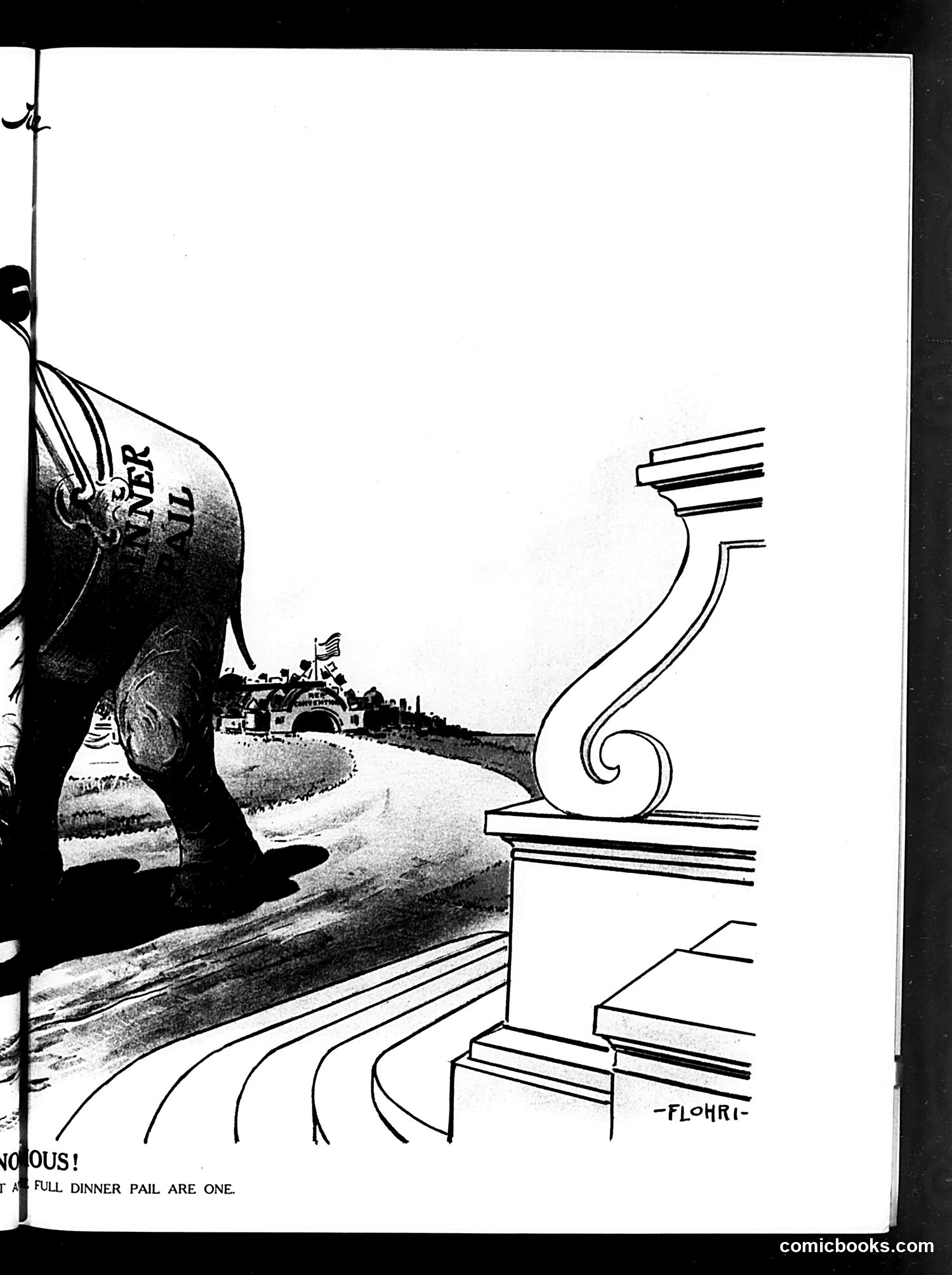
This page contains a political cartoon signed "FLOHR" from *Judge* magazine. The image depicts a large naval vessel or battleship on the left, labeled "UNDER" (partial text visible), approaching a coastal fortification on the right. The artistic style suggests early 20th-century American naval imagery. The OCR'd text fragment "AM FULL DINNER PAIL ARE ONE" appears incomplete but likely references the "Full Dinner Pail" — a Republican campaign slogan from the 1900 McKinley election, associating GOP leadership with prosperity and workers' well-being. Without complete context or caption, the cartoon's specific satirical target is unclear. It may critique naval policy, foreign relations, or economic claims, but the precise meaning requires additional page context or publication date information.
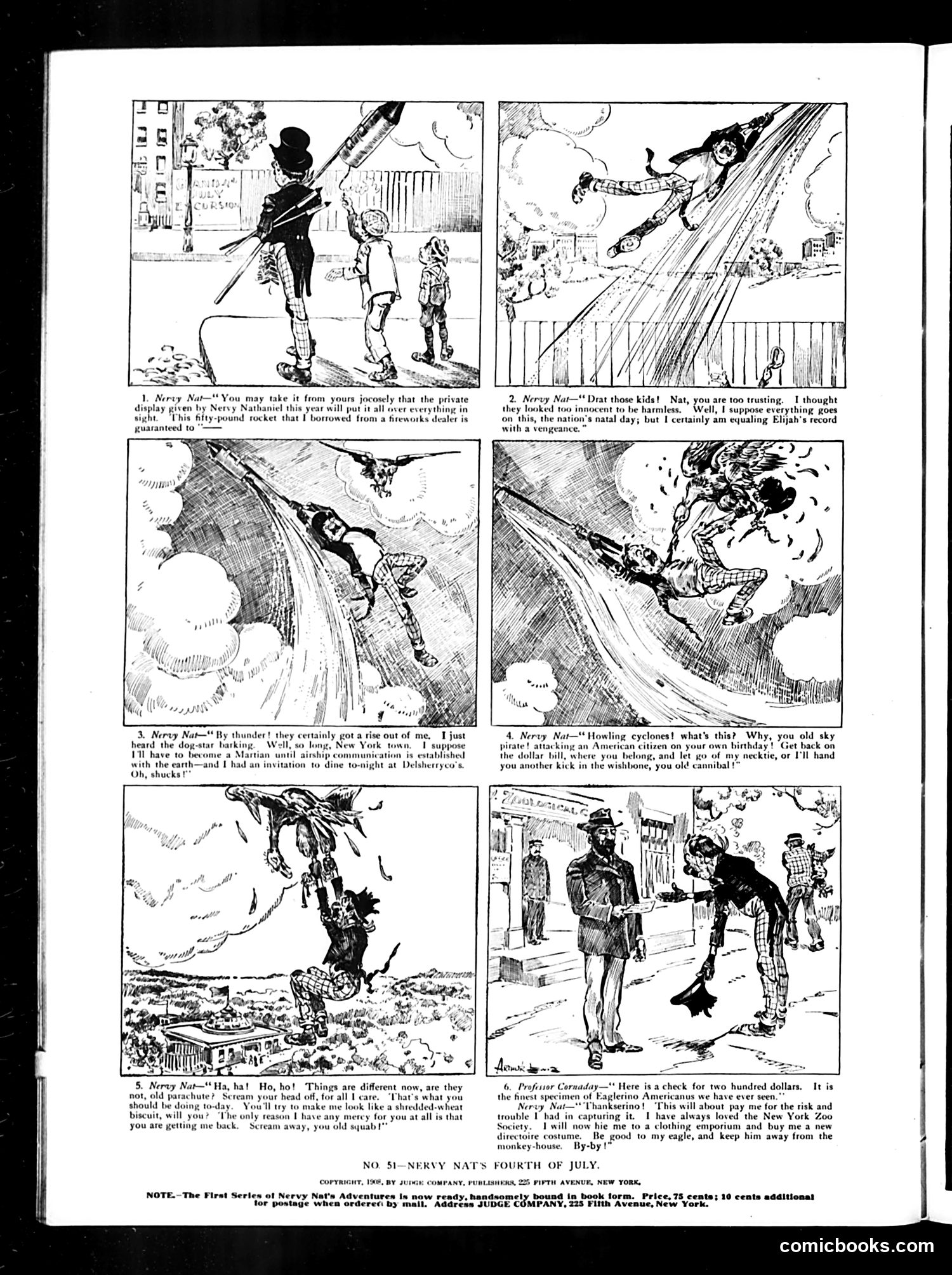
This is a comic strip about "Nervy Nat," a mischievous character creating chaos on Independence Day. The strip shows Nat launching fireworks (including a "fifty-pound rocket" borrowed from a fireworks dealer) that endanger children and others. In subsequent panels, his antics escalate—he appears to collide with a sky pirate mid-air, encounters an angry pirate demanding payment, and causes general mayhem. The humor relies on early 1900s slapstick: reckless Fourth of July fireworks endangering innocent bystanders, class conflict (references to "Delsherryeo's" dinner and a clothing emporium), and physical comedy. The "sky pirate" reference suggests fantastical adventure-story parodies popular at the time. The strip satirizes irresponsible holiday celebrations and the dangerous fireworks culture of the era, presented through comedic misadventure rather than serious critique.
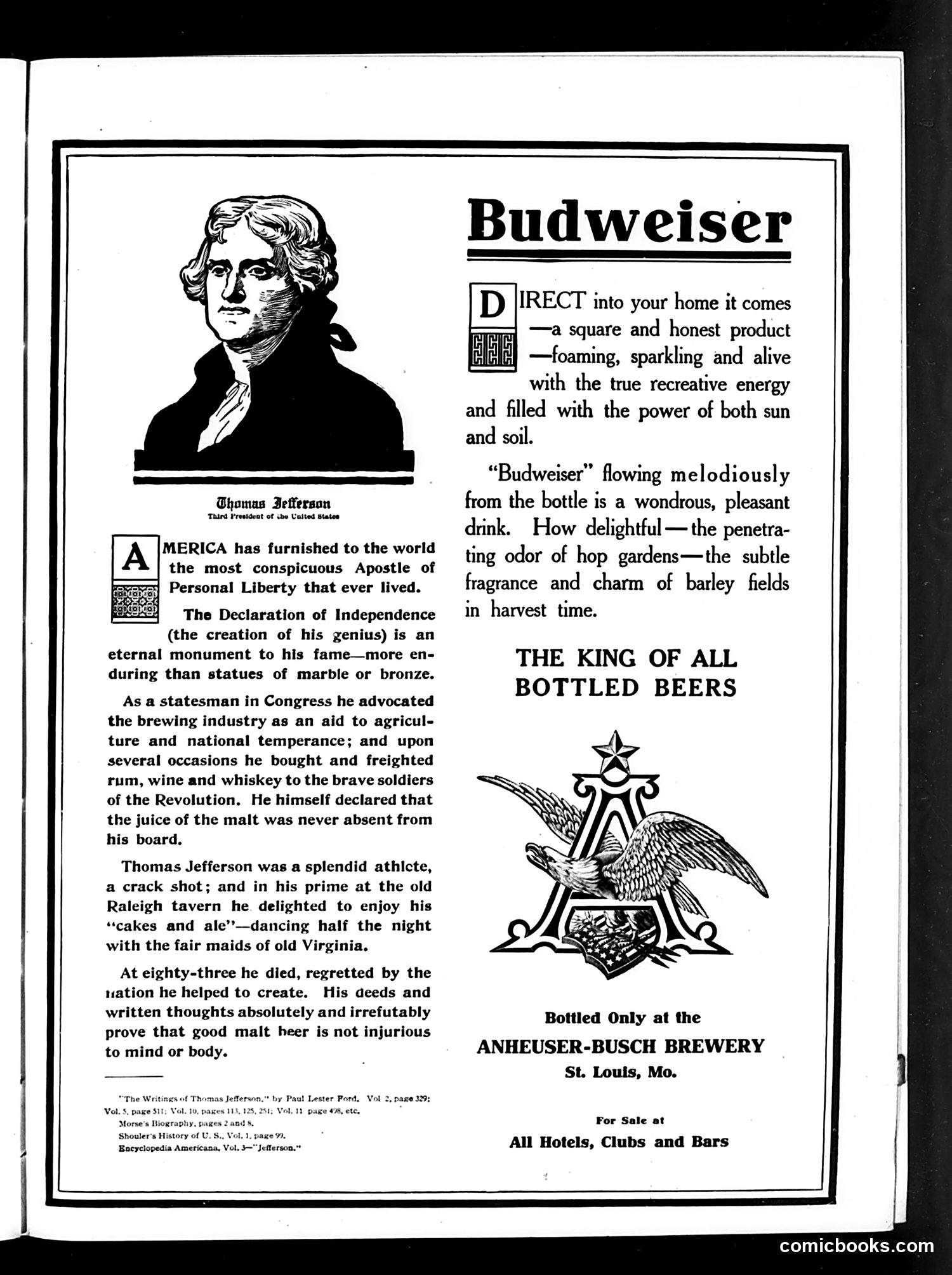
This is primarily a **beer advertisement** using historical revisionism for marketing. The left side presents a highly selective portrait of Thomas Jefferson, selectively quoting his writings and actions to argue that beer consumption is patriotic and healthful. The ad claims Jefferson advocated brewing as "aid to agriculture and national temperance," purchased alcohol for Revolutionary soldiers, and enjoyed "cakes and ale" — concluding that his example "irrefutably prove[s]" beer doesn't harm "mind or body." The right side advertises Budweiser as "THE KING OF ALL BOTTLED BEERS" from Anheuser-Busch Brewery (St. Louis). **The satire/persuasion**: By wrapping beer sales in Founding Father patriotism and pseudo-historical authority, the ad attempts to position Budweiser as wholesome, American, and historically validated. This reflects early-1900s marketing tactics before modern advertising regulations.
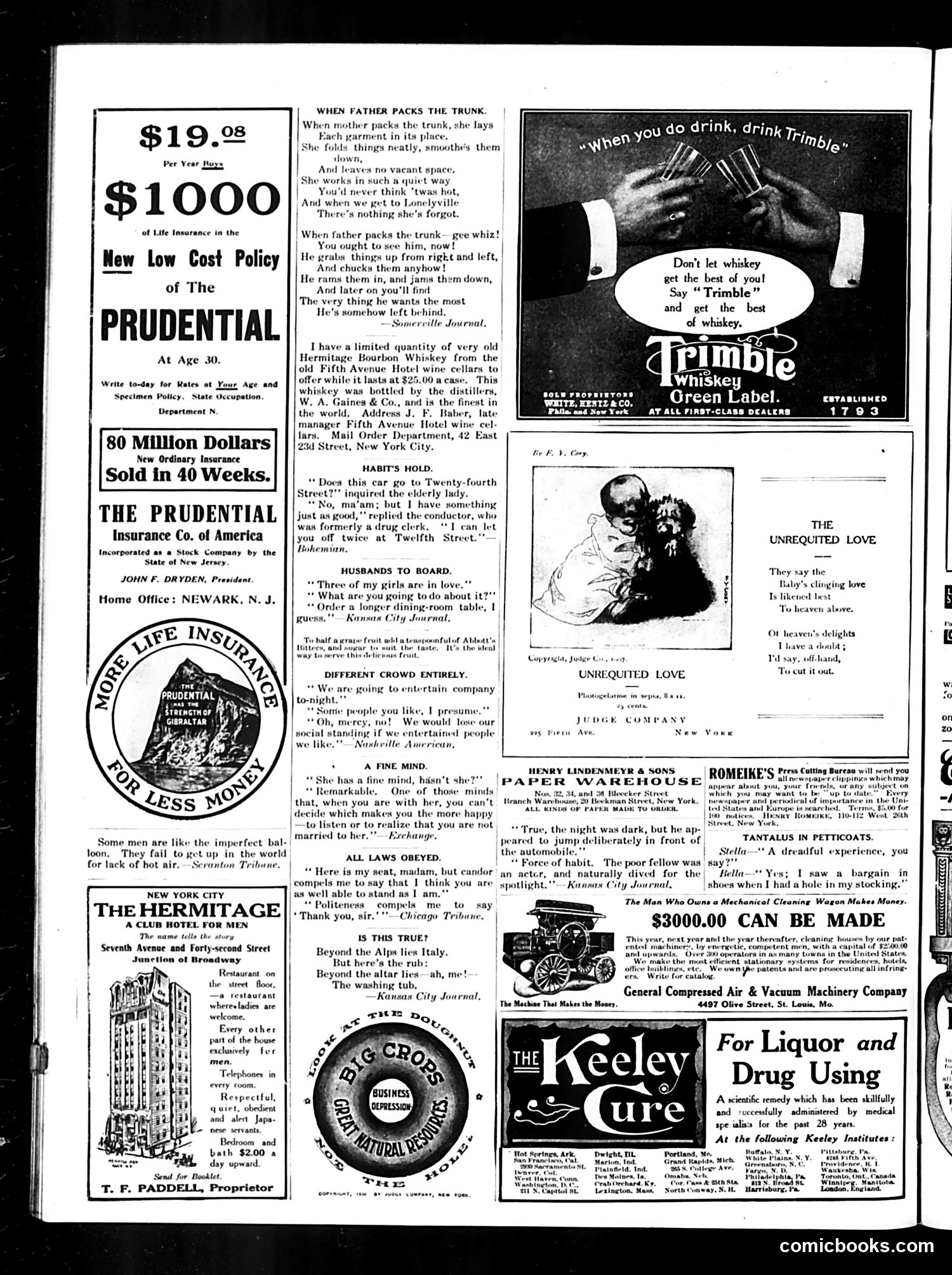
This page is primarily **advertising and humor filler** rather than political satire. The content includes: **Main Advertisements:** - Life insurance policies (Prudential) - Hotel accommodations (The Hermitage, New York City) - Whiskey (Trimble brand) - Various business services **Humor Sections:** Several brief jokes and quips, including: - "When Father Packs the Trunk" — contrasts a mother's neat packing with a father's chaotic approach - "Habit's Hold" — a conductor joke playing on drug terminology - "Husbands to Board" — domestic humor about multiple daughters in love - "Is This True?" — brief jokes about marriage realities **The Cartoon:** Shows a couple with text about unrequited love, illustrating sentimental domestic humor typical of early 20th-century magazines. The page reflects Judge's mixed formula: advertising revenue supporting satirical content, with gentle domestic humor rather than sharp political commentary.
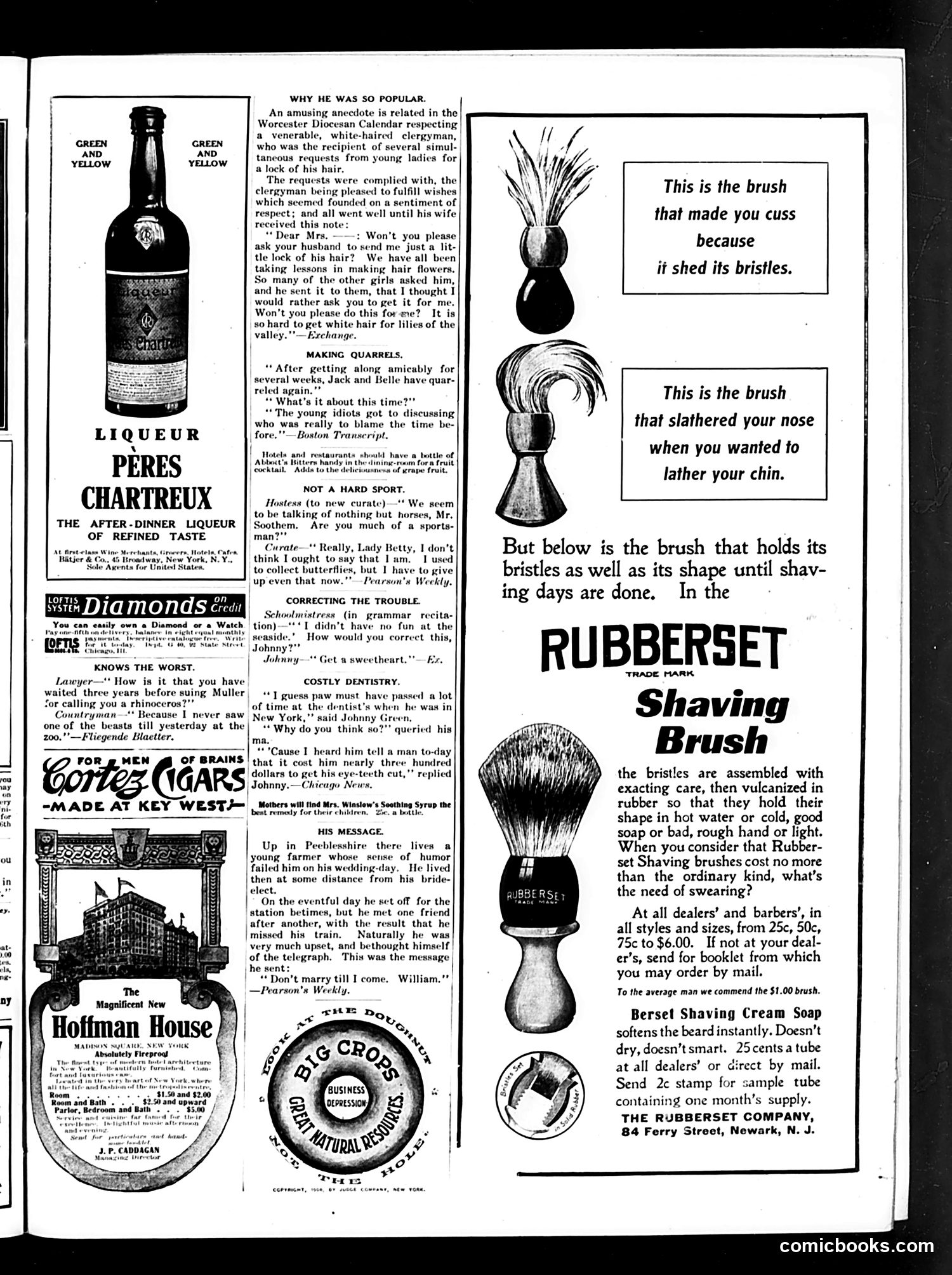
This page is primarily **advertising with embedded humor sections**, typical of early 20th-century Judge magazine format. The advertisements include liqueur, cigars, a hotel, and notably a **Rubberset Shaving Brush** (right side)—the main visual focus. The brush ad emphasizes product superiority through humorous captions about past bristle shedding problems. The text sections contain **light comedic anecdotes** rather than political satire: a clergyman unknowingly providing hair for artificial flowers, young couples quarreling, a grammar lesson joke, and a farmer's telegraph mishap. These are genteel, domestic humor pieces typical of the era. The **"Knows the Worst"** section mocks a man's three-year delay suing someone for calling him a rhinoceros—the joke being he'd never seen the animal to confirm the insult's accuracy. Overall, this reflects **Judge's shift toward lifestyle advertising and gentle, non-political humor** rather than sharp political commentary. The content targets middle-class male readers with product ads and safe, domestic jokes.
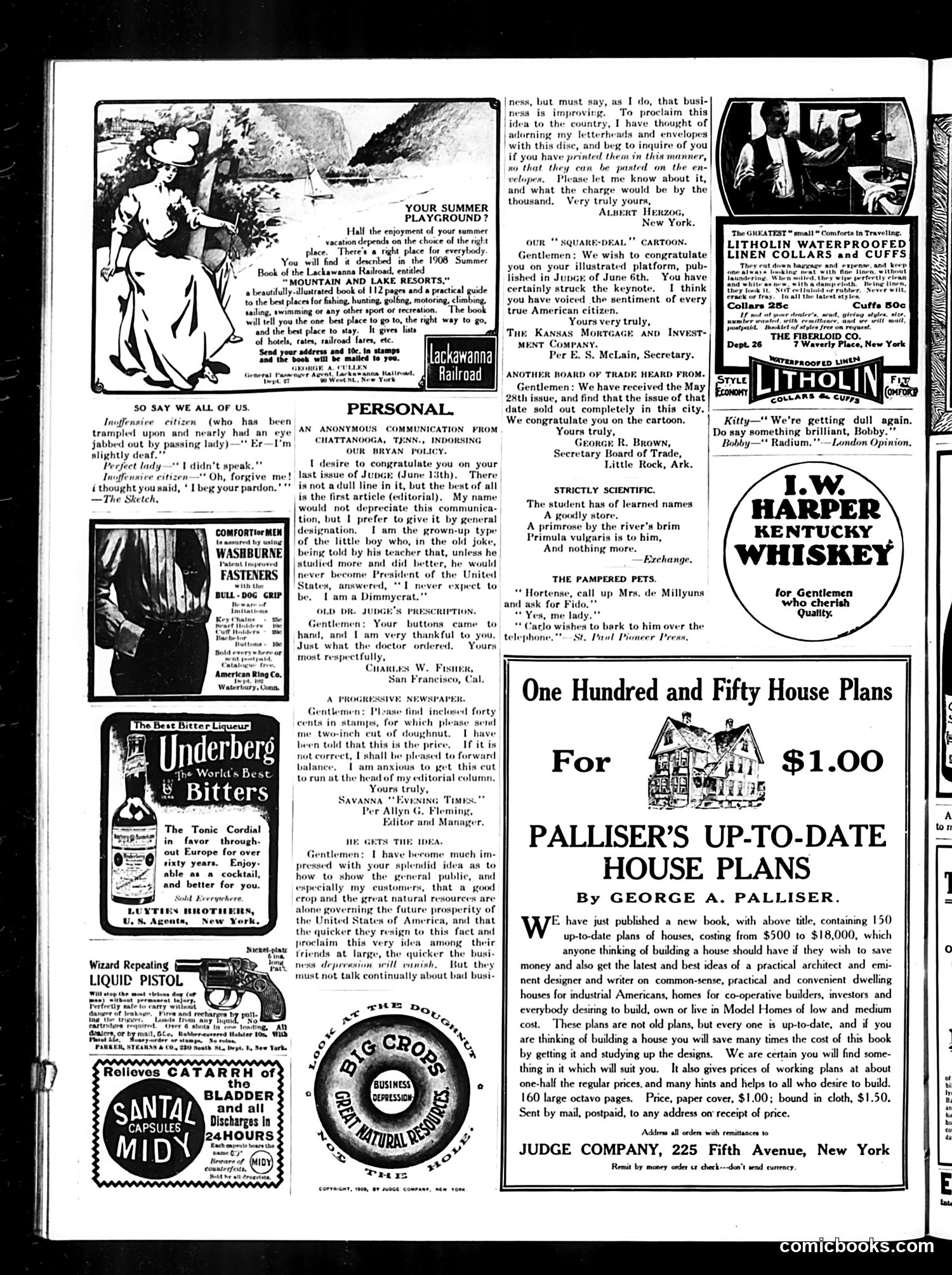
This is primarily an **advertising and personal correspondence page** from Judge magazine, not a political cartoon page. The content consists mostly of: **Personal Letters to the Editor** responding to previous Judge issues, praising their work and sharing anecdotes (including one about a child calling himself a "Dimmycrat," a disparaging term for Democrats—light political humor) **Period Advertisements** for products like the Lackawanna Railroad vacation guide, Underberg bitters, litholin collars, house plans, and medical remedies **Brief Humorous Items** including: - A "So Say We All of Us" cartoon about a deaf man's misunderstanding - A "Pampered Pets" joke about wealthy people naming their dogs - A science joke about overly formal botanical terminology The page reflects early 1900s advertising culture and reader engagement. The only significant satire is the implicit criticism of materialism in "The Pampered Pets," where wealthy city dwellers anthropomorphize their pets. Otherwise, this is a miscellaneous editorial/advertising page rather than substantive political commentary.
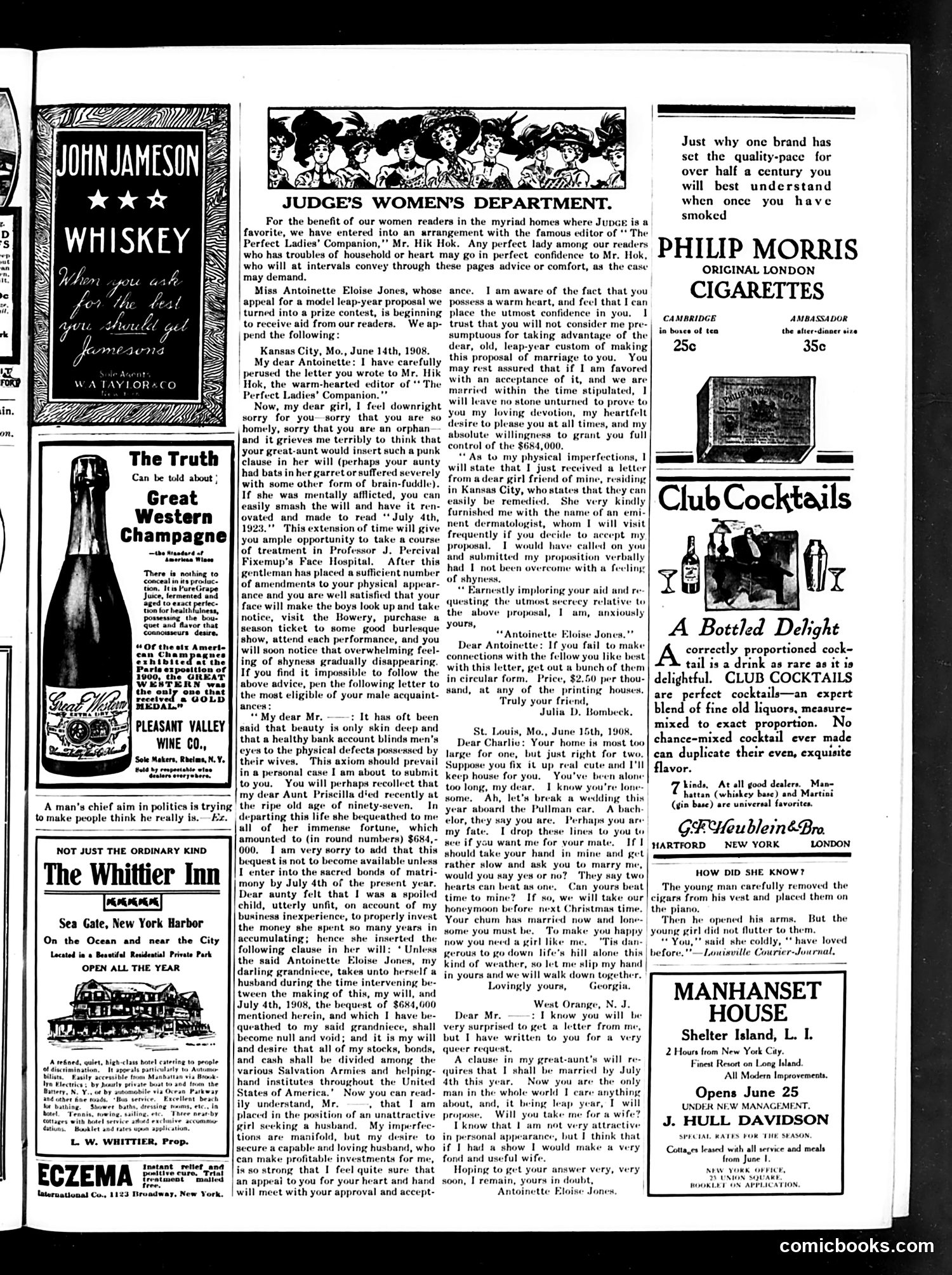
This page is primarily **advertising and advice columns** rather than political satire. The main content is "Judge's Women's Department," an advice column where editor "Mr. Hik Hok" responds to letters from female readers. The featured letter is from **Miss Antoinette Eloise Jones**, who seeks help composing a leap-year marriage proposal. Her situation: she's an orphan, self-described as homely, but has inherited $684,000 conditional on marrying by July 4th, 1908. One response cynically advises her to improve her appearance at "Professor Fixemup's Face Hospital," attend burlesque shows to overcome shyness, then propose to a wealthy man by emphasizing her inheritance. The satire here targets **mercenary marriage practices** of the era—the implication being that money, not beauty or character, drives matrimony. It's gentle mockery of both women's limited options and men's financial motivations. The page also contains period advertisements for champagne, a resort hotel, and cigarettes—typical of the era.
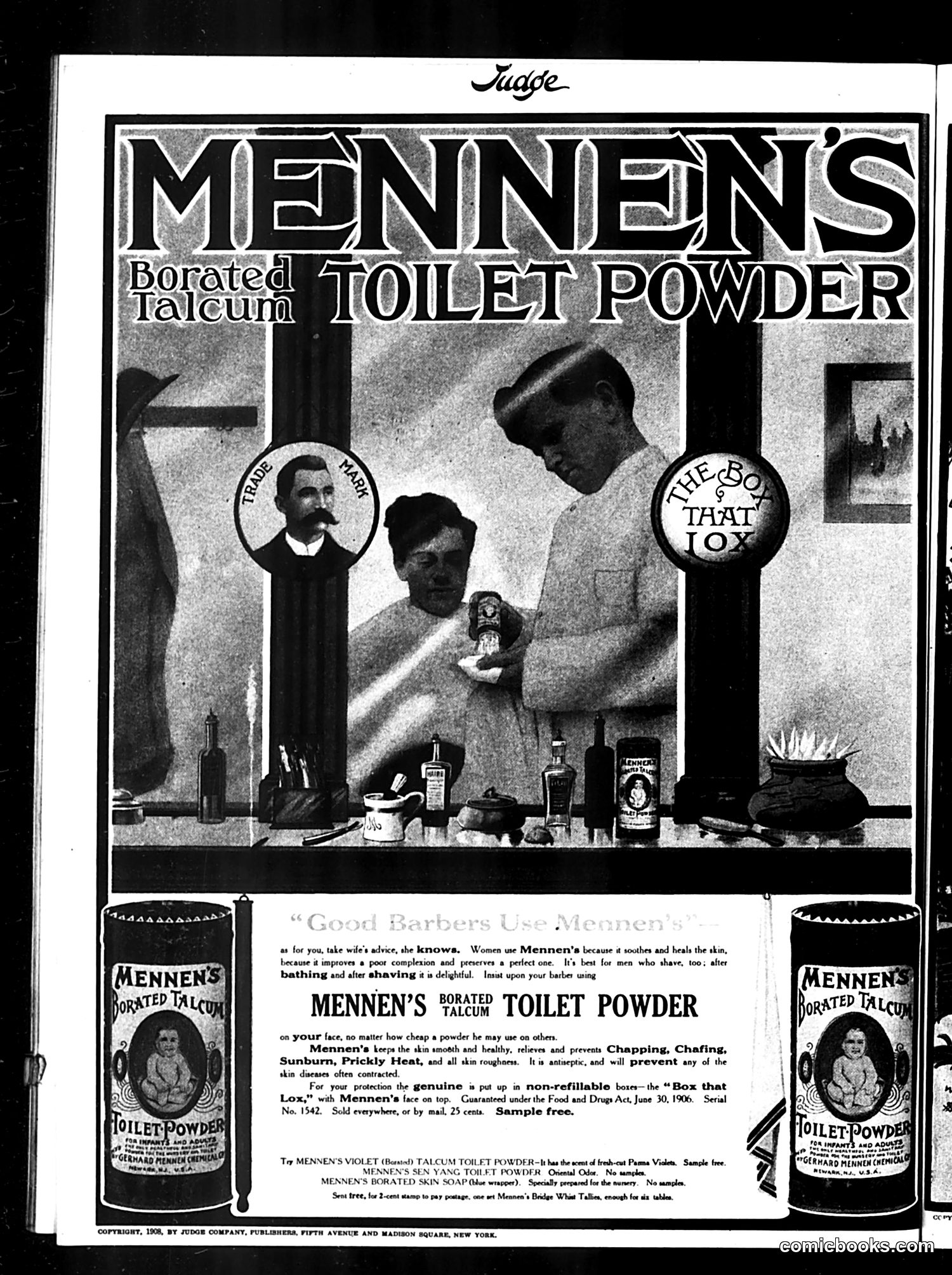
This is primarily a **product advertisement**, not political satire. The page features Mennen's Borated Talcum Toilet Powder, marketed in 1908 as a multipurpose cosmetic for both men and women. The illustration shows a barber shop scene with two male portraits in medallions labeled "Pure" and "That 10X" (unclear references, possibly brand endorsements or quality marks). The central image depicts a barber applying powder to a customer's face, surrounded by various toiletries and grooming products on a shelf. The text emphasizes the powder's benefits: soothing skin, preventing chapping and chafing, and being antiseptic. It notably appeals to male consumers post-shaving and assures purchasers of authenticity via the non-refillable box featuring Mennen's face—a guarantee under the 1906 Food and Drugs Act. This reflects early-20th-century marketing that normalized cosmetic use among men within professional grooming contexts.