
Judge, 1908-07-04 · page 2 of 16
Judge — July 4, 1908 — page 2: what you’re looking at
What you’re looking at
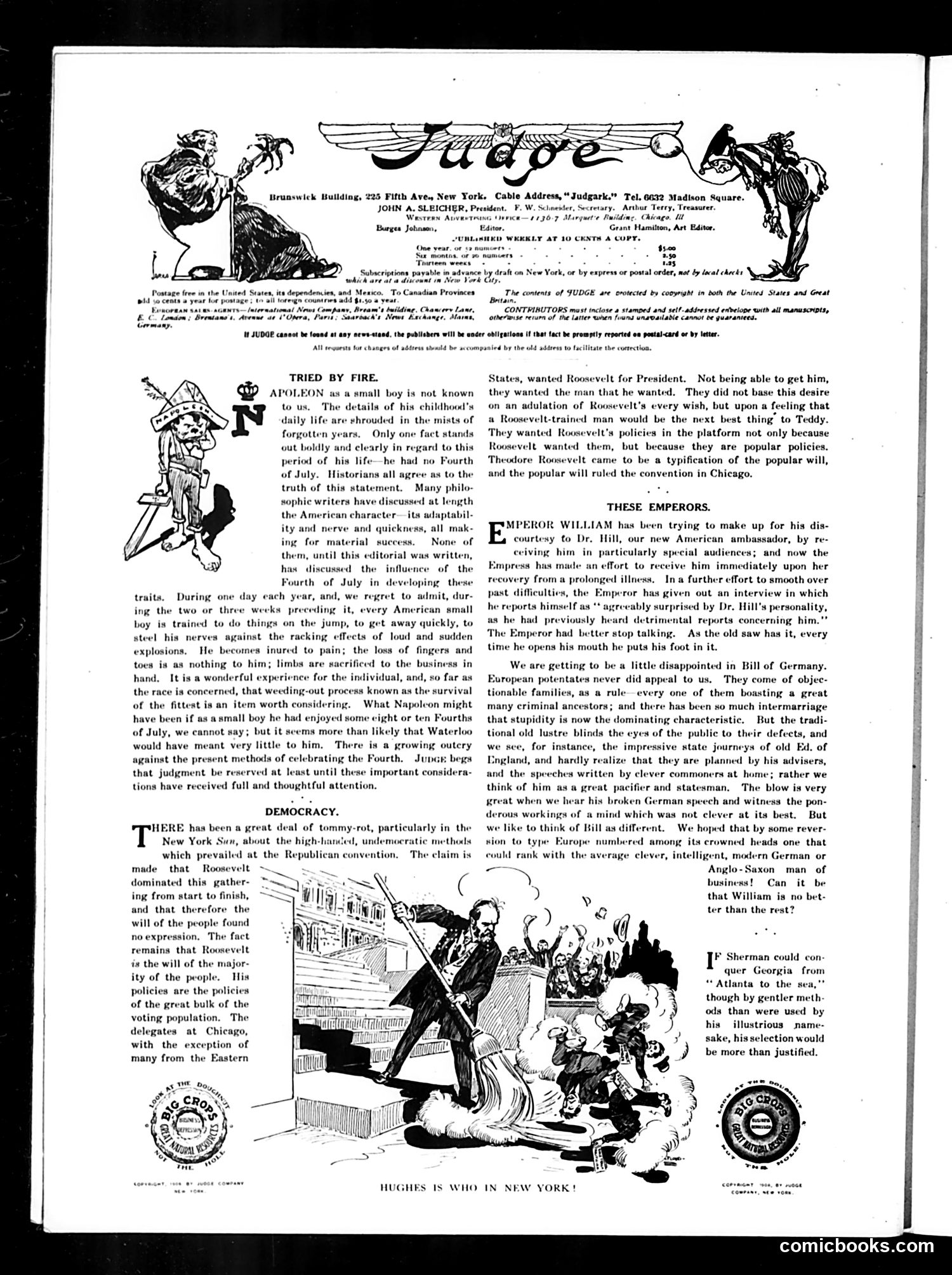
This page contains two political commentaries from Judge magazine (a Republican satirical publication). **"Tried by Fire"** discusses Napoleon as a metaphor for American character development—suggesting hardship builds strength, unlike the "Fourth of July" celebrations that paper over real national challenges. **"Democracy"** satirizes the Republican National Convention in New York. The cartoon shows Roosevelt being rejected by convention delegates who wanted someone else for president but "could not get him." The satire mocks the democratic process as chaotic and manipulated—delegates claiming to represent the people's will while actually pursuing backroom politics. The caption "Hughes is Who in New York!" suggests Charles Evans Hughes emerged as the compromise candidate, highlighting the gap between democratic ideals and convention realities. Both pieces critique American political hypocrisy.
📄 Transcribed text from this page (OCR, searchable)
Machine-transcribed from the original scan — historical spelling and the odd misread are preserved.
Burges Johnson, ‘Thurieen weeus Subscriptions payabl which are tim Ne wadian Provinces | Prost bid so cen tage ; tall to Feworaan sau rs /mtewmational News Com pai EC. London; Brontana t, Aveune at | Opera, Carmany. 0 free in the Un 1 SUDGE caneot be found at TRIED BY FIRE. APOLEON as a small boy is not known to us. The details of his childhood's daily life are shrouded in the mists of forgotten years, Only one fact stands out boldly and clearly in regard to this period of his he had no Fourth of July. Historians all agre truth of this statement. Many philo- sophic writers have discussed at length the Ame aracter— its adaptabil- ity and nerve and quickness, all n erial success. None of Jitorial was written, has discussed the influ of the Fourth of July in developing these During one day each year, and, we regret to admit, dur- ing the two or three weeks preceding it, every American small boy is trained to do things on the jump, to get away quickly, to steel his nerves against the racking effects of loud and sudden explosion comes inured to pain; the toes is as nothing to him; limbs are sacrificed to the busi It is a wonderful experience for the individual, an the race is concerned, that weeding-out process known as the of the fittest is an item worth conside: What Napoleon might have been if as a small boy he had enjoyed some eight or ten Fourths of July, we cannot say; but it se than likely that Waterloo would have meant very little to him. There is a growing outery against the present methods of celebrating the Fourth. Jupcr begs that judgment b st until t mportant considera- tions have received full and thoughtful attention. a as to the ancl ing for n them, until this trai loss of fin so far as hand, urvival ms mort DEMOCRACY. HERE has been a great deal of tommy-rot, particularly in the New York Sun, about the high- he which prevailed at the Republ made that Roosevelt dominated this gather- ing from start to finish, and that therefore the will of the people found no expression. The fact remains that Roosevelt is the will of t ity of the pe policies are the polici of the great bulk of the voting population. ‘The delegates at Chicago, with the exception of many from the Eastern al, undemocratic methods HUGHES _ Brunswick Building, 225 Fifth Ave New York. Cable Address, “Judgark.” Tel. 6632 Madison Square. . JOHN A, SLEICHER, Preside: Wastes Anvmetssine # Editor. vance by draft on New York, or by express or postal order, mot by local checks Vork Cay. ywe-atand, the publishers will be ender obligations if that fact be promptly reported on postal-card or by letter. WHO IN NEW YORK! F.W, Sclineiter, Se A ea 1130-7 9 wur Terry, Treasurer. Chicago. lit Grant Hamilton, Art Editor, KD WKKKLY AT 10 CKNTS A COPY. yucte The contents of JUDGE are orotected by covyrght in both the Unites States and Great Brtain. CONTRIBUTORS must inciose a stamped and self-addressed entvelope with all manuscrDtsy othevivise revurn of the Latter when fuund unawailadle Cannot be guaranteed. ‘It for President. Not being able to get him, they wanted the man that he wanted. They did not base this desire on an adulation of Roosevelt's every wish, but upon a feeling that a Roosevelt-trained man would be the next best thing’ to Teddy. They wanted Roosevelt's policies in the platform not only because t wanted them, but because they are popular policies. Roosevelt came to be a typification of the popular will, popular will ruled the convention in Chicago. States, wanted Roo: Roose THESE EMPERORS. MPEROR WILLIAM has been trying to make up for his dis- courtesy to Dr. Hill, our new American ambassador, by re- 1 audien and now the him in particularly spec Ina further effort to smooth over past difficulties, the Emperor has given out an interview in which he reports himself as ‘* agreeably surprised by Dr. Hill's personal as he had previously heard detrimental reports concerning him: ‘The Emperor had better stop talking. As the old saw has it, every time he opens his mouth he puts his foot in it. We are getting to be a little disappointed in Bill of Germany. European potentates never did appeal to us. They come of obje tionable fam 'y one of them boasting a great a many criminal ancestors; and there has been so much intermarriage a that stupidity is now the dominating characteri: But the tradi- tional old lustre blinds the of the public to their defects, and a 8, as a rule—¢ we see, for instanc 1c journeys of old Ed. of England, and hardly realize that they are planned by his advisers, a and the speeches written by clever commoners at home; rather we | think of him asa great pacifier and statesman, The blow is very ; great when we hear his broke rman speech and witness the pon- a derous workings of a mind which was not clever at its best. But { we like to think of Bill as different. We hoped that by some rever- a to type Europe numbered among its crowned heads one that | could rank with the average cl ntelligent, modern German or Anglo-Saxon man of business! Can it be that William is no bet- | ter than the rest? I * Sherman could con- quer Georgi “Atlanta to the se: though by gentler meth- ods than were used by his illustrious name- sake, his selection would be more than justified. from ay comicbooks.com