
A complete issue · 16 pages · 1907
Judge — August 31, 1907
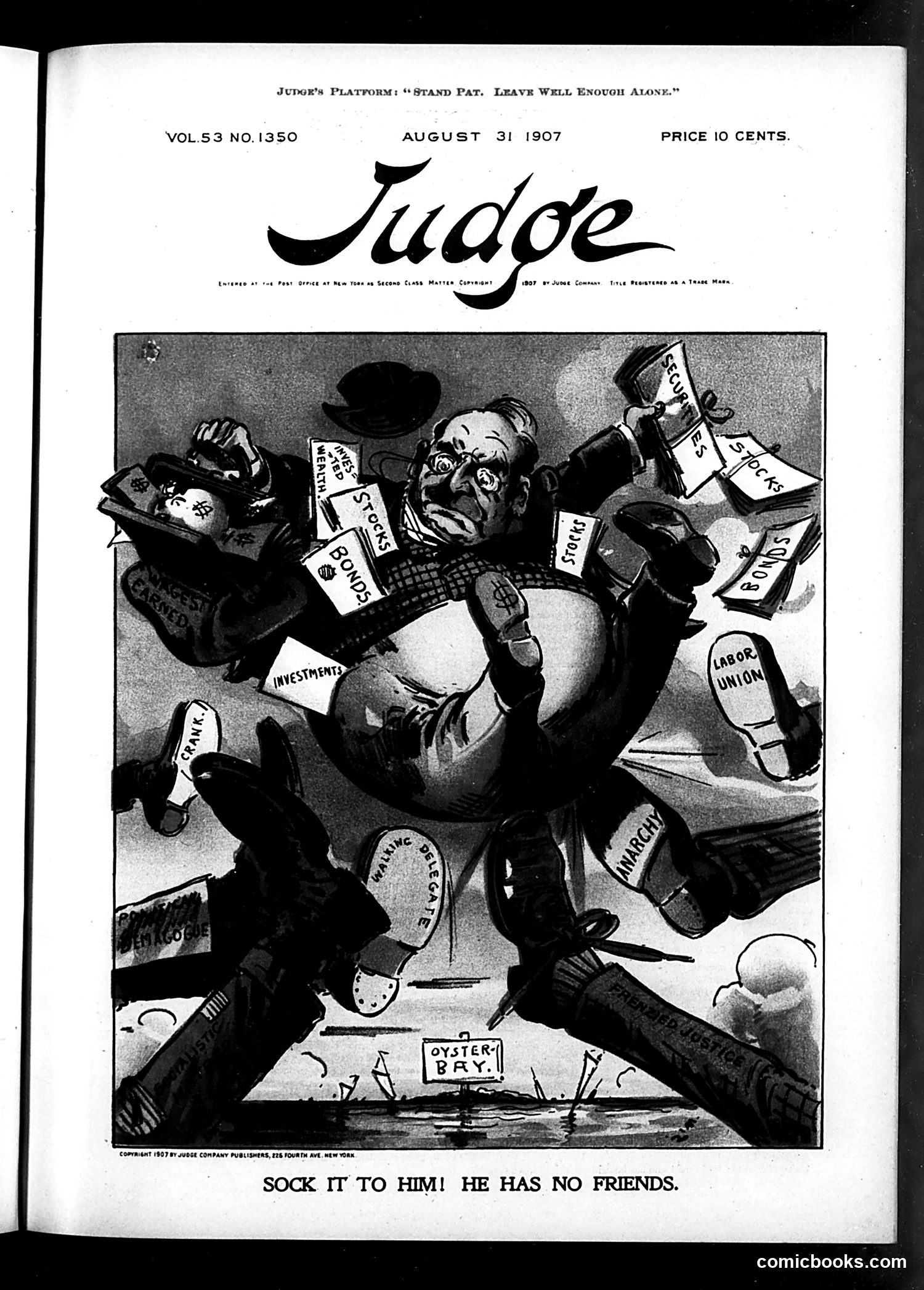
This political cartoon depicts a figure being attacked from multiple directions by labeled weapons and objects representing different interest groups and industries: "STOCKS," "BONDS," "LABOR UNION," "INVESTMENTS," "TARIFF," "RAILWAYS," "TRUSTS," and others. The figure appears to be a politician or public official surrounded by pressuring constituencies. The caption reads "SOCK IT TO HIM! HE HAS NO FRIENDS," suggesting the subject is politically isolated and vulnerable to attack from all sides. The satire critiques how powerful economic interests—corporations, financial institutions, and labor organizations—all demand favorable treatment from politicians, leaving them caught between competing demands with no reliable political support. This reflects early 1900s Progressive Era anxieties about special-interest influence on government.
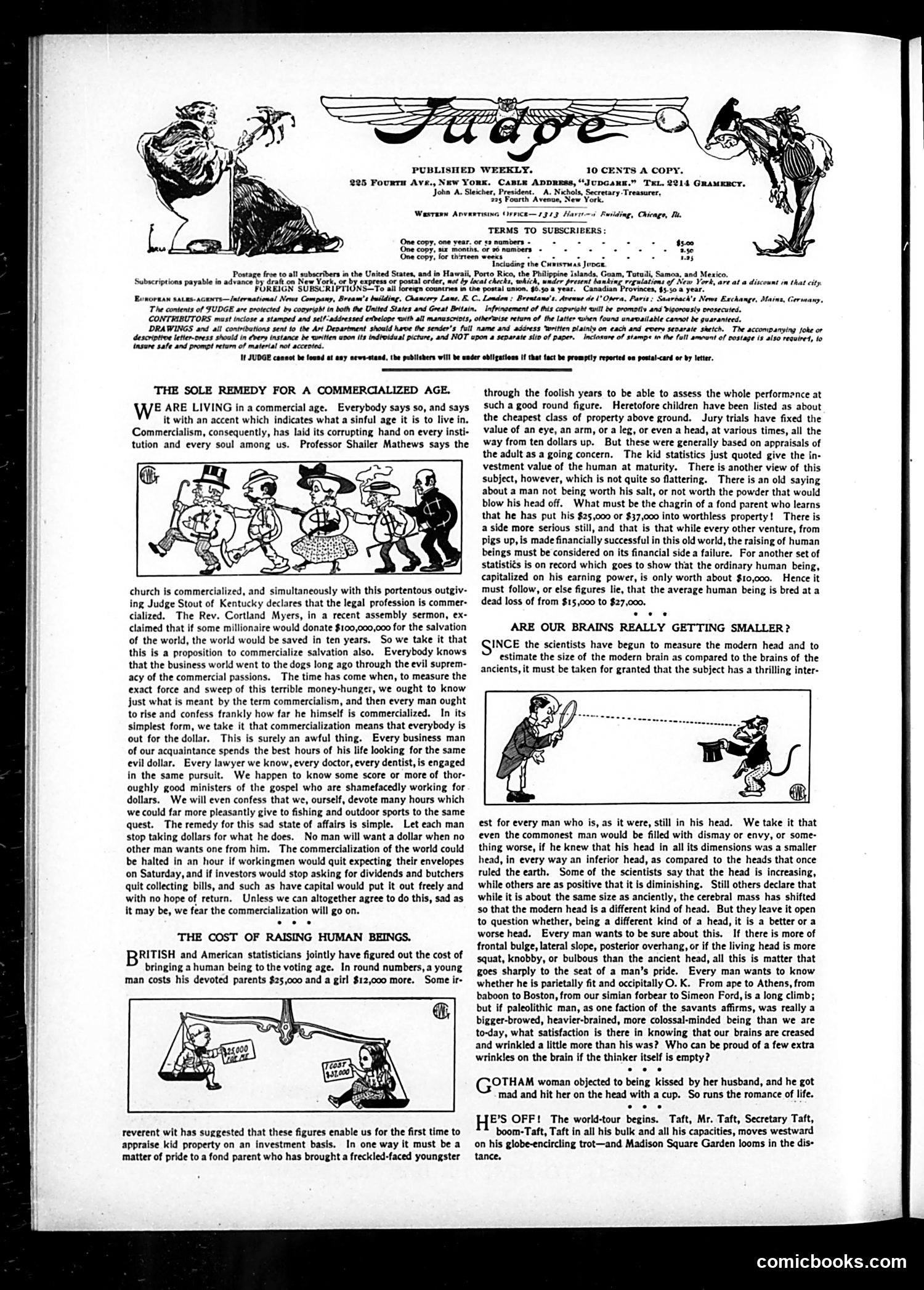
This page contains three satirical articles critiquing early 20th-century American commercialism and materialism. **"The Sole Remedy for a Commercialized Age"** attacks how every institution—church, law, medicine—has become profit-driven, with accompanying cartoon showing figures being reduced to dollar signs. **"The Cost of Raising Human Beings"** presents British and American statistics quantifying childhood expenses ($25,000-$31,000), satirizing the reduction of human life to financial calculation. The cartoon depicts children as investment commodities. **"Are Our Brains Really Getting Smaller?"** questions whether modern heads are shrinking compared to ancestors, using scientific measurement anxiety as commentary on contemporary society's obsessions. The overall satire targets the era's commodification of human experience and society's preoccupation with measurable, financial metrics over intrinsic human value.
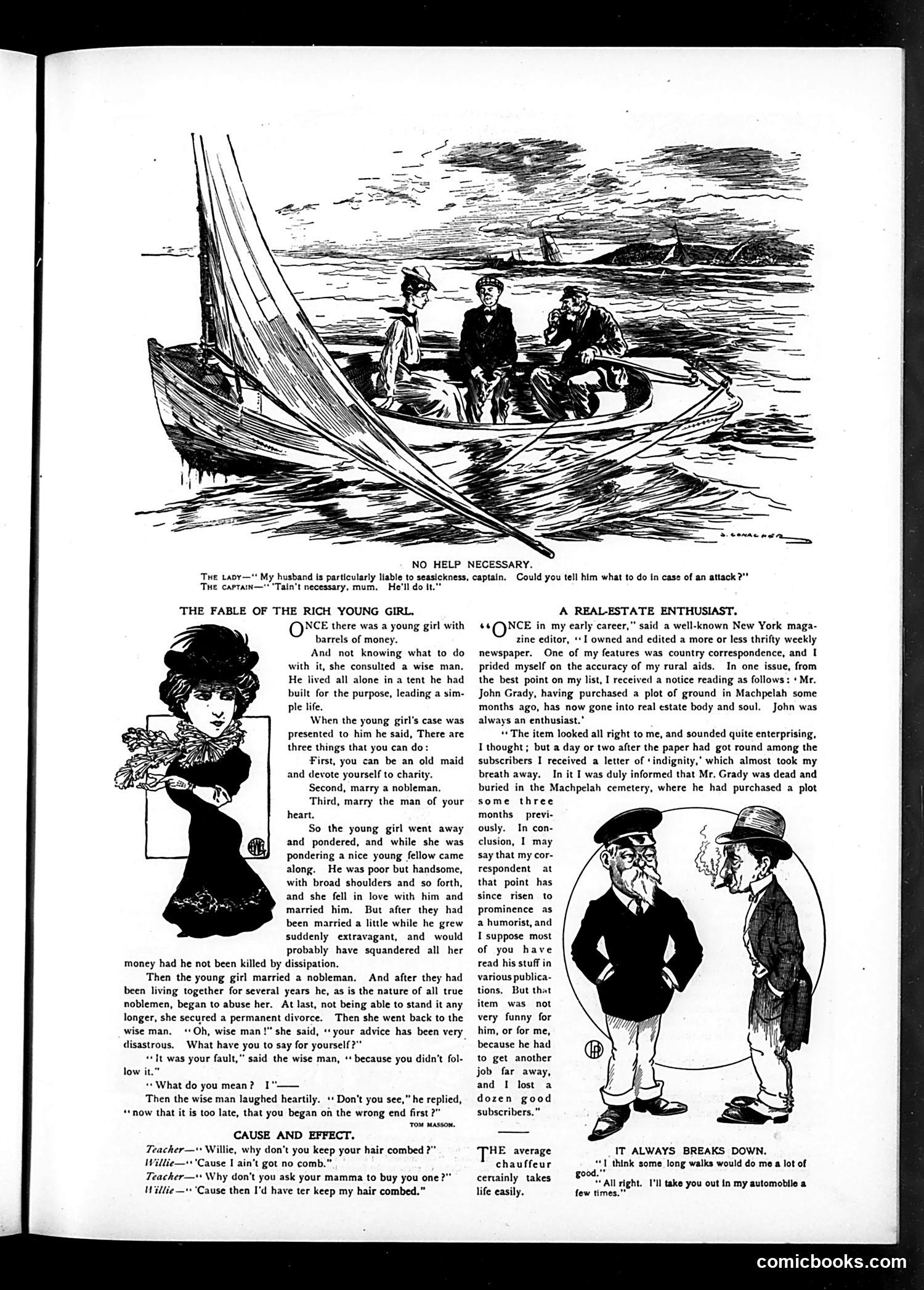
This page contains four separate satirical pieces typical of early 20th-century Judge magazine humor: 1. **"No Help Necessary"** (top): A cartoon about seasickness, joking that a captain needn't advise a seasick husband—he'll manage fine without help. 2. **"The Fable of the Rich Young Girl"** (left): A morality tale about a wealthy young woman who marries a poor but handsome man. After he squanders her money and becomes abusive, she divorces him, then returns asking his advice. The moral: she didn't follow the "wise man's" initial counsel to "begin on the wrong end first." 3. **"A Real-Estate Enthusiast"** (right): A magazine editor recounts losing a newspaper subscriber after publishing a real-estate notice about a man named Grady—who died and was buried there. 4. **"Cause and Effect"** and **"It Always Breaks Down"** (bottom): Brief joke exchanges about practical matters. The humor reflects genteel, domestic-focused comedy typical of the era.
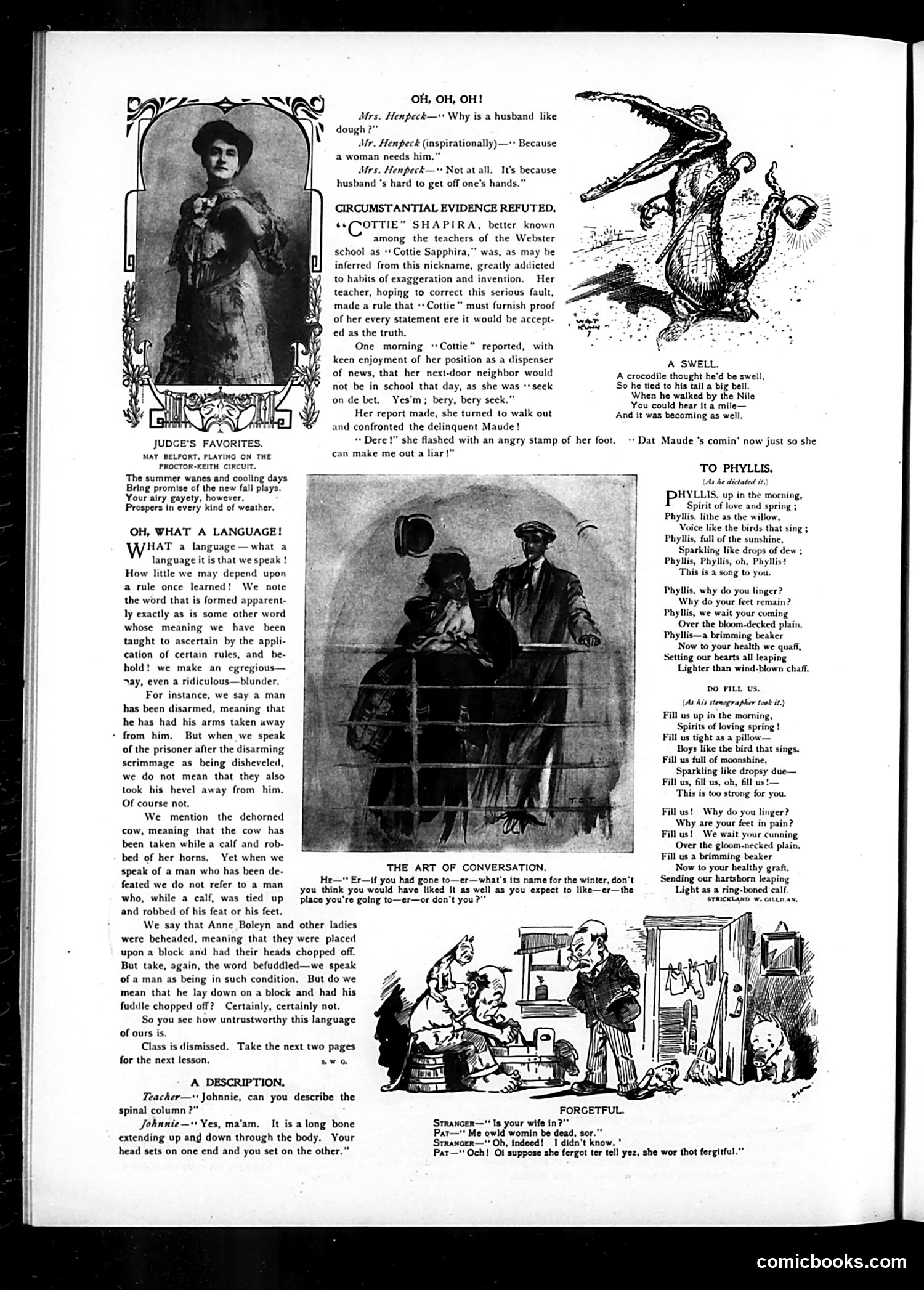
This page contains several unrelated humor pieces and illustrations rather than unified political cartoons. The main content includes: 1. **"Circumstantial Evidence Refuted"** — A dialogue about a woman named "Cottie" Shafira who is accused of exaggeration. She confronts her neighbor Maudie over gossip, illustrating period attitudes about women's reputation and neighborhood social dynamics. 2. **"Oh, What a Language!"** — A satirical piece about English language rules and their illogical exceptions, using examples like "disarmed" versus "prisoner." 3. **"To Phyllis"** — A sentimental poem about spring and love. 4. **Various smaller sketches** — Including classroom scenes and domestic humor about forgotten wives. The page reflects early 20th-century social satire focused on gender relations, linguistic absurdities, and domestic life rather than specific political events.
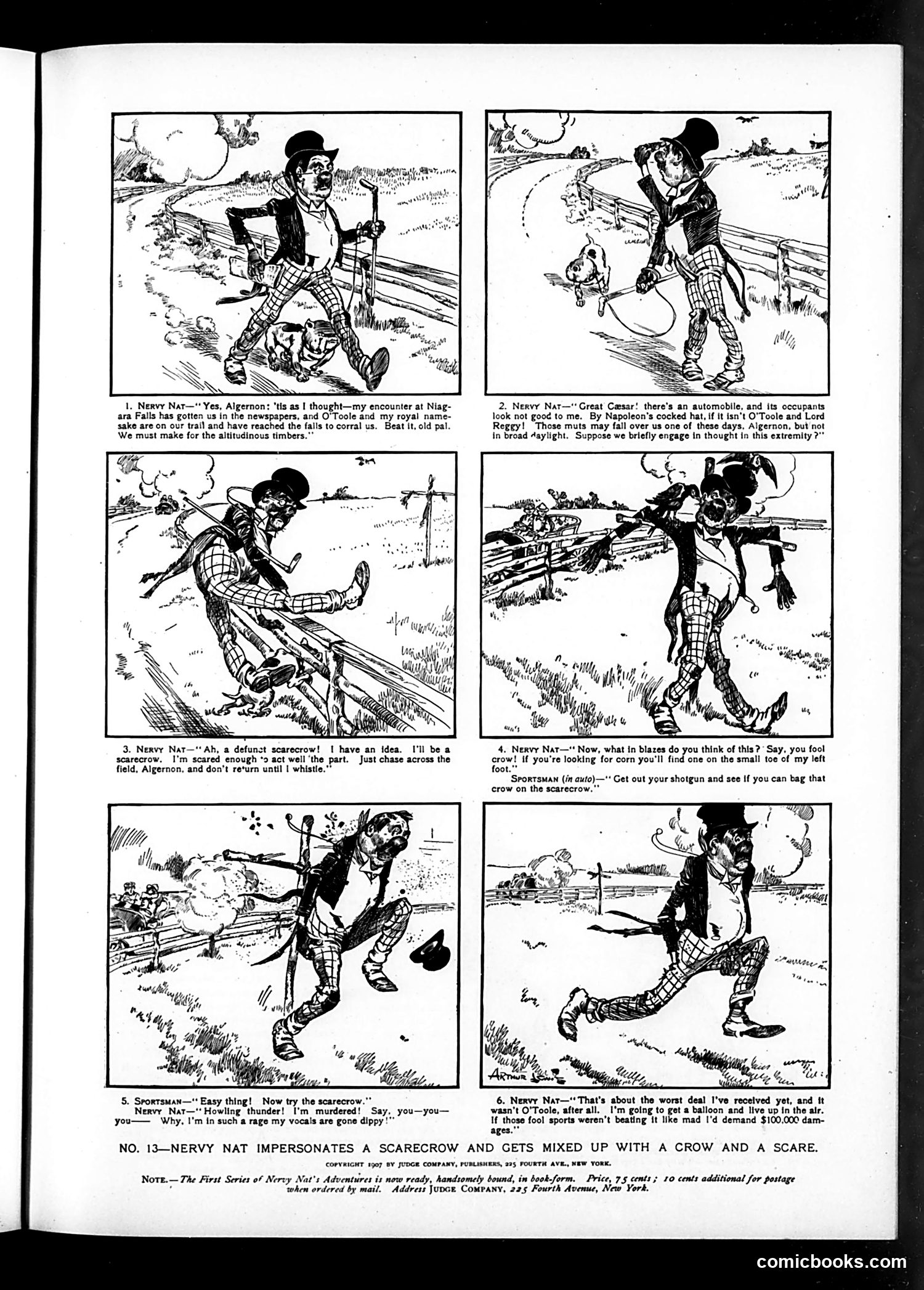
This is a slapstick comic strip featuring "Nervy Nat," a character in a top hat and checkered pants who encounters various misadventures. The narrative follows Nat impersonating a scarecrow in a field, leading to confusion with actual crows and a farmer. The humor is physical comedy typical of early 20th-century comic strips—pratfalls, mistaken identity, and exaggerated reactions. The references to "Napoleon's cocked hat," an automobile, and a sportsman suggest Nat as a somewhat bumbling urban character out of place in rural settings. This appears to be straightforward entertainment rather than political satire—the "Judge" magazine likely ran such humorous strips alongside its satirical content. The appeal lies in visual gags and wordplay rather than social commentary.
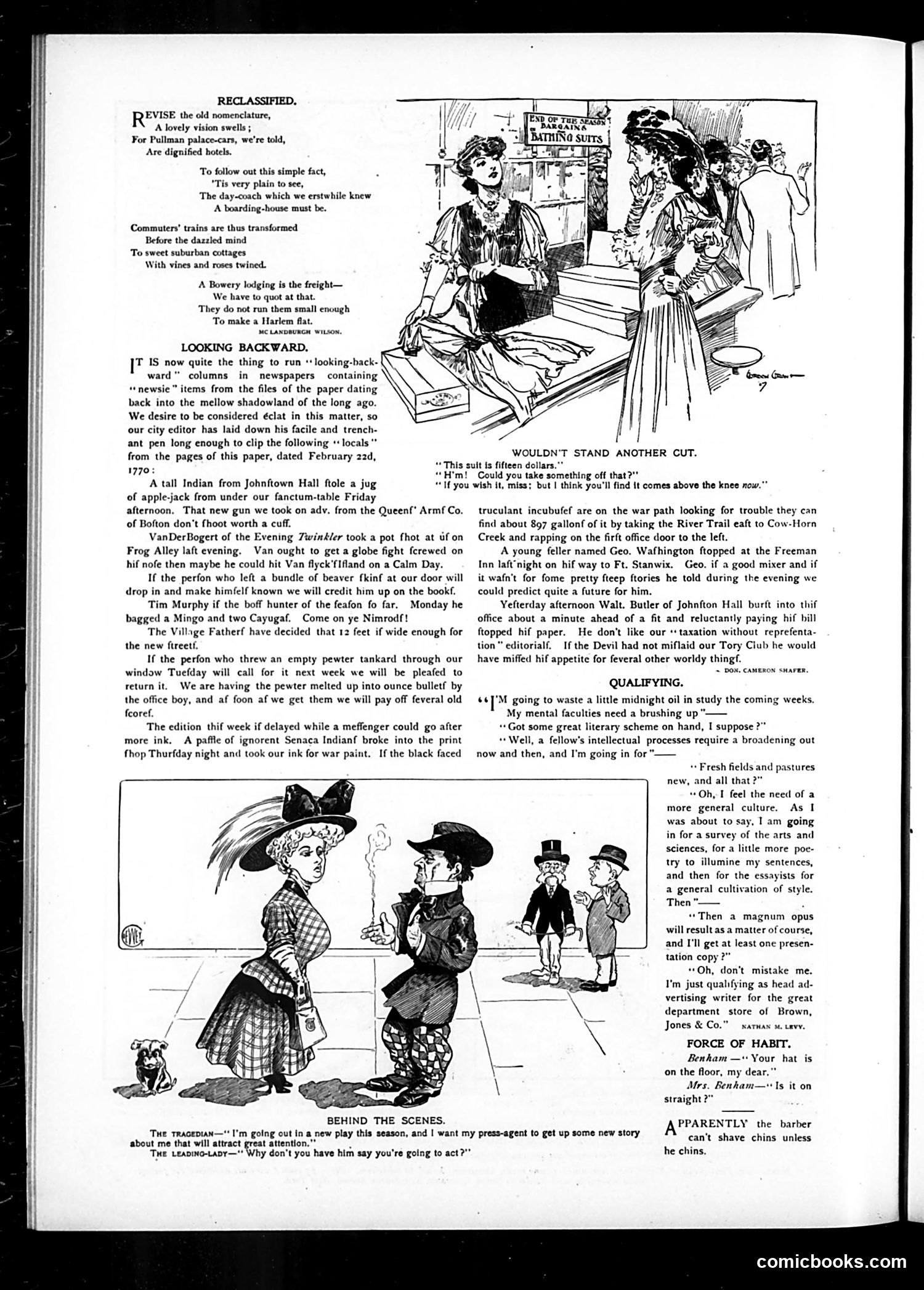
This page from *Judge* magazine (undated, but internal references suggest early 1900s) contains several layers of satire: **"Reclassified"** mocks the railroad industry's euphemistic renaming of passenger cars—calling shabby day-coaches "boarding houses" and Pullman cars "hotels." The satire targets corporate rebranding that disguises poor conditions with fancier language. **"Looking Backward"** is a humorous "throwback" column parodying actual historical records. It presents fabricated 1770 newspaper items involving local figures (an Indian theft, Van Der Bogert shooting, young "Geo. Washington") in mock-archaic style, spoofing both the period and the then-trendy "looking back" columns newspapers were running. **Lower cartoons** appear to depict everyday urban scenes—a woman with a dog, fashion commentary about hemlines ("comes above the knee now"), and office life. The overall effect: satirizing American corporate euphemism, journalistic fads, and social pretension through humor and parody.
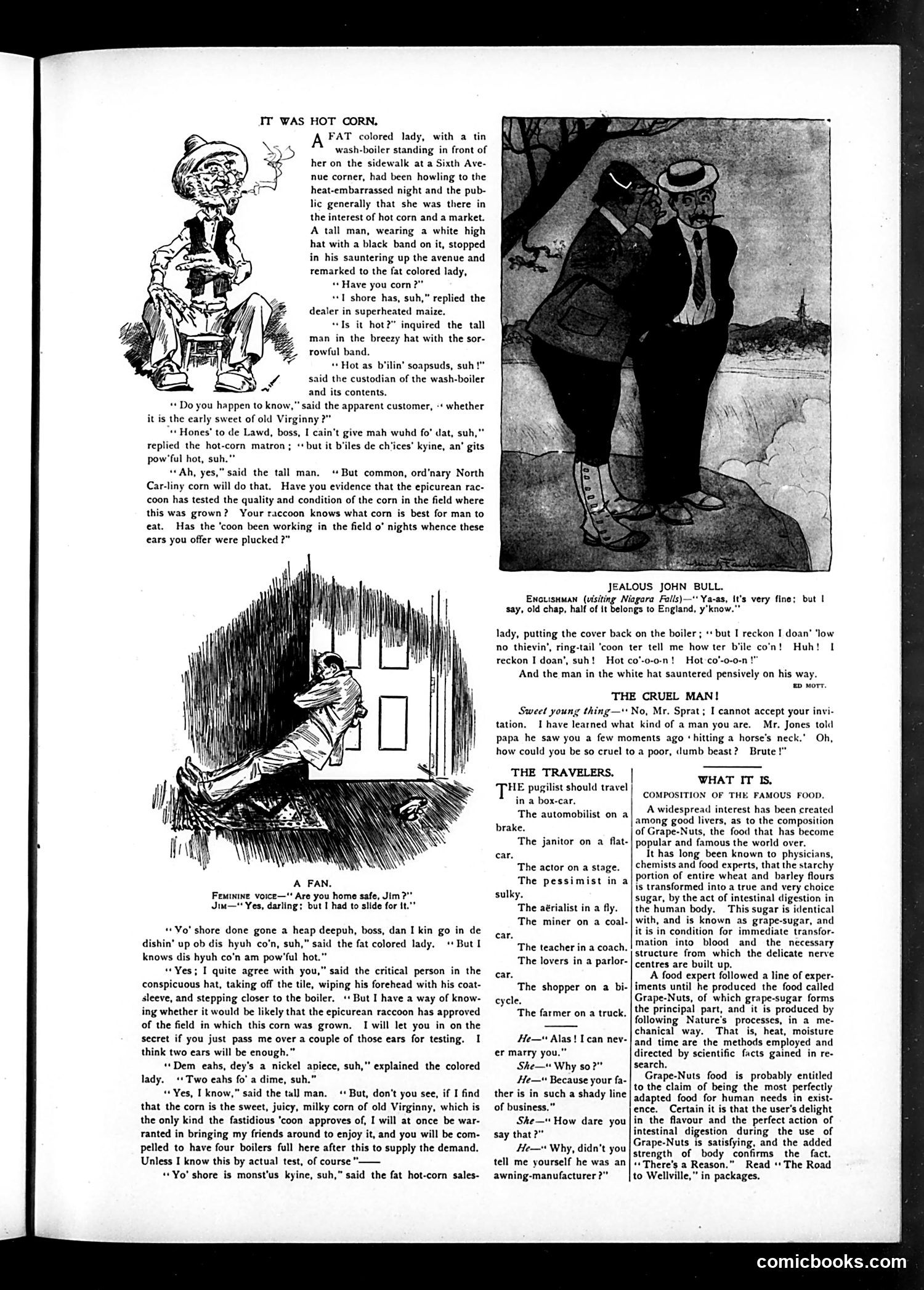
This page satirizes racial stereotypes and class pretension in late 19th-century America. The main cartoon features a well-dressed white man in a high hat (mourning band visible) engaging a Black corn vendor in deliberately obtuse conversation. He asks pseudo-intellectual questions about whether raccoons have "tested" the corn's quality—a ridiculous premise used to justify getting free samples by claiming he needs to verify authenticity before recommending it to friends. The humor relies on depicting the vendor in exaggerated dialect while the gentleman uses flowery, pompous language to essentially con her out of merchandise. The satire appears to mock *both* the pretentious con artist and, implicitly, racial hierarchies that allowed such exploitation. The page also includes unrelated humorous list items (e.g., "The pessimist should travel in a sulky") and brief comedic dialogues typical of Judge's format.
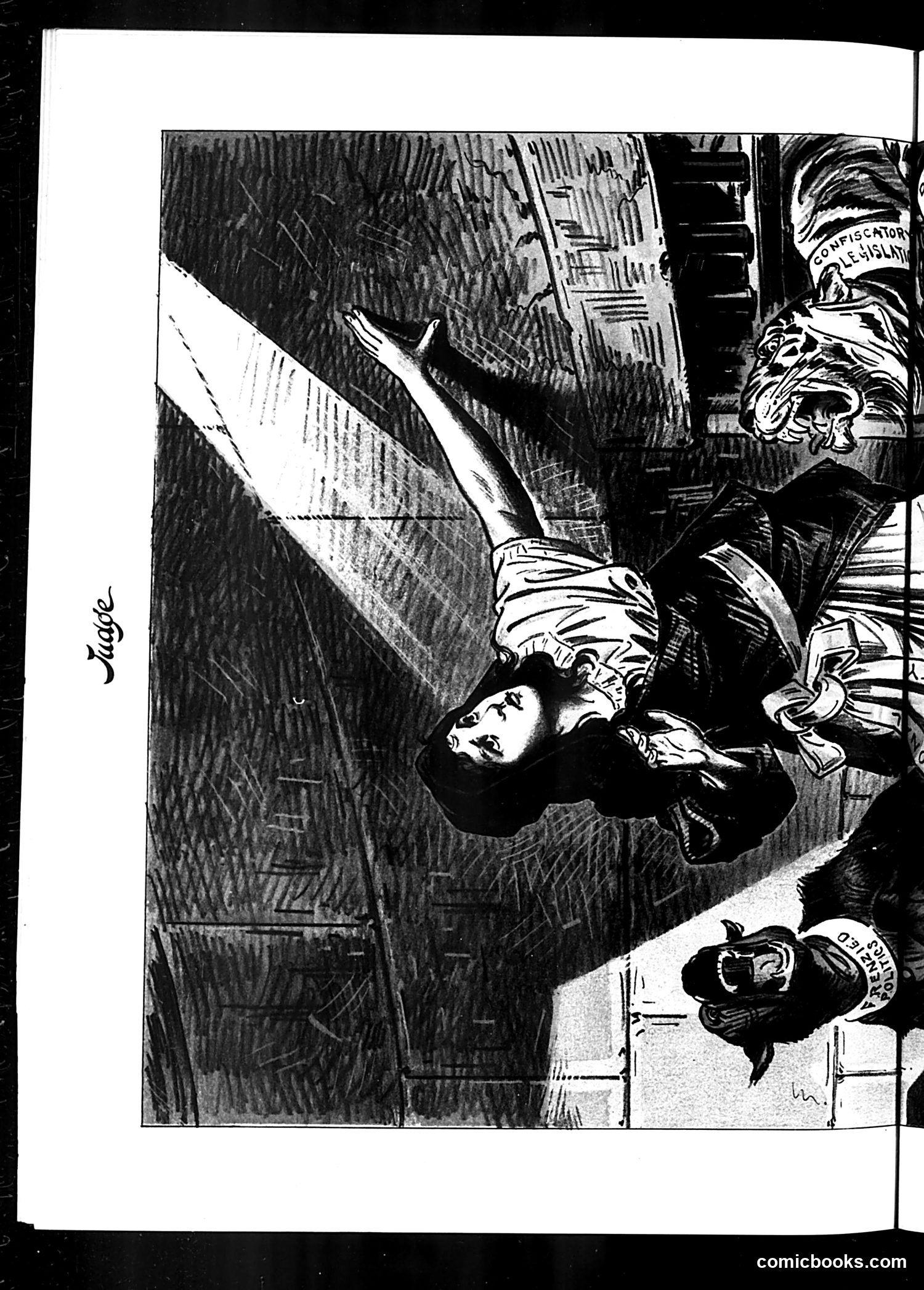
This appears to be a political cartoon from *Judge* magazine, though the OCR text provides minimal context beyond the source attribution. The image shows a figure lying down in what appears to be an interior space, with another figure visible on the right side. There are decorative elements suggesting an ornate setting, and text visible on elements in the image (including what appears to say "CONFISCATOR" on one item). Without clearer OCR text or visible publication date, I cannot definitively identify the specific political figures, events, or satirical point being made. The composition suggests commentary on power dynamics or confiscation, but determining the precise historical reference requires information not reliably visible or readable in this reproduction.
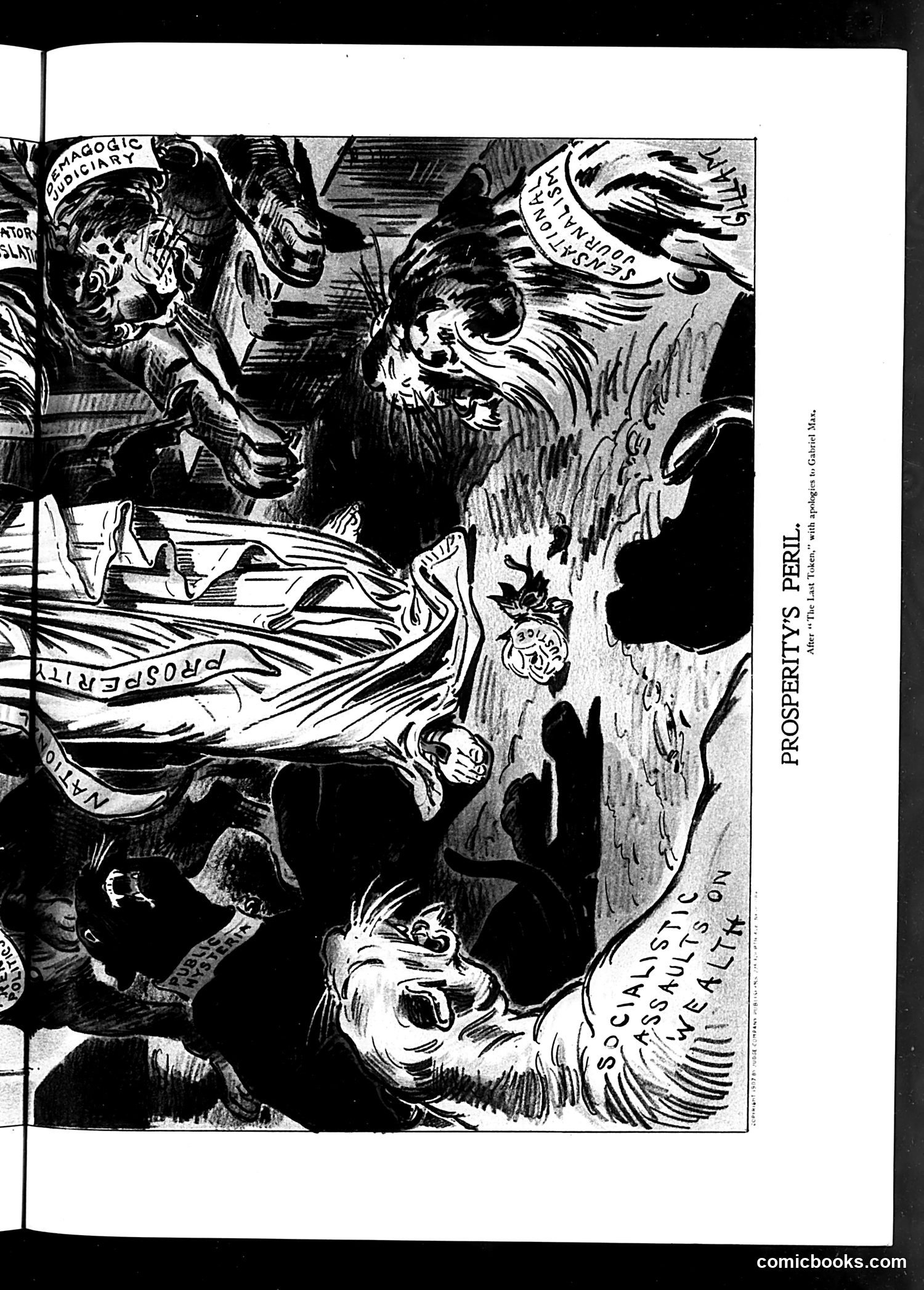
This satirical cartoon appears to depict prosperity or wealth as a vulnerable figure being attacked or threatened by multiple menacing characters with exaggerated features. The visible text fragments suggest economic or financial themes common to Judge magazine's political satire. The style and composition suggest this cartoon warns about threats to American economic well-being, likely referencing early 20th-century anxieties about labor unrest, monopolies, or financial instability. The grotesque caricatures of the attacking figures were typical of period political cartoons representing various perceived threats to the nation's prosperity. However, without clearer text or visible identifying marks, I cannot definitively identify the specific figures, historical moment, or precise satirical target this cartoon addresses.
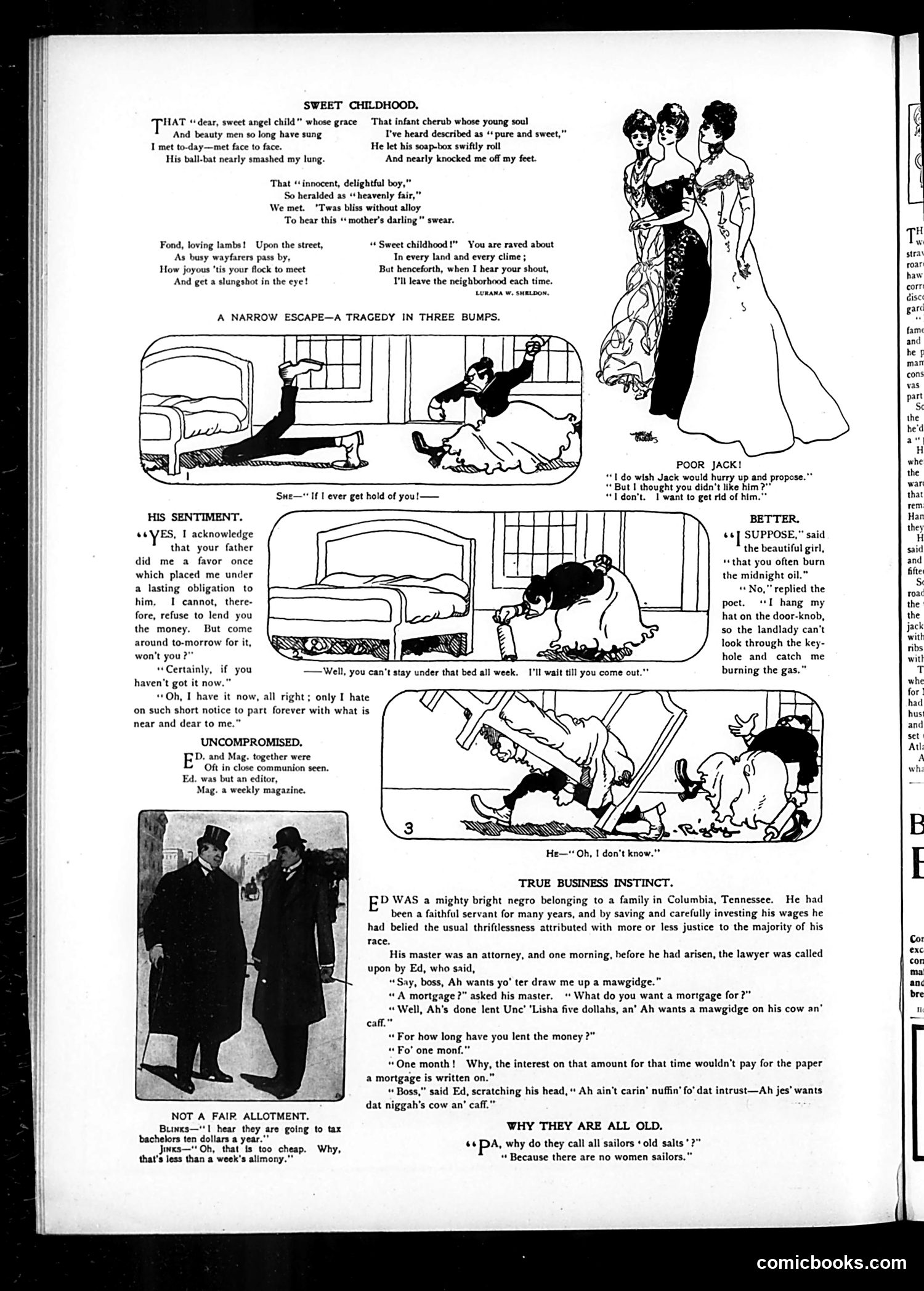
This page contains several satirical pieces typical of late 19th/early 20th-century American humor: **"Sweet Childhood"** mocks the idealized Victorian image of innocent children. The poem contrasts sentimental descriptions ("dear, sweet angel child") with brutal reality—children as violent street urchins who assault adults with slingshots and soap-box carts. The satire targets sentimentalized notions of childhood innocence. **"A Narrow Escape"** is a brief romantic comedy where a woman wants to marry someone she dislikes just to leave the neighborhood—absurdist humor about marriage desperation. **"True Business Instinct"** presents a racist caricature of an African American servant (written in heavy dialect) who, despite being described as "thrifty," misunderstands "mortgage" and wants to seize his debtor's cow. The "joke" relies on racist stereotypes about Black incompetence, though the narrative frames his business shrewdness ironically. Other brief pieces include wordplay about relationships and bachelors' taxes. The page reflects period attitudes including casual racism and anti-romantic sentiment typical of satirical magazines of that era.
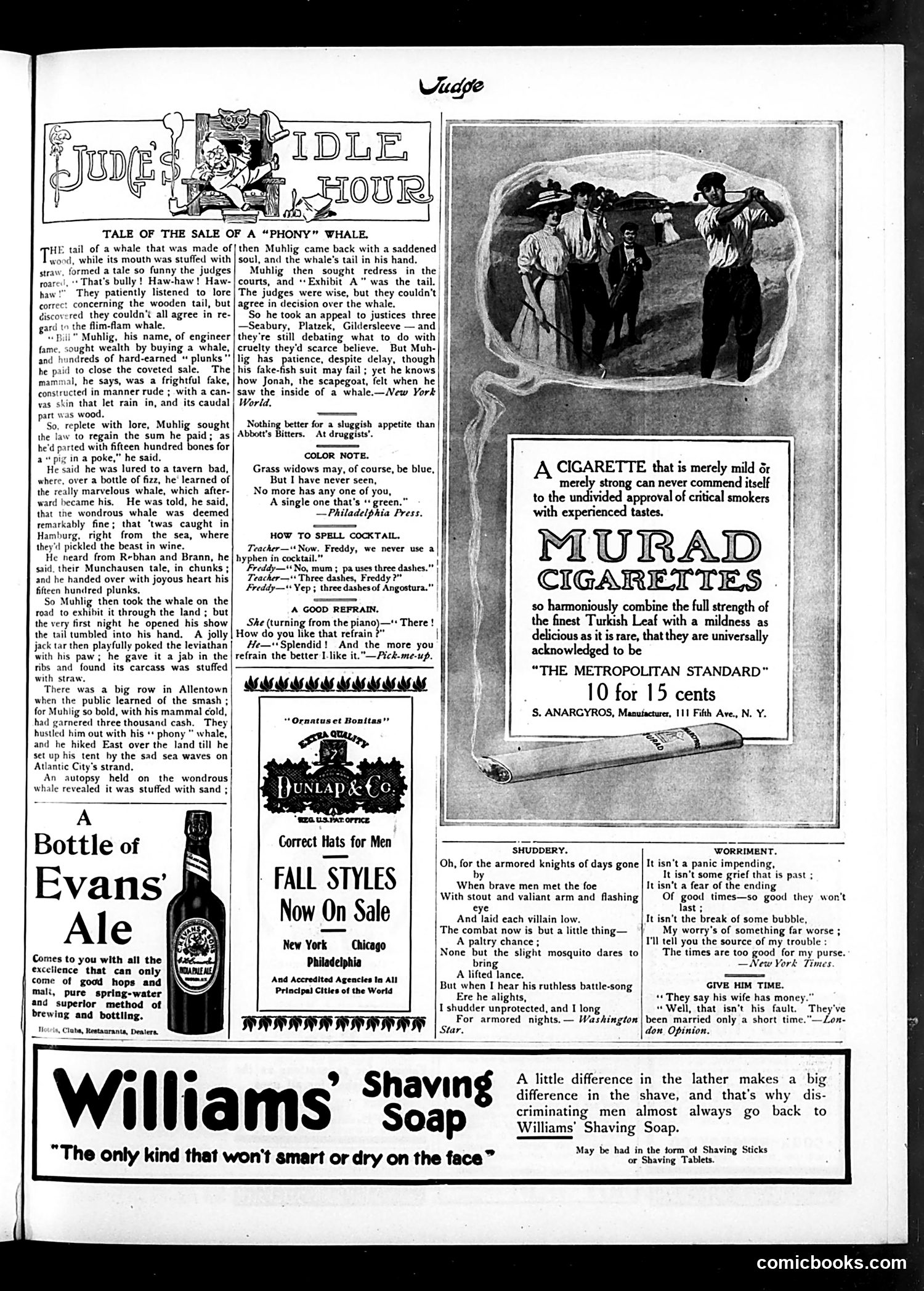
This page from the satirical magazine **Judge** centers on a con-artist story titled "Tale of the Sale of a 'Phony' Whale." The main cartoon satirizes legal incompetence and fraud. **The Story:** A man named Muhlig purchases what he believes is a legitimate whale caught in Hamburg, paying substantial money. He discovers it's a wooden fake stuffed with straw and sand. Taking the case to court, he presents the whale's tail as "Exhibit A," but the judges cannot agree on a verdict. He appeals to three justices (Seabury, Platzek, Gildersleeve—likely real New York jurists), who remain deadlocked. **The Satire:** The joke mocks both Muhlig's gullibility and, more pointedly, the judicial system's inability to reach obvious conclusions. The reference to Jonah suggests absurdist humor about being swallowed by whales. The page is primarily **advertising**—for Evans' Ale, Dunlap & Co. hats, Murad Cigarettes, and Williams' Shaving Soap—surrounding the editorial content.
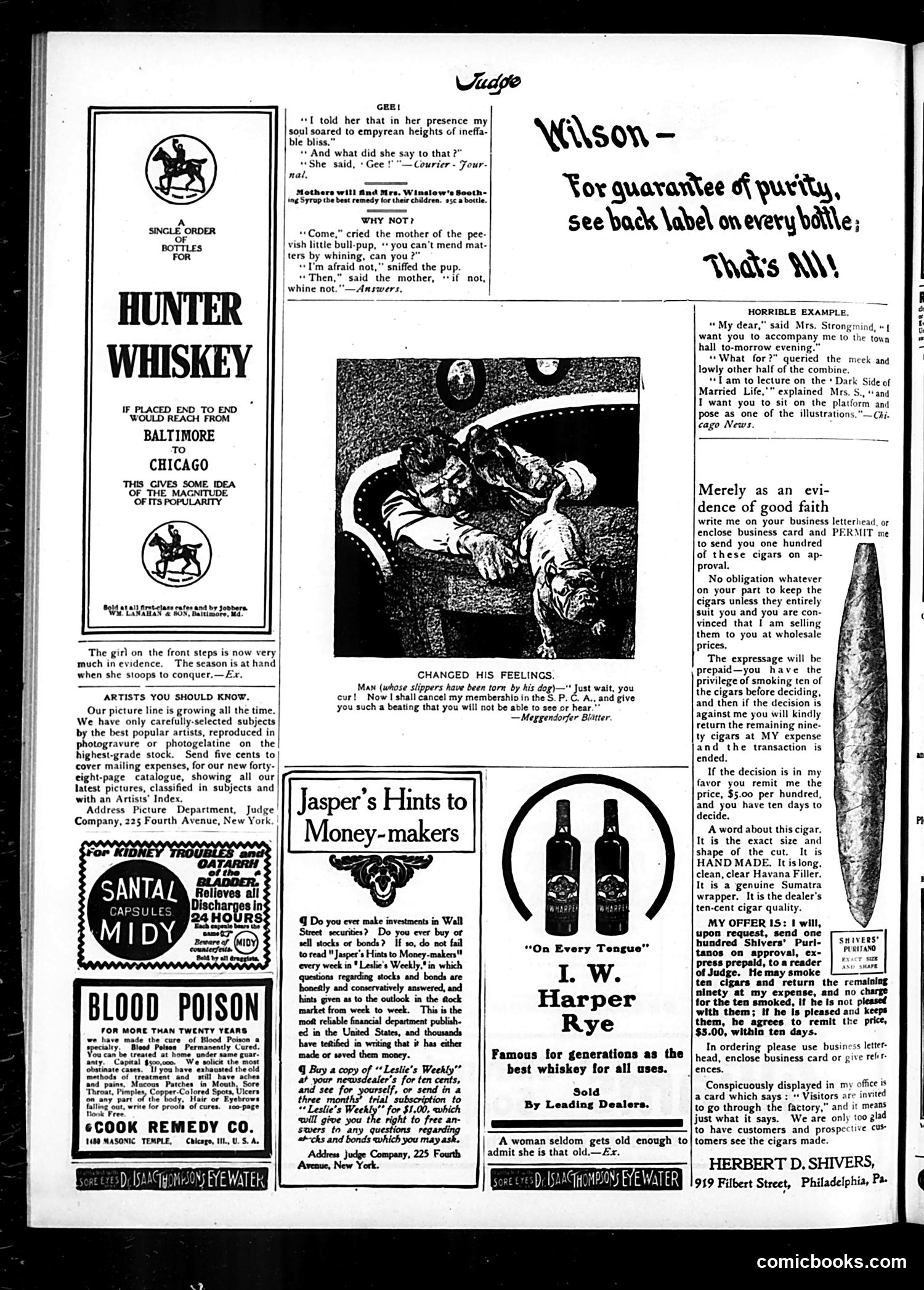
This page from *Judge* magazine contains several disconnected satirical pieces and advertisements typical of early 20th-century humor publications. **Main Cartoon**: "Changed His Feelings" depicts a man whose dog has destroyed his slippers. In fury, he declares he'll cancel his S.P.C.A. (animal welfare society) membership and beat the dog severely—a joke about how quickly people abandon their principles when personally inconvenienced. **Recurring Joke Format**: Several brief quips mock romantic sentimentality ("I told her my soul soared to empyrean heights"), marital discord (the wife lecturing on "Dark Side of Married Life" while displaying her "meek" husband as proof), and dog obedience. **Advertisements**: The page heavily features whiskey, patent medicines (blood poison cure), and cigar promotions—standard for *Judge* of this era. **Social Context**: The humor assumes readers appreciate cynicism about love, marriage, animal welfare activism, and financial speculation. The page reflects early 1900s attitudes toward gender dynamics and consumer culture rather than specific political satire.
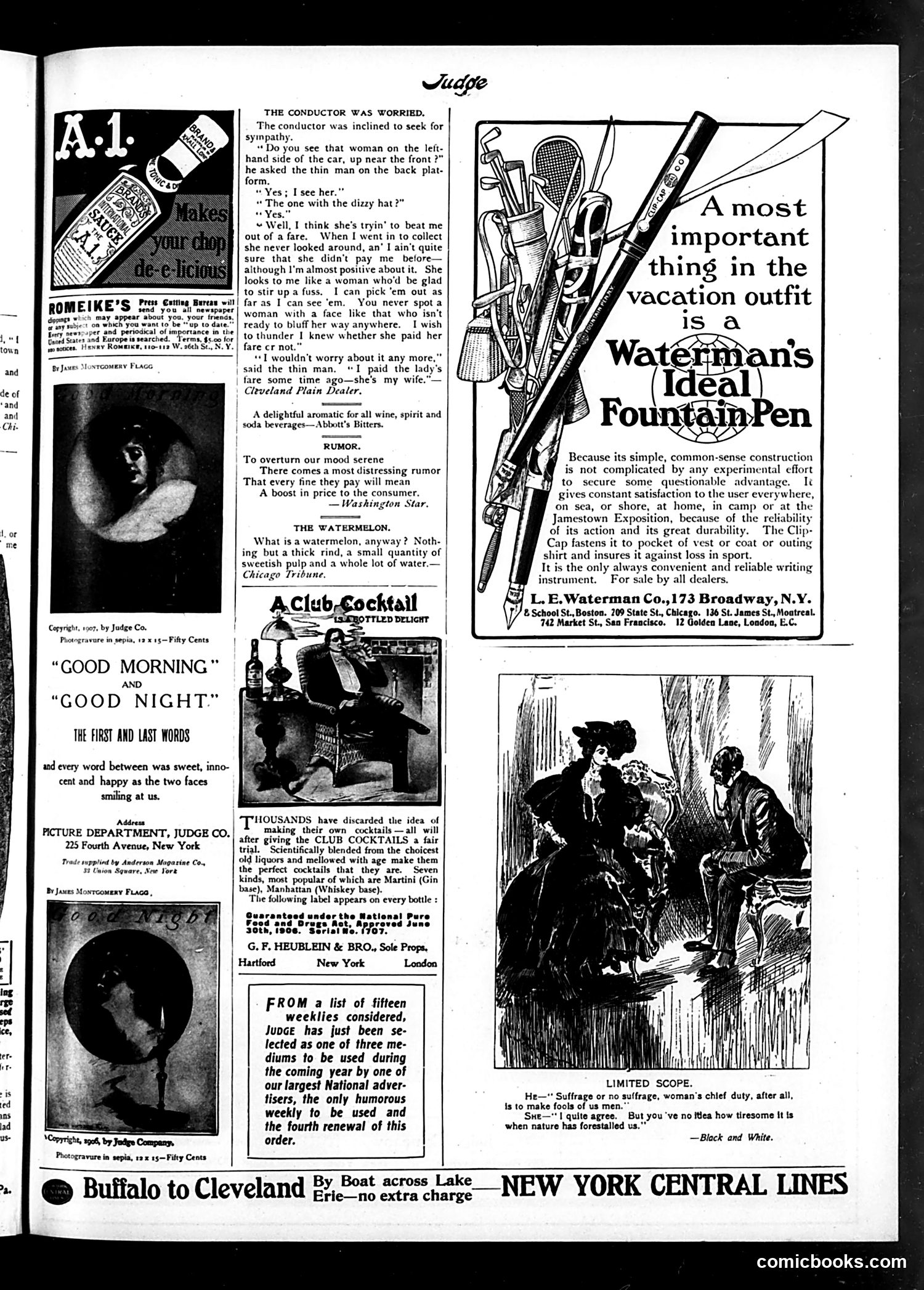
This is primarily an **advertising and humor page** from Judge magazine (1907). The main content consists of advertisements interspersed with short satirical pieces. **The cartoons:** - "The Conductor Was Worried": A streetcar conductor suspects a woman passenger of fare-dodging, but the thin man reveals she's his wife—he already paid. The joke mocks the conductor's poor judgment in reading people. - "Limited Scope": A domestic exchange where a man claims women's "chief duty" is making fools of men, and the woman retorts that nature has already done that work for her—a mild critique of male arrogance. **Advertisements featured:** - Waterman's Ideal Fountain Pen (with sports/vacation imagery) - Club Cocktails by Heublein & Bros - Various food/beverage products The page reflects early-20th-century concerns: women's suffrage is mentioned, cocktail culture is prominent, and there's gentle mockery of urban life and gender relations typical of the era's satirical humor.
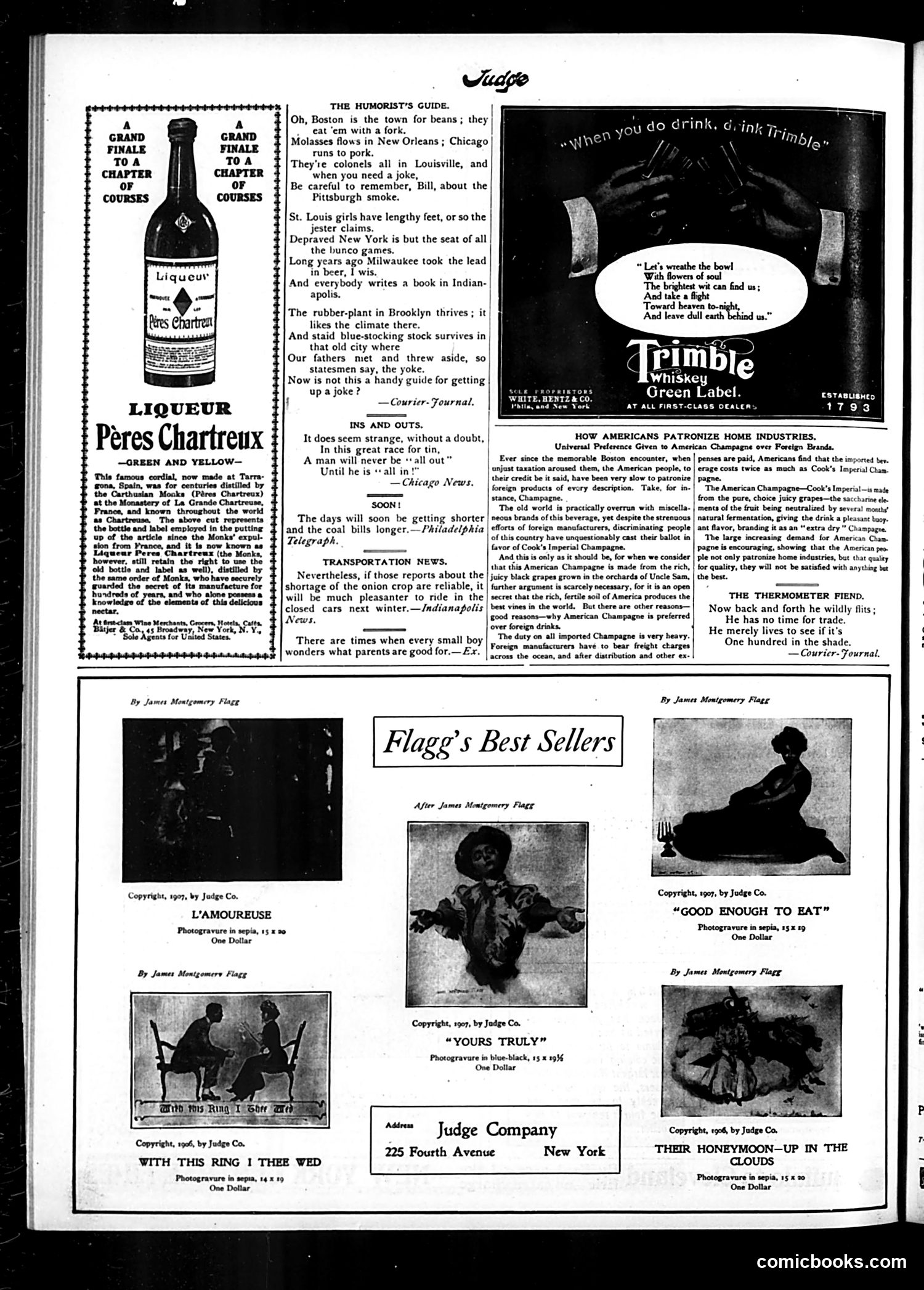
This page contains advertisements and humorous content typical of early 1900s American satire. **"The Humorist's Guide"** is a comedic poem mocking regional American stereotypes—Boston's beans, New Orleans' molasses, Louisville's colonels, Pittsburgh's smoke, St. Louis girls' feet, New York's con artists, Milwaukee's beer, and Indianapolis' authors. It satirizes how comedians resort to tired clichés when constructing jokes. **The Trimble Whiskey ad** uses sentimental poetry about drinking, combining alcohol marketing with quasi-spiritual language. **"Flagg's Best Sellers"** showcases James Montgomery Flagg's popular illustrated works (film stills or photographs), including titles like "L'Amourease," "Yours Truly," "Good Enough to Eat," and "With This Ring I Thee Wed"—typical melodramatic entertainment of the era. The **Cook's Champagne advertisement** is nationalist propaganda, arguing Americans should buy domestic champagne over imported French brands due to import duties and patriotic duty since the Boston Tea Party, positioning consumption as economic patriotism.
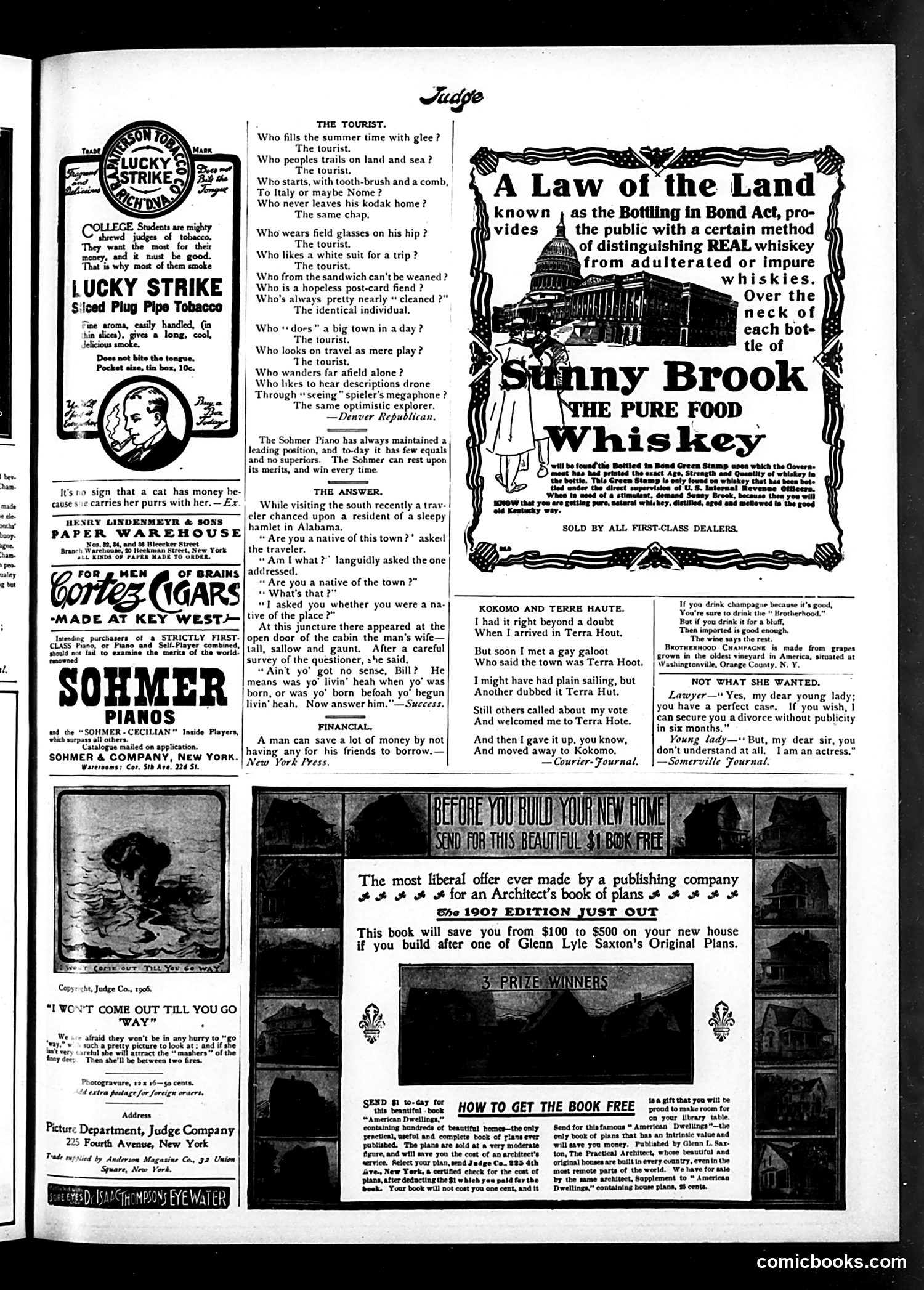
This page is primarily **advertising** interspersed with light humor and verse, typical of Judge magazine's format. The main satirical content includes: **"The Tourist"** poem mocks American tourists of the era—their obsession with souvenirs (kodaks/postcards), standardized travel experiences, eating sandwiches everywhere, and treating sightseeing as mere consumption rather than genuine experience. This reflects growing anxiety about mass tourism and American cultural behavior abroad. **"The Answer"** is a rural dialect joke where an Alabama farmer's wife must literally define "native" (born there vs. living there) to her confused husband—poking fun at Southern rural ignorance. **"Kokomo and Terre Haute"** is a playful poem about pronunciation confusion in Indiana town names. The page is dominated by period **advertisements**: Lucky Strike tobacco, Sohmer pianos, paper warehouse, Cortez cigars, and prominently, "Sunny Brook Whiskey" (featuring a capitol building), plus a book offer for house plans. The small photograph and caption "I Won't Come Out Till You Go 'Way" appears to be unrelated editorial cartoon content about dating/courting anxieties.
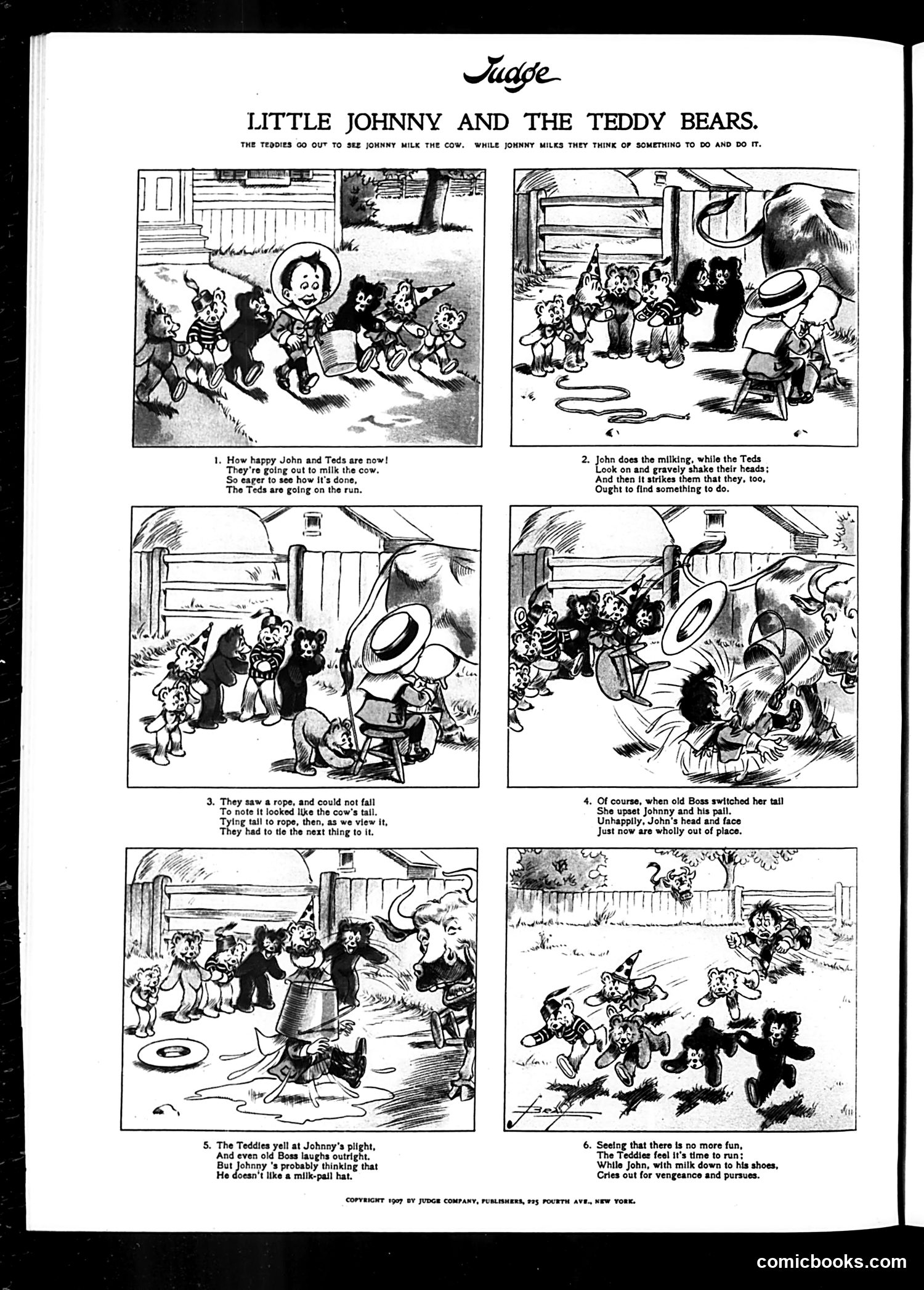
This is a children's comic strip from Judge magazine (1907) featuring "Teddy Bears"—toys named after President Theodore Roosevelt, who was wildly popular and whose image was commercialized into plush toys during this era. The narrative is a simple slapstick comedy: Johnny takes teddy bears to milk a cow. The bears, mischievous and bored, tie the cow's tail to a rope as a prank. When the cow swishes her tail, she kicks over the milk pail onto Johnny's head. The bears flee as Johnny chases them, covered in milk. The humor relies on physical comedy and the bears' impish behavior—anthropomorphized toys causing childish chaos. For modern readers, the main historical detail is that "Teddy Bears" were contemporary merchandise tied to Roosevelt's popularity, making them recognizable toy characters to 1907 audiences.