
Judge, 1907-08-31 · page 10 of 16
Judge — August 31, 1907 — page 10: what you’re looking at
What you’re looking at
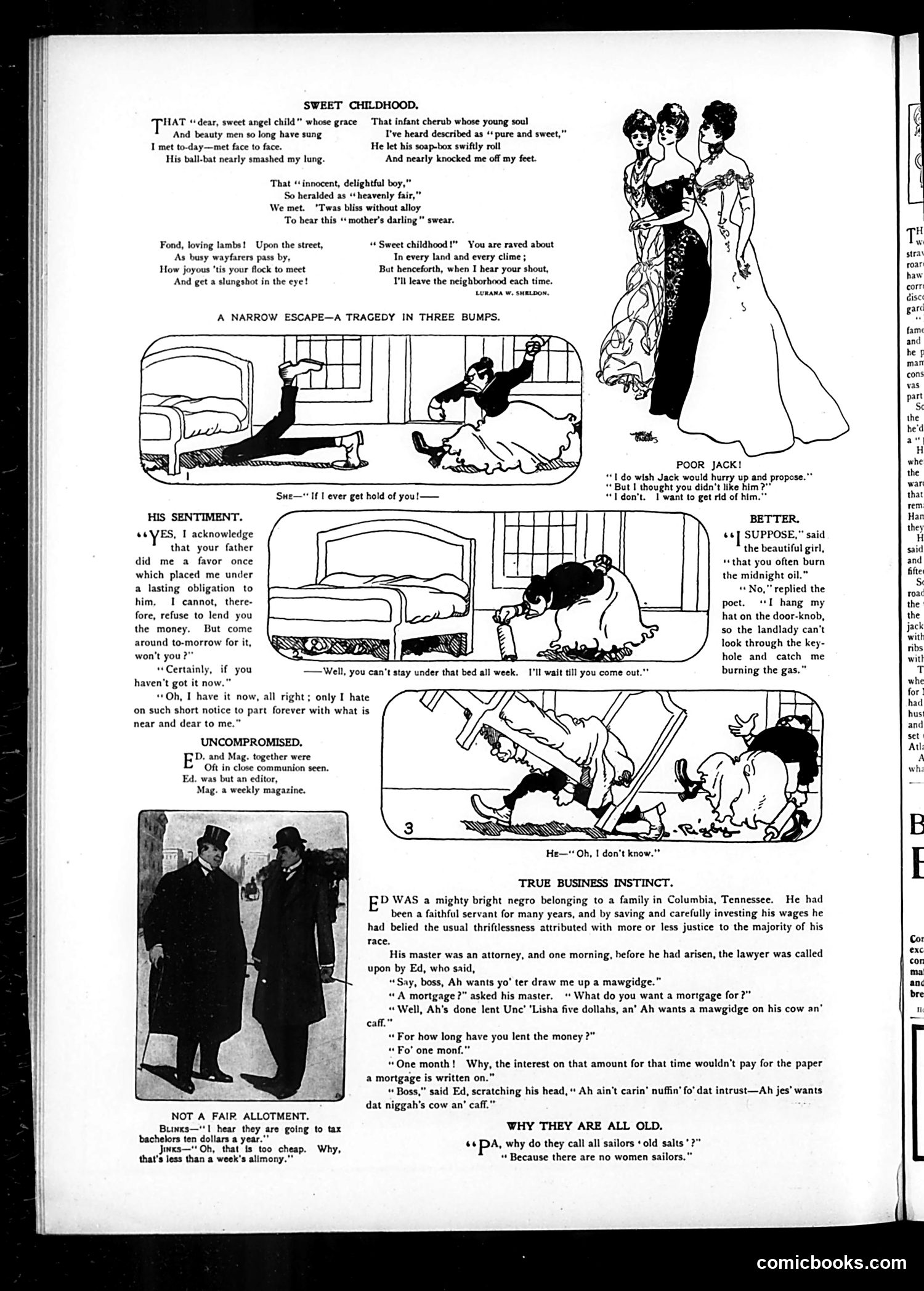
This page contains several satirical pieces typical of late 19th/early 20th-century American humor: **"Sweet Childhood"** mocks the idealized Victorian image of innocent children. The poem contrasts sentimental descriptions ("dear, sweet angel child") with brutal reality—children as violent street urchins who assault adults with slingshots and soap-box carts. The satire targets sentimentalized notions of childhood innocence. **"A Narrow Escape"** is a brief romantic comedy where a woman wants to marry someone she dislikes just to leave the neighborhood—absurdist humor about marriage desperation. **"True Business Instinct"** presents a racist caricature of an African American servant (written in heavy dialect) who, despite being described as "thrifty," misunderstands "mortgage" and wants to seize his debtor's cow. The "joke" relies on racist stereotypes about Black incompetence, though the narrative frames his business shrewdness ironically. Other brief pieces include wordplay about relationships and bachelors' taxes. The page reflects period attitudes including casual racism and anti-romantic sentiment typical of satirical magazines of that era.
📄 Transcribed text from this page (OCR, searchable)
Machine-transcribed from the original scan — historical spelling and the odd misread are preserved.
SWEET CHILDHOOD. HAT ‘dear, sweet angel child” whose grace That infant cherub whose young soul And beauty men so long have sung I've heard described as ‘ pure and sweet,” I met to-day—met face to face. He let his soap-box swiftly roll His ball-bat nearly smashed my lung. And nearly knocked me off my feet. That innocent, delightful boy,” So heralded as «heavenly fair,” We met. ‘Twas bliss without alloy To hear this + mother’s darling” swear. Fond, loving lambs! Upon the street, “« Sweet childhood!" You are raved about As busy wayfarers pass by, In every land and every clime ; How joyous 'tis your flock to meet But henceforth, when I hear your shout, And get a slungshot in the eye! T'll leave the neighborhood each time. LURAMA W, SHELDON, A NARROW ESCAPE—A TRAGEDY IN THREE BUMPS. POOR JACK! “1 do wish Jack would hurry up and propose."* “But I thought you didn't like him 2"" Sne—" If | ever get hold of youl — “don't, Twant to get rid of him.” HIS SENTIMENT. BETTER. se YES, I acknowledge ¢4] SUPPOSE,” said that your father the beautiful girl, did me a favor once «that you often burn which placed me under the midnight oil.” a lasting obligation to + No," replied the him. I cannot, there- XS poct. “I hang my fore, refuse to lend you hat on the door-knob, the money. But come so the landlady can’t around to-morrow for it, WED ¥ ~ Nie look through the key- won't you?” SA ESRARY | s “3 hole and catch me “Certainly, if you —wWell, you can't stay under that bed all week. I'll wait till you come out."* burning the gas.” haven't got it now.” “Oh, I have it now, all right; only I hate on such short notice to part forever with what is near and dear to me.” UNCOMPROMISED. D. and Mag. together were Oft in close communion seen. Ed. was but an editor, Mag. a weekly magazine. He—*' Oh, | don't know.”” TRUE BUSINESS INSTINCT. EP WAS a mighty bright negro belonging to a family in Columbia, Tennessee. He had been a faithful servant for many years, and by saving and carefully investing his wages he had belied the usual thriftlessness attributed with more or less justice to the majority of his race. His master was an attorney, and one morning, hefore he had arisen, the lawyer was called upon by Ed, who said, , boss, Ah wants yo’ ter draw me up a mawgidge.” A mortgage?” asked his master,“ What do you want a mortgage for ?” “Well, Ah’s done lent Unc’ ‘Lisha five dollahs, an’ Ah wants a mawgidge on his cow an’ aff.” “ For how long have you lent the money 2” “Fo! one monf.” “One month! Why, the interest on that amount for that time wouldn't pay for the paper is written on.” said Ed, scratching his head, “Ah ain't carin’ nuffin’ fo’ dat intrust—Ah jes’ wants dat niggah’s cow an’ caf.” NOT A FAIR ALLOTMENT. Buwxs—"'1 hear they are going to tax WHY THEY ARE ALL OLD. bachelors tea dollars a year.’’ 64 PA, why do they call all sailors «old salts *?" Jinxs—" Oh, that 1s too cheap. Why, janie that’s less than a week's alimony.”” “ Because there are no women sailors. comicbooks.com