
A complete issue · 16 pages · 1907
Judge — April 13, 1907
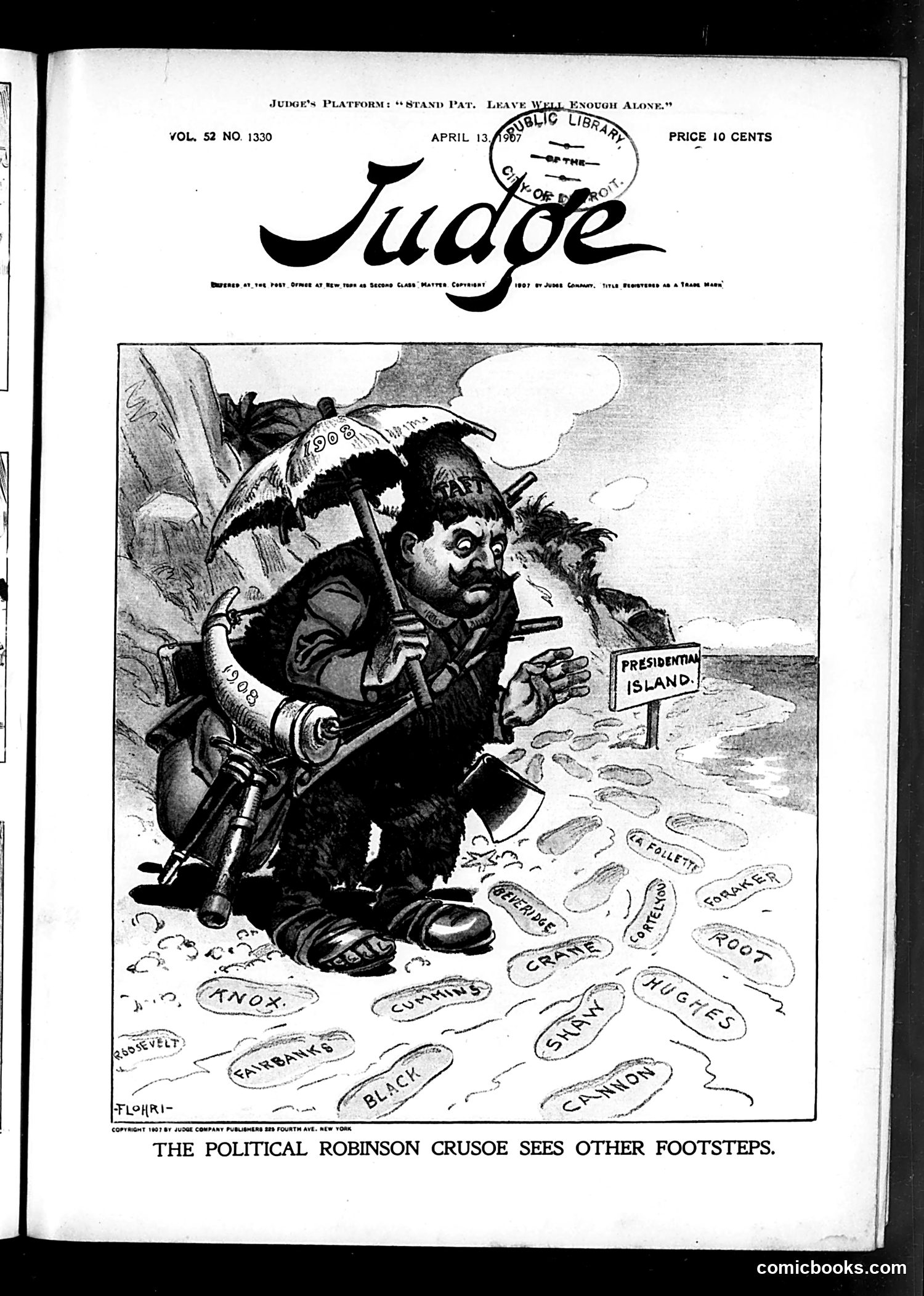
This cartoon from Judge magazine (April 13, 1907) satirizes President Theodore Roosevelt's political isolation. The central figure, caricatured as Robinson Crusoe (the literary castaway), stands on "Presidential Island" surrounded by footprints labeled with names of prominent political figures: Knox, Taft, Cannon, Banksks, Crane, Cortelyou, Root, Hughes, Foraker, Black, and others. The satire suggests Roosevelt felt politically threatened or surrounded by rivals and ambitious politicians vying for power and influence. The Crusoe reference implies Roosevelt saw himself as stranded, observing potential challengers approaching his political territory. This likely comments on succession politics and Roosevelt's complex relationship with his chosen successor and party colleagues during his presidency's final years.
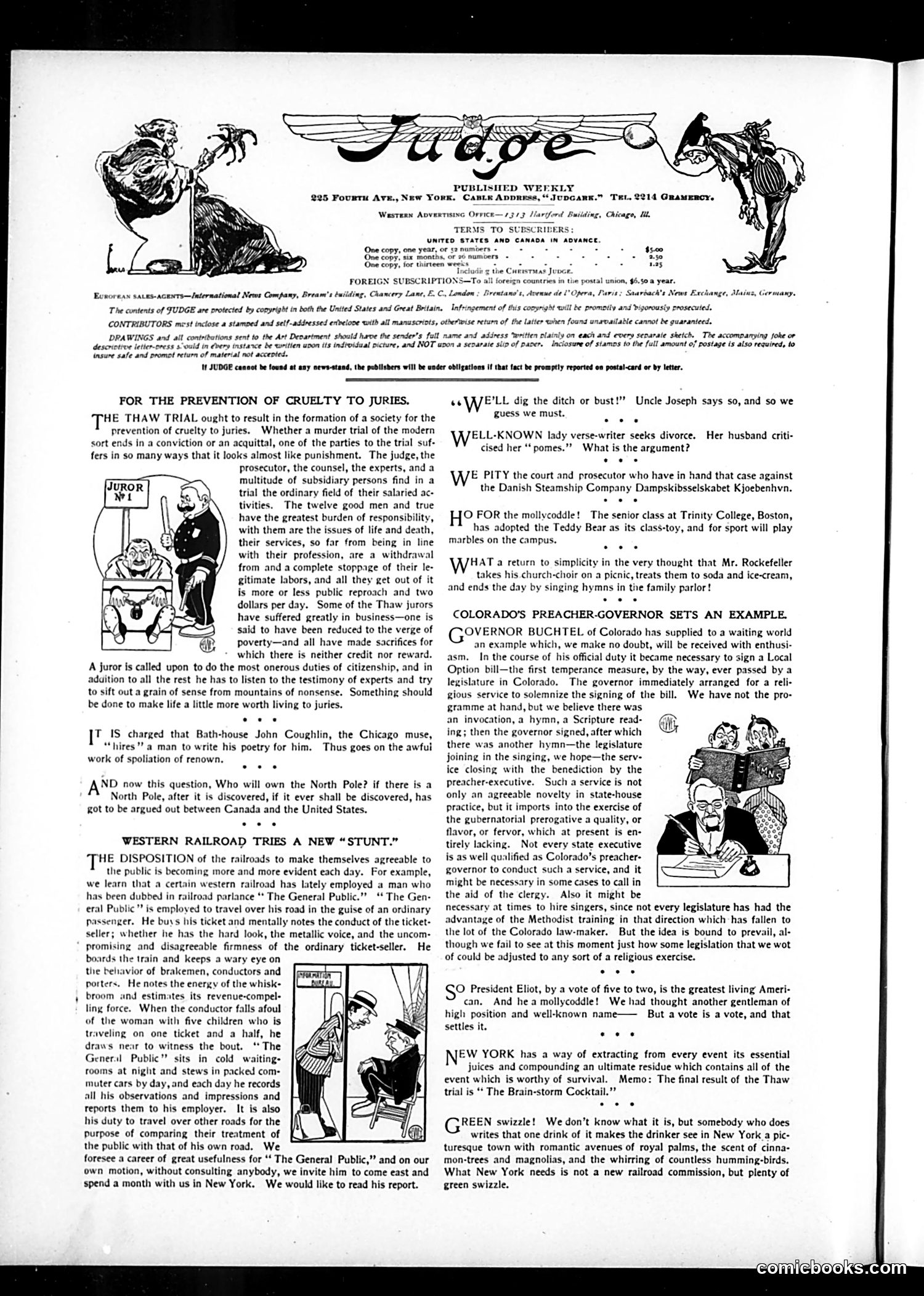
This page contains several satirical editorials rather than cartoons. The main topics include: **"For the Prevention of Cruelty to Juries"** – critiques how jurors suffer through lengthy trials without compensation or proper treatment, comparing their ordeal to criminal punishment. **"Western Railroad Tries a New 'Stunt'"** – mocks railroad management for publicity stunts (likely referring to "The General Public," a train). The piece sarcastically praises the conductor's theatrical observations while criticizing the railroad's self-promotion. **Colorado's Preacher-Governor** – discusses a governor (Buchtel) who conducts religious services, debating whether governmental authority should mix with religious practice. The page also includes brief social commentary on divorce, court cases, and New York's "Brain-storm Cocktail." The cartoons are small and support these editorial pieces with visual humor.
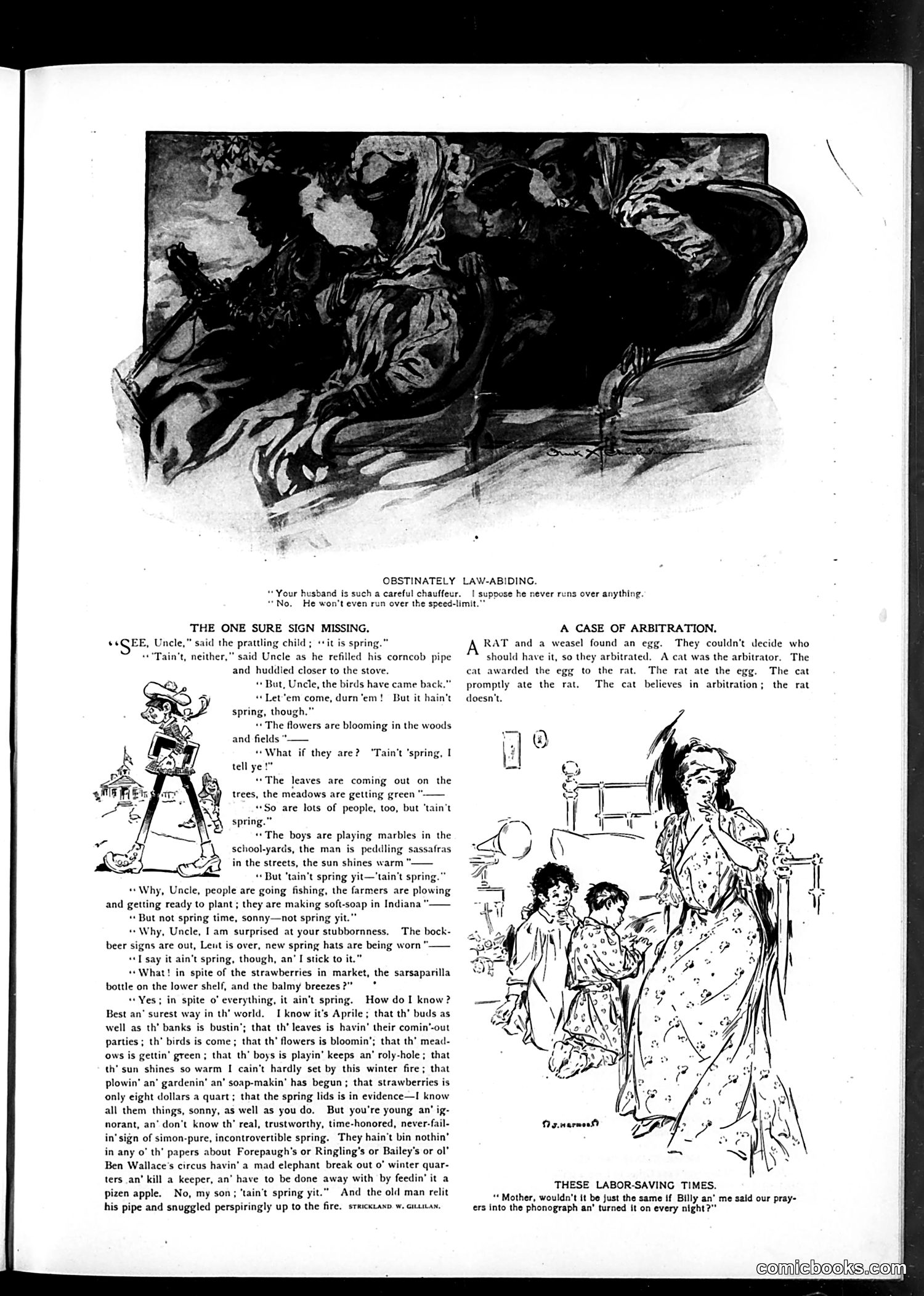
This page contains three separate humorous pieces typical of Judge's satirical style: **Top cartoon** ("Obstinately Law-Abiding"): A joke about a cautious chauffeur who refuses to speed, disappointing his employer—poking fun at early automotive culture and class tensions between wealthy car owners and their careful drivers. **Middle section** ("The One Sure Sign Missing"): An extended dialogue where an uncle insists spring hasn't arrived despite clear evidence (flowers blooming, children playing, etc.). It's a lighthearted debate about recognizing seasonal change, culminating in the uncle's stubborn claim he'll only believe spring when specific items appear—a humorous commentary on obstinate skepticism. **Bottom cartoon** ("These Labor-Saving Times"): A domestic scene suggesting modern conveniences (possibly a phonograph) haven't reduced household labor as promised—satire on unfulfilled technological promises. All reflect Judge's focus on middle-class American life and mild social commentary.
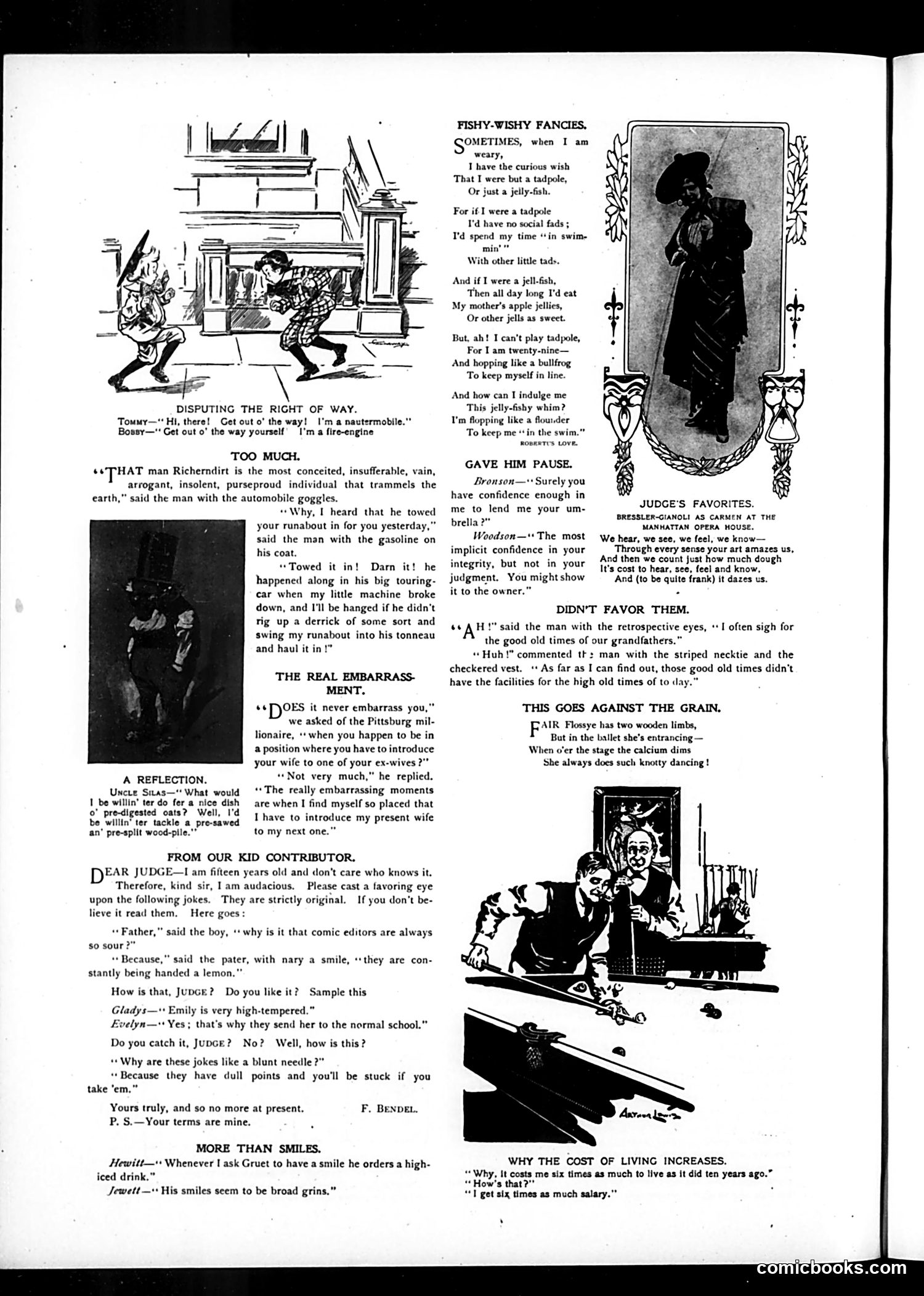
This page contains multiple satirical pieces typical of early 20th-century Judge magazine: **"Disputing the Right of Way"** mocks automobile culture, showing pedestrians confronting motorists over street dominance—reflecting anxiety about automobiles' newness and danger to traditional street users. **"Too Much"** satirizes wealthy automobile owners' entitlement and arrogance toward working-class people, suggesting they view themselves as above normal social rules. **"The Real Embarrassment"** jokes about introducing one's new wife to a previous wife—likely satirizing divorce's increasing prevalence and social awkwardness in this era. **"From Our Kid Contributor"** presents supposedly original jokes submitted by a 15-year-old reader, poking fun at the jokes' predictable, groan-worthy quality. The remaining pieces mock modern life's complications, cost increases, and social anxieties of the period.
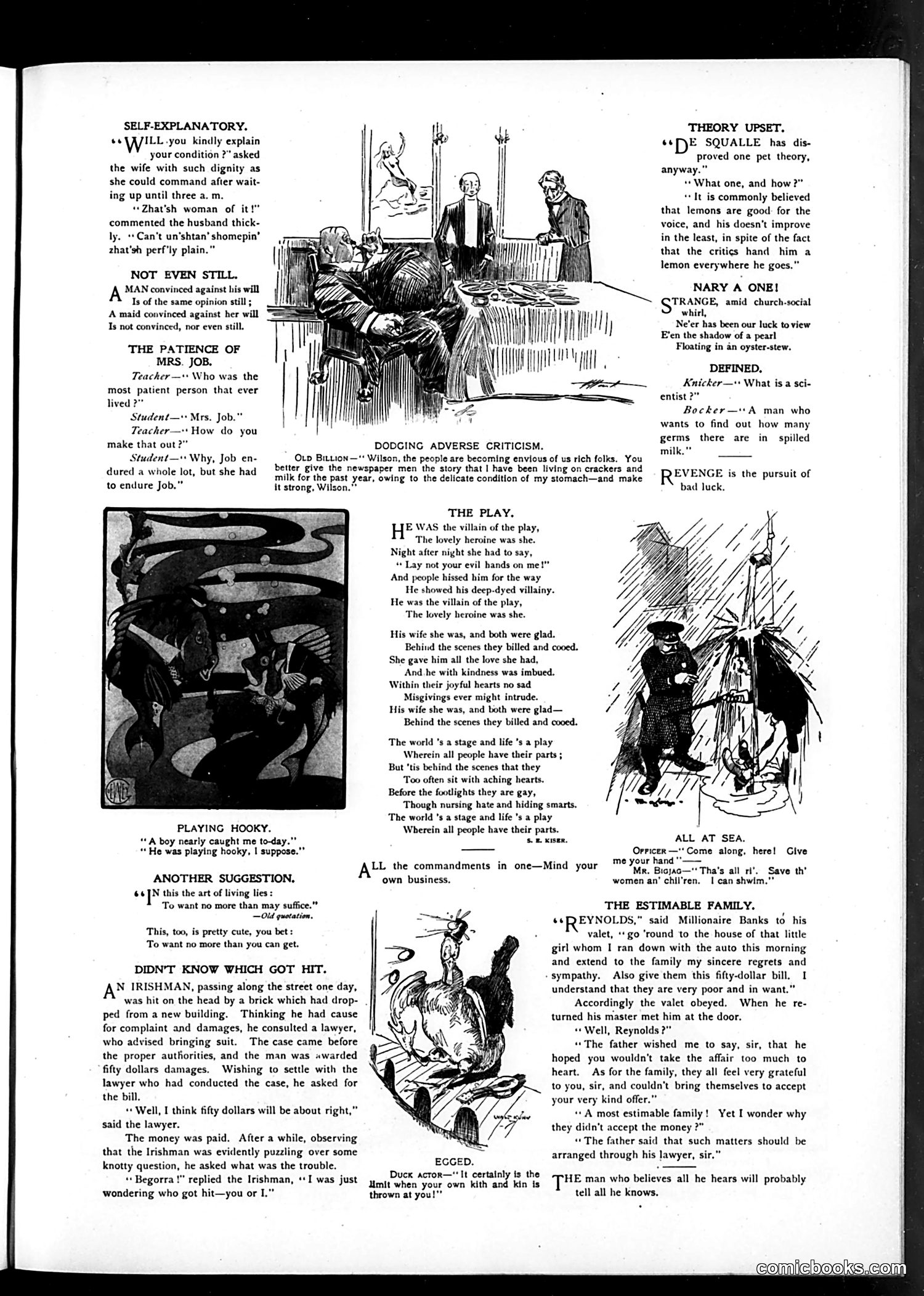
This page contains multiple short humorous pieces and illustrations rather than a single political cartoon. The content includes: **"Self-Explanatory"** and **"Not Even Still"**: Brief jokes about marital patience and stubbornness. **"The Patience of Mrs. Job"**: A dialogue joke about endurance. **"Dodging Advertising Criticism"**: A sketch showing a wealthy man (Old Billion/Wilson) at dinner, apparently complaining about stomach issues while his servants listen. The satire appears to mock wealthy industrialists who publicly claim hardship while living luxuriously. **"The Play"**: A sentimental poem about theatrical villainy and heroism. **"The Estimable Family"**: A story about a millionaire's valet visiting a poor family, offering charity but face-saving excuses. The page satirizes class disparities and wealthy hypocrisy through humor and sentiment typical of early 20th-century American satirical magazines.
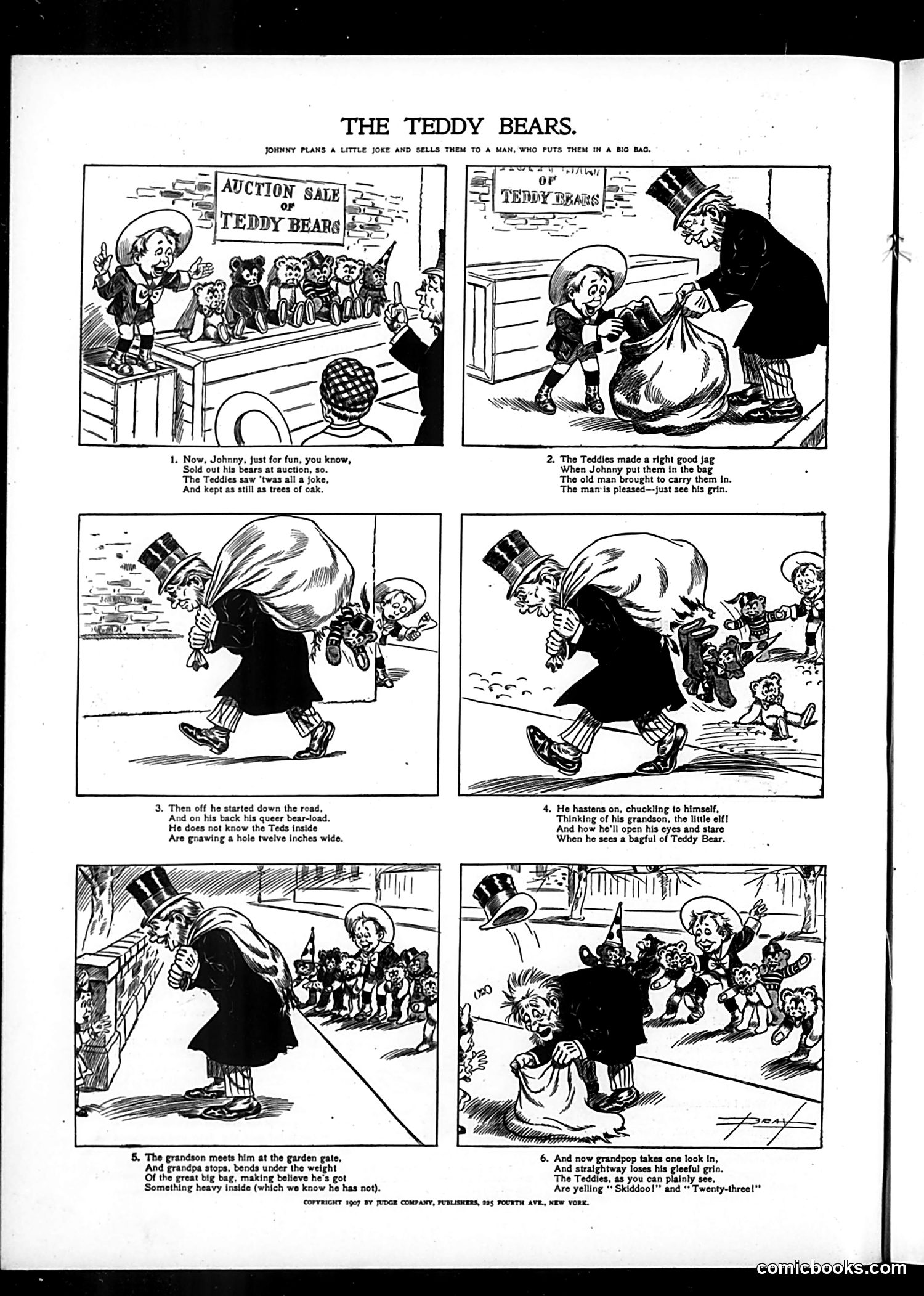
This is a humorous children's story presented as a six-panel comic strip about a prank gone wrong. A boy named Johnny sells his toy teddy bears to an old man, who plans to give them to his grandson as a surprise gift in a large bag. The joke unfolds when the bears, supposedly "playing dead" during the auction, come alive inside the sealed bag as the man carries it. They gnaw a twelve-inch hole and escape. When the grandfather eagerly opens the bag at the garden gate to show his grandson, the bears are nowhere to be found—they've fled, "yelling 'Skiddoo!' and 'Twenty-three!'" (period slang for departing/disappearing). The humor targets the grandfather's disappointment and the boy's failed scheme. "Teddy Bears" were a craze following Theodore Roosevelt's presidency (named after "Teddy"), making them timely commercial reference material for a 1907 satirical magazine audience.
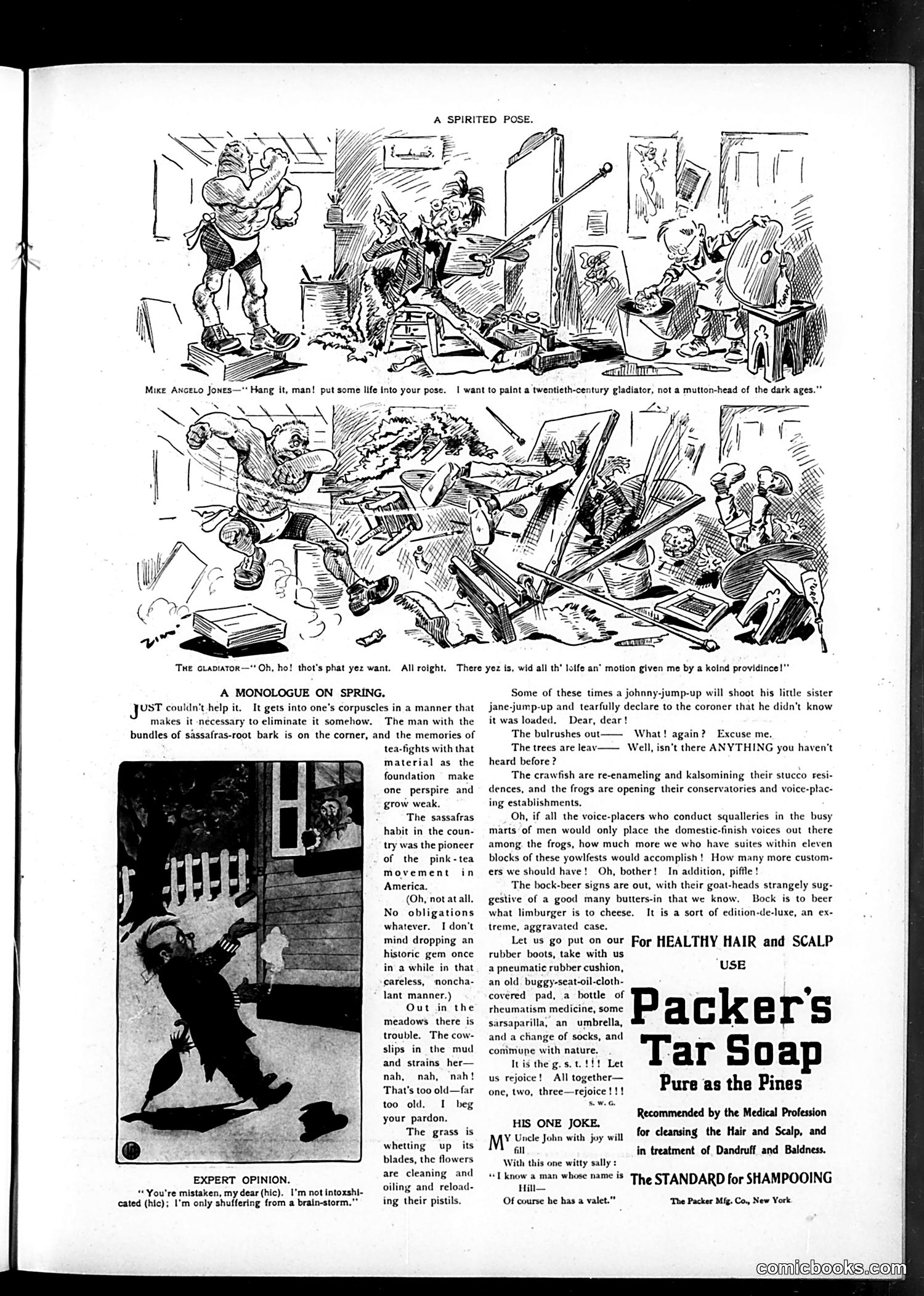
This page contains two unrelated cartoon sequences satirizing American social life, plus advertisements. **"A Spirited Pose"** (top): Shows an artist attempting to paint a "twentieth-century gladiator" but struggling with an uncooperative, energetic male model whose movement and vitality resist capture on canvas. The satire mocks both overly ambitious artistic pretension and the difficulty of depicting modern, dynamic subjects in traditional art. **"A Monologue on Spring"** (center): A rambling, humorous meditation on spring's arrival, using exaggerated dialect and absurdist observations (sassafras tea as cultural history, frogs establishing "voice-placing establishments," etc.). The accompanying photograph shows what appears to be a child with a donkey—its connection to the text is unclear. **"His One Joke"** (bottom right): A brief gag about an uncle repeatedly telling the same joke about a man named "Hill" who has a valet—a timeless satire on tedious storytellers. The page is largely filled with period advertisements for Packer's Tar Soap, interspersed among the editorial content—typical magazine layout of this era.
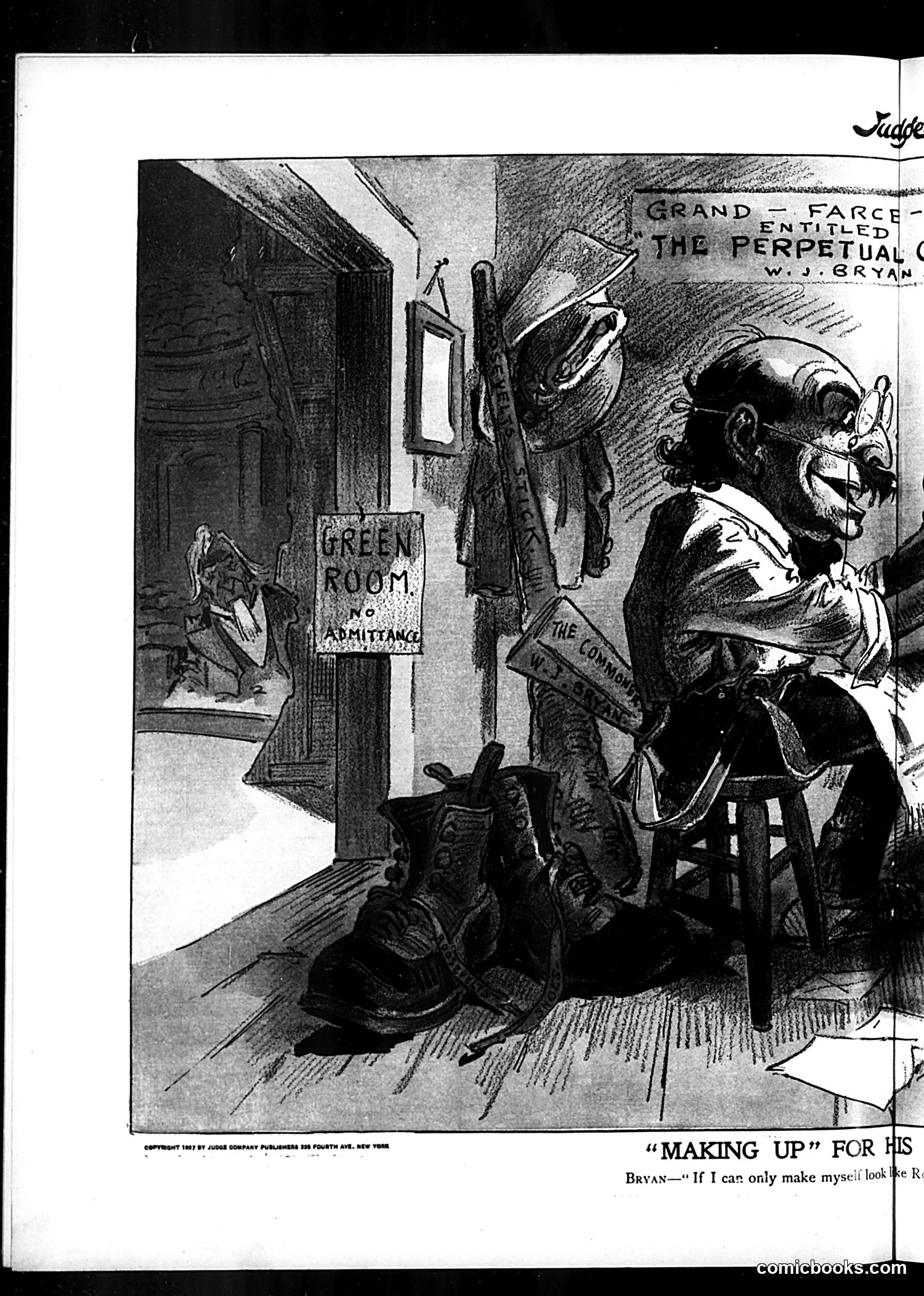
This appears to be a political cartoon referencing William Jennings Bryan, the three-time presidential candidate. The image shows a figure in a "Green Room" (theatrical backstage space) attempting to disguise or transform their appearance, with makeup and costume elements visible. The satire likely mocks Bryan's political positioning or reinvention—the caption "Making Up" for his political ambitions suggests he's artificially constructing a persona to appeal to voters. The theatrical setting emphasizes the performative nature of his political efforts. The incomplete caption ("If I can only make myself look...") implies skepticism about whether cosmetic changes could overcome deeper political or personal liabilities. This reflects Judge magazine's typical Republican-leaning satirical criticism of Democratic figures.
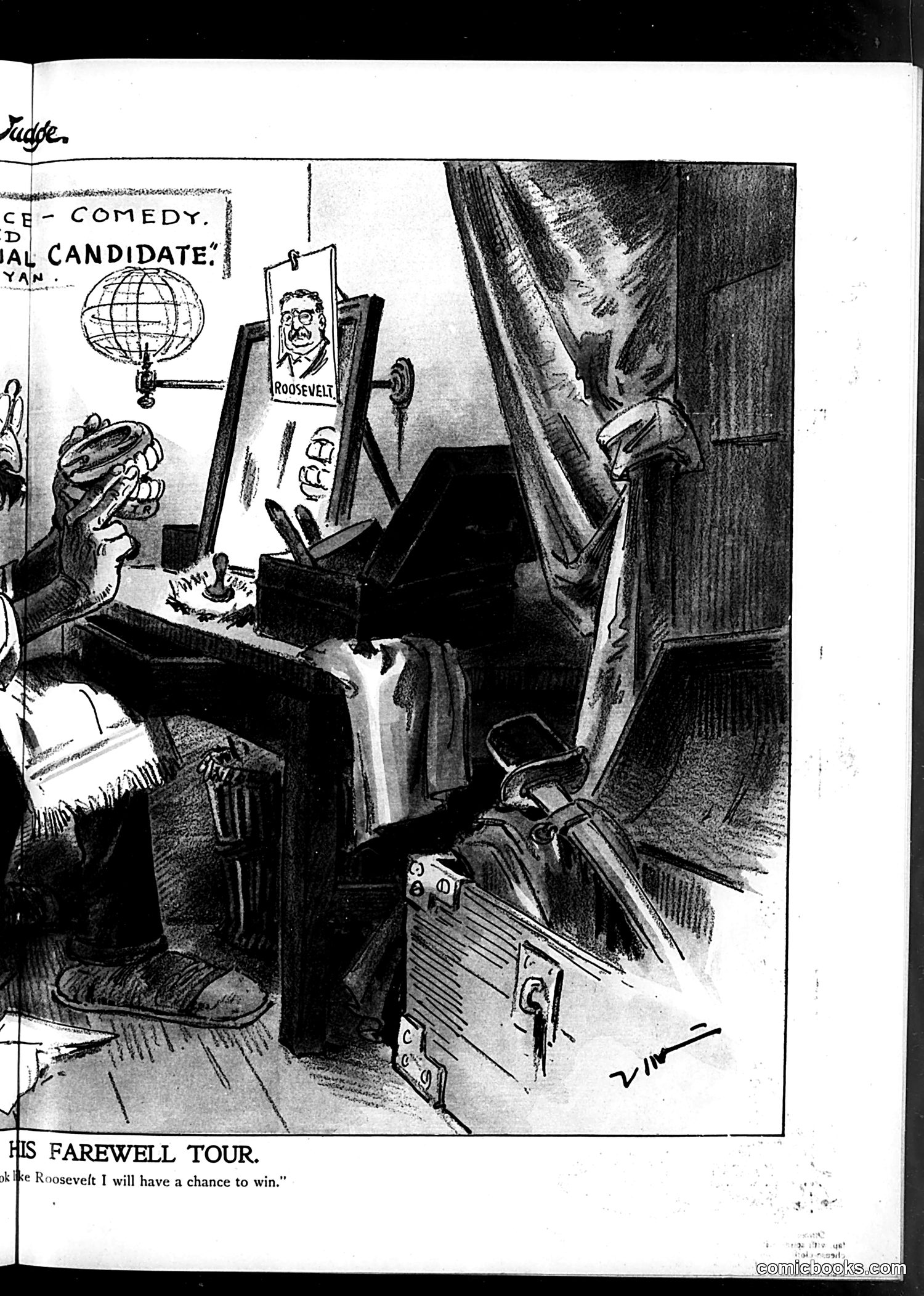
This cartoon satirizes a political candidate's "farewell tour" before an election. The figure at the desk appears to be a campaign manager or politician reviewing campaign materials, including a portrait labeled "Roosevelt" and a globe representing global affairs. The satire mocks the candidate's slim electoral prospects—the caption's sarcastic line "like Roosevelt I will have a chance to win" suggests the candidate's chances are as remote as someone named Roosevelt winning (likely referencing a specific historical context where Roosevelt was considered unelectable or unpopular at that moment). The "comedy" element references campaign theater as performative spectacle. The detailed props—desk, globe, campaign imagery—emphasize how the campaign operates as staged entertainment rather than serious political engagement. Without the publication date visible, the specific Roosevelt and candidate cannot be definitively identified, but the cartoon critiques electoral cynicism and campaign artifice.
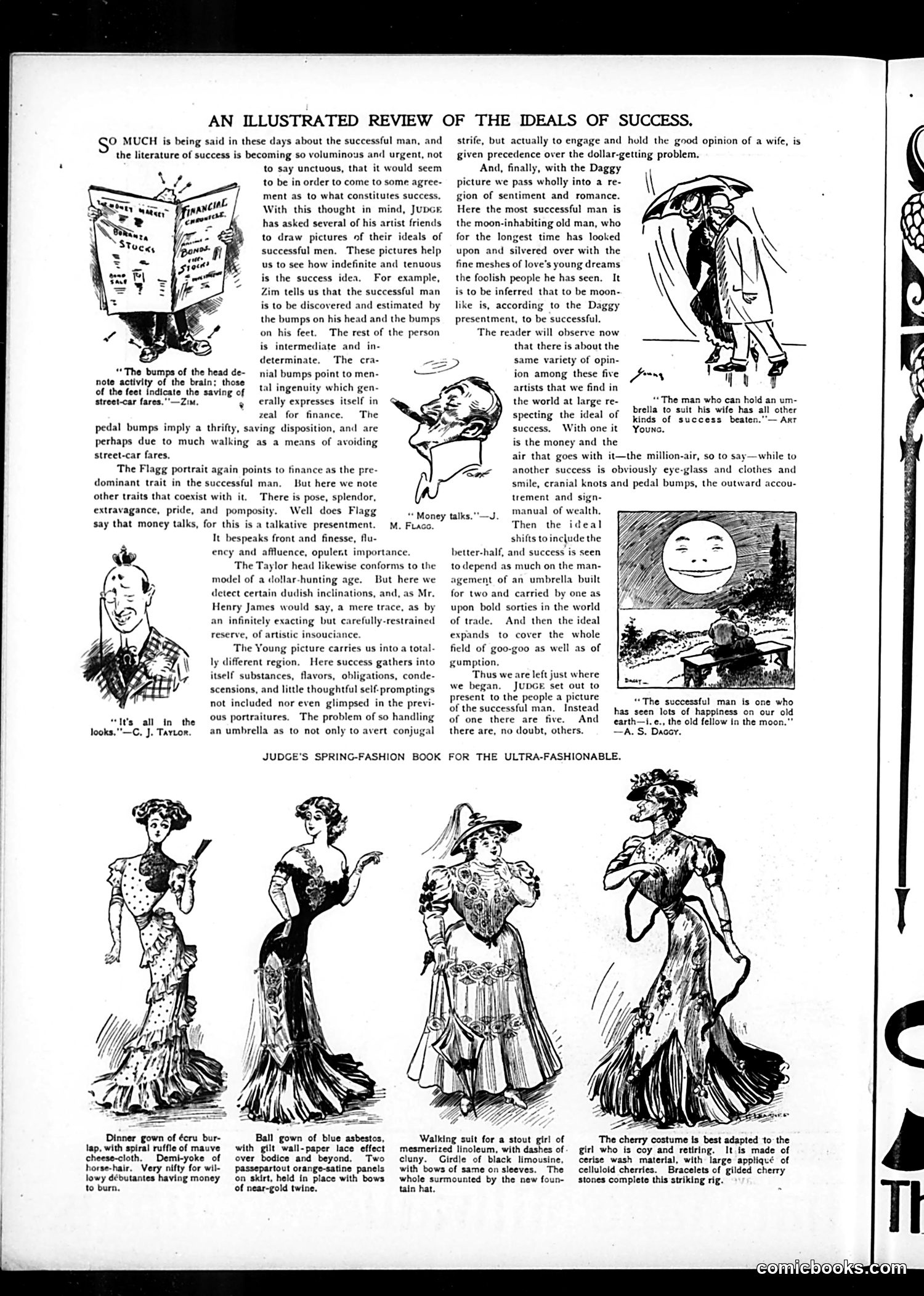
This page satirizes competing American ideologies of "success" in the early 20th century. Judge invited five artists to illustrate their ideal successful man, revealing contradictory cultural values. The five competing ideals shown are: 1. **Zim's phrenology model**: Success defined by head and foot "bumps"—mental acuity for finance and thrifty walking habits 2. **Flagg's materialist**: Wealth, pomposity, and showy affluence—"money talks" 3. **Taylor's artistic reserve**: Refined dudishness with restraint and cultural sophistication 4. **Young's domestic compromise**: Success requiring skill at marital harmony (holding an umbrella for one's wife) 5. **Daggy's romantic idealism**: The moon-gazing poet embodying sentiment over material gain The satire's point: American society fundamentally *disagrees* on what constitutes success. Rather than resolving this, Judge ironically notes readers remain "just where we began"—confused by contradictory cultural messages about achievement, wealth, refinement, domesticity, and romance.
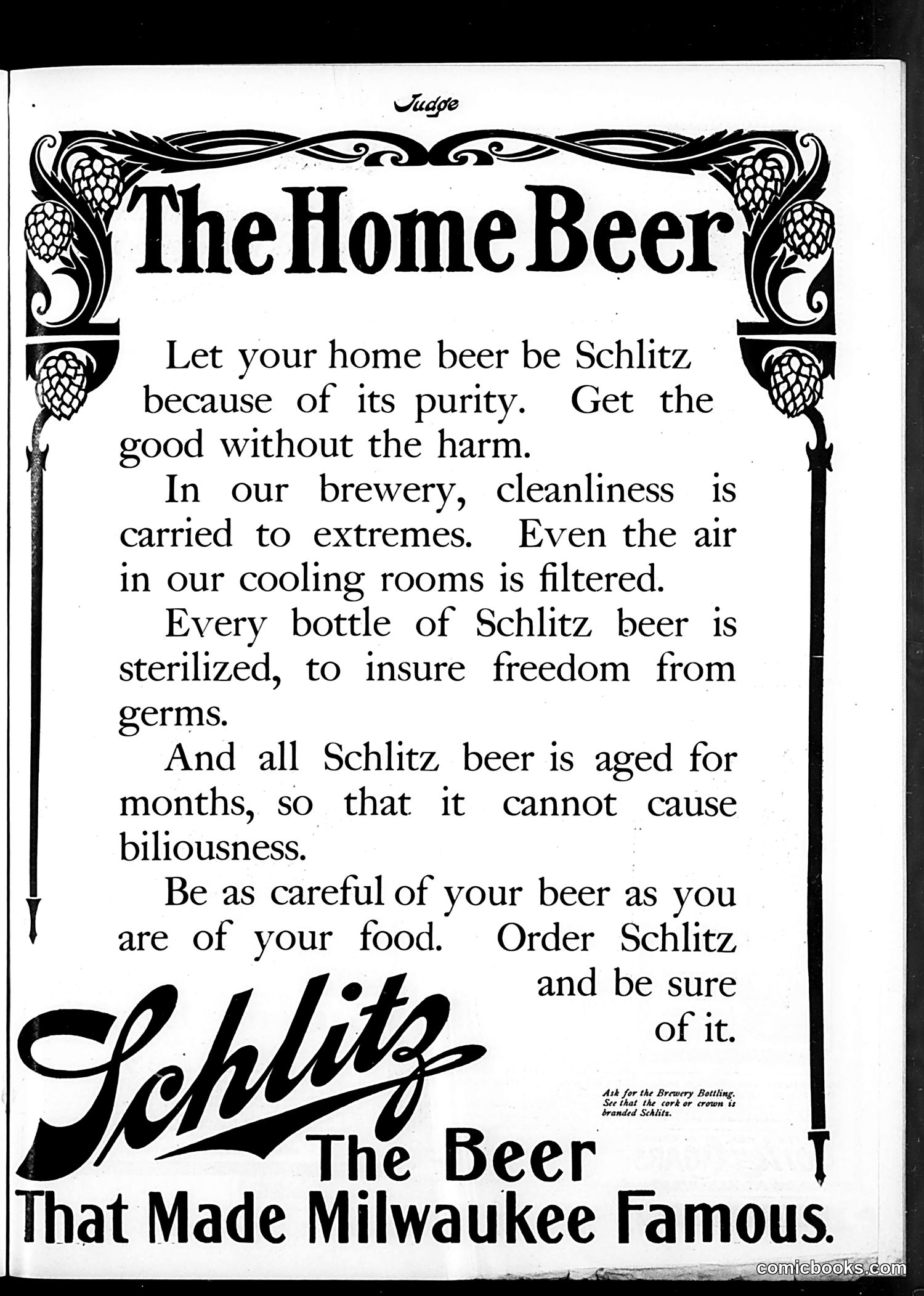
This is a **Schlitz beer advertisement**, not political satire. The page promotes Schlitz as a safe, pure home beer through marketing claims about manufacturing hygiene. The ad emphasizes: - Purity and cleanliness (filtered air, sterilized bottles) - Extended aging to prevent digestive problems ("biliousness") - Quality control comparable to food safety For modern readers: This reflects early 20th-century concerns about contaminated beer and patent medicines. The emphasis on "germ-free" production and health benefits reflects the era's germ theory anxiety. "The Beer That Made Milwaukee Famous" was Schlitz's actual slogan, positioning the brewery as a source of civic pride for Milwaukee, then America's brewing capital. The decorative hop vine border and formal typography were typical Judge magazine advertising aesthetics of this period.
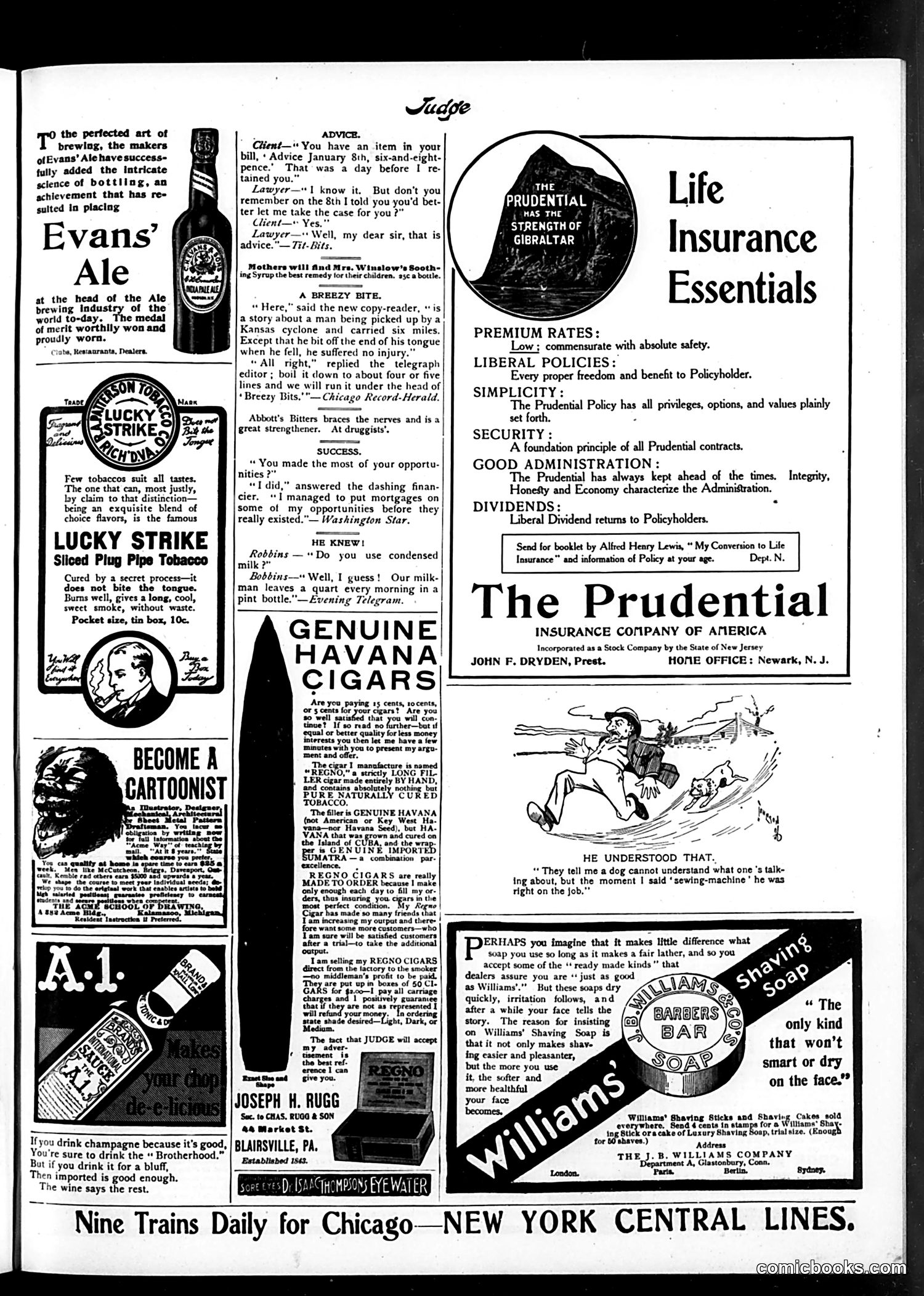
This is primarily an **advertising page** with several short humorous anecdotes interspersed among product ads. The satirical content includes: 1. **"Advice"** — A lawyer jokes that his pre-case consultation counts as billable "advice," satirizing how lawyers monetize every interaction. 2. **"A Breezy Bite"** — Mocks sensationalist journalism: a copy editor reduces a dramatic cyclone story to a brief, absurd item, suggesting newspapers exaggerate or distort news for space/impact. 3. **"Success"** — A financier boasts of putting mortgages on his future opportunities, satirizing get-rich-quick schemes and financial speculation. 4. **"He Knew!"** — A joke about condensed milk appearing to expand when poured into a smaller bottle—mocking consumer gullibility about product quality. The page is dominated by product advertisements (Evans' Ale, Lucky Strike tobacco, Regño cigars, Prudential Insurance, Williams' Shaving Soap), reflecting Judge's commercial nature. The humor is light, observational satire targeting everyday follies rather than political content.
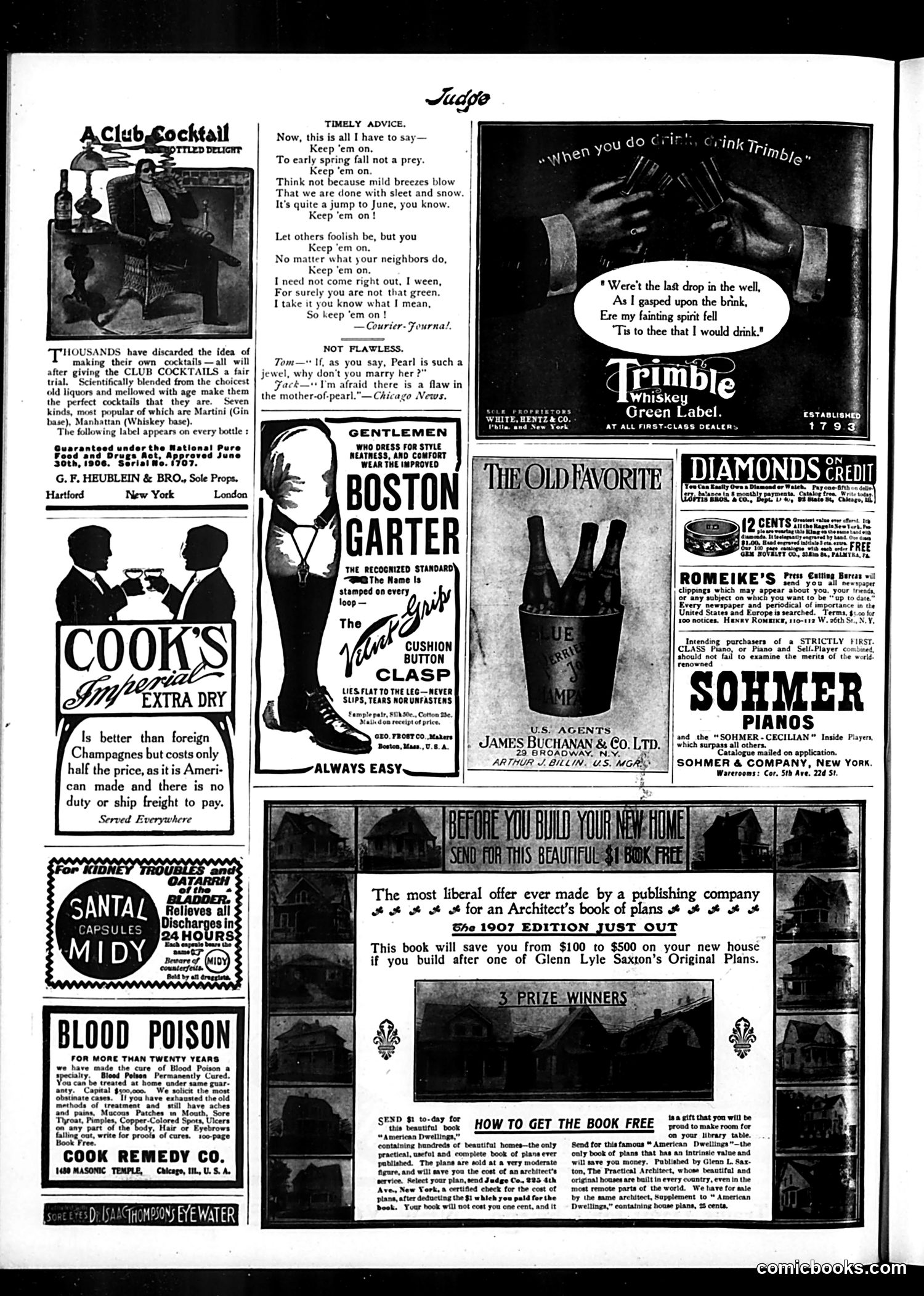
This page is primarily **advertisements and light humor pieces**, not political satire. The "Timely Advice" poem humorously urges readers to keep wearing garters or suspenders into spring—a practical joke about men's fashion, as mild weather tempts premature removal of winter undergarments. The "Not Flawless" joke is a simple pun: a man won't marry his girlfriend Pearl because there's "a flaw in the mother-of-pearl"—wordplay on both the gem and her mother. Most of the page consists of product advertisements: Club Cocktails, Boston Garter (with "cushion button clasp"), Cook's Imperial Extra Dry champagne, Trimble Whiskey, Sohmer Pianos, and remedies for blood poison and kidney troubles. There's also a prominent ad for Glenn Lyle Saxton's "American Dwellings"—an architect's book offering house plans. The Trimble Whiskey ad includes a sentimental verse about drink. Overall, this is a typical early-1900s magazine page mixing light humor with commercial messaging rather than substantive satire.
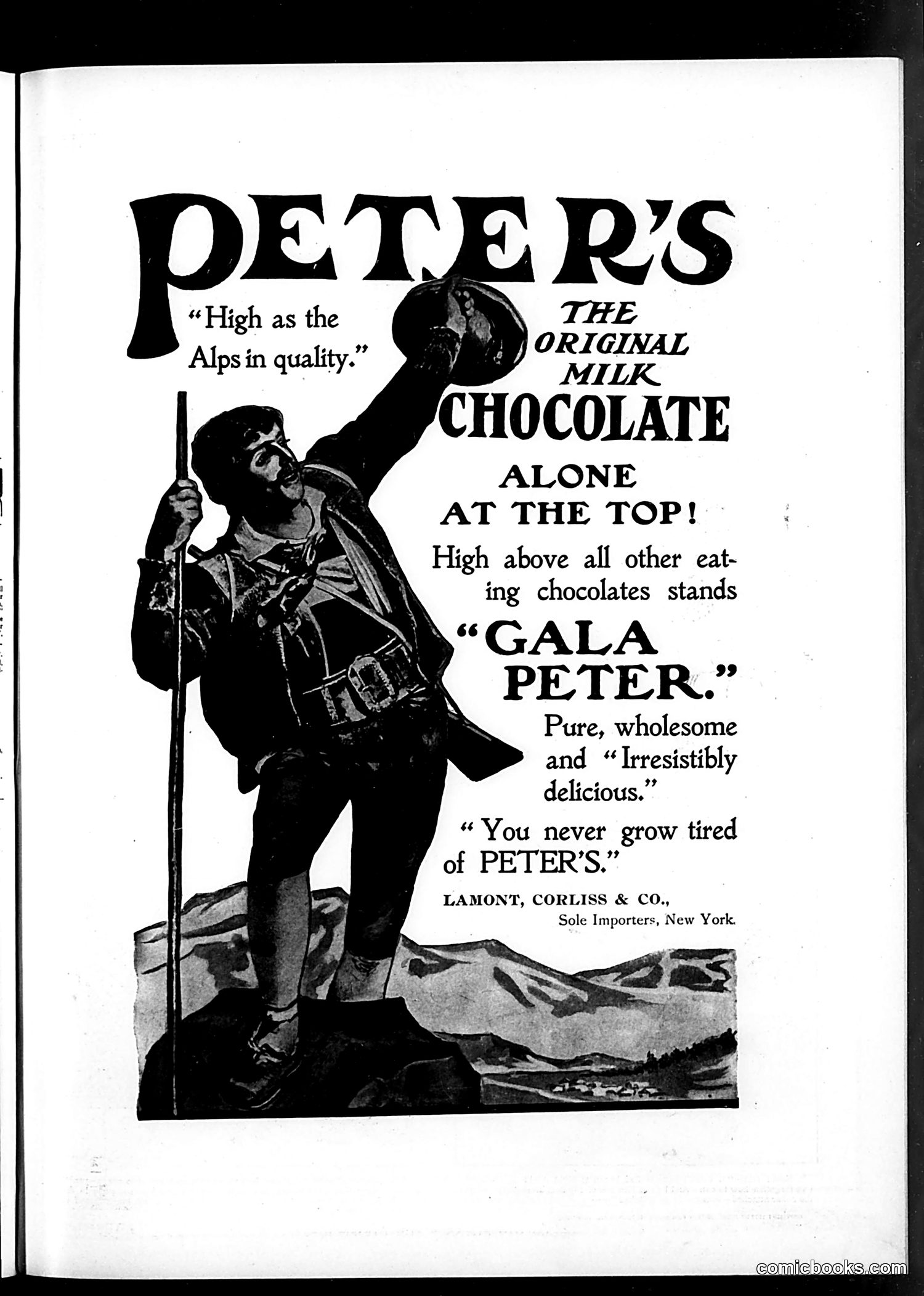
This is a **product advertisement**, not political satire. It promotes Peter's milk chocolate, made by Lamont, Corliss & Co. (New York importers). The ad features an Alpine climber triumphantly planting a flag at a mountain peak, visually reinforcing the tagline "High as the Alps in quality" and the claim that Peter's stands "alone at the top" among eating chocolates. The mountaineer imagery emphasizes superiority and achievement. Key sales claims include: the chocolate is "pure, wholesome," "irresistibly delicious," and customers "never grow tired" of it. The ad combines aspirational adventure imagery with straightforward product benefits typical of early-20th-century advertising, when chocolate was still somewhat of a luxury item and Swiss/Alpine chocolate had premium associations.
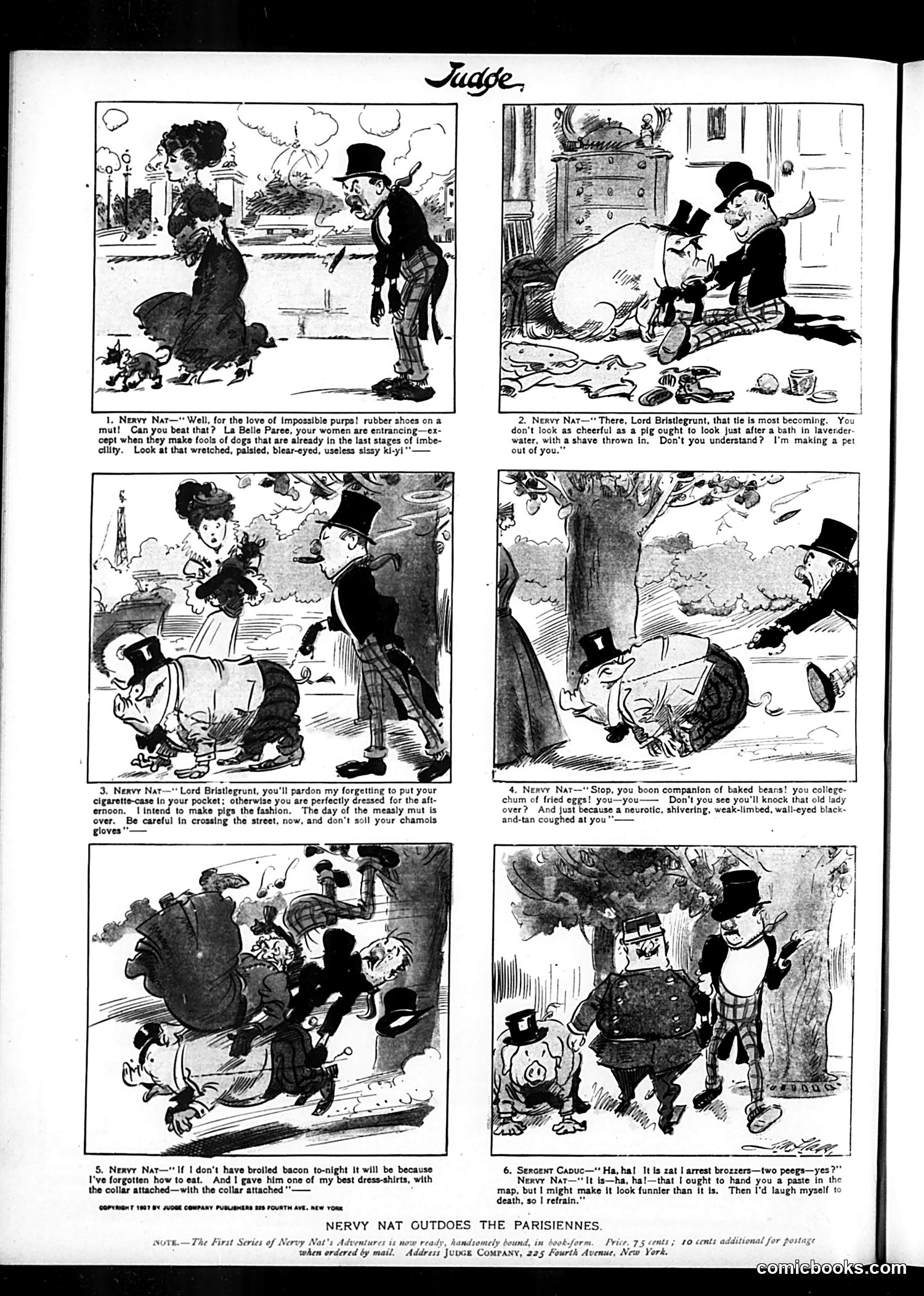
This six-panel comic strip satirizes a character called "Nervy Nat" adopting fashionable Parisian affectations. The humor centers on Nat treating pigs like fashionable pets—a absurd exaggeration of how wealthy Parisians (particularly women) carried small dogs as accessories. In each panel, Nat acts pretentiously while accompanied by pigs, speaking in affected language to aristocratic-sounding characters like "Lord Bristlegrunt." The satire mocks both the fashion-obsessed French elite and Americans who slavishly imitate European sophistication. The joke is that Nat takes the frivolous trend to ridiculous extremes—grooming pigs, dressing them in fine clothing, and treating them with the care society reserved for lap dogs. The final panel includes a French police sergeant, reinforcing the Parisian setting while poking fun at French accents and American tourists abroad.