
Judge, 1907-04-13 · page 10 of 16
Judge — April 13, 1907 — page 10: what you’re looking at
What you’re looking at
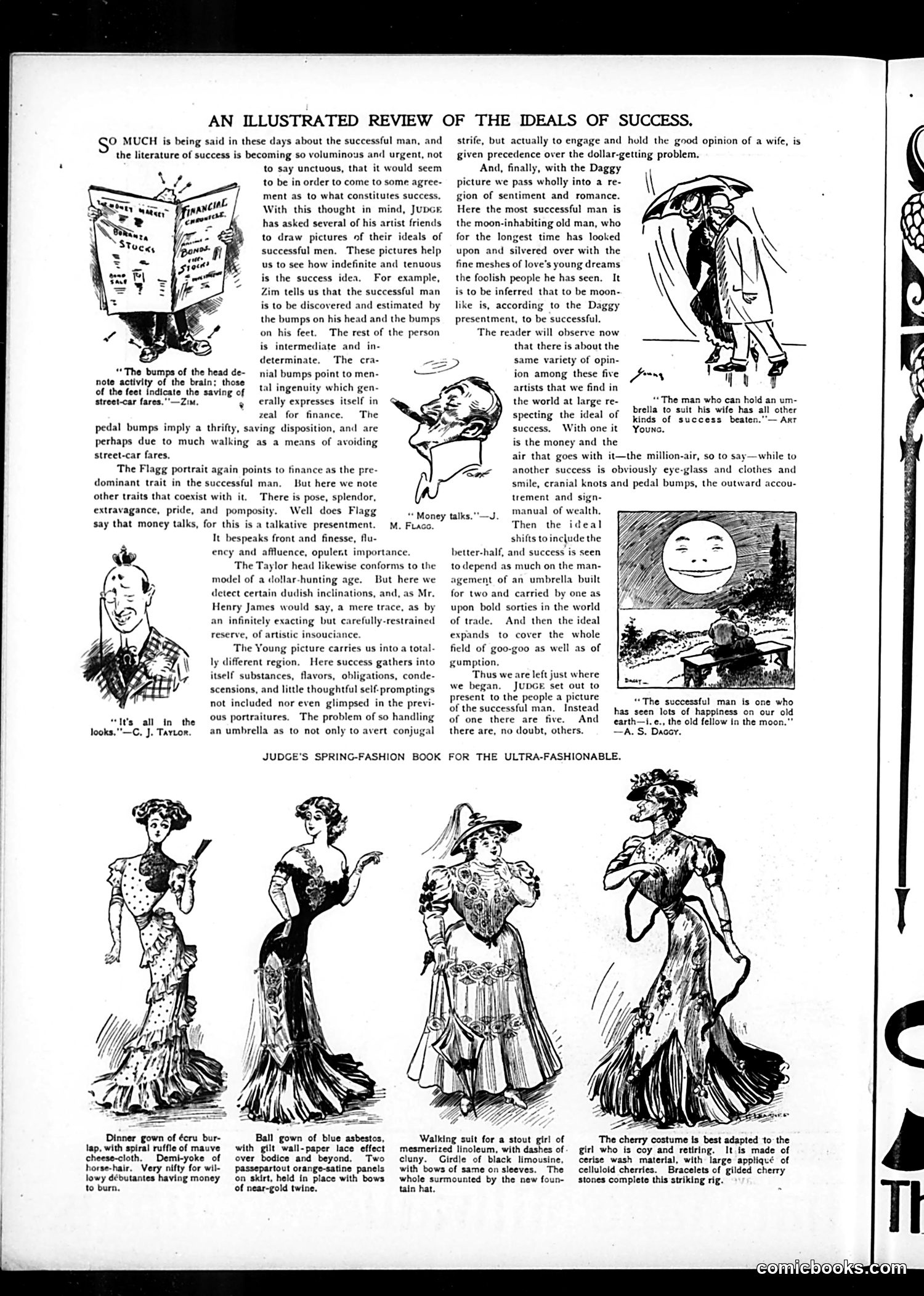
This page satirizes competing American ideologies of "success" in the early 20th century. Judge invited five artists to illustrate their ideal successful man, revealing contradictory cultural values. The five competing ideals shown are: 1. **Zim's phrenology model**: Success defined by head and foot "bumps"—mental acuity for finance and thrifty walking habits 2. **Flagg's materialist**: Wealth, pomposity, and showy affluence—"money talks" 3. **Taylor's artistic reserve**: Refined dudishness with restraint and cultural sophistication 4. **Young's domestic compromise**: Success requiring skill at marital harmony (holding an umbrella for one's wife) 5. **Daggy's romantic idealism**: The moon-gazing poet embodying sentiment over material gain The satire's point: American society fundamentally *disagrees* on what constitutes success. Rather than resolving this, Judge ironically notes readers remain "just where we began"—confused by contradictory cultural messages about achievement, wealth, refinement, domesticity, and romance.
📄 Transcribed text from this page (OCR, searchable)
Machine-transcribed from the original scan — historical spelling and the odd misread are preserved.
AN ILLUSTRATED REVIEW OF THE IDEALS OF SUCCESS. strife, but actually to engage and hold the good opinion of a wife, is given precedence over the dollar-getting problem. And, finally, with the Daggy picture we pass wholly into a re- gion of sentiment and romance. Here the most successful man is the moon-inhabiting old man, who for the longest time has looked upon and silvered over with the fine meshes of love's young dreams the foolish people he has seen, It is to be inferred that to be moon- like is, according to the Daggy presentment, to be successful. The reader will observe now that there is about the same variety of opin- ion among these five artists that we find in the world at large re- specting the ideal of success. With one it is the money and the air that goes with it—the million-air, so to say—while to another success is obviously eye-glass and clothes and smile, cranial knots and pedal bumps, the outward accou- s° MUCH is being said in these days about the successful man, and the literature of success is becoming so voluminous and urgent, not to say unctuous, that it would seem to be in order to come to some agree- ment as to what constitutes success, With this thought in mind, Jupce has asked several of his artist friends to draw pictures of their ideals of successful men. These pictures help us to see how indefinite and tenuous is the success idea. For example, Zim tells us that the successful man is to be discovered and estimated by the bumps on his head and the bumps on his feet. The rest of the person is intermediate and in- determinate. The cra- nial bumps point to men- tal ingenuity which gen- erally expresses itself in zeal for finance. The pedal bumps imply a thrifty, saving disposition, and are perhaps due to much walking as a means of avoiding street-car fares, The Flagg portrait again points to finance as the pre- dominant trait in the successful man, But here we note other traits that coexist with it. There is pose, splendor, extravagance, pride, and pomposity. Well does Flagg say that money talks, for this is a talkative presentment. It bespeaks front and finesse, flu- ency and affluence, opulent importance. The Taylor head likewise conforms to the oon 7 “The man who can hold an um- brella to suit his wife has all other kinds of success beaten."— Arr Youns. “The bumps of the head de- note activity of the brain; those of the feet indicate the saving of street-car fares.""—Zim. e trement and sign- manual of wealth, Then the ideal shifts toinclude the better-half, and success is seen to depend as much on the man- ** Money talks.""—J. M. Fiacs. —C. J. Tarton. model of a dollar-hunting age. But here we detect certain dudish inclinations, and, as Mr. Henry James would say, a mere trace, as by an infinitely exacting but carefully-restrained reserve, of artistic insouciance. The Young picture carries us into a total- ly different region. Here success gathers into itself substances, flavors, obligations, conde- scensions, and little thoughtful self promptings not included nor even glimpsed in the previ- ous portraitures. The problem of so handling all in’ the = an umbrella as to not only to avert conjugal JUDGE'S SPRING-FASHION BOOK agement of an umbrella built for two and carried by one as upon bold sorties in the world of trade. And then the ideal expands to cover the whole field of goo-goo as well as of gumption. Thus we are left just where we began. JUDGE set out to present to the people a picture of the successful man. Instead of one there are five. And there are, no doubt, others. —A. S. Dacor. FOR THE ULTRA-FASHIONABLE. “The successful man is one who has seen lots of happiness on our old earth—i.e., the old fellow in the moon.” Dinner gown of écru bur- lap, with spiral ruffle of mauve cheese-cloth. Demi-yoke of horse-hair. Very nifty for wil- lowy débutantes having money to burn, Ball gown of blue asbestos, with gilt wall-paper lace effect over bodice and beyond, Two tout orange-satine panels on skirt, held in place with bows of near-gold twine. Walking suit for a stout girl of mesmerized linoleum, with dashes of cluny. Girdle of black limousine, with bows of same on sleeves. The whole surmounted by the new foun- tain hat. The cherry costume is best adapted to the girl who is coy and retiring. It is made of cerise wash material, with large appliqué of celluloid cherries. Bracelets of gilded cherry stones complete this striking rig.