
A complete issue · 20 pages · 1907
Judge — March 30, 1907
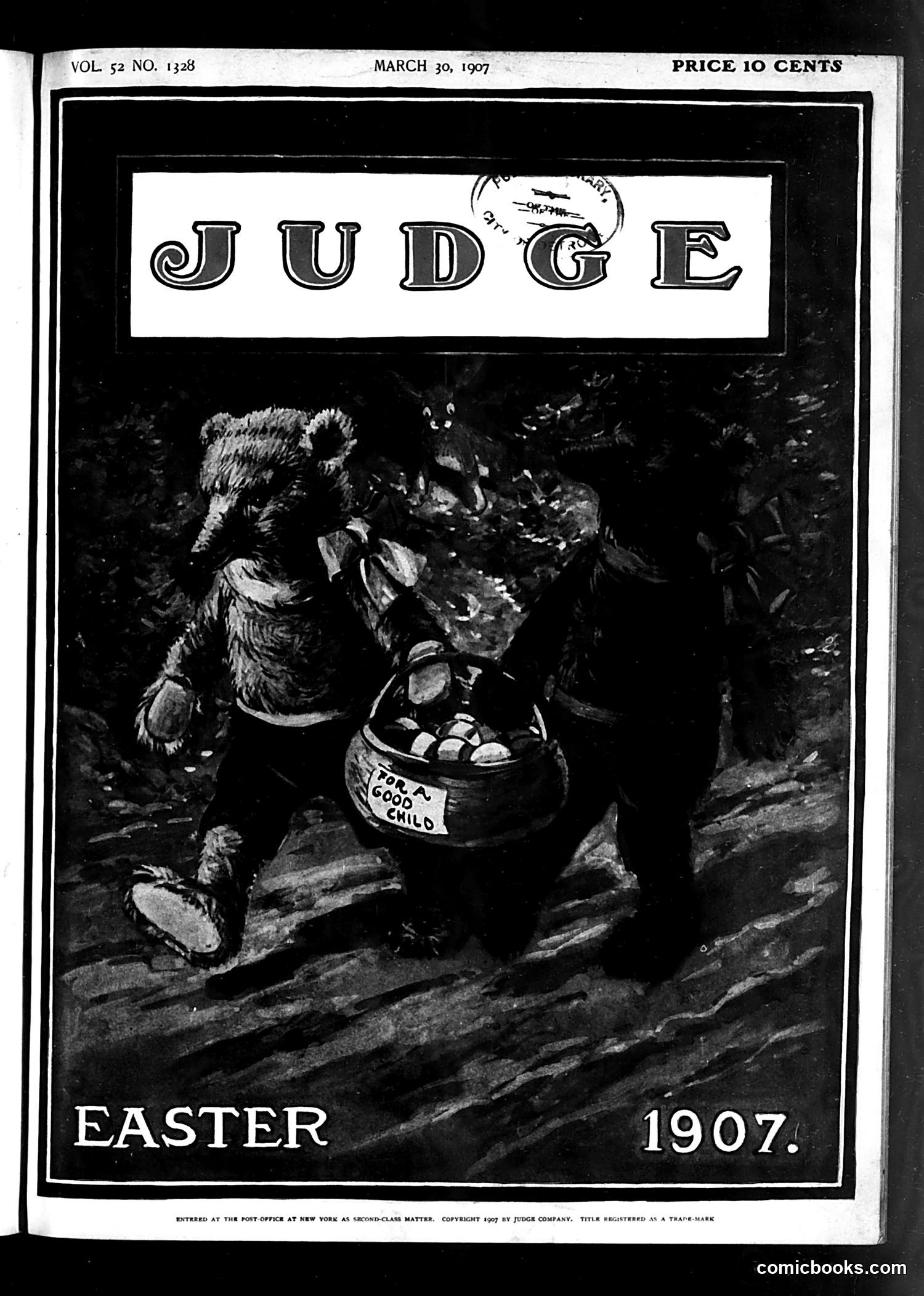
This Easter 1907 cover depicts an anthropomorphic bear carrying a basket labeled "GOOD CHILD." The bear appears to be playing the role of the Easter Bunny—a figure traditionally associated with delivering Easter eggs and gifts to well-behaved children. The satire likely references **Theodore Roosevelt**, whose administration (1901-1909) frequently employed bear imagery in political cartoons due to his famous 1902 bear-hunting incident and his adoption of the "teddy bear" as a cultural symbol. By portraying Roosevelt as an Easter bunny delivering rewards to "good children," Judge appears to be satirizing either his policies toward the American public, his political patronage, or contemporary social dynamics. The specific political commentary remains somewhat unclear without additional contemporary context, but the image plays on Roosevelt's iconic association with bears.
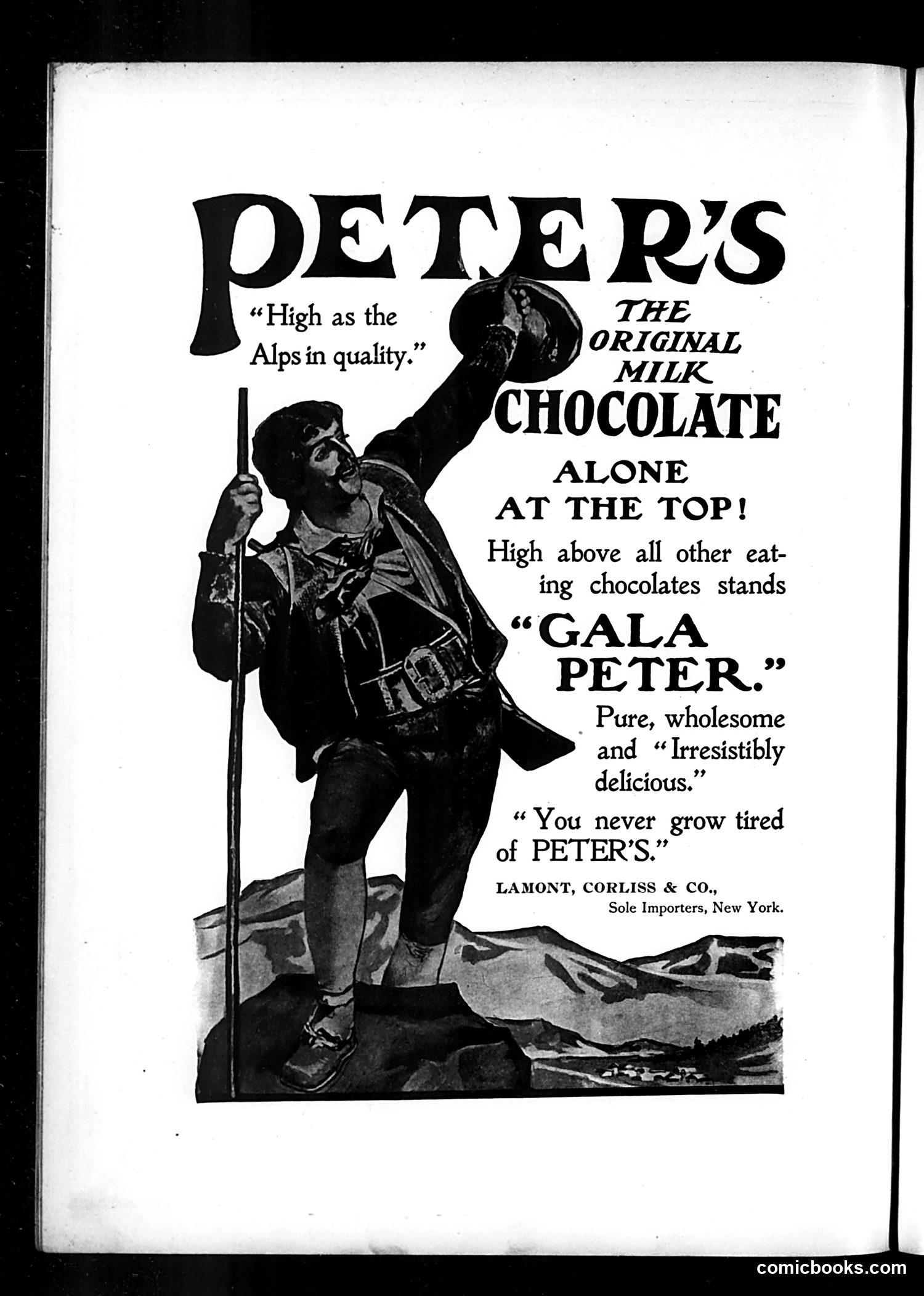
This page is primarily a **product advertisement**, not political satire. It promotes "Gala Peter," a Swiss milk chocolate imported by Lamont, Corliss & Co. of New York. The imagery features an Alpine climber at a mountain peak, visually reinforcing the advertising tagline "High as the Alps in quality." This mountaineer iconography was common in early 20th-century marketing to suggest excellence, purity, and superiority. The ad emphasizes that Peter's chocolate stands "alone at the top" among competitors, using patriotic/conquering imagery typical of period advertising. Phrases like "pure, wholesome," and "irresistibly delicious" were standard quality claims for chocolate products of the era. This represents vintage commercial advertising rather than editorial satire.
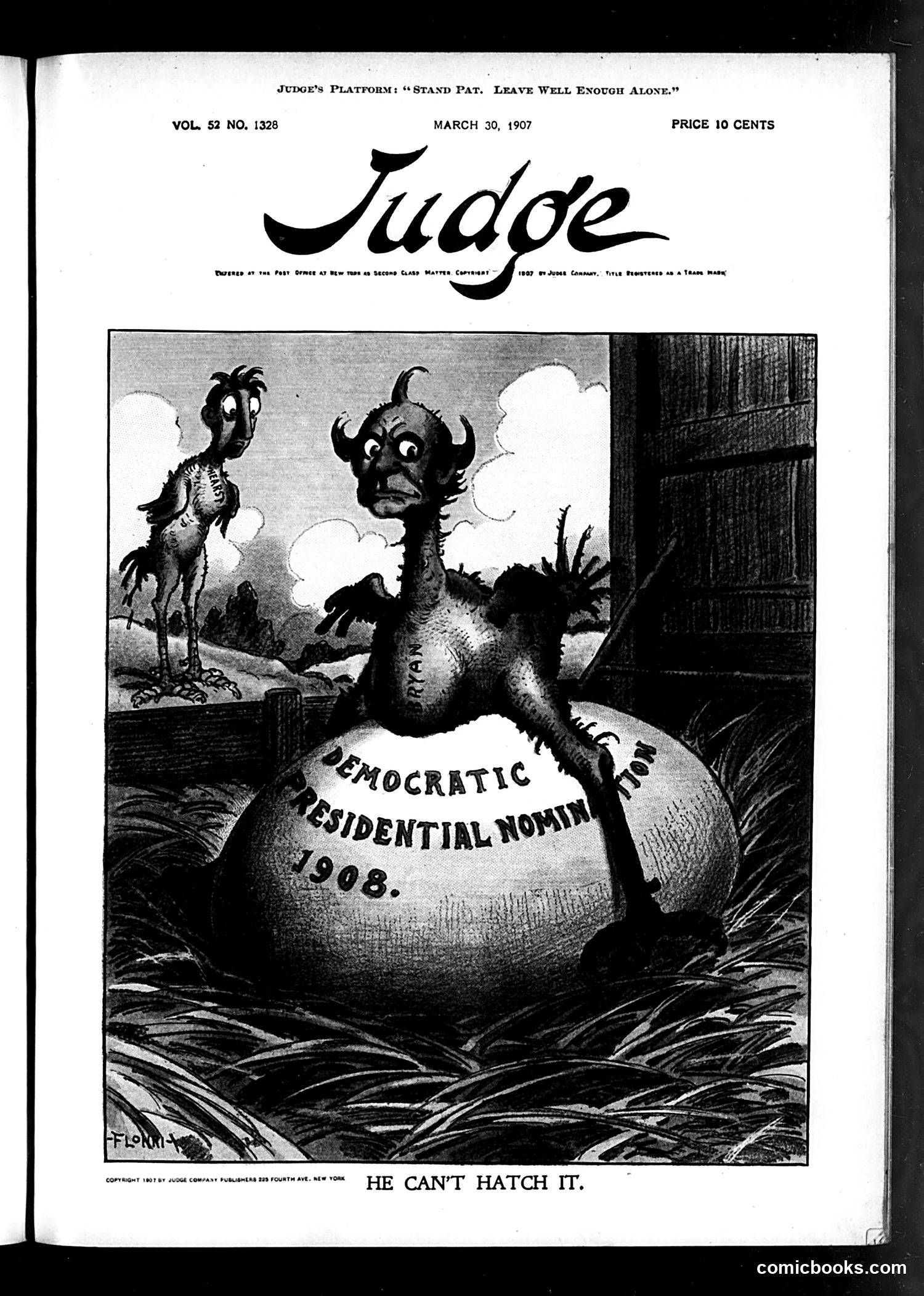
This editorial cartoon depicts a demonic creature sitting on a large egg labeled "DEMOCRATIC PRESIDENTIAL NOMIN 1908." A smaller demon-like figure stands nearby, appearing distressed. The satire comments on the Democratic Party's difficulty selecting a presidential nominee for the 1908 election. The egg symbolizes the nomination itself—something the party struggles to "hatch" or bring to fruition. The grotesque creatures represent either the party's internal chaos or the candidates themselves. President Theodore Roosevelt had pledged not to seek another term, creating uncertainty about succession. The cartoon mocks Democrats' inability to unite behind a viable nominee, suggesting their nomination process was monstrous or impossibly difficult. The title's pun reinforces the idea that success seemed beyond their grasp.
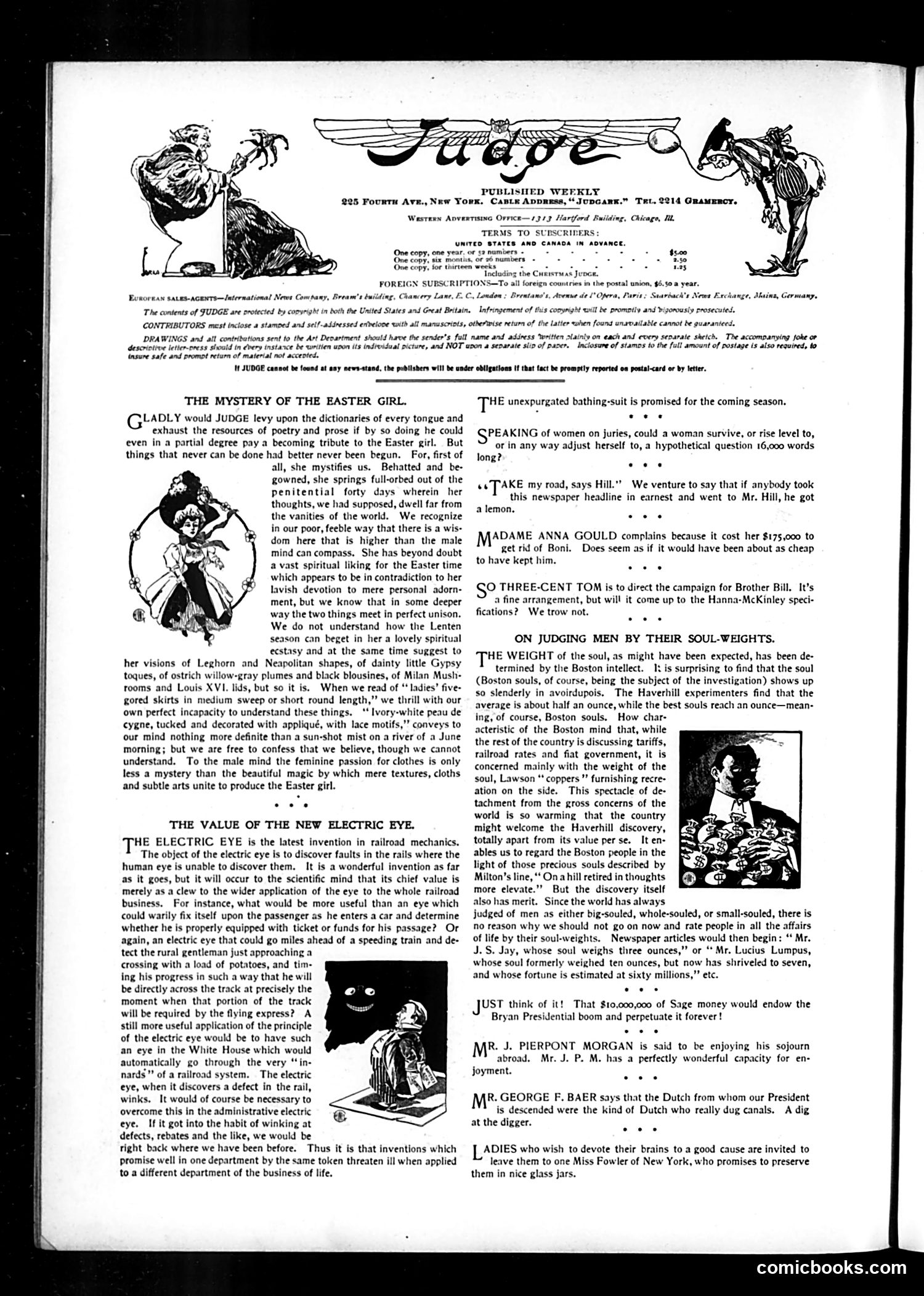
This page contains several satirical articles rather than political cartoons. The main pieces include: **"The Mystery of the Easter Girl"** — a literary critique examining how Easter symbolism appears in women's poetry and prose, suggesting female writers achieve spiritual depth through this theme. **"The Value of the New Electric Eye"** — satire about railroad safety innovations, questioning whether an "electric eye" detecting track obstructions offers genuine practical value or merely impresses investors. **Brief gossip items** mock wealthy figures: Madame Anna Gould's expensive divorce, and comments on J. Pierpont Morgan and George F. Baer's activities. The page lacks clear political cartooning but employs satirical humor targeting technological hype, literary pretension, and wealthy society figures typical of Judge's style. Decorative illustrations accompany the text but depict generic scenes rather than identifiable political figures.
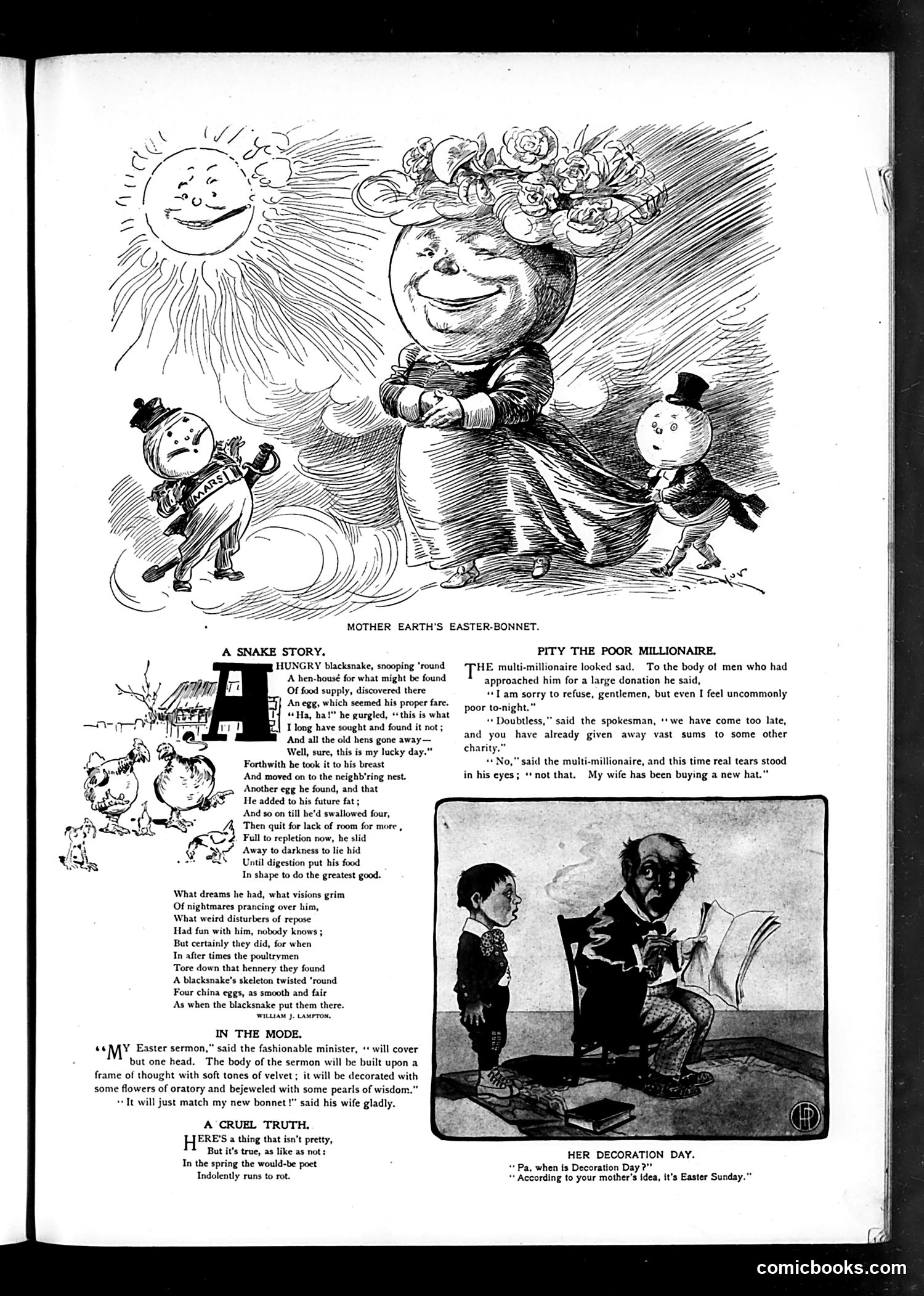
This Judge magazine page contains several Easter-themed satirical pieces. The top cartoon, "Mother Earth's Easter Bonnet," depicts a large figure (likely representing Mother Earth or Spring) wearing a bonnet of flowers, flanked by smaller personified characters—possibly representing seasons or weather conditions. "Pity the Poor Millionaire" mocks wealthy donors' self-pitying attitudes about charitable giving. The accompanying photograph shows a well-dressed man instructing a child, satirizing the performative nature of elite philanthropy. The other poems and sketches—"A Snake Story," "The Mode," and "A Cruel Truth"—offer social commentary on contemporary spring customs and seasonal pretenses. The overall page uses Easter imagery to critique vanity, wealth inequality, and social hypocrisy among the wealthy classes.
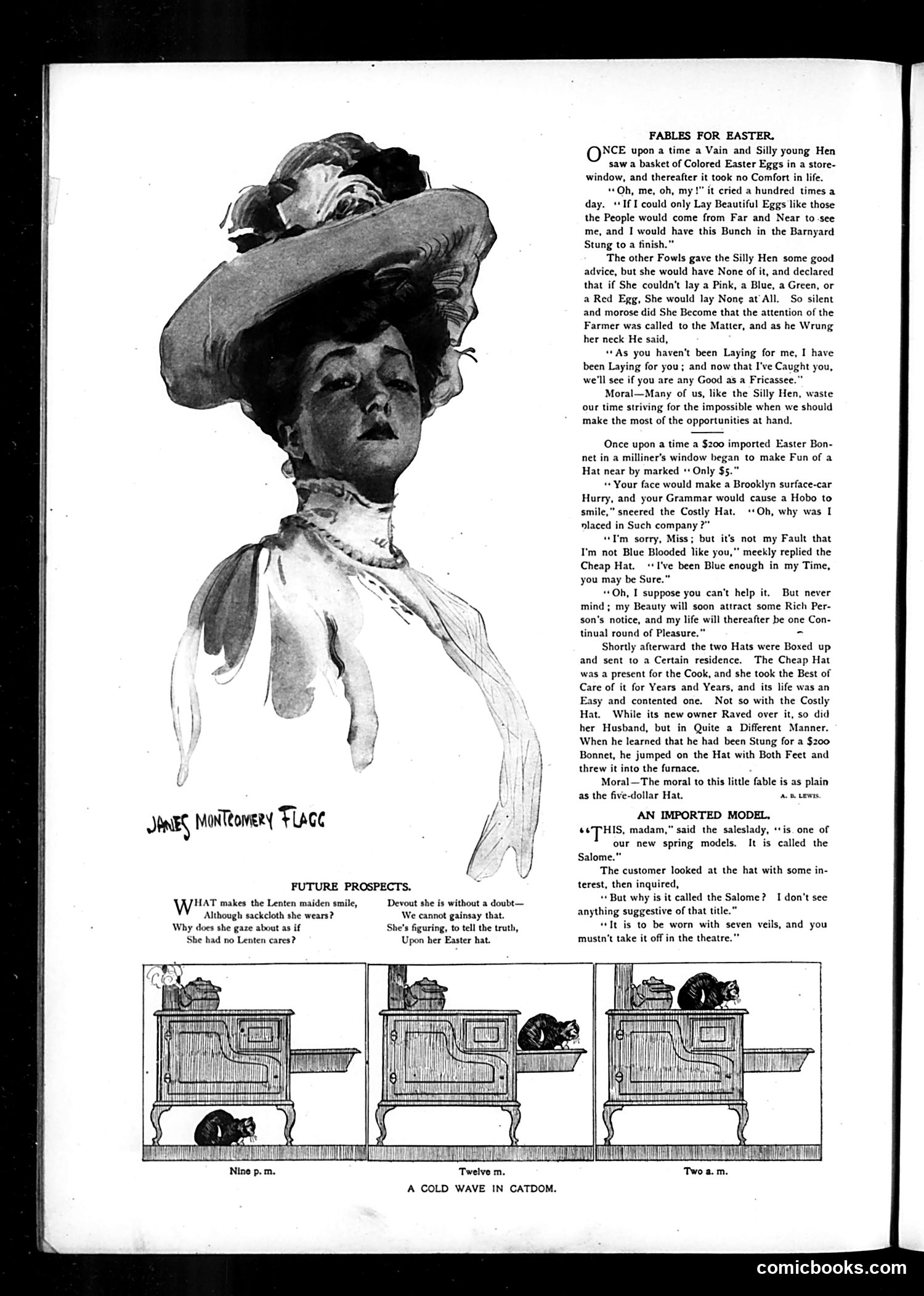
This page contains **two moralizing fables and a fashion satire**, typical of Judge's early 20th-century social commentary. **"Fables for Easter"** presents two Aesop-style tales: A vain hen obsesses over laying colored eggs instead of accepting her nature, ultimately becoming useless and meeting the butcher's block—the moral warns against wasting energy on impossible goals. A $200 imported Easter bonnet mocks a cheap $5 hat, but ends up destroyed by an angry husband, while the cheap hat is cherished by a cook—satirizing class pretension and its comeuppance. **"An Imported Model"** jokes about a ridiculous new hat called the "Salome" that requires seven veils and shouldn't be removed in public—a reference to Oscar Wilde's *Salome*, the biblical character famous for her "Dance of the Seven Veils." The joke mocks absurdist high fashion. **"Future Prospects"** and **"A Cold Wave in Catdom"** appear to be minor accompanying pieces about Lenten observance and cats seeking warmth. The overall message: Judge ridicules vanity, pretension, and impractical fashions while promoting practical virtue.
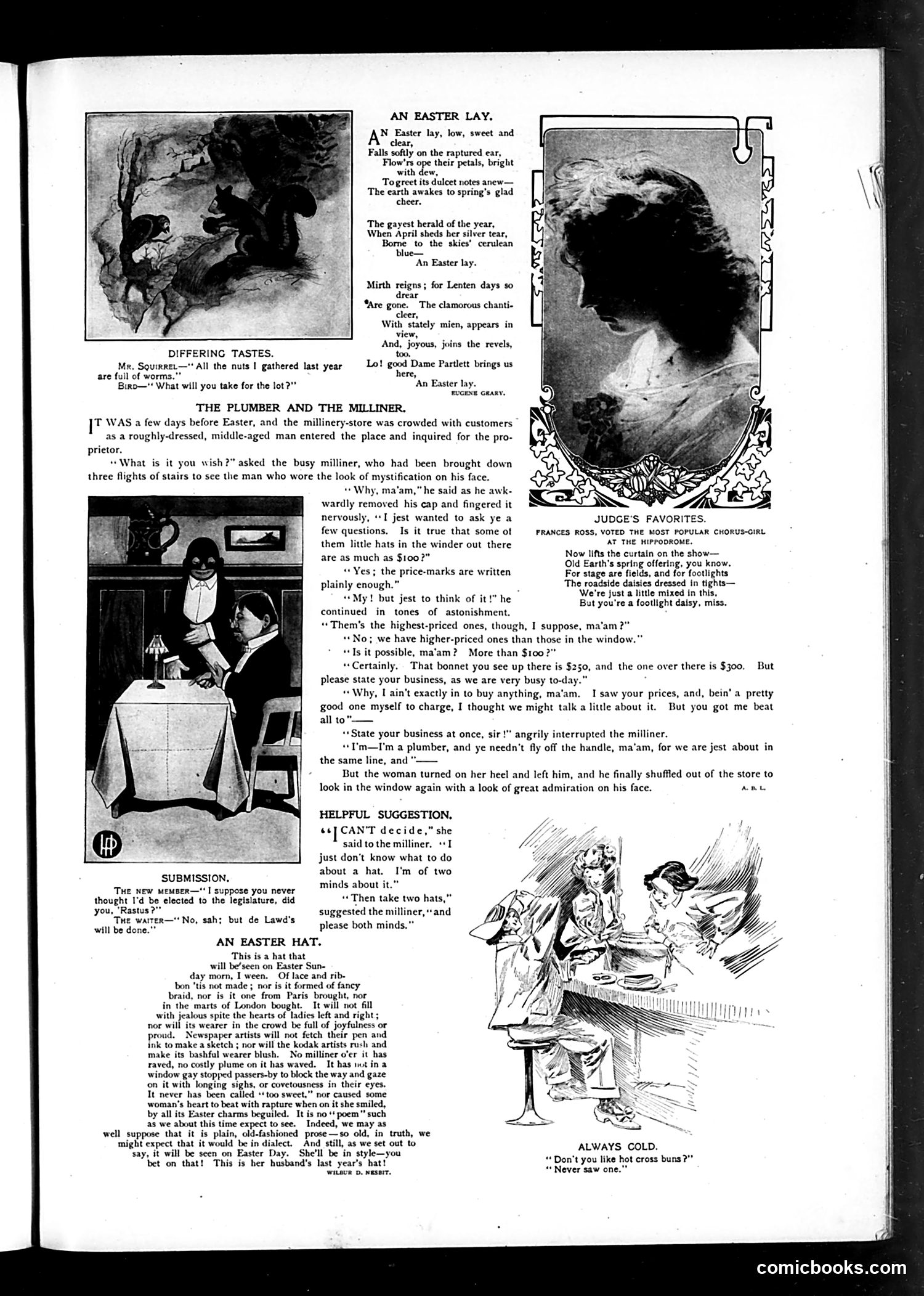
This satirical story mocks working-class pretensions and the rigid class divisions of the era. A rough plumber enters an exclusive millinery shop before Easter, observing that fashionable women's hats cost $250-$300. He attempts to relate to the milliner by claiming his plumbing work involves similarly high prices—crudely suggesting their professions are equivalent. The milliner is scandalized and dismisses him indignantly. The joke targets the plumber's audacity in equating manual labor with high-end retail fashion work, and his misunderstanding of social hierarchy. It also gently satirizes the vanity of Easter hat shopping among the wealthy. The surrounding content includes Easter-themed poetry and humorous vignettes about hat culture, reflecting Judge magazine's focus on contemporary social customs and consumption practices during the Easter season.
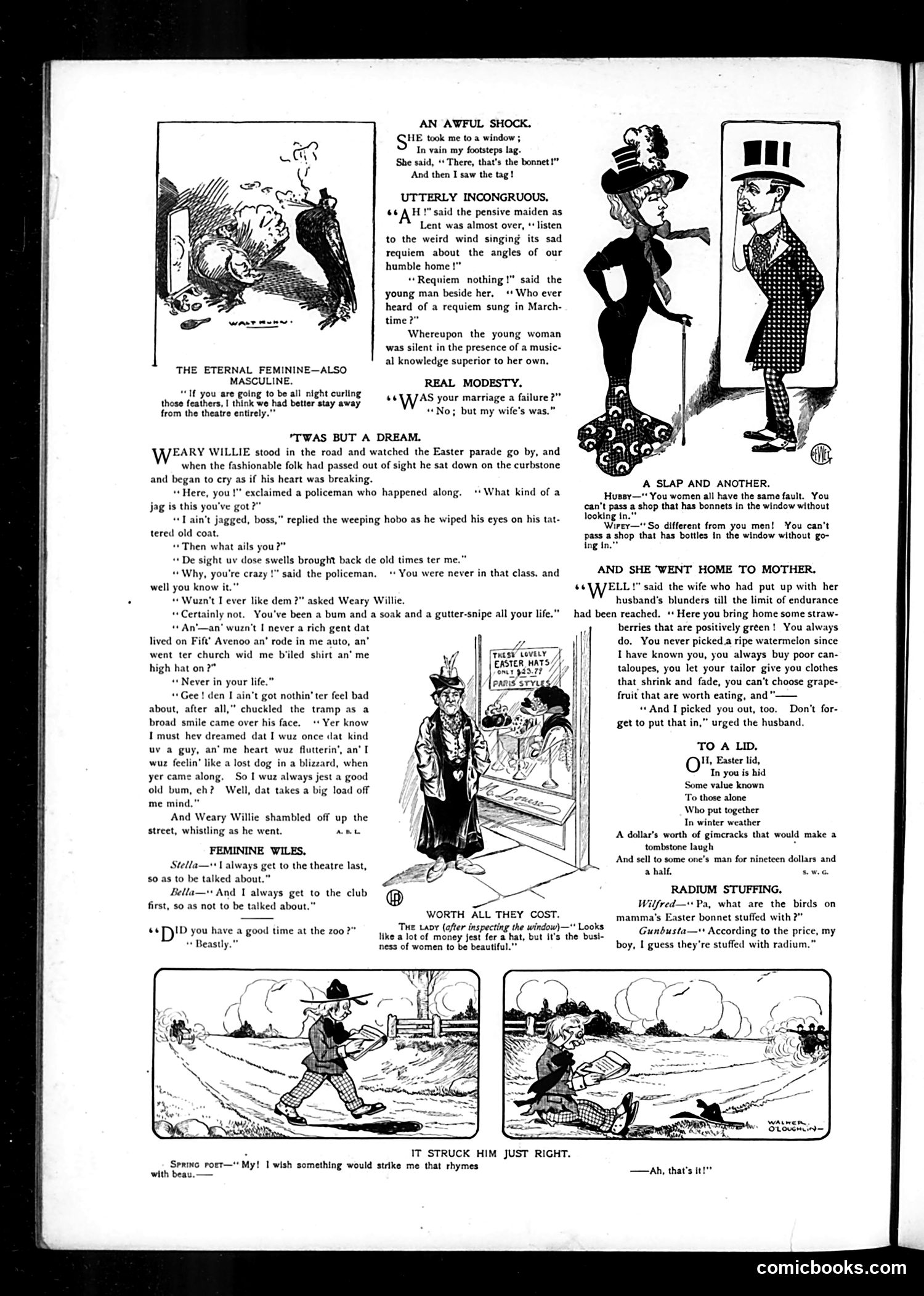
This page from *Judge* contains several short satirical pieces mocking domestic relations and consumer culture, likely from the early 20th century. **Key themes:** **"Easter Parade" sketch**: "Weary Willie," a homeless man, cries watching fashionable people pass. A policeman mocks him for pretending he once belonged to the wealthy class. The joke: Willie reveals he dreamed he was rich once—now he feels better knowing he was always poor. This satirizes class consciousness and the hobo's delusional comforts. **Marital humor**: Multiple sketches mock marriages as failures and wives as incompetent shoppers ("green strawberries," poorly chosen tailors). One wife threatens leaving, and the husband sarcastically notes he "picked" her too—inverting responsibility. **Consumer satire**: "Easter bonnet" pieces mock women's obsession with fashionable hats and window shopping, contrasting this with men's drinking habits. "To a Lid" mocks Easter bonnets as overpriced junk. **Overall tone**: Cynical humor about gender relations, consumerism, and class—typical of *Judge's* satirical approach targeting middle-class foibles and marital discord.
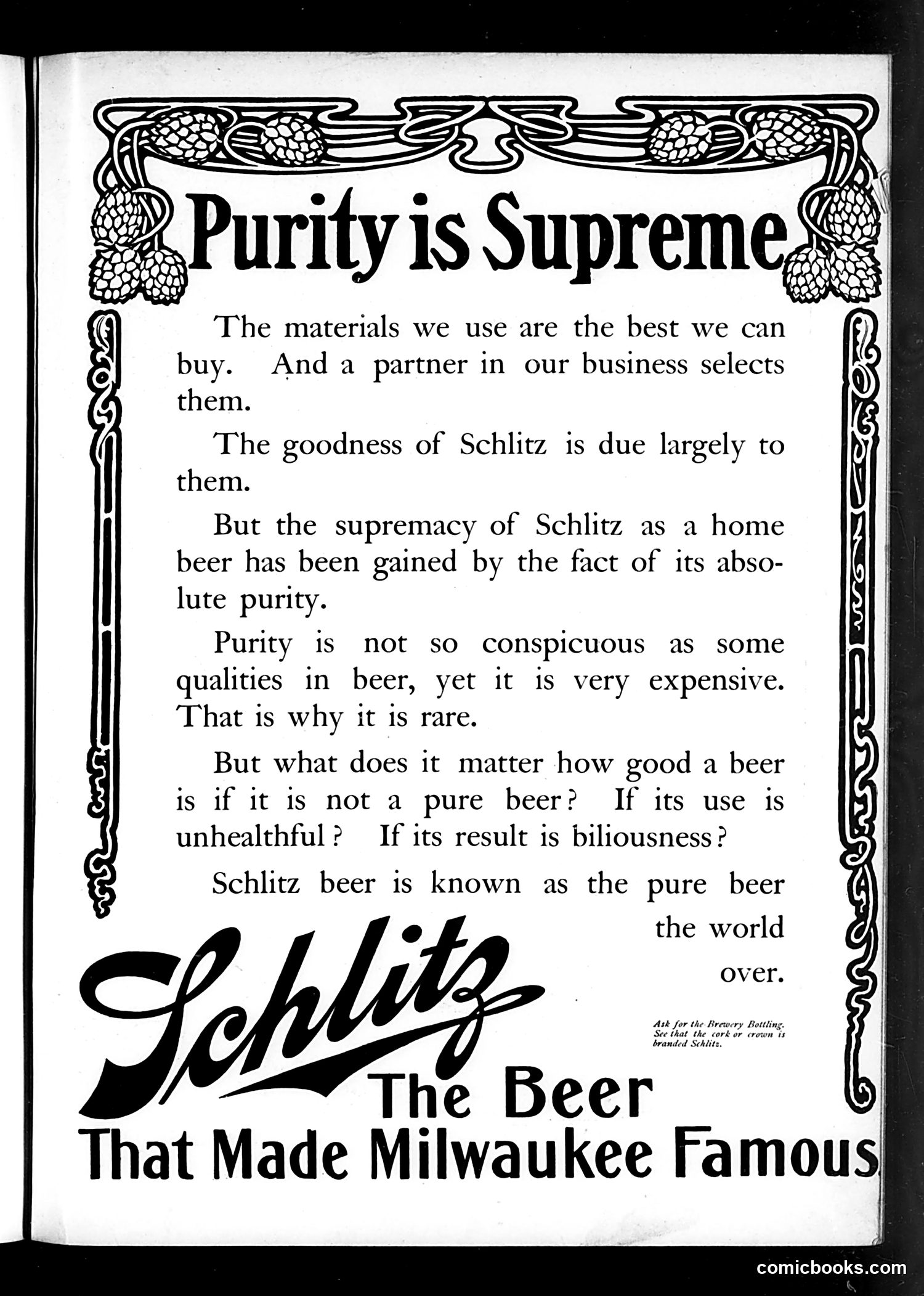
This is a **straight advertisement**, not satire or political commentary. It's a full-page ad for Schlitz beer promoting purity as the brand's key selling point. The ad argues that while purity is expensive and "not conspicuous," it matters most because impure beer causes health problems like "biliousness" (digestive upset). Schlitz positions itself as "the pure beer" globally known for this quality. The ornamental hop-leaf border and prominent typography reflect early 20th-century advertising design. The phrase "The Beer That Made Milwaukee Famous" became Schlitz's actual slogan, indicating this represents genuine brand messaging from that era when beer purity was a legitimate marketing concern—breweries competed on cleanliness standards before modern food regulation. This is corporate promotion, not editorial content.
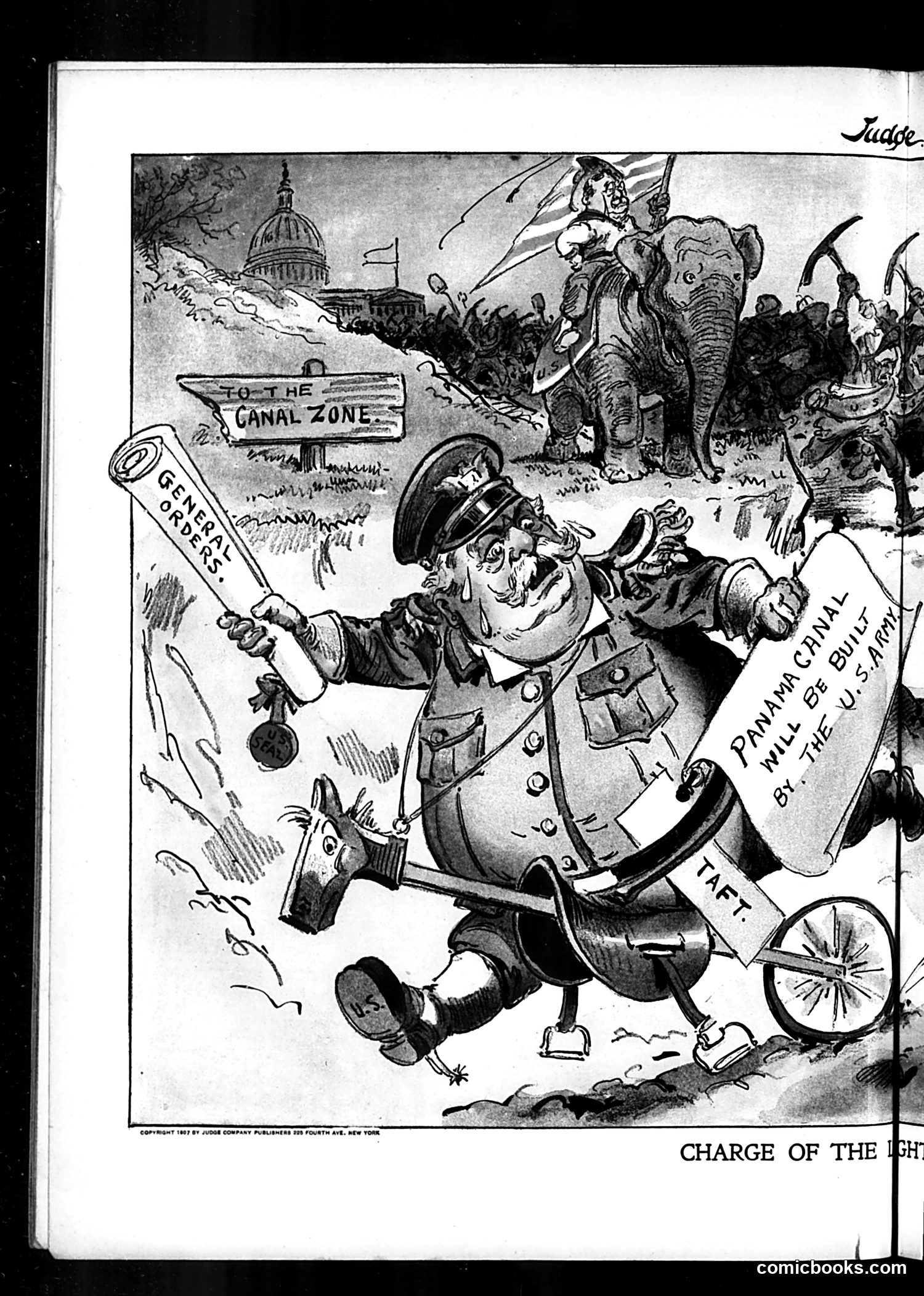
This political cartoon depicts a military figure in the foreground wielding orders marked "GENERAL ORDERS" and "PANAMA CANAL WILL BE BUILT BY THE U.S. ARMY" and "TAFT." Behind him charges an elephant (the Republican Party symbol) alongside military forces toward the Capitol building and a "CANAL ZONE" sign. The satire criticizes President Taft's administration for militarizing Panama Canal construction. The cartoon mocks what appears to be aggressive governmental overreach—using military authority to commandeer the canal project. The "charge" suggests forceful, perhaps reckless action by the Taft administration in pursuing this imperial infrastructure project, likely referencing contemporary debates about American expansionism and the proper civilian versus military control of such undertakings.
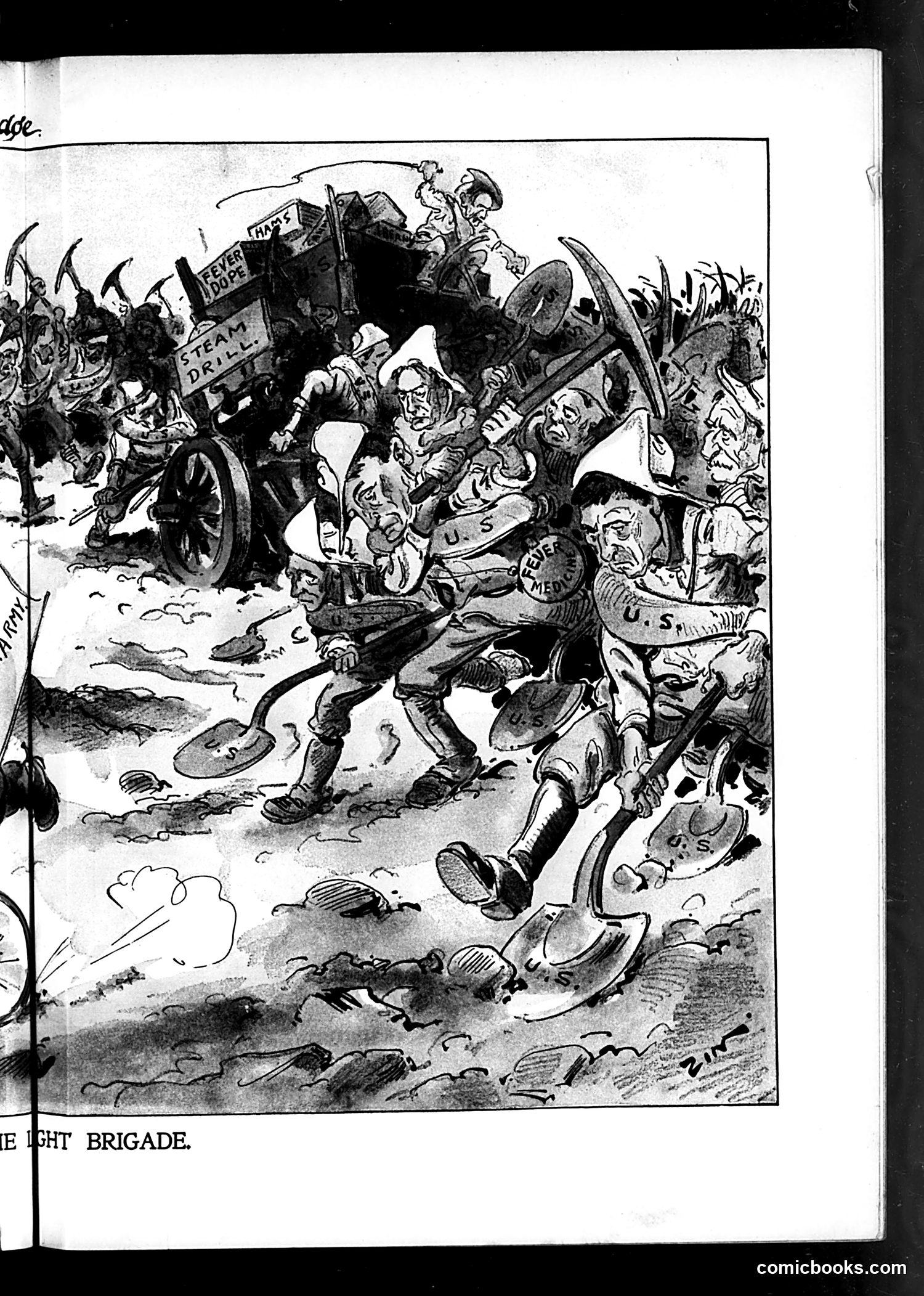
This is a satirical cartoon from *Judge* magazine depicting what appears to be a chaotic military or political scene. The image shows multiple figures labeled with "U.S." markings, engaged in what looks like frantic, disorganized activity around a vehicle or cart marked "NEVER DODGE" and "STEAL DWELL." The cartoon appears to satirize American military or government leadership as incompetent and corrupt—figures are portrayed with exaggerated, unflattering features in a style typical of early-20th-century political satire. The "Eight Brigade" title suggests this critiques a specific military unit or political group of eight people. Without clearer visibility of individual labels or dates, I cannot identify specific historical figures or events being mocked with certainty.
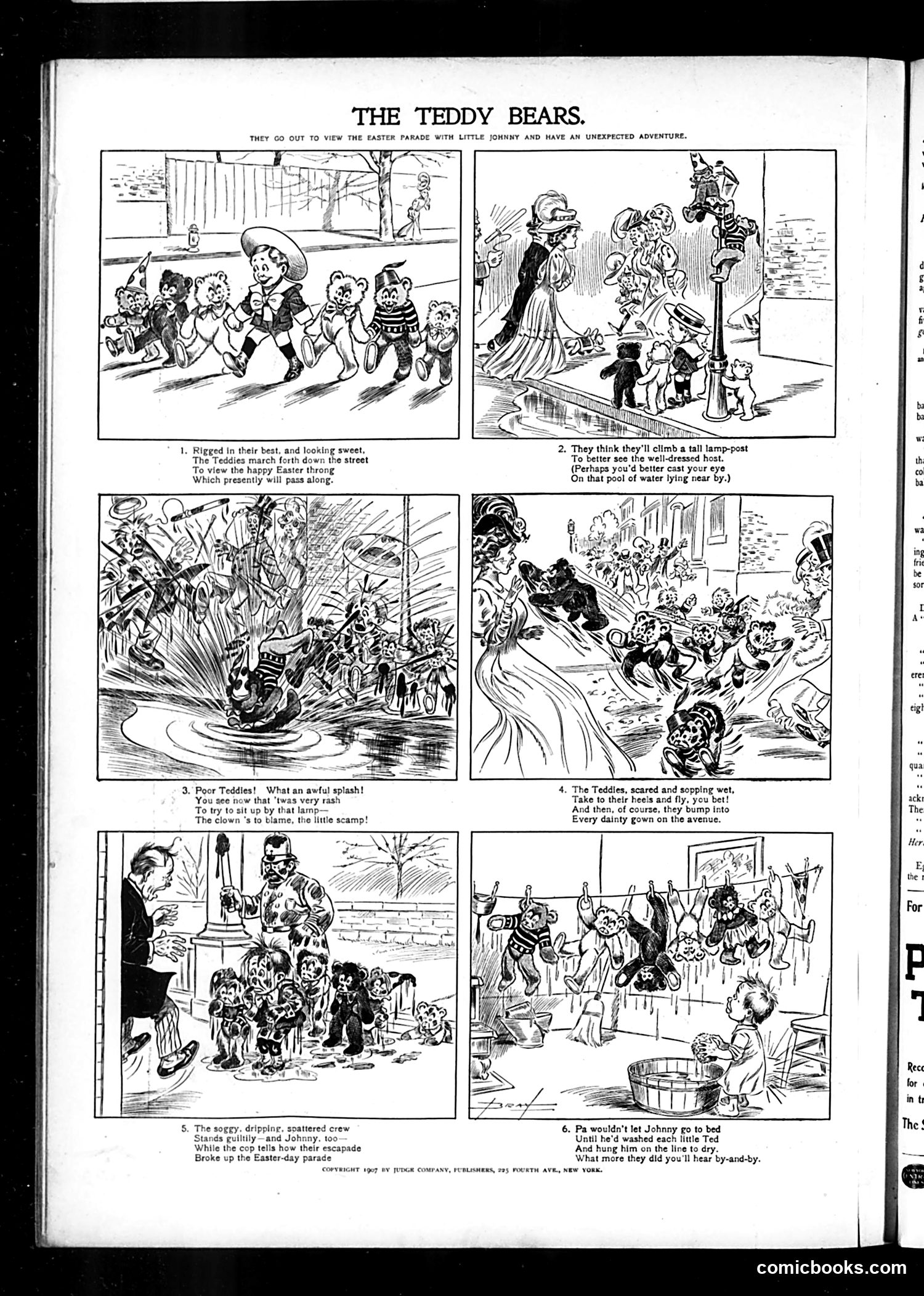
This is a six-panel children's comic strip from *Judge* magazine (1907) featuring anthropomorphic teddy bears as characters. The narrative follows teddy bears accompanying a boy named Johnny to view an Easter parade. The plot is straightforward slapstick: the bears attempt to climb a lamppost for a better view, fall into a nearby pool, become soaked and panicked, collide with parade-goers in their chaotic retreat, disrupt the Easter parade, and are subsequently disciplined by being washed and hung on a clothesline to dry. The "satire" here is gentle and aimed at children—poking fun at the bears' vanity (dressed in "their best"), poor judgment, and the amusing consequences of mischief. The humor relies on physical comedy and a moral lesson about obedience and cleanliness typical of early-1900s children's entertainment. There appears to be no deeper political commentary; this is simply wholesome comic entertainment capitalizing on the "Teddy Bear" craze popularized by President Theodore Roosevelt.
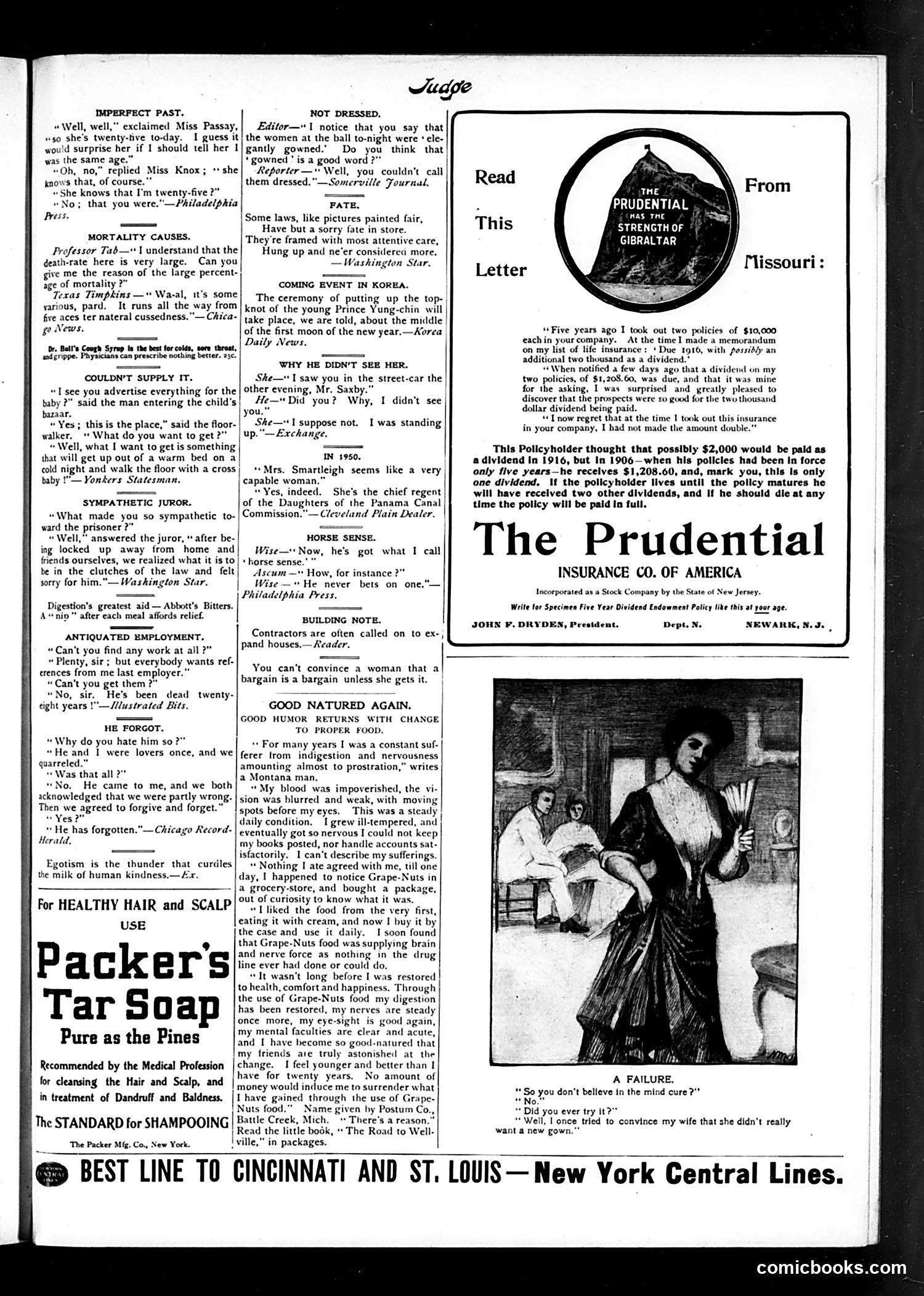
This page from *Judge* (a prominent early-20th-century American satire magazine) comprises primarily **brief humorous anecdotes and advertisements**, not political cartoons. The illustrated content appears limited—there's one small photograph labeled "A Failure" showing what seems to be a domestic scene. The jokes target familiar targets: aging women pretending to youth ("Imperfect Past"), ineffectual job-seeking, marital discord, and bureaucratic absurdity. One item references Korea's "coming event" regarding Prince Yung-chin's topknot ceremony—a light, exoticizing reference to Asian customs. The substantial editorial/advertising space features *Packer's Tar Soap* and *The Prudential Insurance Company*, reflecting this magazine's reliance on commercial support. The "Failure" photo caption satirizes marital dispute resolution. Overall, this represents **mainstream genteel satire** targeting domestic life and minor social follies rather than sharp political critique—typical of *Judge*'s entertainment-focused content during this era.
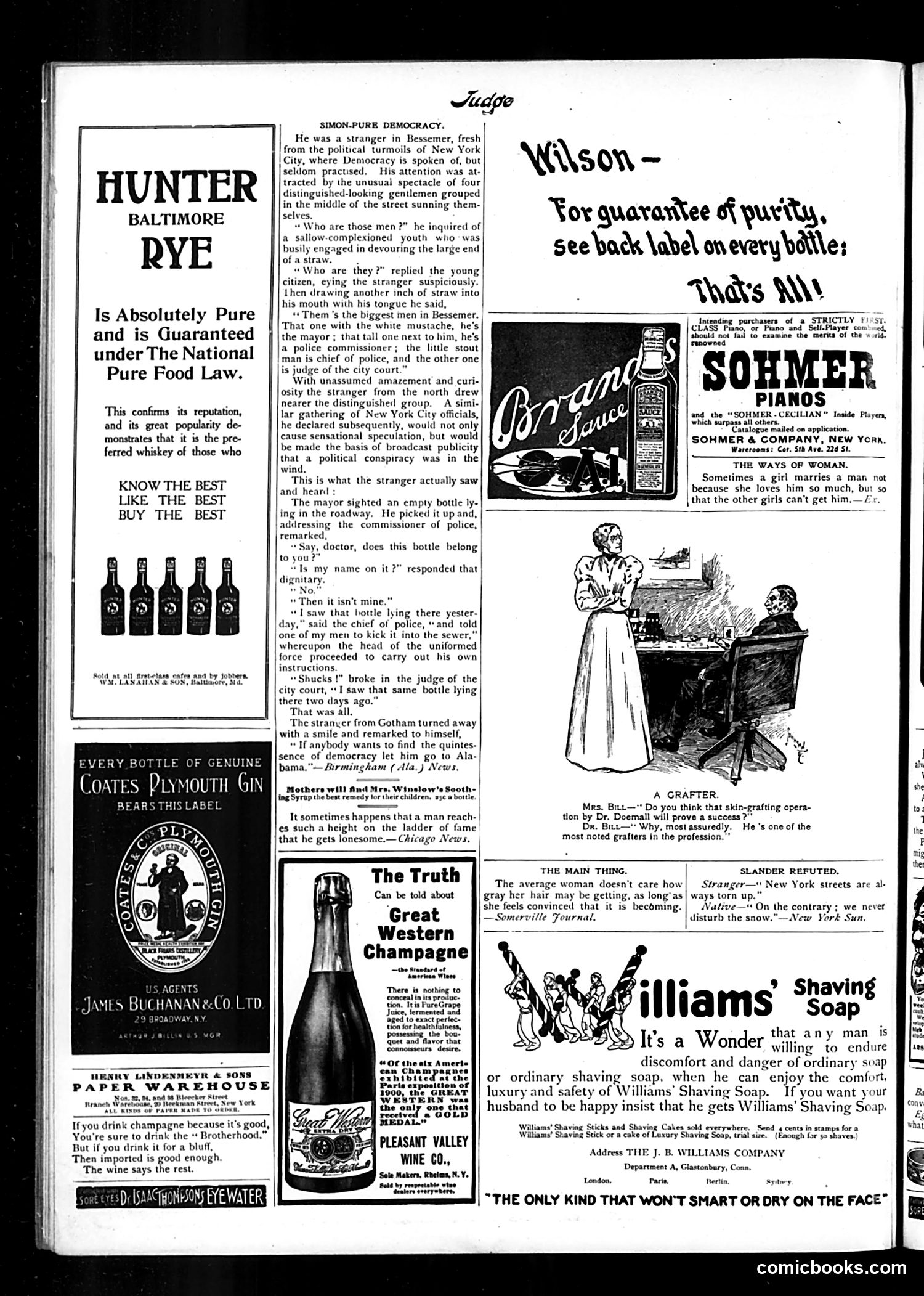
This satirical piece mocks American municipal corruption through the story of a New York visitor witnessing four Bessemer officials—the mayor, police commissioner, police chief, and judge—casually discussing an empty bottle found in the street. Each official denies responsibility, passing blame in circular fashion until nothing happens. The joke targets the hypocrisy of "democracy" in practice. While these officials represent civic authority and law, they exemplify indifference and buck-passing rather than accountability. The title "Simon-Pure Democracy" is ironic—"simon-pure" means genuinely authentic, but the story shows democracy corrupted by negligence and inaction. The visitor's concluding remark—that one must go to Alabama to find "the quintessence of democracy"—appears to be sarcastic commentary on Southern governance, though the exact critique remains unclear from context alone.
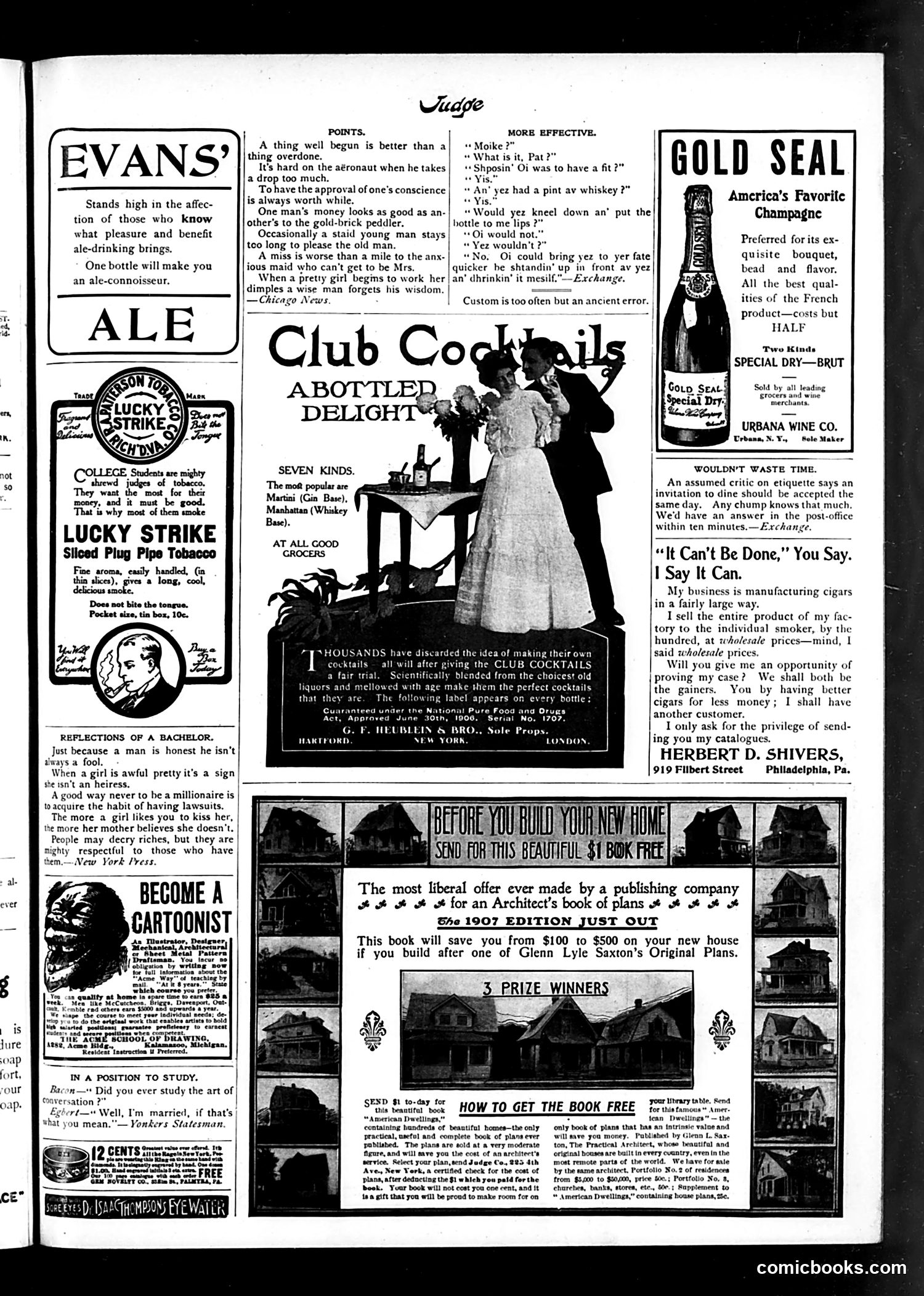
This page contains mostly advertisements and filler content rather than significant political cartoons. The main pieces are: **Advertisements:** Evans' Ale, Lucky Strike tobacco, Gold Seal Champagne, Club Cocktails, and Heublein's spirits dominate. There's also advertising for architectural house plans and correspondence courses in cartooning. **"Reflections of a Bachelor":** Brief cynical observations about human nature—e.g., honest people aren't necessarily foolish; attractive girls aren't heiresses; wealth commands respect despite being criticized. **Irish Dialect Humor:** Two brief comic exchanges between Irish characters (Pat/Moike) featuring heavy Irish brogue and stereotypical Irish imagery popular in early 20th-century American humor. **"It Can't Be Done":** A cigar manufacturer's pitch claiming to sell wholesale directly to smokers. The page reflects typical *Judge* magazine content: advertising-heavy, with light satirical observations and ethnic humor that was commercially acceptable at the time.
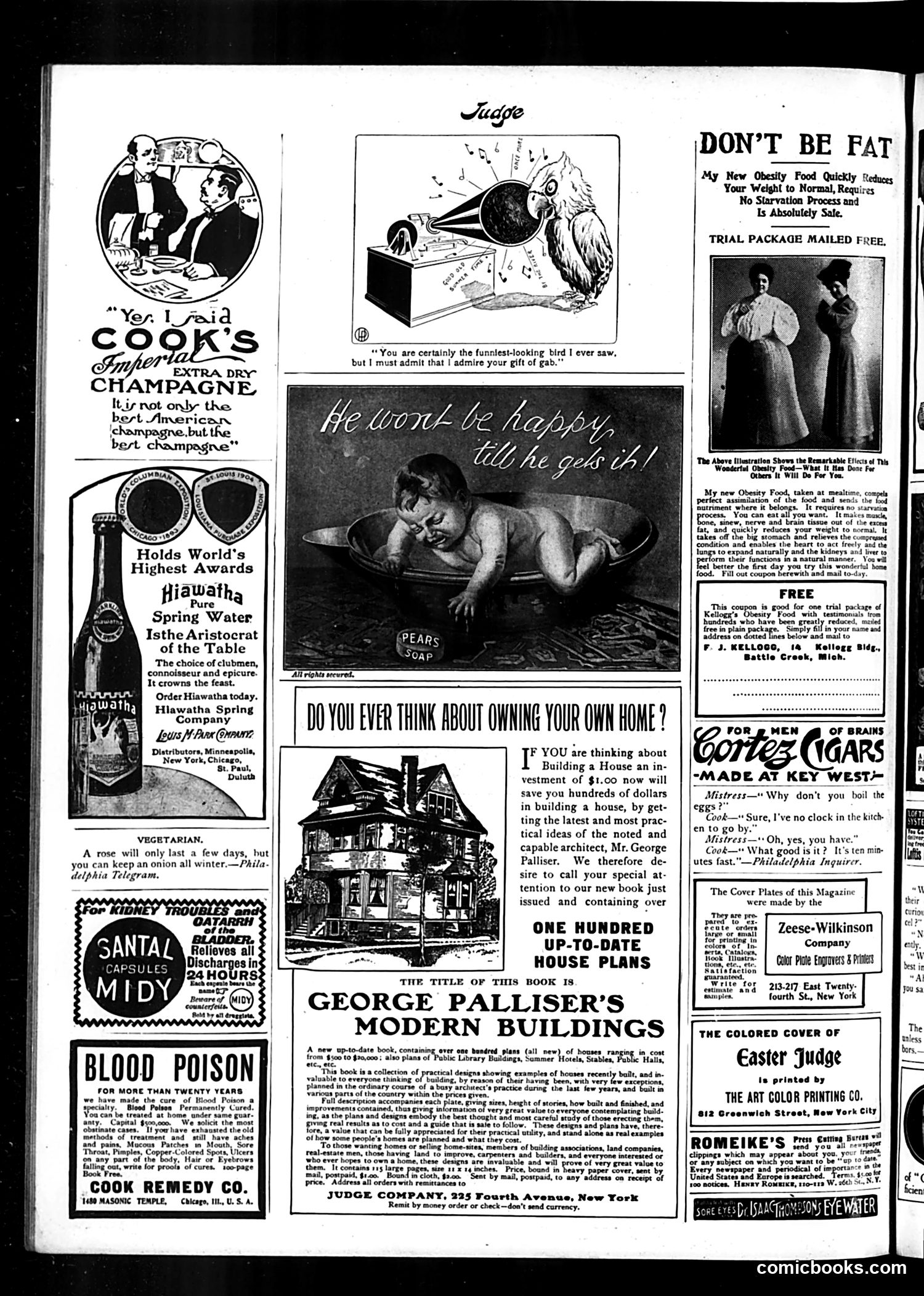
This page is primarily **advertising and filler content** rather than political satire. It contains: **Main cartoons:** - Top left: A social scene with two men discussing champagne (Pommery brand advertisement) - Center: A bird at a scale being complimented on its "gift of gab" (Pears Soap advertisement) - Bottom: A domestic humor exchange between a mistress and cook about kitchen timekeeping **Advertisements dominate**, promoting:**Hiawatha Spring Water, blood poison cures, obesity reduction food, and architect George Palliser's house-plan book. **The humor is mild and apolitical**—relying on puns (the vegetarian onion joke) and domestic comedy rather than social commentary. There are no identifiable political figures or references to current events visible here. This appears to be a typical Judge magazine interior page mixing light entertainment with commercial advertising, typical of early 20th-century American periodicals.
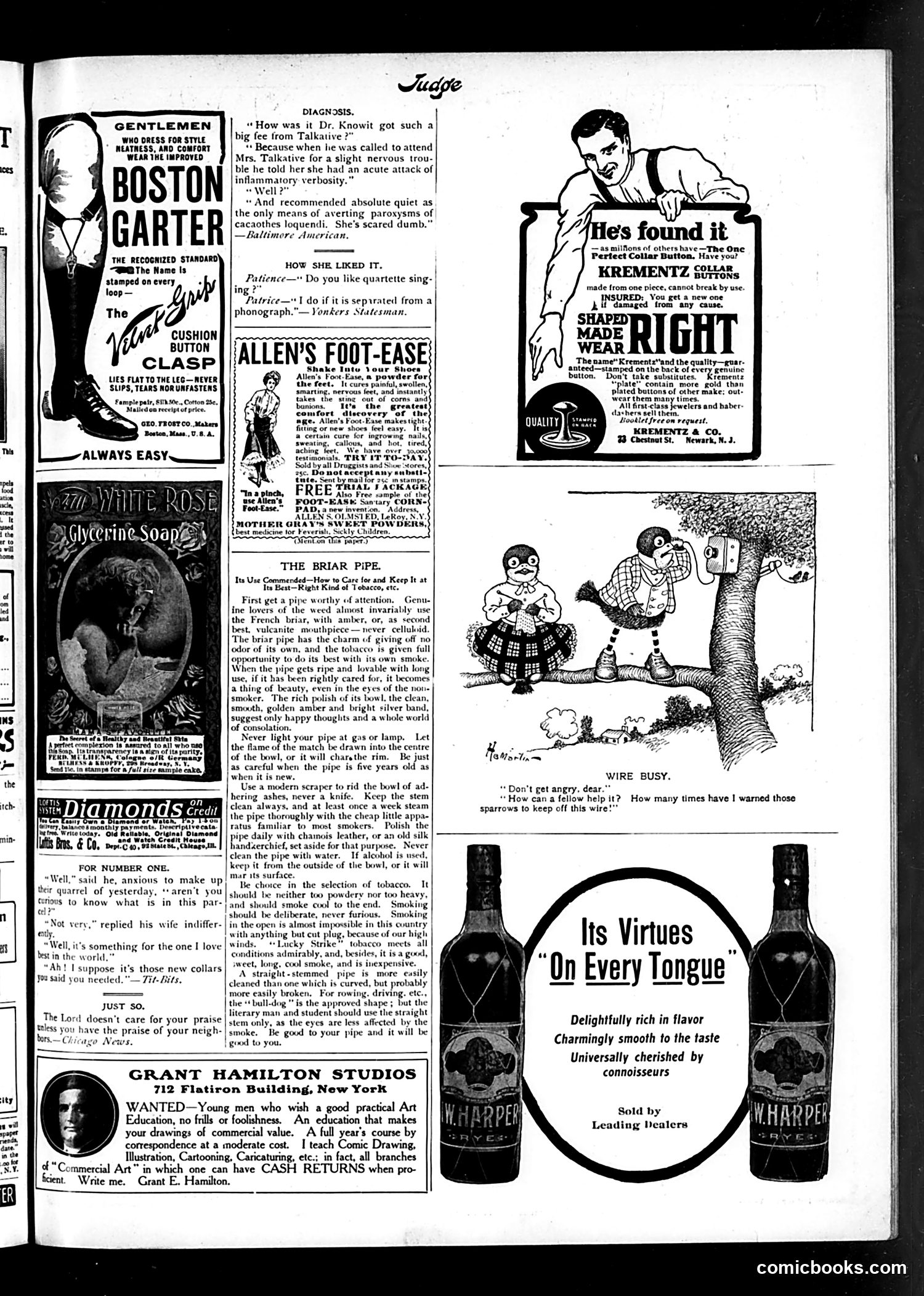
This page contains primarily **advertisements and humor pieces** rather than political cartoons. The main content includes: **Humor Jokes:** - "Diagnosis": A doctor charges a large fee for treating a talkative patient by prescribing silence, which "scares her dumb" (plays on "cacaothes loquendi"—compulsive talking) - "How She Liked It": A brief exchange about quartette singing - "Wire Busy": Sparrows quarreling on a telegraph wire **Advertisements dominate the page:** - Boston Garter (men's accessories) - Krementz collar buttons - Allen's Foot-Ease powder - White Rose Glycerine Soap - Diamonds - Grant Hamilton Studios (art education) **Editorial Content:** "The Briar Pipe"—a detailed instructional essay on selecting, caring for, and smoking briar pipes, emphasizing proper technique and tobacco selection. The page reflects early 20th-century consumer culture and domestic humor, with no apparent political satire or significant caricatures.
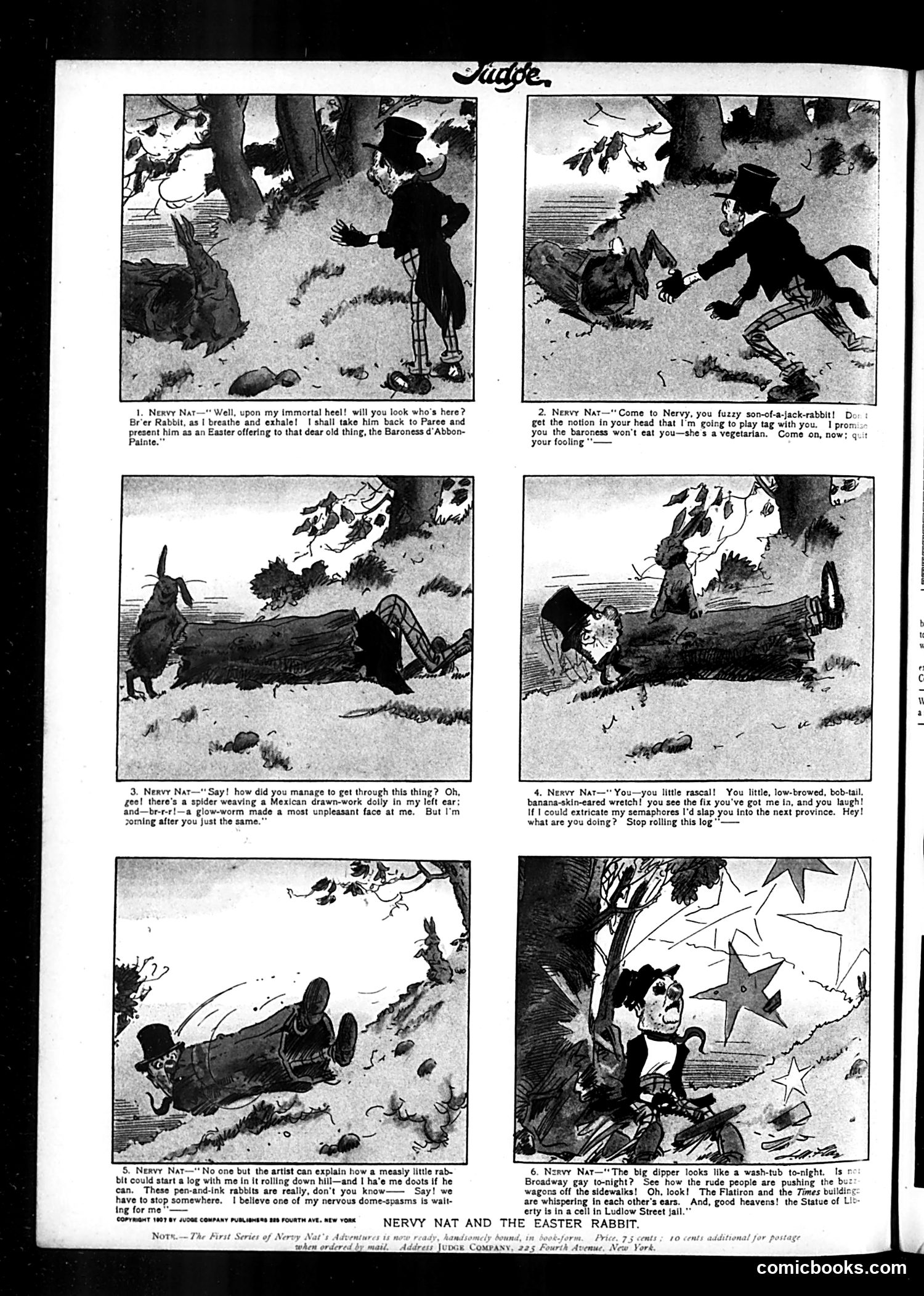
This is a six-panel comic strip featuring "Nervy Nat," a recurring character in Judge magazine. The narrative follows Nat's chaotic encounter with a rabbit he mistakes for Br'er Rabbit (the folk-tale character), which he plans to gift to a French Baroness. The humor derives from slapstick physical comedy: Nat gets tangled with the rabbit in increasingly absurd situations—rolling downhill in a log, getting chased, knocked around. The dialogue emphasizes Nat's exaggerated reactions and mock-sophisticated manner ("upon my immortal heel," "dome-spasms"). Panel 6 shifts to observational humor about New York City nightlife—commenting on Broadway crowds, the Flatiron Building, Times Building, and sarcastically noting the Statue of Liberty "in a cell in Ludlow Street jail" (a humorous social criticism about the neighborhood). The strip is lighthearted character-driven comedy typical of Judge's humor style, blending physical gags with urban wit rather than political satire.
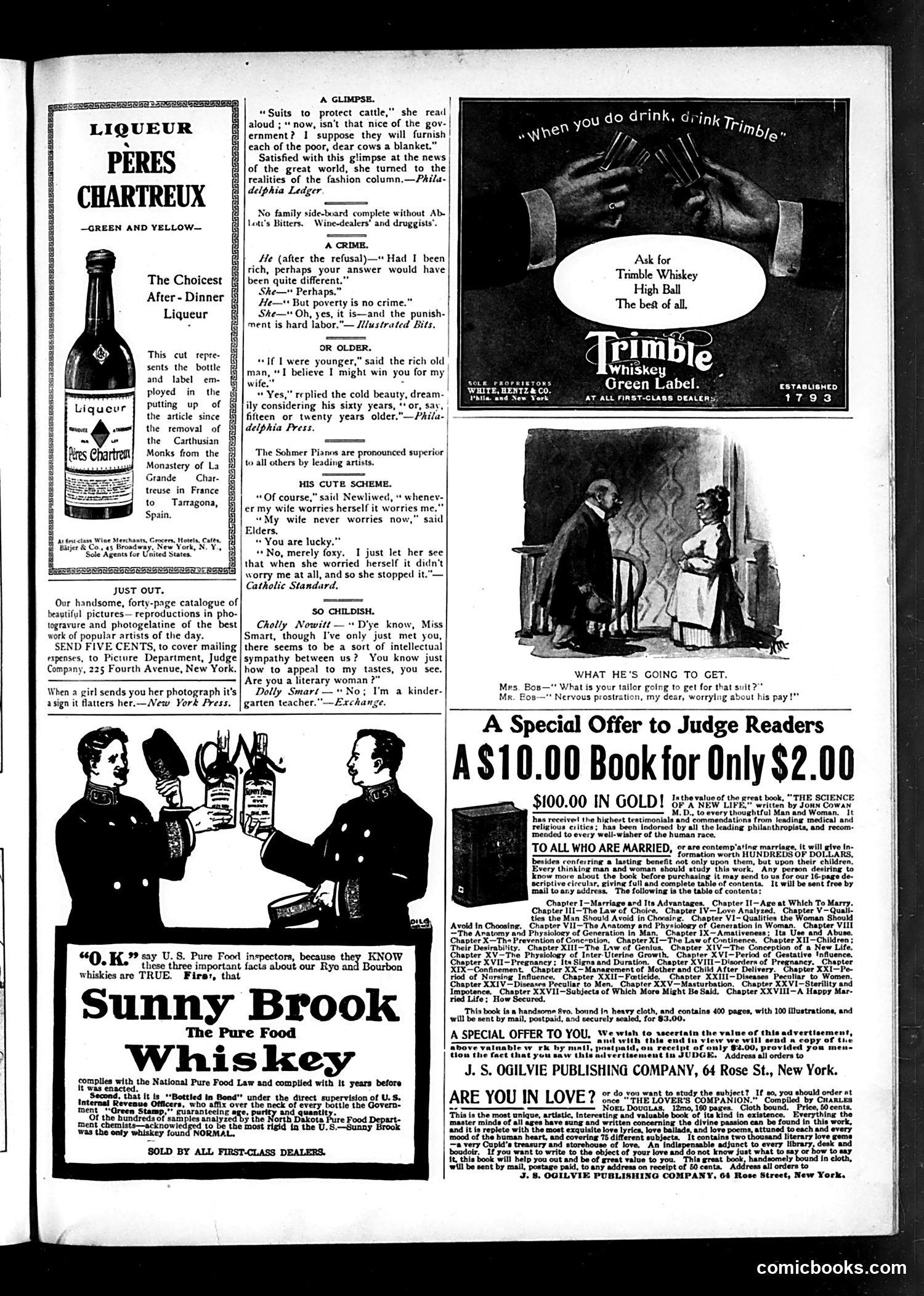
This page is primarily **advertising**, with several short satirical anecdotes typical of early-1900s humor magazines. **The Cartoons/Jokes:** The page contains six brief, untitled comic vignettes poking fun at courtship and marriage: - A woman misreads government cattle-protection news as kindness to animals, ignoring real world affairs - A rejected suitor claims poverty isn't shameful; the woman retorts it *is*—the punishment being "hard labor" - A gold-digger refuses a poor suitor but hints she'd accept if he were older (or younger—meaning, never) - A newlywed claims his wife stopped worrying because he feigned indifference - A man assumes intellectual sympathy with a woman; she admits she's just a kindergarten teacher - A wife jokes that her tailor will get "nervous prostration" worrying about payment **The Satire:** These jokes mock shallow courtship logic, materialism, and domestic manipulation—standard early-20th-century humor targeting romantic pretension and gender dynamics. The remainder is product advertising (liqueurs, whiskey, pianos, books on marriage).
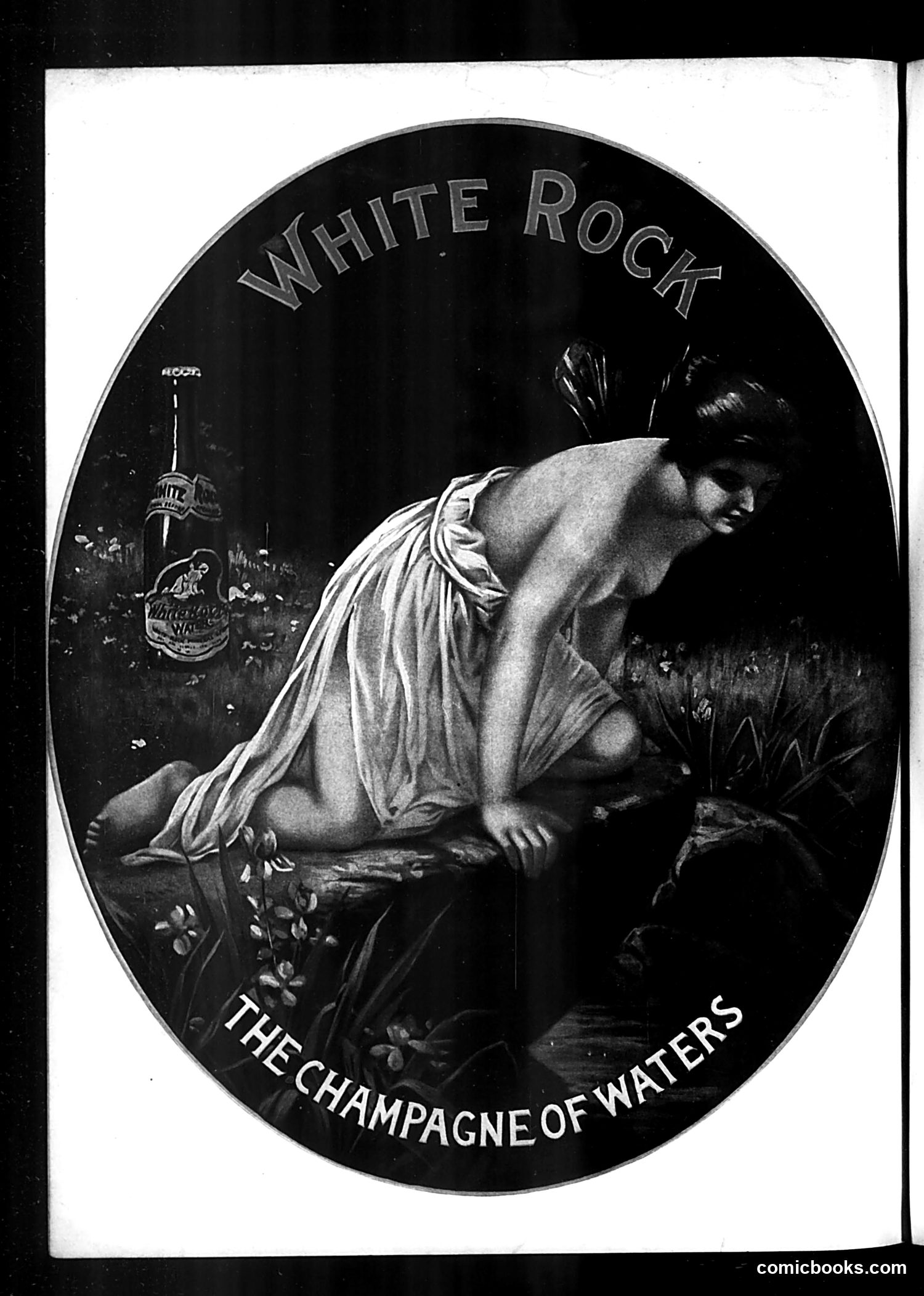
This is an advertisement for White Rock mineral water, not political satire. The oval-framed image depicts a classical female figure in flowing drapery, positioned beside water in a naturalistic setting. The figure appears to reference classical artistic tradition—possibly evoking water nymphs or allegorical representations of purity. The advertisement's tagline, "The Champagne of Waters," uses a luxury comparison to market the product as premium mineral water. The classical styling and elegant presentation were typical marketing approaches of early-to-mid 20th century advertising, associating the product with refinement and natural purity. This is a straightforward commercial advertisement rather than political commentary.