
A complete issue · 16 pages · 1907
Judge — February 9, 1907
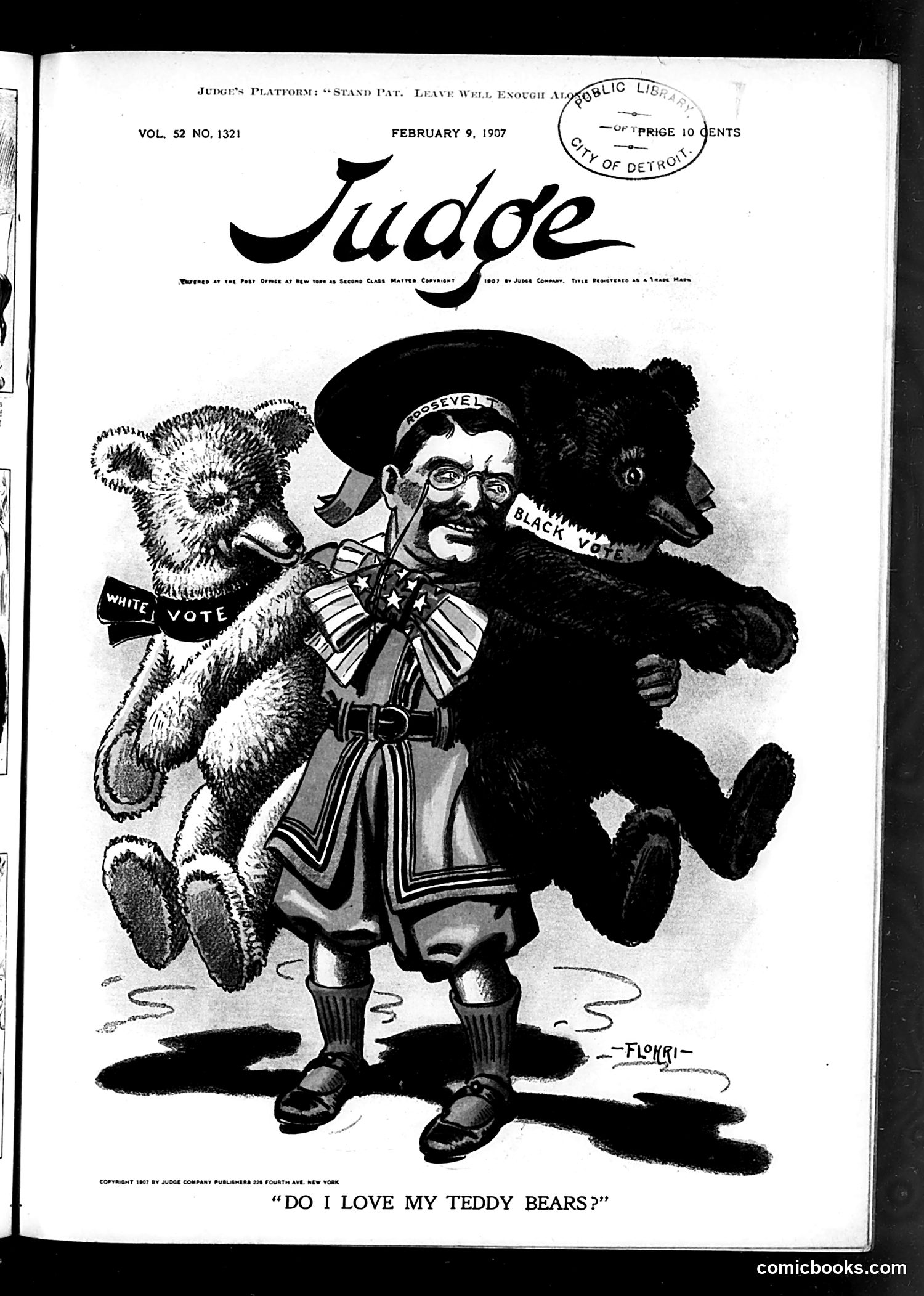
This political cartoon satirizes President Theodore Roosevelt's relationship with conservation and hunting. The central figure, labeled "Roosevelt," holds two teddy bears—one marked "White Vote" and one marked "Black Vote"—while the caption asks "Do I Love My Teddy Bears?" The bears reference the "Teddy Bear," a toy named after Roosevelt following a famous 1902 hunting incident. The satire appears to critique Roosevelt's political manipulation, suggesting he treats voting blocs (racial groups) as toys or playthings rather than constituents with genuine interests. The cartoon implies Roosevelt weaponizes his popular image and sentimental associations to control different voter segments. This reflects early-20th-century anxieties about racial politics and political authenticity.
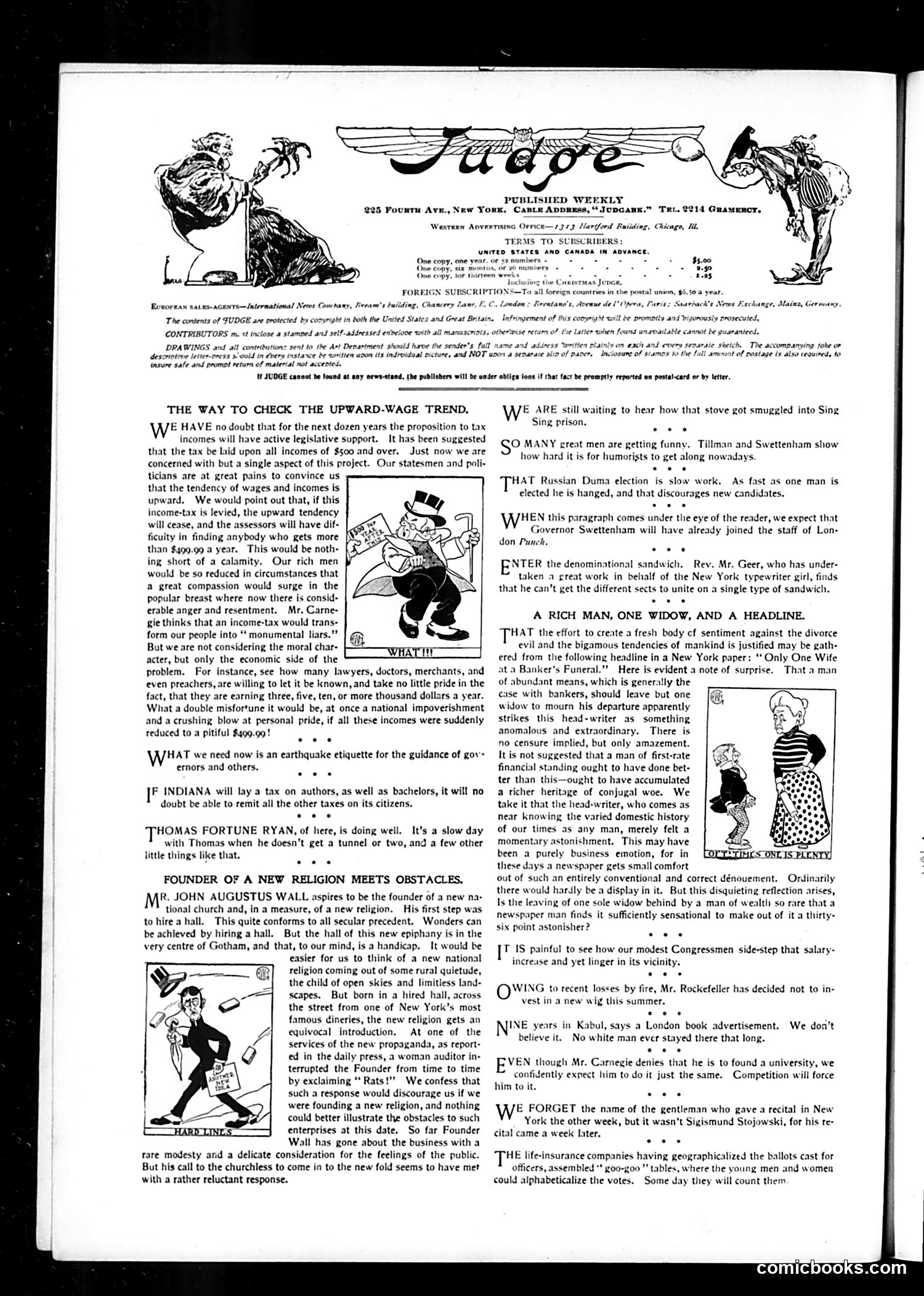
This page contains editorial commentary and satirical columns rather than political cartoons. The main illustrated item shows a figure labeled "WHAT!!!" expressing shock—likely reacting to proposed taxation or income policies discussed in "THE WAY TO CHECK THE UPWARD-WAGE TREND." The text addresses early 20th-century concerns: income taxation on high earners ($500+), labor disputes, a Russian election, and Governor Stettenham's appointment. Other brief items mock Indiana's proposed bachelor tax, Thomas Fortune Ryan's business dealings, and a new religious organization. The cartoons appear to illustrate these short satirical columns rather than constitute standalone political commentary. Without clearer image resolution or bylines, specific targets remain somewhat unclear, though the overall tone criticizes both wealthy industrialists and progressive taxation schemes.
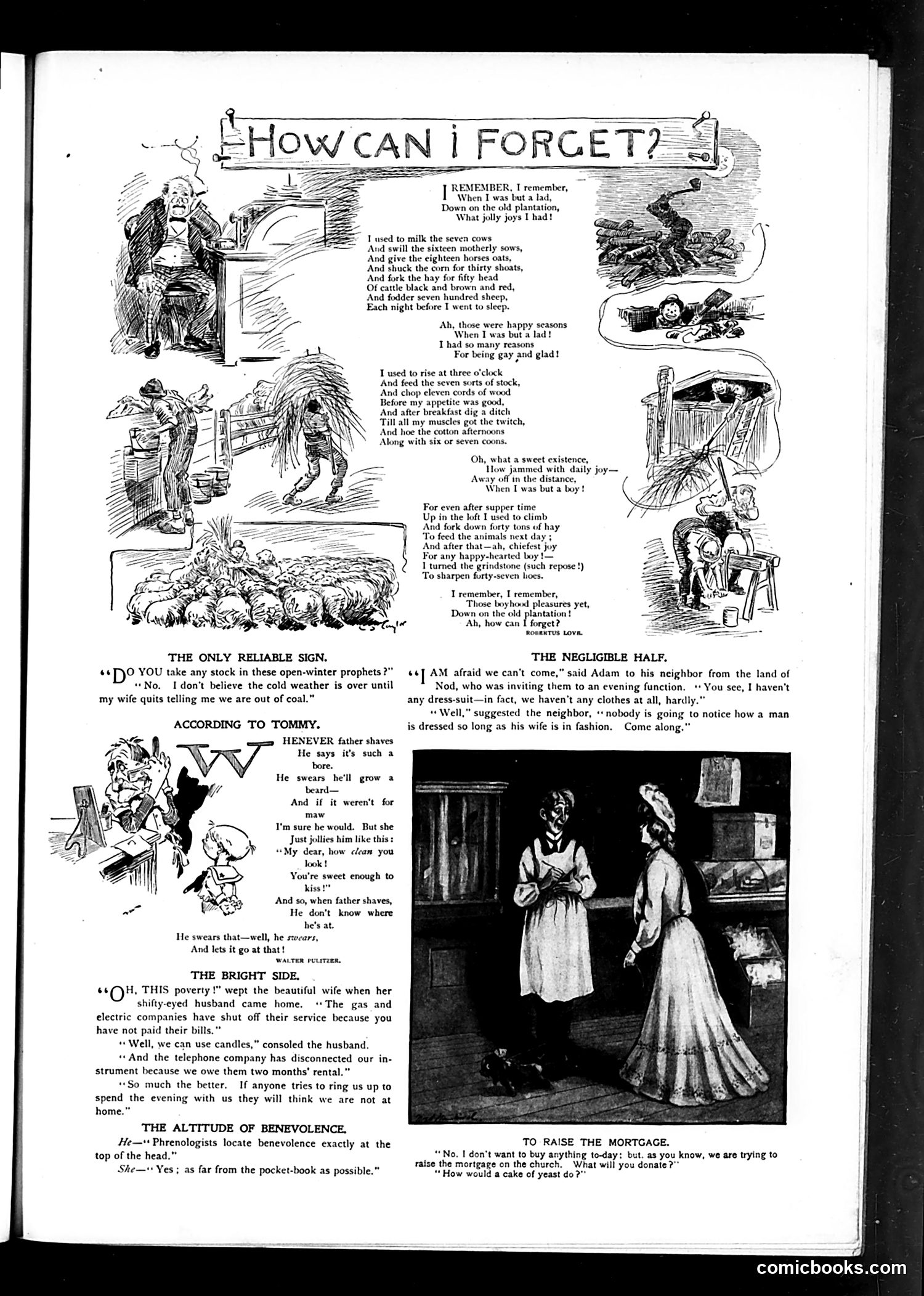
This page contains nostalgic rural humor and social commentary typical of early 20th-century Judge magazine. **"How Can I Forget?"** — A poem with accompanying sketches depicts an aging farmer's bittersweet memories of agricultural childhood labor: milking cows, feeding animals, rising at three o'clock, and physical hardship. The satire suggests the romantic idealization of farm life contrasts sharply with its actual grueling demands. The lower sections present brief humorous anecdotes about poverty and social hardship: a man's wife leaving due to bad weather, a farmer's excuse about lacking "clothes," and a family's financial desperation (attempting to raise mortgage money through cake sales). The overall tone is sympathetic toward working-class struggles while using humor to expose the gap between idealized rural simplicity and harsh economic reality during this era.
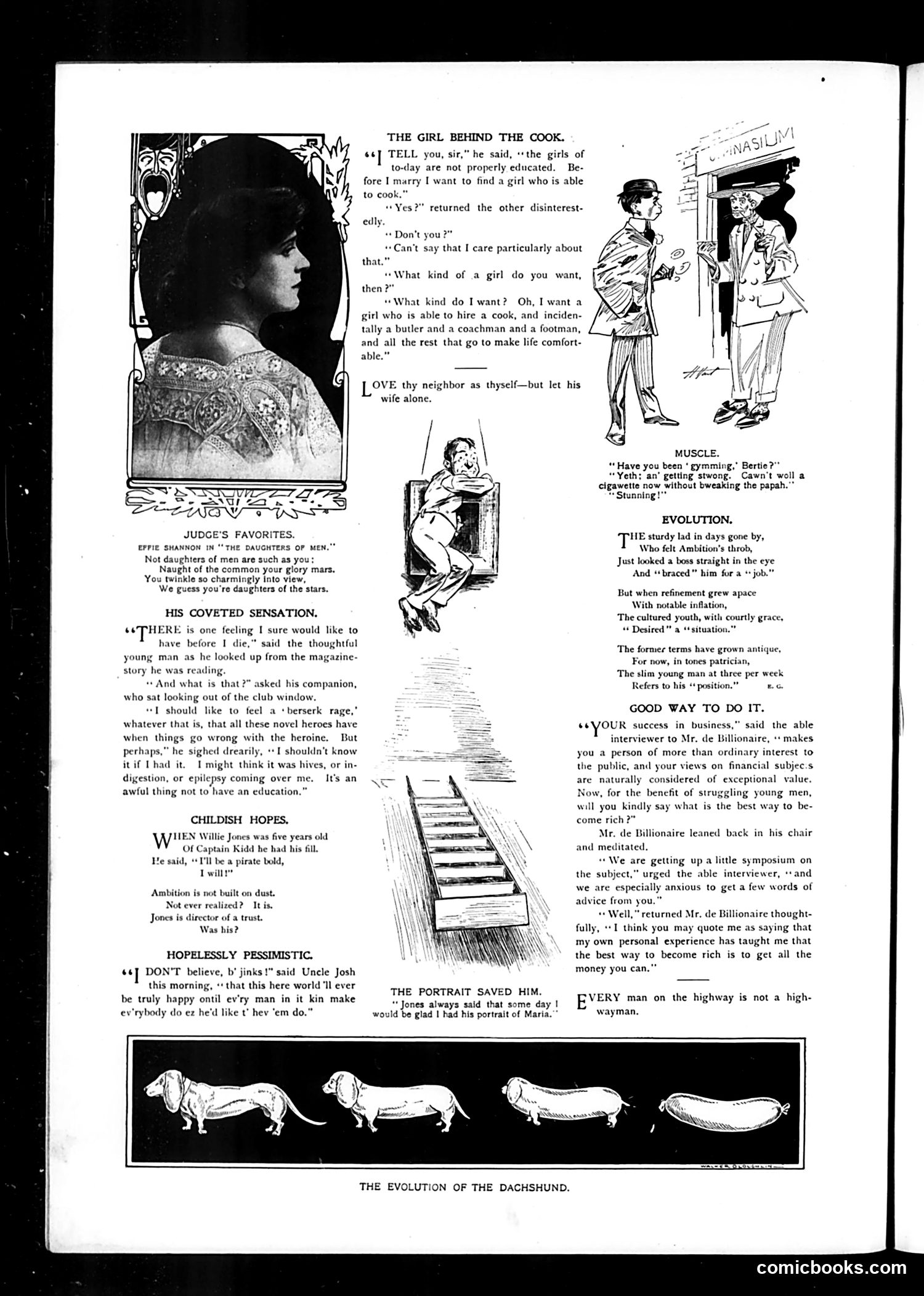
This Judge magazine page contains several satirical pieces reflecting early 20th-century social attitudes: **"The Girl Behind the Cook"** mocks women's education, with a man seeking a wife solely for domestic capability—hiring servants rather than valuing her intellect. **"Evolution"** satirizes social climbing: a "sturdy lad" who once looked "a boss straight in the eye" becomes refined and effete, now seeking a "situation" (job) rather than honest work. **"Good Way to Do It"** features Mr. de Billionnaire advising young men that becoming wealthy requires accumulating as much money as possible—satirizing capitalist greed as life philosophy. **"The Evolution of the Dachshund"** (bottom) humorously illustrates the breed's progressive elongation through selective breeding, presented as literal evolutionary transformation. The page reflects period attitudes about class, gender roles, and social aspiration through satirical commentary.
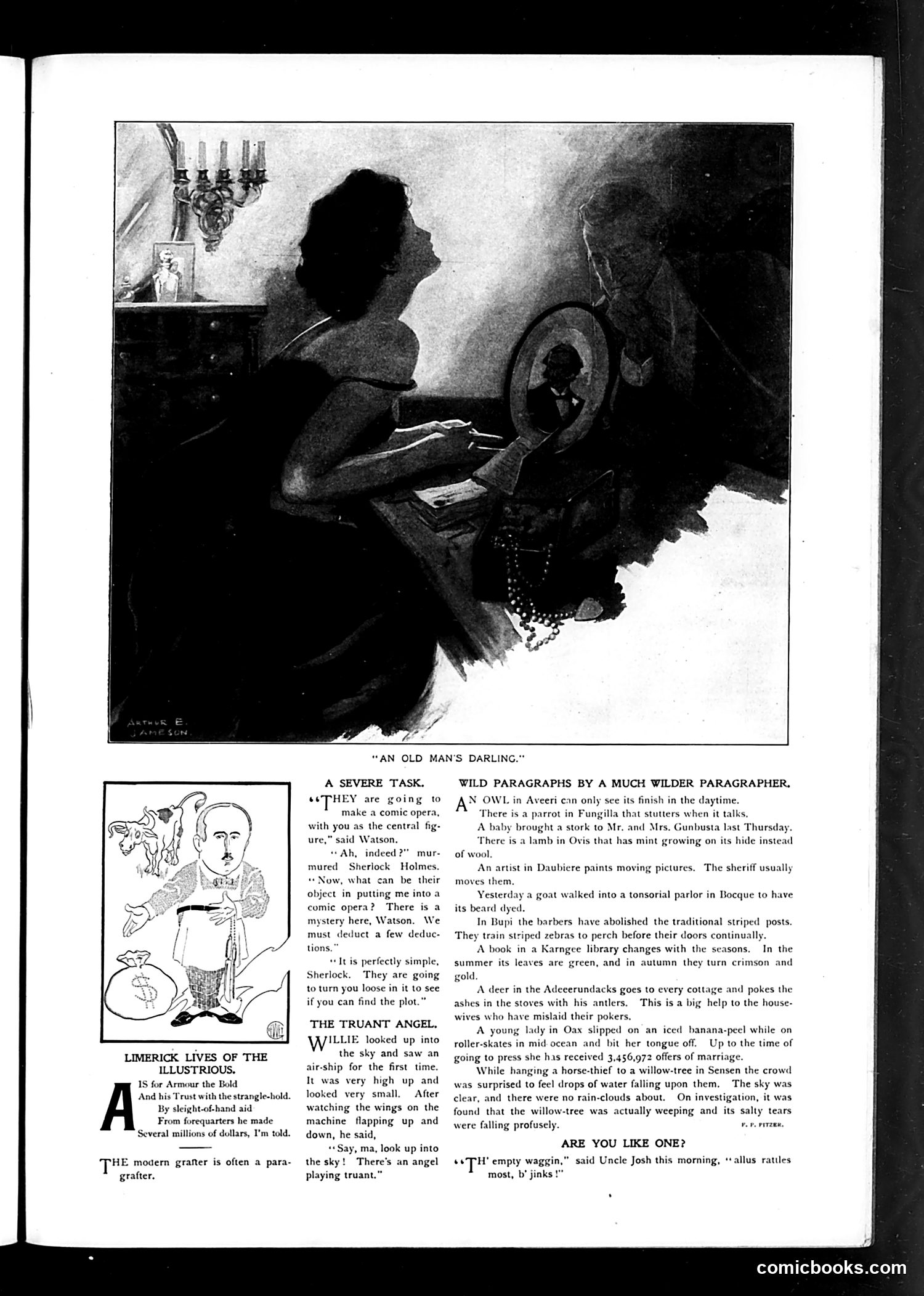
The page contains three distinct elements: 1. **Top illustration ("An Old Man's Darling")**: A silhouette scene showing a woman at a mirror, likely satirizing vanity or aging concerns—a common Judge theme. 2. **"Limerick Lives of the Illustrious"**: A cartoon featuring what appears to be a caricatured figure with text mocking someone's wealth and background. The limerick format suggests lighthearted biographical satire of a public figure, though the specific identity isn't clear from the image alone. 3. **Comic sketches and humorous paragraphs**: The remaining text consists of joke collections titled "A Severe Task," "Wild Paragraphs," "The Truant Angel," and "Are You Like One?"—typical of Judge's miscellaneous humor content. The page primarily showcases Judge's blend of visual satire and written comedy targeting contemporary society and notable figures.
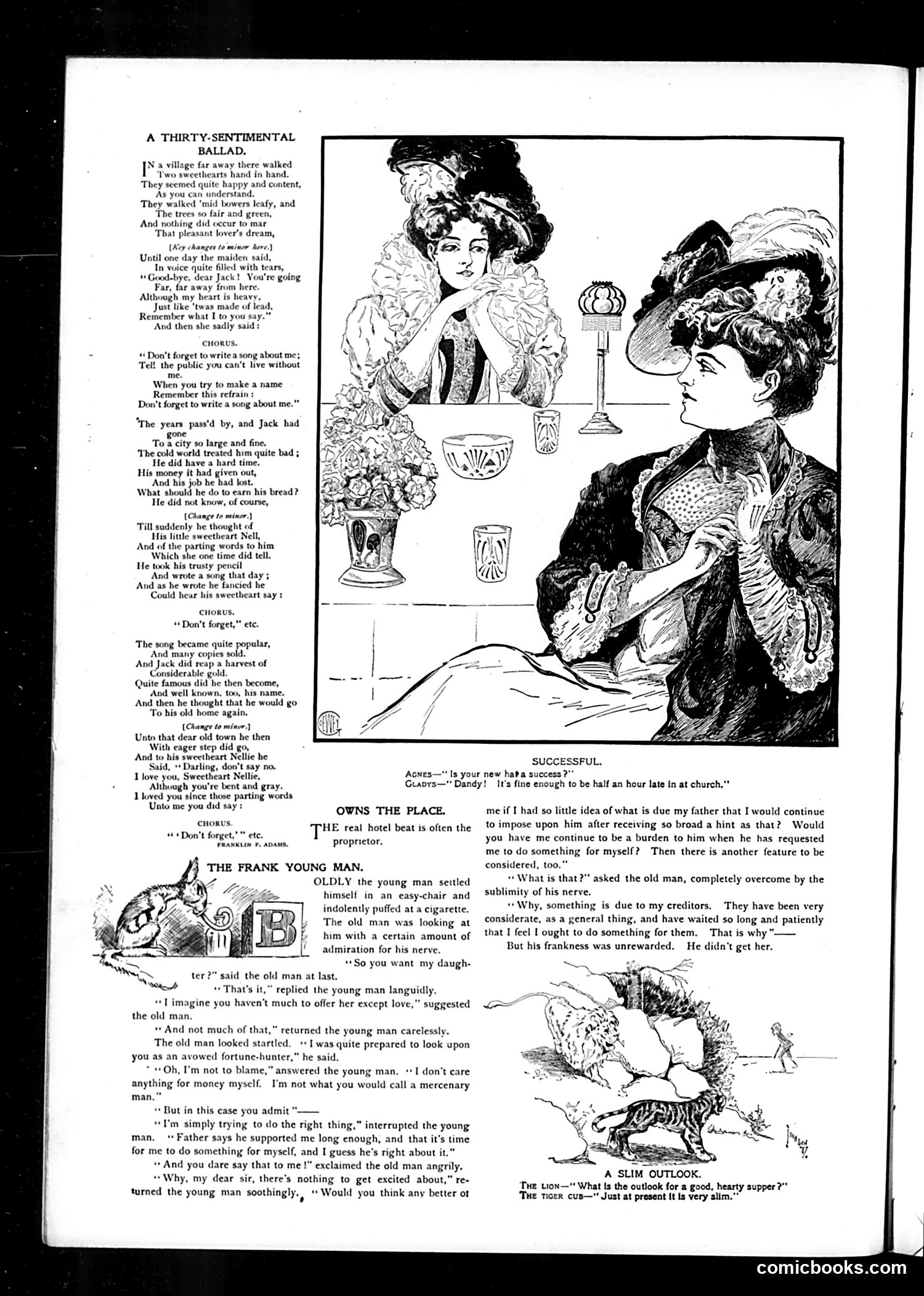
This Judge magazine page contains three distinct pieces of period humor: **"A Thirty-Sentimental Ballad"** satirizes sentimental popular songs of the era. A young man becomes famous writing a song his sweetheart demanded he write about her ("Don't forget to write a song about me"). The satire mocks both the narcissism of the request and the formulaic sentimentality of commercial pop music—suggesting people will buy anything if packaged emotionally enough. **"The Frank Young Man"** ridicules a young suitor who shamelessly admits to his girlfriend's father that he has little to offer except minimal love, and that he's doing the honorable thing by stopping being a burden on his own father and creditors. His cynical honesty—presented as responsible rather than romantic—is meant to be absurd and off-putting, though he seems oblivious to how poorly this proposal lands. **"Owns the Place"** is a brief quip about hotel proprietors being the "real deal." The cartoons reflect turn-of-century anxieties about commercialism, courtship conventions, and youthful lack of deference to parental authority.
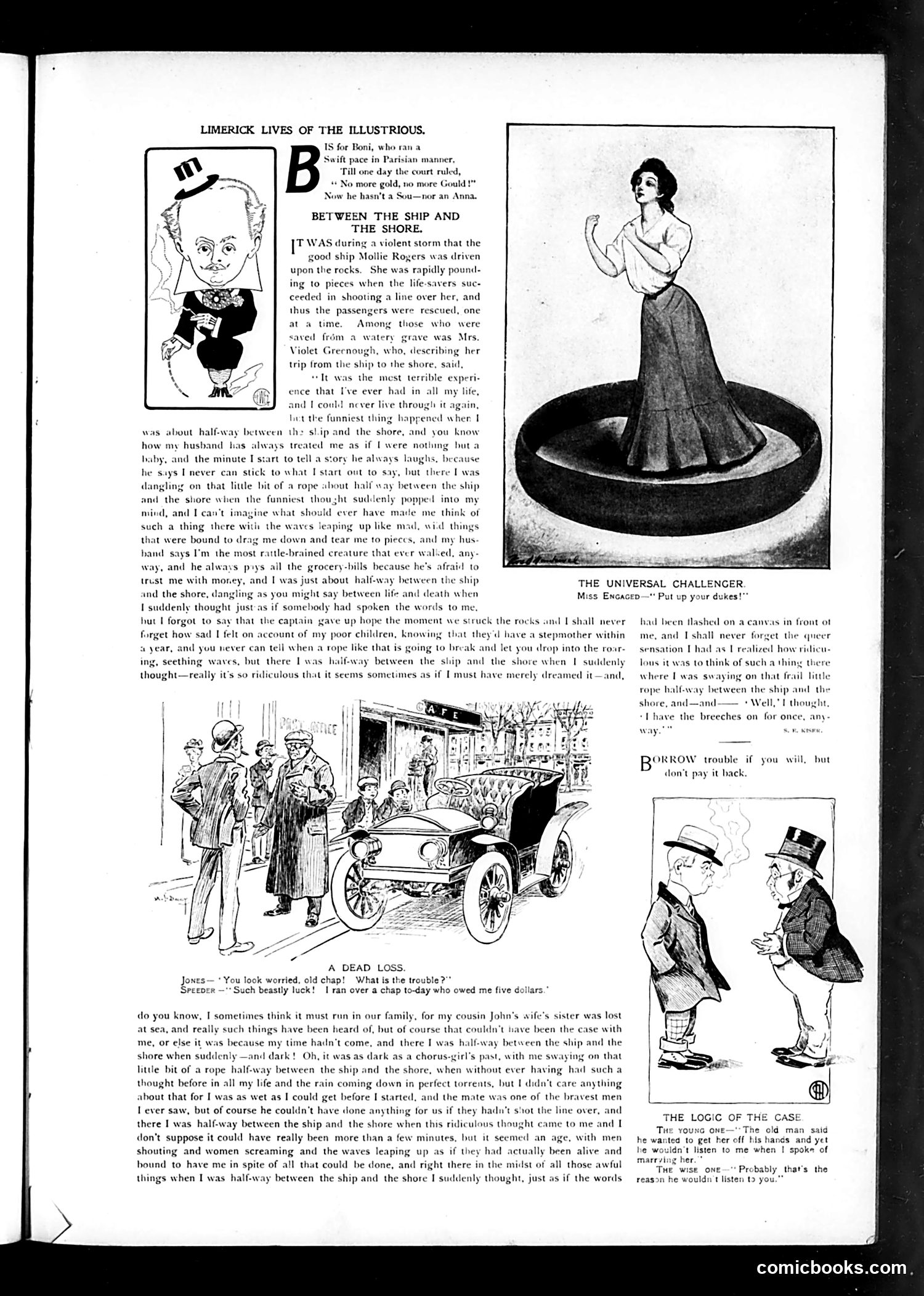
This page contains three distinct pieces of satirical humor from *Judge* magazine: 1. **"Limerick Lives of the Illustrious"**: A brief verse mocking someone named "Boni" who operated at a "Swift pace in Parisian" manner until "the court ruled" he lost his fortune ("Sou"). The wordplay references financial loss and possibly gambling or financial scandal, though the specific figure remains unclear without additional context. 2. **"Between the Ship and the Shore"**: A lengthy humorous monologue by Mrs. Violet Greenough describing a dramatic shipwreck rescue. The satire targets verbose, scatterbrained women—she repeatedly begins recounting her harrowing experience but constantly digresses about her husband's opinion of her intelligence, creating ironic contrast between genuine danger and trivial domestic concerns. 3. **"A Dead Loss"**: A brief joke about financial misfortune, punning on "loss"—one man accidentally killed a debtor before collecting five dollars owed. The cartoons illustrate these pieces with period-appropriate drawings. The humor relies on observational comedy about human nature and class-based stereotypes typical of early 20th-century American satire.
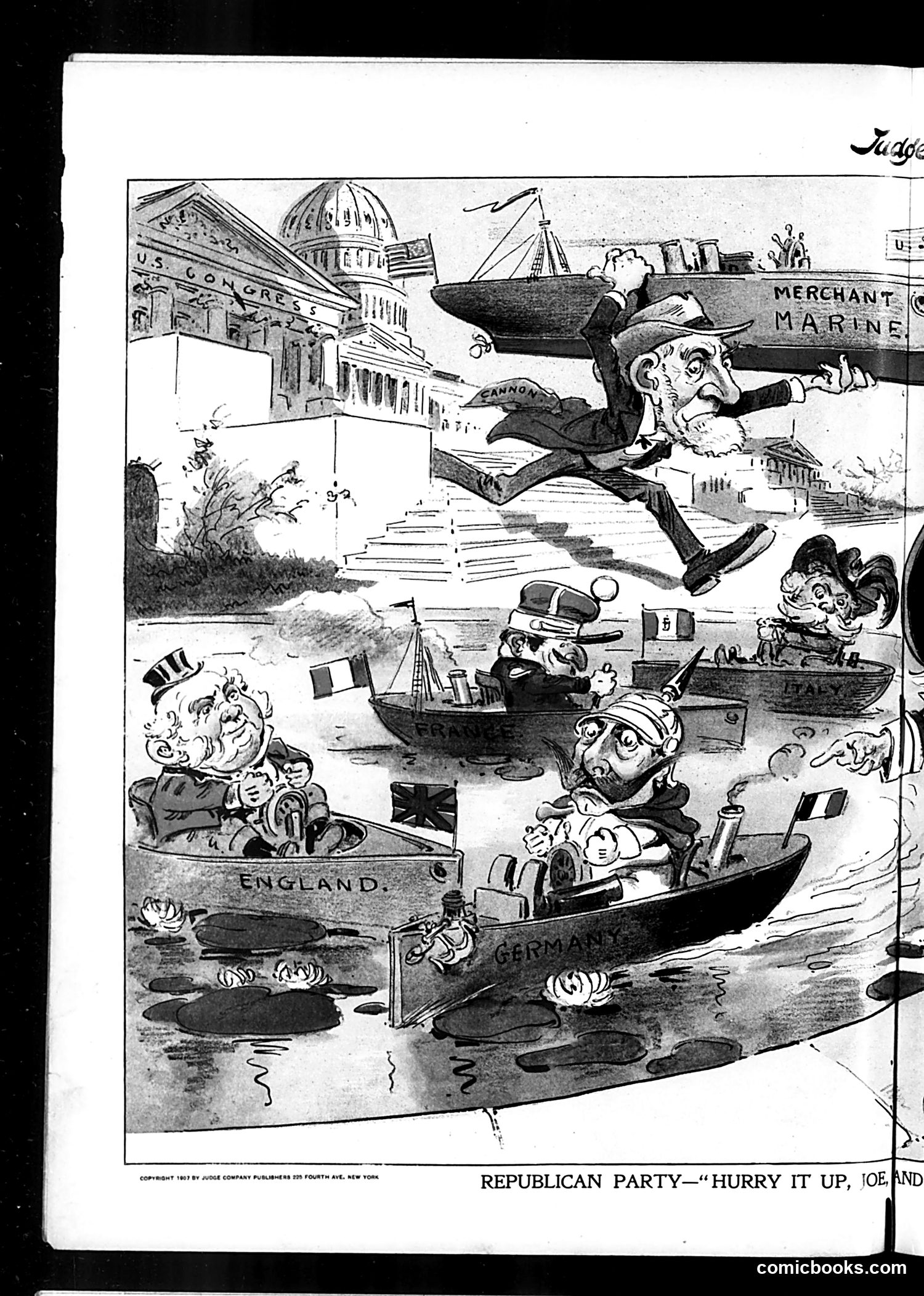
This satirical cartoon depicts the Republican Party urging someone named "Joe" to hurry, shown as a chaotic maritime scene. A figure labeled "Cannon" (likely Speaker Joseph Cannon) jumps frantically above, while boats labeled "England," "Germany," and "France" operate below in turbulent waters. A "Merchant Marine" ship appears in the background. The cartoon appears to criticize Republican leadership's handling of international maritime/shipping policy or foreign relations, possibly regarding merchant marine regulation. The frantic energy and competing national interests suggest political pressure or confusion about direction. The exact historical moment is unclear without a date, but this likely comments on early-20th-century trade or naval policy debates during a period of international tension.
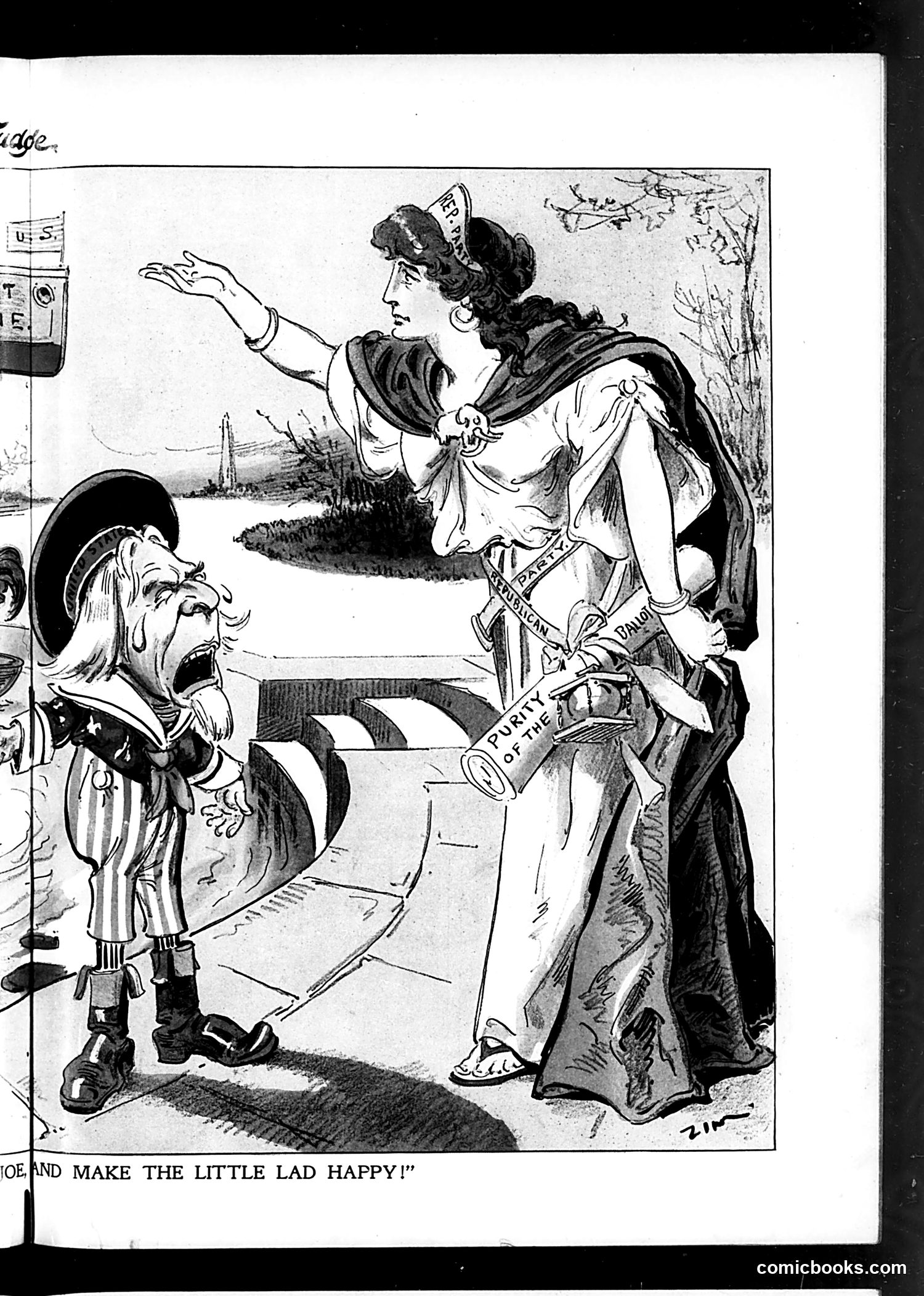
This political cartoon from *Judge* magazine depicts a well-dressed woman (appearing to represent Lady Liberty or American prosperity) addressing a small, caricatured figure labeled with text that appears to reference a political figure or stereotype. The woman gestures expansively toward a landscape, suggesting opportunity or national resources. The caption reads: "...OE AND MAKE THE LITTLE LAD HAPPY!" Without the complete caption or clearer date context, the specific political reference is unclear. However, the cartoon's structure—pairing an allegorical female figure offering prosperity with a diminished male character—suggests satire about political promises, patronage, or resource distribution during a particular American political moment. The exact figures and historical context require additional information to identify with certainty.
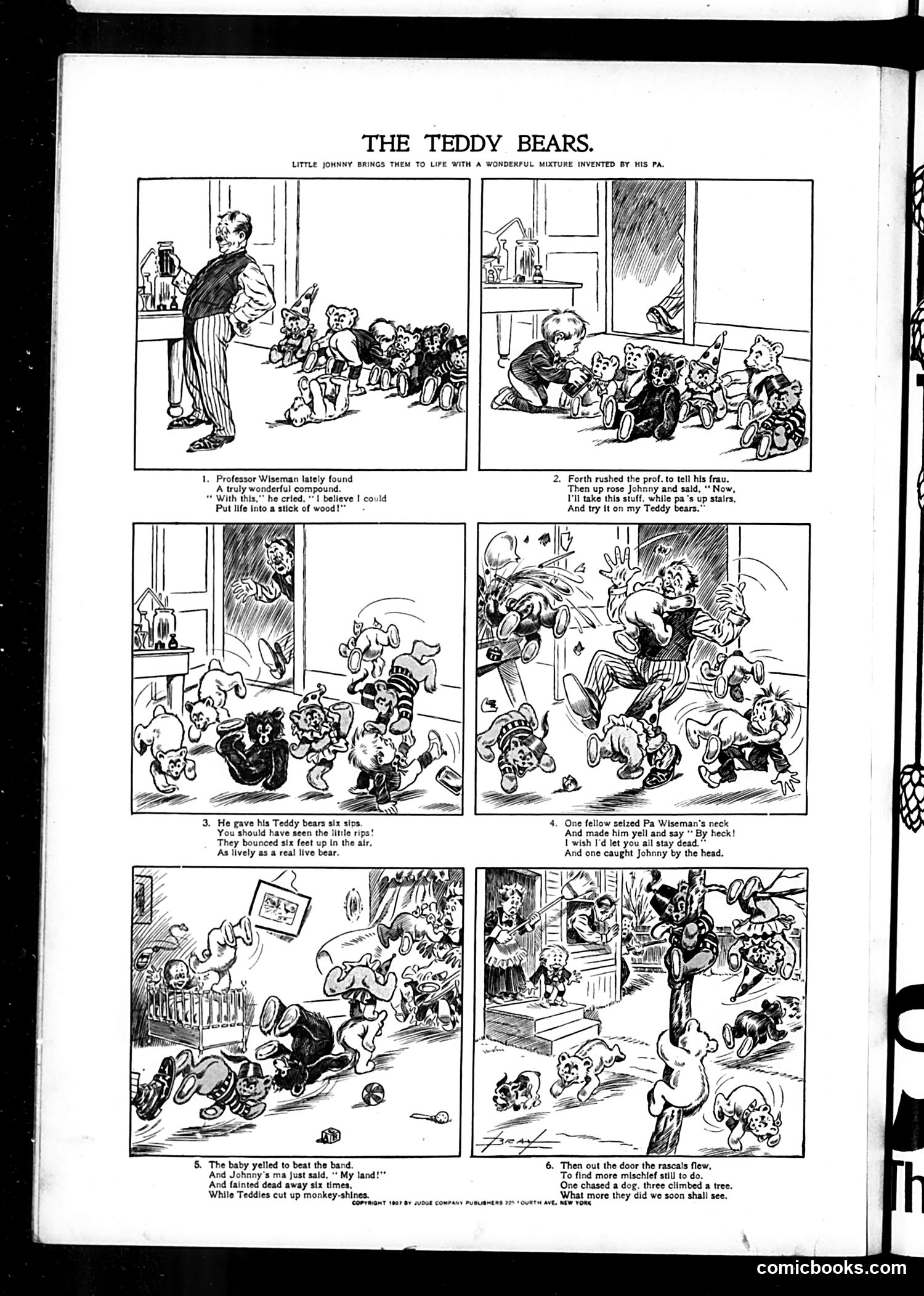
This is a humorous comic strip about a boy named Johnny who experiments on toy teddy bears with a mysterious chemical mixture invented by his father (Professor Wiseman). The narrative follows a classic slapstick formula: Johnny secretly applies the concoction to his bears, which magically animates them into mischievous, destructive creatures. The bears escape Johnny's control, attack the professor, cause family chaos (his mother faints repeatedly), and wreak havoc throughout the house and neighborhood—chasing dogs and climbing trees. The joke relies on the absurdist premise of animated toys and the escalating mayhem they create. The satire appears directed at contemporary scientific enthusiasm and the notion that chemical "mixtures" could produce magical results—poking fun at both scientific hubris and parental warnings about uncontrolled experimentation. The teddy bear itself was a relatively new toy phenomenon of the early 1900s, making this topical.
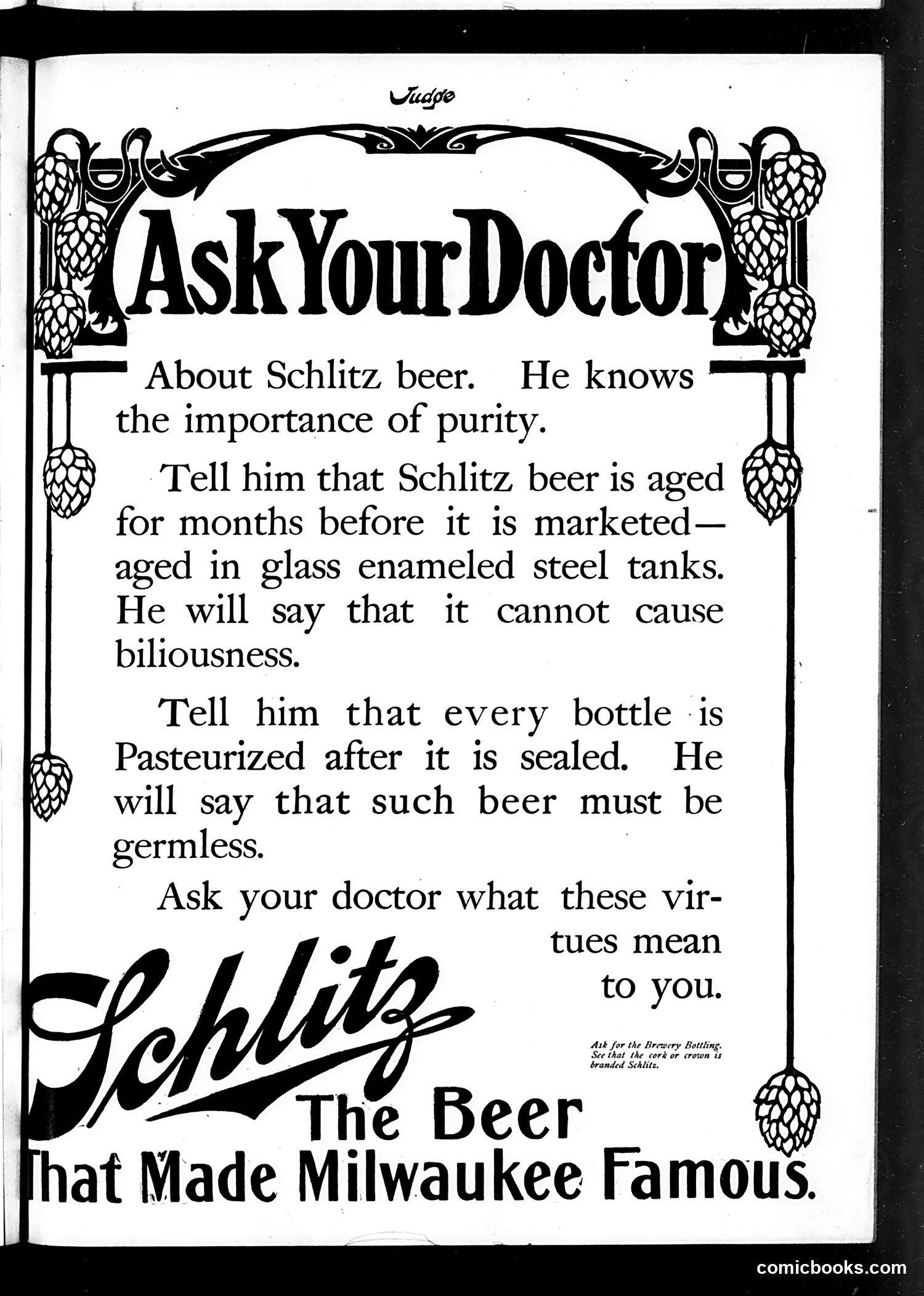
This is a **full-page advertisement**, not satire or political content. The "Judge" magazine header and decorative hop imagery frame what appears to be a straightforward—though now-amusing—marketing pitch for Schlitz beer. The ad urges readers to consult their doctor about Schlitz's purported health virtues: months of aging in steel tanks (preventing "biliousness"/digestive upset) and post-bottling pasteurization (ensuring "germless" product). This reflects early 20th-century marketing that invoked medical authority to legitimize consumer products—a common practice before modern advertising regulations. The slogan promises Schlitz is "The Beer that Made Milwaukee Famous," emphasizing Milwaukee's prominence as a brewing center. Modern readers might find the notion that beer needed doctor endorsement quaint or suspect.
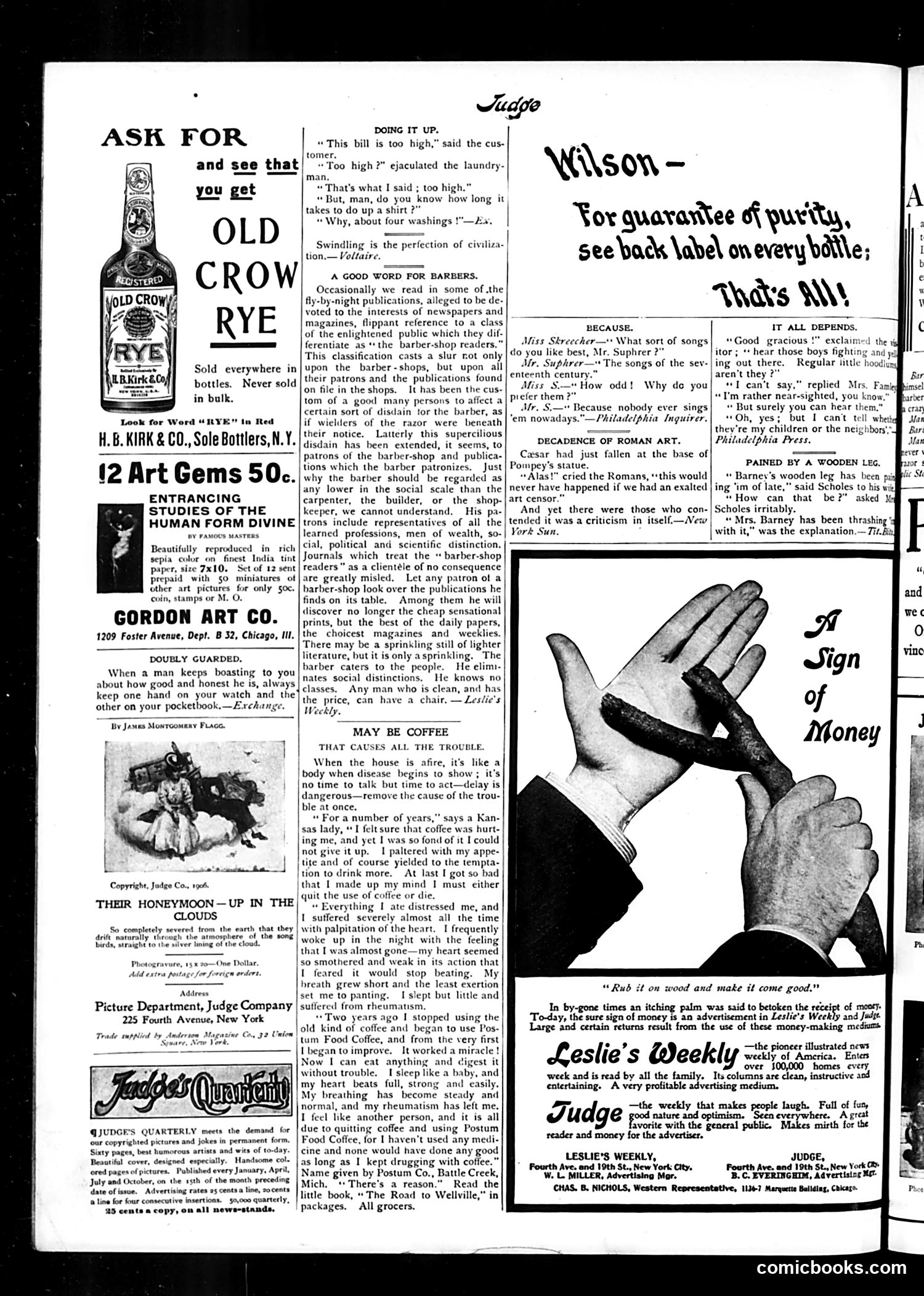
This page is primarily **advertisements and filler content** rather than satirical cartoons. The main elements are: **Advertisements:** - Old Crow Rye whiskey (prominent, upper left) - Gordon Art Co. (art reproductions) - Judge's Quarterly magazine subscription **Short humor pieces and observations:** - A laundry bill joke about shirt washing - A piece defending barbers and barber-shop patrons against snobbish dismissal by "fly-by-night publications" - Miscellaneous witticisms about honesty, coffee addiction, and Roman art **Notable content:** The barber-shop defense is the most substantive piece, arguing that barbers represent all social classes and shouldn't be looked down upon—a mild class-consciousness argument typical of early 1900s American humor magazines. The page reflects Judge's format: mixing advertisements, reader jokes, and brief satirical commentary on everyday social pretensions and minor grievances.
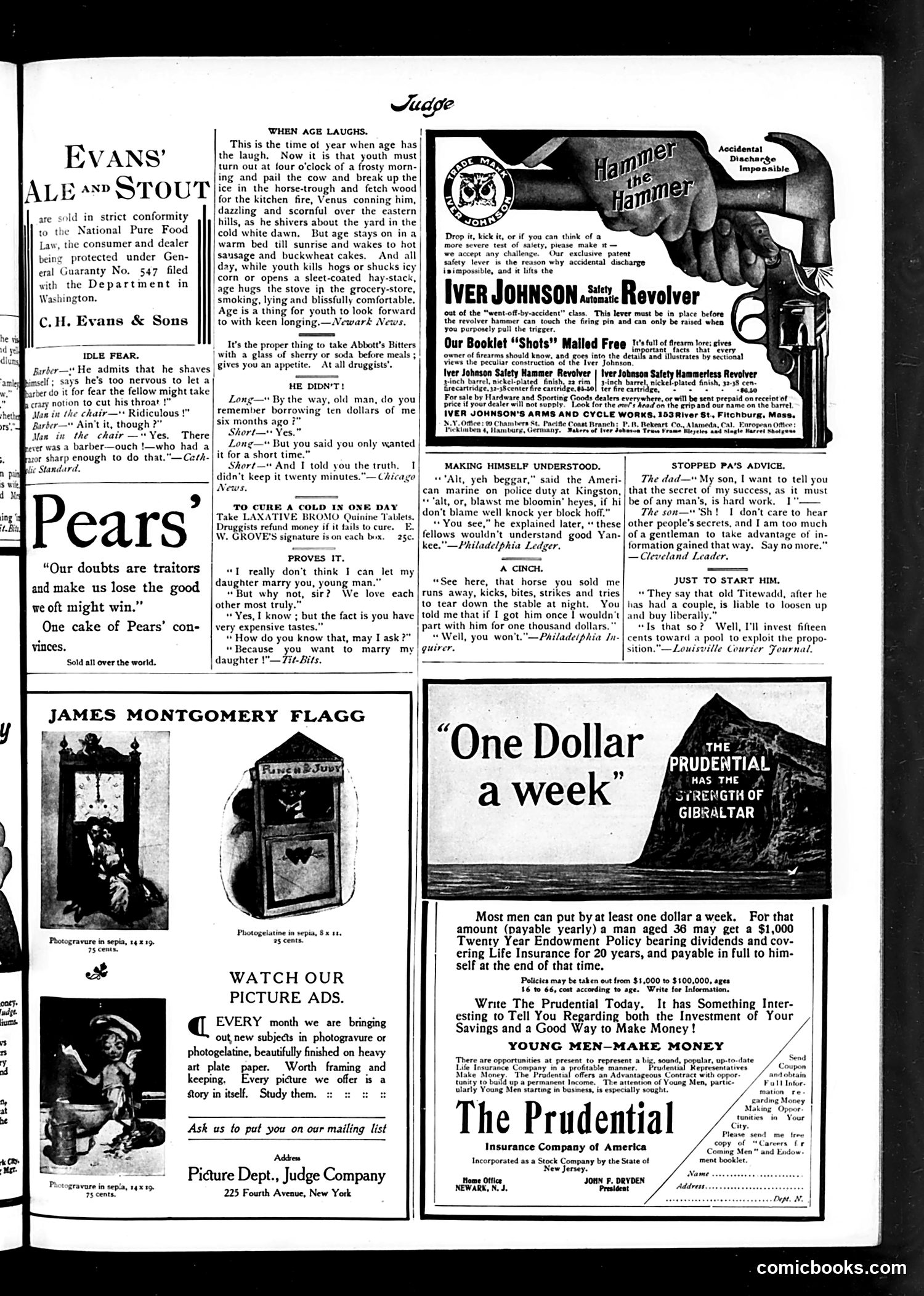
This page primarily contains **advertisements and light humor** rather than political satire. The content includes: **Main Features:** - **Evans' Ale and Stout ad** - promoting food safety compliance - **Barber shop joke** - a customer complains about a dull razor - **"When Age Laughs"** - nostalgic piece contrasting elderly comfort with youth's farm chores - **Iver Johnson Revolver ad** - emphasizing safety features and "accident-proof" design - **Pears' Soap ad** - claiming one cake convinces of quality - **James Montgomery Flagg photography ads** - promoting picture services - **Prudential Insurance ad** - "One Dollar a Week" life insurance pitch - **Various short jokes** about borrowing money, courtship, and miscommunication **Social Context:** These ads reflect early 1900s concerns: food safety laws, firearm safety, farm life, life insurance accessibility for working men, and photography's growing popularity. The page shows **Judge's mix of gentle humor and commercial messaging** rather than sharp political commentary.
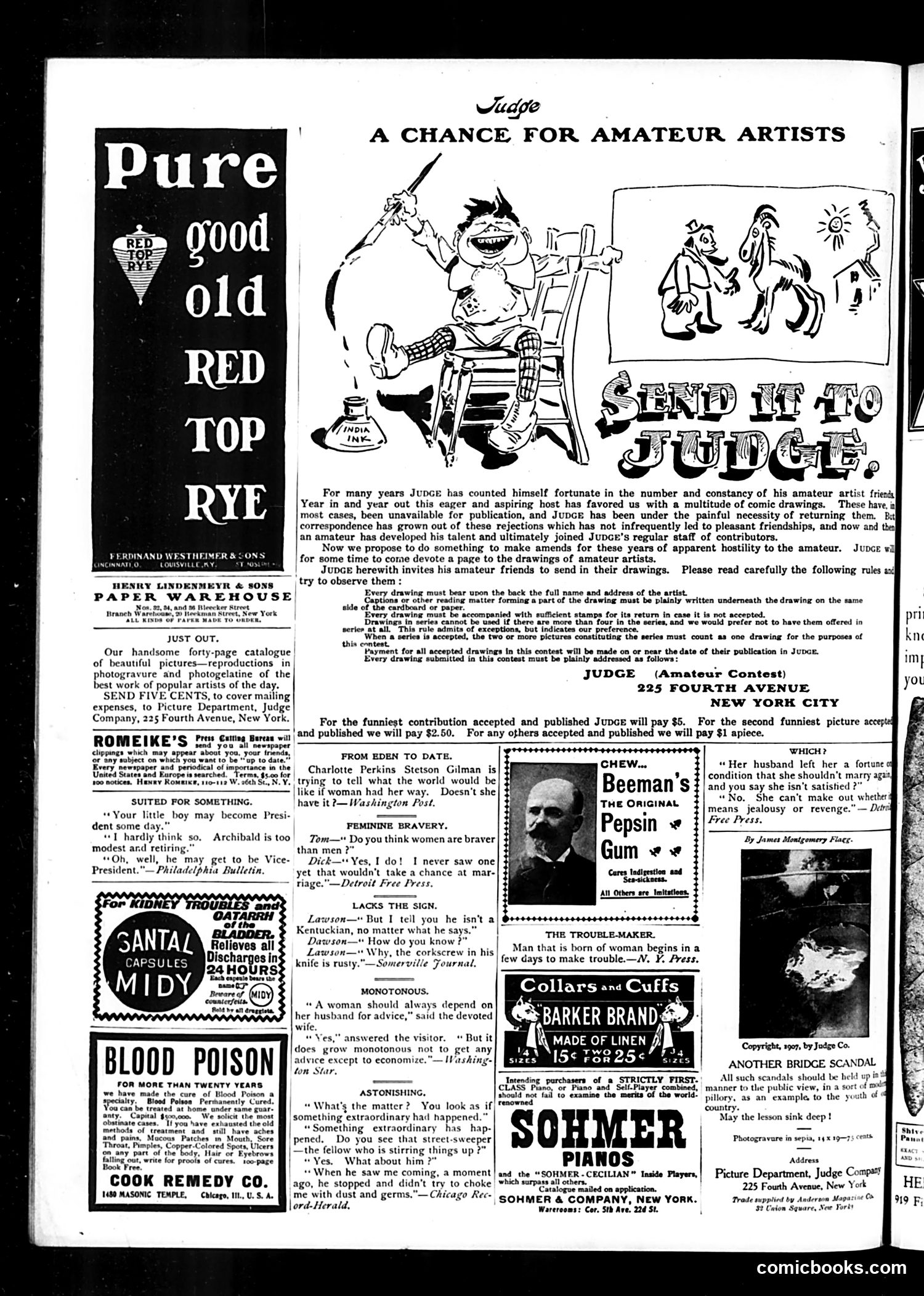
This page is primarily advertisements and editorial announcement from *Judge* magazine, with only modest satirical content. The main feature is Judge's call for amateur artist submissions, inviting readers to submit comic drawings for publication and payment ($5 for first place, $2.50 for second). The text describes years of rejecting amateur work but now seeking to encourage emerging talent. The scattered cartoons and jokes include mild domestic humor: one quips about a woman receiving a fortune conditioned on not remarrying, leaving her uncertain whether her husband meant "jealousy or revenge." Another contrasts supposedly brave women with men, noting women will take "a chance at marriage" — an old chestnut about matrimonial risk. A brief item references Charlotte Perkins Stetson Gilman's feminist writings, sarcastically questioning whether women need liberation when they already "have it." The remainder of the page consists of period advertising for products (Red Top Rye whiskey, Beeman's Pepsin Gum, Santa Capsules) and business services (printing, clipping bureaus), typical of magazine content from this era.
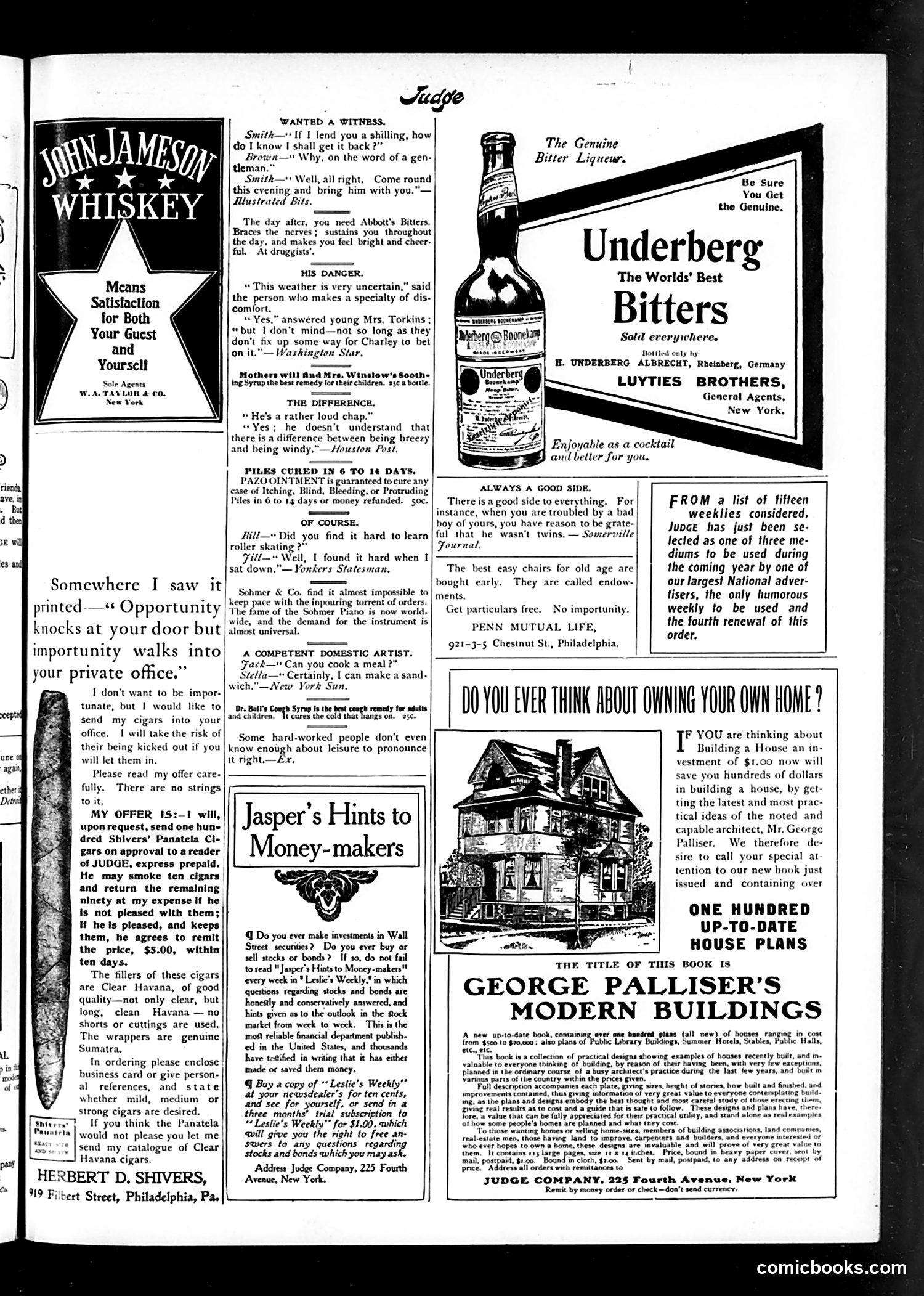
This page is primarily **advertising and filler content** rather than political satire. It contains multiple paid advertisements and light humor pieces typical of Judge magazine's commercial sections. **Key content includes:** - **Cigar advertisement** (Shivers' Panatelas): A lengthy pitch offering cigars on approval to readers - **Whiskey and liqueur ads** (John Jameson, Underberg Bitters): Standard product promotions - **Short humorous anecdotes** about everyday situations (lending money, weather, cooking skills) with no political content - **Finance tips** (Jasper's Hints) promoting Leslie's Weekly investment advice - **Home-building advertisement** promoting George Palliser's architectural plans The humor is gentle, domestic, and non-partisan—jokes about marital dynamics, servant incompetence, and social awkwardness. There are **no discernible political cartoons or caricatures** on this page, and no apparent satire of public figures or events. This appears to be a revenue-generating filler page rather than editorial content.
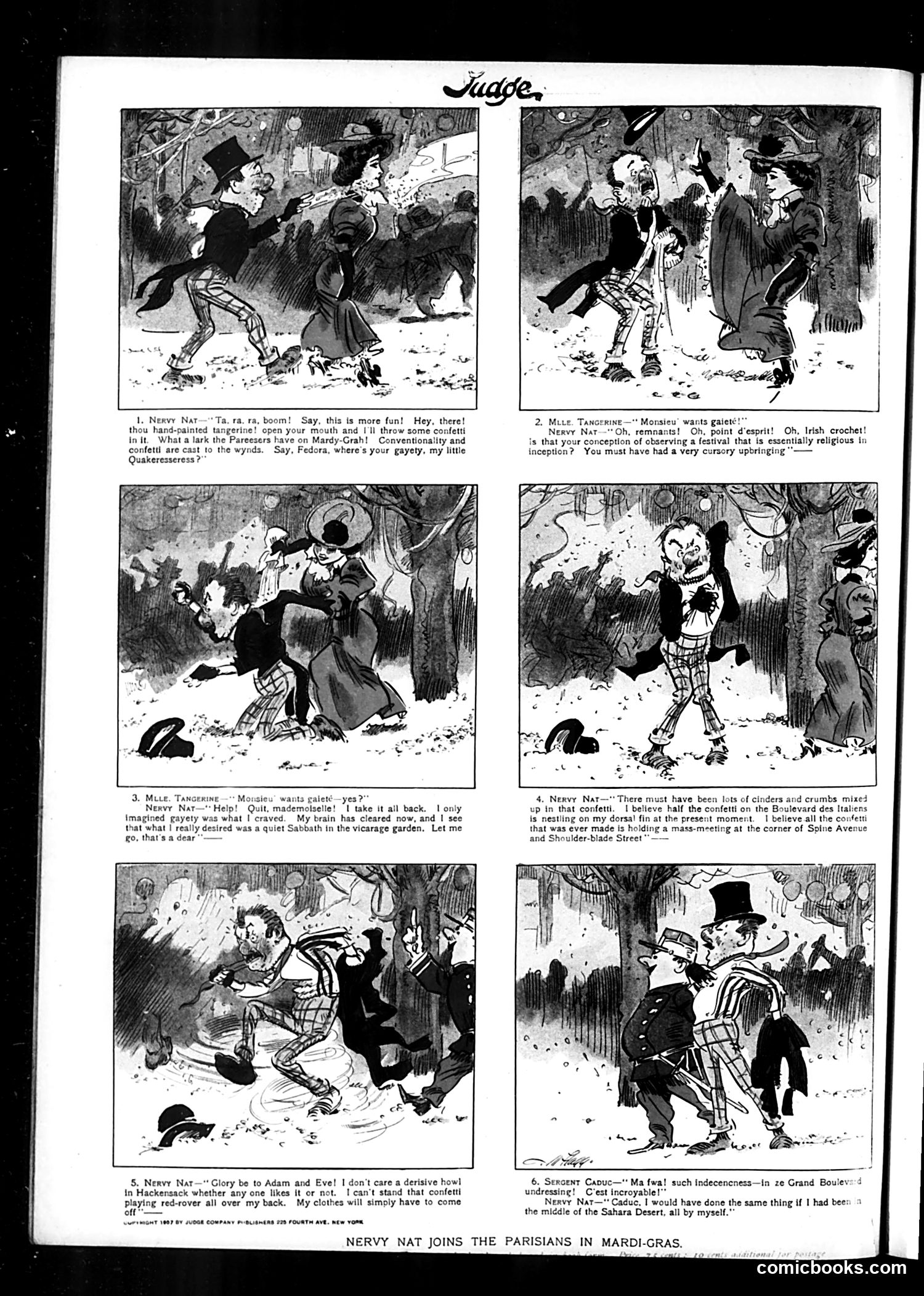
This six-panel comic strip satirizes an American character ("Nervy Nat") experiencing Parisian Mardi-Gras revelry. The humor contrasts American Puritanical restraint with French celebratory excess. Nat initially celebrates the confetti-throwing tradition enthusiastically, but quickly becomes overwhelmed—complaining that confetti covers his clothes and body. A female dancer and a sergeant attempt to engage him in the festivities, but he retreats to longing for quiet, religious observance ("a quiet Sabbath in the vicarage garden"). The satire mocks both cultures: French laxity (the sergeant criticizes "indecency"), and American prudishness and discomfort with uninhibited joy. Nat's repeated complaints about confetti getting everywhere mock Americans abroad who resist foreign customs while claiming to embrace them. The comic suggests Americans can't truly relax into pleasure—a common Judge magazine theme about American vs. European attitudes.