
Judge, 1907-02-09 · page 6 of 16
Judge — February 9, 1907 — page 6: what you’re looking at
What you’re looking at
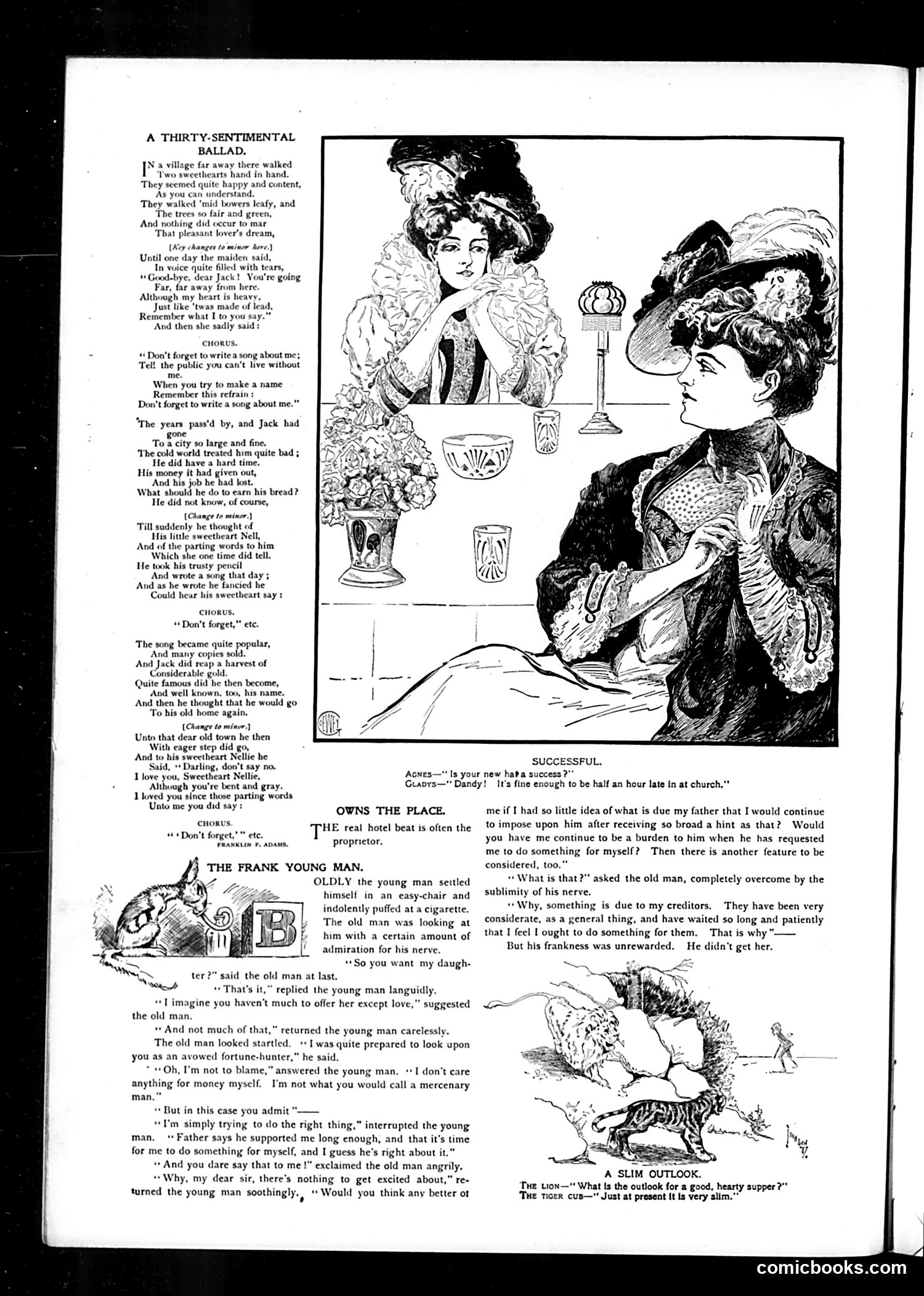
This Judge magazine page contains three distinct pieces of period humor: **"A Thirty-Sentimental Ballad"** satirizes sentimental popular songs of the era. A young man becomes famous writing a song his sweetheart demanded he write about her ("Don't forget to write a song about me"). The satire mocks both the narcissism of the request and the formulaic sentimentality of commercial pop music—suggesting people will buy anything if packaged emotionally enough. **"The Frank Young Man"** ridicules a young suitor who shamelessly admits to his girlfriend's father that he has little to offer except minimal love, and that he's doing the honorable thing by stopping being a burden on his own father and creditors. His cynical honesty—presented as responsible rather than romantic—is meant to be absurd and off-putting, though he seems oblivious to how poorly this proposal lands. **"Owns the Place"** is a brief quip about hotel proprietors being the "real deal." The cartoons reflect turn-of-century anxieties about commercialism, courtship conventions, and youthful lack of deference to parental authority.
📄 Transcribed text from this page (OCR, searchable)
Machine-transcribed from the original scan — historical spelling and the odd misread are preserved.
A THIRTY-SENTIMENTAL BALLAD. N a village far away there walked Two sweethearts hand in hand. ‘They seemed quite happy and content, And noth That p) [Aey changes to minor here.) day the maiden said, filled with tears, Jack! You're going y from here. occur to mar nt lover's dream, And then she sadly sai cuorus. + Don't forget to write a song about me; Tel! the public you can't live without me. When you try to make a name Remember this refrain : Don't forget to write a song about me.” "The years pass'd by, and Jack had gone To a city so large and fine. ‘The cold world treated him quite bad ; He did have a hard time. His money it had given out, And his job he had lost. What should he do to earn his bread? He did not know, of course, (Change to minor.) Till suddenly he thought of His little sweetheart Nell, And of the parting words to him ich she one time did tell. k his trusty pencil And wrote a song that day ; And as he wrote he fancied he Could hear his sweetheart say t cuorus. “Don't forget,” ete. The song became quite popular, ‘And many copies sold. And Jack did reap a harvest of Considerable gold Quite famous did he then become, ‘And well known, too, his name. And then he thought tha To his old home again. (Change to miner.) Unto that dear old town he then With eager step did go, And to his sweetheart Nellie he Said, ** Darling, don't say no. I love you, Sweetheart Nellie, Although you're bent and gray. 1 loved you since those parting words Unto me you did say: Acnes—" Is your OWNS THE PLACE. THE real hotel beat is often the proprietor. cHorus. «Don't forget, FRANKLIN Fe ADASS. THE FRANK YOUNG MAN. OLDLY the young man seitled himself in an easy-chair and indolently puffed at a cigarette. The old man was looking at him with a certain amount of admiration for his nerve. “So you want my daugh- said the old man at last. «That's it,” replied the young man languidly. *Limagine you haven't much to offer her except love,” suggested the old man, + And not much of that,” returned the young man carelessly. The old man looked startled. ++ I was quite prepared to look upon you as an avowed fortune-hunter,” he said. * «Oh, I'm not to blame,” answered the young man, ++I don’t care 1g for money myself. I'm not what you would call a mercenary ter? ** But in this case you admit "—— “I'm simply trying to do the right thing,” interrupted the young ‘ather says he supported me long enough, and that it’s time for me to do something for myself, and I guess he’s right about it.” “+ And you dare say that to me!” exclaimed the old man angrily. “Why, my dear sir, there's nothing to get excited about,” re- turned the young man soothingly. “Would you think any better ot Gtavys—"* Dandy! SUCCESSFUL. new ha?a success?" It’s fine enough to be half an hour late in at church."* me if I had so little idea of what is due my father that I would continue to impose upon him after receiving so broad a hint as that? Would you have me continue to be a burden to him when he has requested me to do something for myself? Then there is another feature to be considered, to “What is that?" asked the old man, completely overcome by the sublimity of his nerv + Why, something is due to my creditors. They have been very considerate, as a general thing, and have waited so long and patiently that I feel | ought to do something for them. That is why "— But his frankness was unrewarded. He didn’t get her. A SLIM OUTLOOK. THe tion—"* What {s the outlook for a good, hag supper ?"* ‘Tue ticer cus—* Just at present it is very slim. comicbooks.com